voltage of 5 V. The final fmax/fmin ratio is 6.5, and the output spectrums at maximum and minimum input frequency are shown in Figures 5(a) and 5(b), respectively.
The phase noise of the two RFDs and reference signal are measured by an Agilent E5052A signal source analyzer, as shown in Figure 6. In the in-band range, the locked signal tracks the low-phase-noise reference signal and provides the obvious im-provement of phase noise about 6 dB. In the out-band range, the RFD with active loads faces the phase noise degradation due to more resistors used in the shunt–shunt feedback amplifier. 4. DISCUSSIONS AND CONCLUSIONS
This article describes the design and performance of the RFD with active loads fabricated in the 2m GaInP/GaAs HBT technology. The active loads are used to increase circuit bandwidth and reduce the input sensitivity power. The operating frequency is from 4 to 26 GHz under the supply voltage of 5 V and the core power consumption of 36.7 mW. As the compared results, the active-loading type obviously has the higher operating frequency and the lower input sensitivity. The fmax/fminratio of 6.5 is higher than that of general RFDs.
ACKNOWLEDGMENT
This work is supported by National Science Council of Taiwan, Republic of China under contract numbers NSC 96 –2752-E-009 – 001-PAE, NSC 95–2221-E-009 – 043-MY3, by the Ministry of Economic Affairs of Taiwan under contract number 95-EC-17-A-05-S1– 020, MoE ATU Program under contract number 95W803, and by the National Chip Implementation Center (CIC). REFERENCES
1. M. Mohktahri, C.H. Fields, R.D. Rajavel, M. Sokolich, J.F. Jensen, and W.E. Stanchina, 100⫹GHz static divide-by-2 circuit in InP-DHBT technology, IEEE J Solid-State Circ 38 (2003), 1540 –1544. 2. K. Murata, T. Otsuji, E. Sano, M. Ohhata, M. Togashi, and M. Suzuki,
A novel high-speed latching operation flip-flop (HLO-FF) circuit and its application to a 19-Gb/s decision circuit using a 0.2-m GaAs MESFET, IEEE J Solid-State Circ 30 (1995), 1101–1108.
3. T. Otsuji, M. Yoneyama, K. Murata, and E. Sano, A super-dynamic flip-flop circuit for broad-band application up to 24 Gb/s utilizing production-level 0.2m GaAs MESFET’s, IEEE J Solid-State Circ 32 (1997), 1357–1362.
4. K. Murata, T. Otsuji, M. Yoneyama, and M. Tokumitsu, A 40-Gbit/s
superdynamic decision IC fabricated with 0.12-m GaAs MESFET’s, IEEE J Solid-State Circ 33 (1998), 1527–1535.
5. R.D. Miller, Fractional-frequency generators utilizing regenerative modulation, Proc IRF 37 (1939), 446 – 457.
6. H. Ichhino, N. Ishihara, M. susuki, and S.Konaka, 18-GHz 1/8 dy-namic frequency divider using Si bipolar technology, IEEE J Solid-State Circ 24 (1989), 1723–1728.
7. T. Sheng-Che, M. Chinchun, C. Chia-Hung, W. Chih-Kai, and H. Guo-Wei, Monolithic broadband gilbert micromixer with an integrated marchand balun using standard silicon IC process, IEEE Trans Micro-wave Theory Tech 54 (2006), 4362– 4371.
8. L. Ockgoo, K. Jeong-Geun, L. Kyutae, J. Laskar, and S. Hong, A 60-GHz push-push InGaP HBT VCO with dynamic frequency divider, IEEE J Solid-State Circ 15 (2005), 679 – 681.
© 2007 Wiley Periodicals, Inc.
SEVEN GHz HIGH GAIN 0.18
m CMOS
GILBERT DOWNCONVERTER WITH
WIDE-SWING CASCODE CURRENT
MIRRORS
Sheng-Che Tseng,1Chinchun Meng,1and Guo-Wei Huang2
1Department of Communication Engineering, National Chiao Tung University, Hsinchu, Taiwan, Republic of China; Corresponding author: [email protected]
2Radio Frequency Technology Center, National Nano Device Laboratories, Hsinchu, Taiwan, Republic of China
Received 21 June 2007
ABSTRACT: A downconversion micromixer with low-voltage cascode
current mirrors at both transconductor and load stages has been imple-mented using the 0.18-m CMOS technology in this article. This micro-mixer has a single-to-differential RF input transconductor formed by the NMOS wide-swing cascode current mirror, while the PMOS wide-swing cascode current mirror is also employed to improve conversion gain. A super source follower is used at the output to reduce the output imped-ance and to transfer more power to the load. This fully integrated downconverter has the high conversion gain of 16 dB and high LO-to-IF isolation of 50 dB at 7 GHz. The current consumption of the mixer core is 1 mA at 1.8 V supply voltage. Thanks to the low-voltage opera-tion property of the wide-swing cascode current mirror, six transistors can be stacked within 1.8 V supply voltage. © 2007 Wiley Periodicals,
Inc. Microwave Opt Technol Lett 50: 435– 437, 2008; Published online in Wiley InterScience (www.interscience.wiley.com). DOI 10.1002/mop. 23095
Key words: cascode current mirror; downconverter; Gilbert mixer;
mi-cromixer; RFIC
1. INTRODUCTION
The Gilbert mixer is the commonly used active mixer performing the frequency translation in the all communication system. Natu-rally, the Gilbert mixer can operate wideband mixing. However, it does not achieve wideband matching easily because of the high input impedance of the common-source-configured transistors. The micromixer, which is a variant of the Gilbert mixer, is in possession of the wideband input matching and single-ended input [1]. Those features facilitate the realization of the wideband and single-ended mixer. Besides, the balanced structure of the mixer can provide excellent port-to-port isolations [2]. However, the common mode rejection provided by the biased current source in the Gilbert mixer deteriorates rapidly at high frequencies and so does the port-to-port isolations [3]. Comparatively, the rival, the
100 1k 10k 100k 1M 10M -160 -150 -140 -130 -120 -110 -100 -90 -80
RFD with Active Loads
RFD with Resistor Loads Reference (HP E8254A)_10GHz
Phase noise (dBc/Hz)
Offset frequency (Hz)
Figure 6 Measured phase noise of the regenerative frequency divider with resistive loads and active loads
micromixer, can render high speed response and eliminates the need for common mode rejection.
The device performance is enhanced along with the technology evolution [4]. Because supply voltage is getting lower, the analog, mixed-signal and radio frequency integrated circuit designs are tougher. The wide-swing cascode current mirror technique is uti-lized appropriately for low voltage operation. A PMOS cascode current mirror is used to combine effectively the differential cur-rent output signals of the mixer for a single-ended output. Further-more, the high output impedance of the cascode NMOS and PMOS transistors improves the conversion gain. At the single-ended output stage, the super source follower is utilized to reduce the high impedance of the PMOS current mirror and to drive more power to measurement equipments. In this article, a micromixer designed with low-voltage cascode current mirrors can achieve high conversion gain. Thanks to the low-voltage operation prop-erty of the wide-swing cascode current mirror, six transistors can stack within 1.8 V supply voltage.
2. CIRCUIT DESIGN
The entire schematic of the micromixer with wide-swing cascode current-mirror transconductor and load is displayed in Figure 1. The mixer is in a micromixer configuration and composed of an input transconductance amplifier, a switch quad, a cascode current combiner, and a super source follower output buffer. In the RF input stage, the common-gate-configured transistor, M1, and com-mon-source-configured transistor, M2, provide equal magnitude but opposite phase transconductance gain (gm). The input imped-ance is 1/gm1paralleled with 1/gm4and it is easily designed with the value of 50⍀ at wideband frequencies. Hence, this micromixer can achieve wideband matching and act wideband frequency trans-lation. One inductor is inserted in front of the input stage to cancel parasitic capacitances and to extend the matching range at higher frequencies. In addition to wideband impedance matching, the input stage of the micromixer also translates unbalanced signals into balanced signals.
To establish a single-ended output, the PMOS current mirror is applied to combine the differential output current signals of the
mixer. The output current doubles and so does the conversion gain. This current mirror consists of transistors, M11, M12, M13, and M14 and is formed in a cascode type to provide high output impedance of the mixer core and to improve the conversion gain as well. A super source follower is employed as an output buffer here for lowering output impedance of the entire mixer and for delivering more power to the measurement equipment.
Two current mirrors are employed in this mixer. However, there would be six stacked transistors with only a 1.8 V supply. A wide-swing cascode form of the current mirror is utilized to solve this headroom problem [5].
3. MEASUREMENT RESULTS
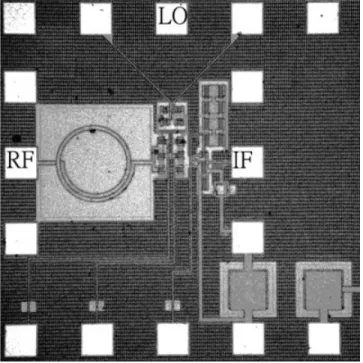
A micromixer with wide-swing cascode current mirrors is fabri-cated using the 0.18-m CMOS technology. The chip takes the estate of 0.7⫻ 0.7 mm2, as shown in Figure 2. The active circuitry only occupies the area of 0.15 mm⫻ 0.25 mm. One inductor is added in front of the micromixer input to compensate capacitive parasitics and then to achieve good input matching up to higher frequencies. Although six transistors in the mixer core stack within 1.8 V supply voltage, this micromixer can operate because of the low voltage operation property of the wide-swing current mirror configuration. The current consumption of the mixer core and buffer is 1 and 5.4 mA, respectively.
The micromixer has a wideband input matching property nat-urally. In addition, because one inductor is utilized to cancel the capacitance, the good matching can be extended to higher frequen-cies. From dc to 10 GHz, the input return loss is below⫺10 dB and the best input matching occurs at 7.5 GHz. The output imped-ance is designed as low impedimped-ance to drive the measurement equipment at the IF frequency.
During the measurement, differential LO signals are provided by an external balun. Because of the frequency range limitation of the balun, the mixer was measured around 7 GHz RF. Figure 3 illustrates the conversion gain of the wide-swing cascode current mirror micromixer with the fixed IF frequency of 50 MHz. Under the condition of⫺4-dBm LO power, the conversion gain is about Figure 1 Schematic of the micromixer with wide-swing cascode
current-mirror transconductor and load
Figure 2 Die photo of the micromixer with wide-swing cascode current mirrors
16 dB. The high conversion gain is attributed to the high output impedance of the mixer core, which is enhanced by the NMOS and PMOS wide-swing current mirrors. This mixer is also measured with a fixed 7 GHz LO signal. The experimental result is exhibited in Figure 4. The 3-dB IF bandwidth is about 150 MHz. The high conversion gain is achieved at the cost of the IF bandwidth.
It is expected that the LO-to-IF isolation is high due to the balanced dc output current of the improved cascode current mirror [6]. For the isolation measurements, the IF frequency is fixed at 50 MHz as RF and LO frequencies are swept simultaneously. As shown in Figure 5, the fully integrated downconversion micro-mixer has the high LO-to-IF isolation of 50 dB, LO-to-RF isolation of 32 dB, and RF-to-IF isolation of 25 dB.
4. CONCLUSIONS
This article demonstrates a downconversion micromixer with low-voltage cascode transconductance amplifier and current combiner using the 0.18-m CMOS technology. The mixer core is formed by a micromixer executing wide range frequency translation since
it has wideband properties of current commutating and input matching. NMOS and PMOS wide-swing cascode current mirrors are employed to improve conversion gain, while the output im-pedance is reduced by a super source follower to transfer more power to the load. The fully integrated downconversion micro-mixer functions at 7-GHz RF frequency with 150-MHz IF band-width and has the high conversion gain of 16 dB, high LO-to-IF isolation of 50 dB, LO-to-RF isolation of 32 dB and RF-to-IF isolation of 25 dB at 1.8 V supply voltage. The input return loss is below⫺10 dB from dc to 10 GHz and the chip size is 0.7 mm ⫻0.7 mm. The total quiescent core current consumption of the mixer is 1 mA. Thanks to the low-voltage operation property of the wide-swing cascode current mirror, six transistors can stack within 1.8 V supply voltage.
ACKNOWLEDGMENT
This work is supported by National Science Council of Taiwan, Republic of China under contract numbers NSC 95-2752-E-009-001-PAE, NSC 95-2221-E-009-043-MY3, by the Ministry of Eco-nomic Affairs of Taiwan under contract number 95-EC-17-A-05-S1-020, MoE ATU Program under contract number 95W803, and by the National Chip Implementation Center (CIC).
REFERENCES
1. B. Gilbert, The MICROMIXER: A highly linear variant of the Gilbert mixer using a bisymmetric Class-AB input stage, IEEE J Solid-State Circuits 32 (1997), 1412-1423.
2. B. Razavi, RF Microelectronics, Prentice Hall, Englewood Cliffs, NJ, 2001, Ch. 6.
3. A.S. Sedra and K.C. Smith, Microelectronic circuits, 4th ed, Oxford University Press, Oxford, 1998, p. 640.
4. H.S. Bennett, R. Brederlow, J.C. Costa, P.E. Cottrell, W.M. Huang, A.A. Immorlica, Jr., J.-E. Mueller, M. Racanelli, H. Shichijo, C.E. Weitzel, B. Zhao, Device and technology evolution for Si-based RF integrated circuits, IEEE Trans Electron Devices 52 (2005), pp. 1235-1258.
5. D. Johns and K. Martin, Analog integrated circuit design, Wiley, Chichester, UK, 1997. Ch. 6.
6. S.-C. Tseng, C.C. Meng, Y.-H. Li, and G.-W. Huang, The port-to-port isolation of the downconversion P-type micromixer using different N-well topologies, IEICE Trans Electron E89-C (2006), pp. 482-487.
© 2007 Wiley Periodicals, Inc.
Figure 3 Conversion gain of the wide-swing cascode current mirror micromixer with respect to RF frequencies
Figure 4 Conversion gain of the wide-swing cascode current mirror micromixer with respect to IF frequencies
Figure 5 Port-to-port isolations of the wide-swing cascode current mir-ror micromixer