
探討女性部落客讀者對美妝部落格中電子口碑及口碑行銷的態度 - 政大學術集成
122
0
0
全文
(2) 探討女性部落客讀者對美妝部落格中電子口碑 及口碑行銷的態度 A Study on Female Blog Readers’ Attitudes toward eWOM and Buzz Marketing in Beauty Blogs. 研究生: 賈德欣. Student: De-hsin Chia. 指導教授: 賴建都. Advisor: Chien-Tu Lai. 學. n. er. io. al. sit. 碩士論文. Nat. 國際傳播英語碩士學程. y. 國立政治大學. ‧. ‧ 國. 立. 政 治 大. Ch. e nThesis A gchi. i n U. v. Submitted to International Master’s Program in International Communication Studies National Chengchi University In partial fulfillment of the Requirement For the degree of Master in International Communication Studies. 中華民國九十九年七月 (July, 2010).
(3) A STUDY ON FEMALE BLOG READERS’ ATTITUDES TOWARD eWOM AND BUZZ MARKETING IN BEAUTY BLOGS. A Master Thesis. National Chengchi University. 立. 政 治 大. ‧. ‧ 國. 學. n. er. io. sit. y. Nat. al. In Partial Fulfillment. i n U. v. Of the Requirement for the Degree. Ch. engchi. Master of Art. By De-hsin Chia July, 2010.
(4) ACKNOWLEDGMENT. Without the great support from my family, this thesis wouldn’t have been completed. Much thank to my parents’ constant pushing, my husband Ivan’s giving suggestions and being my best friend, my brother’s generosity for letting me occupy his room and computer, my in-laws’ helping out and caring, my sisters-in-law Grace’s and Genevieve’s encouragement, and all my relatives’ support.. 政 治 大 Chien-Tu Lai, for his suggestions and advices. I would also like to thank assistant professor, 立. I would like to further express my most sincere thankfulness to my advisor, professor. ‧ 國. 學. Hsih Tsung-Jen from Data Analysis class, for his constant help in answering my questions and giving suggestions. Moreover, much thank to my oral committees, Fong-Kong Chu, Pei-. ‧. Fen Li, and Yi-Long Chiao, for their time and advices that help me adjust as well as refine. er. io. sit. y. Nat. my thesis.. To my friends, thank you all for having faith in me and reassuring me I could make it.. n. al. Ch. i n U. v. Especially thanks to Tina and Momo, for providing your experiences and supports in many. engchi. ways. Thank you, Hui-ting, our department assistant, for your constant provision in help. To those who have filled in my questionnaire, thank you all for your precious time and insightful answers.. Finally, I would like to thank my daughter, Aila, for being my little sunshine, my best cheerleader, always giving me much love, warmth and laughter during my stressful times..
(5) ABSTRACT Ever since “blog” was selected by Merriam-Webster's dictionary as the word of year 2004, the development of blogs has been prospering. More and more bloggers are viewed by blog readers as new opinion leaders on their impact of information-sharing and purchasing decision-making. This study will pay closer attention to one certain category of blog readers—the beauty blog readers and their attitudes toward the emerging phenomenon among bloggers— from simply sharing information to spreading the buzz (online word-of-mouth, or eWOM), and eventually leading to rewarded blog post with incentives. Such business. 政 治 大. behavior is conceptualized as buzz marketing, which has been arousing dilemma about. 立. blogger honesty and credibility.. ‧ 國. 學. Both qualitative and quantitative methods will be applied in this study. In first stage,. ‧. in-depth interviews with well-known beauty bloggers were conducted to first provide with. Nat. sit. y. preliminary yet detailed understanding of how word of mouth operates and the existing buzz. n. al. er. io. marketing among beauty blogs. Quantitative surveys will be designed based on the findings. i n U. v. from first stage, and then be distributed among beauty blog readers to further examine that. Ch. engchi. consumers’ attitudes toward bloggers’ credibility associate with their purchasing behavior. Likewise, consumers’ satisfaction toward blog content may influence their attention paid to WOM in blogs, willingness to conduct Word-of-mouth referrals, and actual purchasing behavior.. Keywords: Blog, eWOM, attitudes, incentives, buzz marketing, credibility.
(6) TABLE OF CONTENTS List of Figures & Tables .......................................................................................................... iii Acknowledgment Abstract. Chapter I Introduction ................................................................................................................ 1 1.1 Research Background....................................................................................................... 1 1.2 Research Rationale & Significance of the Study ............................................................. 2 1.3 Research Purpose ............................................................................................................. 4 1.4 Research Questions .......................................................................................................... 5 Chapter II Literature Review ..................................................................................................... 6 2.1 Word of Mouth (WOM) ................................................................................................... 6. 政 治 大 2.1.2 Electronic Word of Mouth (eWOM) ....................................................................... 13 立. 2.1.1 WOM Model.............................................................................................................. 8. 2.1.3 Women Consumer vs. WOM .................................................................................. 15. ‧ 國. 學. 2.2. Buzz Marketing ............................................................................................................. 16 2.2.1 Buzz ......................................................................................................................... 17. ‧. 2.2.2 Definition of Buzz Marketing.................................................................................. 19. y. Nat. 2.3 Blog ................................................................................................................................ 19. sit. 2.3.1 Historical Background of Blog ................................................................................ 20. er. io. 2.3.2 Blog Definition ........................................................................................................ 21. al. n. v i n 2.3.4 Blog/Blogger CredibilityC ......................................................................................... 25 hengchi U 2.3.5 Blog Glossary .......................................................................................................... 25 2.3.3 Blogging Motivations .............................................................................................. 24. 2.3.6 Blogs vs. Discussion Forums................................................................................... 26 2.4 eWOM, Blogger, and Buzz Marketing .......................................................................... 26 2.4.1 Role of Influential Blogger ...................................................................................... 27 2.4.2 Beauty Blogs............................................................................................................ 29 2.4.3 Blogs and Buzz Marketing ...................................................................................... 32 2.4.4 Blogging vs. Incentive ............................................................................................. 34 2.4.5 Dilemma .................................................................................................................. 35 Chapter III Methodology ......................................................................................................... 37 3.1 Research Framework ...................................................................................................... 37 3.1.1 Hypotheses............................................................................................................... 38 i.
(7) 3.2 Research Procedure ........................................................................................................ 39 3.2.1 First Stage—Preliminary Study ............................................................................... 39 3.2.1.1 Sampling .......................................................................................................... 41 3.2.1.2 In-depth Interview Results ............................................................................... 42 3.2.2 Second Stage—Main Study ..................................................................................... 44 3.2.2.1 Sampling .......................................................................................................... 45 3.2.2.2 Questionnaire Design ....................................................................................... 45 3.3 Research Variables ......................................................................................................... 45 Chapter IV Data Analysis ........................................................................................................ 49 4.1 Sample Structure ............................................................................................................ 49 4.2 Factor Analysis and Reliability Analysis ....................................................................... 55. 治 政 大 4.4 Test of Hypotheses ......................................................................................................... 68 立 4.5 Summary ........................................................................................................................ 78 4.3 Analytical Approach ...................................................................................................... 66. ‧ 國. 學. Chapter V Conclusions ............................................................................................................ 81 5.1 Discussion and Other Finding ........................................................................................ 81. ‧. 5.2 Recommendations .......................................................................................................... 83 5.3 Contribution of the Study ............................................................................................... 83. y. Nat. sit. 5.5 Future Research .............................................................................................................. 84. al. er. io. References ............................................................................................................................... 86. n. Appendix 1 In-depth Interview Outline (Chinese Version) ..................................................... 93. Ch. i n U. v. Appendix 2 Questionnaire (Chinese Version) ......................................................................... 94. engchi. Appendix 3 Questionnaire (English Version) ........................................................................ 105. ii.
(8) LIST OF FIGURES & TABLES Figure 2-1 Schramm’s Interactive Model .................................................................................. 8 Figure 2-2 Tow Step Flow of Communication Model............................................................... 9 Figure 2-3 Elaboration Likelihood Model ............................................................................... 10 Figure 2-4 Inclusive WOM Model .......................................................................................... 11 Figure 2-5 AISAS Consumer Behavior Model ........................................................................ 12 Figure 2-6 AIDEES Model ...................................................................................................... 13 Figure 2-7 Example 1. Beauty Blogger 花猴 .......................................................................... 31 Figure 2-8 Example 2. Beauty Blogger Katy Beauty .............................................................. 32 Figure 2-9 ESTEE LAUDER: Beauty Bloggers Buzz Marketing Example............................ 33 Figure 2-10 Cheetos Campaign Webpage ............................................................................... 34. 政 治 大 Figure 4-1 Horizontal Bar Graph 立on Readers’ Attitudes toward PSBP, STBP, and PPBP ..... 59 Figure 3-1 Research Framework .............................................................................................. 38. ‧ 國. 學. Figure 4-2 Plotting Interaction Effect ...................................................................................... 78 Table 2-1 Thomas’ Four Types of Buzz .................................................................................. 17 Table 3-1 Definition Clarification for Questionnaire Design .................................................. 43. ‧. Table 4-1 Descriptive Analysis: Demographics ...................................................................... 51. y. Nat. Table 4-2 Descriptive Analysis: Internet-using Frequency and Blog-using Habit .................. 55. sit. Table 4-3 Factor Analysis: Consumer Behavior on Searching Beauty-related Information ... 56. er. io. Table 4-4 Mean Scores of Readers’ Attitudes toward PSBP, STBP, and PPBP ..................... 58. al. n. v i n Table 4-6 Cronbach’s Alpha ScoresC in h this Study ................................................................... 66 engchi U Table 4-5 Correlation Analysis of Q94 and Q98 ..................................................................... 65. Table 4-7 Correlation Analysis on Blog Readers’ Satisfaction toward Beauty Blog Content. and Interest-arousing in Products, Services, or Brands ........................................ 69 Table 4-8 Hierarchical Regression Analysis on Blog Readers’ Satisfaction toward Beauty Blog Content and Interest-arousing in Products, Services, or Brands .................. 70 Table 4-9 Correlation Analysis on Blog Readers’ Satisfaction toward Beauty Blog Content and Purchasing Behavior ...................................................................................... 71 Table 4-10 Hierarchical Regression Analysis on Blog Readers’ Satisfaction toward Beauty Blog Content and Purchasing Behavior ................................................................ 72 Table 4-11 Correlation Analysis on Blog Readers’ Satisfaction toward Beauty Blog Content and WOM Referral................................................................................................ 73 iii.
(9) Table 4-12 Hierarchical Regression Analysis on Blog Readers’ Satisfaction toward Beauty Blog Content and WOM Referral ......................................................................... 73 Table 4-13 Correlation Analysis on WOM Credibility and Purchasing Behavior .................. 75 Table 4-14 Regression Analysis on Interaction Effect of Attitudes toward STBP and Purchasing Behavior ............................................................................................. 76 Table 4-15 Regression Analysis on Interaction Effect of Attitudes toward PPBP and Purchasing Behavior ............................................................................................. 77 Table 4-16 Summaries of Hypotheses ..................................................................................... 79. 立. 政 治 大. ‧. ‧ 國. 學. n. er. io. sit. y. Nat. al. Ch. engchi. iv. i n U. v.
(10) A STUDY ON FEMALE BLOG READERS’ ATTITUDES TOWARD eWOM AND BUZZ MARKETING IN BEAUTY BLOGS. CHAPTER I : INTRODUCTION. 1.1 Research Background. According to a Nielsen global survey (2007) on word of mouth (WOM) of 26,486 internet users in 47 markets, recommendations from consumers remain “the most trusted sources of information when consumers decide which products and services to buy”. Among top ten markets that rely heavily on “recommendation from consumers,” Taiwan was ranked the second (91%) in the world. From the same survey, in the finding of “trusting web-based. 政 治 大 been underestimated, and with立 the rapid development of the internet, more online platforms, opinion such as blogs,” Taiwan (76%) also ranked second. The power of WOM has never. ‧. ‧ 國. eWOM.. 學. are easily-accessible for consumers to search as well as share online WOM, also known as. The concept of Web2.0 was first coined by Tim O’Reilly in the Web2.0 conference in. y. Nat. er. io. sit. 2004, with the core idea suggesting web as platform to operate participation through interactivity. In recent year, blogging has become one of the most popular applications of. n. al. Ch. i n U. v. Web2.0. It is not hard to find that blogs have not only been viewed as personal expressive. engchi. channels, but also been utilized as effective marketing tool (BusinessNext, 2005).. “Blog” was chosen by Merriam-Webster’s Collegiate Dictionary the word of the year 2004; the year denoted a defining point for blogs to be “one of the most sought-after media formats” (Wibbels, 2006). A 2006 Pew Internet and American Life Project survey discovered the number of blog creators has increased to about 12 million American adults while blog readers have boosted to 57 million. In 2005, if one searched the word “blog” on Google, there would appear more than 130 million results (Shih, 2005). Today, the number has multiplied to more than 2.5 billion. In Taiwan, a survey done by Market Intelligence & Consulting 1.
(11) A STUDY ON FEMALE BLOG READERS’ ATTITUDES TOWARD eWOM AND BUZZ MARKETING IN BEAUTY BLOGS. Institute (MIC) in 2009 showed 89.6% of the internet users have their own blogs, and female internet users appeared to be more active in browsing popular blogs as well as looking for information from blog (cited from BusinessNext, 2009).. In Taiwan, beauty bloggers are one of the mostly recruited groups to generate word of mouth (WOM) by posting testimonials or sharing experiences after using certain products or services. Many beauty bloggers nowadays write about the samples they receive or subtly introduce product placement in their blogs. When blogging becomes a tool of marketing, the line between posting personal experiences and advertising has become ambiguous, and. 政 治 大. beauty blogging is no exception. From 2008 up to now, there have been more and more. 立. articles discussing about the marketing truth behind a beauty blogger’s recommendation.. ‧ 國. 學. Some condemned the credibility and moral issues( Chang, 2008; Chang, 2008), others (mostly bloggers) brought up defensive counterarguments ( Xi, 2008; Xin, 2008), and still the. ‧. others provided some neutral insights for consumers’ references( Tino, 2008).. sit. y. Nat. io. n. al. er. 1.2 Research Rationale and Significance of the Study. i n U. v. Many scholars in the communications realm have studied Word of Mouth for decades;. Ch. engchi. from their studies, it is noticed that WOM has been evolving with time under different communication environment (Word of Mouth Marketing Association, 2004). Buttle (1998) pointed out that scholars’ contemplation of WOM can be traced back to the fourth century B.C., yet it was not until 50s that modern marketing research on the effectiveness of WOM has started (Katz and Lazarsfeld 1955). Arndt (1967) was one of the earliest to learn about WOM and consumer behavior. According to Breazeale’s overview of WOM studies (2009), many researchers have proven that WOM actually worked better in effecting consumer decision-making than traditional marketing (Day, 1971; Sheth, 1971; Murray, 1991; Buttle, 1998); it is further elaborated that consumers are more prone to be influenced by WOM 2.
(12) A STUDY ON FEMALE BLOG READERS’ ATTITUDES TOWARD eWOM AND BUZZ MARKETING IN BEAUTY BLOGS. because it is credible, reliable and interpersonal (Engel, Blackwell, & Kegerreis, 1969; Day, 1971; Richins, 1983).. Recent research concerning WOM has altered to concentrate more on operating WOM to reach new customers (Kumar & Krishnan 2002; Brown et al. 2005), to maintain existing customers (Maxham & Netemeyer, 2003; Jones & Reynolds 2006; Gremler & Gwinner 2008), and to elevate the value or reputation of the company (Luo & Homburg 2007; Villanueva, Yoo, & Hanssens, 2008; Hong & Yang, 2009). Wojnicki and Jia (2007) pointed out the other main stream of WOM study weighs on the motivations and factors linked with. 政 治 大. behavior, such as expertise (Jacoby and Hoyer 1981), altruism (Price et al. 1995), and self-. 立. enhancement (Wojnicki and Godes 2006). Such motivations and behavior may portray. ‧ 國. 學. opinion leaders (King and Summers, 1976), early adopters (Rogers, 1983), innovative communicators (Baumgarten, 1975), and market mavens (Feick and Price, 1987).. ‧. sit. y. Nat. Current studies on buzz marketing in blogs concentrate more on the impact over. io. er. consumers and their attitudes of subsequent purchasing behavior. Others of which depict the. al. bloggers as opinion leaders or early adopters. Still others observe their specific motivation as. n. v i n C h and information-sharing. well as their behavior in information-seeking However, there is engchi U lacking of study on how blog readers react to different type of blog posts and what their attitudes and tendency towards buzz marketing are.. Most bloggers are recognized as ordinary people blogging for smaller audience (Nardi, Schiano, Gumbrecht, and Swartz, 2004), showing a "long-tail" (Anderson, 2006) pattern in that the majority of blogs attract little attention. As Anderson (2006) stated, blogs as filters could be considered as a powerful long-tail factor that links demand and supply. Being filters, blogs lower the search costs for consumers, and further alter consumers’ demands under the influence of WOM. From the perspective of long tail theory, 20% of eWOM generated by 3.
(13) A STUDY ON FEMALE BLOG READERS’ ATTITUDES TOWARD eWOM AND BUZZ MARKETING IN BEAUTY BLOGS. blogs can easily turn into 80% of WOM in real life among consumers (Anderson, 2006). Furthermore, as more and more people become bloggers, understanding the very nature of blogging activities is crucial for marketers to utilize their ever-growing blogosphere.. 1.3 Research Purpose. The purpose of this study is mainly to observe blog readers’ responses to different type of blog posts as well as their attitudes and tendency towards buzz marketing. In first stage, qualitative in-depth interviews are conducted to provide with understandings of current. 治 政 大 of beauty blog readers quantitative survey is to further examine the attitudes and tendencies 立 phenomenon on beauty blogging and buzz marketing. In the second stage, the use of. toward different blog posts and purchasing behavior. The objectives of this study are as. ‧. ‧ 國. 學. follows:. 1. Arousing consumers’ interest is always the first step in marketing communications.. y. Nat. sit. The first objective is to discuss the relationships between blog readers, as potential. n. al. er. io. consumers, their satisfaction toward blog content and interest-arousing in products, services or brands.. Ch. engchi. i n U. v. 2. Consumers’ satisfaction or dissatisfaction that are generated from how they expect and perceive the product would influence the subsequent output WOM from the experiencing consumers, or become the input WOM source for other consumers who seek information on helping them make purchasing decision (Buttle, 1998). The second objective in this study is to understand the relationships between blog readers’ satisfaction toward blog content and their actual purchasing behavior. 3. As mentioned, satisfaction or dissatisfaction would also be an antecedent of the output WOM. WOM referral is viewed very valuable because WOM has been. 4.
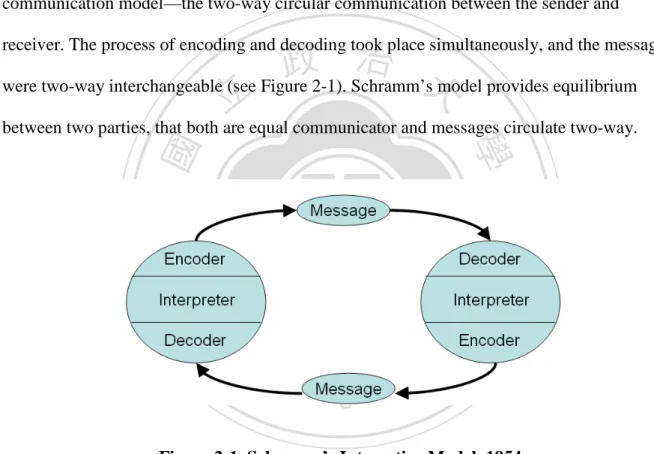
(14) A STUDY ON FEMALE BLOG READERS’ ATTITUDES TOWARD eWOM AND BUZZ MARKETING IN BEAUTY BLOGS. considered more credible than traditional media, especially in Taiwan, where consumers rely heavily on peoples’ recommendations. 4. In order to examine whether incentives do affect blog readers’ attitude towards positive or negative eWOM generated from beauty bloggers, the level of credibility of different types of blog posts will be observed and compared. 5. The study will discuss the relationship between blog readers’ attitudes toward buzz marketing embedded in beauty blogs and purchasing behavior.. 1.4 Research Questions. - First Stage:. 立. 政 治 大. ‧ 國. 學. RQ1. What is the current phenomenon of beauty blogging with and without the involvement. ‧ y. Nat. - Second Stage:. sit. of buzz marketing?. n. al. er. io. RQ1. Does readers’ level of content satisfaction influence their attention towards products, services, or brands?. Ch. engchi. i n U. v. RQ2. Does readers’ level of content satisfaction influence their purchasing behavior?. RQ3. Does readers’ level of content satisfaction influence their conduction of WOM referral?. RQ4. Do different types of blog posts have different WOM credibility?. RQ5. Does WOM credibility moderate the relationships between blog readers’ attitudes toward buzz marketing and purchasing behavior?. 5.
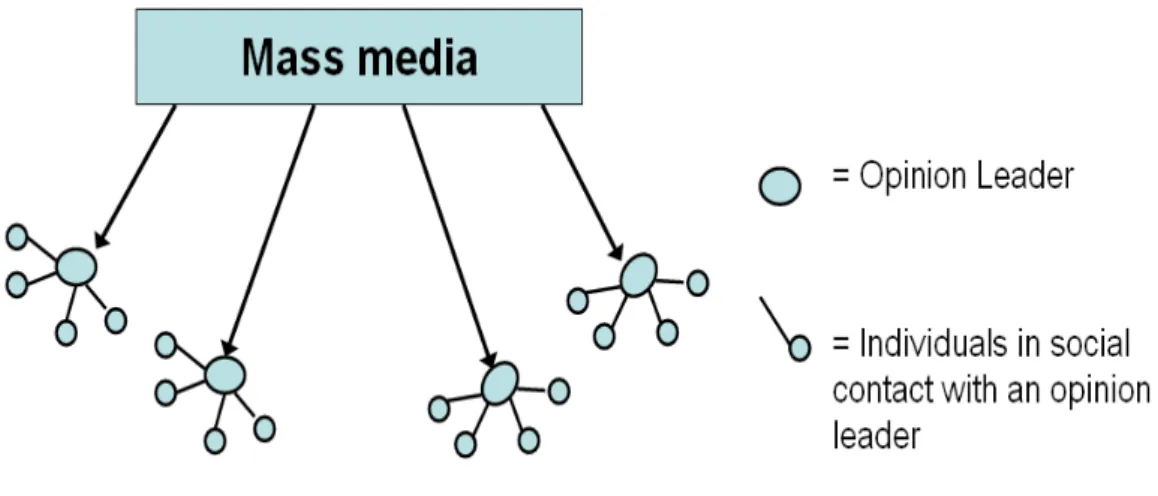
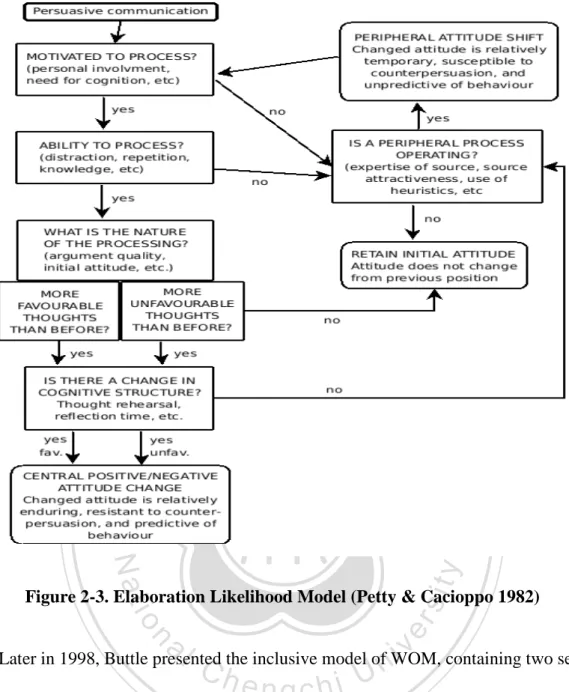
(15) A STUDY ON FEMALE BLOG READERS’ ATTITUDES TOWARD eWOM AND BUZZ MARKETING IN BEAUTY BLOGS. CHAPTER II : LITERATURE REVIEW. For decades, researchers have studied how WOM works on consumer behavior, how WOM has been strategically operated in marketing, how WOM has been evolving in the Web2.0 era, as well as how new media tools, such as blogs, being incorporated into buzz marketing. The following sections review the past literature on WOM, buzz marketing, placement of buzz marketing in blogs, and beauty bloggers’ credibility dilemma.. 2.1 Word of Mouth (WOM). 政 治 大. More and more companies accentuate on the immense power of word of mouth. 立. (WOM). The power of persuasion and influence of WOM has far exceeded its mass media. ‧ 國. 學. counterparts (Price & Feick, 1984). Levinson (2003) pointed out two facts concerning word of mouth; one is that people would credit WOM referrals rather than acknowledging the. ‧. impact of marketing. Nevertheless, on the other hand, most people “do check with friends. y. Nat. sit. before patronizing a business” (2003, p.50). Dichter (1966) indicated WOM is related to 80%. n. al. er. io. of the buying behavior. As Hall (2006) cited from Intelliseek and Forrester, “consumers are. i n U. v. 50% more likely to heed peer recommendations than they are to follow advertisers’ leads” (p.72).. Ch. engchi. The valence of word of mouth may be positive or negative. While positive WOM can significantly enhance the impact on consumer behavior and loyalty (Engel et al., 1969; Richins, 1983; Herr et al. 1991), the negative WOM disseminated by the dissatisfied customers may cause serious consequences, such as change in purchasing decision/behavior, loss of consumer loyalty, even harm to the reputation of the company (Tybout et al., 1981; Richins, 1983; Singh & Pandya, 1991; Soloman, 1999; Zeelenberg & Pieters, 2004).. 6.
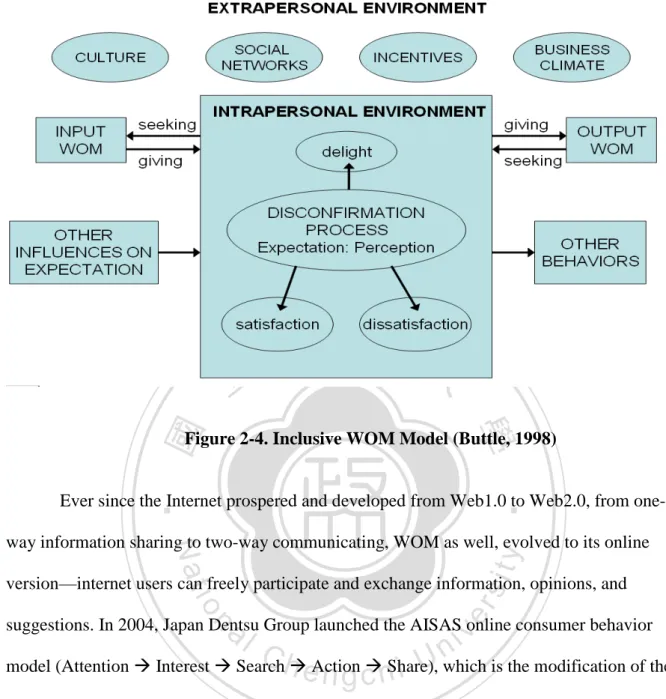
(16) A STUDY ON FEMALE BLOG READERS’ ATTITUDES TOWARD eWOM AND BUZZ MARKETING IN BEAUTY BLOGS. Arndt (1967) defined WOM as “oral, person-to-person communication between a receiver and a communicator whom the receiver perceives as non-commercial, regarding a brand, product or service.” In Buttle’s(1998) review of WOM literature, the author found previous study of WOM inadequate due to market change and innovation of technology. Three reasons suggested by Buttle (1994) are as follows:. 1. WOM not only involve a product/brand/service, it can conclude an organization (Buttle, 1994). It is more frequently seen in later studies that the interrelations between WOM and company’s reputation and values have been examined (Luo &. 政 治 大. Homburg 2007; Villanueva et al. 2008; Hong & Yang, 2009).. 立. 2. WOM can be electronically mediated via cell phone, chatrooms, e-mail, hyperlinks,. ‧ 國. 學. and etc. In this study, this form of online WOM is re-positioned as eWOM, which will be discussed in the following literature. Moreover, noted in Buttle’s (1994) examples. ‧. of electronically mediated WOM, blogs and other online social networks, such as. y. Nat. n. al. er. io. time frame.. sit. discussion forums or microblogs were not documented yet due to the contemporary. i n U. v. 3. In contrast to Bone’s(1992) definition of WOM as “an exchange of comments,. Ch. engchi. thought, and ideas among two or more individuals in which none of the individuals represent a marketing source” (p.579), there has been an increasing inclination of companies offering incentives or rewards for consumers to disseminate positive WOM or make referrals (Buttle, 1994; Trusov, Bucklin, & Pauwels, 2009). This concept of company-created WOM-spreading behavior based on the benefit exchange (e.g. free product, discount, or direct payment) between consumers and companies has challenged its noncommercial nature, which can be found in Harrison-Walker’s definition, that WOM is “informal, person-to-person communication between a perceived noncommercial communicator and a receiver regarding the target object, 7.
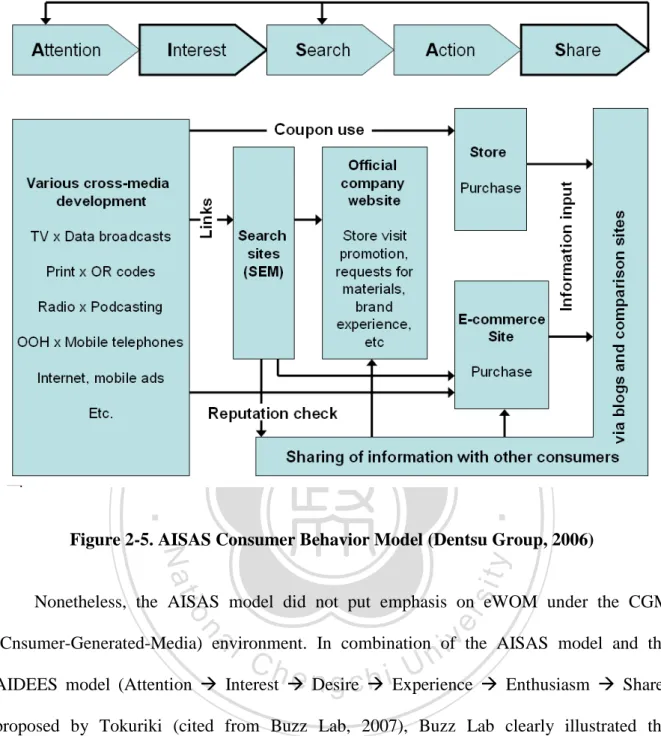
(17) A STUDY ON FEMALE BLOG READERS’ ATTITUDES TOWARD eWOM AND BUZZ MARKETING IN BEAUTY BLOGS. such as brand, product, an organization, or a service” (2001). For the purpose of distinguishing spontaneous WOM and planned WOM, the latter will be redefined as buzz marketing in the following content.. 2.1.1 WOM Model. Recognizing word of mouth, as referring to the previous literature, is the communication between individuals, it is important to look at Schramm’s interpersonal communication model—the two-way circular communication between the sender and. 治 政 大model provides equilibrium were two-way interchangeable (see Figure 2-1). Schramm’s 立. receiver. The process of encoding and decoding took place simultaneously, and the messages. between two parties, that both are equal communicator and messages circulate two-way.. ‧. ‧ 國. 學. n. er. io. sit. y. Nat. al. Ch. engchi. i n U. v. Figure 2-1. Schramm’s Interactive Model, 1954. The earliest WOM theory can be traced back to the two-step flow of Communication (Figure 2-2) proposed by Lazarfeld, Berelson, and Gaudet in 1948, and was elaborated by Katz and Lazarfeld in 1955. By indicating messages, instead of being distributed directly by mass media to the audience, were intentionally sent to opinion leaders/early adopters, who then spread out the WOM to influence their peers/receivers/followers.. 8.
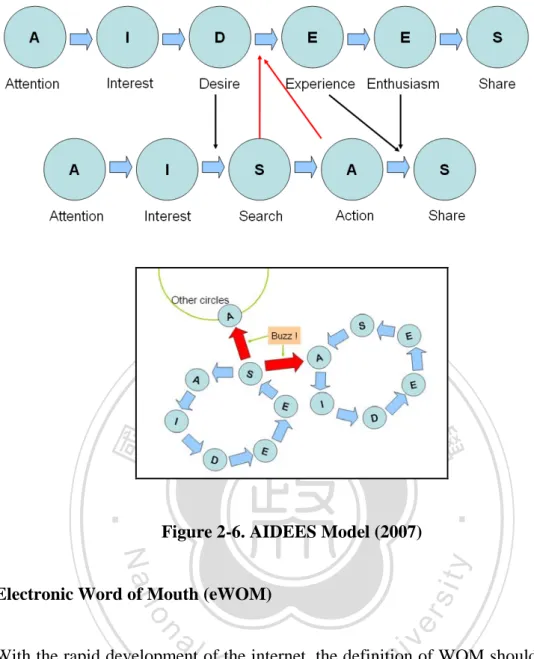
(18) A STUDY ON FEMALE BLOG READERS’ ATTITUDES TOWARD eWOM AND BUZZ MARKETING IN BEAUTY BLOGS. Figure 2-2. Two Step Flow of Communication Model, 1955. 政 治 大. From the view of consumer behavior and WOM, the elaboration likelihood model. 立. (ELM) of persuasion introduced by Petty and Cacioppo (1982) suggest that the route of. ‧ 國. 學. persuasion depends on the level of the consumers’ motivation as well as their ability to think. ‧. about the received information (Figure 2-3). They claimed that the consumer’s attitude changes through diligent consideration of information when ELM is high, and called that. y. Nat. io. sit. central route of persuasion. The input WOM (positive and negative) serves as an important. n. al. er. source of information here. Peripheral route, on the other hand, is more likely when ELM is. Ch. i n U. v. low, and the consumer’s attitude changes without engaging extensive issue-relevant thinking,. engchi. through associating with either positive or negative cues. ELM has been applied to examine the engagement of WOM and its outcome as attitudinal change.. 9.
(19) A STUDY ON FEMALE BLOG READERS’ ATTITUDES TOWARD eWOM AND BUZZ MARKETING IN BEAUTY BLOGS. 立. 政 治 大. ‧. ‧ 國. 學 sit. y. Nat. io. n. al. er. Figure 2-3. Elaboration Likelihood Model (Petty & Cacioppo 1982). Ch. i n U. v. Later in 1998, Buttle presented the inclusive model of WOM, containing two sets of. engchi. variables — the intrapersonal variables and the extrapersonal variables (Figure 2-4). Notice both input WOM (pre-purchase information) and output WOM (post-purchase information) are two-way information exchange by both giving and seeking. In the intrapersonal environment, the interrelationship between expectation and perception would decide consumers’ satisfaction or dissatisfaction, which would lead to subsequent output WOM from the experiencing consumers, or become the input WOM source for other consumers who seek information. In the extrapersonal environment, “incentives” plays one of the four main factors that may influence the construct of WOM.. 10.
(20) A STUDY ON FEMALE BLOG READERS’ ATTITUDES TOWARD eWOM AND BUZZ MARKETING IN BEAUTY BLOGS. 立. 政 治 大. ‧ 國. 學. Figure 2-4. Inclusive WOM Model (Buttle, 1998). ‧. Ever since the Internet prospered and developed from Web1.0 to Web2.0, from one-. sit. y. Nat. way information sharing to two-way communicating, WOM as well, evolved to its online. io. er. version—internet users can freely participate and exchange information, opinions, and. al. v i n C model (Attention Interest SearchheAction Share), n g c h i U which is the modification of the n. suggestions. In 2004, Japan Dentsu Group launched the AISAS online consumer behavior. traditional AIDMA theory (Attention Interest Desire Memory Action) proposed by Ronald Hall in 1920s (Wang, 2009). AISAS model (as shown in Figure 2-5) was developed to “define the new purchasing process that has resulted from the proliferation of internet” (Dentsu, 2006), and has been used to observe the information-searching and information-sharing behavior of online WOM (eWOM) (Hsieh & Hsieh, 2008; Okada & Yamamoto, 2009; Wang, 2009).. 11.
(21) A STUDY ON FEMALE BLOG READERS’ ATTITUDES TOWARD eWOM AND BUZZ MARKETING IN BEAUTY BLOGS. 立. 政 治 大. ‧. ‧ 國. 學 sit. y. Nat. Figure 2-5. AISAS Consumer Behavior Model (Dentsu Group, 2006). n. al. er. io. Nonetheless, the AISAS model did not put emphasis on eWOM under the CGM. i n U. v. (Cnsumer-Generated-Media) environment. In combination of the AISAS model and the. Ch. engchi. AIDEES model (Attention Interest Desire Experience Enthusiasm Share) proposed by Tokuriki (cited from Buzz Lab, 2007), Buzz Lab clearly illustrated the complementary relationships between the two models and how the AIDEE model represents the six stages of consumers being influenced by eWOM in the CGM environment, such as blogs (2007).. 12.
(22) A STUDY ON FEMALE BLOG READERS’ ATTITUDES TOWARD eWOM AND BUZZ MARKETING IN BEAUTY BLOGS. 學 ‧. ‧ 國. 立. 政 治 大. Figure 2-6. AIDEES Model (2007). sit. y. Nat. n. al. er. io. 2.1.2 Electronic Word of Mouth (eWOM). Ch. i n U. v. With the rapid development of the internet, the definition of WOM should be adjusted.. engchi. The internet brought forth a “word-of-mouth Revolution” (Dellarocas, 2003) with millions of internet users “engage in a mass-mediated exchange of personal information and opinions every day” (Thorson and Rodgers, 2008). Hung and Li (2007), in their study of eWOM influence on virtual consumer communities, also observed “product knowledge communicated via eWOM opens up a great quantity and diversity of information that commercial messages rarely can provide.”. Electronic word of mouth (eWOM), also known as word of mouse (Gelb and Sundaram, 2002), is the online form of WOM, which emerges as the internet took part in people’s daily 13.
(23) A STUDY ON FEMALE BLOG READERS’ ATTITUDES TOWARD eWOM AND BUZZ MARKETING IN BEAUTY BLOGS. lives. Hennig-Thuau, Gwinner, Walsh and Gremler (2004) conceptualized eWOM as “any positive or negative statement made by potential, actual, or former customers about a product or company, which is made available to a multitude of people and institutions via the Internet.” The omnipresence of eWOM on the internet has played an irreplaceable role in marketing communication. Nevertheless, it was only until last decade has the research on eWOM and its impact been studied and observed in academic journals (Breazeale, 2009).. Although similar to the traditional oral/face-to-face WOM, eWOM has several distinctive characteristics—. 1.. 治 政 大 2000). Whether reviews in eWOM is dependent on written form (Christiansen & Tax, 立. online forum, opinions in chatrooms, recommendations on websites, experience-sharing. ‧ 國. 學. in blogs, or testimonials in social networks, it is the “online” written WOM that generates. ‧. “offline” behaviors.. sit. y. Nat. 2. Different from traditional WOM’s ephemeral nature, as Stern (1994, p.7) mentioned. io. er. “WOM communication vanishes as soon as it is uttered, for it occurs in a spontaneous. al. manner and then disappears” (cited from Buttle, 1998) eWOM effect can be contagious. n. v i n C hand Pauwels (2009)Ufound out eWOM “induced both a and long-lasting. Trusov, Bucklin, engchi larger short-term response and a substantially longer carryover effect. “ 3. Early studies on WOM and social ties showed strong ties were distinguished to trigger more referrals and thus make greater influence than weak ties, which was perceived as bridging the information flow (Brown & Reingen, 1987). Nevertheless, eWOM often takes place between people with weak ties and can be anonymous ( Dellarocas, 2003;Goldsmith & Horowitz, 2006); this makes consumers more comfortable and willing to share their opinions or experiences (Goldsmith & Horowitz, 2006).. 14.
(24) A STUDY ON FEMALE BLOG READERS’ ATTITUDES TOWARD eWOM AND BUZZ MARKETING IN BEAUTY BLOGS. 4. In the pre-internet era, WOM is distributed by consumers who were passively exposed under mass media channels, such as TV, radio or newspaper. Today, by buzzing on the new media tools such as blogs or social networks, consumers can be active participants on generating media content and drive eWOM that travels far in the world of Web2.0.. In Taiwan, a survey conducted by InsightXplorer in 2009 discovered that 80 % of the internet users view online word of mouth (eWOM) as very important and very influential. Besides searching for pre-purchase information, 60% of the internet users would also post their own experience or comments.. 2.1.3 Women Consumer vs. WOM. 立. 政 治 大. ‧ 國. 學. It is recognized that women consumers are very influential (Yaccato & Yaeger, 2003; Marletta, 2003.) In “The 80% minority: reaching the real world of women consumers”,. ‧. Yaccato and Yaeger point out that women construct and effect around 80% of the purchasing. y. Nat. sit. decision; in North America, women are in responsible of 80% of total expense (2003, p.2 &. n. al. er. io. p.4). A research conducted in 2005 by Leo Burnett, an ad agency, indicates that as women in. i n U. v. Asia become more financially independent, they also become more self-indulgent and are. Ch. engchi. willing to spend more on themselves. Michelle Kristula-Green, the president of the Leo Burnett Asia-Pacific, noted, “as more women come to terms with their sexuality, their desire to improve and enhance their looks is also rising, creating an unprecedented beauty boom with more women across Asia investing in their looks” (White, 2005, p. 8).. According to Yaccato and Yaeger(2003), there are six characteristics of women consumers’ behavior. First, they weighed on human interactions, both online and offline. Second, they tend to refer or pass along information. Statistically, women build more referrals and greater word of mouth than men. Third, they draw attention to or provide 15.
(25) A STUDY ON FEMALE BLOG READERS’ ATTITUDES TOWARD eWOM AND BUZZ MARKETING IN BEAUTY BLOGS. testimonials on personal experiences, either positive or negative ones. In the process of comparing experiences, women continuously build networking and forge interrelationships. Fourth, women are more likely to share knowledge about a product or service. Fifth, women allow self-discovery. Last, they don’t like to waste time (p.141-142 & p.172-173). Blogs provide the exact platform to satisfy all above.. More and more women do online research before purchasing. Instead of merely accepting given marketing messages, women nowadays with the help of the internet, would “trust filters of information to help them weed through the volume of information available” (2003, p.142).. 立. 政 治 大. Many have concluded that women’s referral network work better and thus might. ‧ 國. 學. eventually generate more profit (Barletta, 2003). As a matter of fact, initial buzz would. ‧. equally attract both men and women, yet the following word of mouth is mostly passed and. sit. y. Nat. spread by women. In Marketing to Women, author Martha Barletta puts much emphasis on. io. er. women consumers’ referral behavior that makes them worthier customers. Barletta. al. assertively interprets, “because women customers return more loyalty and referrals to the. n. v i n C h convert representsUmore business in the long run companies they patronize, every woman engchi than her male counterpart” (2003). Being the author of all-time best-selling financial book The Wealthy Barber, David Chilton claims that “there is nothing you can do in marketing that can achieve the same level of success as garnering word of mouth from women consumers” The target group of the present study, therefore, is women, who are the new emerging, powerful consumers.. 2.2 Buzz Marketing. 16.
(26) A STUDY ON FEMALE BLOG READERS’ ATTITUDES TOWARD eWOM AND BUZZ MARKETING IN BEAUTY BLOGS. As the founder of BzzAgent, Balter stated that the impact of buzz marketing is greater than any other traditional media (2006). As mentioned in the earlier literature, buzz marketing is not randomness, for it engages structural and methodical approach to get people talking and media writing (Hugh, 2005). Before unveiling the charm of buzz marketing, the concept of “buzz” needs to be clarified.. 2.2.1 Buzz. “Buzz” in brief explanation, is the “contagious word-of-mouth commentary about. 治 政 Smartketing, further described that true buzz is like a virus大 that changes to meet the challenge 立 products, services, brands, and ideas” (Walker, 2004). Jim Matorin, business catalyst with. of a new environment. There are three distinct stages of the evolution of buzz: inoculation, or. ‧ 國. 學. the introduction of a product; incubation, or the use of the product by a few innovative. ‧. trendsetters; and infection, or widespread use of the product among the mainstream. He then. sit. y. Nat. pointed out that a good buzz marketing campaign should start by establishing infection.. io. er. Rosen (2000) in his book The anatomy of Buzz, identified that “buzz is all about the word of. al. mouth about a brand. It’s the aggregate of all person-to-person communication about a. n. v i n C hat any point in time” particular product, service, or company e n g c h i U (p.7). He also explained the combination of local and nonlocal communication enables buzz to travel faster on the internet (p.22).. Thomas (2004) classified buzz into four, which are shown in the table 2-1:. Table 2-1. Four Types of Buzz (Thomas, 2004). Uncodified Buzz. Definition. Tools. Facts. The information passed on by innovators to their social network. Online media in the form of e-mail, blogs, list serves, personal websites, chat groups. More than 90% of consumers indicated they told at least one other person about a website when the original recommendation came. 17.
(27) A STUDY ON FEMALE BLOG READERS’ ATTITUDES TOWARD eWOM AND BUZZ MARKETING IN BEAUTY BLOGS. Codified Buzz. when encounter new products. Codified buzz is that which is incubated, fostered and underwritten by the firm. Testimonials, endorsements, trial versions, observable usage, gift registries, guarantees, customer communities, embedded customers, hosted chat rooms, passalongs affiliate programmes, referral programmes, experiential marketing, bounce backs, gift certificates, advocacy marketing, customer ratings, demonstrations, preferred customer programmes, seminars, parties and conferences. — 92%decided to buy a grocery, household or health and beauty care product after trying a sample (Greenfield Online, 2001). The problem with this marketing technique is that generally people do not like to be duped, and sending out posers is a dupe tactic.. er. sit. y. ‧. io. a l—Customers need to be iSurprising v customers with added n C h into the processU or unanticipated value and integrated engchi of new product customising value or information. n. Ultimate Buzz. Promotional Agencies. — 73% became aware of new or improved products through samples. 學. Schemed WOM generated by the promotional agencies that have been hired The ultimate buzz is delivering exceptional value, what is known as the relative advantage of the offer. — 84% would consider switching products if they liked the free sample they tried. 政 治 大. Nat. Pseudo Buzz. ‧ 國. 立. from a friend (Jupiter Media Metric, 2004) A January 2001 survey by Brand Marketing, the Promotion Marketing Association, Greenfield and Experian found among its respondents that (see McConnell and Huba, 2004):. development —Having a unique value proposition is not good enough, one has to deliver relevant innovative value propositions (choose a primary value proposition, a secondary, even a tertiary, but understand this requires leadership in the competitive context). 18. about the customer will result in the highest levels of customer satisfaction, higher retention rates (customer loyalty) and higher buzz levels..
(28) A STUDY ON FEMALE BLOG READERS’ ATTITUDES TOWARD eWOM AND BUZZ MARKETING IN BEAUTY BLOGS. 2.2.2 Definition of Buzz Marketing. Thomas (2004) defined buzz marketing as “the amplification of initial marketing efforts by third parties through their passive or active influence.” As defined by Hughes (2005), “buzzmarketing captures the attention of consumers and the media to the point where talking about your brand or company becomes entertaining, fascinating, and newsworthy.” Walter (2006) pointed out the difference between WOM communication and buzz marketing, that the latter apply explicit organizational efforts to stimulate "buzz" by either paying people or seeking volunteers to try new products/services and then have agents "talk them up". 政 治 大. among their social networks. Three examples of this phenomenon are (a) paying people to. 立. talk up a product/service/brand either in online or offline form, (b) recruiting volunteers to. ‧ 國. 學. participate in a campaign, oftentimes in exchange of rewards (e.g. free samples, discounts, points-to-redeem) or the satisfaction that comes along with being the first ones to know/try,. ‧. and (c) creating a platform/network for selected individuals to buzz about certain. y. Nat. al. er. io. marketing strategy rather than mere spontaneous behaviors.. sit. products/services/brands (Carl, 2006). Buzz marketing, therefore, is more about an organized. n. v i n C h of buzz (Walter, Nevertheless, from the classification e n g c h i U 2004), it is suggested that pseudo buzz done by posers would only bring negative effect. Therefore, a successful buzz marketing, even though planned out under structural and methodical approach, should remain truthful and transparent to the consumers.. 2.3 Blog. “The power of blogs lies in their capability to challenge the role media conglomerates play in how information is delivered, phrased, reported, or otherwise distributed” (Wallace, 2008, p.5). According to Forrester, 11.2% of online adults in the U.S. publish a blog at least 19.
(29) A STUDY ON FEMALE BLOG READERS’ ATTITUDES TOWARD eWOM AND BUZZ MARKETING IN BEAUTY BLOGS. once a month. Of the same group, 24.8% read a blog and 13.7% comment on a blog at least once a month. The numbers are higher for youths. Of online youths, 20.8% publish a blog, 36.6% read a blog, and 26.4% comment on a blog at least once a month. (Baker & Green, 2008). 2.3.1 Historical Background of Blog. Back in the early 90s, the concept of “blog” was nothing more than a small population of the Internet users posting online journals to express their opinions as well as sharing links. 治 政 大referred to Mosaic’s “What’s rec.humor.funny as the world’s oldest blog, and while some 立. by manually programming. Being the founder of rec.humor.funny, Brad Templton stated his. New” page in 1993 the first blog (Pack, 2004).. ‧ 國. 學. The word “blog” was originally the contraction of “web log (logging the web)”,. ‧. which was first proclaimed by John Barger in 1997 (Park, 2004). Peter Merholz announced in. y. Nat. sit. early 1999 that he would pronounce weblog as “wee blog” and henceforth got shortened to. n. al. er. io. 'blog” as well as “blogger” referred to the weblog editor (Blood, 2000). In July 1999, Pitas. i n U. v. launched as the first free blog-publishing tool. Later in August, Blogger was released by Prya. Ch. engchi. Labs (Blood, 2000) with the innovative technology to automate the process of updating posts, reducing the barrier of publishing and making it open for anyone without any computerprogramming knowledge (Wibbles, 2006, Wallace, 2008). Henceforth, blogs have altered the way people communicate online and have continued to expand its domain. 2004, the turning point in blog history, blogs were first introduced to politics and celebrities. As indicated by Sirfy (2006), the numbers of existing blogs has augmented 100 times from mid-2003 to mid2006. In early 2008, the search company Technorati indexes 112 million blogs, with 120,000 new ones popping up each day (Baker & Green, 2008).. 20.
(30) A STUDY ON FEMALE BLOG READERS’ ATTITUDES TOWARD eWOM AND BUZZ MARKETING IN BEAUTY BLOGS. 2.3.2 Blog Definition. Huang, Shen, Lin, & Chang defined blogs as “personal journals on the internet arranged in reverse chronological sequence that facilitate interactive computer mediated communication through text, images, and audio/video objects” (2007). “A blog is an easily, instantly, and frequently updated Web site, focused around a topic, industry, or personality” (Wibbels, 2006). Thorson and Rodgers (2008) consider interactive blog a form of eWOM.. Researchers have categorized blogs under diverse criteria. Blood (2002) distinguishes. 治 政 大versus topical and community four types by two dimensions of a blog's orientation: personal 立 three types of blogs by their functions. Krishnamurthy (2002) proposes to classify blogs into. versus individual. Herring, Scheidt, Wright, and Bonus (2005) modify Krishnamurthy's. ‧ 國. 學. categorization and ascribe blogs into five categories. Dearstyne (2005) suggests five types of. ‧. blogs by their uses.. y. Nat. n. al. er. io. 1. Interactive. sit. There are seven characteristics that distinguish blogs from other media:. Ch. engchi. i n U. v. Of all communication tools, blogs are the most interactive (Claxton & Woo, 2008.). Its engaging nature allows bloggers and readers to have two-way conversations via comments, trackbacks, or message boards.. 2. Accessible. Blogs can be accessed from anywhere in the world, as long as the internet works. There are all kinds of blogs (e.g. v-log: video blog, k-log, knowledge blog) in blogosphere, and they are open to the public, unless locked from the bloggers.. 21.
(31) A STUDY ON FEMALE BLOG READERS’ ATTITUDES TOWARD eWOM AND BUZZ MARKETING IN BEAUTY BLOGS. 3. Personality-driven. There is no set rule of how a blog post should be written; instead, the beauty of free speech makes blogging a “creative outlet” (Wallace, 2008, p.8). Many personal blogs are selfexpressive and do not represent any party except the blogger himself/herself. The tone of a personal blog is usually informal and identical with the bloggers’ own personality.. 4. Cost-Efficient. Unlike its mass media counterparts, to communicate on a blog is inexpensive (Brown, 2007,. 政 治 大. p.21). Using an existing blogging software or platform, such as Blogger, Wordpress, or. 立. Wretch (Taiwan), is usually free. Once a blog is set up, one can promote his/her business,. ‧ 國. 學. product, service, or cause for no cost.. ‧. 5. Easy-to-manage. y. Nat. sit. To start a blog does not require computing skills (Brown, 2007, p.21), nor much technology. n. al. er. io. knowledge. There are existing blogging software/platforms for people to create their own. i n U. v. accounts and blog whenever, and wherever. It is easy to manage a blog, even if one decides. Ch. engchi. to stop his/her blog, there will not be any managerial cost or loss involved.. 6. Insightful. A blogger can be any person, from middle school student to the president. In face, there are many bloggers with rich knowledge on specific topics; they offer in-depth analysis or useful information via links(Wibbels, 2006, p.27) and oftentimes, give advises or recommendations. This theme-based blogs that concentrate on certain fields of knowledge is referred to as knowledge blogs, also known as k-logs (Herring et al, 2005).. 22.
(32) A STUDY ON FEMALE BLOG READERS’ ATTITUDES TOWARD eWOM AND BUZZ MARKETING IN BEAUTY BLOGS. 7. Up-to-date. Blogs offer fresh content on a frequent and regular basis (Wibbels, 2006, p.27); they provide a “new breed of ‘citizen journalists’ to supply real time eyewitness accounts of events around the world that the mainstream media does not, or cannot, cover and instantly communicate reports” (Wallace, 2008, p.10). A blog post is put online instantly (Brown, 2007, p.22), unlike a news report needs to be edited or a TV commercial requires long production time.. 8. Credible. 政 治 大. Traditional mass media are bought to promote a product/service/organization, yet blogs are. 立. consumer-generated-media that reveal real-consumer experiences or opinions. Thus, word of. ‧ 國. 學. mouth generated via blogs, as the AIDEES model shows, has undergone the stages of bloggers’ own experience, and being enthusiastically shared in the blogosphere that can. ‧. generate great buzz. Readers trust recommendations from bloggers more highly than from. y. Nat. sit. traditional advertising (Wibbels, 2006, p.22). The credibility of blogs and bloggers will be. er. io. further discussed in following literature.. al. n. v i n C hof the most influential Blogs have been viewed as one e n g c h i U and effective means in current integrated marketing communications (IMC). What blogging can achieve is the more specific and direct targeting (Claxton & Woo, 2008). Professor Kotler and Keller (2004) have named 14 shifts in marketing in their reputed book Marketing Management; within which they mentioned the market has changed from organized by products unit to organized by customer segments as well as the market used to sell to everyone, but now the market serves the welldefined target market. The major purpose of targeting is to reach precise consumer group, further building strong customer relationship. The distinctive outcomes of targeting are its preciseness, customization, directness, reinforced customer relationship, and effectiveness. 23.
(33) A STUDY ON FEMALE BLOG READERS’ ATTITUDES TOWARD eWOM AND BUZZ MARKETING IN BEAUTY BLOGS. New Identities, a marketing agency located in New Jersey, names “the process of putting products in front of potential customers at the exact moment” the pinpoint marketing, which is in contrast to the more expensive and wasteful interruptive marketing, such as television or radio ads.. Consumers are not homogeneous; each consumer has his/her own preference, cultural background…etc. Mass marketing communications in many cases, such as advertising, result in ineffectiveness for both the company and customers – company would waste money and lose profit as well as customers would waste energy and make wrong buying decision, which. 政 治 大. may deteriorate the building of customer loyalty. The best for a value of certain. 立. product/service to be delivered thus is suggested as “the right product to the right consumers. ‧ 國. 學. in the right way” (Kotler, 2004). The readers of blogs are of selected groups with specific interest on certain topics. It is now the targeting or customer segmentation that plays an. ‧. important role in marketing and integrated marketing communications, either in. y. Nat. n. al. er. io. 2.3.3 Blogging Motivations. sit. macroenvironment or microenvironment.. Ch. engchi. i n U. v. In the existing literature, studies mostly focus more on the blogs rather than bloggers (Huang, Shen, Ling, & Chang, 2007). Although several surveys touch the base of bloggers' motivations (e.g. Blood, 2002; Blumenthal, 2005; Herring, Scheidi, Wright,' and Bonus, 2005; Lenhart and Fox, 2006). Nardi, Schiano, Gumbrecht, and Swartz (2004) are the first to investigate the issue in depth, they concluded that there are five blogging motivations— "to document their life experiences, to provide commentary and opinions, to express deeply felt emotions, to articulate ideas through writing, and to form and maintain community forums." They also suggest that for a blogger, these motivations may not be mutually exclusive and may play out simultaneously. Huang, Shen, Lin, and Chang (2007) combined “to express 24.
(34) A STUDY ON FEMALE BLOG READERS’ ATTITUDES TOWARD eWOM AND BUZZ MARKETING IN BEAUTY BLOGS. deeply felt emotions” and “to articulate ideas through writing” into “self-expression” in addition to adding “Information seeking.”. 2.3.4 Blog/Blogger Credibility. Blogs can be viewed as a form of eWOM, and “word of mouth is one of the best sources of credibility….The road to profitability is paved with credibility” (Levinson, 2003, p.41). Levinson, a famous marketing expert as well as many best-sellers author, highlighted the causal relationship between word of mouth and profitability in business by stating the. 治 政 大 than traditional media information. Blogs create a greater sense of trust and reputation 立. importance of source credibility. More and more people would cite blogs as a source of. (Wibbels, 2006, p.22). Researchers found that almost all blog readers thought blogs were. ‧ 國. 學. “moderately to very credible” (Johnson & Kaye, 2004). Blogs are also rated as more credible. ‧. than other online source, and even traditional media source (Banning & Sweetser, 2007).. sit. y. Nat. Although there does exist credibility concern about blogs (anyone can create one, no ethics,. io. er. or anonymity), researchers claim that the peer-view process would compensate the credibility. al. issue (Johnson & Kaye, 2004). Moreover, oftentimes influential bloggers have their own blog. n. v i n readers who consume the content onCa h regular base; these U e n g c h i audiences are looking for valuable. and reliable information. A blogger’s reputation lies in the blog’s credibility, because readers are smart enough to compare and tell from an irresponsible post. Hewitt indicated “the credibility of blogs depends on their timeliness and accuracy, but invariably, the qualification of the bloggers matter as well” (2005, p.108).. 2.3.5 Blog Glossary. Blogosphere—Blogosphere is the internet blogging community with the collective content of all blogs worldwide. 25.
(35) A STUDY ON FEMALE BLOG READERS’ ATTITUDES TOWARD eWOM AND BUZZ MARKETING IN BEAUTY BLOGS. Blogroll— “Users might mention other blogs in their postings, and express their suggested contacts in blogrolls (a sidebar within a particular blog listing the other blogs the blogger frequents)” (Furukawa et al., 2007). Besides RSS, blog viewers sometimes put the links of their interested blogs in their blogrolls, and people who visit their blogs can also click on the linkages to visit the blogs on the list. This is a transformed way of Word of Mouth in the blogosphere.. Trackback—“A TrackBack links to another blog that is referencing that particular post” (Wibbels, 2006). It is “a mechanism that automatically finds other comments about a blog. 政 治 大. post on a weblog, and provides excerpts and links to the comments alongside the post”. 立. (Bowman & Willis, 2003, p.20).. ‧ 國. 學. 2.3.6 Blogs vs. Discussion Forums. ‧. As cited by Wibbels (2006), the differences between blogs and online discussion. y. Nat. sit. forums are explained by a technology forum TechSoup, that “blogs are diaries that can be. n. al. er. io. read by the public, while bulletin boards are town hall meetings in which the public can all. i n U. v. discuss issues equally. The town hall quality of message boards can play off of the. Ch. engchi. informational/journal quality of blogs.” In another word, blogs are more specific and personal while a forum is more content-free and collective.. 2.4 eWOM, Blogger, and Buzz Marketing. Bloggers are “a cohort of internet users who produce as well as consume content on the internet.” Bloggers’ role can be versatile; more than seeking and sharing information, they can also be “communicator, producer, explorer, collector, and player in terms of their consumption of information.” (Huang, Shen, Lin, & Chang, 2007). Certain bloggers with great popularity become valuable for their ability to spread the WOM and influence people’s 26.
(36) A STUDY ON FEMALE BLOG READERS’ ATTITUDES TOWARD eWOM AND BUZZ MARKETING IN BEAUTY BLOGS. attitude, even behavior. The follow up section will discuss about past review on the influential individuals from the respect of communicativeness, innovativeness, marketing, consumer behavior, or social networks. The potential of these influential bloggers on spreading eWOM in the blogosphere has recently been targeted by marketers and henceforward been recruited to facilitate buzz marketing.. 2.4.1 Role of Influential Blogger. The ideas of certain people who are more influential over others and how these people. 治 政 practitioners. Their contributing role in depicting adoption 大 of innovations has been widely立 shape others’ thinking or decisions have drawn much attention from both researchers and. documented. These people have been categorized and labeled with various names, such as. ‧ 國. 學. opinion leaders (Katz & Lazarsfeld, 1955), early adopters (Rogers, 1962), innovative. ‧. communicators (Baumgarten, 1975), market mavens (Freick & Price, 1987), influentials. sit. y. Nat. (Weimann, 1994), and talkers (Sernovitz, 2009).. n. al. er. io. Katz and Lazarsfeld (1955) originally defined opinion leaders as “the individuals who. i n U. v. were likely to influence other persons in their immediate environment,” and this concept of. Ch. engchi. opinion leadership has been thoroughly studied by researchers since then. Rogers (1983) conceptualized opinion leadership as “the degree to which an individual is able to informally to influence other individuals’ attitudes or overt behavior in a desired way with relative frequency” (p. 271). Early adopters, as mentioned in the previous literature of the diffusion of innovations theory, are categorized as the second fastest of individuals who adopt an innovation. According to Rogers (1983), these individuals have the highest degree of opinion leadership among the other adopter categories. From the view of socioeconomic profiles and educational background, early adopters share similar characteristics with opinion leaders (Baumgarten, 1975; Venkatraman, 1989). It is identified by Baumgarten that the overlapping 27.
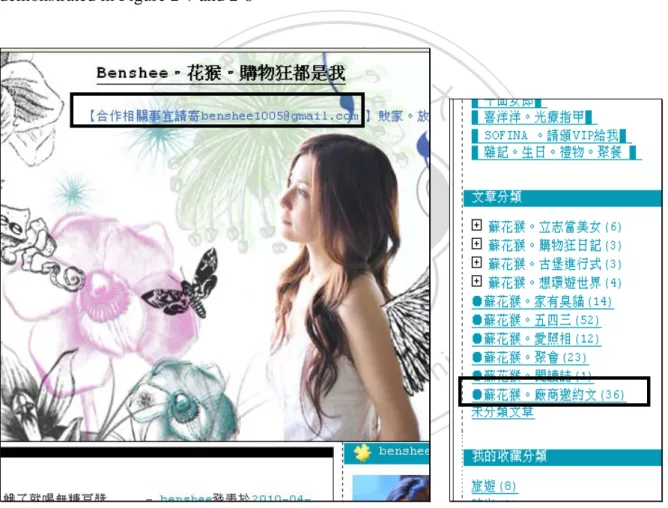
(37) A STUDY ON FEMALE BLOG READERS’ ATTITUDES TOWARD eWOM AND BUZZ MARKETING IN BEAUTY BLOGS. between fashion opinion leaders and fashion early adopter, of which the former implies the degree of communicativeness and the latter of innovativeness, could be fused together to allow measurement on influence—referring to as an innovative communicator (1975).. Market mavens are “individuals who have information about many kinds of products, places to shop, and other facets of markets, and initiate discussions with consumers and respond to requests from consumers for market information” (Feick & Price, 1987, p. 85). To differentiate market mavens from opinion leaders, three considerations based on Feick and Price’s study are—they are more sensitive in market change, the have more general market. 政 治 大. knowledge, and they are self-motivated by the obligation and pleasure to share as well as to. 立. help others (Price, Feick, & Guskey, 1995;Walsh, Gwinner, & Swanson, 2004; cited from. ‧ 國. 學. Ruvio & Shoham). The perception of the influentials was suggested by Weimann (1994) that there is a minority of individuals who influence an exceptional number of their peers.. ‧. However, in recent study conducted by Watts and Dodds (2007), it is found that “large. y. Nat. er. io. individuals.”. sit. cascades of influence are driven not by influentials but by a critical mass of easily influenced. al. n. v i n In his widely-recommendedC book of mouth marketing: how smart companies h eWord ngchi U get people talking, Sernovitz (2006/2009) established Five T’s elements for building WOM— Talkers (find people who will talk about you), Topics (give people a reason to talk), Tools (help the message spread faster and farther), Talking (join the conversation), and Tracking (measure and understand what people are saying). Talkers are “any group of people who have the enthusiasm and connections to reply your message” (Sernovitz, 2006/2009, p.17). Unlike the traditional conception of opinion leader, who comparably has higher social status or education background, talkers can be any regular person, your customers, friends, and even. 28.
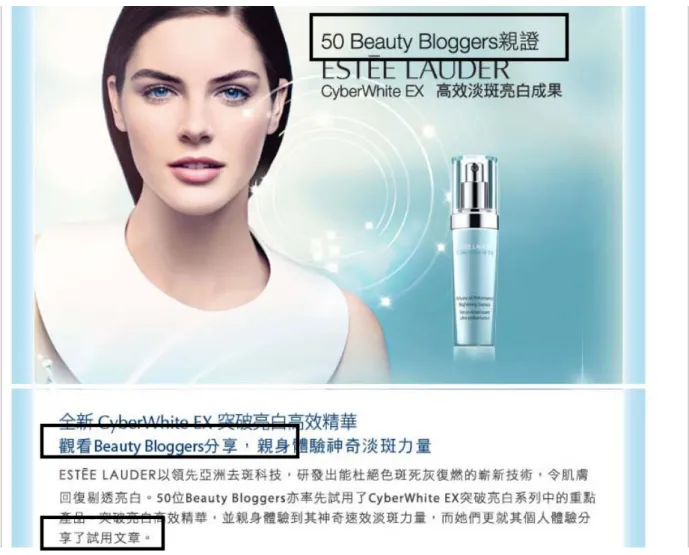
(38) A STUDY ON FEMALE BLOG READERS’ ATTITUDES TOWARD eWOM AND BUZZ MARKETING IN BEAUTY BLOGS. online strangers. What motivates talkers to talk is because they enjoy sharing ideas and helping people.. From the review of the literature above about bloggers as well as influential individuals, influential bloggers are defined as “bloggers who enjoy sharing abundant information about certain topics and influence or are influenced by producing as well as consuming content on the internet.”. 2.4.2 Beauty Blogs. 政 治 大. Beauty-related products, such as cosmetics or fashion apparels, are products of feeling. 立. decision and high involvement (Vaughn, 1980) of which information, feedback and. ‧ 國. 學. testimonials from trusted sources play an important role in buying decisions (Montague-Jones, 2009). By labeling high-involvement products as “conversation products,” Rosen (2000). ‧. pointed out that these products provoke high involvement and create buzz among customers. y. Nat. sit. (p.26). In the era of Web 2.0, consumers are not only doing more and more cosmetics. n. al. er. io. shopping online but they are also scouring social networking sites (e.g. blogs) for information and tips on beauty matters.. Ch. engchi. i n U. v. Rogers in his book Diffusion of Innovations (1962 & 1983), pointed out that diffusion is “the process by which an innovation is communicated through certain channels over time among the members of a social system," and that innovation is "an idea, practice, or object that is perceived as new by an individual or other unit of adoption” (p.11). Diffusion of an innovation happens through five stages—knowledge, persuasion, decision, implementation, and confirmation. Within this conceptual framework, expertly summarized by Rogers ,empirical marketing research has largely focused upon developing a greater understanding of the characteristics of two key consumer "change agents": (1) the innovator, 29.
(39) A STUDY ON FEMALE BLOG READERS’ ATTITUDES TOWARD eWOM AND BUZZ MARKETING IN BEAUTY BLOGS. or early adopter in the life cycle of a new concept or product, who gives the new concept initial physical visibility and functional application; and (2) the opinion leader who presents a "peer group legitimate" evaluation of the new concept and transmits product information and usage experience to the peer group culture. Beauty-related industry (e.g. fashion, cosmetics), due to its high frequency on introducing new products, has been acknowledged that interpersonal communications plays a crucial role in the diffusion of innovative information (Baumgarten, 1975). As more women turn to blogs for advice on beauty, beauty bloggers have become influential “change agents”on pre-purchase information collecting as well as post-purchase experience sharing.. 立. 政 治 大. Beauty bloggers, through expressing their personal experiences on using certain. ‧ 國. 學. cosmetics or beauty-related products/services, they not only provide functional benefits (i.e. smoother skin, increased length of eyelashes, shinier hair, more-evened skin tone, and etc.,). ‧. but also emotional benefits (i.e. strengthened confidence, increased attractiveness, regained. y. Nat. sit. self-esteem, and etc,.). However, different from advertising that speaks to mass without. n. al. er. io. precise targeting, the nature of blogs’ personal, interactivity, specificity, real-time as well as. i n U. v. real-people experience-sharing, blog readers may find the information more accountable,. Ch. engchi. truthful, and convincing. Once this mindset is established, such consumer-to-consumer relationships may generate more buzz in the blogosphere, further building positive WOM, which further lead to purchasing behavior.. It is not uncommon that well-known beauty bloggers posting articles about their evaluations of different product samples, which, are directly sent to them due to their high influence on generating effective “buzz” among other bloggers and numerous blog readers. Moreover, there are even “professional bloggers” that are paid to write, to advertise, or even. 30.
(40) A STUDY ON FEMALE BLOG READERS’ ATTITUDES TOWARD eWOM AND BUZZ MARKETING IN BEAUTY BLOGS. to endorse products in their blogs. The buzz generated by these bloggers, due to their high popularity and credibility, may further motivate the readers’ purchasing behavior.. On the first page of many popular beauty blogs which attract millions of visitors/readers, bloggers’ personal email addresses are given for “cooperation request from firms (廠商合作事宜)”. Most likely, a category for writing about free samples or corporation invitations would be listed in the categorization section. Two examples of beauty blogs are demonstrated in Figure 2-7 and 2-8 —. 立. 政 治 大. ‧. ‧ 國. 學. n. er. io. sit. y. Nat. al. Ch. engchi. i n U. v. Figure 2-7. Example 1. Beauty Blogger 花猴 (http://www.wretch.cc/blog/benshee). 31.
(41) A STUDY ON FEMALE BLOG READERS’ ATTITUDES TOWARD eWOM AND BUZZ MARKETING IN BEAUTY BLOGS. (http://www.wretch.cc/blog/katykissbo). 學. ‧ 國. 政 治 大 Figure 2-8.立 Example 2. Beauty Blogger Katy Beauty ‧. 2.4.3 Blogs and Buzz Marketing. Nat. sit. y. Online businesses are usually categorized into three models: business to business. n. al. er. io. (B2B), business to consumer (B2C), and consumer to consumer (C2C). However, the. i n U. v. recently-emerged buzz marketing via blogs is that marketers exploit the nature of blogs as. Ch. engchi. C2C platforms (Zhao, Fang, & Whinston, 2006) to achieve B2C2C communication. Blogs are useful tools for expanding and accelerating word of mouth by making massage portable through interconnecting, creating new topics with frequent updates, providing a platform for the conversation to happen, and building credibility among bloggers (Sernovitz, 2009, p.140141).. Blogs can build a buzz: getting influential bloggers to review the latest product or service is a great way to generate attention (see example Figure 2-9). Companies such as BzzAgent and Marqui have used bloggers as prime movers in their clients’ marketing 32.
(42) A STUDY ON FEMALE BLOG READERS’ ATTITUDES TOWARD eWOM AND BUZZ MARKETING IN BEAUTY BLOGS. campaigns (Wibbels, 2006, p.29). According to a survey done by Ad:Tech and MarketingSherpa, blogs were perceived by companies as the most prevailing marketing communication tool in 2007; 42% of the surveyed companies have allocated budget in blog marketing. To sum, it is suggested that blogs do have impacts in social and political aspect; its value in business is yet to be verified.. 立. 政 治 大. ‧. ‧ 國. 學. n. er. io. sit. y. Nat. al. Ch. engchi. i n U. v. Figure 2-9. ESTEE LAUDER: Beauty Bloggers Buzz Marketing Example (http://www.getjetso.com/forum/viewthread.php?tid=356142&extra=page%3D1%26amp;filt er%3Dtype%26amp;typeid%3D156). Nevertheless, some successful cases of which bloggers were recruited in buzz marketing campaign revealed bloggers’ potential in spreading positive WOM, resulting in 33.
(43) A STUDY ON FEMALE BLOG READERS’ ATTITUDES TOWARD eWOM AND BUZZ MARKETING IN BEAUTY BLOGS. growth of profit. As reported by BusinessNext (2010), a buzz marketing campaign held by Cheetos Taiwan incorporating famous bloggers to buzz about a new snack (campaign website shown as Figure 2-10) has achieved huge success. Trackbacks of this campaign among blogs have produced huge buzz effects; as a result, there are estimated 1.4 million people engaging in this campaign, and the sale growth has multiplied by seven times.. 立. 政 治 大. ‧. ‧ 國. 學. n. er. io. sit. y. Nat. al. i n U. v. Figure 2-10. Cheetos Campaign Webpage (http://www.cheetos.com.tw/blogger/01.asp). Ch. engchi. 2.4.4 Blogging vs. Incentive. Claxton and Woo, in their co-authored book How to say it: marketing with new media: a guide to promoting your small business using websites, e-zines, blogs, and podcasts, they position that “…of all the new media components, blogs have had the biggest effect on the way business communicate with customers” (2008, p.109). “Think of the implications for businesses of getting an up-to-the-minute read on what the world is thinking” (Baker & Green, 2008). 34.
數據

+7

相關文件
Recommendation 14: Subject to the availability of resources and the proposed parameters, we recommend that the Government should consider extending the Financial Assistance
An additional senior teacher post, to be offset by a post in the rank of Certificated Master/Mistress or Assistant Primary School Master/ Mistress as appropriate, is provided
An additional senior teacher post, to be offset by a post in the rank of CM or Assistant Primary School Master/Mistress (APSM) as appropriate, is provided to each primary
An additional senior teacher post, to be offset by a post in the rank of CM or Assistant Primary School Master/Mistress (APSM) as appropriate, is provided to each primary
An additional senior teacher post, to be offset by a post in the rank of Certificated Master/Mistress or Assistant Primary School Master/Mistress as appropriate, is provided to
(ii) “The dismissal of any teacher who is employed in the school – (a) to occupy a teacher post in the establishment of staff provided for in the code of aid for primary
An additional senior teacher post, to be offset by a post in the rank of CM or APSM as appropriate, is provided to each primary special school/special school with
An additional senior teacher post, to be offset by a post in the rank of CM or Assistant Primary School Master/Mistress (APSM) as appropriate, is provided to each primary
