Soyabean protein hydrolysate prevents the development of hypertension
in spontaneously hypertensive rats
Hsin-Yi Yang
1, Suh-Ching Yang
1, Jiun-Rong Chen
1*, Ya-Hui Tzeng
1and Bor-Cheng Han
21Department of Nutrition and Health Sciences, Taipei Medical University, Taipei 110, Taiwan 2School of Public Health, Taipei Medical University, Taipei 110, Taiwan
(Received 9 February 2004 – Revised 14 April 2004 – Accepted 14 May 2004)
The aim of the present study was to investigate the anti-hypertensive and angiotensin-converting enzyme (ACE) inhibition effects of soya-bean protein hydrolysate in spontaneously hypertensive rats (SHR). Soyasoya-bean protein hydrolysate was prepared by peptic hydrolysis and was added into the feed of SHR (0 % for the S0 group, 0·5 % for the S1 group, and 1 % for the S2 group) for 12 weeks. Systolic blood pressure and mean blood pressure of the S1 (164·3 (SEM4·7); 128·0 (SEM5·0) mmHg) and S2 (156·8 (SEM1·6); 120·8 (SEM3·4) mmHg) groups were significantly lower than those of the S0 group (199·4 (SEM5·2); 158·3 (SEM7·0) mmHg) at the end of the study. In the analysis of ACE activity, plasma and heart ACE activities of the S1 and S2 groups were significantly lower than those of the S0 group, and there were no significant differences in aorta, kidney, and lung ACE activities among all SHR. Soyabean protein hydrolysate had no significant effect on plasma lipids, electrolytes, or on left ventricular wall or aorta wall thickness. The results suggest that the long-term administration of soyabean protein hydrolysate might retard the development of hypertension in SHR by its inhibitory effect on ACE in vivo. Hypertension: Soyabean protein: Angiotensin-converting enzyme: Spontaneously hypertensive rats: Blood pressure
Many epidemiological studies have demonstrated that there is a relationship between increases in blood pressure and cardiovascular diseases (Miura et al. 2001). Angiotensin-converting enzyme (ACE; EC 3.4.15.1) can catalyse the conversion of inactive angiotensin I to angiotensin II, a potent vasoconstrictor. Therefore, the inhibition of ACE may cause a reduction in blood pressure (Cleland, 1993). The Heart Outcomes Prevention Evaluation Study also indi-cated that the use of ACE inhibitors may lower the incidence of hypertension and heart failure in the high-risk group of cardiovascular disease (Yusuf et al. 2000). Recently, many in vitro and in vivo studies have shown that dietary protein hydrolysates have ACE inhibitory activity (Yamamoto, 1997). For example, protein hydrolysates of sardine muscle (Kawasaki et al. 2000), sour milk (Masuda et al. 1996), dried bonito (Yokoyama et al. 1992), wheat bran (Matsui et al. 2000), and a-zein (Miyoshi et al. 1991) have been proposed and used as functional foods for their ACE inhibitory activities after oral administration.
Soya products are an important dietary protein source in Asia. An epidemiological study reported that subjects con-suming a traditional Japanese diet had lower blood pressure and plasma lipids than those on a Western diet (Kagan et al. 1974). An animal study also demonstrated that a soya-based diet attenuated the development of hypertension in
spontaneously hypertensive rats (SHR) when compared with a casein-based diet (Nevala et al. 2000). Studies with 4-week-old female SHR also indicated that dietary soya exerts an anti-hypertensive effect without changing heart rate (Martin et al. 2001). An in vitro study showed that soyabean protein hydrolysates (SPH) could inhibit ACE activity (Chen et al. 2002). In the present study, we prepared SPH by peptic digestion and investigated whether it had effects on blood pressure or on systemic and local ACE activities in SHR after long-term administration.
Materials and methods
Preparation of soyabean protein hydrolysate
Defatted soyabean flour (50 g) was dissolved in tri(hy-droxymethyl)-aminomethane-HCl buffer and centrifuged (18 000 g for 20 min at 258C). The supernatant fractions were adjusted to pH 4·6 by 1 M-HCl and centrifuged (18 000 g for 20 min at 48C). The precipitate (acid-precipi-tated protein) was collected and digested by 3 % pepsin at 378C for 24 h. A hydrolysate solution from pepsin digestion was adjusted to pH 7·0, and the precipitate was discarded after centrifugation. The supernatant fraction was then dried, ground to a powder, and stored at 48C as SPH.
* Corresponding author: Associate Professor Jiun-Rong Chen, fax þ 886 2 2737 3112, email [email protected]
Abbreviations:ACE, angiotensin-converting enzyme; RAS, renin – angiotensin system; SBP, systolic blood pressure; SHR, spontaneously hypertensive rats; SPH, soyabean protein hydrolysate; WKY, Wistar – Kyoto.
Animal experiment
Twenty-four male SHR (8 weeks old) and eight male Wistar – Kyoto (WKY) rats (8 weeks old) were purchased from the National Laboratory Animal Breeding and Research Centre (Taipei, Taiwan). Rats were housed in individual cages which were in a room under controlled lighting 08.00 – 20.00 hours at 24^ 18C and a relative humidity of 55^ 5 %. All rats had a high-Na diet (contain-ing 1 % NaCl) and free access to distilled water contain(contain-ing 0·9 % NaCl. After a 1-week adaptation, the SHR were randomly divided into three groups (S0, S1, and S2 groups), and the WKY rats served as the control group. All rats were fed a high-Na diet containing different percentages of SPH (0 % in the S0 and control groups, 0·5 % in the S1 group, and 1 % in the S2 group; Table 1). During the experimental period, food intake and body weight were recorded daily.
Data collection
Blood sampling. At 4-week intervals, overnight fasting tail venous blood was collected and analysed for plasma total cholesterol, triacylglycerol, Na, K, and Cl. After 12 weeks, the rats were killed, and blood samples were collected from the abdominal aorta into heparinised tubes for the measurement of blood lipids and ACE activity. The blood was immediately centrifuged (2000 g for 10 min at 48C), and then plasma samples were stored at 2 208C until analysis. All samples were determined using a Hitachi 7170 auto-analyzer (Tokyo, Japan).
Blood pressure. The systolic blood pressure (SBP) and mean blood pressure were measured at 4-week intervals during the study by the tail-cuff method using an electro-sphygmomanometer (model 179; Blood Pressure Analyser IITC, Woodland Hills, CA, USA). After 12 h fasting, at least five readings were recorded, the maximum and mini-mum values were discarded, and the average blood press-ure values were calculated from the remaining three values. Angiotensin-converting enzyme activity. Enzyme extracts of the aorta, lung, heart, and kidney were prepared by the method of Das & Soffers (1975) with some modifi-cations (Masuda et al. 1996). All organs were chopped into
small pieces and homogenised in tri(hydroxymethyl)-aminomethane-HCl (50 mmol/l; pH 7·9) containing 0·3 mol NaCl/l using an ultra-disperser. The suspension was filtered through a nylon mesh. Filtrates were centri-fuged at 44 000 g for 90 min, and the supernatant fractions were discarded. Pellets were suspended in the above buffer with 0·5 % Triton X-100. After 1 h, the suspensions were centrifuged at 1000 g for 10 min, and the supernatant fractions were designated the detergent-solubilised ACE fraction. The ACE activities were determined using hip-puryl-glycyl-glycine (Hip-Gly-Gly; Sigma, St Louis, MO, USA) as a substrate according to the method of Yamamoto et al. (1980), and glycyl-glycine (Gly-Gly; Sigma) was used as the standard. The Gly-Gly liberated by ACE reacts with 2,4,6-trinitrobenzenesulfonic acid and can be measured spectrophotometrically at 420 nm. The enzyme-specific activity was expressed as IU/mg protein. The pro-tein was quantified using the Lowry et al. (1951) method. Pathological analysis. The heart and aorta of rats were fixed in 5 % formaldehyde. Samples were stained with haematoxylin and eosin red, and the thicknesses of the left ventricular wall and aortic wall were measured by a pathologist.
Statistical analysis
Data were analysed by two-way ANOVA and Fisher’s least significant difference test using the SAS program (the Statistical Analysis System, version 8.0; Cary, NC, USA). Results are expressed as the mean and standard error of the mean. A value of P, 0·05 was taken as the level of statistical significance.
Results
Body weight and feeding efficiency
Weights of the three SHR groups were significantly lower than the control group from week 2 (P, 0·05; Table 2). At the end of the experiment, the weight of the S0 group was significantly lower than those of the S1 and S2 groups (P, 0·05; Table 2). Feeding efficiencies of the S0, S1, and S2 groups were also significantly lower than that of the control group, and there was no difference among the S0, S1, and S2 groups (Table 2).
Blood lipids and electrolytes
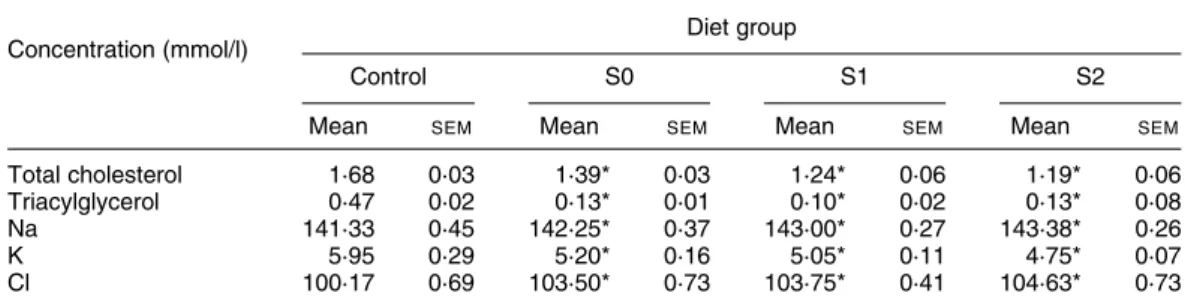
No significant differences were found in blood lipids or elec-trolyte analyses among the SHR groups (Table 3). In the blood analysis, both total cholesterol and triacylglycerols in the three SHR groups were lower than the control group. Plasma Na and Cl levels of the SHR were higher than those of the control group, while the K level was lower.
Blood pressure
In measurement of blood pressure, the SBP and mean blood pressure of the S2 group were lower than those of the S0 group from the second week, whereas those of the S1 group were lower than those of the S0 group from
Table 1. Composition of the experimental diets (g/kg)
Ingredient* Diet group
Control S0 S1 S2
Maize starch 520 520 520 520
Casein 200 200 195 190
Soyabean protein hydrolysate 0 0 5 10
Sucrose 70 70 70 70 Soyabean oil 60 60 60 60 Cellulose 60 60 60 60 Mineral mixture 60 60 60 60 Vitamin mixture 20 20 20 20 NaCl 10 10 10 10
* Casein (high-N), sucrose (food-grade), soyabean oil, cellulose (non-nutritive bulk), mineral mixture (AIN-93M mineral mixture), and vitamin mixture (AIN-93M vitamin mixture) were obtained from ICN Biochemicals (Aurora, OH, USA). Maize starch was purchased from Samyang Genex (Seoul, Korea). NaCl was obtained from Nacalai Tesque (Kyoto, Japan).
week 4 (Fig. 1 (a) and (b)). SBP in the S0, S1, and S2 groups showed no significant changes after the sixth week. This showed that the addition of a soyabean protein supplement in the diet significantly retarded the develop-ment of hypertension. However, there were no differences between the SBP and mean blood pressure of the S1 and S2 groups. At the end of the experiment, only the S0 group had higher blood pressure than the control group.
Angiotensin-converting enzyme activities
In the analysis of plasma ACE activity, the control group had the highest value among all groups at the end of the study, and those of the S1 and S2 groups were significantly lower than those of the S0 group (P, 0·05; Fig. 2). ACE activities of tissue enzyme extracts are shown in Fig. 3; ACE activities of the aorta, heart, and lung in WKY rats were lower than those in SHR (P, 0·05), and there were no significant differences in kidney ACE activities (P. 0·05). Only heart ACE activity in SHR fed SPH was lower than that of the S0 group (P, 0·05).
Pathological analysis
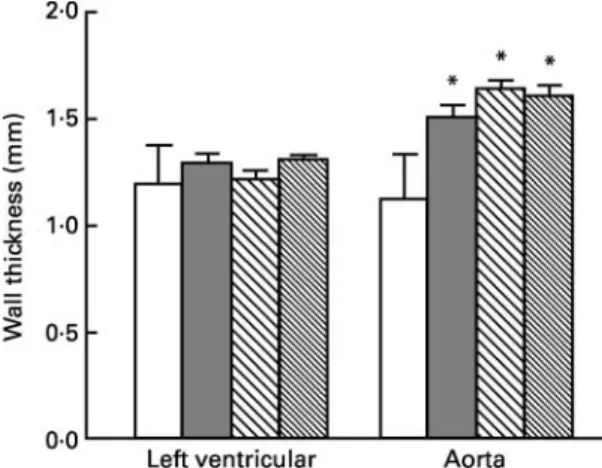
At the end of the study, there was a significant difference in aorta wall thickness between WKY rats and SHR, but there were no significant differences among the three SHR
groups. No significant difference was found in left ventri-cular wall thickness among all groups (P. 0·05; Fig. 4).
Discussion
The SHR and WKY rats fed the same diet showed no differences in food intake, but body weights of the SHR were significantly lower than those of the WKY rats. It has been shown that a lower feeding efficiency in hyper-tensive rats may be caused by excitation of the peripheral sympathetic nervous system (Lamont, 1995; Cabassi et al. 2002). The increasing angiotensin II levels in hypertensive rats might stimulate the sympathetic nervous system and cause a lower feeding efficiency. SHR fed SPH with ACE inhibition potency may have lower plasma and tissue angiotensin II levels and have a lower metabolic rate which resulted in a higher body weight compared with the control group at the end of the present study.
Studies have shown that peptides first digested by pepti-dase in the gastrointestinal tract might be more resistant to the digestive enzymes and can well exert their ACE inhibi-tory activity in vivo. Pepsin is an enzyme responsible for protein digestion in the stomach and its preferred substrate includes peptide bonds adjacent to aromatic amino acids, leucine or methionine. An in vitro study demonstrated that peptides with tryptophan, phenylalanine, proline, or tyrosine residues in the C-terminal and valine or isoleucine
Table 2. Changes in body weight, food intake, and feeding efficiency of rats fed different diets (eight rats per group)‡
(Mean values and standard errors of the mean)
Diet group
Control S0 S1 S2
Mean SEM Mean SEM Mean SEM Mean SEM
Initial body weight (g/rat) 220·9 1·9 210·4 2·8 217·8 2·6 212·8 5·2
Final body weight (g/rat) 458·1 23·0 306·8* 15·3 340·2*† 10·2 355·8*† 7·7
Weight gain (g/rat per d) 2·8 0·3 1·2* 0·2 1·5*† 0·1 1·7*† 0·1
Food intake (g/rat per d) 20·0 0·2 20·0 0·1 19·3 0·3 19·3 0·3
Feeding efficiency§ (%) 14·2 1·4 5·7* 0·8 7·6* 0·6 8·8* 0·3
* Mean value was significantly different from that of the control group at the same time (P, 0·05). † Mean value was significantly different from that of the S0 group at the same time (P, 0·05). ‡ For details of diets, see Table 1 and p. 508.
§ Feeding efficiency ¼ (daily weight gain/daily food intake) £ 100 %.
Table 3. Plasma total cholesterol, plasma triacylglycerol, and electrolytes of rats fed different diets (eight rats per group)†
(Mean values and standard errors of the mean)
Concentration (mmol/l) Diet group
Control S0 S1 S2
Mean SEM Mean SEM Mean SEM Mean SEM
Total cholesterol 1·68 0·03 1·39* 0·03 1·24* 0·06 1·19* 0·06
Triacylglycerol 0·47 0·02 0·13* 0·01 0·10* 0·02 0·13* 0·08
Na 141·33 0·45 142·25* 0·37 143·00* 0·27 143·38* 0·26
K 5·95 0·29 5·20* 0·16 5·05* 0·11 4·75* 0·07
Cl 100·17 0·69 103·50* 0·73 103·75* 0·41 104·63* 0·73
* Mean value was significantly different from that of the control group at the end of the experiment (P, 0·05). † For details of diets, see Table 1 and p. 508.
residues in the N-terminal have higher ACE inhibitory activity (Cheung et al. 1980). In a study performed by Saito et al. (1994), it was found that IYPRY (Ile-Tyr-Pro-Arg-Tyr, a pentapeptide), which is resistant against
pepsin and pancreatin, from sake lee presented ACE inhibi-tory activity in SHR after oral administration. In a previous study, peptides from pepsin-digested soyabean acid-preci-pitated protein decreased the conversion of angiotensin I into angiotensin II in vitro (Chen et al. 2002). In the pre-sent study, blood pressures in both the S1 and S2 groups were lower than those of the S0 group. These results suggest that SPH may lower blood pressure on account of the physiologically functional peptides it contains, and SPH may retard the development of hypertension. On the other hand, the SBP of the S1 and S2 group remained unchanged since the fourth week of the experiment, while the SBP of the S0 group was increasing. Therefore, SPH may help the hypertensive rats to maintain their blood pressure at a lower level when hypertension is established. Although SPH showed its ACE inhibitory activity in a pre-vious study (Chen et al. 2004) and in the present study, it is still not a purified pharmaceutical product but a kind
Fig. 2. Plasma angiotensin-converting enzyme (ACE) activity of rats fed different diets (units/l; eight rats per group). Values are means, with vertical bars representing the standard errors of the mean. (W), Control group; (X), S0 group; (D), S1 group; (O), S2 group. For details of the diets, see Table 1 and p. 508. * Mean value was significantly different from that of the control group at the same week (P, 0·05). † Mean value was significantly different from that of the S0 group at the same week (P, 0·05).
Fig. 3. Tissue angiotensin-converting enzyme (ACE) activity in rats fed different diets (eight rats per group). Values are means, with vertical bars representing the standard errors of the mean. (A), Control group; (B), S0 group; (D), S1 group; (o), S2 group. For details of the diets, see Table 1 and p. 508. * Mean value was significantly different from that of the control group at the end of the experiment (P, 0·05). † Mean value was significantly different from that of the S0 group at the end of the experiment (P,0·05).
Fig. 4. Left ventricular and aorta wall thickness of rats fed different diets (eight rats per group). Values are means, with vertical bars representing the standard errors of the mean. (A), Control group; (B), S0 group; (D), S1 group; (o), S2 group. For details of the diets, see Table 1 and p. 508. * Mean value was significantly differ-ent from that of the control group at the end of the experimdiffer-ent (P, 0·05).
Fig. 1. Systolic blood pressure (a) and mean blood pressure (b) of spontaneously hypertensive rats and Wistar– Kyoto rats fed different diets (eight rats per group). Each point represents the mean change in systolic or mean blood pressure, with vertical bars representing the standard errors of the mean. (W), Control group; (X), S0 group; (D), S1 group; (O), S2 group. For details of the diets, see Table 1 and p. 508. * Mean value was significantly different from that of the control group at the same week (P, 0·05). † Mean value was signifi-cantly different from that of the S0 group at the same week (P, 0·05).
of food. The difference between 0·5 % and 1 % in the diet may be too little to show a dose-dependent response.
The relationship between dietary protein hydrolysate and blood pressure has been discussed in many previous reports. Feeding SHR a diet containing 30 % casein hydrolysate caused a decrease in blood pressure after 2 weeks (Karaki et al. 1990). Another study gave SHR peptides extracted from dried-salted fish, and a significant decrease in the SBP was found after 16 d (Astawan et al. 1995). In a long-term study in rats fed a diet with 2·5 % sour milk, a significant decrease in blood pressure was found after 14 weeks (Naka-mura et al. 1996). In the present study, SHR fed a diet con-taining only 0·5 % SPH showed retarded development of hypertension after 12 weeks of oral administration, which suggests that SPH may have a greater anti-hypertensive potency than other dietary protein hydrolysates.
Peripheral renin – angiotensin system (RAS) activity has been found to be related to long-term blood pressure management, especially its effects on cardiovascular re-modelling (Mancia et al. 2002). Previous reports showed that rats fed a high-Na diet could activate peripheral RAS and develop left ventricular and aorta hypertrophy more easily (Takeda et al. 2001). In all SHR groups, tissue ACE activity was highest in the aorta, but significant differences between rats fed with or without SPH were only found in the heart. This suggests that peptides with ACE inhibition potency in SPH may have different affi-nities for tissues. A study on sour milk with two anti-hyper-tensive tripeptides, Val-Pro-Pro and Ile-Pro-Pro, showed an ACE inhibitory effect mainly in the aorta (Masuda et al. 1996). On the other hand, SHR orally administered capto-pril not only showed an ACE inhibitory effect mainly in the aorta but also elevated plasma ACE activity (Wu & Ding, 2001). The present results which are in contrast to expectations may have been caused by site-specific regu-lation of tissue RAS to the cardiovascular system (Katoh et al. 2000). However, in the study of Martin et al. (2002) it was concluded that the soyabean protein may not exert its anti-hypertensive effect by ACE inhibition. The inconsistency may be caused by the model animals being at different stages of hypertension and by the differ-ence between soyabean protein and SPH. Moreover, studies have shown that hypertensive rats may activate the local RAS without affecting the systemic RAS during the feeding of a high-Na diet (Takeda et al. 2001). There-fore, ACE inhibitors may produce their anti-hypertensive effects via different mechanisms, and further investigations need to be conducted on the mechanism of SPH’s actions on tissue RAS.
In the present study, SPH had no effect on blood lipids or electrolytes. Although there is a report showing that cap-topril may elevate the blood Na level, the IC50of the drug
was much lower than the SPH used in the present study. Soya isoflavones have been reported to be a phyto-oestro-gen, and genistein with natriuretic properties in rats may reduce hypertension by inhibiting Na – K – Cl co-transpor-ters (Martinez et al. 1998). However, SPH in the present study was prepared by acid precipitation and peptic hydrolysis of soyabean protein, and no effect of plasma electrolyte concentrations was found. This suggests that the anti-hypertensive effect of SPH in the present study
might not have been caused by isoflavones. Soyabean protein and soya isoflavones have been shown to have hypolipidaemic effects (Pelsuo et al. 2000), and the lower-ing of body weight and blood lipids may cause a decrease in blood pressure (Ferrier et al. 2002). However, we found that SPH had no significant effects on SHR lipid metab-olism. This may have been because (1) the SPH used in the hypolipidaemic research before was the high-molecu-lar-weight and undigested fractions (Wang et al. 1995), and (2) the hypolipidaemic effects of isoflavones are usually shown in post-menopausal women (Demonty et al. 2003). Therefore, the blood pressure-lowering effects of SPH in the present study may not be related to the effect on lipid metabolism.
In conclusion, SPH can lower blood pressure in hyper-tensive model animals. One of the important factors may be the decrease of ACE activity in vivo, mainly in the plasma and heart. Further studies are still required on the mechanisms of how soyabean protein affects blood pressure, and the results of those studies may be used in dietary management to prevent the development of hypertension.
References
Astawan M, Wahyuni M, Yasuhara T, Yamada K, Tadokoro T & Maekawa A (1995) Effects of angiotensin I-converting enzyme inhibitory substances derived from Indonesian dried-salted fish on blood pressure of rats. Biosci Biotechnol Biochem 59, 425 – 429.
Cabassi A, Vinci S, Cantoni AM, Quartieri F, Moschini L, Cavazzini S, Cavatorta A & Borghetti A (2002) Sympathetic activation in adipose tissue and skeletal muscle of hypertensive rats. Hypertension 39, 656 – 661.
Chen JR, Okada T, Muramoto K, Suetsuna K & Yang SC (2002) Identification of angiotensin I-converting enzyme inhibitory peptides derived from the peptic digest of soybean protein. J Food Biochem 26, 543 – 544.
Chen JR, Yang SC, Suetsuna K & Chao CJ (2004) Soybean protein-derived hydrolysate affects blood pressure in spon-taneously hypertensive rats. J Food Biochem 28, 61 – 73. Cheung HS, Wang FL, Ondetti MA, Sabo EF & Cushman DW
(1980) Binding of peptide substrates and inhibitors of angioten-sin-converting enzyme. J Biol Chem 255, 401 – 407.
Cleland JGF (editor) (1993) The Clinicians Guide to ACE Inhibition, pp. 37 – 75. New York: Churchill Livingstone Inc. Das M & Soffers RS (1975) Pulmonary angiotensin-converting
enzyme. J Biol Chem 250, 6762 – 6768.
Demonty I, Lamarche B & Jones PJ (2003) Role of isoflavones in the hypocholesterolemic effect of soy. Nutr Rev 61, 189 – 203. Ferrier KE, Muhlmann MH, Baguet JP, Cameron JD, Jennings GL, Dart AM & Kingwell BA (2002) Intensive cholesterol reduction lowers blood pressure and large artery stiffness in isolated systolic hypertension. J Am Coll Card 39, 1020 – 1025.
Kagan A, Harris BR, Winkelstein W, et al. (1974) Epidemiologic studies of coronary heart disease and stroke in Japanese men living in Japan, Hawaii and California: demographic, physical, dietary and biochemical characteristics. J Chronic Dis 27, 345 – 364.
Karaki H, Doi K, Sugano S, Uchiwa H, Sugai R, Murakami U & Takemoto S (1990) Antihypertensive effect of tryptic hydrolysate of milk casein in spontaneously hypertensive rats. Comp Biochem Physiol 96, 367 – 371.
Katoh M, Ohmachi Y, Kurosawa Y, Yoneda H, Tanaka N & Narita H (2000) Effects of imidapril and captopril on streptozo-tocin-induced diabetic nephropathy in mice. Eur J Pharmacol 398, 381 – 387.
Kawasaki T, Seki E, Osajima K, Yoshida M, Asada K, Matsui T & Osajima Y (2000) Antihypertenisve effect of valyl-tyrosine, a short chain peptide derived from sardine muscle hydrolysate, on mild hypertensive subjects. J Hum Hypertens 14, 519 – 523. Lamont LS (1995) Beta-blockers and their effects on protein metabolism and resting energy expenditure. J Cardiopulm Rehabil 15, 183 – 185.
Lowry OH, Rosebrough NJ, Farr AL & Randall RJ (1951) Protein measurement with the Folin phenol reagent. J Biol Chem 193, 265 – 275.
Mancia G, Carugo S, Grassi G, Lanzarotti A, Schiavina R, Cesana G & Sega R (2002) Prevalence of left ventricular hypertrophy in hypertensive patients without and with blood pressure control. Hypertension 39, 744 – 749.
Martin DS, Breitkopf NP, Eyster KM & Williams JL (2001) Dietary soy exerts an antihypertensive effect in spontaneously hypertensive female rats. Am J Physiol 281, R553 – R560. Martin DS, Williams J, Breitkopf NP & Eyster KM (2002)
Pressor responsiveness to angiotensin in soy-fed spontaneously hypertensive rats. Can J Physiol Pharmacol 80, 1180 – 1186. Martinez RM, Gimenez I, Lou JM, Mayoral JA & Alda JO (1998)
Soy isoflavonoids exhibit in vitro biological activities of loop diuretics. Am J Clin Nutr 68, 1354S – 1357S.
Masuda O, Nakamura Y & Takano T (1996) Antihypertenisve peptides are present in aorta after oral administration of sour milk containing these peptides to spontaneously hypertensive rats. J Nutr 126, 3063 – 3068.
Matsui T, Li CH, Tanaka T, Maki T, Osajima Y & Matsumoto K (2000) Depressor effect of wheat germ hydrolysate and its novel angiotensin I-converting enzyme inhibitory peptide, Ile-Val-Tyr, and the metabolism in rat and human plasma. Biol Pharm Bull 23, 427 – 431.
Miura K, Daviglus ML, Dyer AR, Liu K, Garside DB, Stamler J & Greenland P (2001) Relationship of blood pressure to 25-year mortality due to coronary heart disease, cardiovascular diseases, and all causes in young adult men: the Chicago Heart Association Detection Project in Industry. Arch Intern Med 161, 1501 – 1508.
Miyoshi S, Ishikawa H, Kaneko T, Fukui F, Tanaka H & Maruyama S (1991) Structures and activity of angiotensin-I-converting
enzyme inhibitors in an a-zein hydrolysate. Agric Biol Chem 55, 1313 – 1318.
Nakamura Y, Masuda O & Takano T (1996) Decrease of tissue angiotensin I-converting enzyme activity upon feeding sour milk in spontaneously hypertensive rats. Biosci Biotechnol Bio-chem 60, 488 – 489.
Nevala R, Vaskonen T, Vehnia¨inen J, Korpela R & Vapaatalo H (2000) Soy based diet attenuates the development of hyperten-sion when compared to casein based diet in spontaneously hypertensive rat. Life Sci 66, 115 – 124.
Pelsuo MR, Winters TA, Shanahan MF & Banz WJ (2000) A cooperative interaction between soy protein and its isofla-vone-enriched fraction lowers hepatic lipid in male obese Zucker rats and reduces blood platelet sensitivity in male Spra-gue-Dawley rats. J Nutr 130, 2333 – 2342.
Saito Y, Wanezaki K, Kawato A & Imayasu S (1994) Structure and activity of angiotensin I converting enzyme inhibitory pep-tides from sake and sake lees. Biosci Biotechnol Biochem 58, 1767 – 1771.
Takeda Y, Yoneda T, Demura M, Furukawa K, Miyamori I & Mabuchi H (2001) Effects of high sodium intake on cardiovas-cular aldosterone synthesis in stroke-prone spontaneously hypertensive rats. J Hypertens 19, 635 – 639.
Wang MF, Yamamoto S, Chung HM, Chung SY, Miyatani S, Mori M, Okita T & Sugano M (1995) Antihypercholesterole-mic effect of undigested fraction of soybean protein in young female volunteers. J Nutr Sci Vitaminol 41, 187 – 195. Wu J & Ding X (2001) Hypotensive and physiological effect of
angiotensin converting enzyme inhibitory peptides derived from soybean protein on spontaneously hypertensive rats. J Agric Food Chem 49, 501 – 506.
Yamamoto N (1997) Antihypertensive peptide derived from food proteins. Biopolymers 43, 129 – 134.
Yamamoto S, Toida I & Iwai K (1980) Re-examination of spectro-photometric assay for serum angiotensin-converting enzyme (in Japanese). Nihon Kyobu Shikkan Gakkai Zasshi 18, 297 – 301. Yokoyama K, Chiba H & Yoshikawa M (1992) Peptide inhibitors
for angiotensin I-converting enzyme from thermolysin digest of dried bonito. Biosci Biotechnol Biochem 56, 1541 – 1545. Yusuf S, Sleight P, Pogue J, Bosch J, Davies R & Dagenais G
(2000) Effects of an angiotensin-converting-enzyme inhibitor, ramipril, on cardiovascular events in high-risk patients. The Heart Outcomes Prevention Evaluation Study Investigators. N Eng J Med 342, 145 – 153.