行政院國家科學委員會補助專題研究計畫-期中報告
(超高能宇宙射線及其對應微中子之關聯性研究)
計畫類別:整合型計畫
計畫編號:96-2112-M-009-023-MY3
執行期間:96 年 8 月 1 日至 97 年 7 月 31 日
計畫主持人:林貴林
共同主持人:
計畫參與人員:賴光昶、張鳳吟、劉宗哲、張研瑜、盧佳均
成果報告類型(依經費核定清單規定繳交):精簡報告
本成果報告包括以下應繳交之附件:
赴國外出差或研習心得報告一份
處理方式:除產學合作研究計畫、提升產業技術及人才培育研究
計畫、列管計畫及下列情形者外,得立即公開查詢
□涉及專利或其他智慧財產權,□一年□二年後可公
開查詢
執行單位:國立交通大學物理研究所
中
華
民
國
97 年
5 月 28 日
中文摘要 PierreAuger 宣稱極高能宇宙射線源與活躍星系核之間有高度統計關聯,我們試 圖檢驗此宣稱與極高能宇宙射線能譜是否存在矛盾。我們發現 PierreAuger 的能 量標定為最重要決定因素。目前我們的研究重點為宇宙線化學成份及其導致的微 中子流量 English Abstract
We have examined the consistency between the measured spectra of ultrahigh energy cosmic rays (UHECR) and the correlation of UHECR to the nearby Active Galactic Nuclei (AGN) claimed by the recent paper of Pierre Auger collaboration.
We pointed out that the energy calibration of Auger data plays an important role for the above consistency to hold. We are currently studying the composition of UHECR and its consequence to the cosmogenic neutrino flux. .
一、 前言
This is a mid-term report for a three-year project on the correlation research of ultra-high energy cosmic ray and corresponding neutrino. In Section II, we state the motivation for such an investigation. In Section III, we discuss existing works on this subject and our approach to the problem. In Section IV, we outline our research method. Our result and its implication are given in Section V.
二、研究目的
The origin of ultra high energy cosmic rays (UHECR) is a long-standing mystery in astrophysics. Active galactic nuclei (AGN) are one of the suggested sources. Recently, Pierre Auger observatory published results on correlation of the
highest-energy cosmic rays with the positions of nearby active galactic nuclei (AGN) [1, 2]. In the Auger result, the correlation is maximal for the threshold energy of cosmic rays at 5.7 × 10¹⁹eV, the maximal distance of AGN at 71 Mpc and the maximal angular separation ofcosmicray eventsatψ = 3.2◦. With continuous energy loss approximation, the GZK horizon for protons with Eth= 57 EeV is about 200 Mpc by assuming a uniformly distributed UHECR sources with identical cosmic ray luminosity and spectral index [3]. The departure of theoretically calculated GZK horizon to the maximum valid distance of the V-C catalog [4] employed in Pierre Auger’sanalysis,which isaround 100 Mpc,canbe attributed to several factors. As mentioned in [2], such a deviation may arise from non-uniformities of spatial distribution, intrinsic luminosity and spectral index of local AGN. In addition, the energy calibration also plays a crucial role since the GZK horizon is highly sensitive to the threshold energy Eth. Our work focuses on examining the consistency of Auger’s analysis and solutions to this departure.
三、文獻探討
GZK horizon of a uniform UHECR source distribution with identical cosmic ray luminosity and spectral index was calculated in [3]. The calculations based upon kinetic equation approach or stochastic energy loss also reach to similar conclusions [5, 6]. These calculations gave a GZK horizon of about 200 Mpc at Eth= 57 EeV. Here we try to introduce a local over density of UHECR sources and proposed energy calibration to resolve the deviation between GZK horizon and the valid distance of V-C catalog.
四、研究方法
We first consider the local over-density of UHECR sources as a possible resolution to the above discrepancy. It is motivated by the existence of Local
Supercluster (LS) which has a diameter of the order 60 Mpc. In LS, the over-density of galaxies has been estimated to be ~ 2 . The local over-density of UHECR sources has been invoked to account for AGASA data. Such a density distribution naturally leads to a smaller GZK horizon. However, it also significantly affects the UHECR energy spectrum in (5 · 1019− 1020) eV region. Hence fittings to the measured UHECR spectrum can provide information on the degree of local over-density. Subsequently, the magnitude of GZK horizon can be better estimated. We next study the energy calibration effect on the estimation of GZK horizon and the spectrum of UHECR.Certainly a20% − 30% upward shifton UHECR energiesreducesthe departure of theoretically calculated GZK horizon to the maximum valid distance of V-C catalog [2].
WefittheUHECR spectrum foreventswith energies above 1019
eV. This is the energy range where the GZK attenuation exhibits its effect. It is also the energy range where the local over-density ofUHECR sourcesshowssignificanteffects. In our analysis, we take the UHECR as protons, which is hinted in the Auger events with energies≥ 57 EeV althoughthe composition study by the same group suggests a heaviercomposition forE ≤ 40 EeV[7]. The HiRes experiment measures the composition up to 50 EeV [8] and obtains a composition lighter than that of Auger. For E > 50 EeV, the event number is still too small for the composition study. To fit the UHECR spectrum at the highest energy, it is more appropriate to treat the cosmic ray energy loss as a stochastic process. There are numerical packages available for treating stochastic energy loss of cosmic ray particles [9, 10]. We employ the latter package for our calculations. Although UHECR loses its energy mostly by scattering offCMB photons, it also loses some amount of energy by scattering offinfrared background photons. Thus we include the infrared photon contribution to the UHECR
energy attenuation. Source evolution n(z) = n0(1 + z)3 is adopted in the calculation of GZK horizon and spectrum, where n0is the source number density at the present epoch. It is from the generally-accepted soft evolution model which traces the star formation history and has been adopted in previous works.
五、結果與討論
GZK horizons corresponding to different local over-densities and Ethare
summarized inTable I. It is seen that local over-densities up to n(l < 30Mpc)/n0= 4 do not alter GZK horizonssignificantly foragiven Eth. One could consider possibilities for higher local over-densities. However, there are no evidences for such
over-densities either from astronomical observations orfrom fittingsto the measured UHECR spectrum. We note that GZK horizons are rather sensitive to Eth. Table I shows that GZK horizons are ~100 Mpc or lessforEth ≥ 80 EeV.
TABLE I: GZK horizons of UHECR calculated with the local over-density n(l< 30Mpc)/n0=1, 2, 4,
and 10, and arrival threshold energy Eth= 57 EeV, 70 EeV, 80 EeV and 90 EeV respectively. The
listed numbers are in units of Mpc.
Table II and figure1 showsourfittingsto theAuger measured UHECR spectrum with γ= 2.5 and 2.6 respectively.Wenotethat,forboth γ= 2.5 and γ= 2.6,theGZK horizon with n(l < 30Mpc)/n0= 10, Eth= 57 EeV, m = 3 and Ecut= 1000 EeV is about 155 Mpc. Since n(l < 30Mpc)/n0= 10 isclearly disfavored by thespectrum fitting, oneexpectsaGZK horizon significantly largerthan 155 Mpc for Eth = 57 EeV.
TABLE II:Thevaluesoftotalχ2from fittingsto theAugermeasured UHECR spectrum.
Numbers in the parenthesisareχ2valuesfrom fittingsto the8 data pointsin theenergy range 19.05 ≤log10(E/eV)≤ 19.75.Thelast4 data pointsrecord eventswith energy greaterthan 71 EeV.
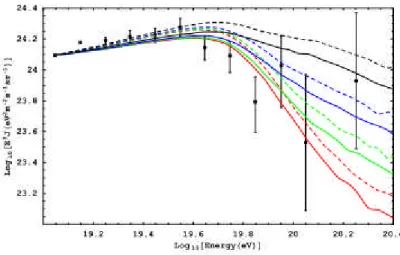
FIG. 1: Fittings to the Auger measured UHECR spectrum where the red, green, blue and black curves denote the model with the local over-density n(l < 30Mpc)/n0= 1, 2, 4, and 10 respectively.
Solid curvescorrespond to γ = 2.6 whiledash curvescorrespond to γ = 2.5.Wetakethesource evolution parameter m = 3 throughout the calculations.
Wenextperform fittingsto theshifted Augerspectrum.Theresultsareshown in Table III and Fig. 2 where the cosmic ray energy is shifted upward by 30%. We note that, with a 30% upward shift of energies, the cosmic ray events analyzed in Auger’s correlation study would have energies higher than 74 EeV instead of 57 EeV. The GZK horizon corresponding to Eth= 74 EeV is 120 Mpc for n(l < 30Mpc)/n0= 2 and 105 Mpc for n(l < 30Mpc)/n0= 4. Thesmallestχ2valueoccursapproximately atγ= 2.4, n(l < 30Mpc)/n0= 2 withχ2/d.o.f = 0.82. Itisseen thatχ2values from current fittingsareconsiderably smallerthanthosefrom fittings to the unshifted spectrum and the best fit imply a possibility for the local over-density of UHECR sources.
TABLE III:Thetotalχ2valuesfrom fittingsto theAugermeasured UHECR spectrum with a 30% upward shifton UHECR energies.Numbersin theparenthesisareχ2valuesfrom fittingsto
the8 data pointsin theenergy range 19.16 ≤ log10(E/eV)≤ 19.86.Thelast4 data points record events with energy greater than 92 EeV.
FIG. 2: Fittings to the Auger measured UHECR spectrum with a 30% upward shift on UHECR energies where the red, green, blue and black curves denote the model with the local over-density n(l < 30Mpc)/n0= 1, 2, 4, and 10 respectively. Solid curvescorrespond to γ = 2.4 whiledash
curvescorrespond to γ = 2.5.We take the source evolution parameter m = 3 throughout the calculations.
We conclude that degrees of local over density constrained by the spectrum can not resolve the deviation between the GZK horizon and the maximum valid distance of V-C catalog. Suitably adjusting the energies of UHECR events can resolve the above deviation, and fittings to the shifted spectrum imply n/n0=(2~4). It is testable in the future cosmic ray astronomy where directions and distances of UHECR sources can be determined.
六、計畫成果自評
We have achieved the goal of the project. A paper is posted in the archive and submitted to Astroparticle Physics [11]. These results were presented in the
international conference, XXth RENCONTRES DE BLOIS-- Challenges in Particle Astrophysics(http://blois.in2p3.fr/2008/), and will be published in the coming proceeding.
參考文獻
[1] J. Abraham et al. [Pierre Auger Collaboration], Science 318 (2007) 939 [arXiv:0711.2256[astro-ph]].
[2] J. Abraham et al. [Pierre Auger Collaboration], Astropart. Phys. 29 (2008) 188 [arXiv:0712.2843 [astro-ph]].
[3] D. Harari, S. Mollerach and E. Roulet, JCAP 0611 (2006) 012 [arXiv:astro-ph/0609294].
[4] M.-P. V´eron-Cetty and P. V´eron, Astron. & Astrophys. 455 (2006) 773. [5] O. E. Kalashev, B. A. Khrenov, P. Klimov, S. Sharakin and S. V. Troitsky,
arXiv:0710.1382 [astro-ph].
[6] M. Kachelriess, E. Parizot and D. V. Semikoz, arXiv:0711.3635 [astro-ph]. [7] M. Unger [The Pierre Auger Collaboration], arXiv:0706.1495 [astro-ph]. [8] Y. Fedorova et al. [HiRes Collaboration], Proc. 30th ICRC, M´erida, Mexico
(2007) p. 1236.
[9] A. Mucke, R. Engel, J. P. Rachen, R. J. Protheroe and T. Stanev, Comput. Phys. Commun. 124 (2000) 290 [arXiv:astro-ph/9903478].
[10] E. Armengaud, G. Sigl, T. Beau and F. Miniati, Astropart. Phys. 28 (2007) 463 [arXiv:astro-ph/0603675].
[11] C. C. Lu and G. L. Lin, [arXiv:0804.3122 [astro-ph]].
Travel Report Feng-Yin Chang December 27, 2007
The trip to Kavli Institute for Particle Astrophysics and Cosmology (KIPAC) from Oct.16th to Dec.14 is for working with Dr. Pisin Chen on the extending
study of plasma wakefield induced by the magnetowave oblique to the external magnetic field and astrophysical applications of snow plow acceleration mechanism. Both theoretical and simulation works were done for the study. During
my staying, Dr. Robert Noble at Stanford Linear Accelerator Center(SLAC) also joined us and was interested in exciting magneto-shocks in plasma by particle in cell simulation. We weekly had a regular meeting on Friday discussing our progress on each work.
I used an one-dimensional particle-in-cell code written by R.Sydora to see the behavior of the magnetowave across the magnetic field. Several cases with different angles between the propagation and magnetic field were studied. The simulation results shows the absence of wakefield when the angle is over some threshold. The driving wave in plasma will have electromagnetic field parallel to
the propagating direction, making the longitudinal electric field an extra component. We thought that may also give a chance to in phase accelerate particles.
Since the Auger Observatory published their newest results on the ultra high cosmic ray origins correlated to AGNs, I also spent some efforts reading AGNs literature to get some ideas of AGN properties and show the application of our acceleration mechanism.
application of snow plow acceleration in plasma, which took place when the driving pulse is very intensive. I've done a simple theoretical derivation using ponderomotive force and phase slippage concept. Some interesting issues are yet to be addressed and many simulation studies are to be worked out.
It is excellent to work at KIPAC and have many discussions with many outstanding physicists there.