Sum-frequency generation from an isotropic
chiral medium
Pao-Keng Yang and Jung Y. Huang
Institute of Electro-Optical Engineering, Chiao Tung University, Hsinchu, Taiwan, Republic of China Received October 31, 1997; revised manuscript received March 6, 1998
We report a theoretical analysis of nonlinear optical sum-frequency generation from the bulk of a chiral liquid in the dipole approximation. In our theoretical formulation the circular birefringence effect of a chiral me-dium was properly taken into account. The angular dependence of the reflected and transmitted sum-frequency signals on the incident angles of two input beams was calculated to yield the optimal geometry for probing bulk chirality. We also derived a microscopic expression for the totally antisymmetric part of a second-order nonlinear optical susceptibility to elaborate unique features in the studies of chirality-related properties with sum-frequency generation. © 1998 Optical Society of America [S0740-3224(98)01706-8]
OCIS codes: 190.4720, 190.2620, 260.1440.
1. INTRODUCTION
Molecules that cannot be superimposed with their mirror images are called chiral molecules. Two possible configu-rations, of l and d forms (l is levrotatory and d is dex-trorotatory), exist for each molecule. Many biologically and pharmaceutically important molecules have chiral structures. It is interesting to know that, in a typical pharmaceutical process, only one enantiomer will assist the treatment of diseases while the other may lead to counterproductive effects. Chiral segments in a biologi-cally active molecule also play an important role in deter-mining the molecular folding structure. The existence of a chiral purity1in living systems remains a major
mys-tery in life science. Inasmuch as optical probes can be applied to any medium that is accessible to light, the de-velopment of new optical techniques for investigating chirality-related structures and properties becomes highly desirable. Such techniques will also improve our understanding of many interesting phenomena ranging from a living system to an artificial device made with ferroelectric liquid-crystal materials.2
In linear optics, optical rotatory dispersion (ORD) and circular dichroism (CD) are popular markers for probing molecular chirality. The former is based on the differ-ence in the index of refraction between left-hand circu-larly polarized (LHCP) and right-hand circucircu-larly polar-ized (RHCP) light, whereas the CD technique measures the difference in absorption coefficients between the two kinds of circularly polarized light. These linear optical effects originate from coupling between the magnetic and the electric transition dipole moments in a molecule3; therefore the resulting signals are usually weak, with a typical response (D«/«) of 0.1% in a CD measurement.4 Recently Hicks and co-workers4–8 successfully extended ORD and CD to surface second-harmonic generation (SHG). The resultant SHG-CD and SHG-ORD tech-niques, which originate from electric-dipole effects, pro-duce a stronger signal than those from chirality-inpro-duced
linear optical effects. The normalized difference of the detected SHG intensity with LHCP and with RHCP light was found to be as large as 0.25. Their results also showed that the SHG-CD signal can be deduced from two separately measured SHG spectra with LHCP and RHCP light. Other experiments,9,10 which measured the SHG intensity difference between two kinds of linearly polar-ized light, yielded a similar sensitivity to molecular chirality. Owing its high sensitivity and surface specific-ity, SHG has been considered to be superior to the linear optical techniques for probing the surface chirality in various materials.
Sum-frequency generation (SFG),11–13which is also a second-order nonlinear optical process, has been demon-strated to be a useful tool for studying surface and inter-facial phenomena with molecular specificity. The sum-frequency signal from an isotropic medium vanishes under the dipole approximation. However, a nonlinear polarization from the electric-dipole transitions can readily be produced inside an isotropic chiral medium, which makes SFG sensitive to bulk chirality.
SFG can be properly described in terms of second-order nonlinear optical susceptibility xijk(2). The totally anti-symmetric part (A)x
ijk
(2) of the third-rank tensorx
ijk (2)is de-fined by ~A!x ijk ~2!5x a ~2!« ijk, (1)
where xa(2)[ @«ijkxijk
(2)#/6, where «
ijk is the Levi-Civita
symbol. Owing to the pseudotensor nature of«ijk,14xa
(2)
becomes a pseudoscalar that is invariant under rotational transformation but changes sign under mirror reflection. Therefore, in a chiral liquid in which no mirror symmetry exists, the pseudoscalar does not vanish. The theory of SFG from a chiral liquid was described by Giordmaine in 1965.15 The experimental demonstration was later per-formed by frequency mixing the fundamental beam from a ruby laser at 694.3 nm with its second harmonic in a
solution of arabinose.16 The study showed that a trans-mitted sum-frequency signal generated from a suscepti-bility pseudoscalar does not vanish only when the nonlin-ear optical process involved is nondegenerate (v1Þv2),
near resonance, and in a noncollinear beam geometry. A totally antisymmetric tensor changes sign by ex-changing any two indices. For the SHG process (v1
5 v2) the nonlinear susceptibility is zero because the
last two indices of this third-rank tensor commute. Note that Kleinman symmetry17 must be violated to yield a
nonvanishing totally antisymmetric susceptibility, which explains why chirality-induced SFG processes occur only near resonance. In a collinear geometry the induced nonlinear polarization is nearly parallel to the direction of the transmitted sum-frequency beam. An oscillating di-pole does not radiate along the didi-pole direction, so the SFG signal will vanish in a collinear beam configuration. When an incident beam is refracted into a chiral me-dium, it splits into two parts with different refractive angles and polarizations. One beam is LHCP and the other is RHCP. This effect is called circular birefrin-gence and can lead to energy coupling between s- and p-polarized waves. Therefore the nonlinear reflection and transmission for s- and p-polarized waves in a chiral medium cannot be solved separately. Some researchers have studied SFG reflection from a chiral medium by ig-noring the circular birefringence effect.18,19 In this paper we include circular birefringence in our formalism to yield a more-accurate description. As far as SFG-CD and SFG-ORD are concerned, it is also important to estimate the nonlinear optical response from the bulk of a chiral medium. Our theoretical formalism enables us to design an optimum experimental geometry for SFG-CD and SFG-ORD. Our results also show that the surface sum-frequency signal can be distinguished from that from bulk with an appropriate polarization combination of the input and output beams.
This paper is organized as follows: Section 2 outlines the calculation procedure for the reflected and the trans-mitted sum-frequency signals from a chiral liquid. The chirality-induced nonlinear polarizations are then de-scribed. We then derive a microscopic expression for the totally antisymmetric part of a second-order nonlinear op-tical susceptibility. Some numerical results and discus-sion are presented in Section 3. Finally, some conclu-sions are drawn in Section 4.
2. BASIC THEORY
A. Solutions of Nonlinear Reflection and Transmission In the following discussion, LHCP light will be indicated by1 and RHCP by 2 in the subscript of a vector. The polarization basis vectors for the LHCP and RHCP waves are eˆ65 (1 /
A
2)(sˆ6 ipˆ), where sˆ 5 yˆ and pˆ 5 kˆ 3 sˆ and kˆ is the unit vector of the wave vector depicted in Fig. 1. For SFG with noncollinear geometry (see Fig. 2), two beams, of frequencies v1 and v2, are incident upon asemi-infinite chiral medium at incident angles ofu1iand
u2i. After refraction, each beam splits into two
circu-larly polarized waves with different angles of refraction. Four possible combinations of the wave vectors can be chosen to generate the nonlinear polarization; they are
ks,15 k1t11 k2t1,
ks,25 k1t11 k2t2,
ks,35 k1t21 k2t1,
ks,45 k1t21 k2t2. (2)
The total nonlinear polarization can be expressed as P~2!~v35v11 v2! 5
(
j51 4 Pj~2!5(
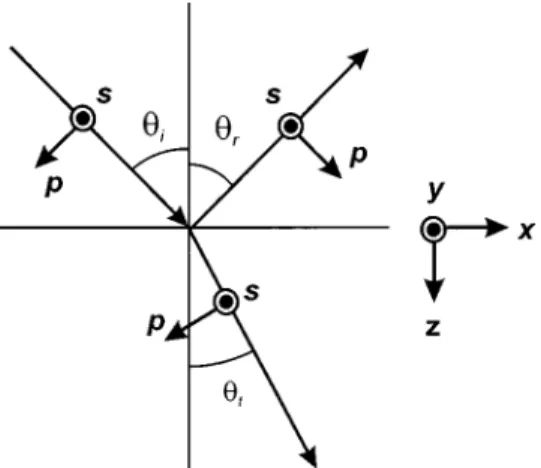
j51 4 pj~2! exp@i~ks, j • r 2 v3t!#. (3)Note that angles of reflection and refraction for each beam can be determined from the nonlinear Snell’s law: Fig. 1. Schematic showing the s- and p-polarized directions and the propagation directions of the incident, refracted, and re-flected waves.
Fig. 2. Vector diagram showing the relative orientations of the wave vectors for the incident, reflected, and refracted waves and the nonlinear polarization source. The splitting of the refracted wave vector by circular birefringence is neglected.
k1isinu1i1 k2isinu2i5 k3r sinu3r5 k3t1sinu3t1
5 k3t2sinu3t25 ks, j sinus, j
5 k1t6sinu1t61 k2t6sinu2t6
5 k1t6sinu1t61 k2t7sinu2t7.
(4) Chirality is introduced into our theory through the consti-tutive relations20
D5 «E 1 ijcB,
H5 B/m 1 ijcE, (5)
where «, m, and jc are, respectively, the dielectric
con-stant, permeability, and chirality admittance of the chiral medium. By substituting the constitutive relations into the Maxwell equations we obtain the following two equa-tions: ¹ • @E~v3! 1 4pP~1!1 4pPj,~2!i# 5 0 (6) ¹ 3 ¹ 3 E~v3! 2 2v3mjc~v3!¹ 3 E~v3! 2v3 2m«E~v 3! 5 4pv3 2 c2 Pj,~2!6, (7)
where Pj,(2)i indicates the component of Pj(2) along ks, j;
Pj,(2)1and Pj,(2)2represent the projections of Pj(2) onto the
RHCP and LHCP waves with a wave vector of ks,j.
Equation (6) determines the longitudinal part of the sum-frequency amplitude, and Eq. (7) governs the wave propa-gation of the transverse components with Pj,(2)6as the
driv-ing source. The general solution of Eqs. (6) and (7) can be expressed as a summation of the homogeneous solution and a particular solution. The homogeneous solution can be written as
Eh5 E3t1eˆ3t1exp@i~k3t1 • r 2 v3t!#
1 E3t2eˆ3t2exp@i~k3t2 • r 2 v3t!#. (8)
Here k3t65 k3t(6j¯c1
A
1 1j¯c2) 5 n6(v3/c), with j¯c5 jc(v3)
A
m/«(v3) and k3t 5 (v3/c)A
m«(v3). Note thatn1n25m«(v3). E3t1and E3t2are two constants that
can be determined with the boundary conditions. We can
further decompose the jth nonlinear polarization in terms of the three orthogonal basis vectors, eˆj,1, eˆj,2, and kˆs, j:
Pj~2!5 ~ pj,1eˆj,11 pj,2eˆj,21 pj,ikˆs, j!
3 exp@i~ks, j • r 2 v3t!#, (9)
and then a particular solution is found to be
Epar5
F
4pv32pj,1 c2~ks, j2 2 2j¯cks, jk3t2 k3t2! eˆj,1 1 4pv3 2p j,2 c2~k s, j 2 1 2j¯ cks, jk3t2 k3t2! eˆj,22 4ppj,i «~v3! kˆs, jG
3 exp@i~ks, j • r 2 v3t!#. (10)Equation (10) shows that the transverse and the longitu-dinal fields have different proportional constants with re-spect to the nonlinear polarization. The inclusion of chirality (j¯cÞ 0) also introduces a small difference in the
proportional constants between the two transverse field components. Neglect of the difference in the proportions of the nonlinear optical polarization between the trans-verse and the longitudinal fields had led to inaccurate re-sults in previous publications.18,19
We express the reflected sum-frequency field as E3r5 E3rseˆ3rsexp@i~k3r • r 2 v3t!#
1 E3rpeˆ3rp exp@i~k3r • r 2 v3t!# (11)
and then apply the continuity condition to the tangential electric and magnetic fields across the planar boundary. This procedure leads to four equations with which the four unknown parameters, E3t1, E3t2, E3rs, and E3rp,
can be determined. These four equations can be written in a compact matrix form:
where S1, j5 21
A
2F
4pv32pj,1 c2~ks, j2 2 2j¯cks, jk3t2 k3t2! 1 4pv3 2p j,2 c2~ks, j2 1 2j¯cks, jk3t2 k3t2!G
,3
1 0 21A
2 21A
2 0 cosu3r iA
2 cosu3t1 2iA
2 cosu3t2 0 2k3r iA
2 k3t1 2iA
2 k3t2 k3r cosu3r 0 1A
2 k3t1cosu3t1 1A
2 k3t2cosu3t24
F
E3rs E3rp E3t1 E3t2G
5(
j51 4F
2S1, j S2, j cosus, j1 S3, jsinus, j ks, jS2, j ks, jS1, jcosus, j1 ijc~v3! v3 c S4, jG
, (12)S2, j5 2i
A
2F
4pv32pj,1 c2~k s, j 2 2 2j¯ cks, jk3t2 k3t 2! 2 4pv3 2p j,2 c2~k s, j 2 1 2j¯ cks, jk3t2 k3t 2!G
, S3, j5 4ppj,i «~v3! , S4, j5 S2, j cosus, j 1 S3, j sinus, j. (13)We can then solve Eq. (12) to determine the reflected and the transmitted SFG amplitudes.
B. Calculation of the Nonlinear Polarization of a Chiral Liquid
For an isotropic chiral medium, the second-order nonlin-ear susceptibility tensor possesses six nonvanishing com-ponents. In a laboratory coordinate (x, y, z) system (see Fig. 1) these components are related to one another by a single independent parameter,xa(2):
xa~2!5xxyz~2! 5xyzx~2! 5xzxy~2! 5 2xxzy~2! 5 2xyxz~2! 5 2xzyx~2!.
(14) The transmitted electric-field amplitudes in the medium can be expressed as
E1t5 E1tseˆ1ts1 E1tpeˆ1tp,
E2t5 E2tseˆ2ts1 E2tpeˆ2tp. (15)
The transmitted field amplitudes are related to the inci-dent fields by means of the Fresnel coefficients,21which are described in more detail in Appendix A. Assuming that the refractive angles of thev1andv2beams areu1t
and u2t, respectively, we can determine the x, y, and z
components of the induced nonlinear polarization: px~2!5xa~2!~E1tsE2tp sinu2t2 E1tpE2ts sinu1t!,
py~2!5xa~2!E1tpE2tp sin~u2t2 u1t!,
pz~2!5xa~2!~2E1tpE2ts cosu1t1 E1tsE2tp cosu2t!.
(16) The four nonlinear polarization terms in Eq. (3) can be generated with appropriate polarization combinations as the input fields in Eqs. (16). For example, by substitut-ing (E1ts, E1tp) 5 (1/
A
2, i/A
2)E1t1 and (E2ts, E2tp)5 (1/
A
2, i/A
2)E2t1into Eqs. (16), we can deduce the x, y and z components of p1(2). The parameters that we need to describe a SFG process are optical frequencies (v1, v2), incident angles (u1i, u2i), incident fieldampli-tudes (E1is, E1ip) and (E2is, E2ip) of the v1 and v2
beams, refractive indices@n6(v1), n6(v2), n6(v3)#, and
the value of the totally antisymmetric part of the second-order susceptibilityxa(2). Note that in Eqs. (16)xa(2)can
be factored out of the expression for the nonlinear polar-ization. It is therefore useful to define a normalized in-tensity by dividing the sum-frequency inin-tensity byuxa(2)u2.
The resulting normalized sum-frequency intensity de-pends only on the linear optical properties of the chiral medium.
C. Microscopic Description ofxa(2)
The expression for second-order nonlinear polarizability can be derived from the density matrix formalism22and was found to contain eight terms. In terms of molecule-fixed Cartesian coordinates (j,h,z ) these terms can be written as ajhz~2!~v 5 v11v2! 5 2e 3 \2
(
g,n,nF
~rj!gn~rh!nn8~rz!n8g ~v 2 vng1 iGng!~v22vn8g1 iGn8g! 1 ~rj!gn~rh!nn8~rz!n8g ~v 2 vng1 iGng!~v12 vn8g1 iGn8g! 1 ~rj!gn8~rh!n8n~rz!ng ~v 1 vng1 iGng!~v21 vn8g1 iGn8g! 1 ~rj!gn8~rh!n8n~rz!ng ~v 1 vng1 iGng!~v11 vn8g1 iGn8g! 2 ~rj!ng~rh!n8n~rz!gn8 ~v 2 vnn81 iGnn8!S
1 v21vn8g1 iGn8g 1 1 v12vng1 iGngD
2 ~rj!ng~rh!n8n~rz!gn8 ~v 2 vnn81 iGnn8! 3S
1 v22vng 1 iGng 1 1 v11vn8g1 iGn8gDG
rg~0!. (17)By transforming the molecular-fixed frame into a system of laboratory coordinates (i, j, k) we found that
xa~2!5 1 6 «ijkxijk~2!5 N
K
1 6 «jhzajhz ~2!L
5 N 16 «jhzajhz~2! 5 Naa~2!, (18)where N denotes the molecular density and^ & is the ori-entational average of the quantity contained within, over a random distribution. The orientational average in Eq. (18) can be removed because the contraction of «jhzand ajhz(2) is invariant under the rotational transformation.
By substituting the expression forajhz(2) in Eq. (17) into Eq. (18) we can writexa(2) as
The important feature of xa(2)} (v12 v2) from Eq. (19)
allows us to conclude that there should be no second-harmonic signal from xa(2) because xa(2)5 0 as v15v2.
Furthermore, from Eq. (19) we find that the totally anti-symmetric part is proportional to the scalar triple product of the three successive transition dipole moments [i.e., xa(2)}mgn • (mnn83mn8g)] that are involved in a
three-photon process. To yield a nonvanishing xa(2), the three
successive transition dipole moments must not be copla-nar; the molecule should therefore possess stereostruc-tures. Note thatmnn83 mn8gexhibits the transformation
property of an axial vector. Therefore the inner product of a polar vector mgn and the axial vector mnn8
3 mn8ggenerates a pseudoscalar that changes sign under
mirror reflection, which explains whyxa(2)can sensitively
reflect molecular chirality.
3. NUMERICAL RESULTS AND DISCUSSION
The first SFG measurement with a 2.46-M solution of arabinose16 showed that the magnitude of xa(2) is ;13 10210esu. With the known number density of
mol-ecules, the chirality-induced nonlinear polarizability aa(2) is estimated to be 1 3 10231esu, which is approximately 5% of a typical achiral nonlinear polarizability component ajjj(2).23
In a non-phase-matching three-wave-mixing process the effective interaction length is limited mainly by the coherence length. Inasmuch as the coherence length lc
in a liquid is;1 3 1023cm, the value ofxa(2)lccan be as
large as 13 10213esu. With a detectability of x(2)l
c
' 1 3 10217esu in a typical detection system, we
con-clude that submicromolar chiral concentration should be detectable by SFG. Note that we can further verify the sum-frequency signal from bulk chirality with an obser-vation of a vanishing signal from a racemic mixture. The absorption of a chiral medium may reduce the value of the effective interaction length. We can take the absorptive effect at frequencyvjinto account in our formalism by
in-troducing complex wave vectors kjt6→ k8jt61 ibj6 in
Eqs. (2) and (8), wherebj6is the attenuation coefficient at
frequencyvjwith polarization along eˆ6. For a strongly
absorptive medium the effective interaction can be re-duced to 1/b.
A. Numerical Results
In Fig. 3 the reflected and transmitted SFG signals are plotted as a function of the incident angle of beam 1 with
three different polarization combinations of the two input beams. The incident angle of beam 2 was fixed at 40°. Here sp denotes that input beam 1 is s polarized and beam 2 is p polarized. The frequencies and the refractive indices used in the calculations are v15 10 000
cm21, v25 20 000 cm21, and (n16, n26, n36)
5 (1.38, 1.40, 1.43). We first neglect the circular bire-fringence of the chiral liquid. The resulting SFG signals with three polarization combinations of pp, sp, and ps are shown in Fig. 3 by dotted, solid, and dashed curves, respectively. Owing to the vanishing intensity, we do not present the sum-frequency signal with an ss polarization combination in Fig. 3. All SFG intensities have been nor-malized touxa(2)u2uE1iu2uE2iu2. The polarization
combina-tions of sp and ps generate a p-polarized SFG signal in the reflected and the transmitted directions, whereas the pp polarization combination generates an s-polarized sig-nal. It is interesting to note that, in a collinear beam ge-ometry (u1i5u2i> 40°), the transmitted SFG signal
vanishes for all polarization combinations, whereas at xa~2!~v 5 v11v2! 5 2N 1 6\2
(
g,n,n8F
mgn• ~mnn83mn8g! ~v 2 vng1 iGng!~v22vn8g1 iGn8g!~v12vn8g1 iGn8g! 2 mgn8• ~mn8n3 mng! ~v 1 vng1 iGng!~v21vn8g1 iGn8g!~v11 vn8g1 iGn8g! 1 mng• ~mn8n3mgn8! ~v 2 vnn81 iGnn8!~v21 vn8g1 iGn8g!~v11vn8g1 iGn8g! 2 mng• ~mn8n3mgn8! ~v 2 vnn81 iGnn8!~v12 vng1 iGng!~v22vng1 iGng!G
~v12 v2!rg~0!. (19)Fig. 3. Calculated sum-frequency intensities [(a), (b) in reflec-tion; (c), (d) in transmission] plotted as a function of the incident angle of input beam 1. In the calculations, the incident angle of beam 2 was fixed at 40°. Left, the input polarizations for two input beams are p polarized. Right, the curves are generated with ps ( p for beam 1 and s for beam 2) or sp input polarization combinations. The circular birefringence of the material is ne-glected.
this incident angle the reflected SFG signal with the sp-and ps-polarization combinations achieves a maximal value. This result indicates that the noncollinear re-quirement can be eliminated in an oblique-incidence con-figuration if the reflected SFG signal is detected.
In Fig. 4(a) the reflected SFG signal is plotted as a function of the incident angle of beam 1 with the incident angle of beam 2 varying from 20° to 80°. The sp polar-ization combination was chosen in the calculations. The maximum reflected SFG signal first increases when the incident angle of the beam 2 is increased fromu2i5 20°
tou2i5 60° and then decreases whenu2iis increased
fur-ther. The decrease of the SFG peak intensity at u2i
5 80° can be ascribed to the effect of the reduced trans-missivity at the grazing incidence, in which only a small portion of incident light is refracted into the chiral me-dium to induce the nonlinear polarization. Therefore there exists optimum incident angles for beams 1 and 2 to generate a maximal reflected SFG signal. Detailed analyses show that the maximum SFG intensity can be achieved with the incident angle of beam 1 fixed at 54° and that of beam 2 fixed at 63°.
In Fig. 4(b) the transmitted SFG signal is plotted. The maximal SFG signal decreases asu2i increases from 20°
to 80°. The transmitted intensity vanishes at the collin-ear geometry. Further analyses show that the maximal signal can be achieved with the s-polarized wave (beam 1)
incident atu2i5 0°, whereas the p-polarized wave (beam
2) is incident near the Brewster angle.
The reflected SFG intensity depends both on the mag-nitude of the nonlinear polarization and on the angle be-tween the nonlinear polarization and the reflected direc-tion of the SFG signal. The nonlinear polarization generated from a chiral liquid is proportional to the cross product of the two transmitted fields of two input beams @P(2)5x
a
(2)E
1t3 E2t#. The transmitted Fresnel
coeffi-cients for both s- and p-polarized light are monotonically decreasing functions of the incident angle. Thus the product of the s- and the p-polarized transmitted fields reaches a maximum at normal incidence. The depen-dence of the reflected SFG signal on the angle between the nonlinear polarization and the propagation direction of the reflected SFG signal suggests that the SFG inten-sity should reach a maximum when this angle is 90°. This condition can be attained with two input beams both incident at the Brewster angle, which has a value of 54.5° for the medium considered here. The optimal incident angles that we found above for two input beams to gener-ate the maximum reflected SFG signal are close to the Brewster angle. This result suggests that the angle be-tween the nonlinear polarization and the propagation
di-Fig. 4. (a) Reflected sum-frequency signal with sp input polar-ization combination plotted as a function of the incident angle of beam 1. The incident angle of beam 2 is increased as shown. (b) Similar results for the transmitted sum-frequency signal.
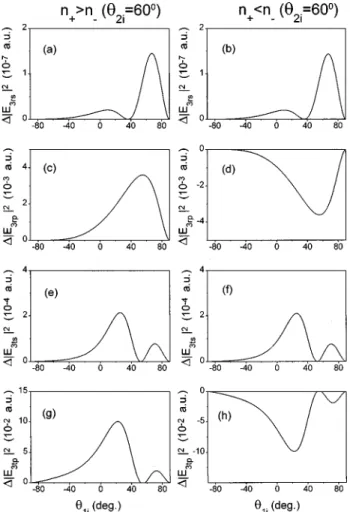
Fig. 5. Calculated SFG intensity corrections for the circular bi-refringence of material. The dotted curves shown in Fig. 4 with
u2i5 60° and a vanishing circular birefringence were chosen for
the intensity references. The corrections for n1. n2are shown at the left; at the right the corrections for n1, n2are presented.
rection of the reflected SFG signal play a crucial role in determining the magnitude of the reflected SFG signal.
Figure 5 shows the SFG intensity corrections caused by the circular birefringence effect of a chiral me-dium. The dotted curves in Fig. 4 with u2i5 60° are
used for the intensity references without circular bire-fringence. The intensity corrections with n1. n2 rela-tive to the references are shown on the left in Fig. 5, and at the right the corrections with n1, n2 are pre-sented. To take circular birefringence into account we used (n11, n21, n31) 5 (1.3800, 1.4000, 1.4300) and (n12, n22, n32)5 (1.3803, 1.4004, 1.4306) in the left column and (n11, n21, n31) 5 (1.3800, 1.4000, 1.4300) and (n12, n22, n32) 5 (1.3797, 1.3996, 1.4294) in the right column of Fig. 5. We found that a nonvanishing s-polarized signal can emerge from an sp input polariza-tion combinapolariza-tion when the circular birefringence effect is included, which indicates that circular birefringence causes the nonlinear polarization to point away from the plane of incidence. In addition, circular birefringence leads to a slight increase in the p-polarized SFG intensity with n1. n2and to a decrease with n1, n2.
In a surface sum-frequency measurement, an azimuth-ally isotropic polar layer with an effective surface suscep-tibility ofxs(2)can generate only an s-polarized SFG signal
by use of an sp input polarization combination.24,25
Based on our analysis of the bulk contribution from a chi-ral liquid, both the sp and the ps polarization combina-tions produce a p-polarized sum-frequency field when the circular birefringence effect is neglected. From the s-polarized intensity variations shown in Figs. 5(a) and 5(b) and the p-polarized intensity reference [the dotted curve in Fig. 4(a)] we can deduce that DI3rs/I3rp
' 1027. Looking at the dotted curves in Figs. 4(a) and
4(b), we can observe that the peak value of the transmit-ted SFG intensity is approximately ten times larger than that of the reflected SFG intensity. This finding indi-cates that the effective nonlinear susceptibility for re-flected SFG, xeff,r(2) , is approximately three tenths of that for the transmitted SFG, xeff,t(2) . Inasmuch asxeff,t(2) for a 2.46-M solution of arabinose was measured to be ;1 3 10210esu,16 x
eff,r
(2) can be estimated to be 3
3 10211esu. For a solution of arabinose, the value of
uxs
(2)/(x eff,r (2) l
c)u2 was therefore found to be;1023, which is
much larger than DI3rs/I3rp. This result implies that
the nonvanishing s-polarized sum-frequency signal caused by the circular birefringence effect of a chiral me-dium is negligible compared with the surface contribu-tion. One can therefore distinguish the surface signal from the bulk contribution by measuring the s-polarized SFG signal for the surface contribution and the p-polarized SFG signal for the bulk contribution by using either sp or ps as the input polarization combination.
B. Spectroscopic Applications
Although electronic CD spectroscopy was developed at the end of last century, the first vibrational CD26,27 was not demonstrated until the 1970’s. During the past few de-cades, vibrational CD had been rigorously developed into a useful tool for probing chirality with molecular
specific-ity. From a theoretical point of view, a vibrational wave function is better understood and is easier to calculate than an electronic wave function. Therefore structural information will be more reliably extracted from a mea-sured vibrational spectrum through a careful comparison with theoretical calculation. Vibrational spectra from an intramolecular functional group have been shown to be highly sensitive to the perturbation from a nearby chiral center.28,29 Therefore a sum-frequency process that com-bines an optical photon and a frequency-tunable infrared photon is a promising tool for studying chirality-induced phenomena.30
In an infrared-visible SFG experiment one can investi-gate the resonant behavior ofxa(2)by tuning the incident
infrared beam across some vibrational resonance of a chi-ral molecule. Unlike linear optical CD, for which one needs to extract a small differential signal from a large background because of the weak coupling between the magnetic and the electric transition dipole moments,26,27 SFG spectroscopy as discussed above is purely electric-dipole contributed and background free. Furthermore, the SFG spectroscopic characterization of xa(2) can offer valuable information about the substructure of a chiral molecule.
The chirality specificity of our proposed spectroscopic technique can facilitate the study of solvation processes. For an accurate measurement of molecular nonlinear op-tical properties in condensed phase the solute–solvent in-teraction must be carefully taken into account. Unfortu-nately, the solvation processes31of a molecule are not well understood. As far as a second-order nonlinear optical process is concerned, an ordered polar structure is needed and the resulting nonlinear optical signal depends on the order of the orientational distribution. To investigate the influence of the surrounding solvent on the nonlinear optical response of the solute molecules we must first have a clear picture of the molecular orientational distri-bution. Chiral molecules can serve as useful probes for studying the solvent effect because the totally antisym-metric part of second-order susceptibility is sensitive only to molecular chirality. Thus the resulting SFG signal will originate purely from the chiral solute if the solvent is achiral. Furthermore, note from Eq. (18) that the to-tally antisymmetric part, which is rotationally invariant under rotational operation, permits a fairly straightfor-ward connection ofxa(2)5 Naa(2)between the macroscopic
nonlinear susceptibility x(2) and the microscopic
nonlin-ear molecular polarizability a(2). Thus the nonlinear
molecular polarizability can easily be determined from the measured nonlinear susceptibility. The solvent effect may be also reflected in a relative peak shift or a magni-tude change in the spectra of chiral molecules in different solvents. The quadrupole contribution from the achiral solvent may mask these chirality-induced signals in a di-lute solution. The SFG amplitude ratio of the quadru-pole to the diquadru-pole contribution can be roughly estimated from the spatial dispersion parameter a/l, where a is the characteristic dimension of the molecules and l is the wavelength. In the visible range, a/l is 1022– 1024. To avoid the masking effect from the solvent’s quadrupole contribution, the volume fraction of the chiral solute must exceed 1022.
4. SUMMARY
We have solved the problem of the nonlinear reflection and transmission for sum-frequency generation from the bulk of a chiral liquid. The dependence of the SFG inten-sity on the incident angles and the polarizations of two in-cident beams was analyzed. The optimal experimental arrangement that gives the strongest SFG signal has been discovered. We also included the circular birefrin-gence effect of a chiral medium in our formalism. Our calculations showed that the circular birefringence of a chiral medium makes only a small correction to the SFG intensity. The potential of chirality-induced SFG in spectroscopic applications was also assessed and dis-cussed.
APPENDIX A: FRESNEL COEFFICIENTS
Owing to the appearance of circular birefringence in a chi-ral medium, the beam refracted into the medium will split into a LHCP and a RHCP wave. Because the eigenwaves in a chiral medium are circularly polarized, we can not separately describe the reflection and the transmission of s- and p-polarized waves. To determine the amplitude of a refracted wave, we first decompose the incident and the reflected electric fields into s and p components, Eis, Eip,Ers, and Erp, and then decompose the refracted wave
into LHCP and RHCP components, Et1and Et2. The
same decomposition is also applied to the magnetic fields. Continuity of the tangential components of electric fields across a planar boundary yields the following two equa-tions: Eis1 Ers5 1
A2
~Et11 Et2!, 2Eip cosui1 Erpcosur5 iA2
~2Et1cosut1 1 Et2cosut2!. (A1)Continuity of the tangential components of magnetic fields across the boundary provides two additional equa-tions: His1 Hrs5 1
A2
~Ht11 Ht2!, 2Hipcosui1 Hrpcosur5 iA2
~2Ht1cosut1 1 Ht2cosut2!. (A2)The electric and magnetic fields are connected by means of the following equations:
His5 2 c m0v kiEip, Hip5 c m0v kiEis, Hrs5 2 c m0v krErp, Hrp 5 c m0v krErs, Ht15 2 c mv ikt1Et1, Ht25 c mv ikt2Et2. (A3)
For nonmagnetic media for whichm 5 m0, Eqs. (A1) and
(A2) can be solved to yield the following matrix equation:
3
1 0 21A
2 21A
2 0 cosur iA2
cosut1 2iA2
cosut2 0 2kr iA
2 kt1 2iA
2 kt2 kr cosur 0 1A2
kt1cosut1 1A2
kt2cosut24
3F
Ers Erp Et1 Et2G
5F
2Eis Eipcosui kiEip kiEis cosuiG
. (A4)By solving Eq. (A4) we can express Ersand Erpin terms
of Eisand Eip:
F
Ers ErpG
5F
r11 r12 r21 r22G
F
Eis EipG
, (A5)F
Et1 Et2G
5F
t11 t12 t21 t22G
F
Eis EipG
. (A6)The matrix elements have been determined to be t115
A2
D ~n2cosui1 cos ut2!2 cosui,
t125
2iA2
D ~n2cosut21 cosui!2 cosui,
t215
A
2D ~n1cosui1 cosut1!2 cos ui,
t225
i
A2
D ~n1cosut11 cosui!2 cosui;
r115
21
D @~n1n22 1!~cosut11 cosut2!cosui 2 ~n11 n2!~cos2 ui2 cosut1cosut2!#,
r125
2i
D ~n1cosut12 n2cosut2!cosui,
r215
22i
D ~n2cosut12 n1cosut2!cosui,
r225
1
D @~n1n22 1!~cosut11 cosut2!cosui 1 ~n11 n2!~cos2 ui2 cosut1cosut2!#,
(A7) where
D [ ~n1n21 1!~cosut11 cosut2!cosui1 ~n11 n2!
3~cos2u
i1 cosut1cosut2!. (A8)
ACKNOWLEDGMENTS
The authors are indebted to K. J. Song for his helpful sug-gestions and stimulating discussions. We also appreci-ate financial support from the National Science Council of the Republic of China under grant NSC86-2112-M009-018.
Address any correspondence to J. Y. Huang.
REFERENCES
1. I. Gutman, V. Babovic, and S. Jokic, ‘‘The origin of biomo-lecular chirality: the generalized Frank model with arbi-trary initial conditions,’’ Chem. Phys. Lett. 144, 187–190 (1988).
2. See, for example, A. W. Hall, J. Hollingshurst, and J. W. Goodby, ‘‘Chiral and achiral calamitic liquid crystals for display applications,’’ in Handbook of Liquid Crystal Re-search, P. J. Collings and J. S. Patel, eds. (Oxford U. Press, Oxford, 1997), Chap. 2.
3. E. U. Condon, ‘‘Theories of optical rotatory power,’’ Rev. Mod. Phys. 9, 432–457 (1937).
4. J. D. Byers, H. I. Yee, and J. M. Hicks, ‘‘A second harmonic generation analog of optical rotatory dispersion for the study of chiral monolayers,’’ J. Chem. Phys. 101, 6233– 6241 (1994).
5. T. Petralli-Mallow, T. M. Wong, J. D. Byers, H. I. Yee, and J. M. Hicks, ‘‘Circular dichroism spectroscopy at interfaces: a surface second harmonic generation study,’’ J. Phys. Chem. 97, 1383–1388 (1993).
6. J. D. Byers, H. I. Yee, T. Petralli-Mallow, and J. M. Hicks, ‘‘Second-harmonic generation circular-dichroism spectros-copy from chiral monolayers,’’ Phys. Rev. B 49, 14,643– 16,647 (1994).
7. J. D. Byers and J. M. Hicks, ‘‘Electronic spectral effects on chiral surface second harmonic generation,’’ Chem. Phys. Lett. 231, 216–224 (1994).
8. J. M. Hicks, T. Petralli-Mallow, and J. D. Byers, ‘‘Conse-quences of chirality in second-order non-linear spectroscopy at surfaces,’’ Discuss. Faraday Soc. 99, 341–357 (1994). 9. T. Verbiest, M. Kauranen, J. J. Maki, M. N. Teerenstra, A.
J. Schouten, R. J. M. Nolte, and A. Persoons, ‘‘Linearly po-larized probes of surface chirality,’’ J. Chem. Phys. 103, 8296–8298 (1995).
10. J. J. Maki, T. Verbiest, M. Kaurenen, S. V. Elshocht, and A. Persoons, ‘‘Comparison of linearly and circularly polarized probes of second-order optical activity of chiral surfaces,’’ J. Chem. Phys. 105, 767–772 (1996).
11. Y. R. Shen, The Principles of Nonlinear Optics (Wiley, New York, 1984), Chap. 6.
12. K. B. Eisenthal, ‘‘Equilibrium and dynamic processes at
in-terfaces by second harmonic and sum frequency genera-tion,’’ Annu. Rev. Phys. Chem. 43, 627–661 (1992). 13. J. Y. Huang and Y. R. Shen, ‘‘Sum-frequency generation as
a surface probe,’’ in Laser Spectroscopy and Photochemistry on Metal Surfaces, H. L. Dai and W. Ho, eds. (World Scien-tific, Singapore, 1995), Vol. 1, pp. 5–53.
14. See, for example, G. Arfken, Mathematical Methods for Physicists (Academic, Orlando, Fla., 1985), Chap. 3. 15. J. A. Giordmaine, ‘‘Nonlinear optical properties of liquids,’’
Phys. Rev. A 138, 1599–1606 (1965).
16. P. M. Rentzepis, J. A. Giordmaine, and K. W. Wecht, ‘‘Co-herent optical mixing in optically active liquids,’’ Phys. Rev. Lett. 16, 762–794 (1966).
17. D. A. Kleinman, ‘‘Nonlinear dielectric polarization in opti-cal media,’’ Phys. Rev. 126, 1977–1979 (1962).
18. S. N. Volkov, N. I. Koroteev, and V. A. Makarov, ‘‘Sum-frequency generation by reflection of light from the surface of a nonabsorbing isotropic and gyrotropic medium,’’ Quan-tum Electron. 25, 1183–1187 (1995).
19. N. I. Koroteev, V. A. Makarov, and S. N. Volkov, ‘‘Sum fre-quency generation by reflection of light from the surface of a chiral medium,’’ Nonlinear Opt. 17, 247–269 (1997). 20. P. Pelet, and N. Engheta, ‘‘The theory of chirowaveguides,’’
IEEE Trans. Antennas Propag. 38, 90–98 (1990).
21. S. Bassiri, C. H. Papas, and N. Engheta, ‘‘Electromagnetic wave propagation through a dielectric-chiral interface and through a chiral slab,’’ J. Opt. Soc. Am. A 5, 1450–1459 (1988).
22. Y. R. Shen, The Principles of Nonlinear Optics (Wiley, New York, 1984), Chap. 2.
23. J. F. Nicoud and R. J. Twieg, ‘‘Organic EFISH hyperpolar-izability data,’’ in Nonlinear Optical Properties of Organic Molecules and Crystals, D. S. Chemla and J. Zyss, eds. (Academic, Orlando, Fla., 1987), Vol. 2, pp. 255–267. 24. Q. Du, R. Superfine, E. Freysz, and Y. R. Shen, ‘‘Vibrational
spectroscopy of water at the vapor/water interface,’’ Phys. Rev. Lett. 70, 2313–2316 (1993).
25. C. D. Stanners, Q. Du, R. P. Chin, P. Cremer, G. A. Somor-jai, Y.-R. Shen, ‘‘Polar ordering at the liquid-vapor interface of n-alcohols (C1–C8),’’ Chem. Phys. Lett. 232, 407–413
(1995).
26. P. J. Stephens and M. A. Lowe, ‘‘Vibrational circular dichro-ism,’’ Annu. Rev. Phys. Chem. 36, 213–241 (1985). 27. T. B. Freedman and L. A. Nafie, ‘‘Stereochemical aspects of
vibrational optical activity,’’ in Topics in Stereochemistry, E. Eliel and S. Wilen, eds. (Wiley, New York, 1987), pp. 113–206.
28. D. Barron, ‘‘Methyl group as a probe of chirality in Raman optical activity,’’ Nature (London) 255, 458–460 (1975). 29. M. Diem, E. Photos, H. Khouri, and L. A. Nafie,
‘‘Vibra-tional circular dichroism in amino acids and peptides: 3. Solution- and solid-phase spectra of alanine and serine,’’ J. Am. Chem. Soc. 101, 6829–6837 (1979).
30. N. I. Koroteev, ‘‘New schemes for nonlinear optical spec-troscopy of solutions of chiral biological macromolecules,’’ JETP 79, 681–690 (1994).
31. J. L. Finney, ‘‘Hydration processes in biological and macro-molucular systems,’’ Discuss. Faraday Soc. 103, 1–18 (1996).
![Fig. 3. Calculated sum-frequency intensities [(a), (b) in reflec- reflec-tion; (c), (d) in transmission] plotted as a function of the incident angle of input beam 1](https://thumb-ap.123doks.com/thumbv2/9libinfo/7928510.157084/5.918.84.788.78.282/calculated-frequency-intensities-reflec-transmission-plotted-function-incident.webp)