1326 IEEE PHOTONICS TECHNOLOGY LETTERS, VOL. 18, NO. 12, JUNE 15, 2006
Wavelength-Interleaving Bidirectional Transmission
System Using Unidirectional Amplification in a
5
100 km Recirculating Loop
Ming-Fang Huang, Student Member, IEEE, Kai-Ming Feng, Member, IEEE, Jason (Jyehong) Chen, Member, IEEE,
Tse-Yu Lin, Chia-Chien Wei, Student Member, IEEE, and Sien Chi
Abstract—This investigation presents a novel 50-GHz
inter-leaved bidirectional transmission system with eight wavelengths that uses four-port interleavers in a bidirectional recirculating loop. This bidirectional configuration shares optical components in the fiber network and an interleaver is utilized to enable unidi-rectional amplification in an erbium-doped fiber amplifier to block noise associated with Rayleigh backscattering. After bidirectional transmission through 500-km LEAF fibers in the recirculating loop, power penalties of less than 2.5 dB were achieved at 10 Gb/s for all channels.
Index Terms—Bidirectional add–drop amplifier, interleaver,
optical fiber communication, optical fiber device.
I. INTRODUCTION
F
OR ANY multispan dense wavelength-division-multi-plexing (WDM) system, optical components such as transmission fiber and optical amplifiers represent substan-tial cost. However, bidirectional transmission is an attractive method for simultaneously reducing operating and mainte-nance costs and increasing the bandwidth utilization of a single optical fiber at the same time [1], [2]. One of the main diffi-culties associated with a bidirectional transmission system is the realization of bidirectional amplification, which typically requires high gain, low noise figure (NF), and the elimination of Rayleigh backscattering (RB) [3]. Possible approaches to bidirectional amplification are channel interleaving or band splitting [3], [5], using arrayed waveguide gratings, the use of Mach–Zehnder WDM couplers, circulators, or gain-clamping SOAs, called linear optical amplifiers (LOAs) [1]. However, these approaches require the use of two or more erbium-doped fiber amplifiers (EDFAs) to amplify the traffic in each direction [3] and may need a dead zone in wavelength channels to preventManuscript received December 6, 2005; revised April 7, 2006. This work was supported by the National Science Council of the Republic of China, Taiwan under Contract NSC 94-2215-E-009-006, Contract NSC 94-2215-E-155-001, Contract NSC 94-2215-E-155-003, Contract NSC 94-2219-E-007-008, Con-tract 94-2752-E-009-004-PAE, and ConCon-tract NSC 94-2752-E-007-002-PAE.
M.-F. Huang, J. Chen, T.-Y. Lin, C.-C. Wei, and S. Chi are with the Institute of Electro-Optical Engineering and Department of Photonics, National Chiao-Tung University, Taiwan 300, R.O.C.
K.-M. Feng is with the Institute of Communication Engineering, Na-tional Tsing Hua University, Hsin-Chu, Taiwan 300, R.O.C. (e-mail: [email protected]).
S. Chi is with the Institute of Electro-Optical Engineering and Department of Photonics, National Chiao-Tung University, Taiwan 300, R.O.C., and also with the Department of Electrical Engineering, Yuan Ze University, Chungli, Taiwan 320, R.O.C.
Digital Object Identifier 10.1109/LPT.2006.877013
crosstalk in blue–red band splitting [5]. The LOA scheme [1], though, can amplify simultaneous bidirectional traffic, and the gain-clamping effect limits the LOA gain to a maximum of 20 dB, inevitably yielding a high NF.
This work proposes and experimentally demonstrates a novel four-port interleaver that enables bidirectional transmission using only unidirectional amplification in a recirculating loop with no dead zone in allocated wavelength channels. The primary function of this four-port interleaver is to redirect the bidirectional eastwardly and westwardly moving traffic into unidirectional transmission in a single amplification section. Copropagating amplifier architecture was employed because highly performing EDFAs are fundamentally unidirectional devices, and are optimized for a low NF and high output power with internal isolators, to ensure stable operation and to eliminate RB. Accordingly, in each transmission direction, optical WDM channels were set with a spacing of 100 GHz and the oppositely transmitting channels were then interleaved into 50-GHz spacing using the interleaver when bidirectional traffic was rerouted into the copropagating EDFA. Placing such innovative configurations in an experimental recirculating loop supports long-distance bidirectional transmission. Fol-lowing bidirectional transmission for 500 km at 10 Gb/s with a bit-error-rate (BER) level of , power penalties of less than 2.5 dB in all eight channels were observed.
II. BIDIRECTIONAL TO UNIDIRECTIONAL
ROUTINGCONFIGURATION
Birefringent crystals have been applied for a long time in de-signing optical filters; such filters comprise birefringent crystal plates and polarizers. The interleaver incorporates birefringent crystal cells, half-wave plates, YVO walkoff crystals, and po-larization beam splitters, as shown in Fig. 1(a). It is designed and fabricated herein as a symmetrical four-port interleaver with two input and two output ports. Consequently, a birefringent crystal is used as an optical delay line, and a half-wave plate is applied to alter the polarization between the delay stages. Details of the design and the operating principles of this inter-leaver are presented elsewhere [6]–[9]. The channel spacing of this interleaver is 50 GHz; it has an insertion loss of 2.2 dB and a 0.5-dB passband of around 35 GHz. Fig. 1(a) presents the measured amplitude response of the interleaver in even and odd channels with residual crosstalk of 17 and 20 dB, respec-tively. Since each channel passes through the interleaver twice, the total isolation exceeds 34 dB for all channels. Accordingly,
HUANG et al.: WAVELENGTH-INTERLEAVING BIDIRECTIONAL TRANSMISSION SYSTEM 1327
Fig. 1. (a) Detail configuration of a four-portL-2L interleaver. (b) Optical transmission response of the four-port interleaver. (c) Schematic diagram to rerout the bidirectional traffic into unidirectional transmission in amplification section using a four-port interleaver. (Color version available online at http://ieeexplore.ieee.org.)
the channel crosstalk is not a serious problem. Moreover, the isolator, within the EDFA, blocks the residual signals and RB noise in the next amplification stage because of rerouting by the interleaver. Hence, this architecture supports multiple-span transmission.
The interleaver is designed to have a complementary wave-length that depends on the routing characteristics for even and odd channels. For example, if (odd channel) enters Port 1, then it will be routed to Port 4. If (even channel) enters Port 2, it will also be directed to Port 4. Such an interleaving property is exploited to route simultaneously both the even channels, which arrive at the interleaver at Port 2, and the odd channels, which enter the interleaver at Port 1, to Port 4. Therefore, the even and odd channels, which propagate in opposite directions, can be transformed into a copropagating transmission in a single am-plification section to achieve unidirectional amam-plification using a single EDFA, as shown in Fig. 1(b). The proposed innovative interleaving configuration not only supports the use of a single EDFA to achieve bidirectional transmission, but also eliminates the presence of a dead zone in the blue–red band splitting tech-nology, further increasing the bandwidth utilization.
III. LONG-DISTANCEEXPERIMENTALSETUP ANDRESULTS
Fig. 2 shows the experimental setup for testing bidirectional transmission over a long distance using four-port interleavers in a recirculating loop. The eight-channel laser sources were grouped into two categories—one with wavelengths between 1550.52 and 1551.72 nm and the other with wavelengths be-tween 1554.54 and 1555.75 nm, all on standard ITU 50-GHz channel spacing grids. The even and odd channels stand for two traffic directions, and were individually modulated by a LiNbO electrooptical modulator at 10 Gb/s with a pseudo-random binary sequence pattern. A polarization controller was applied to the odd traffic to ensure that the polarization states of the odd channels were orthogonal to those of the even chan-nels, to reduce the deleterious nonlinear effects. An interleaver was placed at the input of the recirculating loop to split the east and west channels for bidirectional transmission and oppositely directed traffic was combined for unidirectional amplification. Two spools of 50-km Corning LEAF fiber were adopted in the
Fig. 2. Recirculating loop setup for long-distance bidirectional transmission experiment using four-port interleavers. (Color version available online at http://ieeexplore.ieee.org.)
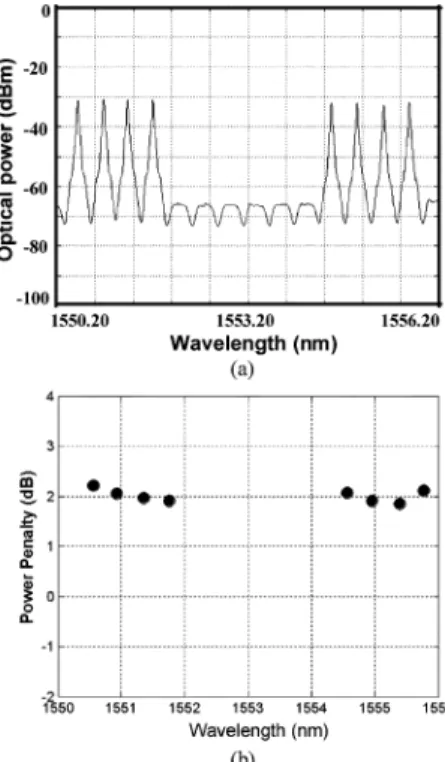
Fig. 3. (a) Received optical spectrum, and (b) received power penalties at BER equal to10 of all channels after 500 km.
recirculating loop. A dual-stage EDFA with 5 km of Corning DCF was employed in the midstage of the loop to compen-sate for the transmission loss and accumulated dispersion in the LEAF fiber. The effective gain and NF of the dual-stage EDFA in all channels was around 23 and 5.5 dB, respectively. The fully compensated wavelength of this fiber loop was lo-cated at approximately 1553.2 nm. The two interleavers in the loop were specially arranged to reduce chromatic dispersion caused by the flat-top transmission band design of the inter-leaver [10]. A 3R receiver with a 32.5-dBm sensitivity at BER of was utilized to evaluate the quality of transmission. Fig. 3(a) displays the received optical spectrum after 500 km with an optical signal-to-noise ratio (OSNR) of over 31 dB for all channels with a 0.02-nm resolution bandwidth on the optical spectrum analyzer. The configuration effectively blocks the RB
1328 IEEE PHOTONICS TECHNOLOGY LETTERS, VOL. 18, NO. 12, JUNE 15, 2006
Fig. 4. (a) BER curves and corresponding eye diagrams at Channel 7 after transmission. (b) Accumulated errors measured as a function of time. (Color version available online at http://ieeexplore.ieee.org.)
using only one amplification section for two traffic directions. Fig. 3(b) shows that the receiving power penalties of BER equal to at all channels. All channels had power penalties of less than 2.5 dB and the penalty differential between them was less than 0.36 dB. Fig. 4(a) plots the BER curves and the cor-responding eye diagrams at Channel 7, for back-to-back, 100-, 300-, and 500-km transmissions. The measured power penal-ties were about 0.3, 1, and 2 dB for 100-, 300-, and 500-km transmissions, respectively, at a BER of under optimal po-larization conditions. The popo-larization controller was used to minimize the polarization effects, such as polarization-depen-dent gain and polarization-depenpolarization-depen-dent loss, in the recirculating loop. The penalties were attributed to amplified spontaneous emission accumulation due to the SNR degradation results from high link loss between the amplifier span. Since in a recircu-lating loop experiment, if the optical data pattern length time is longer than the sampling window used to take the BER mea-surement, then pattern-dependent errors arise from time to time [11]. An accumulated error measurement can verify the stability and ensure that the proper sampling window is utilized in the recirculating loop experiment. The error counts accumulate al-most continuously when the sampling window in the system is kept accurate [11]. Otherwise, the accumulated errors would be
missed for long periods, and then would be over-sampled for certain periods. Fig. 4(b) plots the measured accumulated errors as a function of time (10-s intervals) at a BER of
after 100 and 500 km. This figure demonstrates the robustness in the transmission system for BER measurement. Moreover, the authors believe that this configuration can accommodate more optical channels, 16 or 32 channels, within the -band be-cause this interleaver was designed to cover the whole -band (1530–1560 nm).
IV. CONCLUSION
This investigation proposed and experimentally demon-strated a novel 50-GHz interleaved bidirectional architecture that enables long-distance transmission. An innovative four-port interleaver is utilized to enable unidirectional amplification in a recirculating loop. Given the creative complementary wave-length-sensitive routing scheme, only a single EDFA in the amplification section is needed to achieve bidirectional-traffic amplification. This rerouting configuration in the amplification section provided high gain, low NF, and high OSNR in a bidi-rectional transmission system. After 500 km, the power penalty was less than 2.5 dB at 10 Gb/s, revealing the feasibility of the developed innovative configuration. Given the periodicity of the interleaver, this bidirectional transmission system is believed to be able to include more channels.
REFERENCES
[1] H. S. Chung, J. S. Han, S. H. Chang, and H. J. Lee, “Bidirectional transmissions of 32 channels 10 Gb/s over metropolitan networks using linear optical amplifiers,” IEEE Photon. Technol. Lett., vol. 16, no. 4, pp. 1194–1196, Apr. 2004.
[2] C. H. Kim, C. H. Lee, and Y. C. Chung, “Bidirectional WDM self-healing ring network based on simple bidirectional add/drop amplifier modules,” IEEE Photon. Technol. Lett., vol. 10, no. 9, pp. 1340–1342, Sep. 1998.
[3] J. Ko, S. Kim, J. Lee, S. Won, Y. S. Kim, and J. Jeong, “Estimation of performance degradation of bidirectional WDM transmission systems due to Rayleigh backscattering and ASE noises using numerical and an-alytical models,” J. Lightw. Technol., vol. 21, no. 4, pp. 938–946, Apr. 2003.
[4] S. Radic, S. Chandrasekhar, A. Srivastava, H. Kim, L. Nelson, S. Liang, K. Tai, and N. Copner, “Dense interleaved bidirectional transmission over 52 80 Km of nonzero dispersion-shifted fiber,” IEEE Photon.
Technol. Lett., vol. 14, no. 2, pp. 218–220, Feb. 2002.
[5] L. D. Garrett, M. H. Eiselt, J. M. Wiesenfeld, M. R. Young, and R. W. Tkach, “Bidirectional ULH transmission of 160 Gb/s full-duplex ca-pacity over 5000 km in a fully bidirectional recirculating loop,” IEEE
Photon. Technol. Lett., vol. 16, no. 7, pp. 1757–1759, Jul. 2004.
[6] K. Tai, B. Chang, J. Chen, H. Mao, T. Ducellier, J. Xie, L. Mao, and J. Wheeldon, “Wavelength-interleaving bidirectional circulators,” IEEE
Photon. Technol. Lett., vol. 13, no. 4, pp. 320–322, Apr. 2001.
[7] T. Ducellier, K. Tai, B. Chang, J. Xie, J. H. Chen, L. Mao, and H. Mao, “The “Bi-directional circulator”: An enabling technology for wave-length interleaved bi-directional networks,” presented at the ECOC, Munich, Germany, 2000, Paper PD3-9.
[8] J. Chen, “Dispersion-compensating optical digital filters for 40-Gb/s metro add-drop applications,” IEEE Photon. Technol. Lett., vol. 16, no. 5, pp. 1310–1312, May 2004.
[9] M. F. Huang, J. Chen, K. M. Feng, C. C. Wei, C. Y. Lai, T. Y. Lin, and S. Chi, “210-km bidirectional transmission system with a novel four-port interleaver to facilitate unidirectional amplification,” IEEE Photon.
Technol. Lett., vol. 18, no. 1, pp. 172–174, Jan. 2006.
[10] K. M. Feng, M. F. Huang, C. C. Wei, C. Y. Lai, T. Y. Lin, J. Chen, and S. Chi, “Metro add–drop network applications of cascaded dispersion-compensated interleaver pairs using a recirculating loop,” IEEE Photon.
Technol. Lett., vol. 17, no. 6, pp. 1349–1351, Jun. 2005.
[11] A. H. Gnauck, S. Chandrasekhar, and A. R. Chraplyvy, “Stroboscopic BER effects in recirculating-loop optical transmission experiments,”