Vol.7, pp. 161-182 March, 2013
Social-constructivist Course Design and Efficacy of Teaching
Translation as Language Skill-
Taking a Media Translation
Class as an Example
Yee-chia Hu
∗Abstract
For years there is always a gray area of differentiating between teaching translation as a professional skill (TTPS) and teaching translation as a language skill (TTLS), and in academia the demanding voice of defining these two types of translation courses is getting louder. By reviewing an award-winning course applying TTLS as a teaching method, this paper proposes a basis of constructivism for teaching media translation in a bilingual college program in Taiwan. Communicative teaching, Content and Language Integrated Learning (CLIL), Self-regulated Learning, cooperative learning, peer reviewing, and online learning platforms (Moodle), are implemented as teaching techniques and expressive tasks.
Tracking the participants’ online-learning records serves as a reference for verifying teaching strategies. The paper introduces a college-participant empirical study under the monitor of Action Research. Surveys were done to get the quantitative data. Open-ended questionnaire and classroom observations are also conducted to elicit the qualitative data. Both the quantitative and qualitative data show that, due to the teaching and learning strategies based on constructivist course-design, the class activities are implemented well and the learning outcome is positive. The result from the open-ended questionnaire and classroom observation also indicates that other factors encouraging the participants’ learning include the teacher’s attitude, the advancement of Internet technology, and a happy learning environment. The implementation of this class is expected to benefit college students in bettering their English, translation skills, and communicative competence. Moreover, hopefully the implications can provide language instructors with more constructive insights when teaching translation.
Key words: teaching translation as a language skill (TTLS), self-regulated learning
(SRL), online learning platform, content and language integrated learning (CLIL), social-constructivist course design
∗
Assistant Professor, Department of Teaching Chinese as a Second Language, Ming Chuan University Received December 31, 2012; accepted March 14, 2013; last revised March 29.
第七期,頁 161-182 二○一三年三月
社會建構論下語言翻譯教學之課程設計及其效益
──以媒體翻譯課為例
胡依嘉
∗摘要
長久以來「專業翻譯教學」(Teaching Translation as a Professional Skill) 與「語言翻譯教學」(Teaching Translation as a Language Skill) 一直處於一種 灰色地帶,而認為該將這兩類翻譯課作一區隔的呼籲也在學界日益增高。本文從檢 視一門得獎的「語言翻譯教學」課程,闡述社會建構論的課程設計如何在雙語授課 環境中帶來教學效益。溝通式教學法、學科內容本位語言統整學習法(CLIL)、自主 學習、合作學習、同儕評估,以及網路學習平台等教學步驟,也同時成為具有意義 的學習任務。 以「行動研究」方式所調查的某大學「媒體翻譯」課為例,本研究從課堂觀察、 互動分析、學生線上討論記錄,和開放式問卷取得質化資料,並以封閉式問卷取得 教學反應與學生學習動機策略兩方面的量化資料。。 研究顯示,以社會建構論為基礎的教學策略,在活動執行與學習效益上都呈正 向反應。而從開放式問卷的結果看來,教師的態度、網路科技的發達,及快樂的學 習環境,也是提升學習力的原因。本研究期望由實際課程的執行面,改善學生的英 語力、翻譯力,乃至溝通力。同時本研究亦希望能為從事語言翻譯教學的教師,提 出一些具體參考。 關鍵字:語言翻譯教學、自主學習、網路學習平台、學科內容本位語言統整學習法、 社會建構論課程設計 ∗銘傳大學華語文教學系兼應用英語系助理教授。 到稿日期:2012 年 12 月 31 日;確定刊登日期:2013 年 3 月 14 日;最後修訂日期:2013 年 3 月 29 日。
Taking a Media Translation Class as an Example
1. Introduction
Following the trend of globalization, more and more universities in Taiwan are offering internationalized courses to serve the local students. It is claimed that these courses or programs are designed “through balanced training in theory and practice and career advising for the global market,” as quoted from the website of a university in Taiwan. However, the traditional teaching approach applied in many classes, including the translation classes, makes a mission statement, such as one shown above, become a challenge on many campuses.
In Taiwan, Chinese-English Translation as a subject witnesses unparalleled growth of Translation Studies. However, there are some issues showing the course framework is not clear. The first issue is the so-called translation class has been a significant part of the curriculum of almost all Applied English departments, where English learning actually outpaces translation learning. The second is the teaching of translation is still influenced by the traditional teacher-fronted pedagogy, which frustrates students in telling them to imitate or even copy the “right” translation provided by the textbooks or by the teachers. The third issue is the role of Content and Language Integrated Learning --- one of the main features of the internationalized courses. The objectives of this approaches is usually well-stated, but the implementation is usually another story. As a result, it creates a rather passive, if not boring, translation class. To turn this situation around, a communicative translation teaching, which is based on social constructivism, has been developed, and this paper describes the implementation and examines the implications of the course design.
To which extent a class can be viewed as an internationalized one when the teaching approach in the class is still traditional? This empirical study investigates how a translation class can be a powerful way of learning English when teaching translation as a language skill (TTLS) has been clarified as the objective, and how Content and Language Integrated Learning (CLIL), a dual-focused educational approach, was actually implemented well in a college classroom by the aid of staged bilingual instruction. Moreover, this study also examines how CLIL approach can work better when combined with Self-Regulated Learning strategies.
By introducing a 14-week, 31-participant class experiment and by explaining the theories underlying the test reports, the study shows what CLIL in a translation class and SRL can take a bilingual/ESL learning experience into a further direction. In addition, meaningful tasks related to the study, such as the curriculum design, course outline, E-learning steps, peer reviews, and teaching strategies, are introduced with descriptions, photos, and surveys in the methodology section and the data analysis section. The result of the study indicates that the participants did get a more positive learning outcome when staged bilingual instruction were conducted by the teacher and Self-Regulated Learning strategy were applied by the students.
2. Literature Review
This section draws on concepts and literature from the fields of Second teaching translation as a language skill (TTLS), the importance of curriculum re-conceptualization, Content and Language Integrated Learning (CLIL), and the implication of Self-Regulated Learning (SRL), to explore how some approaches and strategies derived from these fields can be used in a real teaching environment.
2.1 Teaching Translation as a Language Skill
The characteristic of social constructivism in translation was supported by Systemic Functional Linguistics proposed by Halliday in the 1980s. The main idea of this theory is “functional” rather than “formal”, and it means “language as a resource used for communication and not as a set of rules” (Richards, Platt & Platt, 1998, p. 464). As a subject or as a reading process, translation carries the characteristic of social constructivism deeply (Liao, 2007). Consequently, Li (2003) pointed out “glasnost” (Russian term for “openness”) is one of the characteristics of translation.
Bassnett & Lefevere (1998) elaborated many reasons and ways of making translation turn in cultural studies, and this opinion is similar to the point that translation is a changing process of world views (Li, 2010). Lu & Lan (1997) regarded translation as a specified subject in the communication studies, They concluded that translation is an exchange of cross-cultural information, so its nature IS communication. Wu (2005) pointed out that translation is a social behavior involving ideology and power. Dollerup (2007) raised a similar viewpoint. The example he used in his book is the problem of western centrality in translation studies.
The inter-disciplinary characteristic of translation was also recognized by Xie (1994) and Lai (2009). Both scholars mentioned that translation is not just about “languages”, it is also related to the languages behind all kinds of subjects. They also suggested that translation studies should be promoted in different departments. Lai (2009) further suggested that Chinese departments should offer translation courses.
In Taiwan, most of the translation courses are offered by English departments or Applied Linguistics colleges (Liao, 2007). Wang (2003) pointed out that even though the translation courses have been offered by some Translation-Studies departments, the courses still relatively focus on English learning more. This fact indicates that translation has been used as a strategy to enhance English/foreign language learning, and it generates two kinds of voices in terms of the structure of translation courses (Liao et al, 2011). One voice claims that translation studies should be an independent subject with clear objectives and professionalism. The other voice claims that translation needs not to be that “independent” and can keep serving as a course to enhance English/foreign language learning. Liao et al (2011) categorized the latter claim as “teaching translation as a language skill” (TTLS), which fits more of the situation in Taiwan. The study of Chang (2009) also reflected the situation. She defined her class as translation pedagogy, but her class was still with a strong sense of English teaching. Applying corpora tools was her step to address and face the problem of Taiwanese students’ insufficient knowledge of English.
With a viewpoint of social constructivism, McLaughlin (1978) and Corder (1981) claimed that learner’s first language can serve as a foundation of prior knowledge when learning another language and culture. In Taiwan translation was discredited in second or foreign language learning, because many teachers were concerned about the interference of mother tongue, and they kept promoting the idea “when learning the target language, think in the target language” (Laio, 2007). However, many scholars support the positiveness of applying translation to language learning. Ellis (1985) and Swan (1985) suggested that a learner’s mother tongue should NOT be viewed negatively when learning a second or a foreign language, and a translating process in a learner’s head should be re-evaluated in a positive manner. Chellappan (1991), Liu (1997), Liao (2007) agreed that translation can help learners notice the differences of the two languages, and thus enhance the learners’ linguistic and cultural awareness. Ellis (1997, 2003) viewed translation is one of the communication-transfer strategies, which may facilitate the communication skill. Ke (1997, p. 6) highly valued translation-training in language learning. He pointed out
Taking a Media Translation Class as an Example
that other than the four skills, listening, speaking, reading, and writing, translation is an indispensable skill when evaluating target-language proficiency levels.
2.2 The Importance of Curriculum Re-conceptualization
The theories directly related to the modern curriculum design can be dated back to the late 18th century. Chen (2003) pointed out that, the theories developed by Pestalozzi, Froebel, Herbart, Spencer, and Parker, all made some impact on the modern curriculum design. Among them, Spencer is the first scholar who promoted the concept of discipline integration, and Parker developed a children-center learning theory, which turned the foundation of the famous Progressivism promoted by Dewey in the 1930s (Huang, 1995; Chen 2003). Chen (2003) suggested that Dewey is the most influential educator promoting curriculum integration in the 20th century, because his learner-based idea emphasized “sharing” and “social interaction”.
More well-known theories were introduced during the mid 20th century, such as Gestalt Psychology developed by M. Wertheimer and K. Koffka, Cognitive-developmental Theory by J. Piaget, Spiral Curriculum by Bruner, and Tyler Rationale by R. Tyler. Later these theories made some direct impact on Curriculum Re-conceptualization promoted by Pinar, Stenhouse, and Apple in the 70s and 80s (Huang, 1992; Zhang 1998; Chen 2003). Pinar (1975) suggested that the purpose of a new course should cover four training aspects, namely “regressive reflection”, “progressive reflection”, “analytical reflection”, and “synthetical reflection”. Apple (1979) further mentioned that the ideology and power structure in any educational system should be examined from time to time. These post-modern viewpoints later inspired Gagne to claim his Conditions of Learning in 1985, Gardner (1985) pointed out that under the influences made by the previous scholars, concepts like “teach”, “learn”, “knowledge”, and “learning outcome” started to have new interpretations, including those of Multiple Intelligences proposed by Gardner himself. Based on cultural relativism and social constructivism, Cross (1995) claimed that a course structure and content should be co-established by teachers and students. Moreover, Beane (1997) also claimed that any updated course should reveal its objective under the social context.
Nowadays an updated curriculum design has been shifted from teacher-center to student-center. During the course implementation, students not only can be informants, but also negotiators (Lauritzen & Jaeger, 1997). Zhang (2004) also suggested that a world trend of curriculum development emphasizes multi-combinations of students’ competences, such as the competence of problem-solving, critical thinking, and metacognitive learning. In addition, the course content is more activity-oriented.
In the field of education psychology, Reflective Teaching can be viewed as one of the new course paradigms. The essence of Reflective Teaching is derived from social constructivism and even further, dialectical constructivism (O’Donnell, Reeve, & Smith, 2007). It means knowledge is constructed by the learners from time to time, and the teachers are facilitators providing positive learning environment accordingly. O’Donnell, Reeve, & Smith (2007) suggested that this viewpoint actually is very close to the principle proposed by Vygosky decades ago, and nowadays its application is widely extended among learner communities and in computer/internet-aided learning environment.
O’Donnell, Reeve, & Smith (2007) pointed out Reflective Teaching is different from the traditional technical teaching based on standardized norms. Moreover, it is, to some extent, a strategy of enhancing the traditional technical teaching. Schon (1983, p. 20) proposed that the role of teacher in the Reflective Teaching is a reflective practitioner who has the knowledge in action to generate the reflection. Zeichner & Liston (1996) suggested that a reflective-teaching type of teacher has five characters: Firstly,
problem-solving attitude towards course issues. Secondly, a critical thinking towards course values. Thirdly, awareness of the educational system and cultural background. Fourthly, participation of curriculum development. Fifthly, a strong sense of responsibility of professionalism.
2.3 Content and Language Integrated Learning (CLIL)
CLIL is a “dual-focused educational approach in which an additional language is used for the learning and teaching of both content and language” (Mehisto, Marsh & Frigols, 2008, p. 9). This approach has been developed and implemented for decades in Europe, and nowadays in Europe CLIL is used urgently to “increase European cohesion and competitiveness”, and in Asia CLIL is used for social-economic reasons. (Mehisto, Marsh & Frigols, 2008, p. 10).
At college level, one of the common bilingual-teaching models is the Content and Language Integrated Learning (CLIL), which was derived from the concept of Content-Based Language Learning in the ESL field. Garcia (2009) pointed out that CLIL “protects the development of the first language, while exposing students to the second language for a certain time which may start in primary school” (p. 130). Snow (2001) suggested that CLIL could successfully match the objectives proposed in the Second Language Acquisition (SLA) methodologies. Mehisto, Marsh & Frigols (2008) also mentioned that one of the CLIL features is to promote the meta-linguistic awareness (p. 28).
Many people have an impression that teaching-more-than-one-language can be well-applied only to children. However, Baker (2006), Garcia (2009), and Mcgroarty (2001) all suggested that it also can be applied well to adult learners. Mcgroarty (2001) mentioned that both in the field of Teachers of English to Speakers of Other Languages (TESOL) and in the field of Bilingual Education, many voices agreed that quite a number of CLIL methods can be used for monolingual students who want to develop their second language fluently (2001, p. 445).
Mehisto, Marsh & Frigols (2008) made a clear statement that the essence of CLIL is integration, which simultaneously focuses on first, “language learning is included in content classes,” and second, “content from subjects is used in language-learning classes” (p. 11). They also pointed out that “connecting to personal experience in a classroom” is one of the major rationales of CLIL (p. 55), because the connection is based on social constructivism and it directly makes a great impact on learners while they are judging what “meaningful learning” is to themselves. In other words, CLIL can serve as a tool making college second-language learners develop the abilities of facing those internationalized course on campus and in the mean time enhancing their second language proficiency while studying the content of the courses (Snow, 2001, p. 388).
2.4 The Implication of Self-Regulated Learning (SRL)
When talking about the issues of learner-instructor matching and strategy training, Ellis (1997) mentioned that the purpose of strategy training is to “provide a way of helping learners to become autonomous” (p. 87). Liao (2007) suggested that autonomous learners take responsibility for their own learning. In his research regarding the application of on-line Moodle translation learning, the result shows that due to the autonomous learning environment provided by Moodle, the learning outcome of the students is more positive.
For decades scholars also brought up the term “self-regulated learning” to further elaborate the value of learner autonomy. The definition of self-regulated learning, according to Pintrich & De Groot (1990), can be looked into three phases, including “the
Taking a Media Translation Class as an Example
actual cognitive strategies that students use to learn, remember, and understand the material”, “students' metacognitive strategies for planning, monitoring, and modifying their cognition”, and “students' management and control of their effort on classroom academic tasks” (p. 33).
In terms of a learner’s role, Taylor (1986) proposed a theory about the developmental stages. When experiencing self-regulated learning process, in his opinion, learners must go through a cyclic learning pattern involved equilibrium, disorientation, exploration, and reorientation. Taylor’s theory has been a foundation for SRL curriculum designers. For example, the four SRL learning stages proposed by Gibbons (2002), namely those of independent thinking, self-managed, self-planned, and of self-instructed, were based on Taylor’s theory.In aspect of student learning and academic performance in the classroom context, Corno & Mandinach, (1983); Corno & Rohrkemper (1985); and Pintrich & De Groot (1990) all pointed out that cognitive and behavioral self-regulation was very important.
In term of the application of SRL in a translation class, the class experiment done by Chang (2010) indicates that using portfolio as learning tools can bring a better over-all learning outcome. Moreover, the employment of portfolio did foster the translation trainees’ attitude and help them take more learning responsibility. Li (2001) pointed out that self-regulated learning involved students’ taking the initiative in willingness, attitude, and methods. Furthermore, these can be detected when students are showing strong motivation and active manner in a learning process. Being willing to do cooperative learning with peers, setting up a high self-monitoring step, and being perseverant, according to Li (2001), are also the signs of self-regulated learning.
3. Methodology and Course Design
3.1 Research MethodThis mixed-method study combines both quantitative and qualitative data with a concurrent triangulation approach. The researcher applied the approach to “confirm, cross-validate, or corroborate findings within a single study” (Creswell, 2003, p. 217), and the results from both data sets were integrated during interpretation to “note the convergence of the findings as a way to strengthen the knowledge claims of the study or explain any lack of convergence that may result” (Creswell, 2003, p. 217).
In this class experiment, the researcher, who is also the instructor of the class, conducted two surveys to collect quantitative data, and conducted action research to collect qualitative data. The characteristics of action research, according to Nunan (2004, p.17) are: 1. “it is carried out by the practitioners rather than outside researchers”. 2. “it is collaborative.” 3. “it is aimed to change things.
The questionnaires are designed by the Teaching and Learning Resources Center of the school. The participants were 31 undergraduate Applied English majors who took Media Translation course. As to the action research, in this experiment it means all the SRL curriculum-design steps along with the entire semester, including the course framework, syllabus, weekly course instruction, online Moodle assignments, email communication, etc. According to each of the steps, the researcher observed how the students reacted and what they had performed.
There are two questionnaires in this study. One is on responses to teaching. It contains 26 closed-ended questions, which are divided into 6 categories, and followed by 6 open-ended questions. The closed-ended questions are designed to elicit information regarding course design, teaching implementation, class management, teaching evaluation, teaching guidance, and self-Improvement of teachers. As to the open-ended questions, they are listed to get teaching advice from the respondents.
The other questionnaire is the questionnaire on learning motivation and strategies. It contains 85 closed-ended questions, which are divided into 12 categories to elicit information regarding inner motivation, external motivation, thinking about course content, control of learning outcome, anticipation of learning ability and performance, learning ability, time management, strategy management, persistence, peer learning, course difficulty, and learning outcome.
For the closed-ended questionnaires, all the respondents were asked to answer the questions on a five-point Likert scale with the range “strongly agree, agree, neutral, disagree, and strongly disagree.” The survey was conducted with the Chinese-version questionnaires, which are translated into English to fit the writing style of this paper.
All in an on-site self-administered manner, in the 14-week semester, the 85-question survey with the same content was conducted twice, one after the midterm exam, the other before the final exam. The 26-question survey was conducted once at the end of the semester.
3.2 Course Design and Teaching Strategies
What makes the course special is that it is designed in a re-conceptualized manner, and the teaching strategies thus serve as part of the research. The researcher applied communicative approach as the most important teaching method to support the basis of constructivism for teaching media translation in a bilingual college program. The nature of a good translation class is in a small size. This fact may not rationalize the sampling of the quantitative data in this research, but it serves as a good catalytic agent for teacher-student interaction.
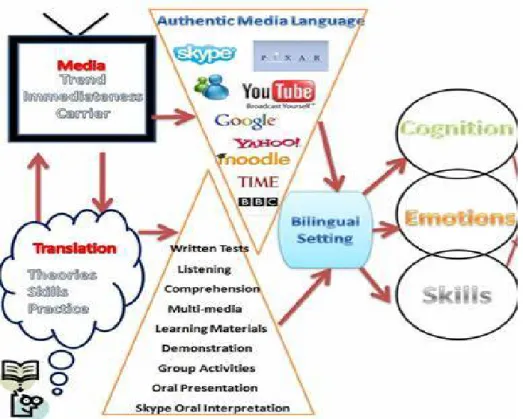
This course is designed for senior students. Moreover, it is a translation class but it also aims at enhancing students’ English proficiency level. Therefore, the course promotes English learning more than translation-theory learning. Nevertheless, as a professional translator, the instructor delivers quality Chinese surely in both oral and writing forms. In addition, the major issues in the field of Translation Studies, such as those of style, translation for media, and cross-cultural pragmatics, are still introduced along the course. Furthermore, regarding the training of translation skills, each activity in the course is designed to practice one or two skills, such as discourse analysis, extract gist, listening comprehension, note-taking, paraphrasing, transcription, retention, shadowing, sight interpretation, etc. Emphasizing “wide” rather than “deep” is for the purpose of offering an interesting introductory course. Below are the diagram and the concept map of the course design:
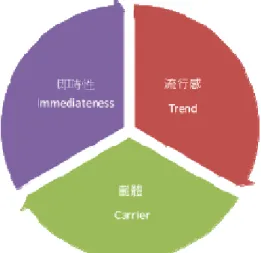
Figure 1. The diagram of the course design
Taking a Media Translation Class as an Example
Figure 2. The concept map of the course design
Source: this study
In the two figures shown above, “media” and “translation” are major categories. The “media” is categorized with its characteristics “trend”, “immediateness”, and “carrier”. On the other hand, “translation” in this course means the environment of enhancing English learning, the “playground” of translation-skill training, and the conditions of practice. The two triangles represent the contents derived from the two major categories. They point to each other because the two triangles eventually will mingle together into one entity in a bilingual environment. The purpose of this design is to help students internally-develop their cognition, emotions, and skills.
Other meaningful tasks are also implemented as teaching techniques, and are introduced as follows:
First, there is a course government comprised by the students and the teacher. The teacher is in charge of theoretical introduction, skill guiding, translating demonstration, but the students are in charge of completing all the assignments. Second, the online learning platforms, in this case, Moodle, is a tool for helping the students develop their self-regulated earning. Third, the group activities and peer reviewing, both in the classroom and on Moodle, are designed to promote cooperative learning. Fourth, the teacher encourages content and language integrated learning (CLIL) throughout the whole semester, including using English to take notes, to reply in oral or written forms, and to take exams.
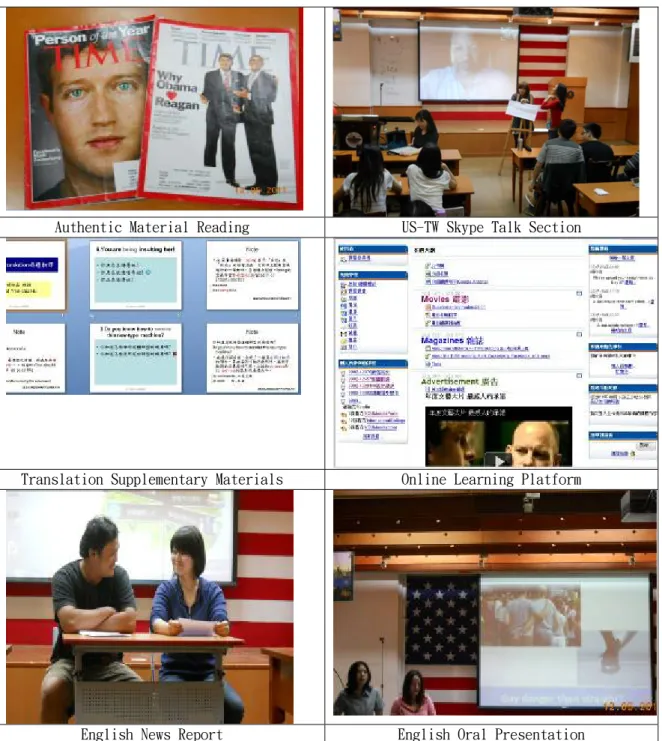
Fifth, the application of authentic media language interests the students more than any traditional textbook. The articles from TIME magazine are the required reading texts but they are not the only assigned reading materials. “The whole world is your textbook” is the concept the teacher wants to promote, therefore the other materials coming from the American ABC, NBC, CBS, BBC, and CNN news, instant news provided by Google and Yahoo, Pixar animation, pop songs, Oscar-winning film, movie trailers, commercial films, press conferences, are also the sources of promoting the practice of listening
comprehension (即席聽力訓練), sight interpretation (視譯訓練), film-subtitle translation (電影字幕翻譯).
Sixth, the Skype long-distance learning is a type of oral-interpretation training (口譯 訓練). It creates a chance to let the students experience a real interaction via telepresence. (The far end is a Berlitz English teacher and the local end is the students. The live assignment goes when the students see the Chinese prompts and they need to translate them into English immediately to the teacher, and the teacher replies in English and everybody checks if the answers are correct.)
Seventh, one of the assigned articles from TIME magazine is about the founder of Facebook Mark Zuckerberg. Through reading his life story, the instructor asks the students to compare different media comments made about Mark, and in the mean time asks the students as a member or a non-member, to reflect on what Facebook has been doing. The students suddenly noticed that a class material could be very close to their personal lives, and they turned more interested in learning English.
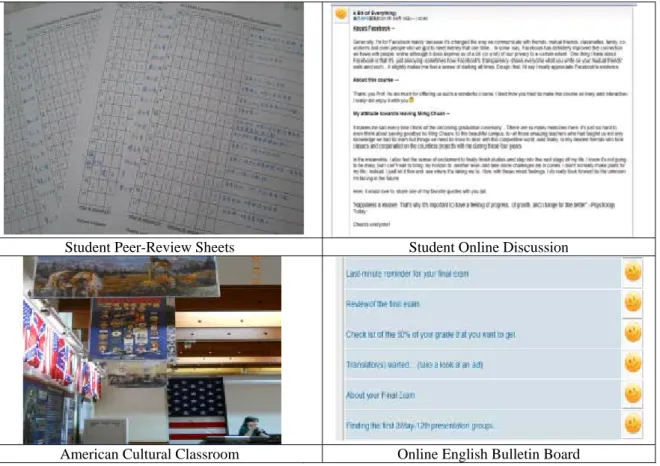
Eighth, both the English and Chinese oral presentations are designed to enhance students’ speaking skill. In different weeks, they are required to broadcast English news and use Chinese to introduce the best translation cases they can find. Eighth, this E+C blended course promotes the learning outside and inside the classroom. E-learning enables the students to review what have been taught at any time, and the “C”, which implies the classroom activities, consolidate the teacher and the students as a whole. The classroom used for this course is the American Culture Classroom specially designed by the Applied English department. The classroom setting is full of the American images, objects, and American-English. This, in a way, strongly promotes the target-language learning.
4. Date Analysis
4.1 Response of the Questionnaire to the Teaching and the Course Design
Since the beginning of the class, the instructor had sensed that two reasons of making this class a highly cooperative one. The first reason is the small-size class of 31 students, and the second reason is that 95% of the students took the instructor’s class before. Both reasons make the class interaction much smoother.
Regarding the result of the questionnaire response to teaching, which was done at the end of the semester, among the 26 closed-ended questions, all of the responses of the 20 questions got the mean of 4.0 or even up to 4.4. There are 4 questions (No. 7, 11, 19, 26) got the mean of 4.5, and 2 questions (No.12 and 22) got the mean of 4.6.
Taking a Media Translation Class as an Example
Table 1
Questionnaire Response to Teaching
回應 教師教學知能題目 非 常 良 好 良 好 無 意 見 可 改 進 尚 需 加 強 平 均
A1. 課程設計 Course Design
1.老師能訂定具體可行之課程目標。
Teacher is able to set concrete and feasible course goals. 39% 61% 0% 0% 0% 4.4 2.老師能依照課程目標選擇適宜之教學內容。
Teacher is able to choose appropriate content in accordance with course goals.
39% 61% 0% 0% 0% 4.4
3.老師能根據目標與學生學習特性組織課程內容。 Teacher is able to organize the course content in accordance with course goals and students’ learning characteristics.
39% 58% 3% 0% 0% 4.4
4.老師能選擇符合學生程度之教材,必要時自行研發 創新教材。
Teacher is able to choose the appropriate teaching materials in accordance with students’ abilities, and create innovative teaching materials in need.
42% 58% 0% 0% 0% 4.4
5.老師能依據課程性質與需要,選擇恰當的教學方 法,例如:講授法、合作學習法等等。
Teacher is able to adopt the appropriate teaching methods in accordance with the quality and demand of the course, such as Lecture Method and Cooperative learning method.
39% 61% 0% 0% 0% 4.4
A2. 教學實踐 Teaching Implementation
6.老師能搭配適合的圖儀設備、網路或教具,以達到 教學目標。
Teacher is able to achieve the teaching goals by using appropriate equipment, web pages and teaching aids.
45% 52% 3% 0% 0% 4.4
7.老師能設計符合課程內容之教學活動,如實作、分 組討論、上台發表等等。
Teacher is able to design teaching activities according to the teaching content, such as practical application, group discussion or presentations.
45% 55% 0% 0% 0% 4.5
8.老師能根據學生程度調整教學方法因應之。
Teacher is able to adjust teaching methods in accordance with students’ abilities.
35% 55% 10% 0% 0% 4.3 9.老師能彈性變動教學內容以配合學生學習。
Teacher is flexible regarding teaching progress and content in accordance with students’ learning status.
37% 59% 3% 0% 0% 4.4
10.老師能關注學生個別的學習困難。
Teacher notices and cares about individual student learning difficulties.
23% 58% 19% 0% 0% 4.0
A3. 班級經營 Class Management
11.老師能善用時事、小故事、笑話、或舊經驗的連 結等方式,激勵學生的學習動機。
Teacher is able to inspire students’ learning motivation
回應 教師教學知能題目 非 常 良 好 良 好 無 意 見 可 改 進 尚 需 加 強 平 均
by using motivating news, issues, stories, humor or personal experience.
12.老師能保持良好的師生互動,維持和諧熱絡之上 課氣氛。
Teacher is able to maintain good interaction with students and harmonious atmosphere in class.
50% 50% 0% 0% 0% 4.6
13.老師能善用提問的方式,刺激學生思考。
Teacher is able to stimulate students’ thinking by raising questions.
35% 58% 6% 0% 0% 4.3
14.老師能鼓勵學生發問,檢視學生學習狀況。 Teacher is able to encourage students to express questions to review their learning progress.
41% 59% 0% 0% 0% 4.4
15.老師能營造不怕犯錯、勇於嘗試的學習殿堂,讓 學生快樂學習。
Teacher is able to create a class atmosphere in which students are not afraid of making mistakes, brave to give it a try and learn happily.
45% 48% 6% 0% 0% 4.4
A4. 教學評量 Teaching Evaluation
16.老師能明訂具體的考試和作業的評分標準。 Teacher sets up concrete evaluation standards for examinations and homework.
32% 65% 3% 0% 0% 4.3
17.老師能採取多元評量方式評比學生分數。
Teacher utilizes multi-faceted evaluation methods. 39% 58% 0% 3% 0% 4.3 18.老師能公平公正地予以評分。
Teacher uses fair and just evaluation methods. 45% 55% 0% 0% 0% 4.4 19.老師能從評量過程中瞭解學生學習狀況,作為修
正課程教學之參考。
Teacher is able to understand students’ learning status from the evaluation process and take this as reference to adjust the course and teaching.
43% 57% 0% 0% 0% 4.5
20.老師的考評方式可以測驗出我的學習成果。 The teacher’s chosen evaluation methods are able to assess my learning outcomes.
42% 52% 6% 0% 0% 4.4
A5. 教學輔導 Teaching Guidance
21.老師能判斷學生學習困難的內容與原因。
Teacher is able to discover students’ learning difficulties regarding course content and the reasons behind them.
16% 74% 10% 0% 0% 4.1 22.老師能瞭解學生先備知識的不足處,進而給予建
議與輔導。
Teacher is aware of students’ lack of prior knowledge and able to advise them accordingly.
30% 68% 2% 0% 0% 4.6
23.老師能針對表現優異的學生,提供額外的學習機 會與資源。
Teacher is able to provide extra learning opportunities or resource for students with excellent academic performance.
Taking a Media Translation Class as an Example 回應 教師教學知能題目 非 常 良 好 良 好 無 意 見 可 改 進 尚 需 加 強 平 均 24.老師能輔導學生選修相關系列課程,協助學生建 構完整的學習歷程。
Teacher is able to assist students’ constructive learning process by advising them to select other related courses.
16% 68% 16% 0% 0% 4.2
A6. 教師自我成長 Self-Improvement of Teachers
25.老師能持續改進教學方法、發展教學策略、或開 發創新課程和教材。
Teacher is able to improve his/her teaching methods, develop teaching strategies or design creative courses and teaching materials continuously.
42% 52% 6% 0% 0% 4.4
26.老師能廣泛關注與課程有關的新知識。
Teacher is highly alert to updated knowledge related to the course.
39% 60% 1% 0% 0% 4.5
Source: this study
The highest-mean (4.5 and 4.6) items suggest that the instructor is able to choose the appropriate teaching materials, properly using equipment, web pages and teaching aids, and maintain good interaction with students It also shows that the instructor can inspire students’ learning motivation by using motivating news, issues, stories, humor or personal experience. Moreover, the evaluation indicates that the instructor understood students’ learning status and knew how to adjust the course and teaching, including giving students advice accordingly. Finally, the instructor’s high interest in updating knowledge related to the course is also shown in the survey result.
The result shows that the students do like the course design, the instruction, and the assigned activities. Moreover, comparing the result with class observations and students’ weekly online discussions, it indicates that a good course design with proper instruction can promote the students’ learning motivation and help them choose better learning strategies.1 Similar indication is also showed in the answers to the six open-ended questions. Please see the English translation of the result in Appendix.
1
One of the good indicators from the classroom observation is the high attendance rate. During the entire course, all but two weeks saw full-attendance.
Figure 3. A sketch of the class activities
Source: this study
4.2 Response of the Questionnaire to Students’ Motivation and Learning Strategies
The second questionnaire were used twice, one was used in the midterm week, the other in the final week. Due to the page limit, the researcher can only describes the results in words and can’t show all of the charts and graphs. Among the 31 student participants in total, 29 students filled in the first survey, which made a 94% responding rate. As to the second survey, all of the students turned in their finished copies, which made a 100% responding rate.
Regarding the questionnaire on learning motivation and strategies, taking the result done in the final week as the example, among the 85 questions, more than 55% (49% in the midterm week) of the questions got the mean of 4.0 or above, and 22% (28% in the
Authentic Material Reading US-TW Skype Talk Section
Translation Supplementary Materials Online Learning Platform
Taking a Media Translation Class as an Example
midterm week) of the questions got the mean of 3.5 or above. This indicates that most of the students’ learning motivation and strategic application are better along with the course instruction.
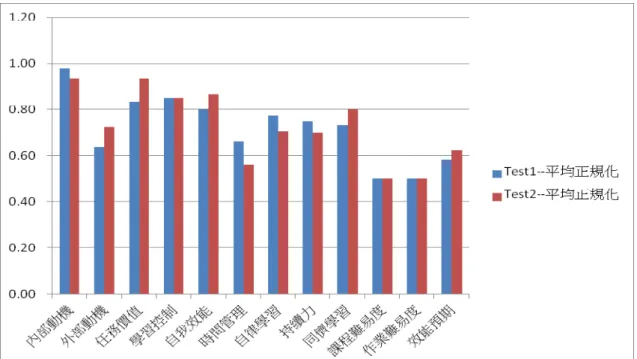
Comparing the two results derived from the two different weeks, there are some lower and higher percentages among the 12 categories. Below is a bar-graph showing the differences. In each pair of the bars, the blue ones are on the left (termed Test 1), and it is the result derived from the midterm week. The red ones are on the right (termed Test 2) and it is the result derived from the final week.
Figure 4. Bar-graph of the comparison of students’ motivation and learning strategies
Source: this study
The 5 items showing an increasing rate are those of external motivation, value of course tasks, learning ability and performance, peer learning (cooperative learning), and the learning outcome. The percentages of the other 3 items remained the same, and they are those of control of learning outcome, course difficulty, and assignment difficulty. Altogether these 8 items imply that the students were highly motivated and they were aware of the value of applying strategies.
Yet there are 4 items showing a decreasing rate, and they are those of inner motivation, time management, strategy management in terms of self-discipline, and persistence. The findings imply that these senior students might be too busy and even too tired to deal with the course, especially during the 4 weeks around the end of April and in May. They needed to deal with all kinds of things for their graduation, plus there was a big required translation written-test in this class. All these might mess up their time management and consequently lower their inner motivation.
Cross-checking with the means of each of the 85 questions supports the findings. There are about 15% of the questions got lower than 3.0, even as low as 2.1, and that’s because those questions are designed for the result that the lower points, the better. For example, question No. 12 “Regarding this course, my only interest is to pass.” It got 2.7 in the final week (2.4 in the midterm week). Question No. 15 “I do not care if I look more stupid than other classmates; however, I do care if I pass this course.” It got 2.7 (2.3 in the midterm week). Question No. 18 “I do not care what I have learned, all I care about is to pass this course. It got 2.4 (2.1 in the midterm week). In other words, the students were more confident for the first 10 weeks. However, along with the increasing difficulty of
this translation class and with their busy senior life, the expectation of passing the class turned relatively more important.
The online learning records and discussions also serve as data evidence. In the 50-30-20 assessment model,2 the students gradually noticed the significance brought by their own self-regulated learning, and consequently realized the importance of peer learning. Furthermore, their attitude toward the assigned American Cultural classroom changed. In the beginning they felt pressured when staying in the room, because that room was full of English-prompted decorations. Later they adjusted the environment because they knew that a room organized for English learning actually invited them to develop their language skills in purposeful ways.
Figure 5. A sketch of the Self-Regulated Learning steps
Source: this study
5. Conclusion
From the classroom observation, online-learning platform observation, and the result of the survey, the research indicates that this is a well-organized class. Furthermore, an official off-campus committee awarded this class as one of the Annual Excellent Classes of the school (教育部教學卓越計畫年度外審績優課程), and this record suggests the effectiveness of the course design.
Teaching does not happen unless learning takes place; therefore, to talk of teaching is to talk of learning. Communicative teaching is based on an attitude of knowing how students learn, a firm knowledge of how the content being taught, and an understanding of how students develop themselves individually. In order to reach these goals, taking this
2
The 50-30-20 assessment model contains 50% of attendance, online-learning assignments, presentations; 30% of English-Chinese translation written tests, and 20% Chinese-English translation written tests.
Student Peer-Review Sheets Student Online Discussion
Taking a Media Translation Class as an Example
media translation class as an example, here are some suggestions:
5.1 Clear course outline
Clearly explaining the course rationale and objectives with a diagram will help both teacher and student in finding their positions. Providing such an explanation should be regarded as a prerequisite of any teacher who wants to re-constructs his/her class. A clear class structure always serves as a process of scaffolding, and it also can be viewed as a “GPS” in both teacher’s and students’ mind.
5.2 Cooperative-learning activities
This is a “must” when conducting a social-constructivist course. According to Borich (2004), this step promotes a collective reasoning ability in a modern democratic society, and let the learners experience collective efficacy. Moreover, it is important to let students know the teacher has a full sense of participation. In other words, let students know that the teacher is also one of the cooperators. On the other hand, those better-level students can also play some guiding roles. Together it will make a good way of building collaborative dialogues and promoting social interaction.
5.3 Being in learners’ shoes
When the learners sense their ways of thinking is one of the components of the course, they will automatically form a “customized” class with their individualized performances, peer reviews, and online forum.
5.4 Promoting positive energy
Besides a sense of humor and a happy learning environment, this also means a chance of letting students develop their “possible selves” proposed by O’Donnell, Reeve & Smith (2007). “Possible selves” implies a self-expectation in a long-term manner. This translation class cannot guarantee all the students will become professional translators, but the positive energy, including the classroom setting, allow them to show their curiosity, creativity, and courage of expressing themselves.
In sum, helping college students in bettering their bi-lingual communicative competence first and then their Chinese-v.s.-English translation skills is the purpose of the implementation of this media translation class, and the study behind suggests that teaching translation as a language skill (TTLS) is a workable teaching strategy. It may provide language instructors with more constructive insights when teaching translation. Finally, there is always some space for improving the study and the course design, and it is welcome for a further discuss with the author.
References
Apple, M. W. (1979). Ideology and Curriculum. London: Routledge and Kegan Paul. Baker, C. (2006). Foundations of bilingual education and bilingualism (2nd ed.).
Clevedon, England: Multilingual Matters.
Bassnett, S. & Lefevere, A. (1998). Constructing cultures: Essays on literary translation. Clevedon, UK: Multilingual Materials.
Beane, J. A. (1997). Curriculum Integration-Designing the Core of Democratic Education. New York: Teacher College Press.
Borich, G. D. (2004). Effective Teaching Methods. 5th edition. New York: Prentice Hall.
Chellappan, K. (1991). The role of translation in learning English as a second language.
Corder, S. (1981). Error analysis and interlanguage. London: Oxford University Press. Corno, L., & Mandinach, E. (1983). The role of cognitive engagement in classroom
learning and motivation. In Educational Psychologist, 18, 88-100.
Corno, L., & Rohrkemper, M. (1985). The intrinsic motivation to learn in classrooms. In C. Ames & R. Ames (Eds.), Research on motivation: Vol. 2. The classroom milieu (pp. 53-90). New York: Academic Press.
Creswell, J. W. (2003). Research design: Qualitative and quantitative approaches (2nd ed.). Thousand Oaks, CA: Sage Publications.
Cross, B. E. (1995). The case for a culturally coherent curriculum. In James M. Beane (Ed.). Toward a Coherent Curriculum. Alexandria, Virginia: ASCD.
Dollerup, C. (2007). Basics of Translation Studies. Shang Hai: Shanghai Foreign Language Education Press.
Ellis, R. (1985). Understanding second language acquisition. Oxford: Oxford University Press.
Ellis, R. (1997). Second Language Acquisition. Oxford, UK: Oxford University Press. Ellis, R. (2003). The study of second language acquisition (2nd ed.). Oxford, UK: Oxford
University Press.
Garcia, O. (2009). Bilingual education in the 21st century – a global perspective. West
Sussex, UK: Wiley-Blackwell.
Gardner, H. (1985). Frames of Mind: The Theory of Multiple Intelligences. New York: Basic Books.
Gibbons, M. (2002). The Self-Directed Learning Handbook: Challenging Adolescent
Students to Excel. John Wiley & Sons.
Lauritzen, C., & Jaeger, M. (1997). Integrating learning through story: The narrative
curriculum. New York: Delmar.
Lee, K. C. (2001). What is self-regulated learning? Teaching and Resource Center, Ming Chuan University. November 30th, 2012 Retrieved from http://tlrc.mcu.edu.tw/zh-hant/node/111
Mcgroarty, M. (2001). Bilingual teaching methodology. In Celce-Murcia M. (Ed.)
Teaching English as second and foreign language (443-457). Taipei: The Thomson
Learning.
McLaughlin, B. (1978). Second language acquisition in childhood. New York: Lawrence Erlbaum.
Mehisto, P., Marsh, D., & Frigols, M. J. (2008). Uncovering CLIL: content and language
integrated learning in bilingual and multilingual education. Oxford: Macmillan
Education.
Nunan, D. (1999). Second language teaching and learning. Boston, Mass.: Heinle & Heinle Publishers.
Nunan, D. (2004). Research Methods in language Learning. Cambridge, UK: Cambridge University Press.
O’Donnell, A. M., Reeve, J., & Smith, J. K. (2007). Educational psychology – Reflection
for action. New York: John Wiley & Sons.
Pinar, W. (1975). Curriculum Theorizing: The Reconceptualists. Berkeley, California: McCutchan.
Pintrich, P., & De Groot, E. (1990). Motivational Self-Regulated Learning Components of Classroom Academic Performance. In Journal of Educational Psychology, 82(1), 33-40.
Richards, J. C., Platt, J., & Platt, H. (1998). Longman dictionary of language teaching
Taking a Media Translation Class as an Example
Schneider, M., & Fujishima, N. (1995). The case of a graduate ESL student. In D. Belcher & G.. Braineb (Eds.), Academic writing in a second language (pp. 3-21). Norwood, NJ : Ablex Pub. Corp.
Shohamy, E. (1994). The role of language tests in SLA theory construction. In E. E. Tarone, S. M. Gass, & A. D. Cohen (Eds.), Research methodology in second
language acquisition (pp. 133-142). Hillsdale, N.J.: Lawrence Erlbaum Associates.
Schon, D. (1983). The reflective practitioner. New York: Basic Books.
Snow, M. A. (2001). Second language and foreign language teaching in content-based teaching model. In Celce-Murcia M. (Ed.) Teaching English as second and foreign
language (387-408). Taipei: The Thomson Learning.
Taylor, M. (1986). Learning for Self-direction in the Classroom: The Pattern of a Transition Process. Studies in Higher Education, 11(1), 55-72
Zeichner, K. M., & Liston, D. P. (1996). Reflective teaching. New York: Lawrence Erlbaum Associates. 王珠惠 (2003)。大專口譯課程教案設計及實踐。翻譯學研究集刊,8,323-347。 李惠紅 (2010)。翻譯學方法論。北京:國防工業出版社。 李平 (2003)。論翻譯學的學科性質。外語研究,2,37-59。 呂俊、蘭陽 (1997)。從學科學的角度談翻譯學的建立。解放軍外語學院學報,2, 31-45。 吳錫德 (2009)。翻譯空間。台北市:書林出版。 柯平 (1997)。英漢與漢英翻譯。台北市;書林出版社。 黃宏偉 (1995)。整合概念及其哲學意蘊。學術月刊,9,12-17。 黃政傑 (1992)。課程設計。臺北市:東華書局。 張文軍 (1998)。後現代教育。臺北市:揚智出版。 張華 (2004)。世界課程改革趨勢研究(上卷)。北京市:北京師範大學出版社。 張嘉倩 (2009)。大學外語科系的中譯英教學:翻譯教學與英語教學的交會點。英 語教學,33,119-152。 張瓊瑩 (2010)。台灣大學生真的很被動嗎?英語系學生對於翻譯學習檔案的經驗 與看法,翻譯學研究集刊,13,293-318。 劉宓慶 (1997)。英漢翻譯訓練手冊。台北市:書林出版社。 廖柏森 (2007)。英語與翻譯之教學。臺北市:秀威資訊科技。 廖柏森、林俊宏、丘羽先、張裕敏、張淑彩、歐冠宇(2011)。翻譯教學實務指引─ 從 15 份專業教案開始。台北市:眾文圖書公司。 賴慈芸(2009)。譯者的養成:翻譯教學、評量與批評。台北市:國立編譯館。 謝天振 (1994)。比較文學與翻譯研究。台北市:業強出版。
Appendix
Appendix 1The result of the open-ended questionnaire on Teaching Advice
1. Do you have any comment on the contents of teaching materials? (Ex. textbook selection or the contents of slides, etc.)
In the midterm-week survey:
1. Very interesting class, but the classroom is a little bit crowded. 2. Very solid class. 3. No, the teaching materials are very useful. 4. No. Excellent. 5. No, I think it was great. 6. Very interesting, very touching-base. 7. The course content is very interesting. Never feel bored. 8. Excellent, very
matches what is happening in the world. 9. Everything is great. 10. Hope I can have more time to read the online materials.
In the final-week survey:
1. Professionally and technically, good job! 2. The reading is a challenge. 3. Can give us more articles to read. 4. Very vivid and interesting. 5. No suggestion. 6. Very good. 7. Perfect! 8.Very proper. 9. Challenging but interesting and vivid! 10. Great. 11. None. 12. The class is not too long but we learned a lot. 13. Nice materials and course design, very multi-cultural. 14. Good. 15. Very good.
2. Do you have any comment on the teacher’s teaching methods? (Ex. teaching by slides or white board; volume control, other areas requiring adjustment, etc.)
In the midterm-week survey:
1. May increase the use of projector. 2. May give us more supplementary vocabularies. 3. Quite fast, but the teacher always knows when to repeat, so I can still keep up. 4. Can give us more chance to practice speaking skill. 5. Hope the online materials can be printed out. 6. Watched a lot of news, and I learned a lot! 7. Nice interaction, good! 8. Good! 9. Good. 10. All are good. 11. good. In the final-week survey:
1. Level appropriate. 2. No! I like her teaching style. 3. Using news as the materials can increase students’ attention. 4. No suggestion. 5. Very well, no comment. 6. Perfect! 7. A;; very good. 8. Skype, PPT, and Youtube are good! Students would concentrate on it. 9. Good.
3. Do you have any comment on the teacher’s lesson progress? (Ex. too fast/too slow/appropriate.) In the midterm-week survey:
1. Appropriate. 2. A lot of the content, so it’s a little bit too fast. 3. Moderate. 4. Too fast. 5.
Excellent. 6. The class is tensed because the length of the whole class, and because the teacher is so diligent. 7. All on schedule. 8. Little bit slow. 9. It’s okay. 10. This is our last semester, only 14 weeks, so it’s a bit rushed.
In the final-week survey:
1. Just right, and interesting! 2. Sometimes a little bit slow , however , I learn lots in this class and realize more about the interpretation skills in media! 3. A little bit too fast. 4. Nice. 5. No suggestion. 6. I feel I learned a lot because each week there’s something new for me to learn. 7. Perfect! 8. A little bit too fast. 9. Fine. 10. In fact, the class is not too fast, it’s because the length of the whole course is short.
4. Do you have any comment on the exams, assignments, or reports requested by the teacher? In the midterm week survey:
1. Good arrangement. 2. The entire semester is too short so I didn’t have enough time to read all the materials. 3. A little bit too rushed because the content is much. 4. Totally ok. 5. So far so good. 6. Not enough activities before the midterm exam, but the quality of each activity is high. 7. Very ok! 8. No stress, I like it. 9. Nice.
In the final-week survey:
1. Appropriate. 2. Okay. 3. We are tested in a quite wide range of reading, good. 4. Nice. 5. Time reading parts is too tough.
5. Do you find any difficulties in learning through this course? If yes, what are they? In the midterm-week survey:
1. No, the level is right. 2. I don’t know enough vocabularies. 3. Translation skill is tough! 4. Translation is a difficult subject. 5. The Time reading is tough. 6. No difficulty. 7. I need to improve my own reading skill. 8. Challenging, and I enjoyed it.
In the final-week survey:
1. I made it, step by step. 2. I need to improve my listening comprehension. 3. Okay. 4. Not much. 5. Different weekly schedule, so sometimes it’s hard to find my group members after the class. 6. TIME magazine is a little bit too hard. 7. TIME is hard, but thank god the teacher tried her best to explain. 8. None. 9. Translation itself is a tough subject. 10, Don’t know my classmate well, so sometimes our group work is not very smooth. 11. This class makes me understand how tough translation can be.
6. Please describe other teaching advice for the teacher. In the midterm-week survey:
1. The teacher shred a lot of her own experience, it makes us closer, and makes us feel a strong sense of participation. 2. The teacher is good。3. Good. 4. I like your teaching style. 5. Excellent. 6. No. 7. The teacher is so into her work. 8. All are good. 9. Good job.
In the final-week survey:
1. The on-stage oral presentation is so challenging and interesting. I want to do more. 2. Okay. 3. I like the course because of the professional, lively, vivid teaching style. 4. She’s so kind and
Taking a Media Translation Class as an Example professional. 5. The teacher is so hard-working. 6. Good. 7. Good enough. 8. Good. 9. None, but overall is good.
Appendix 2
Sample of the questionnaire on Learning Motivation and Strategies (15 out of the total 85 questions)
Learning motivation (external motivation)
1. One of my goals to make myself look smarter than other classmates. 2. It is really important for me not to appear stupid.
3. Regarding this course, my only interest is to pass. Learning Motivation (thinking about course content)
4. I think I can apply what I have learned in this course to other courses. 5. It is really important to learn the content of this course.
6. I am really interested in the content of the course. Learning Motivation (control of learning outcome)
7. I think I can apply what I have learned in this course to other courses. 8. It is really important to learn the content of this course.
9. I am really interested in the content of the course.
Learning Motivation (anticipation of learning ability and performance) 10. I believe I can earn a good score for this course.
11. I believe I can understand the most difficult content of this course. 12. I am confident that I can understand the basic concepts of this course. Time Management
13. I will follow the schedule to study for this course. 14. I will take time to study for this course.