March, 2013
Is Reading The Last Song Effective for Improving Reading
Speed, Reading Comprehension,
and General English Reading Proficiency? :
An Investigation into the Power of Extensive Reading Using a
Bestselling Original Novel
Shih-fan Kao
∗Abstract
This study investigated the power of extensive reading for pleasure by using a popular original novel, The Last Song, as the material to improve learners’ reading speed, reading comprehension, and general English reading proficiency. With intermediate or high-intermediate level of English proficiency, 15 adult participants at Acme Language Institute (ALI), a private language school, received the extensive reading treatment for 10 weeks. The 15 participants were taking a course entitled Novel Reading taught by Bruce, an American teacher who adopted the extensive reading approach. The participants took the pre-test (before the beginning of the class) and post-test (after the end of the class) on reading speed, reading comprehension, and general English reading proficiency developed and administered by ALI. Paired-samples t-test was conducted to check if there was significant progress in the participants’ scores between the pre-test and post-test. Furthermore, each participant was interviewed once after the post-test to check the reliability of the quantitative data. The results showed that due to the characteristics of extensive reading (such as the purposes of reading usually being related to pleasure, information, and general understanding, etc.), the 15 participants significantly enhanced their reading speed and reading comprehension after the treatment. In addition, the results also indicated that by increasing a considerable amount of reading input from the 463-page novel for 10 weeks, the 15 participants significantly improved their overall English reading proficiency including vocabulary usage, grammar knowledge and reading ability. Moreover, data from interviews also showed that all 15 participants expressed positive attitudes toward reading the original novel in the extensive reading approach. As a result, the findings suggested that reading a bestselling original novel extensively is an interesting, effective, and natural way to motivate ESL/EFL learners to become autonomous language acquirers. The pedagogical implications and the limitations of this study were discussed in the end.
Key words: extensive reading, original novel, reading speed, reading comprehension,
ESL/EFL reading
∗
Assistant Professor, Department of Applied Foreign Languages, Jinwen University of Science and Technology.
第七期,頁 37-58 二○一三年三月
閱讀《最終一曲》能有效地增進閱讀速度、理解度、及整體英
文閱讀能力嗎?:
一個檢驗用暢銷原著英文小說來作廣泛閱讀材料的實驗研究
高士凡
∗摘要
本論文的主要目的在檢驗使用暢銷原文小說《最終一曲》來作為樂趣閱讀教材 是否能增進英文學習者的閱讀速度、理解度、及整體英文閱讀能力。參與研究者為 十五位當時在一美語機構 ALI 修習小說閱讀課的成人學員,參與者的英文程度約為 中級至中高級,他們接受美籍教師 Bruce 為期十週的小說閱讀課。參與者在使用廣 泛閱讀方法閱讀『最終一曲』的課程開始前及結束後均接受閱讀速度及理解度測驗, 和 ALI 所設計的英文閱讀能力測驗〈含單字、文法、與閱讀三部分〉。在資料分析方 面,SPSS 統計分析軟體的成對樣本t檢定來檢測前測與後測的平均數是否有統計上 顯著的不同。此外參與者也在後測後接受訪談有關對 Bruce 課程的看法。結果顯示 出:在經過十週使用廣泛閱讀方法閱讀暢銷小說的課程後,十五位參與者不只在閱 讀的速度和理解度有顯著的增加,也在整體英文閱讀能力上有顯著的進步。另外, 十五位課程參與者在訪談時也都表達了他們對 Bruce 老師使用暢銷原文小說作樂趣 閱讀教材的正面態度與看法。因此,本論文的結果指出:使用暢銷原文小說作樂趣 閱讀教材,並搭配使用廣泛閱讀方法來閱讀是既有趣又有效的自然英語習得方法, 而且更能激勵英語學習者變成獨立主動的語言習得者。最後,本論文也探討研究結 果可帶來的教學啟示,和研究本身的限制。 關鍵詞:廣泛閱讀、原文小說、閱讀速度、閱讀理解度、英語為第二語言閱讀/英語 為外國語言閱讀 ∗ 景文科技大學應用外語學系助理教授。 到稿日期:2012 年 7 月 3 日;確定刊登日期:2013 年 3 月 14 日;最後修訂日期:2013 年 3 月 29 日。An Investigation into the Power of Extensive Reading Using a Bestselling Original Novel
39
Introduction
In Taiwan, the status of English is a foreign language and not a second language. For this reason, it might be hard for students here to develop their reading skills effectively or in a native-like manner since they simply do not have a good reading “environment.” From my observation, if an English book comes out in both versions of English and Chinese, most Taiwanese will read just the Chinese version for their convenience. Thus, it is necessary for us as English teachers to teach and train students to read extensively to reach native or native-like proficiency while they are still at school.
It is understandable that English learners in Taiwan do not often enjoy reading English texts because from the learners’ perspectives, students at regular schools often have a negative reaction to prescribed English readings that often focus on grammar and linguistic aspects. Indeed, most language textbooks are very instructional, de-motivating students to read outside the classroom. Interestingly, when asked about what their reading problems were, students almost always told me that the problems were mostly unfamiliar words and grammar. Then I asked them why they were not interested in the textbooks because the textbooks targeted their main language difficulties and met their needs. The students expressed that almost all the textbooks were not story-based and thus less fun. Also, students felt that they were always learning English and not enjoying the texts or real information every time they read English texts. They did not know when they could stop learning English words and start to enjoy the information about the English texts.
For these reasons, reading story-based books extensively is one of the best ways to motivate students to read (much) longer English texts outside the classroom. Furthermore, another commonly recognized problem faced by ESL/EFL (English as a second/foreign language) learners is slow reading (Bell, 2001). This has often been linked with traditional classroom methodology in reading lessons that mainly focus on language development rather than reading per se. Thus, now many ESL/EFL teachers train their students to read extensively by using interesting, story-based graded readers in order to motivate them to read more English texts as well as increase reading speed.
The term of extensive reading refers to a large amount of reading with a focus on the meaning of the text. Simply put, the attributes of extensive reading include the fast reading of a large amount of longer and easy-to-understand materials, with little or no accountability such as tests after reading (Powell, 2005). Extensive reading has real-world purposes in reading because reading extensively has the advantage of being both informative and pleasurable (Iwahori, 2008). From the training of extensive reading, students are more likely to continue reading English texts after they leave school (Kao, 2009a, 2009b). In addition, language-wise, research has shown that extensive reading can improve students’ linguistic abilities such as reading speed and comprehension, vocabulary acquisition, grammar, writing, mechanics including spelling and use of punctuation, etc. (Krashen, 2004).
However, most previous studies regarding the effects of extensive reading in ESL/EFL contexts usually adopted graded readers as the reading material. In my opinion, reading English texts that are mainly for English speakers such as novels and newspapers should be one of the most important objectives in ESL/EFL education. Therefore, the purpose of this paper was to investigate whether reading a popular novel written for English-speaking adults could enhance EFL learners’ reading speed and comprehension, and general English reading proficiency.
Literature Review
Definition, Characteristics, and Theoretical Frameworks of Extensive Reading
As its literal meaning, extensive reading means to read widely and in large quantity with the aim of getting the gist of the longer materials. In other words, extensive reading aims to let ESL/EFL students enjoy reading English materials and not learning vocabulary and grammar consciously. However, these students can acquire the English language simultaneously via extensive reading too. Bamford and Day (2004) provided some important features of extensive reading. These essential characteristics of extensive reading are:
1. a variety of reading with various topics and levels of language difficulty should be available;
2. learners choose what they want to read;
3. the purposes of reading are related to pleasure, information, and general understanding;
4. the reading material should not be too hard and should be within the linguistic competence of the EFL learners;
5. there are no follow-up exercises after reading.
In addition to the above characteristics, Ono, Day, and Harsch (2004) offered some tips for teachers who would like to use the extensive reading approach. They suggested that teachers have students avoid using dictionaries and train them to skip or guess the unknown or unfamiliar words, phrases, and expressions. This is in contrast to the traditional practice in ESL/EFL language teaching pedagogy, which often encourages students to use dictionaries and memorize the words they do not know. Moreover, teachers should encourage students to simply stop reading if the texts they are reading are not interesting. Following the general principles and tips, studies on extensive reading have shown that their participants improved in many linguistic areas such as reading speed and comprehension (Bell, 2001; Sheu, 2003), reading strategies (Hayashi, 1999), vocabulary acquisition and spelling (Krashen, 2004; Nation, 1997), grammar knowledge (Tudor & Hafiz, 1989), motivation and attitudes (Constinito, 1995), writing skills (Mason & Krashen, 1997), listening and speaking (Cho & Krashen, 1994), and second language acquisition (Mason, 2007), etc.
In the field of extensive reading, Stephen D. Krashen, an Emeritus Professor of University of Southern California, might be one of the strongest advocates that we cannot miss. He proposed two hypotheses as the theoretical frameworks supporting extensive reading: the Input Hypothesis (1985) and the Pleasure Hypothesis (2004). According to Krashen (1982, 1985, 1989), language learners acquire languages by understanding messages in a low anxiety context. Particularly, Krashen (1989) explained his Input Hypothesis by stating “comprehensible input is the essential environmental ingredient—richly specified internal language acquisition device also makes a significant contribution to language acquisition” (p. 440). In other words, language learners subconsciously acquire the target language when the language acquisition device is involved. By focusing on meaning rather than form, language learners are less conscious of language acquisition and will achieve what is called “incidental learning” (Krashen, 1989, p. 440). If the Input Hypothesis is correct, the more comprehensible input including aural and written input is provided, the more language acquisition occurs.
The Input Hypothesis also emphasizes the importance of a low anxiety context in order to acquire language. For this reason, Krashen proposed the Pleasure Hypothesis (2004): any pedagogical activities that help language learners acquire a second language
An Investigation into the Power of Extensive Reading Using a Bestselling Original Novel should be enjoyable, “but enjoyment does not guarantee language acquisition” (p. 28). He further stated that there is evidence that free voluntary reading (i.e. extensive reading) outside the classroom is very pleasing.
Following the predictions of Krashen’s two hypotheses, many previous studies mentioned above showed results that supported the Input and Pleasure Hypotheses. In the extensive reading programs of those studies, ESL/EFL learners could choose reading materials whose levels were comprehensible for them. Thus, they got a considerable amount of so-called comprehensible input. Also, those extensive reading programs were conducted in low-anxiety contexts such as reading just for pleasure, no follow-up exercise or quizzes, etc. In addition, it should be noted that comprehensible input is effective on any levels of language learners because the English proficiency among participants in those previous studies were heterogeneous.
Relationships Between Extensive Reading and Reading Fluency
Previous research also showed that extensive reading helps language learners read faster over time. Decoding words automatically is essential for reading speed. The researchers have called words that learners, while reading, can recognize rapidly, accurately, and automatically sight vocabulary (Iwahori, 2008). When learners encounter the same words in reading many times, these words may become their sight vocabulary (Day & Bamford, 1998). For this reason, sight vocabulary is fundamental for improving reading speed. When learners have a larger sight vocabulary, they decode more words automatically. Also, it is critical that learners have opportunities to keep encountering the words that they saw before. As a result, researchers recommended extensive reading to increase reading speed (Lai, 1993; Bell, 2001).
In Lai’s study (1993), three treatment groups (no control group) were involved. Lai conducted the study on the first treatment group in 1988, second in 1989, and third in 1991. Participants in the three treatment groups were secondary students at three different schools in Hong Kong, and their English proficiency was heterogeneous. Participants took the pre-tests and post-tests, and the researcher used the t test to compare mean differences within groups. The results of the post-tests showed that in terms of mean rate, treatment group 1 improved from 165 to 226 wpm (words per minute), treatment group 2 from 85 to 181 wpm, and treatment group 3 from 106 to 121. The t-tests showed that the differences between the pre-tests and post-tests of the first two treatment groups were statistically significant, but not in the third treatment group. Lai concluded that both extensive reading programs in summer (treatment groups 1 and 2) displayed a great deal of improvement in reading speed.
Bell’s (2001) study was another significant one often mentioned in literature regarding reading speed. The main purpose of Bell’s study was to probe into whether or not extensive reading can improve reading speed. Bell conducted his study over two semesters in Yemen to check if young adult students whose English proficiency was at the beginning level could increase their reading speed through extensive reading. There were control and experimental groups in his study. The experimental group received extensive reading, while the control group received traditional intensive reading that focused mainly on reading short texts and analyzing the texts for grammar, vocabulary and collocations, and sentence structures. The mean rates on the post-tests showed that the experimental group improved from 68.10 to 127.53 wpm and the control group from 78.45 to 92.54 wpm. The t-test also showed that the difference for means between two groups were statistically significant. In other words, the results indicated that the students in the extensive reading group read faster than students in the intensive reading group did.
Relationships between Extensive Reading and Reading Comprehension
Reading speed without proper comprehension is worthless. For this reason, reading fluency should depend on both appropriate reading speed and reading comprehension (Reutzel, 2006). However, it seems to vary from scholar to scholar when it comes to “appropriate” reading speed and reading comprehension. Neil, J. Anderson (1999), a distinguished professor and ESL/EFL textbook author in second language reading, suggested that ESL/EFL learners should aim to read English texts at their own levels and at least 200 words per minute with at least 70% comprehension. If the learners can reach the goal of 200 wpm with 70% understanding, it is appropriate reading fluency including reading speed and reading comprehension.
It is interesting to note that the previous studies showed differences in whether or not extensive reading can help language learners develop their reading comprehension (Shang, 2007). For example, Lai’s (1993) study, as described above, showed that only one treatment group achieved significant improvement in reading comprehension, while the other two did not. Lai gave the explanation as “for global understanding didn’t seem to enhance reading comprehension effectively” (1993, p. 29). It seems to make sense that extensive reading might not be an efficient way to improve reading comprehension since its main purpose is to get the gist of longer texts. By giving the participants in the experimental group extra extensive reading, Gao’s (2004) study also showed that the extensive reading program did not significantly lead to improvement in reading comprehension compared to the traditional intensive reading approach. On the other hand, based on the data from her participants’ opinions, Shang (2007) concluded that extensive reading can improve students’ reading comprehension. While reading extensively, students can acquire more words, enhance their reading ability, and improve access to background information, all of which lead to better reading comprehension. Therefore, it does not seem to be a consensus that extensive reading can certainly help ESL/EFL learners enhance reading comprehension.
As discussed above, most previous studies showed that extensive reading can help ESL/EFL learners develop their English proficiency and reading speed. However, almost all studies gave participants extensive reading treatments by using simplified texts or graded readers that usually are written for non-native speakers of English. Few studies about extensive reading were conducted in the ESL/EFL situations by using original readers that are for English-speakers. In her guide to reading levels and suitable reading materials, Carolyn (1997) suggested that an ESL learner at intermediate level or above should start to read unsimplified material and graded readers in equal proportions. Furthermore, an ESL learner at the advanced level should read mainly unsimplified material such as newspapers, magazines, novels, and academic subject materials.
In fact, research as yet has not investigated the effects of books for native learners on ESL/EFL learners’ language acquisition, and thus, it is pertinent to address this issue for expanding resources for extensive reading programs. In my opinion, reading the unsimplified material should be the main goal of reading education. In other words, ESL/EFL learners should be able to read what native speakers of English are reading. For this reason, this study was to investigate whether or not EFL learners in Taiwan can improve their reading speed and comprehension, and enhance their general English reading proficiency as well by reading a popular novel extensively that is mainly written for English-speakers. Based on this purpose, this study was designed to answer the following questions:
1. Did the adult EFL learners significantly increase their reading speed by reading an original novel in the extensive reading approach?
An Investigation into the Power of Extensive Reading Using a Bestselling Original Novel reading an original novel in the extensive reading approach?
3. Did the adult EFL learners significantly improve their general English reading proficiency by reading an original novel in the extensive reading approach?
Method
Generalizability is often one of the major concerns in scientific research. In the field of education, Merriam (1998) suggested that a description of the context and participants is helpful to those who are interested in making decisions about if generalizability could be appropriate in other settings. For this reason, this methodology section has three parts. The first part concisely depicts the research site, the instructor of the extensive reading program, and the participants, all of which can add to the generalizability of the results presented afterwards (Lincoln & Guba, 1985). The other two describe material, and data collection and analysis.
Research Site, Instructor, and Participants
The research site of this study was Acme Language Institute (ALI),1 a private English school in Taiwan that mainly helped adult learners pass English standardized tests like TOEFL (Test of English as a Foreign Language) and TOEIC (Test of English for International Communication) and improve their English proficiency. Besides the standardized-test courses, ALI also offered over 20 English courses for specific purposes such as News English, Time Magazine Reading, Novel Reading, English Writing, etc. To let students and teachers have access to more English materials, ALI had offered a small library that had many materials including many brands of ESL/EFL graded readers such as Oxford Bookworms, Cambridge English Readers, Penguin Readers, etc.,2 and popular novels and magazines that were mainly for English-speakers such as The Firm by John Grisham, Vogue, etc.
The extensive reading program involved in this study was Novel Reading. The 10-week class ran three hours (from 7:00 to 10:00 pm) on Friday nights. Novel Reading was a cycled course with 10 weeks. In other words, students could register Novel Reading again after they had finished one. The reading material chosen would not be the same for each 10-week class.
When the data of this study were collected, the Novel Reading class was instructed by Bruce, an experienced American teacher with a Master’s degree in Teaching English to Speakers of Other Languages (TESOL). Bruce had 20 years of experience in teaching English in some Asian countries such as Taiwan, Japan, and Thailand. He said that he himself was an extensive reader, and usually practiced extensive reading in his own class. He had been teaching Novel Reading at ALI for around two years when this study was being conducted. Bruce preferred bestselling novels (thereafter, original novels) that were mainly for native speakers of English because he believed that reading original novels for recreation should be one of the ultimate goals for ESL/EFL learners. Of course, he agreed
1
In order to protect privacy, all names mentioned in this paper including the language school, program instructor, and participants mentioned later are pseudonyms.
2
Oxford Bookworms readers are simplified texts designed by Oxford University Press, one of the world famous educational publishers, to provide English learners with the joy of pleasure reading. Oxford Bookworms readers provide a wide range of graded readers in seven stages from Starter (250 headwords) to Stage 6 (2500 headwords). Similarly, Cambridge English Readers are designed by Cambridge University Press and published in seven levels from Starter (250 headwords) to Advanced (3800 headwords). Penguin Readers are designed by Longman and published in seven levels from Easystarts (200 headwords) to Advanced (3000 headwords).
that ESL/EFL learners should reach an intermediate or above level of English proficiency in order to read original novels. However, he also believed that after the ESL/EFL learners reached an intermediate level of English proficiency, he/she should read only materials that are mainly for English-speakers in order to acquire language intuition and native-like proficiency. Interestingly, he did not think that reading graded readers was very helpful in reaching a native-like proficiency in the long run. Instead, he thought that reading graded readers might mainly motivate ESL/EFL learners to read English texts. In addition, Bruce believed that the best original novels used in the ESL/EFL classroom should be light and bestselling novels without profound philosophical metaphors and interpretations. For these reasons, he had adopted original novels that were usually very popular as reading material in his Novel Reading class at ALI such as Twilight (by Stephenie Meyer), P.S. I
Love You (by Cecelia Ahern), etc.
The 15 participants were all adult learners aged 23-45. They were taking Novel Reading at ALI for personal interest, English learning, career promotion, or future overseas studies. Each participant took a TOEIC-like test at ALI and their scores ranged from 690 to 800. These scores were considered as an intermediate or above level.3
Material
ALI had a small but nice library where its students could check out books and bring them to read either in class or at home. The library included not only many graded readers but also popular original novels by famous writers such as John Grisham, Stephen King, Tess Gerritsen, Michael Crichton, Nicholas Sparks, Stephenie Meyer, J. K. Rowing, Sara Shepard, etc. After introducing some works by these bestselling novelists, Bruce made (or sort of forced) his students go to the ALI library and look for any original novels that interested them. Then the students discussed and selected which one they preferred to use in class. In other words, it was the students, not Bruce, who decided which original novel would be adopted in class. In this study, the 15 participants chose The Last Song (by Nicholas Sparks) as the reading material. The participants made this final and unanimous choice because almost all of them (13 participants) had watched the box-office romance movie The Notebook based on the same title by Sparks.
As for Bruce’s view on The Last Song, he recalled that the students were very interested in this story from the beginning and the literacy level of the novel fit their language proficiency as well. Bruce further said, “The Last Song was a very enjoyable read. Sparks had a strong plot allowing his characters to learn and grow from their experiences. Also, the powerful emotions that Sparks brought to readers were so touching that they brought us to tears. It was truly a very fluent and expressive work of the human heart and brought great joy to me as a reader.” (B. Peckham, personal communication, August 31, 2012).
Most popular original novels were rather thick and The Last Song was no exception. It had 463 pages. Based on his previous experience, Bruce could only cover 15-20 pages in a weekly three-hour class. For this reason, students were assigned to read around 30 pages in their own time and pace after each class in order to finish the entire book within 10 weeks. Bruce would not cover the assigned 30 pages in class though he did check
3
ALI gave its students two free and compulsory English proficiency tests: one was before the first class and the other after the last class. The English proficiency test developed by ALI included listening and reading. For this reason, the 15 participants took the first English proficiency test before they attended their first class. After 10 weeks, they took the second one right after the Novel Reading classwas over. The reading sections of two proficiency tests the 15 participants took were used as the pre-test and post-test to measure participants’ progress in language proficiency in this study. The reading section consisted of 100 questions including three parts: vocabulary (40 items), grammar (20 items), and reading comprehension (40 items). The administration of the English proficiency test took approximately 75 minutes.
An Investigation into the Power of Extensive Reading Using a Bestselling Original Novel students’ understanding in the beginning of each class. In class, Bruce read the story to the students, stopped at a certain paragraph, and then asked the students if they had any questions. Meanwhile, Bruce and his students also discussed plots that interested or confused the students. Overall, Bruce made three simple rules in his reading class. First of all, using dictionaries was not allowed in his class because it was not a pleasure reading when everyone was looking up words in the dictionaries. Second, students were free to guess words, phrases, and expressions they did not understand in The Last Song, or to just ask him in class if the uncertainties did interfere with their reading. From my observation, most of the students’ questions were either language-related or meaning-related questions. When students did not understand some words or phrases, Bruce often told them the answers in simple synonymous words or phrases. As for meaning-related questions, Bruce summarized what he just read to the class in plain English to affirm that everybody understood it. Third, the classroom language was only English.
In my opinion, the teaching of Bruce’s novel reading class could be certainly considered a great example of the extensive reading approach due to some obvious characteristics.4 First of all, students chose the reading material. Second, students read the novel primarily for general ideas and pleasure instead of intensive English learning. What Bruce did in class was basically to read the story to his students, check their understanding about what he read, and sometimes answer their questions if they had any. Last, there were no follow-up tests or reports. According to Bruce, the 15 participants were not forced to read the assigned 30 pages in their own free time after each class, but they were strongly encouraged to do so because the 30-page reading was for pleasure and not for tests. Although finishing reading a 463-page novel within 10 weeks was not an easy task for these EFL participants, every single one of them had perfect attendance in Bruce’s class.
Data Collection and Analysis
For research purposes, the operational definition of reading speed in this study was the speed measured in words per minutes on a selected text at a level appropriate to the learners’. Likewise, reading comprehension was operationally defined as a score on a test after the selected text accompanied by comprehension-check questions.
There were two commonly used methods to measure reading speed in previous studies (Iwahori, 2008). The first one was a one-minute reading. It means that the learners read a text with the time being recorded, and after exactly one minute, they mark where they reach in the text. The other method was the entire text method. In this method, the learners read an entire text and count how much time they spend. Then the reading speed is the word number of the text divided by the time spent. The entire text method was described as a more authentic reading measure because the learners read a whole text just as people usually do in the real world (Rasinski, 2003). Thus, this study adopted the entire text method. Two readings from Nation and Malarcher’s Reading for Speed and Fluency 4 (2007), which was designed for ESL/EFL learners with an intermediate or above level, were used to measure the reading speed before and after the Novel Reading class. The 15 participants read Nation’s readings and pressed the stopwatches beside them as soon as
4
Here, I would like to thank ALI and Bruce for allowing me to observe his 10-week Novel Reading course. My role was mainly an observer though I read The Last Song by following Bruce’s syllabus and attended each class meeting. However, I neither spoke a word nor participated in any class activities during the entire treatment because I wanted to be a neutral figure “who does not change the situation in any way that might affect the data” (Bogdan, 1972, p. 21). I would also like to thank the 15 student participants for letting me read The Last Song and enjoy the pleasant journey of extensive reading with them for 10 weeks.
they finished the readings. Then they answered the eight multiple-choice comprehension questions after each reading. The administration of this reading speed and comprehension test took 10 minutes.
As for general English reading proficiency, it was defined as a combined knowledge of vocabulary, grammar and reading ability. For this reason, the reading sections of the English proficiency tests developed by ALI were adopted for the pre-test and post-test. To test the null hypothesis that there were no significant differences between the means in reading speed, reading comprehension, and general reading proficiency for the pre-test and post-test, paired-samples t-tests were run and the alpha decision level was set at 0.05. In addition to the pre-test and post-test, all the 15 participants were interviewed once after the post-test and each took around 60 minutes.5 To be flexible and to explore possible emerging issues, semi-structured interview questions (see Appendix) were adopted because they were open-ended and less structured (Merriam, 1998). Moreover, semi-structured interviews were conducted to confirm the findings of the statistical tests and increase the trustworthiness of the research data in social science and humanities (Creswell, 2003).
Results and Discussion
This section includes three main parts. The fist part shows the results of statistical tests and discusses the findings and the second briefs interview data about the 15 participants’ opinions toward reading the original novel extensively. The last part discusses pedagogical implications from the quantitative and qualitative findings of this study.
Quantitative Data
Table 1 shows the descriptive statistics and significance of differences between the pre-test and post-test in reading speed and reading comprehension.
Table 1
Paired-Samples t-tests in reading speed and reading comprehension for pre-test and post-test Pre-test Post-test Variable M SD M SD t Reading Speed 189.60 5.53 233.60 7.77 22.46*** Reading Comprehension 4.93 0.59 7.13 0.74 7.87*** Note. N = 15. ***p < .001.
A descriptive mean comparison between the pre-test and post-test for the two variables (reading speed and reading comprehension) indicated that the 15 participants with an intermediate or high-intermediate level of English proficiency did perform better on the post-test. For example, participants scored better on the post-test than pre-test by 44 wpm (words per minutes) in terms of reading speed. In addition, the results of the t-test showed that the 44-word mean difference for reading speed was statistically significant (p < 0.001). Statistically speaking, the 44-word difference in the means of reading speed between the pre-test (in which the 15 participants had not read The Last Song in the extensive reading approach) and the post-test (in which the 15 participants received the
5
Besides the two free tests offered by ALI, all the 15 participants knew too that they would take the two reading speed and comprehension tests (before and after the class) and be interviewed once (after the class) when they signed up for Bruce’s class.
An Investigation into the Power of Extensive Reading Using a Bestselling Original Novel treatment of reading The Last Song extensively for 10 weeks) probably did not occur by chance alone (99.9 percent sure). That is, after the 10-week extensive reading treatment by reading the original novel, there was a statistically significant improvement in reading speed from the pre-test (M = 189.60, SD = 5.53) to the post-test [M = 233.60, SD = 7.77,
t(14) = 22.46, p < .001].
Along the same line, the paired-samples t-test also showed that there were a significant difference in reading comprehension (p < .001) between the pre-test and post-test. Furthermore, the 2.20-point improvement in reading comprehension probably did not occur by chance alone (99.9 percent sure). That is to say, after the 10-week extensive reading treatment by reading the original novel, there was also a statistically significant improvement in reading comprehension from the pre-test (M = 4.93, SD = 0.59) to the post-test [M = 7.13, SD = 0.74, t(14) = 7.87, p < .001]. It should be noted that as mentioned previously, reading speed without proper comprehension is meaningless and worthless. Most reading experts such as Anderson (1999) and Nation (2009) thought that 70% comprehension is needed. In this study, the 15 participants reached 89.13% (7.13/8*100) comprehension on the post-test, along with 233.60 wpm in reading speed. For this reason, both improvements in reading speed and reading comprehension could be meaningfully interpreted afterwards.
As a result of the above findings, the 15 participants made significant progress in both reading speed and reading comprehension after reading the original novel entitled
The Last Song in an extensive approach for 10 weeks.
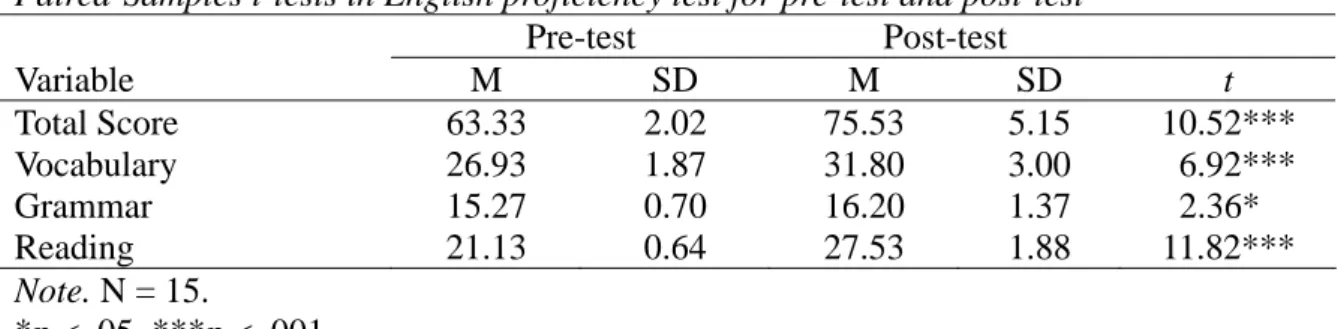
Table 2 displays the descriptive statistics and significance of differences between the pre-test and post-test in general English reading proficiency including three sections: vocabulary, grammar, and reading.
Table 2
Paired-Samples t-tests in English proficiency test for pre-test and post-test
Pre-test Post-test Variable M SD M SD t Total Score 63.33 2.02 75.53 5.15 10.52*** Vocabulary 26.93 1.87 31.80 3.00 6.92*** Grammar 15.27 0.70 16.20 1.37 2.36* Reading 21.13 0.64 27.53 1.88 11.82*** Note. N = 15. *p < .05, ***p < .001.
A descriptive mean comparison between the pre-test and post-test for all the four variables (total score, vocabulary, grammar, and reading) demonstrated that the 15 participants performed better on the post-test. Take total score for example. Participants scored better on the post-test than pre-test by 12.12 points. Moreover, the results of the
t-test showed that the mean difference for the total score were statistically significant (p <
0.001). The 12.12-point difference in means on the general English reading proficiency test between the pre-test (in which the 15 participants had not started to read the original novel) and the post-test (in which the 15 participants finished reading the original novel after 10 weeks) probably did not occur by chance alone (99.9 percent sure). That is, after the 10-week extensive reading treatment by reading The Last Song, there was a statistically significant improvement on the general English reading proficiency test from the pre-test (M = 63.33, SD = 2.02) to the post-test [M = 75.53, SD = 5.15, t(14) = 10.52,
p < .001].
differences in vocabulary (p < .001), grammar (p < .05), and reading (p < .001) between the pre-test and post-test if the English proficiency was further analyzed by its three main sections. And, these mean differences in vocabulary (4.87 points), grammar (0.93 points), and reading (6.40 points) probably did not occur by chance alone either. In other words, by reading the original novel in the extensive approach for 10 weeks, not only did the 15 participants significantly improve their general English reading proficiency as a whole, but they also significantly improved their vocabulary, grammar, and reading, respectively.
It is interesting to note that the participants gained least (0.93 points) in the grammar section compared with the other two sections on the general English reading proficiency test. The significant was also less conservative (p < .05) too. This finding was consistent with Kao’s two previous studies (2009a, 2009b) on extensive reading. By using graded readers as the material in the treatment of extensive reading, the results of Kao’s two studies showed that his participants improved significantly in vocabulary and reading ability, while they improved only slightly in grammar with either significance (2009a) or insignificance (2009b). This finding was consistent with previous studies as well. Reviewing previous studies on extensive reading, Krashen (2003) found that after the extensive reading treatment, the experimental groups either outperformed the control group (often being taught by the traditional instruction with emphasis on vocabulary, grammar rules, and sentence structures) or performed as well as the control groups in grammar. Why did the participants with the extensive reading treatment make significant gains in vocabulary and reading ability but modest gains in grammar in both this study and previous research? My personal interpretation for the modest effect of extensive reading on grammar in this study is that when reading extensively, the 15 participants paid full attention to the story and plot developments, not grammar and sentence structures. The peripheral attention to grammar and sentence structures might slow down the participants’ acquisition of grammar knowledge. Furthermore, many original novels (including The Last Song) are story-based with many conversations. Language-wise, many sentences in The Last Song were incomplete due to the nature of daily conversation. When reading the novel extensively with faster speed for pleasure, these EFL adult learners might not be very aware of the accuracy of the surface structures. For these reasons, the 15 participants in this study did make gains in grammar with significance after the treatment. However, the gains were modest and the significant level was less conservative.
Summing up the first part of this section, the analyses of the above descriptive and inferential statistics display that there was significant improvements in reading speed and reading comprehension after the 15 participants received the 10-week treatment by reading the original novel in the extensive reading approach. Furthermore, the 15 participants also significantly improved their overall English reading proficiency including vocabulary, grammar, and reading after the treatment. The quantitative data of this study confirmed the power of extensive reading by adopting an original novel.
Qualitative Data
The purpose of the interviews was to understand how the extensive reading treatment by reading the original novel improved participants’ reading speed, reading comprehension and English proficiency, as well as changed their attitudes toward English reading. The qualitative data from the interviews were also to confirm the above-discussed quantitative data from statistical analyses.
Generally speaking, all the 15 participants expressed positive attitudes toward reading The Last Song extensively. Four thematic findings were discovered from the interview data. First of all, the participants felt that reading the original novel made them
An Investigation into the Power of Extensive Reading Using a Bestselling Original Novel read faster and more fluently. On average, they had to finish reading 46 pages every week (in class and out of class). All the 15 participants had full-time jobs during the daytime. In order to keep up with Bruce’s teaching pace, the participants unconsciously learned how to get the main points and how to keep reading without paying much attention to the unfamiliar words, phrases, and expressions in The Last Song. For example, Cindy (Participant 2 in my data coding) told me that while reading The Last Song, she usually just guessed the words and expressions she was not sure of and kept on reading. The following paragraph from The Last Song (2009) was the example Cindy used during the interview:
And when they did, it was just as her father had described it. The sun flooded through the glass, splitting into hundreds of jewel-like prisms of glorious, richly colored light. The piano stood in a waterfall of brilliant color, and for a moment Ronnie pictured her father sitting at its keys, his face upturned to the light. It didn’t last long, but she squeezed Jonah’s hand in silent awe. Despite the weight of her grief, she smiled, knowing that Jonah was thinking the same thing (p. 449).
Cindy said that she was not really sure about what it meant by “splitting into hundreds of jewel-like prisms of glorious, richly colored light” because she forgot the meaning of the word prism. However, she simply guessed that the phrase might mean “different colors coming from the glass.” Similarly, she interpreted “silent awe” as “solemn silence” since the context was in Ronnie’s father’s memorial service. All the 15 participants said that they read faster and more fluently by guessing the language they were not familiar with from the contexts. They also recalled that they almost never looked up words in the dictionaries either while reading The Last Song out of class.6 They sometimes did ask Bruce some unfamiliar expressions in class, though.
The second finding was related to the first. That is, in order to read faster and enjoy the story, the participants were developing the habit of tolerating the ambiguity of the texts while under Bruce’s instruction. All the 15 participants said that they became more tolerant of text ambiguity as time went by. During the period of the extensive reading treatment via the original novel, they were getting accustomed to the uncertain texts by not getting frustrated and by continuing to read without necessarily understanding every single word after they were frequently encouraged by Bruce. Bruce emphasized in every class meeting that it was not necessary to understand everything in the novel. For this reason, he encouraged the 15 participants to simply guess the meanings when they were not certain about a word, a phrase, a discourse relationship, a culture-based expression, etc. In this regard, David (Participant 5) mentioned a few sentences in a paragraph of The
Last Song he just read a few weeks before the interview as an example:
I think one important skill or habit I’ve developed during and after this class is that I read faster by trying NOT to understand everything on pages. I know it sounds weird because all of my previous English teachers in regular schools wanted me to look up the words I didn’t understand and memorized them. Bruce’s novel class unconsciously changed my old reading habit. For example, I read these sentences a few weeks ago, “Her mind flashed on a dozen different images: Suddenly she knew why her dad had wanted her and Jonah to come to North Carolina…. And his ceaseless work on the window now made perfect sense. She recalled his coughing fit in the church and the times he’d winced in pain. In hindsight, the pieces all fit together. Yet everything was falling apart (pp. 365-366).” When reading these sentences, I didn’t know what “winced” meant and I wasn’t sure if I understood the sentence “In hindsight, the pieces all fit together.” correctly. Interestingly, I didn’t
6
even try hard to figure out their meanings after reading this book for many weeks. I mean, when we read something in Chinese, we don’t understand all the words either. How many of us will stop reading and then look up the words in the dictionary while reading Chinese stuff? I certainly won’t! If we don’t do it in Chinese, why do we have to do it in English? We all know that in The Last Song, Ronnie’s father was very sick and going to die. So, on my mind, I just automatically translated “winced” as a negative verb and guessed that the sentence “…he’d winced in pain.” meant “he was in great pain.” As for “In hindsight, the pieces all fit together,” I guessed it meant that looking back, Ronnie found that all the things happening to her father had reasons. To tell you the truth, I still don’t know what wince means and I don’t really care. All I care is that I can keep reading and enjoy the pleasure.
It should be noted that according to Bruce, here “guess” is an intelligent, not random, guess which means readers use whatever contextual hints to help them catch a general picture of texts. All the 15 participants said that one critical skill they obtained from Bruce’s class was to learn to make intelligent or educated guesses. Previously, when they encountered an unknown word and if they did not look it up, they felt worried, anxious, and even guilty; furthermore, they did not feel comfortable to continue to read. This reading process often discouraged them from reading any longer English texts such as original novels. It was interesting and thought-provoking that the participants all felt that their previous English education in Taiwan over-emphasized correctness and right answers, and most teachers they met did not encourage “guesses” until the answer was sure to be correct. However, willing to make guesses is considered one of the most important features of a good language learner (Brown, 2007). In this regard, the 15 participants were certainly being good language learners because they were willing to make more guesses about the uncertain texts and kept on reading. Therefore, it was not surprising that they all made significant progress on the post-test after the 10-week treatment of extensive reading.
Here, readers of this paper might wonder why the 15 participants could tolerate the uncertainty of the texts or if the original novel that was written mainly for English-speakers was too difficult for the 15 participants. The key factor was interesting plots. Surprisingly, all the 15 participants thought that a compelling story was much more important to them than the difficulty level of language. When the story was interesting enough, the participants were totally immersed into the story itself by guessing or ignoring the expressions they did not know. Moreover, in theory, when the participants were really absorbed in what they were reading, they were hardly aware of the fact that they were reading in another language (English as a foreign language, in this case). And that was when real language acquisition happened (Krashen, 2007a).
From my observation, there were also two additional reasons why the participants could tolerate the ambiguity of the texts. First, their level of English proficiency was high enough to understand at least 70% of the texts and guess the other uncertain texts by the story contexts. In other words, the texts in The Last Song were comprehensible to the participants. Second, all the books by Nicholas Sparks are easy to read with rich contexts.7 Compared to other popular novelists such as John Grisham, Michael Crichton, and Stephen King, Nicholas Sparks undoubtedly tends to use easier English perhaps because his genre is often a mixture of romance and tragedy, not a complicated legal thrill (like Grisham’s novels) or a conspiracy with many biological and technological terms (like Crichton’s novels). All the above reasons played a role in participants’ ability to
7
I had read Sparks’ bestseller Dear John long before I observed Bruce’s class. While observing Bruce’s class, I was reading The Last Song with Bruce and the class, and I read The Notebook (also by Sparks) for my personal interest after observing Bruce’s class.
An Investigation into the Power of Extensive Reading Using a Bestselling Original Novel tolerate and live with the ambiguity of uncertain texts while they were reading the original novel The Last Song.
The third finding from the interviews was that the participants actively exposed themselves to other original novels by Nicholas Sparks after Bruce’s instruction. All the 15 participants thought that the original novels are much more interesting than graded readers or other ESL/EFL textbooks. Also, they found that the books by Nicholas Sparks are rather easy to understand due to the romantic genre nature. As Jill (Participant 14) said in the interview:
I’m always into the romance genre. The Last Song was one of the best love stories I’ve ever read. It is absolutely more interesting than any textbook essays. It held my interest and I did not have to think too much while reading it. It doesn’t take too long to get through it because readers are eager to read how the situations turn out. I think Nicholas sparks is a great writer and storyteller. I really want to read his other novels too.
Thus, all the participants were planning to read Sparks’ other novels after they finished Bruce’s class. The participants found that they could buy most of the Sparks’ books such as The Lucky One, Message in a Bottle, Dear John, The Notebook, A Walk to Remember,
Nights in Rodanthe, etc., in the bookstores in Taiwan. 12 participants even checked and
watched the movies adapted from Sparks’ works. All of the process made the participants become active readers of the original novels and willingly guess the uncertain texts in the original novels they chose.
The last but not least finding from the interviews was that the participants thought that reading the original novel gave them a considerable amount of English input and increased their exposure to English, reviewed the language they learned previously, motivated them to read longer texts, and helped them to be more confident in keeping reading English. Besides, language-wise, they felt that they were reviewing the vocabulary and grammar subconsciously and acquiring the English language when reading the original novel in the extensive reading approach. Here is an excerpt from the interview with Edward (Participant 9):
It’s been over 20 years since I learned English. Frankly speaking, I’d never read any English materials over 10 pages in one time, let alone a 463-page original novel. I was used to reading textbook English; however, the textbook English was often very instructional with vocabulary items, grammar notes and exercises afterwards. And, the essays were not interesting either. Interestingly, I could understand the textbook essays (often 1-2 pages) 100% by looking up in the dictionary or with teacher’s help, but I didn’t have the motive to read more English after reading textbook English. It was mainly because my textbook was usually filled with lots of Chinese translations, English synonyms, phonetic symbols, notes, etc. after one essay was taught. All of these made me sick of reading English because reading was so burdensome. On the other hand, I certainly didn’t understand The Last Song 100% even after Bruce’s class. However, after Bruce’s class was over, I am eager to read Sparks’ other works and watch the movies based on his novels. I’m more like a movie guy, so I first watched the movie Dear John and I am reading the original novel now. Overall, I think that this process is more interesting and natural: I choose a novel that really interests me and fits my language level, and just keep reading it without any pauses to look up words. If I don’t understand some things on pages, I just guess them from the contexts. Also, while reading The Last Song, I felt that I was receiving lots of real (not textbook) English input every week and reviewing what I learned before in an authentic reading. I believe that my English was improving too while reading the novel. Besides, this process has motivated me to do further readings outside the
classroom.
In this regard, I would like to add my personal interpretation here. Many readers of this study might think that the participants read the original novel to improve their English. However, I think the opposite way. I think that the main intention of Bruce’s Novel Reading was to make the 15 participants love to read in English and enjoy the novel, rather than improving their English. If the participants happened to make any progress in language, it should be an added value along with the recreational reading. In other words, the essential goal of reading the original novel was to develop long-term passion for reading, a guarantee of literacy development for native and non-native speakers, instead of the short-term gains in scores. This process (reading the original novel in the extensive approach) is like that of the first language acquisition. When these Chinese-speakers read any forms of Chinese material, in almost all cases, they read simply for fun as well as enjoyment and not for improvements in Chinese. If any improvements ever happened, it should not be the original intention in most situations. Similarly, Bruce’s treatment of extensive reading was to let the 15 participants reach the pleasant feelings in English reading as those in Chinese reading.
Both the quantitative and qualitative data indicated that reading the original novel
The Last Song by Nicholas Sparks in the extensive reading approach, simply defined as
participants-selected reading for pleasure and without any form of assessment, was a powerful and effortless way to enjoy story plots and acquire English for the adult EFL learners. After the 10-week treatment of extensive reading, the 15 participants of this study made significant progress in reading speed, reading comprehension, and general English reading proficiency including vocabulary usage, grammar knowledge and reading ability. Additionally, reading the original novel through the extensive reading approach also made the participants more tolerant of the uncertain linguistic parts of texts via educated guesses and further made them more confident to keep reading the rest of the texts. Moreover, the participants zealously kept reading other original novels after the treatment. The entire reading process paved the way for these EFL participants to reach native or native-like reading fluency (defined as ability to read with 250 wpm and over 70% comprehension) and overall English reading proficiency. That is, the 15 participants of this study were being autonomous acquirers who picked up English subconsciously, not English learners who consciously learned rules and grammar (Krashen, 2002).
Pedagogical Implications
Three pedagogical implications for ESL/EFL education can be derived from the findings of this study. First and foremost, we, as EFL teachers in Taiwan, should “rethink” some taken-for-granted traditional assumptions we were (and still are in many cases) practicing in English teaching. I would like to point out two specious educational assumptions inspired by the findings of this study. The first one is that EFL teachers in Taiwan often assume that EFL students have to first learn vocabulary items, learn to spell and memorize the meanings, learn grammar, sentence structures, and so on. When students practice in guided and controlled situations provided mostly by textbooks, they will acquire their English ability automatically. School teachers believe that only after these linguistic basics are mastered can EFL learners actually use the English language for real reading. However, it does not appear so in the real world. Krashen (2003) criticized that school practitioners often make the opposite assumption to the real world: Language learners will not “automatize” their language ability simply because they memorize the linguistic basics via textbooks (p. 85). Smith (1986) made a stronger claim that traditional schemes of education “represent the world turned upside down” (p. 75). Indeed, many EFL teachers in Taiwan still believe that if students firmly memorize a great many
An Investigation into the Power of Extensive Reading Using a Bestselling Original Novel vocabulary items and grammar rules, they will not have a problem reading authentic English materials such as newspapers and novels. For this reason, traditional instruction focuses students on memorizing vocabulary and grammar, analyzing sentence structures, and translating the texts via rather short but difficult texts. However, practice of this long-standing belief often results in students losing interest in English before having a decent vocabulary and grammar knowledge; what’s worse, they seldom, if ever, read English materials after leaving school. Thus, the traditional assumption about the learning process is the hard way to acquire English. A better modified assumption is that it is much more effective to pick up vocabulary by reading extensively instead of rote learning. In fact, EFL learners with a 300-word vocabulary are already able to read a 15-page graded reader that is fun and story-based. When they reach an intermediate level of English proficiency, they may start to read original novels under a teacher’s instruction as Bruce did in this study. Through extensive reading, they will enjoy the pleasure reading along with subconsciously or unconsciously improving their English by gradually moving up to higher levels of language proficiency. For those who are very concerned about English learning, many studies including this study already showed that EFL learners who do extensive reading for pleasure not only keep their interest in English but also do well on tests (even on those tests that focus on vocabulary and grammar knowledge). All learners have to do is to select compelling novels and read them in the extensive reading approach. For this reason, EFL practitioners might need to think about modifying the first traditional assumption and make it representative of the real world.
The second popular but untenable assumption we might need to rethink is that EFL learners should look up all the unknown words and phrases in the dictionary in order to understand almost everything in the texts and should not be encouraged to make intelligent guesses. In other words, it seems that risk-taking is often not allowed in many EFL classrooms. However, risk-taking is the heart of educational philosophy. As Brown (2007) stated:
Successful language learners, in their realistic appraisal of themselves as vulnerable beings yet capable of accomplishing tasks, must be willing to become “gamblers” in the game of language, to attempt to produce and to interpret language that is a bit beyond their absolute certainty. (p. 61)
I think what Brown stated strikes at the heart of not only educational philosophy but also EFL education. Unfortunately, many instructional contexts around the world including Taiwan do not encourage risk-taking. Rather, they encourage correctness, right answers or so-called standard answers, and withhold guesses until one is sure to be correct. However, research in education showed the opposite to be more conducive to long-term learning and intrinsic motivation (Brown, 2007). For this reason, Brown suggested that “risk-taking” be one of the principles that language teachers should bear in mind.
In this study, while reading The Last Song either in classroom or outside the classroom, the 15 participants were learning to “live with” the uncertainty of texts, which was almost never strongly encouraged by their previous English teachers in school. Bruce encouraged them to first take a guess every time they had a linguistic question. With necessary risks, the participants could be really absorbed in what they were reading and hardly aware of the fact that they were reading in another language (English as a foreign language, in this case). That is when real language acquisition happens due to comprehensible input and low affective level (Krashen, 2007a). The whole process also trained the participants to be risk takers and then better language acquirers (Brown, 2007). Therefore, EFL practitioners might also need to think about modifying the second traditional assumption and adopt the risk-taking principle in their EFL classrooms. Based on the risking-taking principle, I suggest that EFL teachers should not over-emphasize
correctness and right answers in the practice of extensive reading. Also, students should be encouraged to make guesses about uncertain texts because willing to make guesses is considered one of the most important features of a good language learner (Brown, 2007).
The second implication derived from the findings of this study is that there are some noteworthy considerations for EFL teachers who want to use an original novel in their classrooms. For students who want to read graded readers, it is usually fine for them to simply select one reader they like and read it outside the classroom without any help from the teachers because of a simplified writing style the graded readers use in language and culture. However, using an original novel might be different. An original novel that is written for native speakers often has many expressions related to cultural literacy. I have to admit that Bruce, as an educated native speaker of English, had this advantage over most non-English speaking teachers. For this reason, a combination of in-class and out-of-class reading might be indispensable for an EFL teacher who wants to use an original novel. Also, to encourage students to make intelligent guesses while reading an original novel, I highly recommend that a movie tie-in be adopted. According to the interview data, two participants watched the movie The Last Song before taking Bruce’s class, five watched it during the 10-week treatment, and the other eight viewed it after the treatment. Although it was usually different between the movie and original novel, the seven participants who watched the movie before and during the treatment made many guesses based on the movie while they were reading the book. It makes sense that students are more willing to make guesses about the uncertain texts of the original novel after they watch the movie based on the novel. In addition, students are usually attracted to a movie tie-in novel even if they have not watched the movie yet.
The third implication is that any forms of assessment are not suggested if teachers want to use an original novel. Casual asking in class to check students’ understanding about the texts as Bruce always did was fine. However, quizzes, tests, small book reports, etc., could possibly de-motivate students to do more extensive reading. In this study, Bruce did not administer a single assessment during the class. All he did in class was simply read the story to the 15 participants, summarize the plots when necessary, answer their questions, discuss some interesting points with them, etc. And the results were that all the participants improved in reading speed, reading comprehension, and English proficiency after 10 weeks. The results supported Krashen’s hypothesis (2007b) that “more frequent and more detailed comprehension checking will result in less interest in reading and less progress in literacy development” (p. 27). In this regard, it might be easier for English teachers in a language school like ALI to do so, but it might not be easy for many EFL teachers and students in regular schools since the English education there is still quite exam-oriented. However, extensive reading for recreation should be our lifelong companion, while exams are not. EFL practitioners in Taiwan still have to figure out a way to encourage their students to read extensively for “stress-free” fun as they enjoy reading in Chinese every day, while they might still be watching students’ scores for schools. Otherwise, students would very likely not be interested in reading English materials after they pass whatever tests or leave school.
Conclusion
This study examined the effects of extensive reading by a 10-week treatment with a popular original novel The Last Song (selected by the 15 participants) in a private language school. The results indicated that after the extensive reading treatment, the 15 participants significantly enhanced both their reading speed and reading comprehension. Furthermore, they also significantly improved their general English reading proficiency
An Investigation into the Power of Extensive Reading Using a Bestselling Original Novel including vocabulary usage, grammar knowledge and reading ability, respectively.
In addition, the participants felt that while under Bruce’s instruction, they were improving their English because the original novel gave them an incredible amount of language input (around 46 pages every week, on average). The huge comprehensible input made them not only read faster by guessing the texts they were not sure of but also developed a habit of tolerating the textual ambiguity that is considered a very critical characteristic of a good/fluent reader (Brown, 2007). Moreover, reading the original novel extensively motivated all of them to further read other original novels at some points after Bruce’s class. That is, recreational reading motivated the participants to read more and get more language input after they left the classroom. Participants’ positive attitudes toward the extensive reading in this study confirmed the significant findings from the statistical analyses.
For these reasons, it is not an exaggeration to say that reading original novels for pleasure is one of the easiest and most effortless but most powerful ways for language learners to enjoyably and effectively acquire English. Here, the most important thing about reading original novels for pleasure is that language learners enjoy riveting stories while also reading a great many texts. In the long run, it helps language learners gradually become autonomous acquirers, as Krashen (2005) said, “…when second language acquirers read for pleasure, they can continue to improve in their second language without classes, without teachers, without study….” (p. 147).
Concluding this paper, two limitations of this study need to be noted. First, there was no control group. Generally speaking, without a control group, it is rather difficult to claim conclusively that all the improvements were merely the results of the treatment by reading the original novel extensively though all of the 15 participants reported that reading The Last Song was their main, if not only, English-related activity during the 10 weeks at ALI (because they all were too busy with their full-time jobs during the weekdays). Second, the number of participants was small. In this study, the t test was run to check the difference between the pre-test and post-test because it has one distinct advantage: the t test does not need a large sample because it can automatically adjust the critical value to reject the null hypothesis according to degree of freedom that is calculated by the sample size (Brown, 1988). However, the sample size in this study, by any standards, was still considered rather small. Anyone who wants to generalize the results of this study should consider the context of this study meticulously.
References
Anserson, N. (1999). Exploring second language reading: Issues and Strategies. Boston: Heinle & Heinle Publishers.
Bamford, J., & Day, R. R. (2004). Extensive reading activities for teaching language. Cambridge, UK: Cambridge University Press.
Bell, T. (2001). Extensive reading: Speed and comprehension. The Reading Matrix, 1(1), 1-13.
Bogdan, R. C. (1972). Participant observation in organizational settings. Syracuse, NY: Syracuse University Press.
Brown, H.D. (2007). Teaching by principles: An interactive approach to language
pedagogy (3rd ed.). New York: Longman.
Brown, J. D. (1988). Understanding research in second language learning. Cambridge, UK: Cambridge University Press.
Carolyn, W. (1997). A self-access extensive reading project using graded readers (with particular reference to students of English for academic purpose). Reading in a