Femtosecond high-power spontaneous mode-locked
operation in vertical-external cavity
surface-emitting laser with gigahertz oscillation
Y. F. Chen,* Y. C. Lee, H. C. Liang, K. Y. Lin, K. W. Su, and K. F. HuangDepartment of Electrophysics, National Chiao Tung University, Hsinchu 30010, Taiwan *Corresponding author: [email protected]
Received July 22, 2011; revised October 11, 2011; accepted October 24, 2011; posted October 24, 2011 (Doc. ID 151588); published November 25, 2011
We realize a femtosecond high-power spontaneous mode-locked operation with gigahertz oscillation in a vertical-external cavity surface-emitting laser under the condition of eliminating the internal and vertical-external unwanted reflec-tion. We find that the reflectivity of the output coupler has a significant influence not only on the output power but also on the output pulse duration. With an incident pump power of20 W, we have achieved 2:35 W of average output power with778 fs pulse duration at a repetition rate of 2:17 GHz. The shortest pulse duration was 654 fs at an average output power of0:45 W. © 2011 Optical Society of America
OCIS codes: 140.7270, 140.4050, 140.3480.
Vertical-external cavity surface-emitting lasers
(VECSELs) offer a unique combination of many desirable laser properties such as flexible emission wavelength, high output power, excellent beam quality, and high
ef-ficiency. Since the first demonstration of0:5 W level
op-eration with a circular fundamental Gaussian mode at
1004 nm [1], the VECSEL technology has become one
of promising candidates to overcome the limitations of conventional semiconductor lasers for a wide range of laser applications [2–5].
Although most researches on VECSELs were focused on CW operation, spontaneous mode-locking (SML) in a laser cavity without using additional nonlinearity except for the gain medium is an intriguing phenomenon. Lamb
and coworkers [6] had theoretically used the
semiclassi-cal laser theory in the frequency domain to verify the ex-istence of steady-state SML pulses in multimode lasers without any saturable absorber. Up to now, the SML phenomenon has been observed on different types of
semiconductor laser systems [7–10]. Fairly stable SML
pulses have also been realized in the diode-pumped
Nd-doped vanadate miniature lasers [11] and Nd-doped
dou-ble clad fiber lasers [12]. Even though Lamb’s analysis
has been extended to various semiconductor laser
sys-tems [13,14], the SML operation in VECSELs with
single-pulse emission has not been reported until now. In this Letter we demonstrate a gigahertz femtosecond high-power SML operation in a VECSEL by avoiding the internal and external unwanted reflection. It is experi-mentally found that the reflectivity of the output coupler significantly affects not only the output power but also the mode-locked pulse duration. With an output
reflectiv-ity of 97.5% and at an incident pump power of20 W, we
can achieve5:1 W of average output power with 1:17 ps
pulse duration at a repetition rate of 2:17 GHz. With an
output reflectivity of 99.0% and at an incident pump
power of20 W, the laser can emit 2:35 W of average
out-put power with778 fs pulse duration. With an output
re-flectivity of 99.8%, we obtain the shortest pulse duration
of654 fs at an average output power of 0:45 W.
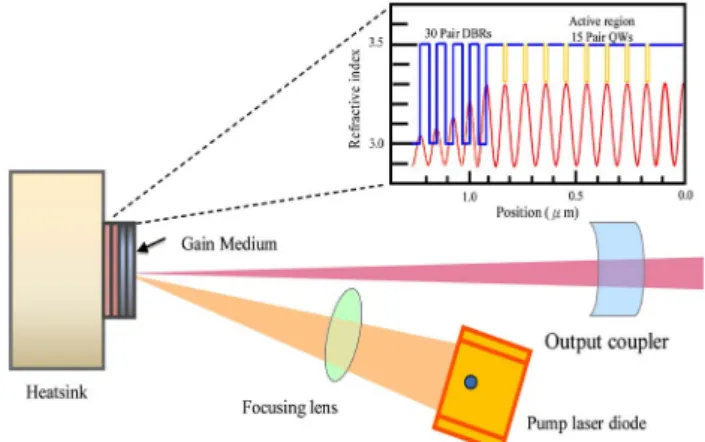
The schematic of the laser experiment is shown in
Fig. 1, together with the refractive index profile and
E-field distribution in the gain medium. The laser cavity consists of an external mirror, a VECSEL chip, and a pumping laser diode. The structure of the gain chip was grown on a (001) GaAs substrate in an upside-down con-figuration with a metalorganic vapor phase epitaxy reac-tor under low pressure. The growth temperature was
varied between600 °C and 750 °C according to the layers.
The epitaxial layer structures included 35-pair AlAs/GaAs bottom distributed Bragg reflectors (DBRs) and a reso-nant periodic gain (RPG) structure. The RPG structure consisted of a total of 15 compressively strained
In0:28Ga0:72As quantum wells (QWs) in 15 antinodes.
The thickness for the strain compensation was
approxi-mately4 nm. Every one QW with a thickness of 7 nm was
placed in each antinode of the standing wave. Note that there are no special differences between the present QW structure and other published designs. The photolumi-nescence emission wavelength of the gain chip was
ap-proximately 1060 nm at room temperature. The barriers
between QWs are formed by the strain compensating
GaAs0:9P0:1 and pump laser absorbing GaAs layers. An
Al0:3Ga0:7As barrier was grown to prevent the excited
carriers from recombining at the wafer surface. A10 nm
thick GaAs layer was deposited to finish the structure.
Fig. 1. (Color online) Experimental setup of an SML optically pumped semiconductor laser system. The inset shows the refrac-tive index profile andE-field distribution in the gain medium. December 1, 2011 / Vol. 36, No. 23 / OPTICS LETTERS 4581
The gain chip was soldered with indium to a chemical vapor deposition diamond heat spreader with DBR side down for effectively removing the heat from the gain structure. After In soldering on the heat spreader, the GaAs substrate on gain chip was then chemically etched to an InGaP etch stop layer.
The cavity of the laser comprised a DBR and an exter-nal concave output coupler with a radius of curvature
of 100 mm. Three different output couplers (OCs),
R ¼ 97:5%, 99.0%, and 99.8%, were used to explore the performance. The external flat side of the OC was cut
with a wedge angle of 1° for avoiding the unwanted
re-flection. The external reflection was found to cause the laser to be in the operation of multipulse mode locking.
An808 nm pump beam was focused on to a VECSEL chip
at an angle of20° to the surface normal. The incident
an-gle of the pump beam was found to be not critical for reaching an SML operation. The cavity length was set
to be approximately 70 mm. The mode diameter was
calculated to be approximately 250 μm. Experimental
results revealed that the cavity length needed to be
con-siderably shorter than 150 mm for obtaining a stable
single-pulse SML operation.
The temperature of semiconductor gain chip was con-trolled by thermal electronic cooler maintained around 25 °C to ensure stable laser output. The mode-locked pulses were detected by a high-speed InGaAs photode-tector (Electro-optics Technology, Inc. ET-3500 with rise
time35 ps) whose output signal was connected to a
digi-tal oscilloscope (Agilent DSO 80000) with10 GHz
electri-cal bandwidth and a sampling interval of 25 ps. The
output signal of the photodetector was also analyzed by an RF spectrum analyzer (Advantest, R3265A) with a
bandwidth of 8 GHz. The spectral information of the
laser was monitored by a Fourier optical spectrum analyzer (Advantest Q8347) containing a Michelson
inter-ferometer with resolution of0:003 nm.
The pump diameter was designed to be approximately 300 μm for the proper mode-size matching. It was experi-mentally found that the mode-to-pump size ratio played a critical role in realizing SML operation. Experimental re-sults revealed that the mode-to-pump size ratio should be
in the range of 0.7–1.3 for achieving the high-quality SML
performance. With a suitable mode-to-pump size ratio, the mode-locking quality is nearly independent of the pump power. The performance of the mode-locking op-eration could be straightforwardly optimized by monitor-ing the real-time trace of the pulse train in the digital oscilloscope. The mode-locked operation was found to sustain robustly for all pump powers from the onset of lasing.
All the following results were obtained with a
mode-to-pump size ratio to be approximately 0.8. Figure2shows
the average output powers versus the incident pump powers for three different OCs. With an incident pump
power of20 W, the average output powers can be seen
to be 5.1, 2.35, and 0:45 W for the output reflectivities
of 97.5%, 99.0%, and 99.8%, respectively. The presented average output power is limited by the maximum output power of the pumping laser diode and could be expected of more power with a higher output laser diode. At a
pump power of20 W, the overall beam quality was found
to be better than 1.2 and 1.4 in the horizontal and vertical directions, respectively.
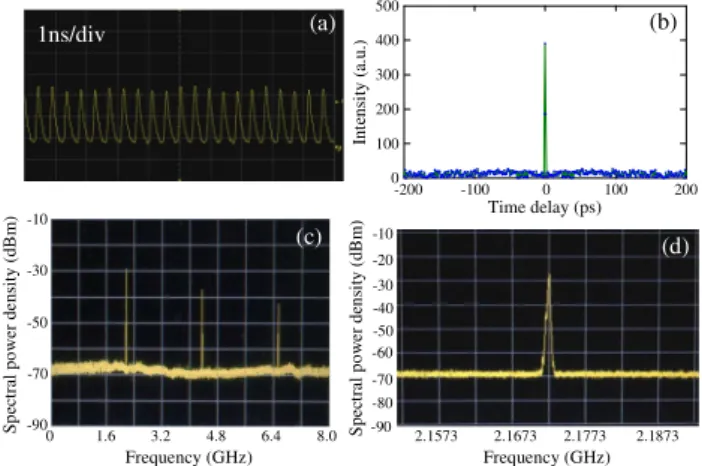
Figure 3(a) shows the pulse train measured with a
10 GHz bandwidth real-time oscilloscope. It can be seen that the pulse trains display full modulation without any CW background, indicating that complete mode locking is achieved. The mode-locked pulse duration was measured with an autocorrelator (APE Pulse Check,
Angewandte Physic & Elektronik GmbH). Figure 3(b)
shows a large enough autocorrelator delay for confirm-ing the sconfirm-ingle-pulse trains. The correspondconfirm-ing power spectrum is measured by an RF spectrum analyzer with
a bandwidth of8 GHz in Fig.3(c), demonstrating the
sig-nal to noise to be greater than40 dB. The high resolution
of power spectrum spanned of50 MHz with 10 KHz
reso-lution bandwidth and10 KHz video bandwidth is shown
in Fig.3(d).
Although the existence of self-starting pulses in
differ-ent semiconductor lasers has been reported [7–10], there
is as yet no consistent explanation for the phenomenon
of SML. In [7] the authors give an interpretation of their
results in terms of Kerr-lens self-mode locking; however,
in [8,9] the authors simply suggest the four-wave mixing
in the gain section as the major phenomenon leading to mode locking. We conjecture that the large number of QWs is responsible for the present mode-locked scenar-io. When the pump does mange to provide enough inver-sion in all QWs, the saturable absorption might be
Pump power (W) 5 10 15 20 Ave ra ge ou tpu t po we r ( W ) 0 1 2 3 4 5 6 R=99% R=97.5% R=99.8%
Fig. 2. (Color online) Average output power versus incident pump power for the stable CW mode locking.
1ns/div 1ns/div (a) 2.1573 2.1673 2.1773 2.1873 Frequency (GHz) S p ec tr al po w er d ens it y ( d Bm ) -80 -70 -60 -50 -40 -30 -20 -10 -90 (d) Time delay (ps) -200 -100 0 100 200 Int ens it y (a .u .) 0 100 200 300 400 500 (b) 1.6 3.2 4.8 6.4 8.0 0 Frequency (GHz) Sp ectral po wer de nsity (dB m ) -90 -70 -50 -30 -10 (c)
Fig. 3. (Color online) (a) Real-time trace of pulse train. (b) Autocorrelation trace for showing the single-pulse trains. (c) RF power spectrum of the pulse train. (d) Power spectrum with a high resolution of10 kHz and a span of 50 MHz. 4582 OPTICS LETTERS / Vol. 36, No. 23 / December 1, 2011
provided by unpumped QWs of gain element, similar to the optical pumped mode-locked integrated
external-cavity surface-emitting laser [15].
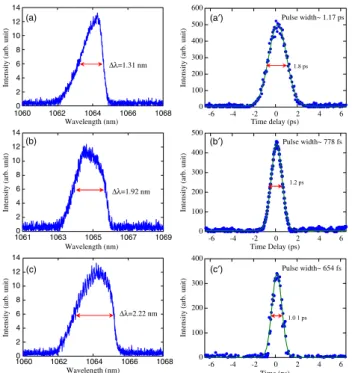
The spectrum information of the laser was monitored
by a Fourier optical spectrum analyzer. Figures4(a)–4(c)
show the lasing spectra for the SML operations obtained with three different OCs. It can be seen that the optical
spectral widths are 1.49, 1.92, and2:22 nm for the output
reflectivities of 97.5%, 99.0%, and 99.8%, respectively.
Figures 4(a′), 4(b′), and 4(c′) depict the measured
results corresponding to the optical spectra shown in
Figs.4(a)–4(c), respectively. It can be seen that the
auto-correlation traces are approximately 1.8, 1.2, and1:01 ps
for the output reflectivities of 97.5%, 99.0%, and 99.8%, respectively. Assuming temporal intensity to be a
sech2shape, the molocked pulse durations can be
de-duced to be as short as1:17 ps, 778 fs, and 654 fs,
respec-tively. Consequently, the time–bandwidth product of the
mode-locked pulse can be found to be in the range of
0.38–0.41 that is quite close to the Fourier-limited value.
To the best of our knowledge, this is the first time that a femtosecond high-power VECSEL was realized with the SML operation. The present average output power and peak power are comparable with the recent results
obtained with additional QW saturable absorbers [16].
Therefore, the current result has a great chance to be a practical laser for high-power applications.
In summary, we have demonstrated a femtosecond high-power SML operation with gigahertz oscillation in a VECSEL under the condition of eliminating the internal and external unwanted reflection. We explored the influ-ence of output reflectivity on the average output power and the pulse duration. With an incident pump power of 20 W, we have achieved 2:35 W of average output power
with778 fs pulse duration at a repetition rate of 2:17 GHz.
The shortest pulse duration was 654 fs at an average
output power of 0:45 W. This femtosecond high-power
VECSEL is expected to be potentially beneficial to many applications.
The authors acknowledge the National Science Coun-cil of Taiwan (NSCT) for their financial support of this research under contract NSC-97-2112-M-009-016-MY3.
References
1. M. Kuznetsov, F. Hakimi, R. Sprague, and A. Mooradian, IEEE Photon. Technol. Lett.9, 1063 (1997).
2. T. Kim, J. Lee, S. Lee, J. Yoo, K. Kim, J. Kim, S. Cho, S. Lim, G. Kim, and Y. Park, Proc. SPIE6132, 61320K (2006). 3. J. Chilla, Q.-Z. Shu, H. Zhou, E. Weiss, M. Reed, and L.
Spinelli, Proc. SPIE6451, 645109 (2007).
4. N. Schulz, J. M. Hopkins, M. Rattunde, D. Burns, and J. Wagner, Laser Photon. Rev.2, 160 (2008).
5. S. Calvez, J. E. Hastie, M. Guina, O. G. Okhotnikov, and M. D. Dawson, Laser Photon. Rev.3, 407 (2009).
6. M. Sargent, III, M. O. Scully, and W. E. Lamb, Jr., Laser Physics (Addison-Wesley, 1974).
7. R. Paiella, F. Capasso, C. Gmachl, D. L. Sivco, J. N. Baillargeon, A. L. Hutchinson, A. Y. Cho, and H. C. Liu, Science290, 1739 (2000).
8. V. L. Kalashnikov, E. Sorokin, and I. T. Sorokina, IEEE J. Quantum Electron.39, 323 (2003).
9. B. G. Bale, K. Kieu, J. N. Kutz, and F. Wise, Opt. Express17, 23137 (2009).
10. A. K. Komarov and K. P. Komarov, Opt. Commun. 183, 265 (2000).
11. H. C. Liang, Y. J. Huang, W. C. Huang, K. W. Su, and Y. F. Chen, Opt. Lett.35, 4 (2010).
12. P. Glas, M. Naumann, A. Schirrmacher, L. Däweritz, and R. Hey, Opt. Commun.161, 345 (1999).
13. Y. Nomura, S. Ochi, N. Tomita, K. Akiyama, T. Isu, T. Takiguchi, and H. Higuchi, Phys. Rev. A65, 043807 (2002). 14. L. Gil and L. Columbo, Phys. Rev. A83, 013822 (2011). 15. B. Rudin, V. J. Wittwer, D. J. H. C. Maas, M. Hoffmann, O. D.
Sieber, Y. Barbarin, M. Golling, T. Südmeyer, and U. Keller, Opt. Express18, 27582 (2010).
16. M. Hoffmann, O. D. Sieber, V. J. Wittwer, I. L. Krestnikov, D. A. Livshits, Y. Barbarin, T. Südmeyer, and U. Keller, Opt. Express19, 8108 (2011). Time (ps) 0 100 200 300 400 Time Delay (ps) 0 100 200 300 400 500 Time delay (ps) 0 100 200 300 400 500 600 Wavelength (nm) Pulse width~ 1.17 ps Pulse width~ 778 fs 1.0 1 ps Wavelength (nm) -6 -4 -2 0 2 4 6 -6 -4 -2 0 2 4 6 -6 -4 -2 0 2 4 6 1061 1063 1065 1067 1069 1060 1062 1064 1066 1068 Wavelength (nm) 1060 1062 1064 1066 1068
Intensity (arb. unit)
0 2 4 6 8 10 12 14
Intensity (arb. unit)
0 2 4 6 8 10 12 14
Intensity (arb. unit)
Intensity (arb. unit)
Intensity (arb. unit)
Intensity (arb. unit)
0 2 4 6 8 10 12 14 (a) (b) (c) ∆λ=1.31 nm ∆λ=1.92 nm ∆λ=2.22 nm 1.8 ps (a′) 1.2 ps (b′) Pulse width~ 654 fs (c′)
Fig. 4. (Color online) (a)–(c) Lasing spectra for the SML opera-tions obtained with the output reflectivities of 97.5%, 99.0%, and 99.8%, respectively. (a′)–(c′) Autocorrelation traces correspond-ing to the optical spectra shown in (a)–(c), respectively.