Vol.16 No.1 THE HONG KONG UNIVERSITY OF SCIENCE AND TECHNOLOGY Mar 2007
S A F E T Y A N D E N V I R O N M E N T A L P R O T E C T I O N O F F I C E
The current issue of Safetywise has been published in electronic format and it can be accessed at :
http://www.ab.ust.hk/sepo/sftywise.htm
March 2007
PDF Version
Safety, Health & Environmental Exhibition and General Interest Lectures 2007
Q & A about Legionnaires' Disease
A Reminder on Some Aseptic Practices
When you see Stray Dogs Roaming Around
HKUST Accident/Incident Statistics for 2006
Best viewed with Internet Explorer.
If you have suggestions or comments, please contact us
Safety & Environmental Protection Office,
The Hong Kong University of Science and Technology. All rights reserved.
Another Way to Change for the Better
Safety, Health & Environmental Exhibition and General Interest Lectures
2007
General Interest Lectures
Date and Time: 11 April 2007; 9:15 am - 4:30 pm
Venue: Lee Wing Tat Lecture Theatre (LTD), Chia-Wei Woo Academic Concourse, HKUST 09:15 - 09:45 Opening Ceremony
09:45 - 10:15 The Challenges of Managing Hong Kong's Environment
Speaker: Prof Lam Kin Chee, SBS, JP, Chairman, Advisory Council on the Environment 10:15 - 10:45 Safeguarding the Food Supply of Hong Kong
Speaker: Prof Kwan Hoi Shan, Chairman, Expert Committee on Food Safety
11:15 - 11:45 The Role of a University in Helping to Shape Hong Kong’s Occupational Health and Safety
Speaker: Mr Pang Kok Lam, Chief Occupational Safety Officer, Labour Department, Hong Kong Government
11:45 - 12:15 Establishing a Network of Healthy Universities in Asia-Pacific Speaker: Prof Sian Griffiths, Director, School of Public Health, CUHK 12:15 - 12:45 Envisioning a Sustainable Campus
Speaker: Prof Gerald Patchell, Division of Social Science, HKUST 14:30 - 15:00 An Insider’s Perspective on a Major Legionnaires' Disease Outbreak
Speaker: Dr Joseph Kwan, Director of Safety and Environmental Protection, HKUST 15:00 - 15:30 Future Development of the HKUST Campus – An Environmental Perspective Speaker: Mr Mike Hudson, Director of Estates Management, HKUST
15:30 - 16:00 HKUST’s Unique, Behind the Scene, Effort in Ensuring a Healthy and Safe Campus Environment
Speaker: Dr Samuel Yu, Senior Engineer, Safety and Environmental Protection Office, HKUST Safety, Health & Environmental Exhibition
Date and Time: 11, 12 and 13 April 2007; 10:00 am - 4:30 pm Venue: Chia-Wei Woo Academic Concourse, HKUST
Main Theme of Exhibition: - Airport Authority Hong Kong
Main Theme: “Green & Healthy Airport”
- Centre for Health Protection, Department of Health Main Theme: “I Love Smoke Free Hong Kong”
Another Way to Change for the Better - Environmental Protection Department, HKSAR
Main Theme: “Waste Reduction”
- Food and Environmental Hygiene Department, Health Education Exhibition & Resource Centre and Centre for Food Safety
Main Theme: “Dengue Fever Prevention” - Hong Kong Fire Services Department Main Theme: “Fire Safety & Prevention” - Occupational Safety and Health Council
Main Theme: Occupational Safety and Health – “Back Care Program” - Tseung Kwan O – "Healthy and Safe City” Project Office
Main Theme: “Sai Kung Healthy and Safe City”
- Friends of the Earth
Main Theme: “Reduce Overpackaging”
- HKUST – Safety & Environmental Protection Office Main Theme: “Campus S.H.E. Management”
- HKUST – Staff Association
Main Theme: “Slogan Design Competition & Health Promotion Activities”
- HKUST – Student Affairs Office/Student Union Main Theme: “Green Olympics”
- HKUST – Students' Environmental Interest Group Main Theme: "Green Lifestyle on Campus"
Two Mobile Units will also be on display on 13 April 2007: - Department of Health Dental Health Education
- Fire Services Department Light Rescue Unit Kick-off Ceremony for Organic Farming Date and Time: 12 April 2007; 12:00 noon Venue: LG7 Lawn
Fire Drill
Date and Time: 13 April 2007; 10:00 am Venue: Whole Campus
he
Q and A about Legionnaires’ Disease…
The recent case of fatal Legionnaires’ Disease infection involving a retired senior civil servant had prompted public concern about this illness, its causation, risk of exposure, control measures, etc. The following Q and As provide important information about this disease.
Q: I retired from the military. Will this make me more prone to getting the disease?
A: No, there is no direct causal relationship between this illness and the fact that one has retired from the military. The name of this disease was adopted because the first known outbreak involved a group of Legionnaires who held their 1976 annual convention in Philadelphia and the hotel they stayed at was infested with this bacterium. As a result, 221 Legionnaires were infected and became ill, and 22 of them died from the infection.
Q: How does one get Legionnaires’ Disease?
A. The common route of exposure is the inhalation of water droplets containing the bacteria Legionella pneumophila. Legionella bacteria are found in a variety of natural water bodies such as lakes, streams, rivers, ponds, etc. They are also found in artificial water bodies such as evaporative cooling systems, domestic water systems, air conditioning plants, ventilation systems, water heaters, humidification systems, shower heads, whirlpools, spas, etc. If the water body is heavily contaminated with the Legionella bacteria and this water is aerosolized into tiny droplets, the bacteria contained in the water droplets can reach deep down into the alveoli (air sacks) of the lungs to cause pneumonia. Q: What are the symptoms of Legionnaires’ Disease?
A: It usually starts with flu-like symptoms of malaise, lethargy, headache, muscle aches and stiffness, sore joints, and fever. It may further progress to the pneumonia symptoms of non-productive cough, shortness of breath, and chest pain. Some patients experience diarrhea, nausea, vomiting and abdominal pain as well.
Q: What are the risk factors for this disease?
A: People with the following conditions are at increased risk of developing Legionnaires’ Disease: old age, cigarette smoking, underlining diseases such as cancer, diabetes, renal failure, suppressed immune systems, alcoholism and the use of chronic ventilation support.
Q: What are the preventative measures?
A: The main effort should focus on preventing infestation of water bodies by the Legionella bacteria. This can be accomplished by treating the concerned water system with disinfectants regularly and monitoring the effectiveness by
he
conducting bacterial culture analysis. In addition, preventing aerosolization of potentially contaminated water sources and avoiding inhaling water droplets from such water sources are also effective preventative measures
Q: Is treatment available for Legionnaires’Disease?
A: If recognized early, this disease can be easily treated with antibiotics such as erythromycin or a combination of erythromycin and rifampin. The key is to seek medical treatment as EARLY as possible!
Another Way to Change for the Better
A Reminder on Some Aseptic Practices
There were a couple of laboratory accidents in recent months involving workers in microbiology laboratories. As a common practice, these workers sprayed their bare or latex-gloved hands with 70% alcohol before starting work as part of their aseptic procedures. However, they either applied too much of the liquid disinfectant or did not wait long enough for the alcohol to completely evaporate, the residual alcohol caught on fire when their hands were placed near the open flame of a Bunsen burner. In the one case with the worker wearing a pair of surgical gloves, the burning glove was taken off promptly to prevent any injury. In the other case, the worker sustained a minor burn to the hand.
These accidents are crucial reminders for all microbiology workers who adopt this practice to remember that alcohol is highly flammable. After applying the disinfectant, the user must rub his hands and wait until the alcohol fully evaporates before putting their hands close to any open flame.
In one of the abovementioned cases, the worker was actually using a Bunsen burner inside a biological safety cabinet (BSC). This leads to another aseptic practice that may need rethinking. A BSC is designed to provide a clean, microbe-free environment for microbiological work, and, at the same time, protect the user and the environment from any potentially infectious microbes being worked on. Therefore many aseptic techniques intended for open-bench work may not be necessary inside a BSC. Of course, procedures such as disinfecting inoculation loop to prevent cross contamination are still needed. However, considering the enclosed work space inside a BSC, and the proximity of the open flame to the HEPA filter and perhaps other flammable components of the BSC, it is advisable to consider using an electric device ("incinerator") to heat sterilize the loops inside a BSC instead of using the open flame of a Bunsen burner. In fact, there was an incident at HKUST several years ago, where a user forgot to turn off a Bunsen burner inside a BSC, and after a few hours, the outside walls of the BSC were heated up to a point that they were hot to touch! Fortunately the situation was discovered before a fire broke out.
If you work in a microbiology laboratory, and have questions about the use of BSC or other aseptic procedures, please feel free to contact SEPO. Our colleagues will be glad to help assess your specific work conditions and provide suitable recommendations.
The following website contains some helpful tips on the proper use of biosafety cabinets: http://www.ehrs.upenn.edu/programs/bio/cabinet_tips.html
http://www.cdc.gov/od/ohs/biosfty/bsc/bsc.htm (Sections 4 and 5)
A Draft of an Interview with Prof Y S Wong, VPAB, on Environmental, Health and Safety Management at HKUST (Revised 2
Roaming stray dogs have been spotted frequently on campus for the last few months. As these dogs are usually abandoned, unsettled and easily irritated, they could launch an attack when they square up with assumed intruders. These dogs pose a threat to all residents on campus not only because they can bite but they also serve as a potential host for rabies.
Rabies is a zoonotic viral disease that causes acute encephalitis in mammals. Rabies is present mainly in wild animal hosts, from which the disease spreads to domestic animals and human. The most common transmission pathway through which humans become infected with rabies is via the bite of infected dogs, cats and wild carnivorous species like skunks, wolves, etc. The virus will spread from the muscle of the infected individual to the peripheral nerves and then to the spinal cord and the brain. Victim may experience flu-like symptoms initially. The illness progresses to convulsions, hallucinations, paralysis or breathing failure and death. Onset of the signs and symptoms of rabies usually appears within one to three months. Rabies can be fatal. It is important to seek medical treatment immediately after exposure.
Rabies is classified as a notifiable infectious disease in Hong Kong. Physicians are required to report any confirmed cases of rabies to the regulatory authority. According to the figures released by the Centre for Health Protection, there were only two reported cases of rabies in Hong Kong over the past ten years. The risk of contacting rabies in Hong Kong is very low but yet, the University’s management continues to adopt a prudent approach in handling the stray dog issue.
The Estates Management Office (EMO) has taken the lead in tackling the stray dog issue in an effort to ensure the safety of our residents. To better monitor the situation, EMO has formed a stray dog patrol team. Members of the team patrol regularly on campus to watch out for any stray dogs and will attempt to catch these dogs whenever they are spotted. Expertise assistance from the Dog Control Team of the Agriculture, Fisheries and Conservation Department is sought regularly to complement the University’s effort in eliminating the stray dog problem. The Dog Control Team has been successful in catching stray dogs when they are called upon from time to time. On top of actively searching for stray dogs, dog traps have been set up in various locations where stray dogs are frequently spotted. Although these efforts may not necessarily eliminate all the stray dogs wondering on our campus, they help to minimize the impact of the stray dogs.
What should one do to avoid dog bites? SEPO had published a Safetywise article on the subject in August 1999. In short, residents should stay calm when seeing stray dogs and avoid intimidating them. These could mean walking slowly away from the dogs, avoiding eyes contact, etc. If the dog attacks, get something to put between you and the
When You See Stray Dogs
Roaming Around
A Draft of an Interview with Prof Y S Wong, VPAB, on Environmental, Health and Safety Management at HKUST (Revised 2 dog’s mouth. Curl up, protect your face, neck and head if the dog knocks you over. If you are bitten by dog, seek
medical treatment immediately. You are recommended to read the article “Safety Tips on Avoiding Dog Bites” for more
details. Whenever you spot stray dogs roaming on campus, report to the Security Office at ext. 6565 for immediate assistance.
HKUST Accident/Incident Statistics For 2005
Number of Work/Study Related Injuries
A total of 35 work/study related injury cases were recorded in 2006. Among the cases: - 25 cases involved staff members
- 8 cases involved students - 2 cases involved contractors
A comparison of accident numbers over the past 10 years is shown in Table 1 below.
Table 1. Comparison of Accident Numbers
Lost Workdays
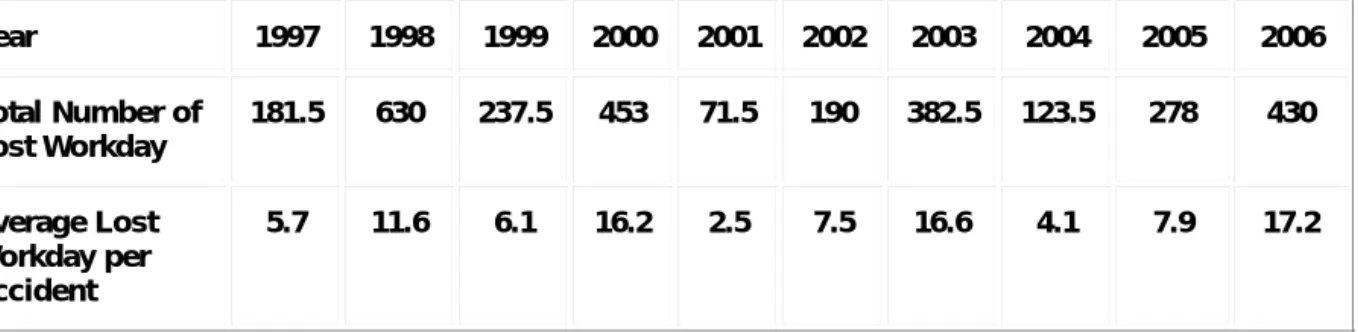
A total of 430 lost workdays were recorded by the end of 2006. About 71% of the total lost workdays, i.e. 310 days, were caused by 2 injury cases with one having 128 lost workdays and the other having 182 lost
workdays respectively. In one of these two cases, a housekeeping staff hurt her leg when she was tidying some guest rooms. The other case involved an operational staff who injured his back when performing some electrical installation work. However, this case was reported by the injured employee a few months after the occurrence of the accident.
A comparison of lost workdays over the past 10 years is shown in Table 2 below.
HKUST
Accident/Incident
Statistics for 2006
Year 1997 1998 1999 2000 2001 2002 2003 2004 2005 2006 Staff Accident Number 32 54 39 28 28 25 23 30 35 25 Student Accident Number 9 4 8 8 10 7 7 6 7 8HKUST Accident/Incident Statistics For 2005
Table 2. Comparison of Lost Workdays
Among the 25 staff injury cases, 4 cases did not incur any lost workdays, 10 cases incurred 3 or less lost workdays and 10 cases incurred more than 3 lost workdays.
Causes of Work/Study Related Injuries
Figure 1 summarizes the causes for all work/study related injuries in 2006.
“Manual handling” and “sharp objects” were the top two causes for work/study related injuries in 2006. Each accounted for 7 cases.
6 out of the 7 manual handling cases involved operational staff when they were performing cleaning and facility maintenance operations. The remaining case involved a clerical staff in an academic department, who injured herself when she was helping to remove some display panels. The injuries resulted in these cases were mainly back injury, cuts and twisting of limbs. About 50% (214 days) of all lost workdays were contributed by 5 of these cases.
Among the 7 cases caused by “sharp objects”, 4 of them involved students working with glassware (3 cases) and needle (1 case) in laboratories. As a matter of fact, 5 of the 7 injuries were caused by broken glassware.
Locations of Accidents
Of the 33 staff and students injury cases: 12 occurred in laboratories
5 occurred in staff/student quarters 6 occurred in common areas
5 occurred in workshops/plant rooms/warehouses 3 occurred in office areas
2 occurred in sport facilities
Year 1997 1998 1999 2000 2001 2002 2003 2004 2005 2006 Total Number of Lost Workday 181.5 630 237.5 453 71.5 190 382.5 123.5 278 430 Average Lost Workday per Accident 5.7 11.6 6.1 16.2 2.5 7.5 16.6 4.1 7.9 17.2
HKUST Accident/Incident Statistics For 2005
Common Root Causes of Accidents
Besides classifying causes of injuries in terms of physical sources and energies involved, investigation of the injury cases also revealed some common underlying root causes. These root causes are summarized in Figure 2 below.
HKUST Accident/Incident Statistics For 2005
Non-injury Incidents
A total of 9 non-injury incidents were recorded in 2006. Among them, 8 occurred in laboratories and 1 in the office area. There were 4 fire incidents, 3 of which occurred in laboratory areas and were minor in nature. The fire incident occurred in the office area of RandD Corp. was considered relatively serious which had caused considerable property damage.
The other cases involved smell complaints (3 cases) and a minor chemical spill in the laboratory areas.
Summary and Recommended Actions
The number of staff injury cases in 2006 (25 cases) was significantly less than that of 2005 (35 cases). The number of student injury cases has increased by 1 case (total 8 cases). The medium numbers of staff and student accidents over the past 10 years were 29 and 8 respectively. The numbers in this year had not deviated much from the medium figures.
Notwithstanding the fewer injury cases, the number of lost workdays in 2006 (430 days) was higher than that in 2005 (278 days). However, more than 70% of all lost workdays were contributed by 2 of the cases.
“Manual handling” and “sharp objects” were the top two causes of work/study related injuries in 2006.
6 out of the 7 manual handling cases involved operational staff that were performing cleaning and facility maintenance operations. 3 of the cases resulted in back injuries which were major contributor for the total
HKUST Accident/Incident Statistics For 2005
workdays lost. Investigations revealed that these injuries could have been avoided if the employees had adopted proper working postures. Adequate safety training for people concerned is one of the important means to prevent injuries caused by manual handling. Refresher safety training courses on manual handling safety are being organized to reinforce colleagues’ knowledge with the objective to reduce recurrence of similar injuries. However, the attitude of the people at work is also a concern that needs to be addressed by the management. As a matter of fact, many of the injured colleagues had actually attended more than one safety training courses on manual handling. Proper work planning is also important in ensuring that colleagues would not be forced to adopt awkward postures in the work process.
Among the 7 injury cases caused by “sharp objects”, 4 of them involved students working with glassware in laboratories. Similar to manual handling accidents, adequate training and proper work attitude are necessary for preventing such accidents from happening.
Articles on these subjects published in previous issues of Safetywise are located at: Back Care Basics (Explains basic principles for preventing back injuries)
(http://www.ab.ust.hk/sepo/mh/index.htm) Prevention Of Sharp Object Induced Injuries