
A Multi-channel MAC Protocol with Novel Channel Selection for Ad Hoc Networks
6
0
0
全文
(2) In the multi-channel environment, if a node is equipped with only one half-duplex transceiver, this node can only activate on a particular channel but can not hear any communication taking place on a different channel. This presents two problems: the multi-channel hidden terminal problem [6] and the deafness problem [13][14]. The multi-channel hidden terminal problem is similar to the conventional hidden terminal problem but happens when doing channel switches. The deafness problem arises when a sender attempts to communicate with a receiver that is already engaged in another communication on a different channel. This will cause the sender several transmission retries. To overcome these problems in multi-channel environments, the related work has shown two broad mechanisms: (1) the use of a dedicated control channel [2][3][8][10][11][15][16], and (2) the use of a common control period [6][7][9][19] to do negotiations. In the first mechanism, one control channel is dedicated to exchange control packets for negotiations. The remaining available channels are called data channels. The common control period is a fixed period of time during which each upcoming sender/receiver pair comes to a common channel for negotiations. Two representative protocols: DCA [15] and MMAC [6] are introduced below. The Dynamic Channel Assignment (DCA) protocol was proposed in [15], which is based on the dedicated control channel scheme. This protocol uses one transceiver which permanently listens to the dedicated control channel for negotiations, and another transceiver that can switch between data channels for data exchanges. In DCA, a data channel that is idle on both the sender and receiver sides is selected for subsequent data exchanges. The major drawbacks of the DCA scheme are the control channel saturation problem [6] and the channel negotiation overhead. In DCA, when total bandwidth offered to the network is fixed, the control channel saturation problem takes place. Serious contentions cause the control channel a bottleneck and an inefficient usage of data channels. Since DCA employs per-packet negotiations, if one packet fails to be delivered on the data channel, the sender has to contend for the control channel and re-negotiate with the receiver again. This will increase the control channel overhead when the channel error is high. The MMAC protocol enables mobile nodes to use multiple channels by switching channels dynamically with only one transceiver. It solves the multi-channel hidden terminal problem by asking all nodes to listen to a common channel periodically. In MMAC, the channel usage is organized into beacon intervals each of which is consisted of a channel negotiation interval (called ATIM window) and a data transmission interval. The ATIM window is a time duration during which all nodes have to listen to the default common channel and do negotiations. The major drawback of the MMAC scheme is the requirement of time synchronization among all nodes, which might become an overhead in. an ad-hoc environment. Also, the packet delivery delay might be long, since any data transmission can only take place in the data transmission interval.. 3: NOVEL CHANNEL SELECTION SCHEME In this section, we give an overview of our proposed Novel Channel Selection (NCS) protocol. In NCS, the data exchange has two phases. In the first phase, a sender contends for the control channel and selects an appropriate data channel to be used. Then, the sender exchanges the CRTS-CCTS packets with the receiver on the control channel. The CRTS and CCTS packets are modified from the RTS and CTS packets, respectively, and carry the information of the selected channel number. In the second phase, the four-way handshake mechanism is exploited by following the sequence RTS-CTS-DATA-ACK on the selected data channel. Before describing the protocol in details, we first summarize our assumptions. z All available channels have the same bandwidth. Nodes have prior knowledge of how many channels are available and how to switch to a particular channel given the channel number. z Each node is equipped with two half-duplex transceivers, one transceiver is assigned to a dedicated control channel for negotiations, and the second transceiver is switched between the remaining data channels for data transmission. z Each node maintains a counter for each data channel, which records the number of times that the data channel has been selected by neighbors for data transmissions. This information can be collected on the dedicated control channel.. 3.1: DESIGN OVERVIEW Our proposed protocol has the following features: z Dedicated control channel strategy Since nodes can use one dedicated transceiver to listen to the control channel permanently, nodes can collect the channel usage information and negotiate with other nodes at any time. z Counter-based channel selection strategy This strategy attempts to balance traffic load on different channels. For each data channel, each node will count the number of source-destination pairs that have selected the data channel for data transmission by overhearing CRTS and CCTS packets. We will select the one with the lowest count when doing each channel selection. z Local negotiation strategy This strategy attempts to reduce channel negotiation overhead on the control channel. If the data transmission on the selected data channel is failed, a sender need not re-negotiate with the receiver on the control channel again. The sender can just initiate the retransmission process on the same data channel immediately.. - 665 -.
(3) to complete the whole transmission process. If the sender fails to receive an ACK packet, it will wait for timeout and will execute the backoff process, and then will initiate a retransmission process on the same data channel. Step 5: Other nodes in the vicinity of the transmission pair will increase their counters of the selected channel by one upon the reception of the CRTS or CCTS packet on the control channel. Figure 1 shows the flow chart of the above operations. The holding of a data packet duration means that a sender has to wait for a time duration the length is equal to the time to transmit a data packet of maximal size. This holding is for avoiding possible collision after switching to the new channel. In Step 2, we check whether the receiver is currently communicating with another node. If yes, the receiver’s data transceiver becomes busy. In this case, the receiver can only communicate with other nodes on the currently used channel. Figure 2 shows an example scenario where nodes P and Q do negotiations by exchanging the CRTS/CCTS packets and select channel 2 as the data channel.. Figure 1: Flow chart.. 3.2: PROTOCOL OPERATIONS The detailed operations of the NCS scheme are described as follows: Step 1: When a sender has packets to send, it needs to transmit a CRTS packet to the receiver on the control channel. The sender will check its counter and will select the channel with the lowest count. The selected channel number is embedded in the CRTS packet. If the control channel is in free status, the sender can immediately transmit the CRTS packet. If the control channel is in busy status, the sender will transmit the CRTS packet after the backoff process. Step 2: Upon the successful reception of this CRTS packet, the receiver will confirm its data transceiver status, and then will increase the counter of the selected channel by one. If the data transceiver is in free status, the receiver replies a CCTS packet which carries the same selected channel number as the sender on the control channel and then switches its data transceiver to the selected channel. If the data transceiver is in busy status, the receiver replies the currently used data channel number by the CCTS packet to the sender. Step 3: When the sender receives the CCTS packet, it switches its data transceiver to the selected data channel that indicated by the CCTS packet. Then, a four-way handshake procedure by following the RTS-CTS-DATA-ACK sequence is initiated after waiting for a data packet duration. Step 4: If the receiver successfully receives the data packet on the data channel, it transmits an ACK packet. Figure 2: An example scenario.. 3.3: ENHANCED MODE Although NCS can efficiently balance channel load and can reduce negotiation overhead on the control channel, it still suffers from bandwidth waste on the control channel. In some cases, the dedicated control channel may become less congested than other data channels. Hence, we propose an improvement on NCS by enabling the control channel to transmit data too when the available channel number is small. Mostly, the enhanced-NCS scheme is similar to the original one, such as the counter-based channel selection and local negotiation strategies. The different between these two schemes is the extra utilization of the control channel. In the enhanced-NCS scheme, when the control channel is selected by the sender for data transmission, the sender initiates a normal RTS/CTS exchange with the receiver.. - 666 -.
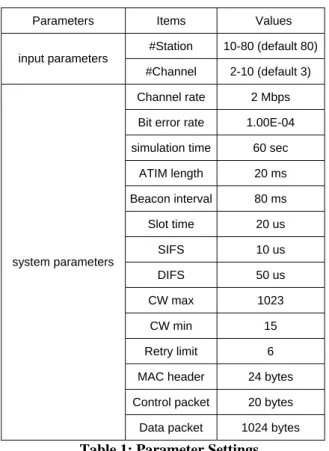
(4) We will show the performance improvements through the simulations.. 4: PERFORMACE EVALUATION We use the CSIM [17] language to write our simulation programs for evaluating the performance of our proposed protocol. We mainly compare our scheme with the DCA and MMAC protocols. Besides, the comparisons of the Original-NCS and Enhanced-NCS schemes are also addressed.. 4.1: SIMULATION MODEL We consider a fully connected topology where all nodes are within the radio range of each other. Each traffic flow is generated by the Poisson distribution. The bandwidth model in our simulation is based on the fixed channel bandwidth model, where each channel has a fixed bandwidth. Since IEEE 802.11b/g in the 2.4GHz band offers three non-overlapping channels, we assume that the default channel number is three. The major parameter settings in our simulation are listed in Table 1. Parameters. Items. Values. #Station. 10-80 (default 80). #Channel. 2-10 (default 3). Channel rate. 2 Mbps. Bit error rate. 1.00E-04. simulation time. 60 sec. ATIM length. 20 ms. Beacon interval. 80 ms. Slot time. 20 us. SIFS. 10 us. DIFS. 50 us. CW max. 1023. CW min. 15. Retry limit. 6. MAC header. 24 bytes. Control packet. 20 bytes. Data packet. 1024 bytes. input parameters. system parameters. No _ Drop _ Packets No _ Total _ Generated _ Packets Packet _ Length * No _ Successful _ Packets Utilization = Total _ Time * No _ Channels Drop _ Rate(%) =. 4.2: SIMULATION RESULTS Figure 3 shows the throughputs of different protocols as the number of stations (sender nodes) increases. The network load becomes heavy when the number of stations is large. When the network load is low, all protocols perform similarly. As network load grows to near saturation, Enhanced-NCS performs significantly better than DCA as well as MMAC. This is because the bandwidth of the control channel is fully utilized by the proposed strategy. Since there are only 3 channels are available, both Original-NCS and DCA use one channel for channel negotiations and other 2 channels for data transmissions. The throughput is dependent on the channel decision strategy. DCA has to concern with each channel state and then agrees with a free channel before data transmission. The results in complex channel negotiations and ineffective reservation when data transmissions fail on the selected data channel. Our proposed protocol which uses the counter-based channel selection can simplify the channel decision and can balance channel load on the network. Besides, when data transmission fails on the selected data channel, the NCS-based schemes can use the local negotiation strategy to reduce the channel renegotiation overhead on the control channel. The simulation result shows that this strategy can get performance improvement over DCA. As compared with MMAC, MMAC uses all 3 channels for data transmissions which results in better performance than Original-NCS and DCA. But it suffers the penalty on the ATIM windows size, which results in lower throughput than Enhanced-NCS. CH 3 Throughput (Kbps). 2000 1500 1000 500 0 10. 20. Table 1: Parameter Settings. Original-NCS. In the simulation, we use the following metrics to measure the performance of each protocol. Throughput =. Packet _ Length * No _ Successful _ Packets Total _ Time. Avgerage _ Delay =. Total _ Packet _ Delay No _ Successfull _ Packets. 30. 40 50 STA number Enhanced-NCS. 60 DCA. 70. 80. MMAC. Figure 3: Throughput vs. Number of stations. Figure 4 shows the average packet delays of different protocols as the network load increases. As can be seen, MMAC shows a higher delay in our simulation due to the ATIM window. Nodes have to wait for the ending of the current ATIM window, and then start. - 667 -.
(5) transmitting data packets. When the network size becomes large, not every transmission pair can finish channel negotiations during the ATIM window. These nodes have to wait for the next ATIM window. This will also postpone the packet delivery. As compared with DCA, our proposed Original-NCS suffers from higher contentions when network size is large. The reason is that only two available channels can be used for data transmission, and Original-NCS uses extra RTS/CTS packets to prevent the hidden terminal problem on the data channel. This will cause a higher packet delay than DCA. Enhanced-NCS can relieve this problem, because all of the available channels are able to transmit data packets. This can reduce the contentions on each of available channels and performs the similar delay with DCA.. 70 60 50 40. 2500 Throughput (Kbps). Avg Delay (ms). CH 3. channel, which results in higher throughput than other ones. DCA adopts the per-packet reservation mechanism. When a packet is failed on the data channel, DCA has to do renegotiation on the control channel, which causes higher contentions on the control channel. When the available channel is small, this phenomenon will become more serious. As compared with DCA, Original-NCS uses the local negotiation strategy when packet deliveries are failed on the data channel. This feature can reduce the overhead of the control channel. In MMAC, all nodes have to finish channel negotiations within the ATIM window. Since the ATIM window size is fixed, the number of nodes which can successfully finish negotiations is limited. In other words, increasing the number of available channels is not helpful on the throughput, because the throughput of MMAC depends on the ATIM window size.. 30 20 10 0 10. 20. 30. 40. 50. 60. 70. 80. STA number Original-NCS. Enhanced-NCS. 2000 1500 1000 500 0. DCA. MMAC. 2. 3. 4. 5. 6. 7. 8. 9. 10. CH number. Figure 4: Average Delay vs. Number of stations.. Original-NCS. Figure 5 compares the drop rates of the protocols. The drop rate is used to evaluate the reliability of protocols, which is directly proportional to the traffic load of the network. The higher drop rate represents the lower reliability of the scheme. As can be seen, Enhanced-NCS has the lowest drop rate among all protocols. DCA suffers from a highest drop rate because of serious contentions on the dedicated control channel.. Enhanced-NCS. DCA. MMAC. Figure 6: Throughput vs. Number of channels. 0.6. Utilization. 0.5 0.4 0.3 0.2 0.1. CH 3. 0. 100% Drop Rate (%). 2. 3. 4. 80%. 5. 6. 7. 8. 9. 10. CH number. 60%. Original-NCS. 40%. Enhanced-NCS. DCA. MMAC. Figure 7: Utilization vs. Number of channels.. 20% 0% 10. 20. 30. 40. 50. 60. 70. 80. STA number Original-NCS. Enhanced-NCS. DCA. MMAC. Figure 5: Drop Rate vs. Number of stations. Figure 6 presents the comparisons of protocols when varying the number of available channels. We use the maximum 80 stations to evaluate the channel number effect. When the available channel is small, Enhanced-NCS performs better than other protocols. This is because the control channel can be used as a data. Figure 7 compares the utilizations of protocols when varying the number of available channels. As can be seen, Enhanced-NCS achieves higher utilization than other protocols with the same traffic load. This is because both control and data channels can be fully utilized for data transmissions. Nodes in MMAC are equipped with only one transceiver, and hence this causes a limitation on the channel utilization when available channel number is small. In DCA, the control channel is only used for channel negotiations. When the available channel number is small, the control channel overhead will seriously effect the utilization. Our proposed. - 668 -.
(6) Original-NCS adopts the local negotiation strategy can bring better utilization than DCA. [7]. 5: CONCLUSIONS In this paper, we have presented a multi-channel MAC protocol that utilizes multiple channels to improve throughput in wireless networks. To overcome the multi-channel hidden terminal and deafness problems, our proposed NCS scheme is based on the dedicated control channel technique. In our proposed NCS protocol, we address three strategies to increase the performance. First, we propose a counter-based channel selection strategy to balance channel load and reduce contentions and collisions among nodes. Second, we propose a local negotiation strategy to alleviate the drawback of the channel renegotiation overhead when data transmissions fail. Third, we propose a strategy that enables the control channel for data transmissions to increase the utilization of this channel. The comparisons between DCA, MMAC, and NCS are given and discussed. In particular, we show that our NCS scheme can achieve higher throughput and channel utilization than DCA and MMAC. Our future work will involve more simulations and deeper analyses of these protocols. We will consider the impact of the routing algorithms (such as AODV, DSR) and study the capacity influenced by different network models as pointed out in [12].. [8]. [9]. [10]. [11]. [12]. [13]. ACKNOWLEDGMENTS This research was partially supported by National Science Council of the Republic of China under Contract No. NSC 94-2213-E-259-016.. [14]. REFERENCES. [15]. [1]. [2]. [3]. [4]. [5]. [6]. A. Nasipuri and J. Mondhe, “Multi-Channel MAC Protocol with Dynamic Channel Selection for Ad Hoc Networks,” Technical Report, January 2004. C. Y. Chang, H. C. Sun, and C. C. Hsieh, “MCDA: An Efficient Multi-Channel MAC Protocol for 802.11 Wireless LAN with Directional Antenna,” Proc. 19th International Conference on Advanced Information Networking and Applications (AINA), Vol. 2, pp. 64-67, March 2005. F. H. P. Fitzek, D. Angelini, G. Mazzini, and M. Zorzi, “Design and performance of an enhanced IEEE 802.11 MAC protocol for multihop coverage extension,” IEEE Wireless Communications, Vol.10, No. 6, pp. 30-39, December 2003. H. Koubaa, “Fairness-Enhanced Multiple Control Channels MAC for Ad Hoc Networks,” IEEE 61st Vehicular Technology Conference (VTC), Vol. 3, pp. 1504-1508, June 2005. IEEE standards Department, “Wireless LAN medium access control (MAC) and physical layer (PHY) specifications, IEEE standard 802.11-1997,” 1997. J. So and N. Vaidya, “Multi-Channel MAC for Ad Hoc Networks: Handling Multi-Channel Hidden Terminals. [16]. [17] [18]. [19]. - 669 -. Using A Single Transceiver,” Proc. 5th International Symposium Mobile Ad Hoc Networking and Computing (MobiHoc), pp. 222-233, May 2004. J. H. Chen and Y. D. Chen, “AMNP: Ad Hoc Multichannel Negotiation Protocol for Multihop Mobile Wireless Networks,” IEEE International Conference on Communication (ICC), Vol. 6, pp. 3607-3612, June 2004. J. Zhu, “A 802.11 Based Dual-Channel Reservation MAC Protocol for In-Building Multi-Hop Networks,” Mobile Networks and Applications Vol. 10, pp. 593-606, 2005. P. Bahi, R. Chandra, and J. Dunagan, “SSCH: Slotted Seeded Channel Hopping for Capacity Improvement in IEEE 802.11 Wireless Networks,” Proc. 10th International Conference on Mobile Computing and Networking (MobiCom), pp.216-230, October 2004. P. Kyasanur and N. Vaidya, “Routing and Interface Assignment in Multi-Channel Multi-Interface Wireless Networks,” IEEE Wireless Communications and Networking Conference (WCNC), Vol. 4, pp. 2051-2056, March 2005. P. Kyasanur and N. Vaidya, “Routing in Multi-Channel Multi-Interface Ad Hoc Wireless Networks,” Technical Report, December 2004. P. Kyasanur and N. Vaidya, “Capacity of Multi-Channel Wireless Networks: Impact of Number of Channels and Interfaces,” Proc. 11th International Conference on Mobile Computing and Networking (MobiCom), pp. 43-57, August 2005. R. Maheshwari, H. Gupta, and S. R. Das, “Multichannel MAC Protocols for Wireless Networks,” IEEE Conference on Sensor, Mesh and Ad Hoc Communications and Networks (SECON), September 2006. R. R. Choudhury and N. Vaidya, “Deafness: A MAC problem in ad hoc networks when using directional antennas,” Proc. 12th International Conference on Network Protocols (ICNP), pp. 283-292, October 2004. S. L. Wu, C. Y. Lin, Y. C. Tseng, and J. P. Sheu, “A New Multi-Channel MAC Protocol with On-Demand Channel Assignment for Multi-Hop Mobile Ad Hoc Networks,” International Symposium on Parallel Architectures, Algorithms and Networks (I-SPAN), December 2000. T. Kuang and C. Williamson, “Performance of ad hoc networks: A bidirectional multi-channel MAC protocol for improving TCP performance on multihop wireless ad hoc networks,” Proc. 7th International Symposium on Modeling, analysis and simulation of wireless and mobile systems, pp. 301-310, 2004. The Mesquite Software Inc., “The User’s Guide of CSIM Simulation Engine,” http://www.mesquite.com/. U. Lee, S. F. Midkiff, and J. S. Park, “A Proactive Routing Protocol for Multi-Channel Wireless Ad-Hoc Networks (DSDV-MC),” IEEE International Conference on Information Technology: Coding and Computing (ITCC), Vol. 2, pp. 710-715, April 2005. Z. Tang and J. J. Garcia-Luna-Axeves, “Hop-Reservation Multiple Access (HRMA) for Ad Hoc Networks,” IEEE International Conference on Computer Communications (INFOCOM), Vol. 1, pp. 194-201, March 1999..
(7)
數據

相關文件
If x or F is a vector, then the condition number is defined in a similar way using norms and it measures the maximum relative change, which is attained for some, but not all
The aim of the competition is to offer students a platform to express creatively through writing poetry in English. It also provides schools with a channel to
The A-Level Biology Curriculum aims to provide learning experiences through which students will acquire or develop the necessary biological knowledge and
Monopolies in synchronous distributed systems (Peleg 1998; Peleg
Shih, “On Demand QoS Multicast Routing Protocol for Mobile Ad Hoc Networks”, Special Session on Graph Theory and Applications, The 9th International Conference on Computer Science
An OFDM signal offers an advantage in a channel that has a frequency selective fading response.. As we can see, when we lay an OFDM signal spectrum against the
n Logical channel number and media information (RTP payload type). n Far endpoint responds with Open Logical
Microphone and 600 ohm line conduits shall be mechanically and electrically connected to receptacle boxes and electrically grounded to the audio system ground point.. Lines in
