Ab Initio Studies of ClO
xRadical Reactions: V. Evidence for a New Path in the Cl +
ClOOCl Reaction
R. S. Zhu and M. C. Lin*
Department of Chemistry, Emory UniVersity, Atlanta, Georgia 30322 ReceiVed: August 15, 2002; In Final Form: February 12, 2003
The mechanism for the reaction Cl + ClOOCl has been investigated by ab initio molecular orbital and transition-state theory calculations. The result shows that the reaction can produce both Cl2+ ClOO and Cl2O + ClO.
The former product pair can be formed by direct and indirect abstraction paths. The direct abstraction path, which dominates at low temperatures, takes place barrierlessly with the rate constant k1) 1.53 × 10⁻¹³T1.1
exp(118/T) cm3molecule-1 s-1 in the temperature range of 200-1000 K. The rate constant of the indirect path, which occurs via the two isomers of the Cl-O(Cl)OCl complex lying 3 kcal/mol below the reactants, k1′) 7.14 × 10⁻¹²T0.86exp(-2370/T) cm3molecule-1s-1, accounting for less than 0.1% of the Cl2yield at
298 K but increasing to about 46% at 1000 K. The new Cl2O + ClO products can be produced by the
fragmentation of the two complexes; the rate constant for their formation was found to be pressure-independent and can be expressed by k2) 2.19 × 10⁻¹⁴T0.70exp(-1110/T) cm3molecule-1s-1covering the temperature
range of 200-1000 K. Above room temperature, Cl2O formation becomes competitive; for example, its
branching ratios, k2/kt, are predicted to be 0.19, 0.55, and 0.62 at 298, 500, and 1000 K, respectively. The
predicted total rate constant agrees closely with available experimental results. The heat of formation of ClOOCl has been examined in detail using different reactions and computational methods. The results of these calculations converge to∆fH°0(ClOOCl) ) 30 ( 2 kcal/mol.
I. Introduction
Chlorine peroxide (ClOOCl), formed by the recombination of ClO radicals, plays a pivotal role in the O3-destruction
chemistry.1-3Its photodissociation reaction in the stratosphere
regenrates Cl atoms and, to some extent, ClO radicals depending on the wavelength.4-9The reaction of ClOOCl with Cl is known
to be very fast with the production of Cl2and ClOO
exclu-sively,10,11
In principle, another exothermic product pair, Cl2O + ClO, could
be formed and possibly quite competitively because two stable molecular complexes between Cl and ClOOCl were found to exist in our recent study of the reaction (vide infra). The formation of the complex might help promote the following reaction:
The objective of this study is to predict the relative contribu-tion of the two product channels on the basis of ab initio molecular orbital and statistical rate constant calculations, which have been shown to be quite useful in estimating total rate constants and product branching ratios as well for several complex ClOxreactions in this laboratory.12-15
II. Computational Methods
The geometries of the reactants, intermediates, transition states, and products of the Cl + ClOOCl reaction are computed
at the G96LYP/6-311+G(3df) level with Barone and Adamo’s Becke-type one-parameter functional using Gill96 exchange and LYP correlation.16Vibrational frequencies employed to
char-acterize stationary points and zero-point energy (ZPE) correc-tions have also been calculated at this level of theory and have been used for the rate constant calculations. Intrinsic reaction coordinate (IRC) calculations17have been performed to confirm
the connection of each transition state with designated reactants and products.
The energies of all species were calculated by the G2M method,18which uses a series of calculations with
G96LYP/6-311+G(3df)-optimized geometries to approximate the CCSD-(T)/6-311+G(3df) level of theory, including a “higher level correction (HLC)” based on the number of paired and unpaired electrons. All calculations were carried out with Gaussian 98.19
The rate constants were computed with a microcanonical variational Rice-Ramsperger-Kassel-Marcus (RRKM) ap-proach using the Variflex20and ChemRate codes.21
III. Results and Discussion
A. Potential Energy Surface and Reaction Mechanism. For this reaction, the products are mainly produced via a doublet potential energy surface (PES). From the PES characteristics of the3O + OClO system,14we have learned that the transition
states on this type of doublet PES are sensitive to the methods employed. To obtain reliable transition states, we first optimized one transition state (TS5 in Figure 1) structure at the G96LYP/ 6-311+G(3df), PW91PW91/6-311+G(3df), MPW1PW91/6-311+G(3df), B3LYP/6-MPW1PW91/6-311+G(3df), and MP2/6-311+G(2d) levels of theory. The〈S2〉values determined by these methods
are, correspondingly, 0.758, 0.760, 0.872, 0.847, and 1.565. The G2M barriers relative to the reactants based on these optimized * To whom correspondence should be addressed. E-mail address:
[email protected]. National Science Council Distinguished Visiting Professor at Chiaotung University, Hsinchu, Taiwan.
Cl + ClOOCl f Cl2+ ClOO (1)
Cl + ClOOCl f Cl‚‚‚O(Cl)OCl f Cl2O + ClO (2)
10.1021/jp0218894 CCC: $25.00 © 2003 American Chemical Society Published on Web 04/10/2003
structures are 0.86, 1.71, 14.3, 14.6, and 8.4 kcal/mol, respec-tively. From our previous calculation,14we noted that when an
optimized molecular structure has a large〈S2〉value, it is difficult
to obtain a reliable G2M energy; therefore, the MPW1PW91/ 6-311+G(3df), B3LYP/6-311+G(3df), and MP2/6-311+G(2d) methods, which gave greater 〈S2〉values, were not used and
only the G96LYP/6-311+G(3df) method was employed to optimize all other transition states or stable species for this reaction. However, we should note that the G2M(cc2)// PW91PW91/6-311+G(3df) method does give reasonable heat of formation for the ClOOCl molecule, 33.9 ( 0.9 and 31.7 ( 0.7 kcal/mol based on the reactions Cl + ClOOCl f ClO + ClOCl and Cl + ClOOCl f Cl2+ ClOO, respectively. These
results are close to the experimental values, 29.722and 32.611
kcal/mol and to our previously predicted value, 29.4 kcal/mol.14b
The PES and the heat of formation for ClOOCl predicted at the G2M(cc2)//G96LYP/6-311+G(3df) level of theory will be discussed below.
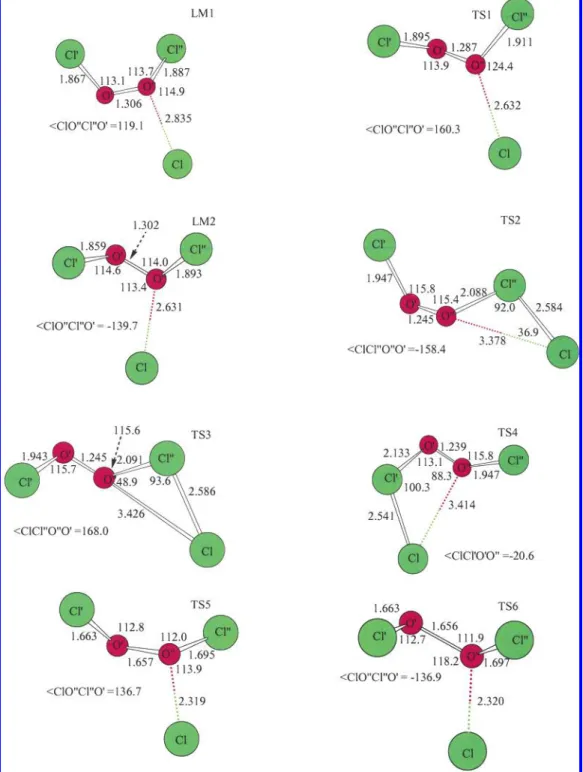
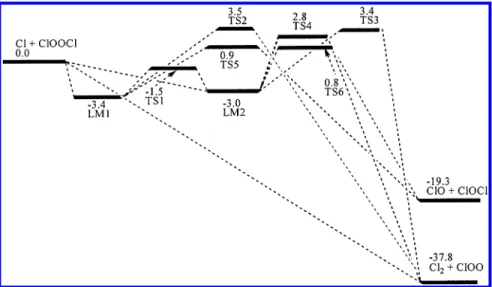
The optimized geometries of the intermediates and transition states for the reaction of Cl + ClOOCl are shown in Figure 1. The potential energy diagram obtained at the G2M//G96LYP/ 6-311+G(3df) level is presented in Figure 2. The vibrational frequencies and rotational constants are summarized in Table 1.
Formation of Cl2 + ClOO Products. As discussed previ-ously,14bamong the five isomers of Cl
2O2, the ClOOCl molecule
with C2symmetry is most stable. Experimentally,10,11the Cl2
-formation channel was found to be fast and has been assumed to be the only channel for the reaction. However, no detailed discussion on the mechanism has been presented in the literature.
Figure 1. The optimized geometry of intermediates and transition states computed at the G96LYP/6-311+G(3df) level for the Cl + ClOOCl
reaction.
As shown in Figure 2, several reaction paths can lead to the abstraction products, Cl2+ ClOO.
Direct Path. In ClOOCl, the two O and the two Cl atoms are equivalent. In principle, Cl atom can attack one of the Cl or O in ClOOCl to form different products. Our ab initio results show that when the Cl atom attacts one of the Cl in ClOOCl, it directly leads to Cl2+ ClOO barrierlessly with the
exothe-micity of 37.8 kcal/mol at the G2M level.
Indirect Path. As shown in Figures 1 and 2, the attacking Cl atom can form two isomeric complexes (LM1 and LM2) with ClOOCl, which will be labeled as Cl′O′O′′Cl′′for the conven-ience of discussion. The two complexes have similar structural parameters (see Figure 1) except that their ClO′′Cl′′O′dihedrals, 119.1°and -139.7°, indicate that Cl attacks the O′′atom from different directions. They lie below the reactants by 3.4 and 3.0 kcal/mol at the G2M level. LM1 can readily isomerize to LM2 via TS1 with a 1.9 kcal/mol barrier.
LM1, having the O′′-Cl bond length of 2.835 Å, is looser and can readily rotate; the interaction of Cl with Cl′′via TS2 can produce Cl2 + ClOO (ClCl′′+ Cl′O′O′′) with a barrier
above the reactants by 3.5 kcal/mol. In LM2, besides the possible interaction of Cl with Cl′′to eliminate ClCl′′via TS3 (with a barrier above the reactants by 3.4 kcal/mol), the Cl atom can also interact with Cl′to form ClCl′+ Cl′′O′′O′via TS4 with a barrier above the reactants by 2.8 kcal/mol (see Figures 1 and 2).
Formation of ClOCl + ClO Products. As discussed in the above section, the reaction of Cl with ClOOCl can form two complexes, LM1 and LM2, which can not only undergo elimination of ClCl′′or ClCl′but also dissociate to give ClO′′Cl′′ + Cl′O′via the corresponding transition states TS5 and TS6. Similar to those of LM1 and LM2, the apparent difference in
structural parameters of TS5 and TS6 lies in the ClO′′Cl′′O′ dihedrals, 136.7°and -136.9°, respectively. The breaking O′O′′ bonds lengthen by about 0.35 Å in TS5 and TS6 compared with those in LM1 and LM2; the forming Cl-O′′bond lengths decrease from 2.835 and 2.631 Å in LM1 and LM2 to 2.319 and 2.320 Å in TS5 and TS6, respectively. At the G2M level, TS5 and TS6 lie above the reactants by 0.86 and 0.79 kcal/ mol, respectively.
Heat of Formation for ClOOCl. Although the heat of formation of ClOOCl does not affect the predicted rate constants in the present case, because of its significant relevance to the stratospheric O3-destruction chemistry, we have examined the
heat of formation of ClOOCl in greater detail. Based on the experimental heats of formation23for Cl, ClO, ClOCl, and ClOO
and the predicted enthalpy changes for the two reactions
the heat of formation of ClOOCl was found to be 34.3 ( 0.5 and 32.9 ( 0.7 kcal/mol, respectively. The predicted values are consistent with the experimental values, 29.722and 32.1 kcal/
mol,11 and are close to some of the previous theoretical
estimates, 34.224and 32.625 at the CCSD(T)/[65321/54321]//
CCSD/TZ2P and MP2/6-31++(3d,2p) levels, which are some-what larger than the predicted values, 29.414b and 30.6,26
calculated at the G2M//B3LYP/6-311+G(3df,2p) and G2 levels, respectively. Similarly, the predicted heats of reaction given above are also close to the corresponding experimental values, -16.8 and -36.9 kcal/mol. Apparently, for this system, the G2M//G96LYP/6-311+G(3df) method provides not only rea-sonable transition-state structures but also reliable energies compared with the G2M//PW91PW91/6-311+G(3df) and other methods as mentioned in the previous section.
Because of the apparent deviation of∼3 kcal/mol in the heat of formation of ClOOCl mentioned above, we have carried out additional calculations using several isodesmic reactions and computational methods as listed in Table 2. The results of these calculations converge to∆fH°0) 30 kcal/mol with about (2
kcal/mol deviation. This lower value in fact agrees more closely with the predicted dissociation energy of ClOOCl to 2ClO, 29.4 kcal/mol,14b which gave rise to a quantitative
pressure-dependence prediction for the reverse association process measured experimentally as discussed in detail in ref 14b.
B. Rate Constant Calculations. The rate constant for the direct abstraction channel (k1) was calculated with the
VARI-Figure 2. The schematic energy diagram for the Cl-ClOOCl system computed at the G2M level. TABLE 1: Vibrational Frequencies and Rotational
Constants of the Reactants, Intermediates, and Transition States for the Reaction Cl + ClOOCl Calculated at the G96LYP/6-311+G(3df) Level species B (GHz) frequencies (cm-1) ClOOCl 12.5, 2.0, 1.8 106, 256, 348, 515, 526,1035 LM1 2.5, 1.1, 0.8 29, 41, 53, 107, 251, 366, 489, 538, 919 LM2 1.9, 1.6, 1.0 46, 57, 79, 112, 263, 362, 485, 542, 919 TS1 2.1, 1.2, 0.8 91i, 42, 67, 117, 227, 350, 489, 521, 971 TS2 7.1, 0.7, 0.7 70i, 37, 83, 178, 226, 314, 429, 529, 1182 TS3 5.0, 0.8, 0.8 83i, 20, 94, 185, 219, 318, 424, 531, 1180 TS4 3.0, 1.2, 1.0 139i, 41, 90, 186, 237, 319, 377, 530, 1209 TS5 2.5, 1.5, 1.0 222i, 45, 92, 119, 190, 268, 398, 602, 711 TS6 2.5, 1.5, 1.0 225i, 45, 93, 119, 189, 269, 389, 602, 710
Cl + ClOOCl f ClO + ClOCl, ∆rH°0) -19.3 kcal/mol Cl + ClOOCl f Cl2+ ClOO, ∆rH°0) -37.8 kcal/mol
FLEX code,20 whereas those for the indirect association/
disproportionation reactions were computed with the ChemRate code21coupling all intermediates involved in the forward and
reverse reactions as shown below:
where / denotes the chemically activated LM1 or LM2. The energies plotted in Figure 2 and the vibrational frequencies and rotational constants listed in Table 1 were used in the calculation. Because the product formation processes were found to be pressuindependent, the Lennard-Jones (L-J) parameters
re-quired for the stabilization of ClO(Cl)OCl (LM1 and LM2) were assumed to be approximately the same as that of ClOOCl.14b
Cl2 + ClOO Formation. As alluded to in the preceding discussion on the results of ab initio calculations, Cl2+ ClOO
can be directly and indirectly formed. The initial association process does not have a well-defined transition state because of the absence of an intrinsic reaction barrier. In this case, the Cl′O′O′′Cl′′-Cl complex on the Cl2 + ClOO side was first
located, and then the Cl-Cl′′bond length of this complex was varied from 2.037 to 4.637 Å, while other geometric parameters were fully optimized and their frequencies calculated at the G96LYP/6-311+G(3df) level. A smooth PES was obtained and the transition-state parameters for this barrierless process were evaluated canonically for each temperature and critical separa-tion, r#(T), based on the maximum Gibbs free energy criterion
as described previously for radical-radical reactions.27,28The
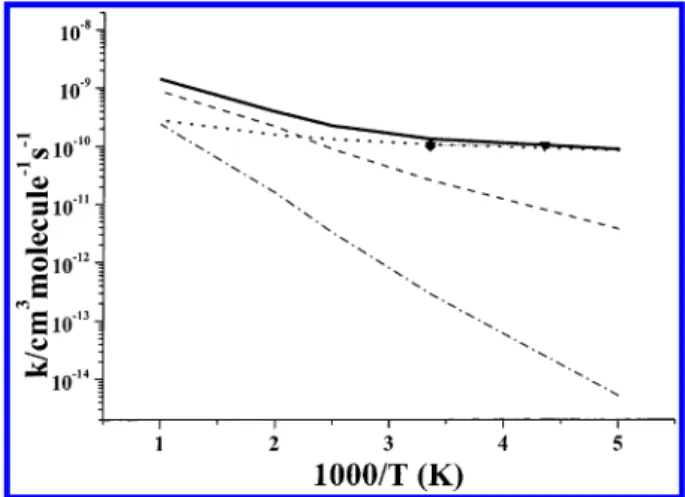
computed direct abstraction rate constant is shown as a dotted line in Figure 3; the result can be expressed by k1) 1.53 ×
10-13T1.1 exp(118/T) cm3molecule-1 s-1. For those indirect
channels that can produce Cl2+ ClOO via TS2, TS3, and TS4
with barriers of 3.5, 3.4, and 2.8 kcal/mol above the reactants, the smallest frequency vibration (less than 50 cm-1) in these TSs was treated as a free rotation and the reduced moment of inertia was approximately determined to be 201.7 amu. The sum of the rate constants for these indirect Cl2-formation paths, k1′,
shown as a dashed-dotted line in Figure 3, is minor at room temperature, amounting to less than 0.1% of Cl2yield at 298
K, but it increases to about 46% at 1000 K. The indirect abstraction rate constant for the formation of Cl2+ ClOO can
be expressed as k1′ ) 7.14 × 10⁻¹²T0.86 exp(-2370/T) cm3
molecule-1s-1in the temperature range of 200-1000 K. ClO + ClOCl Formation. Besides the above paths, LM1 and LM2 can also dissociate to produce ClO + ClOCl via TS5 and TS6. The vibration with the smallest frequency in these two transition states was also treated as a free internal rotator, and the reduced moment of inertia was determined to be 1124 amu. The predicted rate constant of k2is shown as a dashed line in
Figure 3, which can be expressed by k2 ) 2.19 × 10⁻¹⁴T0.70
exp(-1110/T) cm3 molecule-1 s-1, covering the temperature range of 200-1000 K. The total rate, kt) k1+ k1′+ k2, is
shown as a thick solid line in Figure 3. The ratios of k2/ktare
0.04, 0.19, 0.55, and 0.62 at 200, 298, 500, and 1000 K, respectively. Apparently, over 298 K, formation of the ClO + TABLE 2: Comparison of the Predicted Heats of Formation
(kcal/mol) for ClOOCl at 0 K Based on Different Reactions and Methods with Available Data
reaction ∆fH°0
(1) ClO + ClO ) ClOOCl 29.414b
(2) Cl + ClOOCl ) Cl2+ ClOO 32.9 ( 0.7a, 26.1b, 33.6c, 31.7 ( 0.7d
(3) Cl + ClOOCl ) ClOCl + ClO 34.3 ( 0.5a, 29.9 ( 0.5b,
29.6 ( 0.5c,
33.9 ( 0.5d
(4) HO + ClOOCl ) HOOCl + ClOe 29.3 ( 0.5b
(5) HO2+ ClOOCl ) HOOCl + ClOOe 28.2 ( 1.5b
(6) H + ClOOCl ) HOOCl + Cle 31.4b
(7) HOOCl + HCl ) H2+ ClOOCle 30.7b
(8) HOOCl + HOCl ) H2O + ClOOCle 31.9b
(9) HOOH + Cl2) H2+ ClOOCl 28.3b
(10) ClOOCl + H2O ) ClOCl + HOOH 32.1 ( 0.5,b32.6 ( 3.2,25 34.2,24 f30.6,26 29.7,2232.111
aG2M//G96/6-311+G(3df), this work.bG2M//B3LYP/6-311+G(3df),
this work.cG96/6-311+G(3df), this work.d
G2M//PW91PW91/6-311+G(3df), this work.eThe heat of formation of HOOCl, 0.78 (
0.5 kcal/mol, used in the reactions 4-8, is based on the reaction of
HOOH + HOCl ) HOOCl + H2O at the
G2M(CC2)//B3LYP/6-311+G(3df,2p) level; the heats of formation of other species are taken from ref 23.fThis value becomes 32.6 ( 1 kcal/mol if the most recent
heat of formation for Cl2O was used, as discussed in ref 14b.
Scheme 1 Cl + ClOOCl T LM1* f LM1 (+M) f ClO + ClOCl f Cl2(ClCl′′) + ClOO (Cl′OO) T LM2* f Cl + ClOOCl f ClO + ClOCl f Cl2(ClCl′′) + ClOO (Cl′OO) f Cl2(ClCl′) + ClOO (Cl′′OO) f LM2 (+M) Scheme 2 Cl + ClOOCl T LM2* f LM2 (+M) f ClO + ClOCl f Cl2(ClCl′′) + ClOO (Cl′OO) f Cl2(ClCl′) + ClOO (Cl′′OO) T LM1* f Cl + ClOOCl f ClO + ClOCl f Cl2(ClCl′′) + ClOO (Cl′OO) f LM1 (+M)
Figure 3. Comparison of the predicted rate constants with the experimental values in N2. Dotted and dashed-dotted lines represent the predicted formation rate constants of Cl2 + ClOO, k1 and k1′, respectively. Dashed line represents k2for ClO + ClOCl formation, and the thick solid line represents the total rate constant. Symbols are experimental data of ref 11.
ClOCl products becomes quite significant and competitive. The predicted total rate constant is in reasonable agreement with available experimental data10,11,29in which Cl
2+ ClOO were
assumed to be the only products. The predicted rate constant above room temperature needs further experimental substantia-tion.
IV. Concluding Remarks
The kinetics and mechanism for the reaction of Cl with ClOOCl has been investigated at the G2M//G96LYP/6-311+G-(3df) level of theory in conjunction with statistical rate constant calculations. A new product channel giving ClO + ClOCl was found. The total rate constant experimentally determined for Cl + ClOOCl could be reasonably accounted for theoretically. At lower temperatures, the direct abstraction channel forming Cl2 + ClOO is dominant; over 298 K, formation of ClO +
ClOCl becomes very competitive.
Acknowledgment. This work is sponsored by the Office of Naval Research under Contract No. N00014-89-J1949, Dr. J. Goldwasser, program manager. M.C.L. acknowledges the Taiwan National Science Council for the award of a distin-guished visiting professorship.
References and Notes
(1) Rowland, F. S.; Molina, M. J. ReV. Geophys. Space Phys. 1975, 78, 5341. Rowland, F. S. Annu. ReV. Phys. Chem. 1991, 42, 731. Johnston, H. S. Annu. ReV. Phys. Chem. 1992, 43, 1.
(2) Molina, L. T.; Molina M. J. J. Phys. Chem. 1987, 91, 433. Molina M. J.; Tso, T. L.; Molina, L. T.; Wang, F. C.-Y. Science 1987, 238, 1253. (3) Barrett, J. W.; Solomon, P. M.; De Zafra, R. L.; Jaramillo, M.; Emmons, L.; Parrish, A. Nature 1988, 336, 455.
(4) Molina, M. J.; Colussi, A. J.; Molina, L. T.; Schindler, R. N.; Tso, T. L. Chem. Phys. Lett. 1990, 173, 310.
(5) DeMore, W. B.; Tschuikow-Roux, E. J. Phys. Chem. 1990, 94, 5856.
(6) Toniolo, A.; Granucci, G.; Inglese, S.; Persico, M. Phys. Chem. Chem. Phys. 2001, 3, 4266.
(7) Kaledin, A. L.; Morokuma, K. J. Chem. Phys. 2000, 113, 5750. (8) Moore, T. A.; Okumura, M.; Seale, J. W.; Minton, T. K. J. Phys. Chem. A 1999, 103, 1691.
(9) Jacobs, J.; Kronberg, M.; Mueller, H. S. P.; Willner, H. J. Am. Chem. Soc. 1994, 116, 1106.
(10) Atkinson, R.; Baulch, D. L.; Cox, R. A.; Hampson, R. F., Jr.; Kerr, J. A.; Rossi, M. J.; Troe, J. J. Phys. Chem. Ref. Data 1997, 26, 521.
(11) Cox, R. A.; Hayman, G. D.; Nature (London) 1988, 332, 796. (12) Zhu, R. S.; Lin, M. C. PhysChemComm 2001, 25, 1.
(13) Zhu, R. S.; Xu, Z. F.; Lin, M. C. J. Chem. Phys. 2002, 116, 7452. (14) (a) Zhu, R. S.; Lin, M. C. J. Phys. Chem. A 2002, 106, 8390. (b) Zhu, R. S.; Lin, M. C. J. Chem. Phys. 2003, 118, 4094.
(15) Xu, Z. F.; Zhu, R. S.; Lin, M. C. J. Phys. Chem. A 2003, 107, 1040.
(16) (a) Lee, C.; Yang, W.; Parr, R. G. Phys. ReV. B 1998, 37, 785. (b) Gill, P. M. W. Mol. Phys. 1996, 89, 433.
(17) (a) Gonzalez, C.; Schlegel, H. B. J. Chem. Phys. 1989, 90, 2154. (b) Gonzalez, C.; Schlegel, H. B. J. Phys. Chem. 1990, 94, 5523.
(18) Mebel, A. M.; Morokuma, K.; Lin, M. C. J. Chem. Phys. 1995, 103, 7414.
(19) Frisch, M. J.; Trucks, G. W.; Schlegel, H. B.; Scuseria, G. E.; Robb, M. A.; Cheeseman, J. R.; Zakrzewski, V. G.; Montgomery, J. A., Jr.; Stratmann, R. E.; Burant, J. C.; Dapprich, S.; Millam, J. M.; Daniels, A. D.; Kudin, K. N.; Strain, M. C.; Farkas, O.; Tomasi, J.; Barone, V.; Cossi, M.; Cammi, R.; Mennucci, B.; Pomelli, C.; Adamo, C.; Clifford, S.; Ochterski, J.; Petersson, G. A.; Ayala, P. Y.; Cui, Q.; Morokuma, K.; Malick, D. K.; Rabuck, A. D.; Raghavachari, K.; Foresman, J. B.; Cioslowski, J.; Ortiz, J. V.; Stefanov, B. B.; Liu, G.; Liashenko, A.; Piskorz, P.; Komaromi, I.; Gomperts, R.; Martin, R. L.; Fox, D. J.; Keith, T.; Al-Laham, M. A.; Peng, C. Y.; Nanayakkara, A.; Gonzalez, C.; Challacombe, M.; Gill, P. M. W.; Johnson, B. G.; Chen, W.; Wong, M. W.; Andres, J. L.; Head-Gordon, M.; Replogle, E. S.; Pople, J. A. Gaussian 98, revision A.7; Gaussian, Inc.: Pittsburgh, PA, 1998.
(20) Klippenstein, S. J.; Wagner, A. F.; Dunbar, R. C.; Wardlaw, D. M.; Robertson, S. H. VARIFLEX, version 1.00; 1999.
(21) Mokrushin, V.; Bedanov, V.; Tsang, W.; Zachariah, M. R.; Knyazev, V. D. ChemRate, version 1.19; National Institute of Standards and Technology: Gaithersburg, MD, 2002.
(22) Nickolaisen, S. L.; Friedl, R. R.; Sander, S. P. J. Phys. Chem. 1994, 98, 155.
(23) . Chase, M. W., Jr. NIST-JANAF Thermochemical Tables, 4th ed.; J. Phys. Chem. Ref. Data, Monograph 9; American Chemical Society and American Institute of Physics for the National Institute of Standards and Technology: Washington, DC, 1998.
(24) Lee, T. J.; Rohlfing, C. M.; Rice, J. E. J. Chem. Phys. 1992, 97, 6593.
(25) McGrath, M. P.; Clemitshaw, K. C.; Rowland, F. S.; Hehre, W. J. Geophys. Res. Lett. 1988, 15, 883.
(26) Li, W. K.; Ng, C. Y. J. Phys. Chem. A 1997, 101, 113. (27) Hsu, C.-C.; Mebel, A. M.; Lin, M. C. J. Chem. Phys. 1996, 105, 2346.
(28) Chakraborty, D.; Hsu, C.-C.; Lin, M. C. J. Chem. Phys. 1998, 109, 8889.
(29) DeMore, W. B.; Sander, S. P.; Golden, D. M.; Hampson, R. F.; Kurylo, M. J.; Howard, C. J.; Ravishankara, A. R.; Kolb, C. E.; Molina, M. J. JPL Publ. 1997, 97-4.