國
立
交
通
大
學
資訊科學系
碩
士
論
文
超立方體中互相獨立線性配置之嵌入研究
Mutually Independent Linear Array Embeddedings in
Hypercubes
研 究 生:施倫閔
指導教授:譚建民 教授
超立方體中互相獨立線性配置之嵌入研究
Mutually Independent Linear Array Embeddedings in Hypercubes
研 究 生:施倫閔 Student:Lun-Min Shih
指導教授:譚建民 Advisor:Jimmy J.M. Tan
國 立 交 通 大 學
資 訊 科 學 系
碩 士 論 文
A ThesisSubmitted to Institute of Computer and Information Science College of Electrical Engineering and Computer Science
National Chiao Tung University in partial Fulfillment of the Requirements
for the Degree of Master
in
Computer and Information Science June 2005
Hsinchu, Taiwan, Republic of China
超立方體中互相獨立線性配置之嵌入研究
研 究 生:施倫閔 指導教授:譚建民 教授
國 立 交 通 大 學 資 訊 科 學 (研 究 所) 碩 士 班
摘 要
在訊息傳遞中,在每個接收點是要避免碰撞的事件發生,因此訊息傳送
路徑中互相獨立的特性是相當重要的。我們說兩條相同長度的路徑是獨
立的,就代表著除了起始點與終點之外,其餘的時間點中,在同一個時
間所經過的目標是不會相同的;在這篇論文中,我們探討研究了在 n 維
超立方體中,任意的兩點中可以存在著 (n-1) 條任意長度之互相獨立
的路徑,其長度由兩點間最短(漢明距離)到最長(漢米爾頓距離)都有。
Mutually Independent Linear Array
Embeddings in Hypercubes
Student:Samuel Lun-Min Shih Advisor:Jimmy J.M. Tan
Institute of Computer and Information Science
National Chiao Tung University
Abstract
We say that two paths P
0= <u
0,u
1,...u
k-1> and P
1= <v
0,v
1,...,v
k-1> are independent
if u
0= v
0, l(P
0) = l(P
1) and P
0(i
) ≠
P
1(i) fro every 1 < i < k-1. The set of paths
{P
0,P
1,...,P
s} of G are mutually independent if any two different paths in the set are
independent. In this paper, we prove that there exist (n-1) mutually independent
paths of length l joining any vertices u and v such that h(u,v)+2
≦
l
≦
2
n-1 and
誌
謝
首先最感謝的是我的指導教授譚建民老師,在這兩年中用心的教導,時時給 予鼓勵以及共同討論的幫助,以及共同指導教授徐力行老師給予的教導,同時也 高欣欣老師在口試時對這篇論文的指教。在這篇論文形成的階段,堅哥也是給予 我可以順利研究下去不可或缺的人物,感謝你的經驗分享,讓我可以更加順利完 成論文。 此外,感謝我的學長們,在我剛進來的第一年,很受到你們的照顧,在實驗 室的第二年,晃哥和元翔學長繼續就讀博班,而小中中、Panda、史都以及老哲都 畢業了,但是和你們時常的聯係讓我也獲益不少,尤其是小中中,在心思成長及 人生規劃裡,最要感謝你。當然,寶蓮學姐是一定不可以忘卻的大人物,在妳身 旁學習也讓我成長不少,還有妳和弘駿學長的情史,隱蔵得真的讓我們永生難 忘。同時,感謝我的學弟們,聖凱、小廖、尚融、銘皇及宙斯,在你們身上,也 學到不少做人的道理,也提醒了自己真的不可以怠惰下去,也希望你們順利畢業 最後,感謝我的父母以及所有家人,有你們在後面的支持,才能讓我在求學 的旅程上心無旁鶩;還有雅梅,是妳讓我踏上這條成功之路,沒有妳,就沒有現 在的我。 在此獻給許多幫忙我的人、指導我的人最真誠的感謝,謝謝你們。
目
錄
中文摘要
………
i
英文摘要
………
ii
誌謝
………
iii
目錄
………
iv
圖目錄
………
v
Chapter 1
Introduction………
1
Chapter 2
Preliminaries ………
3
2.1
Notations and Definitions ………
3
2.1.1
Basic properties of Qn………
4
Chapter 3
Mutually independent linear array embeddings……
5
Chapter 4
Conclusion………
27
圖 目
錄
Figure 3.1 The Hypercube Q3………
6
Figure 3.2 Illustration for the Lemma 2………
7
Figure 3.3 The Hypercube Q4………
8
Figure 3.4 Illustration for the Lemma 5………
13
Figure 3.5 Illustration for the Lemma 7………
18
Figure 3.6 Illustration for the Case I ………
21
Figure 3.7 Illustration for the Case I ………
22
Figure 3.8 Illustration for the Case II-1………
23
Figure 3.9 Illustration for the Case II-2………
24
Chapter 1
Introduction
An interconnection network topology is usually represented by a graph where vertices represent processors and edges represent links between processors. A network connects the processors of the parallel computer. There are a lot of mutually conflicting requirements in designing the topology of computer networks. It is almost important to design an interconnection network that is the parallel system. A number of mutually independent path for specific multiprocessor architectures have been discussed.
The architecture of an interconnection network is usually represented as a graph. The nodes and edges in a graph correspond to processors and communication links in an interconnection network, respectively. In the design and implementation of local area networks, the ring topology has been used frequently for its good properties such as simplicity , extensibility, regularity and easiness of implementation. To study the graph embedding problem, which maps a guest graph into a host graph, is an important issue in evaluating a network. The problem is mapping each node of the guest graph into a node of the host graph, and mapping each edge of the guest graph into an edge of the host graph.
Many interconnection network topologies have been proposed in the literature for the purpose of connecting hundreds or thousands of processing elements. Among these topologies, the binary n-cube (abbreviated as hypercube) [2], denoted by Qn is one of the
most popular topologies. Linear arrays and rings, which are two of the most fundamental networks for parallel and distributed computation, are suitable for developing simple algorithms with low communication costs. Some efficient algorithms designed on linear arrays and rings for solving a variety of algebraic problems and graph problems can be found in previous works [3, 1].
Chapter 2
Preliminaries
2.1
Notations and Definitions
For the graph theoretical definitions and notations, we follow [1], a graph G = (V, E) consists of a finite set V and a subset E of {(u, v) | u 6= v, (u, v) is an unordered pair of elements of V }. We call V = V (G) the vertex set of G and E = E(G) the edge set of G. A graph G = (V0SV1, E) is bipartite if V (G) is the union of two disjoint sets V0 and
V1, such that every edge joins V0 with V1. Two vertices ,u and v, have the same color if
and only if u and v are in the same partite set. A path is a sequence of adjacent vertices, written as hv0, v1, v2, . . . , vmi, in which all the vertices v0, v1, v2, . . . , vm are distinct except
that possible v0 = vm. We also write the path hv0, P, vmi, where P = hv1, v2, ..., vm−1i.
The length of a path P , denoted by l(P ), is the number of edges in P . Let u and v be two vertices of G. The Hamming distance h(u, v) between u and v is the number of different bits in the corresponding strings of both vertices.
An n-dimensional hypercube can be modeled as a graph Qn, with the vertex set V (Qn)
strings, un−1un−2...u1u0. There is an edge between two vertices if and only if their binary
labels differ in exactly one bit position. If u(i) is the neighbor vertex across dimension i of the vertex u, then the edge between them is said to be on dimension i.
We say that two paths P0 = hu0, u1, . . . , uk−1i and P1 = hv0, v1, . . . , vk−1i are
indepen-dent if u0 = v0, l(P0) = l(P1) and P0(i) 6= P1(i) for every 1 < i < k − 1. The set of paths
{P0, P1, . . . , Ps} of G are mutually independent if any two different paths in the set are
independent. In this paper, we prove that there exist (n − 1) mutually independent paths of length l joining any vertices u and v such that h(u, v) + 2 ≤ l ≤ 2n− 1 and n ≥ 4.
2.2
Basic properties of
Q
nThis paper is aimed at embedding linear arrays and all possible length of paths into the hypercubes. We use induction to prove our main results. Lemmas 1 contribute to the induction basis for inductive proof of our main results.
Chapter 3
Mutually independent linear array
embeddings
Lemma 2 Assume n > 3. Let x be any node of Qn and u and v be any two nodes that
are different color as x of Qn. Then, there exists a path of length l of Qn− {x} joining u
to v for h(u, v) ≤ l ≤ 2n− 2 and l is even.
Proof. We proof this lemma by induction on n. It is easy to construct the path of length h(u, v), and we claim to prove the length is h(u, v) + 2 ≤ l ≤ 2k− 2 and l is even.
Since Q3 is node transitive, we can assume that x = 000. All of the paths with n = 3 are
listed below: chose u = 001, v = 010 h(u, v) = 2 (001, 101, 111, 011, 010) (001, 101, 100, 110, 111, 011, 010) chose u = 001, v = 111 h(u, v) = 2 (001, 101, 100, 110, 111) (001, 101, 100, 110, 010, 011, 111)
The lemma hold for n = 3 above list. As the inductive hypothesis, we assume that the lemma is true for every integer n < k, for all k ≥ 3. Let x = xk−1xk−2...x1x0,
u = uk−1uk−2...u1u0 and v = vk−1vk−2...v1v0. Either xi = ui or xi = ui will satisfy
dimension i and either u or v is in the same subcube as x. Without loss of generality, we may assume that u is in the same subcube as x and {u, x} ∈ V (Q0
k−1). The proof of this
lemma is classified in three cases.
000 010 110 100 101 111 011 001
Figure 3.1: The Hypercube Q3.
Case 1. v ∈ V (Q0
k−1). (see Fig. 3.2(a)).
By induction hypothesis, there exists a path of length l of Q0
k−1 joining u and v for
any h(u, v) + 2 ≤ l ≤ 2k−1− 2 and l is even. Suppose that 2k−1 ≤ l ≤ 2k− 2 and l is
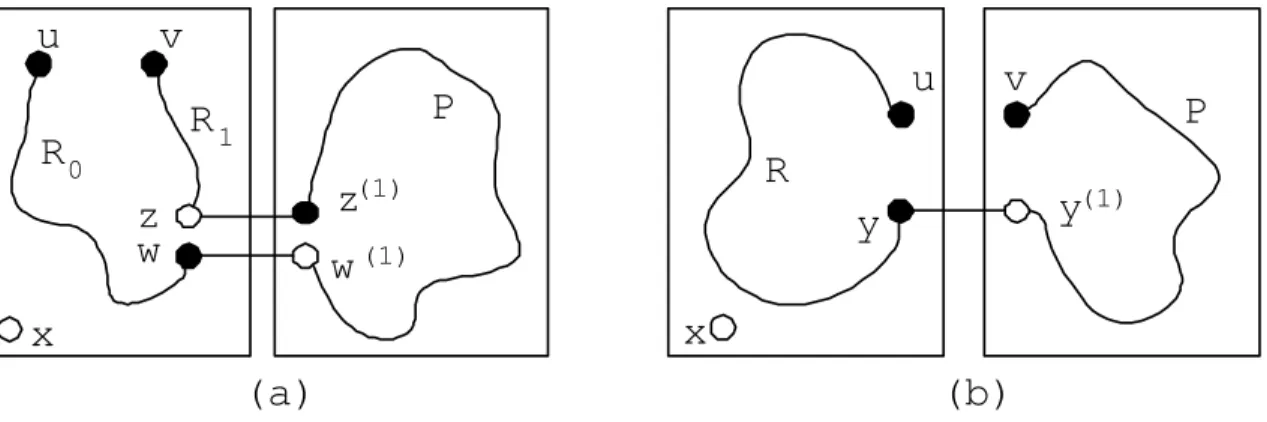
even. Let R be one of the longest path of Q0k−1 − {x} joining u and v. Let (w, z) be any edge on R. We can write R as hu, R0, w, z, R1, vi. By definition, w(1) and z(1) are
vertices in Q1
k−1. By Lemma 1, there exists a path P in Q1k−1 joining w(1) and z(1) for
1 ≤ l(P ) ≤ 2k−1 − 1 and l(P ) is odd. Thus, hu, R
0, w, w(1), P, z(1), z, R1, vi is a path of
length l in Qn connecting u and v.
Case 2. v ∈ V (Q1
k−1). (see Fig. 3.2(b)).
Let y(1) be one neighbor of v such that y 6= u. Thus, h(u, y) = h(u, v). Suppose that
h(u, v) + 2 ≤ l ≤ 2k− 2 for l is even. By induction hypothesis, there exist a path R joining
u and y for any h(u, y) ≤ l(R) ≤ 2k−1− 2 and l(R) is even. Let l
1 = l − l(R) − 1. Then l1
is odd and 1 ≤ l1 ≤ 2k−1. By Lemma 1, there exists a path P of length l1 in Q1k−1 joining
y(1) and v. Thus, hu, R, y, y(1), P, vi is a path of length l in Q
x
u
v
z
w
R
1R
0z
(1)w
(1)x
u
v
y
y
(1)R
P
P
(a)
(b)
Figure 3.2: Illustration for the Lemma 2.
2
Lemma 3 Let x and y be any two nodes from different partite set of Q4, and let u and
v be any two vertices from different partire set of Q4 − {x, y}. Then, there exists a path
P of Qn− {x, y} joining u and v such that h(u, v) ≤ l(P ) ≤ 13 and l(P ) is odd.
Proof. Since Q4 is node transitive, we can assume that x = 0000. Moreover, we suppose
that y = 0001 or 0111 such that the distance between x and y is either 1 or 3. Q4 can
be decomposed into two subcubes Q0
3 and Q13 by dimension 0 or 3 such that x and y are
in the same subcase. Without loss of generality, we may assume that x, y ∈ V (Q0
3). The
proof of this lemma is classified in two cases.
Case I. y=0001.
There exists a hamiltonian cycle C = h0100, 0101, 0111, 0011, 0010, 0110, 0100i of Q0 3−
{x, y}. We can write the cycle C as ha0, a1, a2, a3, a4, a5, a0i. In the other hand, there exist
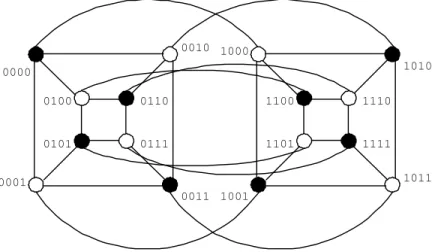
proof of this situation is classified in three cases. 0000 0010 0001 0011 0100 0110 0101 0111 1000 1010 1001 1011 1100 1110 1101 1111
Figure 3.3: The Hypercube Q4.
Subcase I.1. u, v ∈ V (Q0 k−1).
(a) h(u, v) = 1. Suppose that (u, v) is lying on C. By definition, u(1) and v(1) are
vertices in Q1
3 and u(1) is adjacent to v(1). Suppose that l = 3. We can construct P as
hu, u(1), v(1), vi. By above discuss, there exists one path of length 5 joining any edge that
on the C. Suppose that 7 ≤ l ≤ 13 and l is odd. There exist one path R of length 5 joining u and v. Let (w, z) be any edge on R and we can write R as hu, R0, w, z, R1, vi.
By definition, (w(1), z(1)) is in Q1
3. By Lemma 1, there exist a path S of length l1 joining
w(1) and z(1) of Q1
3 for any 1 ≤ l1 ≤ 7 and l1 is odd. Thus, hu, R0, w, w(1), S, z(1), z, R1, vi
is one path of length l joining u and v.
Suppose that (u, v) is not lying on C. In this situation, we only discuss one case about (u, v) = (0110, 0111). We can find a path of length 3 as ha0, a1, a2, a3i like
h0110, 0100, 0101, 0111i. By definition, a(1)1 and a(1)2 are in the Q1
exist a path S of length l1 joining a(1)1 and a (1)
2 of Q13for any 1 ≤ l1 ≤ 7 and l1 is odd. Thus,
u, a1, a(1)1 , S, a (1)
2 , a2, v is a path of length l joining u and v for 5 ≤ l ≤ 11 and l is odd.
Assume that l = 13. P = h0110, 0100, 0101, 1101, 1100, 1000, 1001, 1011, 1111, 1110, 1010, 0010, 0011, 0111i is the path of length l joining u and v.
(b) h(u, v) = 3. In this situation, we only discuss one case about (u, v) = (0100, 0101). There exists a path R of length 5 joining u and v of Q0
3− {x, y} as R = h0100, 0101, 0111,
0110, 0010, 0011i. Let w be R(4) on R. We can write the path R as hu, R0, w, vi. By
definition, w(1), v(1) are both in Q1
3. By Lemma 1, there exist a path S of length l1 joining
w(1) and v(1) of Q1
3 for any 1 ≤ l1 ≤ 7 and l1 is odd. Thus, hu, R0, w, w(1), S, v(1), vi is the
path of length l joining u and v for any 7 ≤ l ≤ 13.
Subcase I.2. u∈ V (Q0
k−1) and v ∈ V (Q1k−1) or u ∈ V (Q1k−1) and v ∈ V (Q0k−1).
Without loss of generality, we assume that u ∈ V (Q0
k−1) and v ∈ V (Q1k−1).
(a) h(u, v) = 1. Let w be the neighbor of u for w ∈ V (Q0
3) and w 6= {x, y} and (u, w)
is lying on C. In addition, let z be the neighbor of v for z ∈ V (Q0
3) and z is adjacent to w.
By Lemma 1, there exist a path S of length l1 joining z and v of Q13 for any 1 ≤ l1 ≤ 7 and
l1 is odd. Therefor, hu, w, z, S, vi is the path of length l joining u and v for any 3 ≤ l ≤ 9
and l is odd. Suppose that 11 ≤ l ≤ 13 and l is odd. By above discuss, there exists a path R of length 5 joining u and w of Q0
3 − {x, y}. Thus, hu, R, w, z, S, vi is the path of
length l joining u and v.
(b) h(u, v) = 3. The same case (a). Let w be the neighbor of u for w ∈ V (Q0 3) and
w6= {x, y} and (u, w) is lying on C. In addition, let z be the neighbor of v for z ∈ V (Q0 3)
omitted.
Subcase I.3. u, v ∈ V (Q1
k−1). In this situation, we only discuss one case about
(u, v) = (1110, 1111). By Lemma 1, there exist a path S of length l1 joining u and v of
Q13 for any 3 ≤ l1 ≤ 7 and l1 is odd. Let w be the node S(l1− 1) on S. The path S can be
wrote as hu, S0, w, vi. By definition, w(0) is in Q03. It is easy to check that w(0) is adjacent
to v(0) and (w(0), v(0)) is lying on C. By above discuss, there exist a path R of length 5
joining w(0) and v(0). Thus, hu, S
0, w, w(0), R, v(0), vi is the path of length l joining u and
v.
Case II. y=0111.
There exists a hamiltonian cycle C = h0100, 0101, 0001, 0011, 0010, 0110, 0100i of Q0 3−
{x, y}. We can write the cycle C as ha0, a1, a2, a3, a4, a5, a0i. In the other hand, there exist
a path of length 5 joining ai and aj of Q03− {x, y} if (ai, aj) is lying on C for i 6= j. The
proof of this case is similar to than Case I and hence the detailed proof is omitted.
2
Lemma 4 Assume n = 3, 4. Let {ei | ei = (wi, bi) ∈ E(Qn), bi is black node and wi
is white node, 1 ≤ i ≤ n − 1} be any n-1 disjoint edges in Qn. Then, there exist n-1
independent paths P1, ..., Pn−1 of length l in Qn joining wi and bi for 1 ≤ l ≤ 2n− 1.
Proof. It is easy to construct the path of length 1, and the path of length 3 ≤ l ≤ 7 such that l is even are listed below:
chose (000, 001) and (101, 100) l= 3 (000, 010, 011, 001) (101, 111, 110, 100) l= 5 (000, 010, 110, 111, 011, 001) (101, 111, 011, 010, 110, 100) l= 7 (000, 010, 110, 100, 101, 111, 011, 011) (101, 111, 011, 001, 000, 010, 110, 100) chose (000, 001) and (110, 111) l= 3 (000, 010, 011, 001) (110, 010, 101, 111) l= 5 (000, 010, 110, 111, 011, 001) (110, 100, 000, 001, 101, 111) l= 7 (000, 010, 110, 100, 101, 111, 011, 001) (110, 100, 000, 010, 011, 001, 101, 111) chose (000, 001) and (110, 100) l= 3 (000, 010, 011, 001) (110, 111, 101, 100) l= 5 (000, 010, 110, 111, 011, 001) (110, 111, 011, 001, 101, 100) l= 7 (000, 010, 110, 100, 101, 111, 011, 001) (110, 111, 101, 001, 011, 010, 000, 100) chose (000, 001) and (101, 111) l= 3 (000, 010, 011, 001) (101, 100, 110, 111) l= 5 (000, 010, 110, 111, 011, 001) (101, 100, 000, 010, 110, 111) l= 7 (000, 010, 110, 100, 101, 111, 011, 001) (101, 100, 000, 010, 011, 001, 101, 111)
By above list, the lemma holds for n = 3.
Suppose that n = 4. There are 4 dimensions in Q4, so Q4 can be decomposed into Q03
and Q1
3 two subcubes by dimension j such that ei are not cross edges for all 1 ≤ i ≤ 3.
Then, the number of the black nodes is equal to the white nodes in Qi
3, i = 0, 1. Therefor,
the proof is divided into two major cases.
Case 1. Not all of the disjoint edges are in the same subcube.
Without loss of generality, we may assume that e1,e2 ∈ E(Q03) and e3 ∈ E(Q13).
Assume that i = 1, 2. Suppose that 1 ≤ l ≤ 7 and l is odd. By above discuss, there exist 2 mutually independent path of length l joining wi and bi. By Lemma 1, there exists
one path of length l joining w3 and b3 of Q13. Suppose that 9 ≤ l ≤ 13 and l is odd.
joining w3 and b3. Obviously, l(R1) = l(R2) = l(R3) = 7. In addition, let xj be the node
Rj(6) and we can write Rj as hwj, R0j, xj, bji for all 1 ≤ j ≤ 3. By definition, x (1)
i and
b(1)i are the vertices in Q1
3. By above discuss, there exist 2 mutually independent path Si
of length l1 joining w(1)i and b (1)
i for any 1 ≤ l1 ≤ 7. By definition, x (0) 3 and b
(0)
3 are the
vertices in Q0
3. By Lemma 1, there exist one path S3 of length l1 joining w3(0) and b (0) 3
for any 1 ≤ l1 ≤ 7. Thus, hwi, R0i, xi, x (1) i , Si, b
(1)
i , bii and hw3, R03, x3, x(0)3 , S3, b(0)3 , b3i are 3
mutually independent path of length l joining wj and bj for any 1 ≤ l ≤ 13 and 1 ≤ j ≤ 3.
Case 2. All of the disjoint edges are in the same subcube.
Without loss of generality, we may assume that e1,e2,e3 ∈ E(Q03). In this situation, we
only discuss one case about any two edges are lying on different dimensions. Since Q4 is
vertex transitive, we can assume that e1 = (000, 001), e2 = (100, 110) and e3 = (111, 011).
Suppose that 3 ≤ l ≤ 7 and l is odd. With above discuss, there exist 2 mutually independent path of length l joining wi and bi. In addition, , w(1)3 and b
(1)
3 are the vertices
in Q1
3. By Lemma 1, there exists one path R of length l − 2 joining w (1) 3 and b (1) 3 of Q13. Thus, hw3, w(1)3 , R, b (1)
3 , b3i is the path of length l joining w3 and b3. Suppose that
9 ≤ l ≤ 15. The paths are listed below:
l= 9 (0000, 0010, 0110, 0100, 0101, 0111, 1111, 1011, 0011, 0011) (0101, 0111, 0011, 0001, 0000, 0010, 1010, 1110, 0110, 0100) (0011, 1011, 1010, 1110, 1100, 1000, 1001, 1101, 1111, 0111) l= 11 (0000, 0010, 0110, 0100, 0101, 0111, 1111, 1011, 1001, 1011, 0011, 0011) (0101, 0111, 0011, 0001, 0000, 0010, 1010, 1000, 1100, 1110, 0110, 0100) (0011, 1011, 1010, 1110, 1100, 1000, 1001, 0001, 0101, 1101, 1111, 0111) l= 13 (0000, 0010, 0110, 0100, 0101, 0111, 1111, 1110, 1100, 1011, 1001, 1011, 0011, 0011) (0101, 0111, 0011, 0001, 0000, 0010, 1010, 1000, 1001, 1101, 1100, 1110, 0110, 0100) (0011, 1011, 1010, 1110, 1100, 1000, 1001, 0001, 0101, 0000, 0100, 1101, 1111, 0111) l= 15 (0000, 0010, 0110, 0100, 0101, 0111, 1111, 1110, 1010, 1000, 1100, 1011, 1001, 1011, 0011, 0011) (0101, 0111, 0011, 0001, 0000, 0010, 1010, 1000, 1001, 1011, 1111, 1101, 1100, 1110, 0110, 0100) (0011, 1011, 1010, 1110, 1100, 1000, 1001, 0001, 0101, 0000, 0010, 0110, 0100, 1101, 1111, 0111) 2
Lemma 5 Assume n ≥ 4. Let x and y be any two nodes from different partite set of Qn,
and let u and v be any two vertices from different partite set of Qn− {x, y}. Then, there
exists a path P joining u and v of Qn− {x, y} for h(u, v) ≤ l(P ) ≤ 2n− 3 and l(P ) is
odd.
Proof. We prove this lemma by induction on n. By Lemma 3, we observe that the lemma holds for n = 4. For k ≥ 4, we assume that the lemma is true for every integer n < k. Let x = xk−1xk−2...x1x0 and y = yk−1yk−2...y1y0. Hence xi = yi for some i.
Accordingly, Qk can be decomposed into two subcube Q0k−1 and Q1k−1 by dimension i
and x and y are in the same subcube. Without loss of generality, we may assume that x, y ∈ V (Q0
k−1). Therefor, the proof is divided into three major cases.
(a)
(b)
(c)
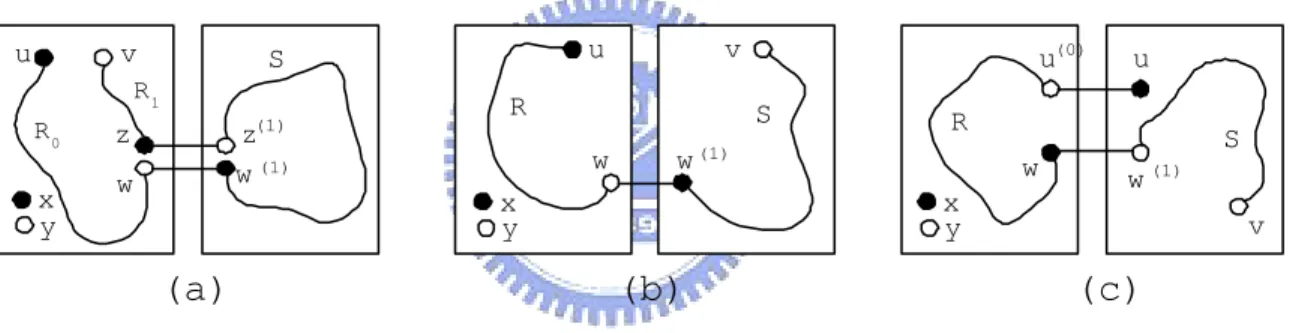
x y z(1) z w u v w(1) R0 R1 S x y xy u w w(1) v R S u v u(0) w w(1) R SFigure 3.4: Illustration for the Lemma 5.
Case 1. u, v ∈ V (Q0
k−1). By inductive hypothesis, there exists a path of length l0
connecting u and v of Qk− {x, y} for any h(u, v) ≤ l0 ≤ 2k−1 − 3 such that l0 is odd.
Suppose that 2k−1− 1 ≤ l ≤ 2k− 3 with l is odd. Let R be one of the longest path of
Q0k−1 joining u and v. Since l(R) = 2k−1− 3 ≥ 5 if k ≥ 4, there exists an edge (w, z) in
R. We can write the path R as hu, R0, w, z, R1, vi. In subcube Q1k−1, let w(1) and z(1) be
1 ≤ l(S) ≤ 2k−1− 1 with l(S) is odd. Therefor, P = hu, R
0, w, w(1), S, z(1), z, R1, vi is a
path of length l joining u and v of Qk− {x, y}.
Case 2. u∈ V (Q0
k−1) and v ∈ V (Q1k−1) or u ∈ V (Q1k−1) and v ∈ V (Q0k−1). Without
loss of generality, we may assume that u ∈ V (Q0
k−1) and v ∈ V (Q1k−1). Let w(1) be
one neighbor of v and w(1) ∈ V (Q1
k−1). By definition, w is the neighbor of w(1) and
w ∈ V (Q0
k−1). Obviously, h(u, w) = h(w(1), v) = 1. By inductive hypothesis, there exists
a path R of length l0 connecting u and w of Qk− {x, y} for 1 ≤ l0 ≤ 2k−1 − 3 and l0
is odd. Let l1 = l − l0 − 1. By Lemma 1, there exists a path S of length l1 joining
w(1) and v. Thus, P = hu, R, w, w(1), S, vi is a path joining u and v of Q
k − {x, y} for
h(u, v) ≤ l(P ) ≤ 2k− 3.
Case 3. u, v ∈ V (Q1
k−1). In this subcase discussion, we assume that at most one
vertex in {u, v} is adjacent to {x, y}. Otherwise, Qk can be decomposed into another
two subcubes by another dimension j for x and y in the same subcube and the proof is the same as Case 1. Without loss of generality, we may assume that u is not adjacent to {x, y}. By Lemma 1, there exists a path of length l joining u and v of Q1
k−1 for any
h(u, v) ≤ l ≤ 2k−1−1 such that l is odd. Suppose that 2k−1+1 ≤ l ≤ 2k−3 and l is odd. By
definition, u(0)is vertex in Q0
k−1. Let w be any vertex that are different color as u(0)of Q0k−1
and w 6= {x, y}. Let w(1) be the neighbor of w and w(1) ∈ V (Q1
k−1). By Lemma 2, there
exist a path S joining w(1)and v of Q1
k−1−{u} for any h(w(1), v) ≤ l(S) ≤ 2k−1−2 and l(S)
is even. Let l0 = l−l(S)−2. Then l0is odd and 1 ≤ l0 ≤ 2k−1−3. By induction hypothesis,
there exists a path R of length l0 joining u(0) and w. Thus, P = hu, u(0), R, w, w(1), S, vi
2
Lemma 6 Assume n ≥ 3. Let {ei | ei = (wi, bi) ∈ E(Qn), bi is black node and wi is white
node, 1 ≤ i ≤ n − 1} be any n-1 disjoint edges in Qn. Then, there exist n-1 independent
paths P1, ..., Pn−1 of length l in Qn joining wi and bi for 1 ≤ l ≤ 2n− 1.
Proof. We prove this lemma by induction on n. By Lemma 4, we observe that the lemma holds for n = 3, 4. As the inductive hypothesis, we assume that the lemma is true for 3 ≤ k < n. There are k dimensions in Qk, so Qk can be decomposed into Q0k−1 and
Q1
k−1 two subcubes by dimension j such that ei are not cross edges for all 1 ≤ i ≤ k − 1.
Then the number of the black nodes is equal to the white nodes in Qi
k−1, i = 1, 2. The
proof is divided into two major cases.
Case 1. Not all of the disjoint edges are in the same subcube.
Without loss of generality, we may assume that ei ∈ E(Q0k−1) and ej ∈ E(Q1k−1) for
1 ≤ i ≤ j ≤ k − 1 and |ei| + |ej| = k − 1. Suppose that 1 ≤ l ≤ 2k−1− 1 and l is odd. By
above discuss, there exist i mutually independent path of length l of Q0
k−1 joining wi and
bi and j mutually independent path of length l of Q1k−1. joining wj and bj. Suppose that
2k−1+ 1 ≤ l ≤ 2k− 1 and l is odd. Let R
i be the longest paths of Q0k−1 joining wi and bi
and Rj be the longest path of Q1k−1 joining wj and bj. Obviously, l(Ri) = l(Rj) = 2k−1−1.
In addition, let xi be the node Ri(2k−1− 2) and we can write Ri as hwi, Ri0, xi, bii. By
definition, x(1)i and b(1)i are the vertices in Q1
k−1. By above discuss, there exist i mutually
independent path Si of length l1 joining w(1)i and b (1)
i for any 1 ≤ l1 ≤ 2k−1 − 1. The
same as above proof. Let xj be the node Rj(2k−1− 2) on Rj and we can write Rj as
hwj, R0j, xj, bji. By definition, x (0)
j and b (0)
there exist j mutually independent path Sj of length l1 joining w(0)j and b (0) j for any 1 ≤ l1 ≤ 2k−1 − 1. Thus, hwi, R0i, xi, x (1) i , Si, b (1) i , bii and hwj, R0j, xj, x (0) j , Sj, b (0) j , bji are
k− 1 mutually independent path of length l for any 1 ≤ l ≤ 2k− 1.
Case 2. All of the disjoint edges are in the same subcube.
Without loss of generality, we may assume that all edges are in Q0
k−1. For convenience,
we assume that 1 ≤ i ≤ k − 2. It is trivial to construct the path of length 1 connecting wi
and bi. Suppose that 3 ≤ l ≤ 2k−1− 1. By induction hypothesis, there exist k − 2 paths
Pi of length l joining wi and bi in Q0k−1. By definition, w (1)
k−1 and b (1)
k−1 are the neighbors
of wk−1 and bk−1 for w(1)k−1 ∈ Q1k−1 and b (1) k−1 ∈ Q
1
k−1. By Lemma 1, we can find a path R
with length l − 2 joining wk−1(1) and b(1)k−1. Thus, hwk−1, wk−1(1) , R, b(1)k−1, vk−1i is the path Pk−1
of length l in Qk joining wk−1 and bk−1.
Suppose that 2k−1 + 1 ≤ l ≤ 2k− 1. Assume that 2k−1 − 3 ≤ l
0 ≤ 2k−1 − 1. With
above discussion, let Ri be k − 2 mutually independent paths with length l0 joining wi
and bi. Let xi and yi be the nodes Ri(l0 − 2) and Ri(l0− 1) on Ri. We can write Ri as
hwi, R0i, xi, yi, bii. Let x (1) i and y
(1)
i be the neighbors of xi and yi in Q1n−1. By Lemma 6,
there exist k − 2 path Si joining x (1)
i and y (1)
i in Q1k−1 for 3 ≤ l(Si) ≤ 2k−1 − 1. Thus,
Pi = hwi, R0i, xi, x(1)i , Si, y(1)i , yi, bii are k − 2 paths with length l in Qk joining wi and bi.
By definition, w(1)k−1 and b(1)k−1 are the neighbors of wk−1 and bk−1 for wk−1(1) ∈ Q1k−1 and
b(1)k−1 ∈ Q1
k−1. Let z be one neighbor of bk−1 and z 6= yi. Otherwise, bk−1 is adjacent to yi
and we can construct Pj as hwi, R0i, xi, x (1) i , Si, y
(1)
i , yi, bk−1i such that one neighbor of bj is
not equal all yi for j ∈ [1, k − 2]. In addition, let a be any node that are different color as
and a(1) 6= x(1)
i . By Lemma 5, there exist a path Rk−1 with length l0− 2 connecting w(1)k−1
and a(1) of Q1
k−1− {z(1), b (1)
k−1}. By Lemma 3, there exist a path St−1 with length |Si| − 2
joining a and z. Thus, Pk−1 = hwk−1, wk−1(1) , Rk−1, a(1), a, Sk−1, z, z(1), b(1)k−1, bk−1i is the k −1
mutually independent path with length l joining wk−1 and bk−1.
2
Lemma 7 Assume that n ≥ 3. Let v be any vertex of Qn. There exist n-1 independent
path P1, ..., Pn−1 of length l in Qn from v to vi such that vi is the neighbor of v for
1 ≤ i ≤ n − 1 and 1 ≤ l ≤ 2n− 1.
Proof. We prove this lemma by induction on n. Since Q3 is node transitive, we can
assume that v = 000 and v1 = 001 and v2 = 010. The required path of n = 3 are listed
below: chose v = 000, v1= 001 v2= 010 l= 1 (000, 001) (000, 010) l= 3 (000, 100, 101, 001) (000, 001, 011, 010) l= 5 (000, 100, 110, 111, 101, 001) (000, 001, 101, 100, 110, 010) l= 7 (000, 100, 110, 010, 011, 111, 101, 001) (000, 001, 011, 111, 101, 100, 110, 010)
The lemma hold for n = 3 above list. As the inductive hypothesis, we assume that the lemma is true for 3 ≤ k < n.
Without loss of generality, we may assume the subcube is Q0
t−1. The proof of this
subcase is classified in three parts.
For convenience, we assume that 1 ≤ i ≤ k − 2. It is trivial to construct the path of length 1 connecting v and vi. Suppose that 3 ≤ l ≤ 2k−1− 1. By induction hypothesis,
u
v
ix
iy
ix
i(1)y
i(1)v
k-1u
(1)v
k-1(1)z
(1)a
(1)a
z
R
i0R
k-10S
iS
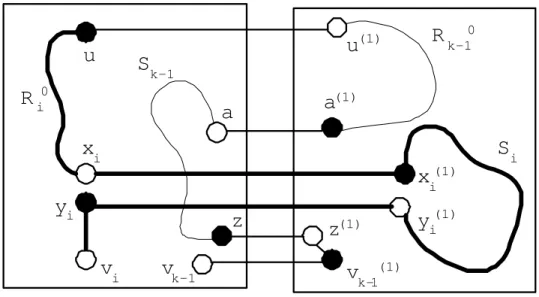
k-1Figure 3.5: Illustration for the Lemma 7.
there exist k − 2 paths Pi of length l joining v and vi in Q0k−1. By definition, v(1) and v(1)k−1
are the neighbors of v and vk−1 for v(1) ∈ Q1k−1 and v (1)
k−1 ∈ Q1k−1. By Lemma 1, we can
find a path R with length l − 2 joining v(1) and v(1)
k−1. Thus, hv, v(1), R, v (1)
k−1, vk−1i is the
path Pk−1 of length l in Qk joining v and vk−1.
Suppose that 2k−1 + 1 ≤ l ≤ 2k− 1. Assume that 2k−1 − 3 ≤ l
0 ≤ 2k−1− 1. With
above discussion, let Ri be k − 2 mutually independent paths with length l0 joining v
and vi. Let xi and yi be the nodes Ri(l0− 2) and Ri(l0 − 1) on Ri. We can write Ri as
hv, R0
i, xi, yi, vii. Let x (1)
i and y (1)
i be the neighbors of xi and yi in Q1n−1. By Lemma 6,
there exist k − 2 path Si joining x(1)i and y (1)
i in Q1k−1 for 3 ≤ l(Si) ≤ 2k−1 − 1. Thus,
Pi = hv, R0i, xi, x(1)i , Si, y(1)i , yi, vii are k − 2 paths with length l in Qk joining v and vi. By
definition, v(1) and v(1)
k−1 are the neighbors of v and vk−1 for v(1) ∈ Q1k−1 and v (1)
k−1 ∈ Q1k−1.
Let z be one neighbor of vk−1 and z 6= yi. Otherwise, vk−1 is adjacent to yi and we can
all yi for j ∈ [1, k − 2]. In addition, let a be any node that are different color as vk−1
and a 6= xi. By definition, z(1) and a(1) are the vertices in V (Q1k−1) and z(1) 6= y (1)
i and
a(1) 6= x(1)i . By Lemma 5, there exist a path Rk−1 with length l0− 2 connecting u(1) and
a(1) of Q1
k−1 − {z(1), v (1)
k−1}. By Lemma 3, there exist a path Sk−1 with length |Si| − 2
joining a and z. Thus, Pk−1 = hv, v(1), Rk−1, a(1), a, Sk−1, z, z(1), v(1)k−1, vk−1i is the k − 1
mutually independent path with length l joining v and vk−1.
2
Theorem 1 Assume n ≥ 4. Given any two vertices u, v in Qn and the distance d(u, v) =
d. There exist n-1 mutually independent path P1, ..., Pn−1 of length l joining u and v in
Qn for l = d + 2, d + 4, ..., 2n− 1 − d(−1)
d+1
2 e.
Proof. We prove this lemma by induction on n. The required path of n = 4 are listed below:
chose u = 0000, v = 0001, h(u, v) = 1 (0000, 0100, 0101, 0001) (0000, 0010, 0011, 0001) (0000, 1000, 1001, 0001) (0000, 0100, 0110, 0111, 0101, 0001) (0000, 0010, 1010, 1011, 0011, 0001) (0000, 1000, 1100, 1101, 1001, 0001) (0000, 0100, 0110, 0010, 0011, 0111, 0101, 0001) (0000, 0010, 1010, 1110, 1111, 1011, 1001, 0001) (0000, 1000, 1001, 1011, 1010, 0010, 0011, 0001) (0000, 0100, 0110, 0010, 1010, 1011, 0011, 0111, 0101, 0001) (0000, 0010, 0011, 0111, 0110, 0100, 0101, 1101, 1001, 0001) (0000, 1000, 1010, 1110, 1100, 1101, 1111, 1011, 0011, 0001) (0000, 0100, 0110, 0010, 1010, 1110, 1111, 1011, 0011, 0111, 0101, 0001) (0000, 0010, 0011, 0111, 0110, 0100, 0101, 1101, 1100, 1000, 1001, 0001) (0000, 1000, 1100, 1101, 1111, 0111, 0110, 1110, 1010, 1011, 0011, 0001) (0000, 0100, 0101, 0111, 0011, 1011, 1010, 1000, 1100, 1101, 1001, 1011, 0011, 0001) (0000, 0010, 0110, 0100, 0101, 0111, 0011, 1011, 1010, 1000, 1100, 1101, 1001, 0001) (0000, 1000, 1010, 1011, 1001, 1101, 1100, 1110, 1111, 0111, 0110, 0100, 0101, 0001) (0000, 0100, 0101, 0111, 0110, 0010, 1010, 1000, 1100, 1110, 1111, 1011, 1001, 1011, 0011, 0001) (0000, 0010, 0110, 0100, 0101, 0111, 0011, 1011, 1010, 1000, 1100, 1110, 1111, 1101, 1001, 0001) (0000, 1000, 1010, 1011, 1001, 1101, 1100, 1110, 1111, 0111, 0011, 0010, 0110, 0100, 0101, 0001) chose u = 0000, v = 0111, h(u, v) = 3 (0000, 0100, 0110, 0010, 0011, 0111) (0000, 0010, 0011, 0001, 0101, 0111) (0000, 1000, 1010, 1011, 1111, 0111) (0000, 0100, 0110, 0010, 0011, 0001, 0101, 0111) (0000, 0010, 0011, 0001, 0101, 0100, 0110, 0111) (0000, 1000, 1100, 1110, 1010, 1011, 1111, 0111) (0000, 0100, 0110, 0010, 0011, 0001, 1001, 1011, 0011, 0111) (0000, 0010, 0011, 0001, 0101, 0100, 1100, 1110, 0110, 0111) (0000, 1000, 1010, 1110, 0110, 0010, 0011, 1011, 1111, 0111) (0000, 0100, 0110, 0010, 0011, 0001, 1001, 1000, 1100, 1101, 1111, 0111) (0000, 0010, 0011, 0001, 0101, 0100, 1100, 1101, 1111, 1110, 0110, 0111) (0000, 1000, 1010, 1110, 0110, 0010, 0011, 1011, 1001, 0001, 0101, 0111) (0000, 0001, 0101, 0100, 0110, 0010, 0011, 1011, 1001, 1000, 1010, 1110, 1111, 0111) (0000, 0010, 0011, 0001, 0101, 1101, 1001, 1000, 1010, 1110, 1100, 0100, 0110, 0111) (0000, 1000, 1001, 1011, 1010, 1110, 1100, 0100, 0110, 0010, 0011, 0001, 0101, 0111) (0000, 0001, 0101, 0100, 0110, 0010, 0011, 1011, 1001, 1101, 1100, 1000, 1010, 1110, 1111, 0111) (0000, 0010, 0011, 0001, 0101, 1101, 1001, 1000, 1010, 1011, 1111, 1110, 1100, 0100, 0110, 0111) (0000, 1000, 1001, 1011, 1010, 1110, 1111, 1101, 1100, 0100, 0110, 0010, 0011, 0001, 0101, 0111) chose u = 0000, v = 0110, h(u, v) = 2 (0000, 0001, 0011, 0010, 0110) (0000, 0010, 1010, 1110, 0110) (0000, 0100, 0101, 0111, 0110) (0000, 0001, 0011, 0111, 0101, 0100, 0110) (0000, 0010, 1010, 1011, 1111, 1110, 0110) (0000, 0100, 0101, 0001, 0011, 0111, 0110) (0000, 0001, 0011, 0111, 0101, 1101, 1100, 0100, 0110) (0000, 0010, 1010, 1011, 1111, 1011, 1010, 1110, 0110) (0000, 0100, 0101, 0001, 0011, 1011, 1111, 0111, 0110) (0000, 0001, 0011, 0111, 0101, 1101, 1001, 1000, 1100, 0100, 0110) (0000, 0010, 1010, 1011, 1111, 1110, 1100, 0100, 0101, 0111, 0110) (0000, 0100, 0101, 0001, 0011, 0111, 1111, 1011, 1010, 1110, 0110) (0000, 0001, 0011, 0111, 0101, 1101, 1001, 1000, 1010, 1011, 1111, 1110, 0110) (0000, 0010, 1010, 1011, 1111, 0111, 0011, 0001, 1001, 1101, 1100, 0100, 0110) (0000, 1000, 1001, 1101, 1100, 1110, 1010, 1011, 1111, 0111, 0011, 0010, 00110) (0000, 0001, 0011, 0111, 0101, 0100, 1100, 1000, 1001, 1101, 1111, 1011, 1010, 0010, 0110) (0000, 0010, 1010, 1110, 1100, 1000, 1001, 1101, 1111, 1011, 0011, 0111, 0101, 0100, 0110) (0000, 1000, 1001, 1011, 1010, 0010, 0011, 0001, 0101, 0100, 1100, 1101, 1111, 1110, 0110) chose u = 0000, v = 1111, h(u, v) = 4 (0000, 0001, 0011, 0010, 0110, 0111, 1111) (0000, 0010, 0110, 0100, 0101, 1101, 1111) (0000, 1000, 1100, 1101, 1001, 1011, 1111) (0000, 0001, 0011, 0010, 0110, 0111, 0101, 1101, 1111) (0000, 0010, 0110, 0111, 0101, 1101, 1100, 1110, 11111) (0000, 1000, 1100, 1101, 1001, 0001, 0101, 0111, 1111) (0000, 0001, 0011, 0111, 0101, 0100, 0110, 0010, 1010, 1011, 1111) (0000, 0010, 0110, 0100, 1100, 1101, 1001, 0001, 0101, 0111, 1111) (0000, 1000, 1100, 1101, 1001, 0001, 0101, 0111, 0110, 1110, 1111) (0000, 0001, 0011, 0111, 0101, 0100, 0110, 0010, 1010, 1000, 1001, 1011, 1111) (0000, 0010, 0110, 0100, 1100, 1000, 1010, 1011, 1001, 0001, 0101, 0111, 1111) (0000, 1000, 1100, 1101, 1001, 0001, 0011, 0111, 0101, 0100, 0110, 1110, 1111) (0000, 0001, 0011, 0111, 0101, 0100, 0110, 0010, 1010, 1110, 1100, 1000, 1001, 1101, 1111) (0000, 0010, 0110, 0100, 1100, 1110, 1010, 1000, 1001, 1101, 0101, 0001, 0011, 0111, 1111) (0000, 0100, 0101, 0001, 0011, 1011, 1001, 1101, 1100, 1000, 1010, 0010, 0110, 1110, 1111)
The lemma holds for n = 4 above list. As the inductive hypothesis, we assume that the lemma is true for every integer n < k, for all k ≥ 4. Therefor, the proof is divided
into two major cases.
Case I. u and v are the same colored vertices.
In this case, let u = uk−1uk−2...u1u0 and v = vk−1vk−2...v1v0. Hence ui 6= vi for some
i. Accordingly, Qk can be decomposed into two subcube Q0k−1 and Q1k−1 by dimension i.
Therefor, u and v are in the different subcube. Without loss of generality, we may assume that u ∈ V (Q0
k−1) and v ∈ V (Q1k−1).
For convenience, we assume that 1 ≤ i ≤ k − 2.
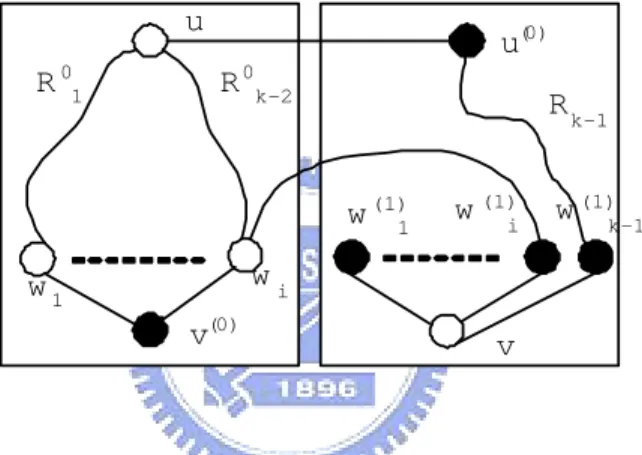
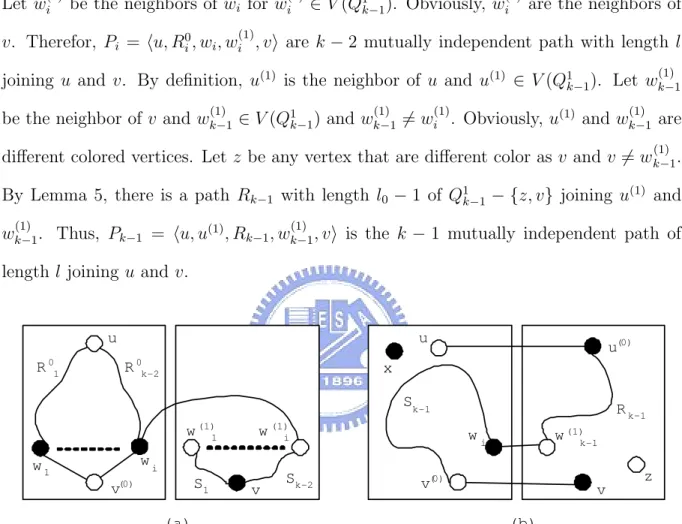
u v wi w1 w(1) 1 w (1) i v(0) R0 1 R 0 k-2 w(1) k-1 u(0) Rk-1
Figure 3.6: Illustration for the Case I.
Suppose that h(u, v) + 2 ≤ l ≤ 2k−1 and l is even. Let v(0) be the neighbor of v and
v(0) ∈ V (Q0
k−1). Thus, h(u, v(0)) = h(u, v) − 1. Assume that h(u, v(0)) + 2 ≤ l0 ≤ 2k−1− 1
for l0 is odd. By induction hypothesis, there are k − 2 mutually independent path Ri of
length l0 connecting u and v(0). Let wibe the nodes Ri(l0−1) on Ri. We can write the path
Ri as hu, R0i, wi, v(0)i. Let w(1)i be the neighbors of wi for w(1)i ∈ V (Q1k−1). Obviously, w (1) i
are the neighbors of v. Therefor, Pi = hu, Ri0, wi, w (1)
i , vi are k − 2 mutually independent
path of length l joining u and v. By definition, u(1)is the neighbor of u and u(1) ∈ V (Q1 k−1).
Let wk−1(1) be the neighbor of v and wk−1(1) ∈ V (Q1
k−1) and w (1) k−1 6= w
(1)
w(1)k−1 are the same colored vertices. By Lemma 2, there is a path Rk−1 with length l − 2 of Q1 k−1− {v} joining u(1) and w (1) k−1. Thus, Pk−1 = hu, u(1), Rk−1, w (1) k−1, vi is the k − 1
mutually independent path of length l joining u and v.
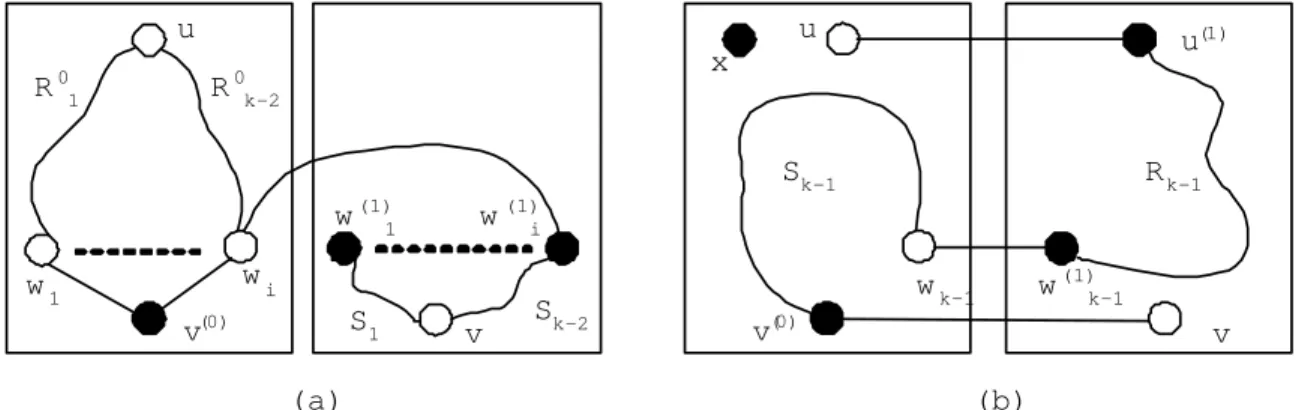
u v wi w1 w(1) 1 w(1)i v(0) w(1) k-1 wk-1 v(0) v u(1) u x R0 1 R 0 k-2 Sk-2 S1 Rk-1 Sk-1 (a) (b)
Figure 3.7: Illustration for the Case I.
Suppose that 2k−1+ 2 ≤ l ≤ 2k− 2 and l is even. By above discussion, there exist k − 2
path R0
i of length 2k−1− 2 joining u and wi in Q0k−1 and one path Rk−1 of length 2k−1− 2
joining u(1) and w(1)
k−1 in Q1k−1. By Lemma 7, there exist k − 2 mutually independent path
Si in Q1k−1 from v to w(1)i for 3 ≤ l(Si) ≤ 2k−1 − 1. Thus, Pi = hu, Ri0, wi, w(1)i , Si, vi
are k − 2 mutually independent path with length l joining u and v. Let x be any vertex that are different color as u of Q0
k−1 and x 6= v(0). By Lemma 5, there exists a path
Sk−1 joining wk−1 and v(0) of Q0k−1 − {u, x} for 1 ≤ l(Sk−1) ≤ 2k−1 − 3. Therefore,
Pk−1 = hu, u(1), R
k−1, w(1)k−1, wk−1, Sk−1, v(0), vi is the k − 1 mutually independent path
with length l joining u and v.
Case II. u and v are different colored vertices.
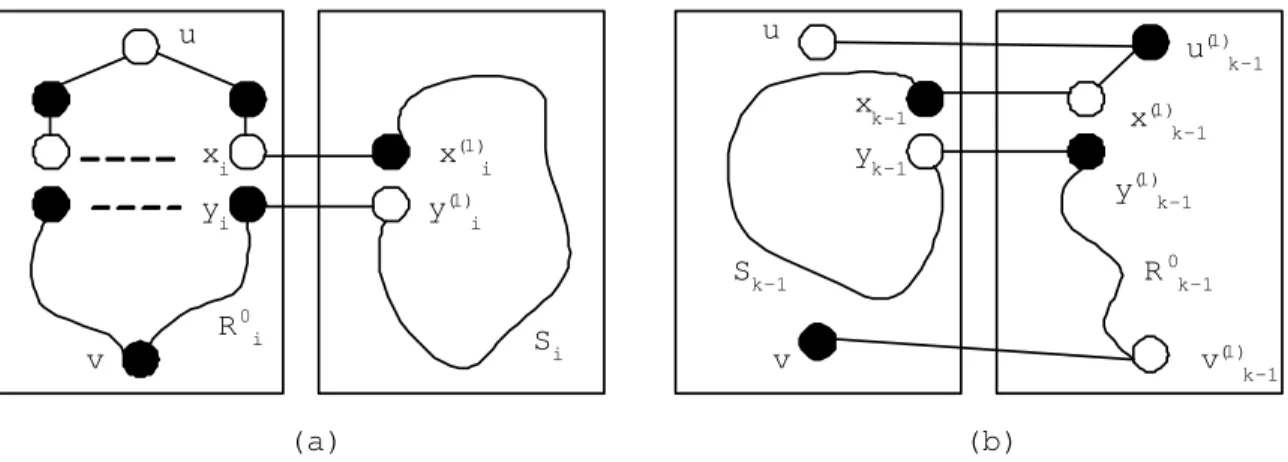
Subcase II-1. h(u, v) < k. u Si xi yi R0 i (a) v u v (b) R0 k-1 Sk-1 v(1) k-1 x(1) i xk-1 yk-1 y(1) i u(1) k-1 y(1) k-1 x(1) k-1
Figure 3.8: Illustration for the Case II-1.
In this case, let u = uk−1uk−2...u1u0 and v = vk−1vk−2...v1v0. Hence ui = vi for some
i. Accordingly, Qk can be decomposed into two subcube Q0k−1 and Q1k−1 by dimension i.
Therefor, u and v are in the same subcube. Without loss of generality, we may assume that u and v are both in Q0
k−1.
Suppose that h(u, v) + 2 ≤ l ≤ 2k−1− 1 and l is odd. By inductive hypothesis, there
are k − 2 mutually independent paths of length l joining u and v in Q0
k−1. By definition,
u(1) and v(1) are the neighbors of u and v for u(1), v(1) ∈ V (Q1
k−1). By Lemma 1, we can
find a path R with length l − 2 joining u(1) and v(1) in Q1
k−1. Thus, hu, u(1), R, v(1), vi is
the path Pk−1 of length l in Qk joining u and v.
Suppose that 2k−1+ 1 ≤ l ≤ 2k− 3 for l is odd. With above discussion, let R
i be k − 2
mutually independent paths of length l0 joining u and v in Q0k−1for any l0 = 2k−1− 1. Let
xi and yi be the nodes Ri(2) and Ri(3) on Ri. We can write Ri as hu, Ri(1), xi, yi, R0i, vi.
By definition, x(1)i and y (1)
i are the neighbors of xi and yi for {x(1)i , y (1)
By Lemma 6, there exist k − 2 independent path Si joining x (1) i and y (1) i in Q1k−1 for 1 ≤ l(Si) ≤ 2k−1 − 3. Thus, Pi = hu, Ri(1), xi, x (1) i , Si, y (1) i , yi, R0i, vi is k − 2 mutually
independent paths of length l in Qk joining u and v.
By definition, u(1)and v(1)are neighbors of u and v for u(1), v(1) ∈ V (Q1
k−1). By Lemma
1, there exists a path Rk−1 of length |Ri|−2 joining u(1)and v(1). Let x(1)k−1and yk−1(1) be the
nodes Rk−1(1) and Rk−1(2) on Rk−1. We can write Rk−1 as hu(1), x (1) k−1, y
(1)
k−1, R0k−1, v(1)i.
By definition, xk−1 and yk−1 are vertices in Q0k−1. By Lemma 5, there exists a path
Sk−1 joining xk−1 and yk−1 of Q0k−1− {u, v} for 1 ≤ l(Sk−1) ≤ 2k−1 − 2. Thus, Pk−1 =
hu, u(1), x(1)
k−1, xk−1, Rk−1, yk−1, y (1)
k−1, R0k−1, v(1), vi is the k − 1 mutually independent path
with length l joining u and v.
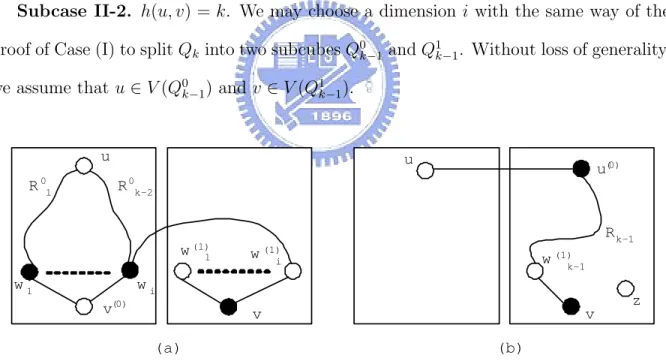
Subcase II-2. h(u, v) = k. We may choose a dimension i with the same way of the proof of Case (I) to split Qkinto two subcubes Q0k−1 and Q1k−1. Without loss of generality,
we assume that u ∈ V (Q0 k−1) and v ∈ V (Q1k−1). u v wi w1 w(1) 1 w(1)i v(0) R0 1 R 0 k-2 u(0) Rk-1 w(1) k-1 v u z (a) (b)
Suppose that h(u, v) + 2 ≤ l ≤ 2k−1− 1 and l is odd. Let v(0) be the neighbor of v and
v(0) ∈ V (Q0
k−1). Assume that h(u, v(0)) + 2 ≤ l0 ≤ 2k−1− 2 for l0 is even. By induction
hypothesis, there are k − 2 mutually independent path Ri of length l0 connecting u and
v(0). Let wi be the nodes Ri(l0− 1) on Ri. We can write the path Ri as hu, R0i, wi, v(0)i.
Let wi(1) be the neighbors of wi for w(1)i ∈ V (Q1k−1). Obviously, w (1)
i are the neighbors of
v. Therefor, Pi = hu, R0i, wi, w (1)
i , vi are k − 2 mutually independent path with length l
joining u and v. By definition, u(1) is the neighbor of u and u(1) ∈ V (Q1
k−1). Let w (1) k−1
be the neighbor of v and w(1)k−1 ∈ V (Q1
k−1) and w (1) k−1 6= w (1) i . Obviously, u(1) and w (1) k−1 are
different colored vertices. Let z be any vertex that are different color as v and v 6= w(1)k−1. By Lemma 5, there is a path Rk−1 with length l0 − 1 of Q1k−1 − {z, v} joining u(1) and
w(1)k−1. Thus, Pk−1 = hu, u(1), Rk−1, w (1)
k−1, vi is the k − 1 mutually independent path of
length l joining u and v.
u v wi w1 w(1) 1 w(1)i v(0) R0 1 R0k-2 Sk-2 S1 (a) u(0) Rk-1 w(1) k-1 v u z x wi v(0) Sk-1 (b)
Figure 3.10: Illustration for the Case II-2.
Suppose that 2k−1+ 1 ≤ l ≤ 2k− 3 and l is odd. By above discussion, there exist k − 2
path R0
i of length 2k−1− 3 joining u and wi in Q0k−1 and one path Rk−1 of length 2k−1− 3
joining u(1) and w(1)
Si in Q1k−1 from v to w (1)
i for 3 ≤ l(Si) ≤ 2k−1 − 1. Thus, Pi = hu, R0i, wi, w (1) i , Si, vi
are k − 2 mutually independent path with length l joining u and v. Let x be any vertex that are different color as u of Q0
k−1 and x 6= v0. By Lemma 5, there exists a path
Sk−1 joining wk−1 and v0 of Q0k−1 − {u, x} for 1 ≤ l(Sk−1) ≤ 2k−1 − 3. Therefore,
Pk−1 = hu, u(1), R k−1, w
(1)
k−1, wk−1, v(0), vi is the k − 1 mutually independent path with
length l joining u and v.
Chapter 4
conclusion
Since every component in the interconnection network may have different reliability, it is important to consider properties of a network with mutually independent linear array embeddings. In this paper, the n-dimensional hypercube with (n − 1) mutually indepen-dent path of any length l joining any vertices u and v for h(u, v) ≤ l ≤ 2n− 1. It is also
impossible to make n mutually independent paths and cycles except one case that u is adjacent to v.
Bibliography
[1] F.T. Leighton, Introduction to Parallel Algorithms and Architectures: Arrays, Trees, Hypercubes (Morgan Kaufmann, Los Altos, CA, 1992).
[2] Y. Saad, M.H. Schultz, ”Topological properties of hypercubes,” IEEE Trans. Com-put. Vol. 37 pp. 867-872, 1988.
[3] S.G. Akl, ”Parallel Computation: Models and Methods,” Prentice Hall, NJ, 1997.
[4] Tseng-Kuei Li, Chang-Hsiung Tsai, Jimmy J. M. Tan, and Lih-Hsing Hsu, ”Bi-panconnectivity and edge-fault-tolerant bipancyclicity of hypercubes,” Information Processing Letters Vol. 87 pp. 107-110, 2003.
[5] M. Lewinter, and W. Widulski, ”Hyperhamiltonian laceable and caterpillar-spannable product graphs,” Comput. Math. Appl. Vol. 34 pp. 99-104, 1997.