‧
國
立
政 治 大
學
‧
N
a
tio
na
l C
h engchi U
ni
ve
rs
it
y
國立政治大學國際研究英語碩士學位學程
International Master’s Program in International Studies
College of International Affairs
National Chengchi University
碩士論文
Master’s Thesis
糧食安全援助與非營利組織之研究
A Study of the Aid for Food Security and the Non-Profit Organizations
Student: Teyla V. Darce Zuniga
Advisor: Dr. Bai-Ku Wei
中華民國一零三年七月
July 2014
‧
國
立
政 治 大
學
‧
N
a
tio
na
l C
h engchi U
ni
ve
rs
it
y
糧食安全援助與非營利組織之研究
A Study of the Aid for Food Security and the Non-Profit Organizations
研究生:戴思佳
Student: Teyla V. Darce Zuniga
指導教授:魏百谷
Advisor: Dr. Bai-Ku Wei
國立政治大學
國際研究英語碩士學位學程
碩士論文
A Thesis
Submitted to International Master’s Program in International Studies
National Chengchi University
In partial fulfillment of the Requirement
For the Degree of Master in International Studies
中華民國一零三年七月
‧
國
立
政 治 大
學
‧
N
a
tio
na
l C
h engchi U
ni
ve
rs
it
y
iAcknowledgements
Foremost, I would like to express my sincere gratitude to my advisor Prof. Bai-Ku Wei for the continuous support of my Master’s thesis study and research, for his patience, motivation, enthusiasm, and immense knowledge. His guidance helped me in all the time of research and writing of this thesis. I could not have imagined having a better advisor and mentor for my Master study.
Besides my advisor, I would like to thank the rest of my thesis committee: Prof. Pai-Po Lee and Prof. Alex Chiang, for their good willing, advices and so important comments during the thesis proposal as well as the encouragement, insightful comments that were a key to me for finishing my research.
I would also like to express my grateful to the College of International Affairs of the National Chengchi University for the excellence in their labor in forming the student, and my thanks to the International Cooperation and Development Fund of Taiwan for all the support during my studies in the Republic of China (Taiwan).
My sincere gratitude to the organizations that were willing to cooperate in my research, and especially to The Asia Foundation Taiwan for welcoming me to be part of their office as an intern.
Last but not the least, I would like to thank to God for all the opportunities and faith for my future, and my family: my mother Daysi Zuniga and my brother Carlos Darce, for supporting me spiritually throughout my life and encouraging me to complete my master studies .
‧
國
立
政 治 大
學
‧
N
a
tio
na
l C
h engchi U
ni
ve
rs
it
y
iiAbstract
The International Organizations the same as the non-profit organizations are aware of how much this issue matter around the world and the government from the different more vulnerable countries represent in many cases, the principal problem that difficulties the work of the non-profit sector. There is a clear need to build a new system strategy for each bloc according to their characteristics in order to apply the correct plan for ensuring the food access for all the people as equals, but there is no doubt that the income inequality is a social issue that affects every country in the world and that also bring consequences for the food security of the people in countries such as Haiti. This topic was selected for its importance worldwide, in order to analyze the type of work of the non-profit organizations in the food security sector as aid channels in Latin American and the Caribbean regions, and how their partnership with government agencies and international organizations is indispensable for the complementation of the work.
And the research finding of the two cases study is about the capacity of sustainability that the farmers of the countries can reach through the aid for food security provided by the non-profit organizations, and on the other hand, the dependency that the aid provided can cause in the donors (in the case of Haiti). The potential that both regions have to improve the food security and develop the agricultural sector, but also explaining the case of the most poor countries in each region (Nicaragua and Haiti), both cases study serve to compare the different activities of the NPO and how their work affect the sustainability and development of the beneficiaries in the field of food security.
‧
國
立
政 治 大
學
‧
N
a
tio
na
l C
h engchi U
ni
ve
rs
it
y
Ȇ
ҳ
ࢇ ݽ σ
Ᏸ
Ȇ
ŏ
Ţ
ŵŪŰ
ůŢ
ŭġń
ũ ŦůŨŤũŪġŖ
ůŪ
ŷŦ
ųŴ
Ūŵ
ź
iii TABLE OF CONTENTS Acknowledgements i Abstract iiTable of Contents iii
Index of Figures v
Index of Tables vi
Index of Graphics vii
1. Introduction 1
1.1. Research Background and Motivation 1 1.2. Purpose of Study and Research Questions 4
1.3. Research Delimitations 4
1.4. Methodology 6
1.5. Literature Review 8
1.5.1 Food Deficit, Food Security and Food Aid 8 1.5.2 The Role of Non-Profit Organizations on Aid for Food Security 11 2. The Work of the Non- Profit Organizations on Aid for Food Security 16 2.1 Background of Aid for Food Security 16 2.2 Panorama of the Food Security and Food Insecurity in the World 19 2.3 A Millennium Development Goal: Eradicate Extreme 26
Poverty and Hunger, Latin America and Caribbean Perspective
3. Aid for Food Security in Latin America 31 3.1 Overview of the Situation of Lack of Food and Development of 31
Agriculture in Latin American Countries
3.2 The Value of the Agricultural Sector and the Non-Profit Work 37 3.3 Non-Profit Organizations Work and the Government in Nicaragua 44 3.4 Case Study of Non-Profit Organizations Working in Food Security 47
‧
國
立
政 治 大
學
‧
N
a
tio
na
l C
h engchi U
ni
ve
rs
it
y
‧
國
立
政 治 大
學
‧
N
a
tio
na
l C
h engchi U
ni
ve
rs
it
y
iv4. Aid for Food Security in the Caribbean 52 4.1 Overview of the Situation of the Caribbean Countries 52 4.2 Initiatives of Aid and Food Security Plan in the Region 60 4.3 Canalization of Aid and Partnership between Non-Profit 66
Organizations and International Institutions
4.4 Case Study of Non-Profit Organizations Working in Food 70 Security in Haiti 5. Conclusion 75 5.1 Research Findings 75 5.2 Recommendations 80 5.2.1 Nicaragua 80 5.2.2 Haiti 83 Bibliography 86
‧
國
立
政 治 大
學
‧
N
a
tio
na
l C
h engchi U
ni
ve
rs
it
y
v INDEX OF FIGURESFigure 1.1: Global Hunger Index Calculation 9
Figure 2.1: World Map of Food Security Risk 21
Figure 2.2: Access to Drinking Water World Map 22
Figure 3.1: Global Hunger Index Score by region 1990-2013 33
Figure 3.2: Cereal Price Increases 2006-2008 34
Figure 3.3: Food Price Index 2000-2007 35
Figure 3.4: Increasing of the Agricultural Activity in Bosawas 42
Figure 4.1: Imports of Food by the Caribbean Countries 53
‧
國
立
政 治 大
學
‧
N
a
tio
na
l C
h engchi U
ni
ve
rs
it
y
vi INDEX OF TABLESTable 2.1: Food Assistance Convention Donors 18
Table 3.1: Countries of Latin America with Major Import of Corn, 36
Wheat and Soy Bean in 2011, in Million Dollars
‧
國
立
政 治 大
學
‧
N
a
tio
na
l C
h engchi U
ni
ve
rs
it
y
vii INDEX OF GRAPHICSGraphic 2.1: Latin America and the Caribbean: 28
Extreme Poverty and Undernourishment, 2000-2002
Graphic 2.2: Latin America and the Caribbean (24 Countries): 30
Changes in the Undernourished Population between 1990-1992 and 2000-2002
‧
國
立
政 治 大
學
‧
N
a
tio
na
l C
h engchi U
ni
ve
rs
it
y
11. Introduction
The chapter one is divided into five parts and will describe the motivation for this topic of research as well as the purpose of study and will mention the research question delimited for the research. The methodology used for the collecting of the data and the literature review, which is divided into two subtitles, the first one will be focus in the concepts of food security, food aid and food deficit, and the second one will be emphasis on the role that the non-profit organizations have been doing on the aid for food security.
1.1. Research Background and Motivation
In the new world order and due to the discrepancy on natural and economic resources distribution, the underdeveloped regions face many common and basic needs, such as the food and housing, education and health, among others. Those needs in most of the cases cannot be covered or resolved by the local government and the foreign aid plays a very important and significant role in the life of those in greater needs.
Despite the Official Development Assistance (ODA) that the poorest nations receive from the diplomatic allies, only some people can be favored, therefore the need still remain in some innermost areas. There is where mostly the non-profit organizations try to work their projects. Many of those projects try to reach the basic needs as food security, as also listed in the United Nations Millennium Development Goals.
‧
國
立
政 治 大
學
‧
N
a
tio
na
l C
h engchi U
ni
ve
rs
it
y
2There are many factors that affect large amount of population around the world and their conditions of living, the increasing rate of malnutrition and hunger, which is visible in almost every corner of the world and mainly in the underdeveloped countries. Hunger is today the principal reason of deaths more than the worse diseases according to the World Food Program’s hunger statistics, and 870 million of the world’s population suffer from the consequences of the lack of food. 1
The aid is very important in order to reduce the rate of population affected by hunger and the non-profit organizations are one of the most important and common channels to send the aid to the communities where the lack of food is many times due to the ignorance on how to produce to be self-sufficient and what to produce according to the characteristics of a specific area and its resources and land characterization. The principal target on food security is to ensure the reasonable quantity and quality of food for the people in order to help them to have a life with at least access to the basic needs to be led towards development.
The United Nations Organization talked for first time about Food Security in 1970, but until 1975 the concept of Food Security came as “Food security exists when all people, at all times, have physical and economic access to sufficient, safe and nutritious food that meets their dietary needs and food preferences for an active and healthy life”.2 But even before in 1948 the Right to Food was declared as indispensable
for the people to have all the other rights.
Food Security is more than basic, is vital, is not a luxury, and is what all the habitants as equals need without race, religion, ideology, and culture and education distinctions. Food Security means the access to a diet with the nutrition that human
1 World Food Programe, Hunger FAQs/Undernurishment
http://www.wfp.org/hunger/faqs Access date: November 2013.
2 Trade Reform and Food Security: Conceptualizing the linkages, chapter 2: Food Security Concepts and
‧
國
立
政 治 大
學
‧
N
a
tio
na
l C
h engchi U
ni
ve
rs
it
y
3needs for a normal and well psycho-motor development.
When talking about food security, there are also many other terms that come included due to the width and importance of the topic, as a right, as a need, as a duty from the strongest to the weakest ones. Then, it is necessary to understand food sovereignty, food riot, hungers and food safety concepts and what it implies and how it is connected to food security.
After the United Nations Organization addressed the importance of food security, and how it is an obligation of governments, international organizations, private sector, non-profit organizations and civil society to talk about this important issue, the information about the serious situation of the actual food insecurity and the need to change this fact is day by day more important.
Many non-profit organizations have changed their scope in order to try to help the people in their basic needs, therefore nowadays there are many non-profit organizations working towards ensure the accomplishment of this right for those in greater need. The research motivations is to know the importance and relevant labor of the third sector in the field of food security and how those organizations work in order to help the people in the poorest zones as Latin America and the Caribbean, and how this work will also help to achieve the accomplishment of the Millennium Development Goals by 2015.
Through two case study of selected countries of both regions mentioned above, this analysis will seek to understand the work and activities (projects) of the non-profit organizations that work for the aid for food security for the future agricultural development in those developing countries where the conditions of living and the lack of governmental actions toward food security are the principal barrier to access to this vital right as is the food.
‧
國
立
政 治 大
學
‧
N
a
tio
na
l C
h engchi U
ni
ve
rs
it
y
41.2. Purpose of Study and Research Questions
The principal purpose of this study is to examine the impact of work by the non-profit organizations in the field of aid for food security that the recipients to have a better life towards development and how it is necessary to continue the task to try to teach the aid’s recipients to be self-sufficient.
The research is aim to seek and analyze the non-profit organizations work’s for the food security in developing countries and how the projects have led farmers to be self-sufficient and in consequence to achieve a better level of living towards development by stating and answering the questions listed below:
What is the work of the non-profit organizations in the field of food security and is their work really helping those developing countries to be self-sufficient in food security?
1.3. Research Delimitations
The primary objective of this research is to introduce the role of the non-profit organizations as a third sector, which importance is increasing over the decades and due to the changes of the social structures. To understand the role that those organizations play in the field of the aid for food security, to change the lives of the poorest ones in the world and to know these organizations’ work evolution during the past decades since 1990 until the present. To conduct this thesis, the author will focus the investigation in two main areas, Latin American region and the Caribbean region, in order to present one comparative case study of the work conducted by the non-profit organizations for food security aid projects in two different countries of the mentioned zone. From the regions mentioned previously, the research will focus on two countries
‧
國
立
政 治 大
學
‧
N
a
tio
na
l C
h engchi U
ni
ve
rs
it
y
5for the comparative case, Nicaragua in Central America and Haiti in the Caribbean, in order to find out the reasons because the same type of projects applied in both countries do not reach the same output.
Nicaragua was selected because of the current situation of the agriculture in the country and the lack of resources for food in many poor zones of Nicaragua and taking into account that in the list of countries with lack of food of the FAO, Nicaragua still remain even though the foreign aid destined for the development of the agriculture and the food security as well as the self-sustainable development projects in the country. In the case of Haiti, this Caribbean country was selected in order to know the situation and how take measurements in order to change the actual reality of the country, which receive a lot of foreign aid through different channel as the non-profit organizations and the country still remain in the extreme risk of food security according to FAO. For this, it will be necessary to analyze the reports of the data collection from different international organizations, as well as the official reports of the non-profit organizations and the central bank of the selected countries. The principal limitation to achieve this, will be the in situ research for the comparative case, since the time is not enough to visit the selected countries in Central America and the Caribbean in order to conduct interviews with the non-profit organizations to collect information that will be presented in the comparative case study; therefore, to join this information the author will communicate with the embassies of both countries in Taiwan and also with some international non-profit organizations that as well run projects in both countries.
‧
國
立
政 治 大
學
‧
N
a
tio
na
l C
h engchi U
ni
ve
rs
it
y
61.4. Methodology and Approach
This research will be conducted by applying a qualitative research method, since the research aims to know and analyze the real situation of the Non-profit organizations’ work and the aid for food security, furthermore this is a topic which importance go beyond measuring the food as a product but measuring food as a principal right of the humanity.
According to Pope, qualitative research incorporates a variety of philosophies, research designs and specific techniques including in-depth qualitative interviews; participant and non-participant observation; focus groups; document analyses; and a number of other methods of data collection.3 Therefore the research will include
interviews to the staff of the non-profit organizations and case study in order to know the differences and principal risk and measurements that need to be taken by the non-profit sector working in the food security field in order to help communities to overcome the lack of food and lead them into the path of sustainable development and food security. The principal approach of this thesis is to deep analyse the situation of the food scarcity and the steps that have been taken to reach the food security, specially focus on Nicaragua and Haiti as comparative cases study which has the purpose of associating the situation and work and the general problem of the food security in both countries by researching about the similitudes and differences to find out the principal characteristics of the aid in food security according to the country and its laws as well as the environment in which the non-profit sector works, finally, after analyse and compare both cases, the author will conclude the research with an overview of the condition and problems that both countries are facing and how non-profit organizations are addressing
3 Mays N. Pope C, Quantitative Methods in Health Research. In Pope C, Mays N. (editors).
Qualitative Research in Health Care (3rd edition). Chapter 20: Qualitative research and Cochrane Reviews Malden (MA): Blackwell Publications/BMJ Books, 2006. pp 5-10.
‧
國
立
政 治 大
學
‧
N
a
tio
na
l C
h engchi U
ni
ve
rs
it
y
7those problems through the running of agricultural projects and lastly, the observations and the research outcomes in order to list recommendations about this issue.
Questions asked in the interview to the non-profit organization staff:
1. What kind of project is FFP doing in the field of food security?
2. In the case of Nicaragua, why did the organizations involved, choose to run an agricultural project for the production of fruits and vegetables instead grain?
3. Since the papaya farms was a success project in Nicaragua, why not to do it in Haiti, Guatemala or Jamaica as well?
4. What are the principal differences between the work that FFP do in Haiti and the Central American countries?
5. Why does FFP donate more food in Haiti and instead settle new projects for producing the food?
6. What kind of partnerships has FFP for the projects in Nicaragua? With government or with other NPOs?
7. How many beneficiaries are there in the projects of fruits in Nicaragua? And where are the projects located?
8. How are the projects divided? What is the scope of each cycle?
9. Are those projects still working? Has FFP observed a real improvement of the production as well as in the income of those farmers after each cycle?
10. How does the aquiculture projects in Haiti started?
11. How many aquiculture farms are currently involved in this project? 12. What is the principal problem that FFP face in Haiti for running the
‧
國
立
政 治 大
學
‧
N
a
tio
na
l C
h engchi U
ni
ve
rs
it
y
8 1.5. Literature ReviewIn this section, the literature review will be presented in reference to the nature of the non-profit organizations and the types of aid that those organizations can provide in the field of food security.
In addition, the importance of the role of the non-profit organizations in the agricultural field and the contribution for the future self-sufficient and development of the aid to recipients. In the case of the literature review, the main objective is to explain the terms of aid for food security and deficit, and the work that NPO’s run in order to reduce the global hunger.
1.5.1. Food Deficit, Food Security and Food Aid
The access to the food is the basic right that every people should have, nevertheless the reality around the globe is showing a different picture. The lack of food is not a problem presented only in the countries listed in LIFDC4 classification, but also in many where the habitants do not have equal access to the food.
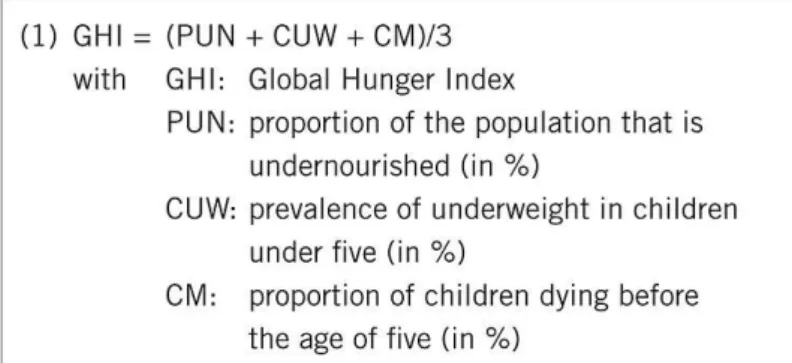
Hunger is the world’s top issue for the health and there are more than 850 million of people in the worlds suffer from hunger. The Global Hunger Index (GHI) is a tool designed to measure the hunger globally (see figure 1.1), by region and as single countries status.5
4 LIFDC: Low-Income Food Deficit Countries, a classification of the Food and Agriculture Organization. 5 GHI: Global Hunger Index, Diet fewer than 1,800 calories a day
International Food Policy Research Institute (IFPRI) official website
http://www.ifpri.org/ourwork/about Access date: December 2013.
‧
國
立
政 治 大
學
‧
N
a
tio
na
l C
h engchi U
ni
ve
rs
it
y
9Figure 1.1: Global Hunger Index Calculation
Note: Global Hunger Index 2008 Source: Ifpri/welthungerhilfe/Concern Access date: December 2013
A country is considered to be in low-income or food-deficit, according to FAO, for the next criteria: First, a country should have a per capita gross national income (GNI) below the "historical" ceiling used by the World Bank to determine eligibility for IDA6 assistance and for 20-year IBRD terms, applied to countries included in World
Bank's categories I and II. The 2013 LIFDC list is based on the GNI for 2010 (estimated by the World Bank using the Atlas method) and the historical ceiling of USD1 915 for 2010.7
The second criterion is based on the net (i.e. gross imports less gross exports) food trade position of a country averaged over the preceding three years for which statistics are available, in this case from 2008 to 2010. Trade volumes for a broad basket of basic foodstuffs (cereals, roots and tubers, pulses, oilseeds and oils other than tree crop oils, meat and dairy products) are converted and aggregated by the calorie content of individual commodities. Thirdly, the self-exclusion criterion is applied when countries that meet the above two criteria specifically request FAO to be excluded from
6 IDA: International Development Association is the World Bank’s fund for the poorest.
7 Food and Agricultural Organization of the United Nations, Low-income Food Deficit Countries, list for
2013 official website http://www.fao.org/countryprofiles/lifdc/en/ Access date: December 2013.
‧
國
立
政 治 大
學
‧
N
a
tio
na
l C
h engchi U
ni
ve
rs
it
y
10the LIFDC category.8
Gabbert and Weikard included in their research the definition food aid as a transfer of resources to individual countries or sectors as food, either donated or sold with at least 25% of concessionality in character and in the form of monetary donations or loans (with a maturity period of ten years or more) linked to food purchases.9 Many developing countries, as Latin American countries are recipients of this time of aid for the food security. In spite of this aid, the countries still remain in situations of lack of food and facing long times of hunger, of course there are many factors affecting the situation, as the lack of water which is a case affecting many countries, especially in the case of Haiti, where the potable water or the water for irrigation is a big distance from the villages and therefore the access for the people is very difficult.
Again Gabbert and Weikard (1998) mentioned in their book about how the Food Aid has been a very important topic of discussion and critics for the types of aid and also how this aid is channeled to the countries in need, as well as the matter of the commercialization of resources and the policies for the use of the land. Correspondingly the principal critiques to the well-developed countries that provide the aid to the developing ones, is for the interest and the quantity of aid comparing with to the real need and conditions of the aid recipients countries and the capacity of the donor.10
8 Food and Agriculture Organization of the United Nations
LIFDC: Low-income, Food deficit countries, data of 2013, but according to FAO, the countries will be listed out officially after 3 years of not food deficit.
9 Gabbert Silke, Hans-Peter Weikard (1998), Food déficit, food security and food aid: concepts and
measurements, Paper prepared for the Annual Conference of the European Economic Association, Berlin, 2-5 September 1998, pp. 2-4.
10Gabbert Silke, Hans-Peter Weikard (1998), Food déficit, food security and food aid: concepts and
measurements, Paper prepared for the Annual Conference of the European Economic Association, Berlin, 2-5 September 1998, pp. 2-4.
‧
國
立
政 治 大
學
‧
N
a
tio
na
l C
h engchi U
ni
ve
rs
it
y
111.5.2 The Role of Non-Profit Organizations on Aid for Food Security
The origin of philanthropy and charity took place in the world from ancient times, giving born to the first nonprofit organizations. The non-profit organizations are distinguished from the private and public sector due to its nature.11
According to Simmons, NGOs on the ground often make the impossible to be possible by doing what governments cannot or will not do. Some humanitarian and development NGOs have a natural advantage because of their perceived neutrality and experience.12 The importance and the role those organizations play, as the impact they have in every different sector is what help to change the inequality among the world, again P.J Simmons touch every single point through his description, by saying “They are changing societal norms, challenging national governments, and linking up with counterparts in powerful transnational alliances. And they are muscling their way into areas of high politics, such as arms control, banking, and trade that were previously dominated by the state. In general terms, NGOs affect national governments, multilateral institutions, and national and multinational corporations in four ways: setting agendas, negotiating outcomes, conferring legitimacy, and implementing solutions.”
It can be consider that without the non-profit organizations, the international laws, the international institutions and even the state itself would not be in a plenty role for the reaching of human development and life progress, Antonio Donini (1995) said in the following way: "the Temple of States would be a rather dull place without
11 The difference between NPO and NGO, is that the second one, is a non-governmental organization, but
most of its funds comes from government donations, but it maintains a non-governmental position, therefore government council is not necessary. But, NPO’s uses its extra funds for the purpose of the organization, rather than dividing it between the stakeholders and the owners of the organization.
‧
國
立
政 治 大
學
‧
N
a
tio
na
l C
h engchi U
ni
ve
rs
it
y
12nongovernmental organizations.”13 A real fact that make non-profit organization to be
more and more important, it has the close relationship that they can build with the society, with the aid recipients. Alison Alkon (2008) referred that non-profit organizations have the facility to spread the information among the people, about the needs, and how to find the solutions, through the programs and campaigns, this role is very important in order to influence the behavior of the people, and to empower them to change their ways of living and to try to work towards the production of their own food.14 For this reason is also that many non-profit organizations job is considered as a boycott to the local government and also are considered as a channel used by the big elites to spread information against governments. In Nicaragua in the years of the administration of the president Arnoldo Aleman (1998-2002) the non-profit sector suffered revisions and repressions by the government.15
As mentioned before, the access to food is a principal right for every human being, never the less there are many factors that can affect the access, monetary and also the natural resources that can permit the facility of food production for the people. From this, can be mentioned “food citizenship”, which is not other than the rights associated to living in one specific place, this term was first mentioned by Wilkins in 2005.16 This term can certainly lead to a better understanding of what and how sustainable agriculture should be in order to work towards food security. Thus, the projects that the non-profit organizations run in the different poor areas should be firstly studied and implemented in accordance to the resources (type of land, type of cultivations that
13 Antonio Donini, (1995) The Bureaucracy and the Free Spirits Stagnation and innovation in the
relationship between the UN and NGOs, Third Worlds Q 420.
14 Alison Alkon (2008), from value to values: sustainable consumption at farmers markets.
15 El Nuevo Diario, “Alemán comete grave error” Managua, Nicaragua, lunes 18 de diciembre de 2000
http://archivo.elnuevodiario.com.ni/2000/diciembre/18-diciembre-2000/nacional/nacional14.html date of Access: February 2014.
16 Jenifer Wilkins (2005), Eating right here: Moving from consumer to food citizen, 2004 Presidential address to the Agriculture, Food, and Human Values Society, Hyde Park, New York, June 11, 2004.
‧
國
立
政 治 大
學
‧
N
a
tio
na
l C
h engchi U
ni
ve
rs
it
y
13would be suitable), also to empower people in the way that will be easier for them to produce, to have food and to reach food security.
For the articles and book cited and analyzed, according to the current situation, the purpose of the literature review section is to deepen research about the academic overview of the work that the non-profit sector do in the food security field. For the author’s consideration, the topic of the food security and how the local governments and international organization are addressing this issue, is not enough to solve the problem that hundreds of thousands of small and large communities are facing, therefore the project run by the third sector play a very important role, for this, and finding that the literature review is mostly writing by the well-developed countries, it is necessary to talk and spread information about this issue from whiting the most affected countries, as the case of Haiti.
The land policy and the distribution and administration of resources in the countries, overall in the affected by hungers, is a matter that can be solved only by the action of the communities, the main country affected; the international organizations can only influence in a certain way according to the type and amount of aid that they allocate in those underdeveloped countries, therefore the role of the non-profit organizations is more important and many times more tangible in order to inform, educate and teach the people how to produce, how to survive and how to overcome the actual situation of extreme poverty and lack of food. There are many questions about why even with all the food aid that poor countries like Haiti receive, after decades the population remains in the same situation, even big part of the aid recipients in Haiti call the aid program as “long life to hungers”, due to the high dependency that Haiti has on the food aid from United States and other countries. The Haitian food production continue to be deteriorated and ignored for long time by successive governments and
‧
國
立
政 治 大
學
‧
N
a
tio
na
l C
h engchi U
ni
ve
rs
it
y
14international donors, since in many cases the aid is sent but there are no evaluations of the programs or the distribution. Agriculture sector accounts for about 25 percent of the gross domestic product of Haiti, and until recent years this sector was the source of employment, directly or indirectly for more than two thirds of the population in that country.17 The case of Haiti is very particular since the situation came to be even worse after the earthquake of 2010, the international non-profit organizations that provide the food aid to this country are currently trying to evaluate whether the food aid is really supporting the Haitians or will bring the local agriculture sector down. According to Philippe Mathieu, from Oxfam organization in Haiti, the grants and subsidies of rice from United States and other humanitarian aid have reduced the income of Haitian farmers, while the U.S. government is investing in Haitian agricultural development.18 Therefore there are some contradictions and discrepancies in the way that the aid, grants and investment as other types of aid are being applied in the Caribbean country. Thus, big part of the population lives in total dependency of the food aid and at the same time many people in Haiti still die every day for the lack of food.
Nevertheless, the literature review about the current case of Haiti and Nicaragua in the field of the aid for food security that the farmers receive and the work of the non-profit organizations is principally by reports or articles from newspaper or official website of the non-profit organizations, since there are few information by scholars about those two countries, therefore the author believes it is important to continue with the conduction of this research in order to find the principal and most important academic opinion and articles as well as none academic ones for this section of
17 “Ayuda alimentaria eternice el hambre Haitiana” Inter Press Services agencia de noticias, Puerto
Príncipe October 14th, 2013. http://www.ipsnoticias.net/2013/10/detras-del-hambre-haitiana/ Access date: February 2014.
18 “Los Agricultores Haitianos no quieren ayuda alimentaria”, Guía ONGs, noticias ONGs,
EP/Washington,
http://www.guiaongs.org/noticias/ongs/Los%20agricultores%20haitianos%20no%20quieren%20ayuda% 20alimentaria-2-4-2341 Access date: February 2014.
‧
國
立
政 治 大
學
‧
N
a
tio
na
l C
h engchi U
ni
ve
rs
it
y
15literature review, to furthermore have a global perspective of how the aid for the food security is being evaluated, and to have an overview of the importance that the non-profit organizations have and the role they play in transferring the information to the communities as well as their close relation with the aid recipients.
‧
國
立
政 治 大
學
‧
N
a
tio
na
l C
h engchi U
ni
ve
rs
it
y
162. The Work of the Non-Profit Organizations
on
Aid for Food Security
This chapter will refer about the background of the food security in the world, how this topic turned into an issue of relevant importance in the international community, being the first of the UN millennium development goals. Furthermore it will describe the relation between the international organizations and the non-profit organization as channels for the aid. In the end of the chapter, the main geographic areas of research will be the Latin American and the Caribbean regions, describing the panorama of the food insecurity and the perspective for eradicating poverty and hunger.
2.1. Background of Aid for Food Security
The non-governmental food aid is distributed through the nonprofit organizations, of which commonly act as distribution channels for both bilateral and multilateral aid, although sometimes have their own resources. Their weight has been multiplied from the 80’s reaching more than 20% of total aid.
The primary origins of food assistance was the Marshall, one quarter of the resources of which were allocated to support plan such. This North American initiative had the following objectives contribute to the rebuilding of a Europe devastated by World War II, stop the communist advance for it and outputting the U.S. agricultural surplus to prevent falling prices. Similar political and commercial objectives have largely persisted over time. Later, in 1954, the U.S. approved the Law for Relief and
‧
國
立
政 治 大
學
‧
N
a
tio
na
l C
h engchi U
ni
ve
rs
it
y
17Agricultural Trade Development,19 which is the, still in force, legislative framework of food assistance in the country and the initiation of targeting Third World countries.
With the growing of the populations, the migration from one country to another developed, the world’s powerful nations addressed this important issue – aid for food security - in the round of Kennedy for the negotiation of GATT20 in 1967, which was the first international grains agreement. This agreement referred to the need of the constriction of the grains productions and market and as well as the wish of the food aid donor countries to share their effort with the least developed countries.
The first Food Aid Convention, resulted in the involvement of its members to provide annual food aid totaling 4.5 m. tons of grain to the developing countries.21 The donors came to a great commitments by guaranteeing the level and the minimum limit of food aid that least developed countries should receive even if global scarcity forced to increase the price of grains in the world’s stock. Donors were free to decide how to distribute their aid, but the FAC encouraged them to channel some multilaterally. Since the beginning, FAC food aid has been an important resource for the World Food Programmed in support of its various projects. In the year 1971, this Food Aid
19 The Law for Relief and Agricultural Trade Development is better known as Public Law 480 (PL480),
what in the actuality became The Food for Peace Act (FPA). FPA provides assistance to countries at a particular level of economic development. This Act is divided into 3 titles: Title I is administered by USDA, and Titles II and III are administered by USAID.
See: United States Department of Agriculture official website
http://www.usda.gov/wps/portal/usda/usdahome?navid=AGENCY_REPORTS
20 GATT: The General Agreement on Tariffs and Trade (GATT) covers international trade in goods. The
workings of the GATT agreement are the responsibility of the Council for Trade in Goods (Goods Council) which is made up of representatives from all WTO member countries. The current chairperson is Amb. Dacio CASTILLO (Honduras).
See: World Trade Organization / GATT and the goods council official website http://www.wto.org/english/tratop_e/gatt_e/gatt_e.htm
21 FAC: Food Aid Convention
Objective: “To contribute to world food security and to improve the ability of the international
community to respond to emergency food situations and other food needs of developing countries”. FAC members make quality food aid available to developing countries with the greatest needs on a predictable basis, irrespective of fluctuations in world food prices and supplies. Particular importance is attached to ensuring that food aid is directed to the alleviation of poverty and hunger of the most vulnerable groups. Source: www.foodassistanceconvention.org
‧
國
立
政 治 大
學
‧
N
a
tio
na
l C
h engchi U
ni
ve
rs
it
y
18Conventions was successfully renewed by the member countries and some small changed have been applied.22At the 106th session of the Food aid Committee members
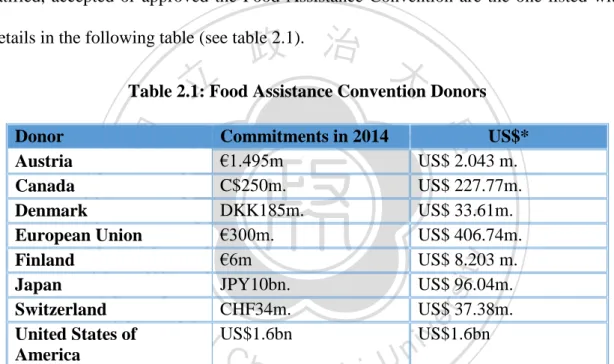
agreed not to extend the Food Aid Convention, 1999. Accordingly, this Convention expired on 30 June 2012. On 1st January 2013, a new Food Assistance Convention came into effect, which objectives changed in order to save lives, reduce hunger, improve food security, and to give assistance in to help developing countries recover the nutritional status. And by January 2014, the commitments of the parties who have ratified, accepted or approved the Food Assistance Convention are the one listed with details in the following table (see table 2.1).
Table 2.1: Food Assistance Convention Donors
Donor Commitments in 2014 US$*
Austria €1.495m US$ 2.043 m.
Canada C$250m. US$ 227.77m.
Denmark DKK185m. US$ 33.61m.
European Union €300m. US$ 406.74m.
Finland €6m US$ 8.203 m.
Japan JPY10bn. US$ 96.04m.
Switzerland CHF34m. US$ 37.38m.
United States of America
US$1.6bn US$1.6bn
*Note: exchange rate of December 2013, using website of XE currency exchange Source: Food Assistance Committee, information note of January 2014
www.foodassistanceconvention.org Access date: January 2014
22 Food Aid Convention official website, about the FAC
http://www.foodaidconvention.org/en/index/aboutthefac.aspx Food Assistance Committee, information note of January 2014.
‧
國
立
政 治 大
學
‧
N
a
tio
na
l C
h engchi U
ni
ve
rs
it
y
192.2. Panorama of the Food Security and Food Insecurity in the World
If the world produce enough food for everyone, then, why are there still thousands of people suffering and dying due to food scarcity? The picture is really chaotic in most of the developing and least developed countries around the world. Despite the increase of the population by 70 percent in the last decades, according to the Food and Agriculture Organization, the world is producing 17 calories more than 30 years ago, but the distribution of the agriculture its output is what really affect many countries in the world.23 The World Bank statistics data show that there is a progress in Latin America and the Caribbean Countries, nevertheless large amount of the population face the reality of food scarcity in their region.
The agricultural activity is a very important part of the industry of the Latin American and Caribbean countries, big part of the GPD belongs to that sector. But still there are many areas where the farmers do not have access to water, tools or even the input to buy the seeds. In many rural areas of those countries, where the poverty and the income inequality is visible, the people suffer from hunger and malnutrition, this is the repeatable case from one country to another, mostly in the borders, where local government do not act in order to improve the livelihood of hundreds of people. Those are the places where the NPO’s provide the aid and the technical training to teach the farmers how to produce, the role of this organizations start at this point, where the only support that the farmers get do not come from the local government but from the activities that the NPO’s run to help the family farmers, their activities range from the
23 World Hunger official website, articles 2013 World’s Hunger and Poverty statistics, World Hunger
Education Service, hunger concepts and definitions
http://www.worldhunger.org/articles/Learn/world%20hunger%20facts%202002.htm Date of Access: December 2013.
‧
國
立
政 治 大
學
‧
N
a
tio
na
l C
h engchi U
ni
ve
rs
it
y
20type of projects they run such as fruits and vegetables farms or the plantation of grains, also the projects for access to potable water in those communities where the habitants have no access to any source of clean water, as well as the workshops teaching the farmers how to identify the principal problems that the crops could present, or what is better to produce depending the size and type of land they have, marketing assistance, among others. The function of the NPO’s depends on their nature, some are working for charity and welfare, others for religious mission, education, etc.,24 therefore the function of the NPO’s working in the field of aid for food security will depend if the organizations purely run projects for this matter, but as mentioned before, it could be classified according the nature and the mission of the organization. In the Latin American and in the Caribbean regions, there are numerous NPO’s working for the food security, such as Food for the Poor, Oxfam, Bread For the World, InterAction and its members, among other local and smaller NPO’s working some in particular countries. The role of most of the NPO’s is sometimes considered as a boycott to local governments, since their activities cover part of the population that is the most vulnerable and forgotten by the governments. The activities of the NPO’s through their projects help the farmers to be able to have access to not only loans but also education on how to cultivate as well as in the marketing and the role of these NPO’s are becoming more and more important and crucial for the food security in Latin America and the Caribbean, but the truth is that Latin America still have a lot to work for to help those communities in greater need. As shown in the following map (see figure 2.1), the case of Latin America, specifically Central America and the Caribbean, is similar with part of Africa.
24 Chron, Small Business, The Function of a Non-Profit Organization,
‧
國
立
政 治 大
學
‧
N
a
tio
na
l C
h engchi U
ni
ve
rs
it
y
21Figure 2.1: World Map of Food Security Risk
Source: MapleCroft official website
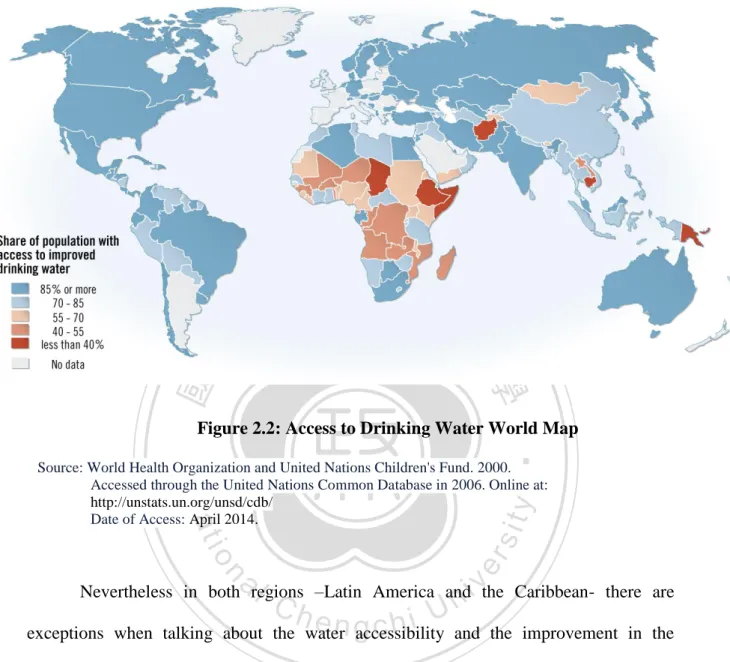
It is clear that the African continent face the most difficult part of the food insecurity and the lack of food in the world. Unlike Latin America and the Caribbean, the drought makes the production capacity to be more in risk in Africa, and the lack of water turns the situation to be more difficult for the farmers to produce. The civil wars and the corruption is one of the principal reasons because Africa continue to suffer hunger, but in Latin American and in the Caribbean region, the countries are not in civil war and the access to potable water is more efficient than in the African continent. Latin America and the Caribbean region have the capacity to produce more food for its own countries and for feeding a large part of the neighbor regions. In the following map it is
‧
國
立
政 治 大
學
‧
N
a
tio
na
l C
h engchi U
ni
ve
rs
it
y
22shown the access to drinking water in the different regions of the world (see figure 2.2).
Figure 2.2: Access to Drinking Water World Map Source: World Health Organization and United Nations Children's Fund. 2000.
Accessed through the United Nations Common Database in 2006. Online at:
http://unstats.un.org/unsd/cdb/ Date of Access: April 2014.
Nevertheless in both regions –Latin America and the Caribbean- there are exceptions when talking about the water accessibility and the improvement in the agricultural sector, in most of the Latin American countries and in the Caribbean, the habitant subsist among other activities, from the agriculture. Even though only about the 20% of the territory of Nicaragua is appropriate for this activity, for example, the agriculture has been a base for the economy and the development for the country, the same as in other countries along the Latin American sub-region and the Caribbean countries. The agriculture is the base of subsistence for the world, no one can subsist without food but we see the majority of the countries trying to subsist without big industrialized zones, the development of this activity is what can really bring a better
‧
國
立
政 治 大
學
‧
N
a
tio
na
l C
h engchi U
ni
ve
rs
it
y
23reality for the least developed countries. Nowadays the countries face the situation of inequality, this is the principal barrier, income inequality, resources distribution inequality, gender inequality, and the inequality access to the food, even this is a principal right. Thus, the work for the food security in the zone is very important, since according to statistical research, show that even in the last twenty years the mortality rate of children in Latin America has been reduced, the extreme poverty in some areas is very serious and in places like Haiti where living conditions and the infrastructure add more to the poverty and sanitary conditions and the difficult access to potable water, or water for irrigation of the crops present more challenges when trying to run projects for the food security in the country.
The food scarcity in many developing and least developed countries becomes worse while the economy goes slow too, therefore the hungers and the malnutrition will also affect the mortality since the lower income the people have, the fewer food they can afford and principle, the lower calories and protein they can consume. According to the statistics date and the research papers about child mortality rate in the Sub-Saharan Africa, there is a relation between the malnutrition and the increasing on child mortality rate, when comparing the nutrition of the kids in region outside the Sub-Saharan Africa.25 This, is another effect of the low GDP per capita of those countries, since the habitants live in precarious conditions and due to the lack of food during the childhood, the body is not well developed and therefore they are more likely to suffer from illness and mortality. The child mortality rate and the increasing of it, has been studied and pointed for many international organizations, in many journals of health and also addressed in the governments agenda, but the relation between the mortality rate and the income
25 Yoko Akachi, David Canning (2010), Health trends in Sub-Saharan Africa: Conflicting evidence from
infant mortality rates and adult heights, Harvard University, Cambridge Journal, MA 02138, United States, pp. 1- 281.
‧
國
立
政 治 大
學
‧
N
a
tio
na
l C
h engchi U
ni
ve
rs
it
y
24inequality is not clear for everybody yet. Many families even in developed countries or developing countries still live in very unfair conditions and the work of their land, the their harvest and therefore their income is not enough to have the basic nutrition to be healthy and strong. Income inequality and how the low GDP per capita affects the life of one person, one family, one community, a big part of one country, the major percent of habitants in the world, is not really addressed in the way it should be, therefore the ignorance about how income inequality is directly linked to high rates of child mortality still remain, as well as how poverty is directly linked to the food scarcity in the world, according to the research of Parul, in 2010, in the world, the people know more about the deaths related to food scarcity or food insecurity,26 nevertheless the fact that the poverty is linked to this, is still not a clear matter for most of the people.
The Panorama of food insecurity in the world is every day more clear, the lack of food in many countries of the world prevails due to the income inequality and the growing of poverty in many communities, poverty or income inequality will always involve many other factors affecting the life of those in more need, for example, the mortality rate will be also affected by a number of causes of death, like the disability in the children, which many times is due to the no well-built psycho-motor developing from childhood and the undernourishment. Also the ones who face this kind of illness, will face more problems for the work, even there are many laws trying to protect their rights, and so, the reality is that they still face much more limitation than the non-disabled ones. According to Elwan (1999), the income of families with disable member
26Christian Parul (2010), Impact of the Economic Crisis and Increase in Food Prices on Child Mortality:
Exploring Nutritional Pathways, Center for Human Nutrition, Department of International Health, Johns Hopkins Bloomberg School of Public Health, Journal of Nutrition, pp. 1-178.
‧
國
立
政 治 大
學
‧
N
a
tio
na
l C
h engchi U
ni
ve
rs
it
y
25will be in most of the cases lower than the other families.27 Sadly, this is a fact that the limitations for the food, medicine, education, and housing are more serious and in many cases the family cannot afford the medicine and this can also lead to death and the lack of food is related to the health problems, or in other cases, the lack of knowledge about how to use the agrochemicals in the family farms, will later be the cause of some genetic problems in the kids, more in the cases such Latin American countries where the kids work in the farms in order to help the family.
The particular case of Latin America differs from the other developing areas because in spite of the reduction on the birth mortality rate, the child mortality rate is still high and this is due to the inequality to the access of the social and health care system for those who are poorer. According to the WHO, the mortality rate in children is higher in Latin America more than in other countries and particularly the death for no reason, that in other words could be interpreted as the result of the poor health care system and the lack of food in those countries,28 as the level of poverty in which most of the families live, also the sanitary conditions that will facilitate the spread of diseases and morbidity after the natural disasters are common in the region due to the lack of infrastructure for the water distribution. According to the statistical data of Fides Organization, in Latin America the child mortality rate is five times higher than in other areas,29 even the region has the potential to produce more food to feed the world.
27Elwan Ann (1999), Poverty and Disability, a survey of the literature, background paper for WDR
2000/20001 and as part of the Social Protection Unit's research on the economic consequences of disability, pp. 1-21.
28Fides Agency 2013, Pobreza y Mortalidad Infantil en América Latina, América/Panamá- Las muertes
de los niños pobres son 5 veces superiores en América Latina que en el resto del mundo, http://loiolaxxi.wordpress.com/2013/09/17/pobreza-y-mortalidad-infantil-en-america-latina/ date of Access: January 2014.
29 Fides Agency 2013, Pobreza y Mortalidad Infantil en América Latina, América/Panamá- Las muertes
de los niños pobres son 5 veces superiores en América Latina que en el resto del mundo,
http://loiolaxxi.wordpress.com/2013/09/17/pobreza-y-mortalidad-infantil-en-america-latina/, Date of Access: January 2014.
‧
國
立
政 治 大
學
‧
N
a
tio
na
l C
h engchi U
ni
ve
rs
it
y
262.3. A Millennium Development Goal: Eradicate Extreme Poverty and Hunger,
Latin America and Caribbean Perspective
Poverty and hunger are two dangerous issues that through the years have been affecting the world, one of the other's hand, consequently, lack of monetary resources always affect the right to food. This has being an issue of global interest, with more and more influence over the decisions of the international community regarding how to deal with the growing level of poverty and hunger in the most vulnerable and least developed places in the world. The progress is growing in certain countries while others remain in extreme poverty and with lack of food, the size of the problem is more than visible and understandable, but the interest of the states go far from the needs of the habitants, the civil wars and the conflicts only turn the problem into more severe, making more difficult for the international organizations and the non-profit organizations to be able to reach the places where the people do not have access to potable water and for consequence to clean food.
Addressed by the international organizations, as well as the governments from well-developed countries the same as least developed ones, issue taken into the list of projects of the non-profit and charitable organizations, topic of research and social interest, the need to eradicate hunger is a fact, nevertheless the goal planned is still far from the reality that hundreds of thousands of people live every day in their normal life, the only life they know, the only reality, is sadly a life with very scarce resources to get food and the nutrients that every person need as a right.
Eradicate poverty and hunger is the first in order of importance between the eight millennium development goals listed by the United Nations Organization, and to
‧
國
立
政 治 大
學
‧
N
a
tio
na
l C
h engchi U
ni
ve
rs
it
y
27be accomplished is necessary to complete each of the targets, detailed as following:30 The Target 1.A for the halve, which should be completed from 1990 to the year 2014, is designated for the proportion of people that have incomes of less than US$1.25 per day, this target aims to reduce the extreme poverty rates to half was met five years ahead of the deadline that should be in 2014. The global poverty rate at $1.25 a day fell in 2010 to less than half the 1990 rate. According to the data, 700 million fewer people lived in conditions of extreme poverty in 2010 comparing with the data of 1990 respectively. However, at the global level 1.2 billion people are still living in extreme poverty.
The Target 1.B is seeking for the achieve of aa full and productive employment and decent work for all the people as equal, for women and for young people as well, since according to the data, globally 384 million workers lived below the $1.25 a day poverty line in 2011, a reduction of 294 million was reached since the year 2001. The second part of this target is about the gender equality for the employment, since gender gap in employment persists, with a 24.8 percentage point difference between men and women in the employment-to-population ratio in 2012.
Finally, the Target 1.C, Halve in the same period of time, from 1990 to 2015, the proportion of people in the world who suffer from hunger. This target aims to reach the reduction of hunger by 2015. According to the data, globally there are about 870 million people that are estimated to be undernourished in the world and more than 100 million children under age five are still undernourished and underweight.
Hunger is the principal reason of child mortality rate and continue to ascend. Although food is a human right, and even Latin America and the Caribbean region have
30 Millennium Development Goals and Beyond 2015, Goal 1: Eradicate extreme poverty and hunger,
‧
國
立
政 治 大
學
‧
N
a
tio
na
l C
h engchi U
ni
ve
rs
it
y
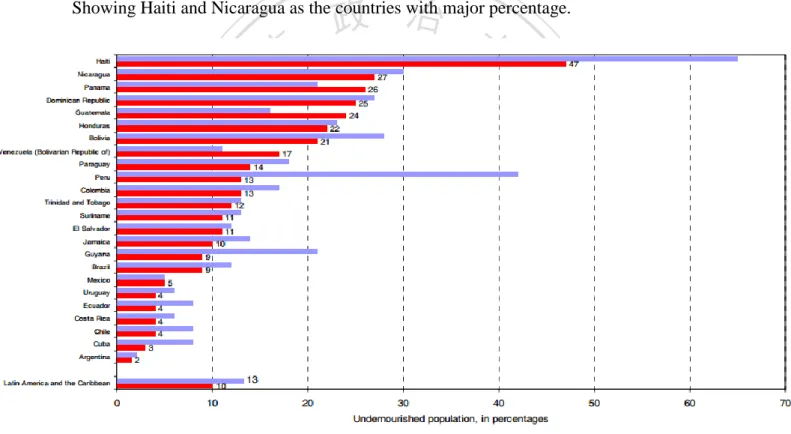
28the capacity and the land extension and characteristics needed to fight hunger, the lack of food and the lack of assistance for to boost the agricultural development in the region are some of the consequences because both regions still face very serious cases of food insecurity and poverty from one country to another. As shown in the following graphics (see graphic 2.1), Haiti and Nicaragua have been facing the most serious problems among both region, according to the statistics and the perspectives for the period of 1990-2015, the estimations points both countries as well as Guatemala, Panama and Honduras as the countries in the region with more problems of poverty and hunger, Haiti is the one on the top. 31
Graphic 2.1: Latin America and the Caribbean: Extreme Poverty and Undernourishment, 2000-2002
Source: Economic Commission for Latin America and the Caribbean (ECLAC), on the basis of information from the Food and Agriculture Organization of the United Nations and ECLAC, Social Panorama of Latin America, 2004 (LC/G.2259-P), Santiago, Chile, 2005, in press. Date of Access: May 2014.
31 The Millennium Development Goals: Latin America and Caribbean perspective, United Nations Publications, Santiago de Chile, 2005, pp. 58.
‧
國
立
政 治 大
學
‧
N
a
tio
na
l C
h engchi U
ni
ve
rs
it
y
29The graphic shows the countries of both regions and positions, detailing that the higher percent of people living in extreme poverty, the high percent of population in undernourishment, what clearly reflex that there is a direct relationship between the level of poverty and the less access to food.
There is a big effort that has been done by the countries of both regions trying to eradicate the extreme poverty and the lack of food, following the warnings from the international organizations, the governments adopted measures in the seeking of the reduction of hunger and undernourishment, but the effort and the measures have to be designed as well as the policies, individually, because each country face different reason of the increasing of poverty, as well as different macroeconomic figures and different food production capacity and the income inequality, therefore it is the labor of the policymakers to address seriously and to include the issue of the eradication of extreme poverty and hunger as one priority to done in order to well utilize the capacity of production of each country and to also take the most possible advantage of technical assistance and food aid provided by the international organizations through the non-profit and charity organizations.
To complete each target by 2015, it is necessary the involvement of the governments, together with the international organizations and the non-profit sector, to promote the development of the agricultural sector in Latin America and the Caribbean regions, especially to take measures in the countries where the food aid did not make any effect and the poverty level is increasing, such as Haiti and Nicaragua. According to the statistical data from the report of the Food and Agriculture Organization of the United Nations, the Latin America and the Caribbean region presented an improvement in percentage of reducing undernourishment, both region reached a 10% in the