Parameters for selective colorimetric sensing of mercury(
II
) in aqueous
solutions using mercaptopropionic acid-modified gold nanoparticles{
Chih-Ching Huang
aand Huan-Tsung Chang*
abReceived (in Cambridge, UK) 23rd October 2006, Accepted 27th November 2006 First published as an Advance Article on the web 11th December 2006
DOI: 10.1039/b615383f
We unveil a new homogeneous assay-using mercaptopropionic acid-modified Au nanoparticles in the presence of 2,6-pyridinedicarboxylic acid for the highly selective and sensitive detection of Hg2+ions.
Heavy-metal ions pose severe risks for human health and the environment.1 In particular, mercury-based pollutants that arise
mainly from coal-burning power plants are of great environmental concern because of the high toxicity of many Hg compounds.2 Chemical sensors for the detection of Hg2+include devices based on thin films of gold,3 environmentally sensitive organic molecules,4polymeric materials,5and bio-composites,6but many
of these systems are of limited practical use because of such factors as poor aqueous solubility, cross-sensitivity toward other metal ions, matrix interference, and low sensitivity. Thus, the develop-ment of new and practical assays for determining Hg2+levels in real samples remains a considerable challenge.
Metal nanoparticles are emerging as important colorimetric reporters because their extremely high visible-region extinction coefficients (108–1010 M21 cm21) are often several orders of magnitude higher than those of organic dyes.7–12 In addition, differently sized and shaped Au nanoparticles (AuNPs) display unique optical properties. For example, 13- and 56-nm diameter AuNPs exhibit large surface plasmon extinction bands centered at 520 and 530 nm, respectively; thus, solutions of 13- and 56-nm AuNPs are colored rose red and purple red, respectively. When 11-mercaptoundecanoic acid is self-assembled upon the 13-nm AuNP surface, its ‘‘recognition’’ of heavy-metal ions induces aggregation of the AuNPs.8This process brings the AuNPs into closer proximity and the resultant coupling interactions cause a red-shifting and broadening of the surface plasmon absorption band. However, AuNP-based metal ion sensors often suffer from poor selectivity and/or low water solubility.8,12
In this study, we took advantage of the aggregation-induced color changes of 3-mercaptopropionic acid (MPA)-functionalized AuNPs (MPA-AuNPs) in aqueous solutions (in the presence of 2,6-pyridinedicarboxylic acid (PDCA)) to develop a highly selective optical sensor for Hg2+. The AuNPs (13.3 ¡ 0.5 nm) employed as chromophores were capped with MPA through Au–S bonds. If their aggregation were to be driven by the recognition
and binding of heavy-metal ions, the color change would allow visual sensing of the ions. Fig. 1(a) displays the UV-Vis absorption response of a 3.0 nM suspension of MPA-AuNPs in 50 mM Tris– borate (TB) buffer (pH 9.0) to the presence of Hg2+ ions. The dispersed MPA-AuNPs displayed an extinction band at 520 nm; upon aggregation, the signal underwent a red shift with decreased extinction, while the intensity of the signal at 650 nm increased. The extinction coefficients at 650 and 520 nm are related, respectively, to the quantities of the dispersed and aggregated MPA-AuNPs. Inset a. in Fig. 1(a) indicates that the color changed from red to purple following the addition of 1.0 mM Hg(NO)3
(100 mL) to the MPA-AuNP solution (900 mL); the aggregated MPA-AuNPs precipitated after 1 h. As inset b. of Fig. 1(a) sug-gests, by monitoring the ratio of extinction coefficients (Ex650/520),
the Hg2+-induced aggregation of the MPA-AuNPs reached its completion within 60 min. Fig. 1(b) and (c) display TEM and optical dark-field scattering (DFS) images of the MPA-AuNP solutions in the absence and presence of Hg2+. Because of the low scattering intensity and faster diffusion of the 13.3-nm AuNPs, the
aDepartment of Chemistry, National Taiwan University, Taipei, Taiwan.
E-mail: [email protected]; Fax: 011-886-2-33661171; Tel: 011-886-2-33661171
bDepartment of Natural Science Education, National Taitung
University, Taitung, Taiwan
{Electronic supplementary information (ESI) available: Experimental procedures on prepared compounds and Fig. S1. See DOI: 10.1039/ b615383f
Fig. 1 (a) UV-Vis absorbance spectra, (b) TEM and (c) scattering images of solutions containing MPA-AuNPs in the (A) absence and (B) presence (100 mM) of Hg2+. The concentration of the MPA-AuNPs was
3.0 nM. Inset a.: Photographic image of MPA-AuNP solutions in the (A) absence and (B) presence of Hg2+ (100 mM). Inset b.: Time-course measurement of Ex650/520for MPA-AuNPs upon the addition of Hg2+
(100 mM). Buffer: 50 mM Tris–borate solution (pH 9.0).
COMMUNICATION www.rsc.org/chemcomm | ChemComm
light scattered from single MPA-AuNPs was not readily observed by our DFS system. Note that strong scattering occurred once the MPA-AuNPs had aggregated; the orange and red spots corre-spond to scattering images of MPA-AuNP aggregates.
Fig. 2 compares the effect of the buffer composition on the sensing of four metal ions (Sr2+, Pb2+, Hg2+and Cd2+) using the MPA-AuNPs. For comparison, the as-prepared MPA-AuNPs in 50 mM Tris–borate (in the absence of metal ions) was used as a control. Surprisingly, the buffer composition (Tris–borate, Tris– HCl or borate–NaOH; pH 9.0) did play a significant role in affecting the sensing of these four metal ions; herein, we describe the concentrations of the Tris–borate and Tris–HCl buffers and the borate–NaOH buffer in terms of their molarities of Tris and borate, respectively. The MPA-AuNPs aggregated to varying degrees in solution through chelation in the presence of Pb2+, Hg2+
and Cd2+and through counter ion pairing in the presence of Sr2+. As expected, in the buffers containing Tris (Tris–borate and Tris– HCl), the degree of aggregation of the as-prepared MPA-AuNPs with the four metal ions decreased in the following order: Hg2+
. Cd2+.Pb2+.Sr2+.13In the presence of borate, all four of these ions aggregated the MPA-AuNPs to a lesser degree; surprisingly, the sensing capability of the MPA-AuNPs for the four ions was lost almost completely in borate–NaOH solution. To understand the role that the buffer composition plays in determining the interactions of the MPA-AuNPs with the metal ions, we determined the zeta potentials of the as-modified MPA-AuNPs in 2 mM sodium citrate solution (prior to preparation in the buffers) and in Tris–borate, Tris–HCl and borate–NaOH buffers; they were 235, 223, 221 and 228 mV, respectively. The high zeta potential of the as-modified MPA-AuNPs indicates that high negative charge densities exist on their surfaces, mainly because of the adsorption of citrate (pKa3= 6.39) and MPA (pKa= 4.87),
which both dissociate under the experimental conditions. In the three buffer systems, the weakly bound citrate ions were displaced by such species as Tris (pKa= 8.5) and chloride, hydroxide, borate
(pKal= 9.2) and sodium ions. We note that all of these bound
species interact very weakly with the tested metal ions and MPA; thus, they do not have any dramatic impact on the interactions between MPA and the tested metal ions. Because the interactions of MPA with the metal ions in the three buffer systems were affected only slightly by changes in the ionic strength, we suggest that repulsion (charge screening) was the main reason why metal ion-induced aggregation (cross-linking of NPs) did not occur in the borate–NaOH solution. One other advantage of using Tris as the
buffer is its weak complexation with these metal ions;14i.e., it does not interfere significantly with the MPA-AuNP/metal ion aggregation, but it prevents the formation of metal oxides and metal hydroxides that precipitate at high values of pH. We note that precipitation did not occur in any of the three buffer systems. Fig. 2 also indicates that the interference from Pb2+and Cd2+in
the determination of Hg2+when using MPA-AuNPs in the Tris– borate buffer was less than that in Tris–HCl. This result suggests that it is possible to tune the metal ion sensing capability of the MPA-AuNPs simply by controlling the surface charge density through careful selection of a suitable buffer. In the following experiments, we used Tris–borate buffer to prepare all of the MPA-AuNP solutions.
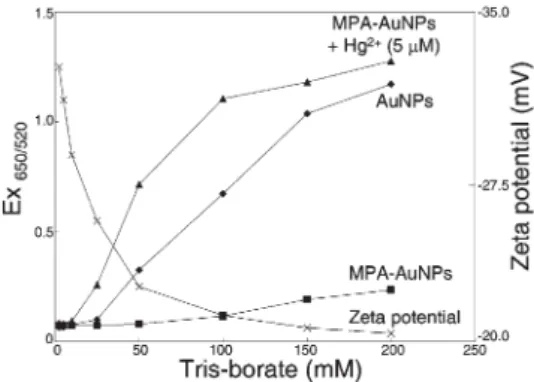
Next, we recorded the UV-Vis spectra and zeta potentials of AuNP and MPA-AuNP solutions prepared in Tris–borate buffers of various concentrations in the absence and presence of Hg2+ions (5 mM). Increasing the Tris–borate concentration, leads to a greater amount of the weakly adsorbed citrate ions being replaced from the surfaces of the AuNPs and MPA-AuNPs by Tris and borate species. As a result, the zeta potentials of the AuNPs and MPA-AuNPs decreased, as exhibited in Fig. 3, and eventually the NPs aggregated. The AuNPs and MPA-AuNPs aggregated in Tris– borate solutions having concentrations above 25 and 100 mM, respectively; presumably, the MPA-AuNPs were more stable than the AuNPs at higher Tris–borate concentrations because of the ionized carboxylic acid units of their MPA moieties. Based on the stability of the AuNPs and the aggregation of the MPA-AuNPs mediated by Hg2+(5 mM), the optimized concentration of Tris–borate for our MPA-AuNP-based Hg2+sensor was 50 mM.
Next, we investigated the optimum MPA density on the MPA-AuNPs’ surfaces for the binding of Hg2+ions. Fig. S1 (ESI{)
dis-plays the calibration curves of Hg2+ in various MPA-AuNP solutions. When using the solutions of MPA-AuNPs having 6.70 6 102, 1.76 6 103, 3.35 6 103and 6.70 6 103MPA ligands per NP, the Ex650/530ratios reached plateaus at Hg2+
concentra-tions of 7.5, 10, 25 and 50 mM, respectively. These results indicate that the MPA-AuNPs having lower MPA densities were more sensitive toward the Hg2+ ions. On the other hand, the
MPA-AuNPs having greater MPA densities had the ability to trap a larger number of Hg2+ions, which is a useful feature for trapping purposes. A decrease in the number of receptor groups per NP reduces the redundancy in the metal ion based particle linking process and, thus, provides better sensitivity,8but we found that
Fig. 2 Values of Ex650/520ratios for the MPA-AuNPs in 50 mM Tris–
borate, 50 mM Tris–HCl and 10.1 mM borate–NaOH after the addition of 100 mM metal ions (Sr2+, Pb2+, Hg2+and Pb2+) at pH 9.0.
Fig. 3 Effect of the concentration of Tris–borate on the zeta potential of the MPA-AuNPs and on the Ex650/520ratios of AuNPs and MPA-AuNPs
(in the absence/presence of 5 mM Hg2+) at pH 9.0.
the MPA-AuNPs aggregated in 50 mM Tris–borate (pH 9.0) when the MPA density was less than 6.70 6 102 ligands per AuNP.
Based on the stability of the MPA-AuNPs and their sensitivity toward the detection of Hg2+ions in 50 mM Tris–borate solution, the optimized ligand density was 6.70 6 102 MPA units per AuNP.
Under the optimum conditions, we tested the practicality of using the MPA-AuNPs for the sensing of various metal ions. Fig. 4 displays the changes in the colors and UV-vis absorption spectra of the MPA-AuNPs (3.0 nM) 2 h after adding various metal ions (100 mM). In this series, we found that the presence of Ca2+, Sr2+, Mn2+, Pb2+, Cd2+and Cr3+ions led to increases in Ex650/520to
varying degrees, whereas the remaining ions exhibited no significant effects under identical conditions. These results suggest poor selectivity of the MPA-AuNP-based Hg2+probe with respect to Ca2+, Sr2+, Mn2+, Pb2+, Cd2+ and Cr3+ ions. Fortunately, greater selectivity of the MPA-AuNP probe toward Hg2+ions was readily achieved in the presence of the chelating ligand PDCA (1.0 mM). PDCA forms much more stable complexes with heavy-metal ions, such as Hg2+(log b2= 20.28), than with other metal
ions.15 To ensure better masking and the formation of stable complexes with Hg2+, we added PDCA to each MPA-AuNP solution at a concentration at least ca. 10 times greater than that (100 mM) of Hg2+. As indicated in Fig. 4, MPA-AuNP in 50 mM
Tris–borate (pH 9.0) containing 1.0 mM PDCA responded selectively toward Hg2+ions, by 100-fold or more, relative to the other metal ions. We suggest that some PDCA ligands bound to the MPA-AuNP species through Au–N bonds,16improving the probes’ selectivity toward Hg2+ions through a cooperative effect,
while the PDCA ligands in the bulk solutions formed complexes with the other metal ions, suppressing their interference with the probes. We performed a series of competitive experiments to test the practical applicability of our MPA-AuNP nanosensor for the selective colorimetric detection of Hg2+. After adding Hg2+ (10 mM) and the interfering metal ions (Ca2+, Sr2+, Mn2+, Pb2+,
Cd2+and Cr3+; 100 mM) to a mixture of MPA-AuNP and PDCA (1.0 mM), we did not observe any significant interference in the detection of the Hg2+ions. As indicated in Fig. 5, the Ex650/520
ratios of the MPA-AuNPs (0.2 nM) increased upon increasing the concentration of Hg2+ions. A linear correlation (R2= 0.95) existed
between the value of Ex650/520and the concentration of Hg2+ions
over the range 250–500 nM. The LOD for Hg2+, at a signal-to-noise ratio of 3, was 100 nM. Thus, our approach pushes the sensitivity lower, by one order of magnitude, than those of other reported chelation/aggregation-mediated colorimetric AuNP-based sensors.8,12 Although the detected linear range of this MPA-AuNP-based Hg2+sensor was narrow, we believe that this range could be extended by modulating the MPA ligand density or the concentration of the Tris–borate buffer. More importantly, in the presence of PDCA, the MPA-AuNP nanosensor behaved almost completely free to interference from any other metal ion.
In conclusion, the high selectivity and sensitivity (LOD = 100 nM) of MPA-AuNPs for Hg2+results from fine control of the buffer composite, the MPA ligand density on the MPA-AuNPs, and the excellent cooperativity of PDCA. We believe that this simple, low-cost approach may serve as a foundation for the preparation of practical nanosensors that will allow the rapid determination of Hg2+ concentrations in aqueous biological and environmental samples.
Notes and references
1 L. M. Campbell, D. G. Dixon and R. E. Hecky, J. Toxicol. Environ. Health B, 2003, 6, 325.
2 Q. Wang, D. Kim, D. D. Dionysiou, G. A. Sorial and D. Timberlake, Environ. Pollut., 2004, 131, 323.
3 T. Morris and G. Szulczewski, Langmuir, 2002, 18, 5823.
4 E. M. Nolan, M. E. Racine and S. J. Lippard, Inorg. Chem., 2006, 45, 2742.
5 Y. Tang, F. He, M. Yu, F. Feng, L. An, H. Sun, S. Wang, Y. Li and D. Zhu, Macromol. Rapid Commun., 2006, 27, 389.
6 A. Ono and H. Togashi, Angew. Chem., Int. Ed., 2004, 43, 4300. 7 A. Moores and F. Goettmann, New J. Chem., 2006, 30, 1121. 8 Y. Kim, R. C. Johnson and J. T. Hupp, Nano Lett., 2001, 1, 165. 9 C. A. Mirkin, R. L. Letsinger, R. C. Mucic and J. J. Storhoff, Nature,
1996, 382, 607.
10 H. Otsuka, Y. Akiyama, Y. Nagasaki and K. Kataoka, J. Am. Chem. Soc., 2001, 123, 8226.
11 N. T. K. Thanh and Z. Rosenzweig, Anal. Chem., 2002, 74, 1624. 12 X. He, H. Liu, Y. Li, S. Wang, Y. Li, N. Wang, J. Xiao, X. Xu and
D. Zhu, Adv. Mater., 2005, 17, 2811.
13 For acetate, the stability constants are: log K(Pb) = 4.1; log K(Hg) = 10.1; log K(Cd) = 3.2; and log K(Sr) = 1.1: F. M. M. Morel, in Principles of Aquatic Chemistry, Wiley-Interscience, New York, 1983, ch. 6, pp. 248–249.
14 P. J. Brignac, Jr. and C. Mo, Anal. Chem., 1975, 47, 1465.
15 E. Norkus, I. Stalnioniene˙ and D. C. Crans, Heteroat. Chem., 2003, 14, 625.
16 R. D. Felice and A. Selloni, J. Chem. Phys., 2004, 120, 4906. Fig. 4 (Top) Photographic images of the colors and (bottom) Ex650/520
differences of the MPA-AuNPs in the absence and presence of PDCA (1.0 mM) after the addition of 100 mM metal ions in 50 mM Tris–borate solutions (pH 9.0).
Fig. 5 UV-Vis absorption responses of MPA-AuNPs (0.2 nM) after the addition of various concentrations of Hg2+ions (0, 100, 200, 250, 275, 300, 325, 350, 400, 450 and 500 nM). Inset: Plot of Ex650/520of MPA-AuNPs as
a function of the Hg2+concentration.