IEEE COMMUNICATIONS LETTERS, VOL. 13, NO. 10, OCTOBER 2009 797
Modeling the Slotted Nonpersistent CSMA Protocol for
Wireless Access Networks with Multiple Packet Reception
Rung-Hung Gau, Member, IEEE
Abstract—In this paper, we propose probability models for performance analysis of the slotted nonpersistent CSMA protocol in wireless networks with multiple packet reception. Variants of the CSMA protocol are well-known and play important roles in medium access control. Most of the previous works on CSMA use the conventional(0, 1, 𝑒) channel model, which prohibits an access point from concurrently receiving multiple packets from distinct nodes. In this paper, we use the Poisson random traffic model to study the performance of the slotted nonpersistent CSMA protocol when the access point could simultaneously re-ceive two or more packets from different nodes in wireless access networks. We show that in terms of the network throughput, our analytical results are consistent with simulation results.
Index Terms—Carrier sense multiple access, multiple packet reception, wireless access network, performance analysis.
I. INTRODUCTION
I
N this paper, we analyze the performance of theslot-ted nonpersistent CSMA (Carrier Sense Multiple Access) protocol [1] [2] for distributed random access in wireless access networks with multiple packet reception (MPR) [4].
We assume that there are an access point and 𝑀 nodes in
the wireless access network. The CSMA mechanism plays an essential role in many well-known medium access control protocols such as the IEEE 802.11 standard and the IEEE 802.15.4 standard. Most of the previous works on medium
access control used the conventional(0, 1, 𝑒) channel model
[2], which prohibits the access point from successfully re-ceiving/decoding two or more packets from distinct nodes in a time slot. In contrast, in a wireless network with multi-ple packet reception, the access point could receive/decode a number of packets from different nodes simultaneously. MPR technologies could increase the network throughput without increasing the transmission power or the bandwidth requirement. In addition to capture effects, multiple packet reception could be realized by CDMA multiuser detection
techniques and successive interference cancellation. Let𝑟𝑖,𝑗
be the probability that the access point will successfully
receive/decode 𝑗 packets given that 𝑖 nodes simultaneously
transmit packets. Note that 𝑟𝑖,0 = 1 −∑𝑖𝑗=1𝑟𝑖,𝑗, ∀𝑖. The
multiple packet reception capability at the access point is
fully characterized by the 𝑀 × 𝑀 channel matrix 𝑅 such
that[𝑅]𝑖,𝑗= 𝑟𝑖,𝑗,∀1 ≤ 𝑖, 𝑗 ≤ 𝑀 [4].
Manuscript received June 22, 2009. The associate editor coordinating the review of this letter and approving it for publication was S. Gupta.
This work was supported in part by the National Science Council, Taiwan, R.O.C. under grant number NSC-97-2221-E-110-052-MY3.
R.-H. Gau is with the Department of Electrical Engineering, National Chiao Tung University, Hsinchu 30010, Taiwan (e-mail: [email protected]).
Digital Object Identifier 10.1109/LCOMM.2009.091306
Zhao and Tong [4] proposed the MQSR protocol, which is a polling-based medium access control scheme for wireless networks with multiple packet reception. Gau and Chen [8] proposed a predictive polling algorithm for medium access control in wireless networks with multiple packet reception and queueing. Naware, Mergen, and Tong [7] studied the impact of multiple packet reception on the stability and delay of slotted Aloha. Lotfinezhad, Liang, and Sousa [9] derived the optimal retransmission probabilities for slotted Aloha in wireless sensor networks with multiple packet reception. Gau and Chen [10] proposed probability models to derive the network throughput and the average packet delay for the classic tree/stack splitting algorithm in wireless networks with multiple packet reception. Kleinrock and Tobagi [1] analyzed the performance of CSMA protocols based on the conventional (0, 1, 𝑒) channel model. Chan and Berger [5] investigated the impact of multiple packet reception on CSMA, when each node always has packets to be transmitted. In contrast, we use the Poisson random traffic model in this paper. Chan, Berger, and Tong [6] used drift analysis techniques to evaluate the performance of the slotted nonpersistent CSMA protocol in wireless networks with multiple packet reception. While they focused on the value of the maximum stable throughput, we derive the complete throughput function, which is a mapping from the network traffic load to the network throughput. Our work is the first in the literature that extends and applies the analytical techniques developed in [1] to CSMA protocols in wireless networks with MPR.
II. PROBABILITYMODELS ANDANALYTICALRESULTS
Except for the channel model, we adopt all the system models in [1]. We assume that each packet is of constant length. We choose the time unit to be the packet transmission
time. Let𝑎 be the maximum propagation delay. Namely, when
a node starts packet transmission at time𝑠, all other nodes in
the network will sense the packet transmission before or on time𝑠 + 𝑎. A minislot equals 𝑎 time units. According to the
slotted nonpersistent CSMA protocol, when a packet arrives at a node within a minislot, the node will not perform carrier sense until the beginning of the next minislot. Without loss of
essential generality, it is assumed that 1
𝑎 is an integer.
As in [1] [3], it is assumed that the network has a large num-ber of nodes, which collectively generate a Poisson traffic with
mean aggregate rate of 𝐺 channel requests/packets per time
unit. The time interval[0, ∞) is partitioned into regenerative
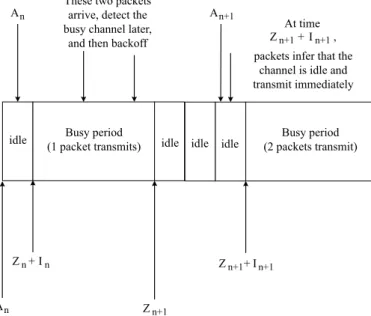
cycles [11]. Let𝑍𝑛 be the beginning of the𝑛-th regenerative
cycle, ∀𝑛 ≥ 1. Note that 𝑍1 = 0. Each regenerative cycle
is composed of an idle period and a subsequent busy period
[1]. Let 𝐴𝑛 be the time instance when the first channel
798 IEEE COMMUNICATIONS LETTERS, VOL. 13, NO. 10, OCTOBER 2009
A
idle (1 packet transmits)Busy period idle idle idle (2 packets transmit)Busy period These two packets
arrive, detect the busy channel later,
and then backoff
At time packets infer that the
channel is idle and transmit immediately n An An+1 Zn+1 Z +n+1 In+1 Z +n+1 I ,n+1 Z +n I n
Fig. 1. An illustration of network evolution (𝑎 = 0.25).
request/packet in the 𝑛-th regenerative cycle arrives. The
packet could be either a new packet or a retransmitted packet.
Denote the ceiling function by ⌈⋅⌉. According to the slotted
nonpersistent CSMA protocol, the packets that arrive within
the time interval(𝐴𝑛, ⌈𝐴𝑛/𝑎⌉ ⋅ 𝑎) will not sense the channel
until time⌈𝐴𝑛/𝑎⌉⋅𝑎. Thus, the idle period in the 𝑛-th
regener-ative cycle is defined to be the time interval[𝑍𝑛, ⌈𝐴𝑛/𝑎⌉ ⋅ 𝑎).
Let𝐼𝑛= ⌈𝐴𝑛/𝑎⌉⋅𝑎−𝑍𝑛be the length of the idle period in the 𝑛-th regenerative cycle. The packet arriving at time 𝐴𝑛 will
learn that the channel is idle at time⌈𝐴𝑛/𝑎⌉ ⋅ 𝑎 and will be
transmitted during the time interval[⌈𝐴𝑛/𝑎⌉⋅𝑎, ⌈𝐴𝑛/𝑎⌉⋅𝑎+1].
On the other hand, packets arriving during the time interval (⌈𝐴𝑛/𝑎⌉ ⋅ 𝑎, ⌈𝐴𝑛/𝑎⌉ ⋅ 𝑎 + 1) will learn that the channel is
busy and therefore postpone their transmissions. Therefore,
the busy period in the𝑛-th regenerative cycle is defined to be
the time interval[⌈𝐴𝑛/𝑎⌉ ⋅ 𝑎, ⌈𝐴𝑛/𝑎⌉ ⋅ 𝑎 + 1). Note that the
first packet that arrives after time ⌈𝐴𝑛/𝑎⌉ ⋅ 𝑎 + 1 will learn
that the channel is idle. Therefore,𝑍𝑛+1 = ⌈𝐴𝑛/𝑎⌉ ⋅ 𝑎 + 1.
An example of system evolution is shown in Fig. 1.
We now derive the probability mass function of 𝐼𝑛. First,
since 1
𝑎 is an integer, 𝑍𝑎𝑛 is also an integer. Therefore,
⌈𝐴𝑛
𝑎 ⌉ ⋅ 𝑎 − 𝑍𝑛 = ⌈𝐴𝑛−𝑍𝑎 𝑛⌉ ⋅ 𝑎. Since the arrivals of channel
requests/packets form a Poisson process with rate 𝐺, the
random variable 𝐴𝑛 − 𝑍𝑛 is exponentially distributed with
mean equals 1 𝐺. Then, 𝑃 {𝐼𝑛= 𝑘𝑎} = 𝑃 {⌈𝐴𝑎𝑛⌉ ⋅ 𝑎 − 𝑍𝑛 = 𝑘𝑎} = 𝑃 {⌈𝐴𝑛− 𝑍𝑎 𝑛⌉ ⋅ 𝑎 = 𝑘𝑎} = 𝑃 {(𝑘 − 1)𝑎 < 𝐴𝑛− 𝑍𝑛 ≤ 𝑘𝑎} = 𝑒−𝐺𝑎(𝑘−1)× (1 − 𝑒−𝐺𝑎) (1)
Denote the expected value of a random variable𝑋 by 𝐸[𝑋].
Since 𝐼1, 𝐼2, 𝐼3, ... are IID (independent and identically
dis-tributed) random variables, we abbreviate𝐸[𝐼𝑛] by 𝐸[𝐼]. We
now derive the value of𝐸[𝐼] as follows.
𝐸[𝐼] = ∑∞ 𝑘=1 𝑘𝑎 × 𝑃 {𝐼𝑛= 𝑘𝑎} = ∑∞ 𝑘=1 𝑘𝑎 × 𝑒−𝐺𝑎(𝑘−1)× (1 − 𝑒−𝐺𝑎) = 𝑎(1 − 𝑒−𝐺𝑎) ×∑∞ 𝑘=1 𝑘 ⋅ (𝑒−𝐺𝑎)𝑘−1 = 1 − 𝑒𝑎−𝐺𝑎 (2)
The second equality is due to the previous equation. The fourth
equality is due to that∑∞𝑘=1𝑘 ⋅ 𝑟𝑘−1= 1
(1−𝑟)2,∀𝑟 ∈ (0, 1).
Let𝑄𝛽be the probability that𝛽 nodes will simultaneously
transmit packets in a busy period. Let 𝑋𝑛 be a random
variable that represents the total number of arrivals of channel
requests/packets in the last minislot of the 𝑛-th regenerative
cycle. Then,𝑄𝛽= 𝑃 {𝑋𝑛= 𝛽}. We now derive the values of
𝑄𝛽’s. By definition, 𝑄0 = 0. Let 𝑌 be a random variable
that represents the total number of arrivals of channel
re-quests/packets in a minislot. Since{𝑁(𝑡), 𝑡 ≥ 0} is a Poisson
counting process with rate𝐺, 𝑌 is a Poisson-distributed
ran-dom variable with mean equals𝐺𝑎. Then, ∀𝛽 ∈ {1, 2, .., 𝑀},
𝑄𝛽 = 𝑃 {𝑋𝑛= 𝛽} = 𝑃 {𝑌 = 𝛽∣𝑌 ≥ 1} = 𝑃 {𝑌 = 𝛽, 𝑌 ≥ 1} 𝑃 {𝑌 ≥ 1} = 𝑃 {𝑌 = 𝛽}𝑃 {𝑌 ≥ 1} = (𝐺𝑎)𝛽𝑒−𝐺𝑎 𝛽!(1 − 𝑒−𝐺𝑎) (3)
The second equality is due to that at least one channel request/packet arrives in the last minislot of an idle period.
The fourth equality is due to that𝛽 ≥ 1.
Let 𝑈𝑛 be a random variable that represents the total
number of packets that are successfully received by the access
point in the 𝑛-th regenerative cycle. Let 𝑃𝑘 = 𝑃 {𝑈𝑛 = 𝑘}
be the probability that the access point will successfully
receive/decode𝑘 packets in a busy period. Then,
𝑃 {𝑈𝑛= 𝑘} = ∑𝑀 𝛽=1 𝑃 {𝑈𝑛= 𝑘, 𝑋𝑛 = 𝛽} = ∑𝑀 𝛽=1 𝑃 {𝑋𝑛= 𝛽} × 𝑃 {𝑈𝑛= 𝑘∣𝑋𝑛 = 𝛽} = 𝑀 ∑ 𝛽=1 𝑄𝛽⋅ 𝑟𝛽,𝑘 (4)
The last equality is based on the MPR channel model. Since
𝑈1, 𝑈2, 𝑈3, ... are IID random variables, we abbreviate 𝑈𝑛 by 𝑈 whenever appropriate.
In addition, 𝐸[𝑈] = ∑𝑀𝑘=1𝑃𝑘× 𝑘. Let 𝑆 be the network
throughput of the nonpersistent CSMA protocol. Recall that the length of a busy period is always one time unit. According
GAU: MODELING THE SLOTTED NONPERSISTENT CSMA PROTOCOL FOR WIRELESS ACCESS NETWORKS WITH MULTIPLE PACKET RECEPTION 799 0 5 10 15 20 25 30 0 0.2 0.4 0.6 0.8 1 1.2 1.4
G: offered traffic rate
Throughput
Slotted Non−persistent CSMA, a=0.1
C=1, analytical results C=2, analytical results C=2, simulation results C=3, analytical results
Fig. 2. The throughput function.
to renewal theory [1] [11],𝑆 = 𝐸[𝐼]+1𝐸[𝑈] . Based on the above
equations, we have 𝑆 = ∑𝑀 𝑘=1𝑘 ⋅ ∑𝑀 𝛽=𝑘 (𝐺𝑎) 𝛽𝑒−𝐺𝑎 𝛽!(1−𝑒−𝐺𝑎)⋅ 𝑟𝛽,𝑘 𝑎 1−𝑒−𝐺𝑎+ 1 (5)
III. NUMERICAL ANDSIMULATIONRESULTS
We wrote a Matlab program to obtain numerical results based on the equations in this paper. In addition, we wrote
a C program to perform discrete event simulation. Let 𝐶 be
a positive integer that represents the maximum number of successfully received packets in a time slot. As in [4] [10],
we study on the case in which 𝑟𝑖,𝑖 = 1, ∀1 ≤ 𝑖 ≤ 𝐶,
while all other elements in the matrix 𝑅 are zeros. Note
that 𝑟𝐶+1,𝐶+1 = 𝑟𝐶+2,𝐶+2 = .. = 𝑟𝑀,𝑀 = 0. Namely, if
more than𝐶 nodes transmit packets simultaneously, the access
point receives none of them for sure. For each value of 𝐺,
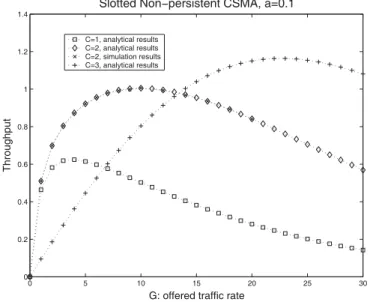
we simulate 100000 regenerative cycles to obtain the network throughput. In Fig. 2, we show that our analytical results are
consistent with simulation results when 𝐶 = 2, 𝑎 = 0.1,
and𝐺 ∈ [0, 20]. For example, when 𝐺 = 1.0, the analytical
result is 0.5100, while the simulation result is 0.5098. When
𝐺 = 10.0, the analytical result is 1.0050, while the simulation
result is 1.0057.
IV. CONCLUSION
In this paper, we have proposed probability models for performance analysis of the slotted nonpersistent CSMA pro-tocol in wireless networks with multiple packet reception.
Most of the previous works on CSMA use the conventional (0, 1, 𝑒) channel model, which prohibits an access point from concurrently receiving multiple packets from distinct nodes. In this paper, we have used the Poisson random traffic model to study the performance of the slotted nonpersistent CSMA protocol when the access point could simultaneously receive two or more packets from different nodes. We have shown that in terms of the network throughput, our analytical results are consistent with simulation results. Since multiple packet reception techniques could increase the throughput without increasing the bandwidth requirement, they could be applied to wireless networks in which bandwidth is relatively scarce. As
the value of 𝐶 increases, the hardware complexity to realize
the corresponding multiple packet reception capability also increases. Our studies shows that the increasing rate of the maximum throughput tends to be a decreasing function of
𝐶. Thus, we recommend to select 𝐶 ∈ {2, 3} for hardware
implementation in practice.
REFERENCES
[1] L. Kleinrock and F. A. Tobagi, “Packet switching in radio channels— part 1: carrier sense multiple-access models and their throughput-delay characteristics,” IEEE Trans. Commun., vol. 23, no. 12, Dec. 1975, pp. 1400–1416.
[2] D. Bertsekas and R. Gallager, Data Networks, 2nd Ed. Upper Saddle River, NJ: Prentice Hall Publication, 1992.
[3] Z. J. Haas and J. Deng, “Dual busy tone multiple access (DBTMA)— a multiple access control scheme for ad hoc networks,” IEEE Trans.
Commun., vol. 50, no. 6, June 2002, pp. 975–985.
[4] Q. Zhao and L. Tong, “A multiqueue service room MAC protocol for wireless networks with multipacket reception,” IEEE/ACM Trans.
Networking, vol. 11, no. 1, Feb. 2003, p. 125–137.
[5] D. S. Chan and T. Berger, “Performance and cross-layer design of CSMA for wireless networks with multipacket reception,” in Proc. 38th Asilomar
Conference on Signals, Systems and Computers, Nov. 2004, vol. 2, pp.
1917–1921.
[6] D. S. Chan, T. Berger, and L. Tong, “On the stability and optimal decen-tralized throughput of CSMA with multipacket reception capability,” in
Proc. Allerton Conference on Communications, Control, and Computing,
Sept. 2004.
[7] V. Naware, G. Mergen, and L. Tong, “Stability and delay of finite-user slotted ALOHA with multipacket reception,” IEEE Trans. Inform. Theory, vol. 51, no. 7, July 2005, pp. 2636–2656.
[8] R.-H. Gau and K.-M. Chen, “Predictive multicast polling for wireless networks with multipacket reception and queueing,” IEEE Trans. Mobile
Computing, vol. 5, no. 6, June 2006, pp. 725–737.
[9] M. Lotfinezhad, B. Liang, and E. S. Sousa, “Adaptive cluster-based data collection in sensor networks with direct sink access,” IEEE Trans.
Mobile Computing, vol. 7, no. 7, July 2008, pp. 884–897.
[10] R.-H. Gau and K.-M. Chen, “Probability models for the splitting algorithm in wireless access networks with multi-packet reception and finite nodes,” IEEE Trans. Mobile Computing, vol. 7, no. 12, Dec. 2008, pp. 1519–1535.
[11] S. M. Ross, Stochastic Processes, 2nd Ed. New York: John Wiley and Sons Inc., 1996.