Computer Physics Communications 177 (2007) 138–139
www.elsevier.com/locate/cpc
A new paradigm for solving plasma fluid modeling equations
C.-T. Hung
a,∗, M.-H. Hu
a, J.-S. Wu
a, F.-N. Hwang
baDepartment of Mechanical Engineering, National Chiao-Tung University, HsinChu, Taiwan bDepartment of Mathematics, National Central University, ChungLi, Taiwan
Available online 23 February 2007
A new paradigm for solving plasma fluid modeling tions is proposed and verified in this paper. Model equa-tions include continuity equaequa-tions for charged species with drift-diffusion approximation, electron energy equation, and Poisson’s equation. Resulting discretized equations are solved jointly by the Newton–Krylov–Schwarz (NKS)[1]scheme by means of a parallelized toolkit called PETSc. All model equa-tions are nondimensionalized and are discretized using fully implicit finite-difference method with the Scharfetter–Gummel scheme for the fluxes. At electrodes, thermal flux is consid-ered for electrons, while both thermal and drift fluxes are considered for ions. A quasi-1D argon gas discharge with a radio frequency power source (13.56 MHz, Vp−p= 200 Volts),
gap distance= 20 mm and 20 mm × 20 mm (100 × 100 mesh points) in size is used as the test case.
Results of evolution of potential and plasma number density are shown Fig. 1, which are comparable to previous studies. Table 1lists all the resulting timings of the present parallelized code using different combination of preconditioners (Additive Table 1
Simulation time for various preconditioners and solvers (1000 time steps, unit in seconds)
No. proc.
GMRES BCGS
ASM BJacobi ASM BJacobi
ILU LU ILU LU ILU LU ILU LU
2 7211 4524 6002 4224 6032 4257 5881 4646 4 3676 2073 3043 2083 3353 2448 2988 2590 8 2205 944 1572 1035 2928 1133 1493 1271 16 1245 919 935 1044 1112 1101 775 1196 28 816 657 462 608 673 671 455 635 * Corresponding author.
E-mail address:[email protected](C.-T. Hung).
Fig. 1. Distribution of densities and potential.
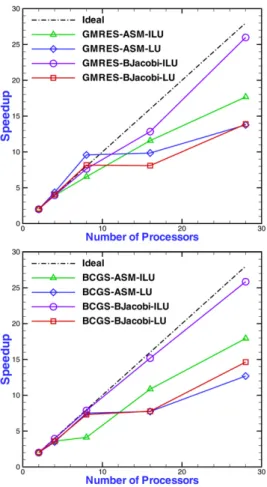
Schwarz Method and Block Jacobi) and linear equation solvers (GMRES and BiCG-Stab) for 10 RF cycles (100 time steps each cycle) for the number of processors up to 28 of a PC clus-ter system (dual cores and dual processors each node, 2.2 GHz and InfiniBand networking). Note the Block Jacobi, which does not require any overlapping in preconditioning, can be consid-ered as a special case of general ASM preconditioning, which 0010-4655/$ – see front matter © 2007 Elsevier B.V. All rights reserved.
C.-T. Hung et al. / Computer Physics Communications 177 (2007) 138–139 139
Fig. 2. Parallel performance of different preconditioners and solvers.
requires the communication for overlapping the updated data at interfacial nodes. In addition, both LU and ILU linear equation solvers are tested in solving the preconditioned matrix equation in each subdomain. At each time step only three outer (Newton) iterations with∼40 inner iterations are needed for convergence. Results show that with the present test case the combination of Block Jacobi preconditioner with ILU and BiCG-Stab per-forms the best with 92.8% of parallel efficiency at 28 processors (Fig. 2). However, it seems the parallel performance of ASM precoditioner improves with increasing number of processors (not shown), which requires more tests in the very near fu-ture.
We conclude preliminarily that the plasma fluid modeling equations can be efficiently solved using the NKS scheme if proper preconditioner and linear equation solver are selected. Future works in this direction include adding more model equa-tions, including excitation, chemical reacequa-tions, possibly radia-tion transport, and the Navier–Stokes equaradia-tion solver into the present parallelized code.
References
[1] X.C. Cai, et al., in: Proceedings of the Eighth International Conference on Domain Decomposition Methods, 1997, p. 387.