Phenomenological analysis of martensitic transformation in cold-rolled
TiNi-base shape memory alloys
S.K. Wu
a, H.C. Lin
b,∗, S.H. Chen
aaInstitute of Materials Science and Engineering, National Taiwan University, Taipei 106, Taiwan, ROC bDepartment of Materials Science, Feng Chia University, Taichung 400, Taiwan, ROC Received 8 March 2000; received in revised form 13 April 2000; accepted 15 May 2000 Abstract
The martensitic transformation in cold-rolled TiNi-base shape memory alloys has shown that the first reverse martensitic transforma-tion temperature (A1∗) increases with an increasing amount of cold rolling due to the increment of the transformation energy barrier
introduced by cold-rolling induced dislocations. Meanwhile, the increment ofA1∗temperature increases linearly with an increase in the
specimen’s solution-treated hardness. A phenomenological analysis from the thermodynamic viewpoint of cold-rolling induced disloca-tions can elucidate these features successfully. After the first reverse transformation, the strengthening effects of retained dislocadisloca-tions on martensitic transformation temperatures follow the equationM∗= TO−K1σys. The K value is found to be proportional to the specimen’s
solution-treated hardness, because the harder specimen has the stronger interaction of martensite plates and dislocations induced by cold rolling. The thermal hysteresis ofA2∗− M∗, associated with the frictional work during the transformation, does not obviously change in
the cold-rolled TiNi-base shape memory alloys. © 2001 Elsevier Science B.V. All rights reserved.
Keywords: TiNi-base shape memory alloys; Martensitic transformation
1. Introduction
TiNi-base alloys are known to be the most important shape memory alloys (SMAs) because of their numerous applications based on the shape memory effect (SME) [1] and pseudo-elasticity (PE) [2,3]. The transformation behav-ior and mechanical properties in TiNi-base shape memory alloys [2–10] have been extensively studied. These stud-ies have confirmed that the transformation behavior and mechanical properties can be affected by internal stresses induced by various thermal–mechanical treatments, includ-ing thermal cyclinclud-ing [11,12], aginclud-ing treatment in Ni-rich alloys [13–16], and annealing after cold working [17–19]. In our previous articles [19,20], the effects of cold rolling on the martensitic transformation of TiNi binary alloys have been systematically studied. The phenomenon of mechanical-induced martensite stabilization was observed in the cold-rolled TiNi martensite. Both deformed marten-site structures and deformation-induced defects are consid-ered to be responsible for the martensite stabilization. After the occurrence of the first reverse martensitic transforma-tion of B190→B2, the martensite stabilization dies out and transformation temperatures are depressed by retained
dis-∗Corresponding author.
E-mail address: [email protected] (H.C. Lin).
locations in the subsequent thermal cycles. In order to better understand the general phenomena of mechanical-induced martensite stabilization occurring in TiNi-base SMAs, we extend the investigation into the TiNiX (X=Pd, Zr, Cu) ternary alloys. TiNiCu alloy has been commercialized and TiNiPd, TiNiZr are candidates with potentiality of high temperature shape memory alloys. These TiNiX (X=Pd, Zr, Cu) ternary alloys exhibit the B19 (or B190) martensite structure at room temperature. Meanwhile, thermodynamic analysis is also used to phenomenologically interpret the martensitic transformation of cold-rolled TiNi-base shape memory alloys.
2. Experimental procedure
The conventional tungsten arc-melting technique was employed to prepare the TiNi-base shape memory al-loys, including TiNi, TiNiPd, TiNiZr and TiNiCu alloys. The as-melted buttons were homogenized at 1050◦C in a 7×10⁻⁶Torr vacuum furnace for 72 h, and then hot rolled into plates with a 5 mm thickness. Specimens for cold rolling were carefully cut from the plates with a low-speed diamond saw. These specimens were solution-treated at 800◦C for 2 h and then quenched in water. After solu-tion treatment, some specimens were cold-rolled at room
0254-0584/01/$ – see front matter © 2001 Elsevier Science B.V. All rights reserved. PII: S 0 2 5 4 - 0 5 8 4 ( 0 0 ) 0 0 3 4 8 - 5
Nomenclature
A1∗ reverse martensitic transformation temperatures for the first heating cycle in the DSC measurement (◦C)
A1(CR)∗ the first reverse martensitic transformation temperature in cold-rolled TiNi-base shape memory alloys (◦C)
A2∗ reverse martensitic transformation temperatures for the second heating cycle in the DSC measurement (◦C) As reverse martensitic transformation start
temperature (◦C)
B2 cubic structure
B19 orthorhombic structure
B190 monoclinic structure
E the accumulated dislocation energy
per unit volume
f2 the square of resonant frequency
HD0 specimen’s solution-treated hardness K, K0, Kb,
c1, c2, c3,
c4, c5, p, q constants
M∗ forward martensitic transformation
temperatures in the DSC measurements (◦C) Ms forward martensitic transformation
start temperature (◦C)
P pressure
T0 equilibrium temperature (◦C)
Tm–p transformation temperature from martensite
to parent phase
Tp–m transformation temperature from parent
phase to martensite
V specimen’s volume
Wfr irreversible frictional work Greek symbols
1A1∗ increment ofA1∗temperature due to cold rolling
1G Gibbs free energy change
1G1 Gibbs free energy changes in as-quenched TiNi-base shape memory alloys
1G2 Gibbs free energy changes in cold-rolled TiNi-base shape memory alloys
1Gav available chemical energy change
1Gch available chemical free energy change
1Gd the increased transformation energy barrier due to the cold-rolled dislocations
1Gel reversible elastic energy
1H enthalpy change
1Hc transformation heat of forward martensitic transformation in the DSC
measurement (J g−1)
1Hh transformation heat of reverse martensitic transformation in the DSC measurement (J g−1)
1S entropy change
1U internal energy change
1Ud the increased internal energy due to the cold-rolled dislocations
1V volume change
1σys increased yielding stress due to the
cold-rolled dislocations
µ shear modulus
σys yielding stress
τ shear stress
temperature to a preset thickness reduction and then sub-jected to the DSC measurement, hardness test and internal friction test. A Du Pont 9990 thermal analyzer, equipped with a quantitative scanning system 910 DSC cell and cooling accessory LNCA II, was used to run controlled heating and cooling cycles on samples encapsulated in an aluminum pan. Temperatures ranged from−60 to +400◦C with a cooling/heating rate of 10◦C min−1. Heats of trans-formation (1H), though an error of about 10% may be expected with the DSC measurements, were automatically calculated from the areas under the DSC peaks with the equipment software packages. Specimens for a hardness test were mechanically polished and then measured in the Vickers microhardness tester with a 1000 g load at room temperature. For each specimen, the hardness value, Hv, was averaged from at least five test readings. The details of equipment and specimens used for the internal friction test were described in our previous paper [13].
3. Experimental results
3.1. DSC measurements of cold-rolled Ti50Ni20Pd30alloys
Fig. 1(a)–(c) shows the results of DSC measurement for the as-quenched, 10 and 20% cold rolled Ti50Ni20Pd30
al-loys, respectively. In Fig. 1, the subscripts “1” and “2” of reverse transformation peak temperatures,A1∗andA2∗, in-dicate, respectively, the first and second heating cycle for each specimen just after the cold rolling. In Fig. 1(a), the heating curve shows that the B19→B2 reverse transforma-tion is an endothermic reactransforma-tion with1Hh1=24.49 J g−1and
A1∗ = 240◦C. The cooling curve of Fig. 1(a) shows that the B2→B19 transformation is an exothermic reaction with
1Hc=23.41 J g−1andM∗ = 216◦C. In Fig. 1(b),A1∗ ap-pears at 276◦C on the first heating cycle from room tem-perature to 400◦C,M∗ appears at 208◦C on the following cooling cycle from 400 to 100◦C, andA2∗appears at 230◦C on the heating cycle from 100 to 400◦C. In Fig. 1(c),A1∗ appears at 313◦C on the first heating cycle from room tem-perature to 450◦C,M∗ appears at 192◦C on the following cooling cycle from 450 to 100◦C, andA2∗appears at 220◦C on the heating cycle from 100 to 450◦C. In Fig. 1(a)–(c),
Fig. 1. DSC curves for the Ti50Ni20Pd30alloy: (a) as-quenched specimen; (b) 10% cold-rolled specimen; (c) 20% cold-rolled specimen.
one can find that not only the positions of the peaks but also their shapes change significantly with the amount of cold rolling and with cycling. The DSC curves for 5, 15 and 30% cold-rolled specimens are all similar to those shown in Fig. 1(b) and (c), except for the difference of peak tempera-tures, peak shapes and1H values, and therefore are omitted in this paper. The detailed data of DSC results, including peak temperatures and1H values, for the Ti50Ni20Pd30
al-loys with 0–30% cold rolling are summarized in Table 1. The data of transformation peak temperatures vs. cold rolling in Table 1 are also plotted in Fig. 2. In Fig. 2, theA1∗ temper-ature increases significantly, butA2∗ andM∗temperatures decrease slightly with an increase in cold rolling, and these characteristics are discussed in Section 4.
Table 1
DSC measurements of thermal properties for Ti50Ni20Pd30alloy at various amounts of cold rolling
CRa(%) A 1∗(◦C) 1Hh1(J g−1) A2∗(◦C) 1Hh2 (J g−1) M∗(◦C) 1Hc(J g−1) 0 240 24.49 240 24.49 216 23.41 5 250 22.96 232 23.25 211 22.13 10 276 21.22 230 21.97 208 21.17 15 301 12.43 224 20.29 200 20.07 20 313 8.29 220 20.13 192 19.18 30 404 7.58 215 20.15 186 18.73
aCR means cold rolling or thickness reduction amounts.
Fig. 2. Transformation peak temperatures vs. amount of cold rolling for the Ti50Ni20Pd30alloys.
Fig. 3. Transformation peak temperatures vs. amount of cold rolling for the Ti41.5Ni48.5Zr10 alloys.
3.2. Comparison of transformation behaviors in cold-rolled TiNi-base shape memory alloys
To better understand the general effects of cold rolling on the TiNi-base shape memory alloys, the cold-rolled TiNi binary and TiNiX (X=Zr, Cu) ternary alloys have also been investigated in this study. The transformation behaviors in these cold-rolled alloys are similar to those shown in Figs. 1 and 2 for the cold-rolled Ti50Ni20Pd30 alloy. For example,
Fig. 4. The increment ofA1∗temperature (1A1∗) by 30% cold rolling as a function of specimen’s solution-treated hardness for the cold-rolled TiNi-base alloys.
amount of cold rolling for the Ti41.5Ni48.5Zr10 alloy. The
variation tendency of transformation peak temperatures vs. cold rolling is similar to that shown in Fig. 2 for the Ti50Ni20Pd30 alloy. However, some important differences
for these TiNi-base shape memory alloys, which originate from the effects of cold rolling, are compared in Figs. 4 and 5. Fig. 4 shows the increment of A1∗ temperature (1A1∗) by 30% cold rolling as a function of the specimen’s solution-treated hardness (HD0) for these TiNi-base alloys.
Here,1A1∗indicates the difference betweenA1∗ tempera-tures with and without cold rolling, and HD0is the hardness
tested at room temperature for specimens with solution treatment at 800◦C for 2 h. The HD0 is a material intrinsic
property, which would not be affected by the amount of cold rolling. In Fig. 4,1A1∗is found to increase linearly with an increase in the specimen’s solution-treated hardness for var-ious TiNi-base alloys. It is worthy to mention that the linear relationship between1A1∗and specimen’s solution-treated
Fig. 5. The relationship betweenM∗temperatures and specimen hardness for the TiNi-base alloys which have been subjected to various amounts of cold rolling and the first reverse martensitic transformation.
hardness can also be observed for other amounts of cold rolling. Fig. 5 shows the relationship betweenM∗ tempera-ture and specimen hardness for the TiNi-base alloys which have been subjected to various amounts of cold rolling and the first reverse martensitic transformation. In Fig. 5, M∗ temperature is found to decrease with increasing specimen hardness for each kind of TiNi-base alloy. The characteris-tics shown in Figs. 4 and 5 are also discussed in Section 4.
4. Discussion
4.1. Thermodynamic analysis of martensitic transformation in cold-rolled TiNi-base shape memory alloys
From Figs. 1 and 2, one can find thatA1∗increases signif-icantly, butA2∗andM∗temperatures decrease slightly with an increasing amount of cold rolling for the Ti50Ni20Pd30
alloy. The above phenomenon is regarded as the mechan-ically induced martensite stabilization, the same behavior as reported in the Ti50Ni50 alloy [19]. According to TEM
observations of cold-rolled Ti50Ni50 [19] and Ti50Ni20Pd30
[21] alloys, a variety of deformed martensite structures and deformation-induced defects are observed when the speci-mens have been subjected to cold rolling. These deformed martensite structures and deformation-induced defects are expected to inhibit the reverse martensitic transformation by imposing a friction stress on the martensite/parent interfaces. Therefore, the reverse martensitic transformation tempera-tures,A1∗, must shift to higher ones since the transforma-tion requires additransforma-tional energy to overcome the increased friction stress.
Based on thermodynamic analysis [22–25], the thermoe-lastic behavior is a condition of local balance between chem-ical and non-chemchem-ical forces. Chemchem-ical forces arise from the difference in Gibbs free energy between parent phase and martensite, and act as a driving force promoting the phase with lower energy at each temperature. Non-chemical forces can be acknowledged to arise from two different sources, namely, the elastic energy and frictional work. The elastic energy is stored in the specimens during the transforma-tion from parent phase to martensite, and reversibly recov-ered during the reverse transformation. The frictional work is mainly devoted to overcome frictional barriers opposing interfacial motion either during growth or during shrinkage of the martensite plates. The net driving force or available chemical free energy difference (1Gav) per mole of the mov-ing plates can be explicitly written as follows:
1Gav= −1Gch+ 1Gel+ Wfr (1)
where 1Gch, 1Gel and Wfr represent the chemical free
energy change, stored elastic energy and frictional work, re-spectively. The increases in1Gelor Wfrwill both cause Ms
(transformation temperature from parent phase to marten-site, or M∗ here) to decrease, while As (transformation
decreases with increasing1Gel but increases with increas-ing Wfr. Meanwhile, Wfr will cause the transformation
hysteresis.
Titchener and Bever [26] reported that cold rolling will raise the internal energy due to the introduction of a new phase, lattice strain or crystal imperfections within the ma-terial. These deformed features will also have effects on the nucleation and growth of farther martensitic transformations, as reported in the thermoelastic Cu–Zn–Al alloys [27–29]. As mentioned above, the deformed martensite structures and deformation-induced defects exist in the cold-rolled TiNi-base shape memory alloys. We are interested to un-derstand how these deformed features affect the Gibbs free energy change during the subsequent reverse and forward martensitic transformations. In assuming that the twinned martensite plates in TiNi-base shape memory alloys are cre-ated by a pole mechanism [30,31], it is believed that a high density of twin dislocations exist around the interfaces of the twinned martensite. By neglecting the minor effects of point defects and considering that the movement of twinned martensite plates is caused by the movement of twin dis-locations, the variation of available chemical free energy change associated with the martensitic transformations in the cold-rolled TiNi-base shape memory alloys can be sim-ply discussed with the effects of dislocations. The energy difference of the dislocations, when embedded in the parent B2 phase or martensite, will affect their relative stability and therefore the transformation temperatures.
Consider the thermodynamic formula
1H = 1U + P 1V (2)
where1H is the enthalpy change, 1U the internal energy change, P the pressure, and1V is the volume change asso-ciated with the martensitic transformation. For the thermoe-lastic TiNi-base shape memory alloys, the transformation volume change is quite small. Hence, by neglecting P1V, Eq. (2) becomes
1H = 1U (3)
Cottrell [32] evaluated the entropy change 1S by using Boltzmann’s equation and found that the 1S associated with the formation or movement of one dislocation is only about 0.1 eV, which is far below the dislocation strain en-ergy. Hence, the Gibbs free energy change for the marten-sitic transformations of cold-rolled TiNi-base shape memory alloys can be simply expressed as follows:
1G = 1H − T 1S ; 1H = 1U (4) As mentioned above, the cold rolling on TiNi-base shape memory alloys will introduce deformed martensite struc-tures and crystal defects. These deformed feastruc-tures must be overcome during the subsequent reverse and forward trans-formations, and hence the transformation energy barrier will be increased. This increased energy barrier resulting from cold rolling, 1Gd, is considered to be proportional to the
increased internal energy due to cold rolling,1Ud, which comes from the accumulated dislocation energy introduced by cold rolling. Namely,
1Gd= Kb1Ud (5)
where Kbis a constant. The accumulated dislocation energy
in a plastic deformed material is reported [33] to be
E ; 25τ2
µ (6)
where E is the accumulated dislocation energy per unit vol-ume,τ the shear stress, and µ is the shear modulus. During plastic deformation, the applied shear stressτ must exceed the yielding shear stressτys, i.e.,
τ = τys+ τ0= K0σys+ τ0 (7) whereτ0 is the exceeding amount of shear stress and K0 is the transformation factor between the yielding shear stress
τysand the yielding stressσys. According to the empirical
formula [34] of yielding stressσys and hardness HD0 for
the solution-treated specimens,
σys= 1
3HD0 (8)
and using Eqs. (7) and (8), Eq. (6) becomes
E ; 25τµ2 = 25[ 1
3K0HD0+ τ0] 2
µ (9)
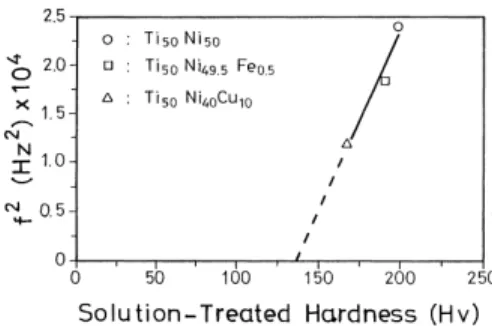
According to the vibration theory, the shear modulus µ is proportional to the square of the resonant frequency f, namely,µ ∝ f2. In our previous paper [35], the resonant frequency f and specimen’s solution-treated hardness HD0
for TiNi-base shape memory alloys have been measured. Based on the experimental data in [35], the square of reso-nant frequency f2 at room temperature is plotted as a func-tion of HD0 in Fig. 6 for several TiNi-base shape
mem-ory alloys. From Fig. 6, a linear relationship between f2 and HD0 is observed. Hence, we can derive thatµ is
pro-portional to the specimen’s solution-treated hardness HD0,
namely,
µ = c1HD0+ c2 (10)
Fig. 6. The relationship between the square of resonant frequency (f2) and specimen’s solution-treated hardness (HD0) for the TiNi-base shape memory alloys.
where c1and c2are constants. Therefore, E ;25[ 1 3K0HD0+ τ0] 2 µ ; 25[13K0HD0+ τ0]2 [c1HD0+ c2] ; c3HD0+ c4+ c5 [c1HD0+ c2] ; c3HD0+ c4 (11)
where c3, c4, and c5 are also constants. In this study, the
plastic deformation was carried out by a multiple passage. The amount of cold rolling in every passage was quite small, and thusτ0 σysis expected. Therefore, the constant c5in
Eq. (11), being related to the square ofτ0, can be reasonably omitted. From Eq. (11), the raised transformation energy barrier due to cold rolling in Eq. (5) can be derived to be
1Gd= Kb1Ud= KbEV= KbV [c3HD0+ c4] (12)
where V is the specimen’s volume. Eq. (12) indicates that
1Gdis proportional to the specimen’s solution-treated hard-ness HD0of TiNi-base shape memory alloys.
4.2. A phenomenological discussion of martensite stabilization in cold-rolled TiNi-base shape memory alloys
According to the thermodynamic analysis in Section 4.1, the net driving force or available chemical free energy change in cold-rolled TiNi-base shape memory alloys can be expressed as follows:
1Gav = −1Gch+ 1Gel+ Wfr+ 1Gd (13)
Fig. 7. The illustrated diagrams of Gibbs free energy vs. temperature showing the increase of transformation energy barrier and the raise of A1∗ temperature for the cold-rolled TiNi-base alloys: (a) undeformed TiNi-base alloys; (b) cold-rolled TiNi-based alloys at T=T0; (c) cold-rolled TiNi-based alloys atT = A1∗; (d) cold-rolled TiNi-based alloys atT = A1(CR)∗.
where 1Gd is the Gibbs free energy change introduced by cold-rolling induced dislocations. The phenomenon of martensite stabilization in cold-rolled TiNi-base shape mem-ory alloys is illustrated in Fig. 7(a)–(d). In Fig. 7(a), the Gibbs free energies of martensite and parent phase at the equilibrium temperature T0are equal. However, to overcome
the transformation energy barrier, the reverse martensitic transformation temperatures have to shift to higher ones. The higher the transformation energy barrier, the higher is the transformation temperature. In Fig. 7(b), the dash and solid lines indicate the transformation energy barriers for the as-quenched martensite with and without cold rolling, respectively, to transform to the parent phase at T=T0. As shown in Fig. 7(b), more driving force is necessary for the cold-rolled martensite to transform to the parent phase. At
T = A1∗, the reverse transformation temperature of the as-quenched martensite, there is not enough driving force to overcome the energy barrier to cause the reverse trans-formation of cold-rolled martensite, as shown in Fig. 7(c). Then, the transformation temperature has to shift to a higher one (A1(CR)∗) to start the first reverse transformation of cold-rolled martensite, as shown in Fig. 7(d). The greater the amount of cold rolling, the greater the transformation energy barrier1Gd, i.e., (1G2−1G1) increases (Fig. 7(a)). Hence theA1(CR)∗temperature should increase with an increasing amount of cold rolling. From Fig. 7(a), one can find that
[A1∗− T0] [A1(CR)∗− T0] =
1G1
⇒ A1(CR)∗− A1∗=[A1 ∗− T0][1G2− 1G1] 1G1 =[A1∗− T0][1Gd] 1G1 (15) ⇒ 1A1∗= A1(CR)∗− A1∗= [A1∗− T0][1Gd] 1G1 (16)
The specimen’s chemical composition does not change dur-ing cold rolldur-ing, and henceA1∗, T0 and1G1remain
con-stant. Thus, Eq. (16) indicates a proportional relationship between 1A1∗ and 1Gd. Combining Eqs. (12) and (16), one can obtain
1A1∗= [A1∗−T0]KbV [c3HD0+ c4]
1G1 = p HD0+ q (17)
where p and q are constants. Eqs. (12) and (17) indicate that, for the TiNi-base shape memory alloys, the higher the specimen’s solution-treated hardness, the higher the incre-ment of transformation energy barrier1Gd, and hence the higher the increment ofA1∗ temperature. Namely, for the cold-rolled TiNi-base shape memory alloys,1A1∗increases with an increase in the specimen’s solution-treated hardness. This phenomenon is consistent with the experimental results shown in Fig. 4.
4.3. Strengthening effects of cold rolling on martensitic transformation temperatures of TiNi-base shape memory alloys
In Fig. 2, M∗ and A2∗ temperatures are found to de-crease with an inde-crease in cold rolling for the Ti50Ni20Pd30
alloy. The decrease of these transformation temperatures is attributed to the retained dislocations after the first reverse martensitic transformation [19]. Fig. 5 shows the relation-ship betweenM∗ temperatures and specimen hardness Hv for many cold-rolled TiNi-base shape memory alloys. From Fig. 5,M∗temperatures obviously decrease with increasing hardness for each kind of cold-rolled TiNi-base shape mem-ory alloys. This feature can be expressed by the equation [36,37]
M∗= T0− K1σys (18)
where the constant K contains the factors of proportion-ality between the critical shear stress and the yield stress
1σys, the equilibrium temperature T0 is a function of the
chemical composition, and the yield stress 1σys is
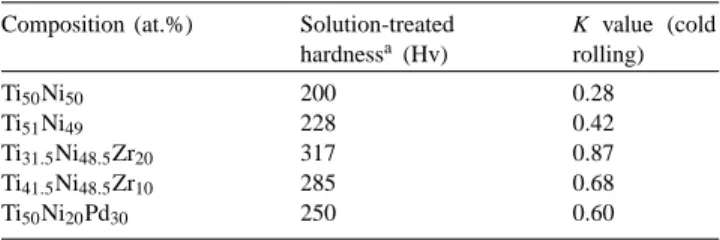
re-garded as being proportional to the hardness. From Fig. 5, one can find that the K values, namely the slopes of M∗ temperature vs. hardness curves, are different for various TiNi-base shape memory alloys. The solution-treated hard-ness of various TiNi-base shape memory alloys and their corresponding K values of cold rolling are summarized in Table 2. From Table 2, one can find that the higher the specimen’s solution-treated hardness, the larger the K value. These results indicate that the depression of M∗ and A∗
Table 2
The solution-treated hardness and corresponding K values of cold rolling for various TiNi-base shape memory alloys
Composition (at.%) Solution-treated hardnessa(Hv) K value (cold rolling) Ti50Ni50 200 0.28 Ti51Ni49 228 0.42 Ti31.5Ni48.5Zr20 317 0.87 Ti41.5Ni48.5Zr10 285 0.68 Ti50Ni20Pd30 250 0.60
aSolution-treated hardness is the hardness tested at room temperature for specimens with no cold rolling.
temperatures by cold rolling is stronger for the alloys with higher solution-treated hardness. These phenomena can be explained as follows.
As mentioned in Section 3.2, if the cold-rolled speci-mens are subjected to a reverse martensitic transformation, the cold-rolling induced dislocations still remain in the par-ent phase. These retained dislocations can slightly increase the energy barrier during the subsequent forward marten-sitic transformation, as illustrated in Fig. 8(a). More driving force is needed for these cold-rolled specimens to transform from parent phase to martensite. Hence, M∗ temperature must shift to a lower one to start the transformation. How-ever, during this forward martensitic transformation, more elastic energy can be produced and stored in the martensite due to the interaction between dislocations and martensite plates as a result of the movement of the martensite bound-ary, as illustrated by the dashed line in Fig. 8(b). Namely, the dislocation energy can be changed into elastic energy1Gel and stored in the martensite plates. As mentioned in Section
Fig. 8. The illustrated diagrams of Gibbs free energy vs. temperature showing: (a) the variations of transformation energy barrier; (b) stored elastic energy for the cold-rolled TiNi-base alloys after the first reverse martensitic transformation.
4.1, this stored elastic energy will promote the second re-verse transformation and hence theA2∗temperature will be lowered. If the specimens are subjected to more cold rolling, more residual dislocations remain in the matrix and more elastic energy is stored in the martensite plates. This feature can elucidate whyA2∗andM∗temperatures monotonously decrease with increasing cold rolling in TiNi-base shape memory alloys. Meanwhile, in Table 2, one can find that the higher the specimen’s solution-treated hardness, the larger the K value. This phenomenon is reasonable because the en-ergy barrier increases as a result of the retained dislocations if the specimen has a greater solution-treated hardness, as derived from Eq. (12). In other words, if the specimens have greater solution-treated hardness, the interaction between retained dislocations and martensite plates requires more driving force to cause the movement of martensite/parent interfaces during the martensitic transformations, and hence have a larger K value. Additionally, after carefully examin-ing Figs. 2 and 3, the thermal hysteresis ofA2∗−M∗is found to be nearly the same for various amounts of cold rolling. This indicates that the frictional work Wfr, which causes the
thermal hysteresis ofA2∗− M∗, does not experience an ob-vious change if the TiNi-base alloys are subjected to cold rolling and a following reverse martensitic transformation.
5. Conclusions
The martensitic transformations in cold-rolled TiNi-base shape memory alloys have been systematically studied by using the DSC measurement, a hardness test and an internal friction test. The important conclusions are as follows: 1. The increased transformation energy barrier, 1Gd, will
be induced by cold rolling in the TiNi-base shape mem-ory alloys. The higher the amount of cold rolling, the higher the 1Gd. Hence the A1∗ temperature will in-crease with an increasing amount of cold rolling. Mean-while, the higher the specimen’s solution-treated hard-ness, the higher the increment of1Gdinduced by cold rolling. Therefore, the increment of A1∗ temperature (1A1∗) increases linearly with increasing specimen’s solution-treated hardness. A phenomenological analysis to explain these features, from the thermodynamic view-point of cold-rolling induced dislocations, is discussed and has found that these features can be elucidated successfully.
2. After the first reverse transformation of the cold-rolled TiNi-base shape memory alloys, the strengthening ef-fects of retained dislocations on martensitic transforma-tion temperatures follow the equatransforma-tion of M∗ = T0−
K1σys. The higher the specimen’s solution-treated hard-ness, the larger the K value. This is because the inter-action of martensite plates and dislocations induced by cold rolling is stronger for the specimen with greater hardness. The thermal hysteresis ofA2∗− M∗does not experience an obvious change if the TiNi-base shape
memory alloys are subjected to various amounts of cold rolling. This means that the frictional work, Wfr, does not
change much by the cold-rolling induced dislocations in TiNi-base shape memory alloys.
Acknowledgements
The authors are pleased to acknowledge the financial sup-port of this research by National Science Council (NSC), Republic of China, under the NSC Grant 86-2216-E002-033.
References
[1] S. Miyazaki, K. Otsuka, Y. Suzuki, Scripta Metall. 15 (1981) 287. [2] S. Miyazaki, Y. Ohmi, K. Otsuka, Y. Suzuki, Proceedings of
ICOMAT-82, J. Phys. 43 (1982) C4-255.
[3] S. Miyasaki, T. Imai, Y. Igo, K. Otsuka, Metall. Trans. A 17 (1986) 115.
[4] G.D. Sandrock, A.J. Perkins, R.F. Hehemann, Metall. Trans. A 2 (1971) 2769.
[5] K. Otsuka, T. Sawamura, K. Shimizu, Phys. Stat. Sol. (a) 5 (1971) 457.
[6] H.C. Ling, R. Kaplow, Metall. Trans. A 12 (1981) 2101.
[7] C.M. Hwang, M. Meichle, M.B. Salamon, C.M. Wayman, Philos. Mag. 47 (1983) 9.
[8] S.K. Wu, C.M. Wayman, Mater. Sci. Eng. 96 (1987) 295. [9] M. Nishida, C.M. Wayman, T. Honma, Metall. 19 (1986) 99. [10] C.M. Hwang, C.M. Wayman, Scripta Metall. 17 (1983) 1449. [11] S. Miyazaki, Y. Igo, K. Otsuka, Acta Metall. 34 (1986) 2045. [12] T. Tadaki, Y. Nakata, K. Shimazu, Trans. Jpn. Inst. Met. 28 (1987)
883.
[13] S.K. Wu, H.C. Lin, T.S. Chou, Acta Metall. 38 (1990) 95. [14] M. Nishida, T. Honma, Scripta Metall. 18 (1984) 1293. [15] M. Nishida, C.M. Wayman, Scripta Metall. 18 (1984) 1389. [16] S.K. Wu, H.C. Lin, Scripta Metall. Mater. 25 (1991) 1295. [17] Y. Okamota, H. Hamanaka, F. Miura, H. Tamura, H. Horikawa,
Scripta Metall. 22 (1988) 517.
[18] T. Todoroki, H. Tamura, Trans. Jpn. Inst. Met. 28 (1987) 83. [19] H.C. Lin, S.K. Wu, T.S. Chou, H.P. Kao, Acta Metall. Mater. 39
(1991) 2069.
[20] H.C. Lin, S.K. Wu, Acta Metall. Mater. 42 (1994) 1623. [21] Y.C. Lo, S.K. Wu, Trans. Mat. Res. Soc. Jpn. 18B (1994) 1029. [22] R.J. Salzbrenner, M. Cohen, Acta Metall. 27 (1979) 739. [23] Y. Liu, P.G. McCormick, Acta Metall. Mater. 42 (1994) 2401. [24] J. Ortin, A. Planes, Acta Metall. 36 (1988) 1873.
[25] P. Wollants, J.R. Roos, L. Delaey, Prog. Mater. Sci. 37 (1993) 227.
[26] A.L. Titchener, M.B. Bever, Progress in Metal Physics, Pergamon Press, New York, 1958, p. 247.
[27] E. Hornbogen, Proceedings of ICOMAT-86, Nara, Japan, 1986, p. 453.
[28] D. Roqueta, F.C. Lovey, M. Sade, Scripta Materialia 34 (1996) 1747.
[29] D. Rios-Jara, G. Guenin, Acta Metall. 35 (1987) 109. [30] A.H. Cotrell, B.A. Bilby, Philos. Mag. 42 (1951) 573. [31] J.W. Christian, J. Phys. 12 (1974) C7-65.
[32] A.H. Cottrell, Dislocations and Plastic Flow in Crystals, Section 6, Oxford University Press, NY, 1953.
[33] P. Haasen, Physical Metallurgy, Cambridge University Press, Cambridge, 1978, p. 350.
[34] M.F. Ashby, D.R.H. Jones, Engineering Materials, Cambridge University Press, Cambridge, UK, p. 103.
[35] H.C. Lin, S.K. Wu, Y.C. Chang, Metall. Mater. Trans. A 26 (1995) 851.
[36] E. Hornbogen, Acta Metall. 33 (1985) 595.