
Discrete Cosine Transform Image Compression Using Modified Set Partitioning in Hierarchical Trees
8
0
0
全文
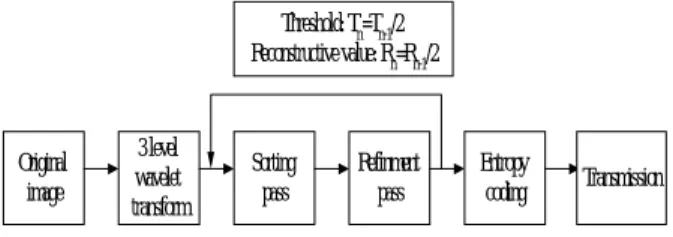
(2) 1 2 Where c ( w) = 1. (Rn=Rn-1/2). Forth step, the encoding bits access. , for w = 0 .. entropy coding and then transmit.. , otherwise. 4. Proposed algorithm. The computation of full frame DCT in. These algorithms for DWT coefficients,. whole image is heavy so the image is usually. such as EZW, SPIHT, GTW, etc, are excellent in. divided into non-lapped sub-images (8x8) for. image. furthermore processing in many DCT based. complexity of DWT is a common defect in these. compression algorithms.. algorithms. Therefore, this algorithm adopts. 3. SPIHT The. wavelet-based. algorithms. compression,. the. computing. DCT, and modified the SPIHT algorithm that. image. considerably. designed initially for encoding the DWT. encoding. improve. coefficients in order to suit to encode DCT. the. compression rate and the visual quality, therefore. coefficients.. many. (A) Representation. researches. but. proposes. many. different. methods for encoding the wavelet-based images.. An input image is first partitioned into nxn. The SPIHT is a famous wavelet-based image. blocks, where n = 2 , L > 0 , and each block. coding, so describe this algorithm as follows.. is transformed into the DCT domain and can be. L. taken as an L-scale tree of coefficients with. 3 xL + 1 subbands decomposition. After that,. Threshold: Tn=Tn-1/2 Reconstructivevalue: Rn=Rn-1/2. we represent DCT coefficients into a single DCT clustering entity. Fig. 2 gives an example of the. Original image. 3level wavelet transform. Sorting pass. Refinment pass. Entropy coding. representation of DCT coefficients on the Lena. Transmission. test image with DCT transform. Fig. 2(a) shows 8x8 DCT coefficients, and Fig. 2(b) shows the Fig. 1: Flowchart of SPIHT.. representation of 8x8 DCT coefficients. The flowchart of SPIHT is presented in Figure 1. First step, the original image is decomposed into ten subbands. Then, the method finds the maximum and the iteration number. Second step, the method puts the DWT coefficients into sorting pass that finds the significance coefficients in all coefficients and encodes. the. coefficients.. sign Third. of step,. these. significance. the. significance. Fig. 2: (a) DCT coefficients (b) Reorganized 8x8 DCT coefficients into a as 8 x 8 blocks on Lena single DCT clustering image entity on Lena image. coefficients that be found in sorting pass are put. (B) Combination. into the refinement pass that use two bits to. For. better. compression. ratio,. the. exact the reconstruct value for closing to real. redundancy across subbands must be eliminated.. value. The front second and third steps are. Table. iterative, next iteration decreases the threshold. corresponding coordinate in LH3, HL3 and HH3. (Tn=Tn-1/2). in several types of ISO 400 images. The “same”. and. the. reconstructive. value 2. 1. shows. the. correlation. at. the.
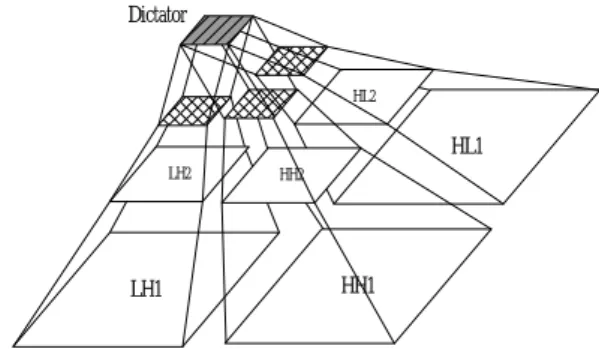
(3) condition implies that the coefficients at. level subband relationship is exploited here to. corresponding coordinate in LH3, HL3 and HH3. reduce redundancy.. “different”. Based on the features that the signal energy. condition implies that the coefficients at. is concentrated mostly into dc coefficients and. corresponding coordinate in LH3, HL3 and HH3. small numbers of ac coefficients are related to. have at least one important value. In woman test. the edges in spatial domain and the significant. image, this statistic shows that the percentage of. coefficients within subbands tend to be more. insignificant coefficients in subbands (not. clustered, in order to eliminate the correlation in. include LL3) is 98%. Large redundancies were. the same level subbands to improve the. hidden in these coefficients.. compression rate, this work proposes the. have. unimportant. values.. The. combination that removes the correlation in the Table 1. Percentages of important coefficients at corresponding coordinate in LH3, HL3 and HH3 for several kinds of images. same level subbands in all spatial orientation tree (SOT) roots. If the DCT-based and represented. Test. Same. Different. image is C(x,y), the all SOT tree roots in. images. condition. condition. DCT-based and represented image are the. Woman. 98%. 2%. coordinates in LH3, HL3, HH3. The proposed. Bike. 89%. 11%. method uses a set α to reduce the redundancy. Café. 88%. 12%. in these three subbands. The set α records which subband among LH3, HL3 and HH3 has a. Table 2. Percentages of important coefficients in treenodes whose roots are at corresponding coordinate in LH3, HL3 and HH3 in all recursions for several kinds of images. Test. Same. Different. images. condition. condition. Woman. 98%. 2%. Bike. 89%. 11%. Café. 87%. 13%. significant coefficient. The proposed method adopts a set α to eliminate the correlation in the same level subbands. α={α(x, y)|LH3(x, y)∪HL3(x, y)∪HH3(x, y)}. (3). The set α must be sent to the decoder. If. α(x, y)=1, then the values in LH3(x, y), HL3(x, y) and HH3(x, y) would be send to the decoder. If. α(x, y)=0, nothing is sent to the decoder. Unlike. Table 2 indicates the correlation of the. by the original SPIHT, which sends all the bits of. corresponding coordinate in LH1, HL1, HH1, LH2,. LH3 (x, y), HL3 (x, y) and HH3 (x, y) to the. HL2 and HH2 in all recursions in test images.. decoder. Compared with SPIHT, The proposed. The “same” condition implies that the treenode’s. method can reduce the bit rate about 0.1~ 0.2. coefficients are unimportant on quad-trees. bpp at a given PSNR (Pak signal to noise ratio).. whose roots are at corresponding coordinate in. (C) Dictator. LH3, HL3 and HH3. The “different” condition. The proposed methods applied the dictator. implies that the treenode’s coefficients are at. to remove the correlation in the other subbands. least important on a quad-tree whose roots are at. (in LH2, HL2, HH2, LH1, HL1, HH1) that are the. corresponding coordinate in LH3, HL3 and HH3.. leaf of the SOT tree. Those subbands include. The statistic presented that the redundancy exist. few significant coefficients, and the original. in the same level subbands. Therefore, The same 3.
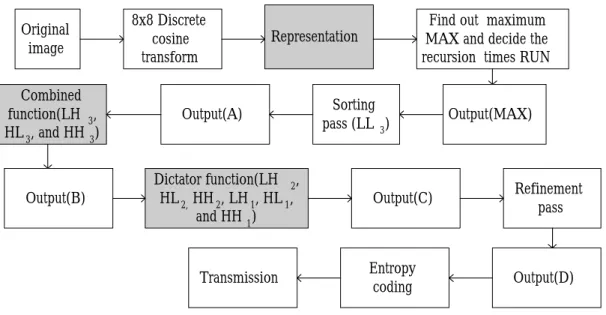
(4) Dictator. SPIHT algorithm suggests the use of one bit to represent whether the significant coefficient is in. HL2. the quad-tree. The fact that a quad-tree includes. HL1 LH2. at least one significant coefficient is represents. HH2. as 1. That all of the nodes in the quad-tree are HH1. LH1. insignificant coefficients is presented as 0. The subbands originally neglected by the SPIHT. Fig. 3: The proposed algorithm uses the dictator concept and framework. algorithm neglected exhibits quite a large correlation among the same level subbands, and. Fig. 3 shows the concept and framework of. the proposed algorithm presents the dictator to. the dictator. The oblique-line block is the set Su,. solve this problem. According to the quad-tree. u=1, 2 and 3. This way saves the bits required to. concept, a correlation exists between LH1 and. represent insignificant coefficients.. LH2. Equally the correlation exists between HL1. subband with significant coefficients can be. and HL2. Equally the correction exists between. identified.. HH1 and HH2. Therefore, LH2, LH1, HL2, HL1,. Fig. 4 presents the complete block diagram. HH2 and HH1 are divided into three partitions, Pt,. of the encoder for compressing still images. First,. t=1, 2, and 3.. the test image passes through 8*8 block-DCT. Q1={ LH2∪LH1 }. (4). Q2={ HL2∪HL1 }. (5). Q3={ HH2∪HH1}. transform. into. subband. and calculates the number of recursions, RUN. Then, the proposed algorithm deals with. in Qt are significant. S1 is modified by the. subband LL3 in a sorting pass that is the same as. following conditions in the set Q1.. that of the SPIHT algorithm. The proposed. x / 4 and J= y / 4 . (7) S (I, J)= 1, if LH (x, y)=1, I= x / 2 , and J= y / 2 . (8). S1(I, J)= 1, if LH1(x, y)=1, I=. algorithm sends A, which includes the bitmap. 2. and. (9). the. sign. information. of. significant. coefficients. LH3, HL3, and HH3 subbands are. Q2 and Q3 in the same steps result in S2 and S3.. handled by a combined function that reduces the. The correlation among the three sets (S1, S2, S3). interband redundancy, and then outputs B, which. is greater, so the proposed algorithm creates the. includes information indicates which subband. dictator that determines which subband has. has. significant coefficients. The dictator d will. significant. coefficients.. The. proposed. algorithm deals with the other subbands using a. decide what needs to be sent. d={d(m, n)| S1(m, n)∪S2(m, n)∪S3(m, n)}. represented. finds the maximum MAX that is sent to decoder,. Su indicates whether that the subtree coefficients. S1(I,J)=0,otherwise.. and. distribution image. Then, the proposed algorithm. (6). The set Su, u=1, 2 and 3 is defined. The set. 1. From d, the. dictator function and outputs C, which decides (10). which should be sent. The proposed algorithm also uses the refinement pass and sends D that includes the bits to correct the reconstructed value. Finally, entropy coding is used to improve performance. 4.
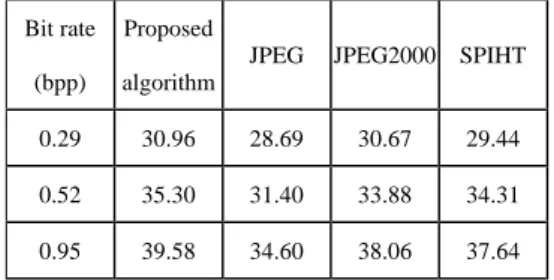
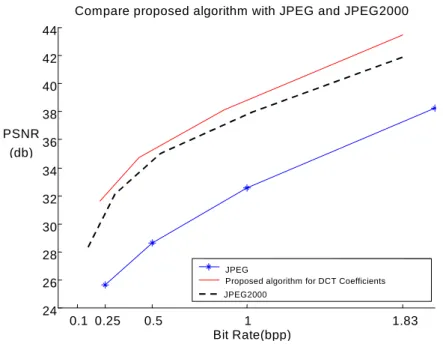
(5) Table 5. PSNR values for JPEG standard and proposed algorithm at various bit rates in Café test image. 5. Simulation Results The. proposed. algorithm. for. DCT. coefficients is compared with JPEG and. Bit rate. Proposed. JPEG2000. The test images are Woman, Bike. (bpp). algorithm. and Café, and the sizes of the others images are. 0.29. 2048*2560. Fig. 5(a) shows a part size of 300x500 in the Café test image that has more. JPEG. JPEG2000. SPIHT. 24.52. 22.24. 23.88. 22.73. 0.58. 29.06. 25.24. 27.76. 26.59. 0.99. 33.92. 28.69. 31.96. 31.34. image context. Fig. 5(b) shows the test image decoded by JPEG at a bit rate of 0.99 bpp with a. 6. Conclusions. PSNR of 28.69 dB and Fig. 5(c) shows the test. The proposed algorithm is similar to SPIHT,. image decoded by JPEG2000 at a bit rate of 0.99. but the differences between the proposed. bpp with a PSNR of 31.96 dB. Fig. 5(d) shows. algorithm and SPIHT are transform and the. the test image decoded by proposed algorithm at. sorting pass. This method is to represent the. a bit rate of 0.99 bpp with a PSNR of 33.92 dB.. DCT coefficients similarity to the subband coefficients and. Table 3. PSNR values for JPEG standard and proposed algorithm at various bit rates in Woman test image Bit rate. encoding. the DCT. coefficients by our algorithm. This algorithm proposes combination and dictator to eliminate. Proposed JPEG. then. the correlation in the same level subband for. JPEG2000 SPIHT. (bpp). algorithm. 0.29. 30.96. 28.69. 30.67. 29.44. complexity of the proposed algorithm for DCT. 0.52. 35.30. 31.40. 33.88. 34.31. coefficients is just close to JPEG but the. 0.95. 39.58. 34.60. 38.06. 37.64. performance is higher than JPEG2000. The. encoding the DCT-based images. The coding. proposed algorithm outperforms JPEG and. Table 4. PSNR values for JPEG standard and proposed algorithm at various bit rates in Bike test image Bit rate. Proposed. (bpp). algorithm. 0.31. 31.20. 28.14. 30.75. 29.64. 0.54. 35.17. 30.99. 33.96. 33.80. 0.98. 39.48. 34.37. 37.95. 37.14. JPEG. JPEG2000 in terms of both PSNR and the perceptual results at the same bit rate.. JPEG2000 SPIHT. Acknowledgement This research is supported partially by the National Science Council of Taiwan under the contract number of NSC 92-2213-E-006-081 From Table 3 to Table 5, compare the PSNR of test images at various bit rates for JPEG, JPEG2000 and the proposed algorithm for DCT coefficients. At a given bit rate, Fig. 6 shows that the average rate distortion for test. References. images is absolutely higher than the JPEG and. [1] Dony, R.D., Haykin, S, “Optimally adaptive. JPEG2000 standard system.. transform coding,” IEEE Transactions on Image Processing, vol. 4 no. 10 pp. 1358 5.
(6) -1370, Oct. 1995.. IEEE Transaction on Signal Processing, vol.. [2] N. Ahmed, T. Natarajan and K. R. Rao,. 41, no. 12, pp. 3445–3462, Dec. 1993.. IEEE. [5] A. Said and W. A. Pearlman, “A New, Fast,. Transations Comput.,” vol. C-23, pp. 90-93,. and Efficient Image Codec Based on Set. Jan. 1974. Partitioning in Hierarchical Trees,” IEEE. “Discrete. cosine. transform,. ”. [3] M. Antonini, M. Barlaud, P. Mathieu, and I.. Transactions Circuits and System for Video. Daubechies, “Image coding using wavelet. Technology, vol. 7,no. 3, pp. 243-250, June. transform,” IEEE Transaction on Image. 1996. [6] Edwin S. Hong and Richard E. Ladner,. Processing,” vol. 1, no. 2, pp. 205-220, Apr.. “Group Testing for Image Compression,”. 1992. IEEE Transactions On image processing, vol.. [4] J. M. Shapiro, “Embedded image coding. 11, no. 8, pp. 901-911, Aug. 2002. using zerotrees of wavelet coefficients,”. Original image Combined function(LH 3, HL 3, and HH 3). Output(B). 8x8 Discrete cosine transform. Find out maximum MAX and decide the recursion times RUN. Representation. Sorting pass (LL 3). Output(A). Dictator function(LH 2, HL 2, HH 2, LH 1, HL 1, and HH 1). Transmission. Output(MAX). Output(C). Refinement pass. Entropy coding. Output(D). Fig. 4: Proposed algorithm for DCT coefficients flowchart. 6.
(7) (a). (b). (c). (d). Fig.5: A part of café test image (a) A part of original test image (b) Compressed by JPEG, bit rate=0.99 bpp, PSNR =28.69 dB (c) Compressed by JPEG2000, bit rate=0.99 bpp, PSNR =31.96 dB (d) Compressed by proposed algorithm, bit rate=0.99 bpp, PSNR =33.92 dB. 7.
(8) Compare proposed algorithm with JPEG and JPEG2000 44 42 40 38 PSNR (db). 36 34 32 30 28 JPEG Proposed algorithm for DCT Coefficients. 26. JPEG2000. 24. 0.1 0.25. 0.5. 1 Bit Rate(bpp). 1.83. Fig. 6: Comparison proposed algorithm DCT coefficients with JPEG2000 and JPEG. 8.
(9)
數據

+3
相關文件
Primal-dual approach for the mixed domination problem in trees Although we have presented Algorithm 3 for finding a minimum mixed dominating set in a tree, it is still desire to
Then, we tested the influence of θ for the rate of convergence of Algorithm 4.1, by using this algorithm with α = 15 and four different θ to solve a test ex- ample generated as
For the proposed algorithm, we establish a global convergence estimate in terms of the objective value, and moreover present a dual application to the standard SCLP, which leads to
Lance Williams: Brute Force in image space (shadow maps in 1978, but other similar ideas like Z buffer, bump mapping using textures and so on).. Completely
As n increases, not only does the fixed locality bound of five become increasingly negligible relative to the size of the search space, but the probability that a random
ReadInt - Reads a 32-bit signed decimal integer from standard input, terminated by the Enter key. ReadString - Reads a string from standard input, terminated by the
“A feature re-weighting approach for relevance feedback in image retrieval”, In IEEE International Conference on Image Processing (ICIP’02), Rochester, New York,
Using the DMAIC approach in the CF manufacturing process, the results show that the process capability as well as the conforming rate of the color image in
