J O U R N A L O F M A T E R I A L S S C I E N C E 3 4 (1 9 9 9 ) 5669 – 5675
Multi-strengthening effects on the martensitic
transformation temperatures of TiNi shape
memory alloys
S. K. WU∗
Institute of Materials Science and Engineering, National Taiwan University, Taipei, Taiwan 106, Republic of China
E-mail: [email protected] H. C. LIN
Department of Materials Science, Feng Chia University, Taichung, Taiwan 400, Republic of China
P. C. CHENG
Institute of Materials Science and Engineering, National Taiwan University, Taipei, Taiwan 106, Republic of China
The multi-strengthening effects, introduced by combining cold rolling, aging and thermal cycling, on the martensitic transformation temperatures of Ti50Ni50and Ti49Ni51 shape memory alloys have been studied by using DSC and microhardness measurements. Experimental results show that both pre-cold-rolling of Ti50Ni50 alloy and aging treatments of Ti49N51alloy can impede the further introduction of dislocations during the thermal cycling and hence effectively reduce the effect of thermal cycling on transformation temperatures. For Ti49Ni51 alloy, whether the cold rolling is conducted before or after the aging treatment, the strengthening of cold rolling can significantly increase the specimen hardness but only slightly affect the following thermal cycling effect. The
multi-strengthening effects on the martensitic transformation temperatures are also found
to follow the equation of Ms= T0− K1σy. °C 1999 Kluwer Academic Publishers
1. Introduction
TiNi alloys are known as the most important shape memory alloys (SMAs) because of their many applica-tions based on the shape memory effect (SME) [1] and pseudoelasticity (PE) [2, 3]. This comes from the fact that TiNi alloys have superior properties in ductility, fatigue, recoverable strain, biocompatibility and corro-sion resistance. Intensive studies have been made on the transformation behaviors and mechanical properties of TiNi alloys [2–5]. It has been confirmed that TiNi SMAs can be affected by the internal stress retained in the al-loys after various thermo-mechanical treatments, such as cold rolling [6–8], thermal cycling [9, 10] and ag-ing treatment in Ni-rich alloys [11–13]. Meanwhile, the properties of SME and PE are reported to be improved by these thermo-mechanical treatments [3, 14]. These treatments can strengthen the alloys and suppress the permanent plastic deformation by raising the flow stress for slip. However, the multi-strengthening effects, in-troduced by combining these thermo-mechanical treat-ments, on the martensitic transformations of TiNi alloys have still not been reported. In this study, we combine the processes of cold rolling, thermal cycling and aging
∗Author to whom all correspondence should be addressed.
to strengthen the TiNi alloys with an aim to understand the multi-strengthening effects on the martensitic trans-formation temperatures of TiNi alloys.
2. Experimental
The conventional tungsten melting technique was em-ployed to prepare the Ti50Ni50 and Ti49Ni51 (in at %) alloys. Titanium (purity, 99.8%) and nickel (purity, 99.9%) were melted and remelted at least six times in an argon atmosphere. Pure titanium buttons were also melted and used as getters. The as-melted buttons were homogenized at 1050◦C for 72 h. These buttons were cut into several plates of 3 mm thickness with a low speed diamond saw and then annealed at 800◦C for 2 h and subsequently quenched in water. After annealing, several multi-strengthening treatments, e.g. cold rolling + thermal cycling, aging + cold rolling + thermal cy-cling, etc. were conducted. The martensitic and R-phase transformation temperatures were measured by using the differential scanning calorimetry (DSC) of Du Pont 2000 thermal analyzer equipped with a quantitative scanning system 910 DSC cell and a cooling accessory
LNCA II. Measurements were carried out at tempera-tures ranging from−150 to 200◦C under a controlled cooling/heating rate of 10◦C/min. Heats of transforma-tion (1H) were automatically calculated from the areas under DSC peaks by means of an equipment software. Specimens for hardness tests were mechanically pol-ished and measured in a microvickers hardness tester at room temperature, with a load of 500 g. For each specimen, the average hardness value was taken from at least five test readings.
3. Results and discussion
3.1. Cold rolling+ thermal cycling
Fig. 1a–c show DSC curves of Ti50Ni50 specimens with the conditions of as-annealing, 10% cold-rolling at room temperature (cold-rolled at martensite B190 phase) and 16% cold-rolling at 150◦C (cold-rolled at parent B2 phase), respectively. Fig. 1a represents typi-cal DSC curves of stress-free Ti50Ni50alloy in which the exothermic and endothermic peaks are associated with the B2↔B190martensitic transformation. The cooling curve shows the peak temperature M∗near 23.3◦C and the heating curve shows the peak temperature A∗near 69.6◦C. In Fig. 1b, for the specimen with 10% cold-rolling at room temperature, A∗1temperature appears at 112.9◦C on the first heating cycle of room temperature to+200◦C; M∗temperature appears at 19.3◦C on the following cooling cycle of+200 to −100◦C; and A∗2 temperature appears at 62.7◦C on the second heating cycle of−100 to +200◦C. This phenomenon is refer-red to as the martensite stabilization induced by the de-formed martensite structures of cold-rolled TiNi alloys [8]. After the first reverse martensitic transformation, the martensite stabilization dies out and transformation temperatures are depressed by the retained dislocations on subsequent thermal cycles. In Fig. lc, for the spec-imen with 16% cold rolling at 150◦C, no transforma-tion peak is observed on the first heating cycle of room temperature to +200◦C; two peaks associated with R-phase and martensitic transformations respectively appear on the following cooling cycle, and a martensitic transformation peak appears during the second heating cycle. This phenomenon can be explained as below. Be-cause the cold-rolling is carried out at 150◦C, i.e., at the
Figure 1 The DSC curves for the Ti50Ni50specimens with the conditions of (a) as-annealing, (b) 10% cold-rolling at martensite B190phase, (c) 16% cold-rolling at parent B2 phase.
parent B2 phase, there should be no deformed marten-site structure and hence no martenmarten-site stabilization can occur. The retained dislocations induced by cold-rolling at the parent B2 phase will depress the M∗and A∗ tem-peratures and promote the formation of R-phase on the cooling cycle.
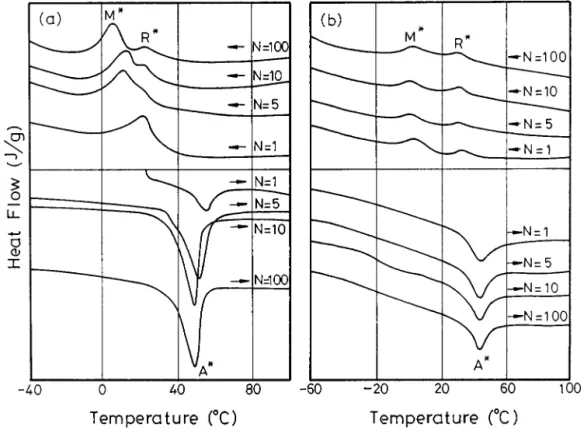
Fig. 2a–c show the DSC curves of thermal cycling N = l–100 for the as-annealed, 10% cold-rolled, and 32% cold-rolled (both are cold-rolled at room tempera-ture, i.e., B190phase) Ti50Ni50specimens, respectively. In Fig. 2a, the M∗ and A∗ temperatures are found to decrease significantly with increasing thermal cycles and R-phase transformation appears in the cooling after 10 cycles. These features are well known to be related to the dislocations introduced by thermal cycling. In Fig. 2b, the M∗and A∗temperatures have only a slight decrement during the course of thermal cycling. The R-phase transformation appears just after the second cycle. This means that the pre-cold-rolling can depress the effect of thermal cycling on martensitic transfor-mation temperatures but at the same time promote the R-phase transformation. Here, the R-phase transfor-mation is essentially unaffected by pre-cold-rolling, but since the M∗ temperatures are depressed and the R-phase becomes observable. The more the pre-cold-rolling, the less the effect of thermal cycling on trans-formation temperatures, as shown in Fig. 2c for the 32% pre-cold-rolling specimen. In Fig. 2c, there is no obvi-ous effect of thermal cycling because M∗, A∗and R∗ temperatures maintain nearly the same values during thermal cycling. This phenomenon is ascribed to the strengthening dislocations introduced by the pre-cold-rolling. These dislocations will inhibit the further in-troduction of dislocations during the course of thermal cycling and hence reduce the effect of thermal cycling. Similar phenomenon also occurs on the specimens pre-cold-rolled at the Ti50Ni50B2 parent phase. As shown in Fig. 3a and b, there is only a slight or even nonexistent effect of thermal cycling on transformation tempera-tures for Ti50Ni50 specimens subjected to 7 and 21% pre-cold-rolling at their B2 phase, respectively.
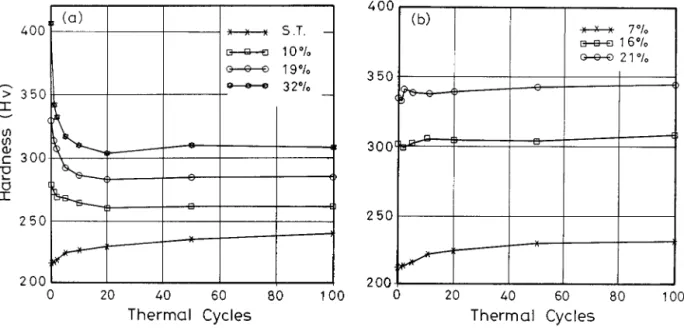
Fig. 4a and b show the specimen hardness as a func-tion of thermal cycles for Ti50Ni50specimens subjected to various degrees of pre-cold-rolling at the martensite and B2 phase, respectively. In Fig. 4a, the hardness of
Figure 2 The DSC curves of thermal cycling N= l–100 for the TiNi specimens with the conditions of (a) as-annealing, (b) 10%, (c) 32%. Both (b) and (c) are cold-rolled at martensite B190phase.
Figure 3 The DSC curves of thermal cycling N= l–100 for the Ti50Ni50specimens subjected to (a) 7%, (b) 21% pre-cold-rolling at parent B2 phase.
as-annealed specimen increases with increasing ther-mal cycles due to the introduction of dislocations dur-ing thermal cycldur-ing. However, it is interestdur-ing to find that the hardness of 10–32% pre-cold-rolled specimens decreases with increasing cycles in the early thermal cycles and then maintains some constant values after 20 cycles. The defects annihilation of deformed marten-site structures and rearrangement of retained disloca-tions are considered to be responsible for the decrease of specimen hardness in the early 20 cycles. After that, dis-locations density and morphology may be unchanged
and hence the specimen hardness can maintain some constant value. In Fig. 4b, the hardness of a 7% pre-cold-rolled specimen slightly increases with increasing cycles. This indicates that a few dislocations can be in-troduced during the course of thermal cycling and hence thermal cycling still has some effect on transformation temperatures, as shown in Fig. 3a. However, for the 16 and 21% pre-cold-rolled specimens, no obvious varia-tion of specimen hardness is observed after 10 cycles in Fig. 4b and hence no obvious effect of thermal cycling can appear. The results of Fig. 4 provide more evidence
Figure 4 The specimen hardness as a function of thermal cycles for the Ti50Ni50specimens subjected to various degrees of pre-cold-rolling at (a) martensite B190phase, (b) parent B2 phase.
to clarify the fact that the effect of thermal cycling can be impeded by pre-cold-rolling. By the way, compared to Fig. 4a, no significant hardness decrement on the early cycles of Fig. 4b can be observed for the pre-cold-rolled specimens because no deformed martensite structure exists in specimens which were subjected to cold-rolling at parent B2 phase.
3.2. Aging+ thermal cycling
It is well known that the martensitic and R-phase trans-formation temperatures are all affected by the aging time in a 400◦C aged Ti49Ni51 alloy. The variation of these transformation temperatures vs. aging time periods is similar to that reported in our previous paper [15]. Table I presents the specimen hardness at various aging time periods for the 400◦C aged Ti49Ni51 spec-imens. From Table I, we can find that the specimen hardness increases rapidly to reach a maximum value at 1–2 h aging and then decreases slowly with further aging. This feature is related to the precipitation harden-ing of coherent Ti11Ni14precipitates in the TiNi matrix [16]. In order to understand the aging effect on the ther-mal cycling, the 400◦C× 20 h aged Ti49Ni51specimen is selected to run the thermal cycling. The DSC curves at 1–100 cycles for this specimen are shown in Fig. 5 and the specimen hardness at various cycles are presented in Table II. As can be seen in Fig. 5 and Table II, the trans-formation temperatures and specimen hardness nearly maintain the same values during the course of thermal cycling. This indicates that the 400◦C × 20 h aged Ti49Ni51specimen shows no obvious effect of thermal
T A B L E I The specimen hardness at various aging times for the 400◦C aged Ti49Ni51specimens Aging As solution —
time treatment 1 h 2 h 5 h 10 h 20 h 50 h 100 h
Hardness (Hv) 280.3 366.0 366.2 354.0 340.4 333.2 306.8 296.2
T A B L E I I The specimen hardness at various cycles for the 400◦C× 20 h aged Ti49Ni51specimen
Thermal
cycle N 1 2 5 10 20 50 100
Hardness (Hv) 333.2 332.8 333.6 334.9 332.7 331.6 332.5
Figure 5 The DSC curves of thermal cycling N= l–100 cycles for the 400◦C× 20 h aged Ti49Ni51specimen.
Figure 6 The specimen hardness vs. 400◦C aging time for Ti49Ni51 specimens subjected to various degrees of cold-rolling at parent B2 phase.
cycling. In other words, the dislocation density may not be increased during the thermal cycling for this aging-strengthened Ti49Ni51specimen. In the same way, the 400◦C× 1–20 h aged specimens should exhibit similar phenomenon during the thermal cycling, because they are also strengthened by Ti11Ni14precipitates and their hardnesses, as presented in Table I, are higher than that of the 400◦C× 20 h aged specimen.
3.3. Cold rolling+ aging
Fig. 6 shows the variation of specimen hardness as a function of 400◦C aging time for Ti49Ni51 speci-mens subjected to various degrees of cold-rolling at room temperature (at parent B2 phase). In Fig. 6, the specimen hardness is found to slightly increase in the early 2 h of aging and then monotonically decrease with increasing aging time. In this study, both cold-rolling and 400◦C aging have a strengthening effect on the Ti49Ni51 specimens. The solution-treated Ti49Ni51 specimen has a hardness of Hv = 280 and increases its hardness to values of Hv= 367–386 after the cold-rolling of 5–33%, as shown in the ordinate of Fig. 6. After cold-rolling, the subsequent precipitation hard-ening of 400◦C× 20 h aging can further increase the specimen hardness, although the recovery of disloca-tions introduced by cold-rolling may occur during the aging process. As mentioned in Section 3.2, the pre-cipitation hardening can reach its maximum effect at 400◦C× 2 h of aging, and then decreases with increas-ing agincreas-ing time period. Therefore, after 2 h of agincreas-ing, both the decay of precipitation hardening and the recovery of dislocations will soften the cold-rolled specimens, as shown in Fig. 6. The longer the aging time period, the more the softening effect is, and hence the specimen hardness will decrease with increasing aging time.
3.4. Aging+ cold rolling + thermal cycling
Following the results of Section 3.3, the multi-strengthening effect of aging+ cold rolling + thermal
Figure 7 The specimen hardness vs. thermal cycles for the 400◦C× 20 h aged Ti49Ni51specimens subjected to the following 5–15% cold rolling.
cycling on transformation temperatures of Ti49Ni51 al-loy is also investigated. A 400◦C× 20 h aged Ti49Ni51 specimen is selected to study this effect. Fig. 7 shows the specimen hardness vs. thermal cycles for the Ti49Ni51 specimens aged at 400◦C× 20 h with sub-sequent 5–15% cold rolling. As shown in the ordi-nate of Fig. 7, the specimen hardness can be raised to higher values by various degrees of cold-rolling, although these specimens have been strengthened by Ti11Ni14precipitation hardening. During the course of thermal cycling, a little softening occurs due to the re-arrangement of retained dislocations, but the specimen hardness generally maintains a nearly constant value for each specimen. Meanwhile, the experimental results of DSC measurement do not exhibit any obvious variation of transformation temperatures, as shown in Fig. 8 for the Ti49Ni51 specimen aged at 400◦C× 20 h and then cold-rolled at 9%. These results clearly indicate that the processes of aging and cold-rolling can simultaneously strengthen Ti49Ni51specimens and hence strongly de-press the effect of thermal cycling.
3.5. Discussion of multi-strengthening effects on TiNi alloys
According to the experimental results presented in Sec-tions 3.1–3.4, all the strengthening treatments, involv-ing thermal cyclinvolv-ing, cold rollinvolv-ing and aginvolv-ing, have their individual effects on the martensitic transformation temperatures. These strengthening effects are also con-sistent with the reported expression [17–20] of
Ms= T0− K 1σy (1) where the equilibrium temperature T0is a function of chemical composition, and the yield stress1σy is re-garded as proportional to the hardness and the con-stant K represents the activity of strengthening effects. From Figs 2–4, the K values are found to be 1.19 and
Figure 8 The DSC curves of thermal cycling N = l–100 for the 400◦C× 20 h aged and then 9% cold-rolled Ti49N51specimen.
0.28◦C Hv−1 for the strengthening process of thermal cycling and that of cold rolling at the parent B2 phase, respectively. This feature is a result of the different dis-location distribution and/or clustering manner which can be induced by different strengthening processes, be-cause the former strengthening process originates from the B2↔B190transformation and the latter one results from the plastic deformation of the B2 phase. The fact that K = 1.19◦C Hv−1 À K = 0.28◦C Hv−1also in-dicates that the martensitic transformation temperatures of Ti50Ni50alloy can be more effectively depressed by thermal cycling than by cold rolling at the B2 phase.
From Figs 5–8, the aging treatment for Ti49Ni51alloy can significantly impede the effect of thermal cycling on the transformation temperatures. The cold rolling process, whether it is conducted before (Fig. 7) or after (Fig. 6) the aging treatment, can effectively increase the specimen hardness, but only slightly affects the subsequent thermal cycling effect. This implies that, for Ti49Ni51 nickel-rich alloy, the aging precipitation hardening provides a more effective method than cold
Figure 9 The SEM observation of cold-rolled fracture surface for the 400◦C× 20 h aged Ti49Ni51specimen.
rolling does to reduce the thermal cycling effect in ap-plications. Meanwhile, it is worthy to mention that al-though aging can have a strong strengthening effect, it also embrittles the Ti49Ni51specimen. For the 400◦C× 20 h aged Ti49Ni51 specimen, brittle fracture may occur sometimes even under 5% cold-rolling and there are lots of microcracks distributed on the fractured sur-face, as shown in Fig. 9. Therefore, the cold rolling process for the aged Ti49Ni51specimens should be con-ducted more carefully.
4. Conclusions
The multi-strengthening processes in Ti50Ni50 and Ti49Ni51 alloys by combining the cold rolling, ag-ing and thermal cyclag-ing have significant effects on the martensitic transformation temperatures. Both pre-cold-rolling on Ti50Ni50alloy and aging treatments on Ti49Ni51 alloy can impede the further introduction of dislocations during the thermal cycling and hence sig-nificantly reduce the effect of thermal cycling. The precipitation hardening of 400◦C× 1–2 h aging treat-ment can further increase the specimen hardness of pre-cold-rolled Ti49Ni51 alloy. On the other hand, the specimen hardness of aging-strengthened Ti49Ni51 al-loy can also be raised to higher values by the subsequent cold-rolling. However, for Ti49Ni51 alloy, whether the cold rolling is conducted before or after the aging treat-ment, the strengthening of cold rolling has only a slight effect on the following thermal cycling effect. This means that, for Ti49Ni51 alloy, the aging process pro-vides an effective method to reduce the thermal cycling effect in SMAs applications. In this study, the multi-strengthening effects on the martensitic transformation temperatures are also found to follow the equation of Ms= T0− K 1σy.
Acknowledgement
The authors are pleased to acknowledge the financial support of this research by National Science Council (NSC), Republic of China, under Grant NSC 83-0405-E002-011.
References
1. S. M I Y A Z A K I,K.O T S U K AandY.S U Z U K I, Scripta Metall.
15 (1981) 287.
2. S. M I Y A Z A K I,Y. O H M I,K. O T S U K AandY.S U Z U K I, in Proc. of ICOMAT-82, International Conf. on Martensitic Transfor-mations, Belgium, Supplement to J. de Physique 43 (1982) C4-255. 3. S. M I Y A Z A K I,T. I M A I,Y. I G OandK. O T S U K A, Metall. Trans. A 17A (1986) 115. 4. G. D. S A N D R O C K, A. J. P E R K I N S and R. F. H E H E M A N N, ibid. 2 (1971) 2769. 5. H. C. L I N GandR. K A P L O W, ibid. 12 (1981) 2101. 6. Y.O K A M O T O,H.H A M A N A K A,F.M I U R A,H.T A M U R A
andH. H O R I K A W A, Scripta Metall. 22 (1988) 517. 7. T. T O D O R O K IandH. T A M U R A, Trans. JIM 28 (1987) 83. 8. H. C. L I N,S. K. W U,T. S. C H O UandH. P. K A O, Acta
Metall. Mater. 39 (1991) 2069.
9. T. T A D A K I,Y. N A K A T AandK. S H I M I Z U, Trans. JIM 28 (1987) 883.
10. S. M I Y A Z A K I,Y. I G O andK. O T S U K A, Acta Metall. 34 (1986) 2045.
11. M. N I S H I D AandT. H O N M A, Scripta Metall. 18 (1984) 1293 & 1389.
12. S. K. W U,H. C. L I NandT. S. C H O U, Acta Metall. Mater.
38 (1990) 95.
13. S. K. W UandH. C. L I N, Scripta Metall. 25 (1991) 1295. 14. H. C. L I NandS. K. W U, Scripta Metall. Mater. 26 (1992) 59. 15. S. K. W U,H. C. L I NandT. S. C H O U, Scripta Metall. 23
(1989) 2043.
16. S. K. W UandH. C. L I N, ibid. 25 (1991) 1529.
17. M. C O H E N,E.S.M A C H L I NandV.G.P A R A N J P E, “Ther-modynamics in Physical Metallurgy” (American Society for Metals, Metals Park, OH, USA, 1950), p. 242.
18. E. H O M B O G E N, Acta Metall. 33 (1985) 595.
19. S.E U C K E NandE.H O M B O G E N, J. Mater. Sci. 19 (1984) 1343. 20. H. C. L I NandS. K. W U, Mater. Sci. Eng. A158 (1992) 87. Received 18 November 1996