Introduction
Cinnamomum kanehirae Hayata is an endemic and high quality timber
species for manufacturing furniture in Taiwan. A well-known medicinal polypore, antrodia camphorata, is only restricted to Cinnamomum kanehirae Hayata. Nowadays the population of Cinnamomum kanehirae becomes rapidly sparse. In addition to its entomophilous characteristic and not easily to collect sufficient seeds, cutting seedlings are used as planting materials to conserve this kind of species. After cuttings treated by plant hormone, IBA, cuttings were planted in the rooting media in the greenhouse. The cuttings developed adventitious roots about a month.
Adventitious roots formation involved a complex process of redifferentiation, which predetermined cells switch from their morphogenetic path to act as mother cells for the primordial root
(Aeschbacher et al. 1994). Generally, adventitious roots formation leads to three recognition phases: the induction, initiation and expression phases (Rout et al. 2000). Many studies on adventitious root formation have
suggested a fundamental role for peroxidases in controlling rooting (Rival et
al. 1997; Syros et al. 2004). Changes in peroxidase activity and peroxidase
isoform patterns have been proposed as biochemical markers of the
successive rooting phases (Rout et al. 2000;Syros et al. 2004). Plants with higher peroxidase activity rooted easier (Gaspar et al.1992).
Peroxidases, a class of enzymes in animal, plant and microoganism tissues, catalyze oxidoreduction between H2O2 and various reductants. Class III
plant peroxidase (POX, EC 1.11.1.7) is a classical enzyme whose activity was described as early as 1855 and whose purification followed a few decades later. POX is a heme-containing glycoprotein. In some plants, a high duplication rate has led to large multigene families, as suggested by the presence of 138 POXs encoding genes in Oryza sativa (Passardi et al. 2004), whereas Arabidopsis encoding 73 POXs (Tognolli et al. 2002; Welinder et
al. 2002). The conservation of duplicated genes can be explained by
the acquisition of either a new expression profile (subfunctionalisation) or a novel function (neofunctionalisation).
Due to POXs implication in a broad range of physiological processes such as auxin metabolism, lignin and suberin formation, cross-linking of cell wall components, defence against pathogens or cell elongation, peroxidase
activity can be easily detected in the whole lifespan of various plants: from the early stage of germination to the final step of senescence, through the control of cell elongation, defence mechanisms, and several other roles (Passardi et al, 2005).
In our research of Cinnamomum kanehirae adventitious roots, the
peroxidase (POX) activity significantly decreased in the IBA-treated tissues as compared with the control. Hence, we suggest that the inhibition on POX activity may lead to the redifferentiation processes induced by IBA, which produces the new root primordia during the formation of adventitious roots. In order to understand the function and regulation of POX in plant growth and development, we isolated one POX cDNA clone CKPX1. Potential regulatory regions within the CKPX1 promoter were identified by sequence homology to other known regulatory regions (Passardi et al. 2005).
Materials and Methods 1. Plant materials
2. RNA isolation and reverse transcription of RNA 3. Cloning of the CKPX1 full length cDNA
4. PCR cloning of CKPX1 promoter sequence
Results
Sequence analysis of the peroxidase cDNA for CKPX1
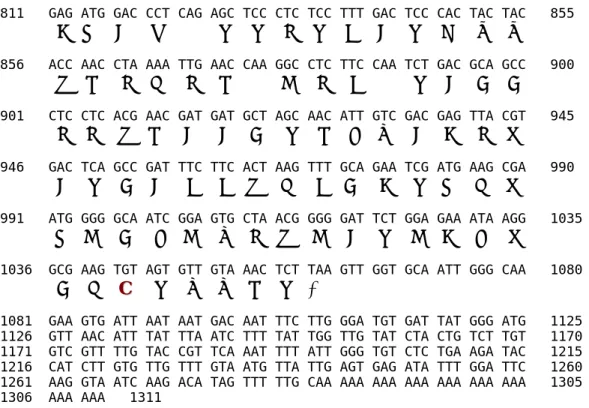
The cDNA clones isolated for CKPX1 contained an insert of 1311 bp including 84 bp of 5’- and 249 bp of 3’-untranslated regions (Fig. 1). This cDNA encodes a polypeptide of 325 amino acids. The deduced amino acid sequence of CKPX1 was aligned to a consensus sequence of class III plant peroxidases (Welinder.1992) and compared with the previously reported POXs using NCBI (http://www.ncbi.nlm.nih.gov/BLAST/). The analysis results showed between 57% and 70% identity with those species. Like all previously isolated sequence of class III POXs, thought SOSUI
(http://bp.nuap.nagoya-u.ac.jp/sosui/) analysis, the encoded protein contains a signal peptide for targeting to the endoplasmic reticulum. In addition,
CKPX1 was deduced to directly secret through iPSORT prediction
(http://www.psort.org/).
The mature CKPX1 protein has a calculated molecular mass of 36.75 kDa and a calculated pI of 4.8. And it encoded eight putative N-glycosylation sites (NX (S/T) X; X≠P).
Sequence analysis of the CKPX1 promoter for CKPX1
The CKPX1promoter was characterized by sequencing and mapping (Fig. 3).
CKPX1 promoter contained auxin response element (Nagao et al, 1993), and
Maize P element, related with lignin synthesis. Sequence analysis of the POX promoter revealed elements common to most eukaryotic promoters as well as several potential regulatory elements though PLACE
Discussion
Exogenous auxins are reported to stimulate the formation of adventitious roots in many plants. In our investigation, synthetic auxin, IBA,
promoted effectively the rooting in Cinnamomum kanehirae cuttings. The amount of easy-to-root genotype cuttings, H107, responded to IBA much than that of difficult-to-root ones, L41. Previous researchers have
investigated that auxin-indcued changes in POX occurred during the rooting processes (Fett-Neto et al. 1992; Liu et al.1996; Chen et al. 2002). The variation in POX activity corresponds to an inverse variation in the
concentration of free IAA (Ripetti et al. 1994; Gaspar et al. 1994). On the other hand the independent phases (induction, initiation, expression) were not observed in cuttings of other species and thus a clear relationship
between rooting and POX activity was not established (de Klerk et al. 1990; San-Jose et al. 1992; Concalves et al. 1998; Syros et al. 2004).
We isolated an anionic POX cDNA, CKPX1. According the peptide information obtained from the poplar SYR-oxidizing POXs (Christensen et
al. 2001), we designed degenerate primer to amply Cinnamomum kanehirae
cDNA. The full-length deduced amino acid sequence (Fig. 1) showed that it contains eight conserved Cys residues for disulifide bridges, a proximal and a distal catalytic His, all other catalytic residues identified, and an
N-terminal endoplasmic reticulum-targeting signal peptide (Gajhede et al, 1997). The cDNA encodes all totally and highly conserved domains observed among class III POXs. But the deduced amino acid sequence of
CKPX1 was predicted that it lacked a carboxyl-terminal propeptides of POX,
which may lead POXs to be vascular targeting (Marjamaa et al, 2006). The deduced amino acid sequence of CKPX1 contains eight putative
N-glycosylation sites suggesting solubility or stabilizing function (Nigel, 2004). The analysis of CKPX1 promoter also found up an element related with
lignification, two elements related with auxin response element, and some elements related with GA response (Table 1). Klotz and Lagrimini (1996) reported that IAA and NAA strongly suppressed POX gene expression through regulating the multiple auxin responsive elements within the POX gene promoter. And among the POX isozymes, the anionic POX is most likely involved in lignification ( Lagrimini 1991). Hence, due to the decline of the activity of POXs, we suggest that the inhibition of the lignification in the IBA-treated Cinnamomum kanehirae cuttings may be in part. And the expression of CKPX1 was regulated with auxin. Furthermore, the inhibition on POX may lead to the redifferentiation processes induced by IBA, then
produce the new root primordia during the formation of adventitious roots (Friedman et al. 1979; Chao et al. 2001).
References
Aeschbacher RA, Schiefelbein JW, Benfey PN (1994) The genetic and molecular basis of root development. Annual Review of Plant Physiology and Plant Molecular Biology 45, 25-45.
Chao IL, Cho CL, Chen LM, Liu ZH (2001) Effect of indole-3-butyric acid on the endogenous indole-3-acetic acid and lignin contents in soybean hypocotyl during adventitious root formation. J. Plant Physiol. 158, 1257-1262.
ChenLM, Cheng JT, Chen EL, YiuTJ, LiuZH (2002) Naphthaleneacetic acid suppresses peroxidase activity during the induction of adventitious root in soybean hypocotyls. J. Plant Physiol. 159, 1349-1354
Christensen1 J H, Overney S, Rohde A, Diaz W A, Bauw G, Simon P, Montagu M V and Boerjan W The syringaldazine-oxidizing peroxidase PXP 3-4 from poplar xylem: cDNA isolation, characterization and expression. Plant Molecular Biology
47,581-593
Concalves JC, Diogo G, Amancio S (1998) In vitro propagation of chestnut (Castanea sativa X C. crenata): Effects of rooting treatments on plant survival, peroxidase activity and anatomical changes during adventitious root formation. Sci Horticult. 72, 265–275.
de Klerk G, ter Brugge J, Smulders R, Benschop M (1990) Basic peroxidases and rooting in microcuttings of Malus. Acta Hortic 280, 29–36.
Fett-Neto AG, Teixeira SL, Dasilva, EAM, Anna RS ( 1992 ) Biochemical and morphological changes during in vitro rhizogenesis in cuttings of Sequoia sempervirens (D. don ) Endi. Journal of Plant Physiology 140, 720-728.
Friedman R, Altman A, Zamski E ( 1979 ) Adventitious root formation in bean hyopcotyl cuttings in relation to IAA translocation and hypocotyl anatomy. Journal of
Experimental Botany 30, 768-777.
Gajhede M, Schuller DJ, Henriksen A, Smith AT, Poulos TL(1997) Crystal structure of horseradish peroxidase C at 2.15 Å
resolution. Nature Structural Biology 4, 1032 - 1038
Gaspar T, Kevers C, Hausman JF, Berthon JY, Ripetti V (1992) Practical uses of peroxidase activity as a predictive marker of rooting performanceof
micropropagated shoots. Agronomie. 12, 757-765.
Gaspar T, Kevers C, Hausman JF, Ripetti V (1994) Peroxidase activity and endogenous free auxin during adventitious root formation. In: Lumsden PJ, Nicholas LR, Davies WJ (eds) Physiology, Growth and Development of Plants in Culture. Kluwer
Academic Publishers, Dordrecht pp 289–298
Marjamaa K, Hildén K, Kukkola E, Lehtonen M, Holkeri H, Haapaniemi P, Koutaniemi S, Teeri TH, Fagerstedt K and Lundell T (2006) Cloning, characterization and localization of three novel class III peroxidases in lignifying xylem of Norway spruce (Picea abies) Plant Molecular Biology 61, 719-732.
Nigel CV(2004) Horseradish peroxidase: a modern view of a classic enzyme. Phytochemistry 65, 249 259
Klotz KL, Lagrimini LM ( 1996 ) Phytohormone control of the tobacco anionic peroxidase promoter. Plant Molecular Biology 31, 565-573.
Lagrimini LM (1991) Wound-induced deposition of polyphenols in transgenic plants overexpressing peroxidase. Plant Physiology 96, 577-583.
Liu ZH, Hsiao IC, Pan YW (1996) Effect of naphthaleneacetic acid on endogenous indole-3-acetic acid, peroxidase and auxin oxidase in hypocotyl cuttings of soybean during root formation. Botanical Bulletin of Academia Sinica 37, 247-253.
Nagao R, Goekjian V, Hong J, Key J(1993) Identification of proteinbinding DNA sequences in an auxin-regulated gene of soybean. Plant Mol Biol 21,1147-1162 Passardi F, Penel C, Dunand C (2004) Performing the paradoxical: how plant peroxidases
modify the cell wall. Trends Plant Science 9, 534-540.
Passardi F, Longet D, Penel C, Dunand C (2004) The class III peroxidase multigenic family in rice and its evolution in land plants. Phytochemistry 65,1879-1893 Passardi F, Cosio C, Penel C, Dunand C (2005) Peroxidases have more functions than a
Swiss army knife. Plant cell rep.24, 255-265
Rival A, Bernard F, Mathieu Y (1997) Changes in peroxidase activity during in vitro rooting of oil palm (Elaeis guineensis Jacq.). Scientia Hortic 71, 103–112.
Rout GR, Samantaray S (2000) In vitro rooting of Psoralea corylifolia Linn: Peroxidase activity as a marker. Plant Growth Regulation 30, 215–219.
San-Jose MC, Vidal N, Ballester A (1992) Anatomical and biochemical changes during root formation in oak and apple shoots cultured in vitro. Agronomie 12, 767–774. Syros T, Yupsanis T, Zafiriadis H, Economou A (2004) Activity and isoforms of
peroxidases, lignin and anatomy, during adventitious rooting in cuttings of Ebenus cretica L. J. Plant Physiol. 161, 69–77.
Tognolli M,Penel C,Greppin H,Simon P(2002) Analysis and expression of the class III peroxidase large gene family in Arabidopsis thaliana. Gene 288, 129-138
Welinder KG (1992) Plant peroxidases: structure-function relationship. In Plant Peroxidases (Penel, C. et al., eds), pp.1-24, University of Geneva, Switzerland.
Welinder KG, Justesen AF, Kjaersgard IV, Jensen RB, Rasmussen SK, Jespersen HM, Duroux L (2002) Structural diversity and transcription of class III peroxidases from Arabidopsis thaliana. Eur J Biochem. 269, 6063-81
1 CGC GGG GAT TGG TGT GTA AGA AAT AAA AGA CCG TTT TTC TTG TTT 45 46 GAG GAG AGT GAG ATA GTT AAG AGA GGC TGT TTC CTG AGG ATG AGG 90 M R
91 TTC ATC CAT CTC CTT TTC TTG GTT TCT GTA GTA GTC TTT GGA ACT 135 F I H L L F L V S V V V F G T
136 CTT GGG GGG TGT AAT GGA GGA CAG TTG AGA AAG AAT TTC TAC AGG 180 L G G C N G G Q L R K N F Y R
181 AAG AGC TGT CCT CAT GCT GAG GAT ATT GTT AAG AAC ATT ATA TGG 225 K S C C P H A E D I V K N I I W
226 AAA CAT GTT GCA AGC AAC TCC TCA CTG CCG GCC AAG CTC CTC CGT 270 K H V A S NN SS SS LL P A K L L R
271 ATG CAT TTC CAT GAC TGC TTT GTT AGG GGC TGC GAT GCC TCG GTG 315 M H F HH DD CC FF VV R G C C D A S V
316 CTG GTG AAT TCT ACT GCG AAT AAC ACT GCA GAA AGA GAC GCA ATC 360 L V NN SS TT AA NN NN TT A E R D A I A
361 CCA AAC CTA TCA TTG GCT GGT TTT GAT GTT ATT GAT GAA GTG AAG 405 P NN LL SS LL A G F D V I D E V K
406 GCA CAG CTA GAG ACG ACA TGC CCT GGT GTA GTT TCA TGT GCA GAC 450 A Q L E T T CC P G V VV SS CC AA DD
451 ATT CTT GCT CTC AGT GCA AGG GAT TCC GTT TCC TTT CAA TTC AAG 495 I L A L S A R D S V S F Q F K
496 AAA TCA ATG TGG AAA GTG AGG ACA GGG AGG AGA GAC GGG ATA GTG 540 K S M W K V R T G R R D G I V
541 TCA CTT GCT TCG GAG GCC CTA GCC AAC ATA CCC TCG CCA TTC TCC 585 S L A S E A L A N I P S P F S
586 AAC TTC ACC ACC CTC ACG CAG GAC TTC GCC AAC AAA GGC CTC AAT 630
N
N FF TT TT L T Q D F A N K G L NN
631 GTC ACG GAT CTT GTT GTC CTC TCA GGA GCA CAT ACT ATT GGA AGA 675 VV TT DD L V V L S G A H H TT II GG RR
676 GGA CAT TGC AAT CTT TTC AGC AAC AGG CTC TAC AAC TTC ACA GGG 720 GG HH C C N L F S N R L Y NN FF TT GG
721 AAC GGG GAT GCT GAC CCT TCT CTA AAT TCA ACC TAT GCA GCC TTC 765 N G D A D P S L NN SS TT Y A A F Y
766 TTG AAA ACC GAA TGC CAG AGC CTC TCA GAC ACC ACC ACC ACC GTG 810 L K T E CC Q S L S D T T T T V
811 GAG ATG GAC CCT CAG AGC TCC CTC TCC TTT GAC TCC CAC TAC TAC 855 E M D P Q S S L S F D S H Y Y
856 ACC AAC CTA AAA TTG AAC CAA GGC CTC TTC CAA TCT GAC GCA GCC 900 T N L K L N Q G L F Q S D A A
901 CTC CTC ACG AAC GAT GAT GCT AGC AAC ATT GTC GAC GAG TTA CGT 945 L L T N D D A S N I V D E L R
946 GAC TCA GCC GAT TTC TTC ACT AAG TTT GCA GAA TCG ATG AAG CGA 990 D S A D F F T K F A E S M K R
991 ATG GGG GCA ATC GGA GTG CTA ACG GGG GAT TCT GGA GAA ATA AGG 1035 M G A I G V L T G D S G E I R
1036 GCG AAG TGT AGT GTT GTA AAC TCT TAA GTT GGT GCA ATT GGG CAA 1080 A K CC S V V N S *
1081 GAA GTG ATT AAT AAT GAC AAT TTC TTG GGA TGT GAT TAT GGG ATG 1125 1126 GTT AAC ATT TAT TTA ATC TTT TAT TGG TTG TAT CTA CTG TCT TGT 1170 1171 GTC GTT TTG TAC CGT TCA AAT TTT ATT GGG TGT CTC TGA AGA TAC 1215 1216 CAT CTT GTG TTG TTT GTA ATG TTA TTG AGT GAG ATA TTT GGA TTC 1260 1261 AAG GTA ATC AAG ACA TAG TTT TTG CAA AAA AAA AAA AAA AAA AAA 1305 1306 AAA AAA 1311
Fig. 1 The cDNA sequence and the deduced amino acid sequence of CKPX. Totally and highly conserved POX residues, eight cysteines and three
conserved domains, are indicated in the sequence of CKPX1 with a dark red. Propetide is underlined. The end of the protein is marked with an asterisk. Putative N-glycosylation sites (NX (S/T)X; (X≠P)) are in light green. The degenerate primer sites were indicated with green blue background.
Table 1. Main cis-elements present in the upstream of the CKPX1 gene
*The data have been obtained with PLACE.
Element Sequence Function Positions for CKPX1
ASF-1 TGACG
auxin and/or SA response
element -388(-)
AREa TAGTNCTGT auxin response element -292
Maize Pb CCWACC Myb-related protein binding site -126 GARC TAACAAA Part of GA response complex -43(-) W-box TTGAC
SA-induced WRKY DNA protein
binding site -387(-)
TGAC
Part promoter of transcriptional repressor WRKY of GA signal pathway
-387(-), -171(-), -152(-), -50(-), -335(-)
*W and N in the sequence indicate A or T and A, T, C or G, respectively. a
Nagao R, Goekjian V, Hong J, Key J: Identification of protein binding DNA sequences in an auxin-regulated gene of soybean. Plant Mol Biol 21:1147-1162 (1993).
b Erich G, bruce JD, Ben B, and Rhomas P: The myb-homologous P gene controls phlobaphene pigmentation in maize floral organs by directly activating a flavonoid biosynthetic gene subset. Cell 76: 543-553 (1994)