Preparation of NiCuZn ferrite nanoparticles from chemical
co-precipitation method and the magnetic properties after sintering
Wei-Chih Hsu
a, S.C. Chen
a,b,∗, P.C. Kuo
a,c, C.T. Lie
a, W.S. Tsai
a aInstitute of Materials Science and Engineering, National Taiwan University, Taipei, TaiwanbDepartment of Mechanical Engineering, De Lin Institute of Technology, Taipei, Taiwan cCenter for Nanostorage Research, National Taiwan University, Taipei, Taiwan
Received 11 July 2003; accepted 5 April 2004
Abstract
NiCuZn ferrite nanoparticles with composition of NixCuyZn1−x−yFe2O4 (wherex = 0.15–0.5 and y = 0–0.35) were prepared by the
chemical co-precipitation method at various reaction temperatures with a final pH value of 12. From the analysis of X-ray diffraction patterns, the nanocrystalline NiCuZn ferrite particles could be obtained at pH= 12 and reaction temperature between 30 and 90◦C with the reaction time of 6 h. The particle size ranges from 2 to 60 nm by observation of transmission electron microscopy. Uniform size of cubic crystalline particles with particle size of about 30 nm were obtained at reaction temperature of 70◦C. The ferrite powders were compressed and sintered at various temperatures between 800 and 1000◦C for 2 h. According to experimental results, the NiCuZn ferrite powders with high Cu content could be sintered at about 800◦C. The density of the sintered Ni0.18Cu0.31Zn0.51Fe2O4 ferrite was 5.01 g/cm3after sintering at 900◦C. The
initial permeabilityµ of this sintered sample is about 390 at frequency of 1 MHz. Its Hcvalue is about 0.7 Oe andBs∼= 3100 G. We found that Cu substitution for Ni in NiZn ferrite would enhance the densification of the ferrite and subsequently increases theµ value as well as Bs value, and decreases the Hcvalue of the sintered ferrite.
© 2004 Elsevier B.V. All rights reserved.
Keywords: Chemical co-precipitation; Nanocrystalline NiCuZn ferrite; Magnetic properties
1. Introduction
NiZn ferrite have been used widely as high frequency ferrite because of their high electrical resistivity and high permeability in RF frequency region. Since the trend of technology development, the electronic device should be processed into microchip. The multilayer chip inductor (MLCI)[1–3]composes ferrite, inner conductor, and outer electrode. Silver is a suitable material for inner conductor, because of its characters of high conductivity, oxidative resistibility, and low cost. However the melting temperature of silver is 961◦C, which is too low to co-fire with NiZn ferrite at 1250◦C. Developing suitable process to fabricate smaller NiZn ferrite particles and modifying its compo-sition to reduce the sintering temperature below 900◦C is necessary. From the viewpoint of thermal dynamics,
∗Corresponding author. Tel.:+886-2-23648881; fax:+886-2-23634562.
E-mail address: [email protected] (S.C. Chen).
the smaller particle own the higher surface free energy to achieve high density at low sintering temperature in shorter time.
Very fine ferrite particles can be produced by the chemi-cal co-precipitation and sol–gel methods[4–8]. The size and shape of the ferrite particles are dependent on the synthesis process. It has been reported that the NiZn ferrite particles can be synthesized by chemical co-precipitation or hydrazine precursors method [6,9]. Actually, these methods demon-strated that high-density NiZn ferrite could be obtained at relatively low sintering temperature of about 1100◦C. How-ever, this sintering temperature is still too high to co-fire with the Ag conductor. It had been shown that adding CuO to the NiZn ferrite could also lower its sintering tempera-ture with conventional solid-state reaction method[10–13]. In this paper, we used the chemical co-precipitation method to fabricate the nano-size NiCuZn ferrite powders. Effects of reaction temperature on the particle size, shape, and crys-tallization of the precipitated particles are examined. The effects of Cu content on the powders’ sintering behaviors,
0921-5107/$ – see front matter © 2004 Elsevier B.V. All rights reserved. doi:10.1016/j.mseb.2004.04.009
W.-C. Hsu et al. / Materials Science and Engineering B 111 (2004) 142–149 143
magnetic properties of the sintered ferrites, and microstruc-tures are also investigated.
2. Experimental procedure
Nanocrystalline NiCuZn ferrite particles were synthe-sized by the chemical co-precipitation method. The start-ing materials are high-purity NiSO4·6H2O, CuSO4·5H2O,
ZnSO4·7H2O, and FeSO4·7H2O. According to the
for-mula of NixCuyZn1−x−yFe2O4 (where x = 0.15–0.5 and y = 0–0.35), each starting material was weighted, all added
into 500 ml de-ionized water with concentration of 0.25 M, and stirring to complete dissolution. The NaOH solution is prepared by dissolving NaOH into 500 ml de-ionized water with concentration of 1 M. These two solutions mentioned above are mixed together by stirring, heated to the reaction temperature between 30 and 90◦C, and aerated uniformly by pumping air through porous glass to promote an oxi-dization reaction for 6 h. During oxidation, a small amount of NaOH solution was continuously added to keep the pH value at 12. After 6 h of reaction, the precipitated particles are washed and filtered six times then dried at 60◦C. After drying, the co-precipitated ferrite particles were compressed into toroidal shape and sintered between 800 and 1000◦C for 2 h.
The crystalline structure of the precipitated particles was examined by X-ray diffractometer (PW1830 generator, PHILIPS). The particle size and shape of the particles were characterized by transmission electron microscopy (TEM). The B–H loop of the sintered sample was measured with a B–H tracer (YOKOGAWA 3257), and their microstructure was observed with a scanning electron microscopy (SEM). The chemical compositions of the particles were analyzed by atomic absorption spectrometer (PERKIN ELMER 3100). The initial permeability (µ) and Quality factor (Q) were measured by HP4192A L.C.R meter at frequency of 1 MHz. The crystallization was characterized by a differ-ential thermal analysis (Thermal Analyst 2000, Du Pont Instrument).
3. Results and discussion
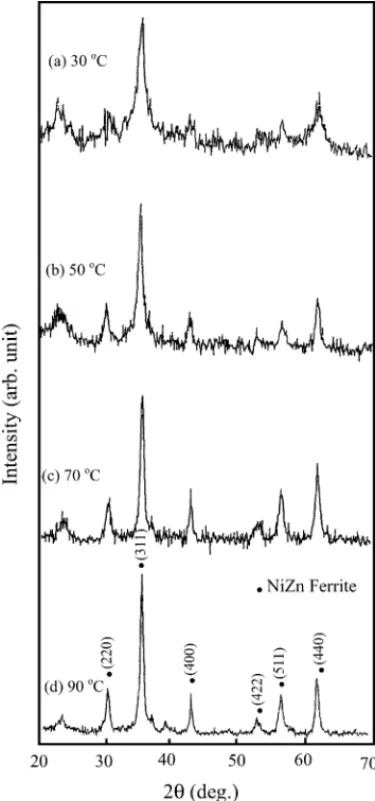
The reaction temperature of the mixed solution and reaction time will influence the particle size, shape, and crystallization of the precipitated particles. Fig. 1
shows the X-ray diffraction patterns of the precipitated Ni0.39Cu0.11Zn0.5Fe2O4 particles which were reacted at
various temperatures. We can see that the crystal structure of all the particles is the same as that of spinel NiZn fer-rite. InFig. 1(a), the broaden peaks of the X-ray diffraction pattern indicate that the particle size is very small and crystallization of NiCuZn ferrite is not good at the reaction temperature of 30◦C. The X-ray peaks of Fig. 1(b) are sharper than that ofFig. 1(a), this means that the particles
Fig. 1. X-ray diffraction patterns of the Ni0.39Cu0.11Zn0.5Fe2O4particles
precipitated at: (a) 30◦C, (b) 50◦C, (c) 70◦C, and (d) 90◦C. The pH value is 12 and the reaction time is 6 h.
precipitated at 50◦C are larger and better crystallization than that of 30◦C. The more sharp peaks in Fig. 1(c) and (d) show better crystallization and larger grain size at higher reaction temperature of 70 and 90◦C from the calculation of Scherrer’s formula[14].
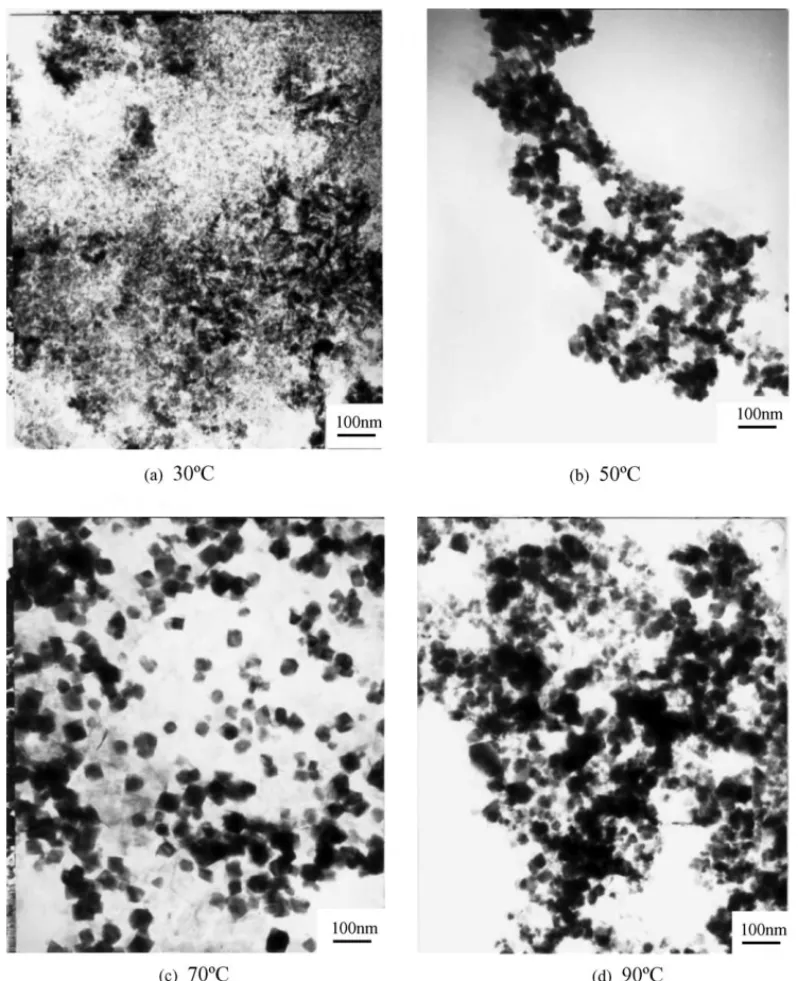
Fig. 2(a–d)shows the TEM images of the particles which precipitated at the reaction temperature of 30, 50, 70, and 90◦C, respectively. The particles are very small and agglom-erated together like colloidal at the reaction temperature of 30◦C as shown inFig. 2(a). The average particle size is only about 2 nm. As the reaction temperature increases to 50◦C, the average particle size grows to about 15 nm and the parti-cle shape is granular as shown inFig. 2(b). The shape of par-ticles is cubic and the particle size becomes very uniform at the reaction temperature of 70◦C, as shown inFig. 2(c). The particle size is about 30 nm. As the reaction temperature in-creases to 90◦C, the shape of precipitated particles becomes irregular and the distribution of particle size is broaden as shown inFig. 2(d). The average particle size is about 60 nm.
Fig. 2. Transmission electron micrographs of Ni0.39Cu0.11Zn0.5Fe2O4 particles precipitated at: (a) 30◦C, (b) 50◦C, (c) 70◦C, and (d) 90◦C. The pH
value is 12 and the reaction time is 6 h.
The solid lines ofFig. 3 show the composition analysis of the precipitated particles at various reaction temperatures by AA. The dash lines are the estimated contents of various oxides from the weighted starting materials. The deviations of NiO, CuO, ZnO, and Fe2O3contents in precipitated
par-ticles from estimated values are small and acceptable at the reaction temperatures between 30 and 90◦C.
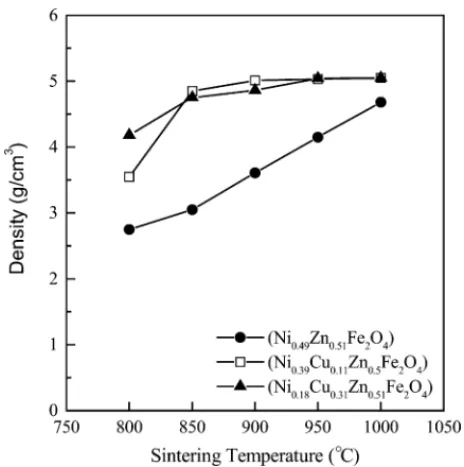
All of the sintering samples were fabricated from the pre-cipitated particles which is obtained at the reaction temper-ature of 70◦C and pH= 12.Fig. 4 shows the dependence of the sintering density on the sintering temperature of the precipitated particles with different Cu content. It is obvious that the Cu substitution for Ni in NiZn ferrite will enhance
the sintering density of the particles. This is owing to the Cu oxide has a lower melting point than that of the other oxides. The melting points of Fe2O3, NiO, CuO, and ZnO are 1565,
1984, 1320, and 1975◦C, respectively. The sintered density inFig. 4reveals that the Cu substitution for Ni in NiZn fer-rite enhances the densification largely as the sintering tem-perature is lower than 950◦C. When the sintering temper-ature is 850◦C, the ferrites’ density is increased from 3.05 to 4.82 g/cm3as Cu mole ratio increases from 0 to 0.11 and 0.31. At this Cu content range (Cu mole ratio= 0.11–0.31), the Cu content does not obviously affect the sintering den-sity as the sintering temperature is higher than 850◦C. The sintering density of the Ni0.18Cu0.31Zn0.51Fe2O4particles is
W.-C. Hsu et al. / Materials Science and Engineering B 111 (2004) 142–149 145
Fig. 3. Relationships among estimated composition, AA composition analysis of precipitated particles and reaction temperature. The pH value is 12 and the reaction time is 6 h.
about 5.01 g/cm3at 900◦C; this is 93.2% of the theoretical density.
The SEM micrographs in Fig. 5 indicate that the frac-ture surfaces of the ferrites sintered at 800◦C. Fig. 5(a)
shows the pure NiZn ferrite, which contains no Cu ion, reveals no sintering performance and only compact par-ticles. Fig. 5(b) shows the particles with composition of Ni0.39Cu0.11Zn0.5Fe2O4 reveals only a little sintering
phe-nomenon.Fig. 5(c)displays the powder with composition of Ni0.18Cu0.31Zn0.51Fe2O4has slight sintering performance at
800◦C, but not very dense. Its grain size is about 1m.
Fig. 4. The relationship between sintering density and sintering tempera-ture of precipitated particles with various Cu content.
Fig. 5. Scanning electron micrographs of the fracture surface of: (a) Ni0.49Zn0.51Fe2O4, (b) Ni0.39Cu0.11Zn0.5Fe2O4, and (c)
Fig. 6. Scanning electron micrographs of the fracture surface of: (a) Ni0.49Zn0.51Fe2O4, (b) Ni0.39Cu0.11Zn0.5Fe2O4, and (c)
Ni0.18Cu0.31Zn0.51Fe2O4 sintered at 900◦C for 2 h.
Fig. 7. Scanning electron micrographs of the fracture surface of: (a) Ni0.49Zn0.51Fe2O4, (b) Ni0.39Cu0.11Zn0.5Fe2O4, and (c)
W.-C. Hsu et al. / Materials Science and Engineering B 111 (2004) 142–149 147
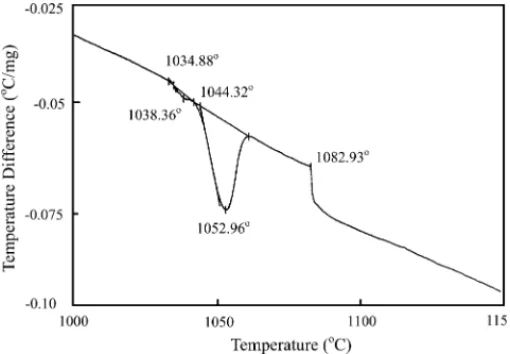
Fig. 8. DTA analysis of the Ni0.18Cu0.31Zn0.51Fe2O4powders.
Fig. 6(a) shows the pure NiZn ferrite, which contains no Cu ion, reveals no sintering performance at 900◦C yet.
Fig. 6(b) and (c) show the powder with compositions of Ni0.39Cu0.11Zn0.5Fe2O4 and Ni0.18Cu0.31Zn0.51Fe2O4,
re-spectively, obviously they all reveal sintering phenomenon at 900◦C. Their grain sizes are almost the same and range from 2 to 5m.
Fig. 7(a)shows the pure NiZn ferrite, which contains no Cu ion, reveals slight sintering performance at 1000◦C, but not dense. The grain size is about 0.7m. Fig. 7(b)shows the powder with composition of Ni0.39Cu0.11Zn0.5Fe2O4,
re-veals sintering performance at 1000◦C obviously. Its grain size ranges from 6 to 10m. On the other hand, the powder with composition of Ni0.18Cu0.31Zn0.51Fe2O4 reveals the
phenomenon of liquid-phase sintering on grain boundary at 1000◦C, as shown inFig. 7(c).Fig. 8shows the differen-tial thermal analysis (DTA) of the Ni0.18Cu0.31Zn0.51Fe2O4
Fig. 9. Variation of the initial permeability with sintering temperature of various ferrites.
powder, there is an endothermic peak near 1052◦C with the heating rate of 5◦C/min. From the analysis of element line scanning by SEM, we confirm that the phase segregated on grain boundary ofFig. 7(c)is Cu-rich phase.
Comparing the scanning electron micrographs of
Figs. 5–7, it can be seen that the grain size is increased sig-nificantly with increasing the sintering temperature. At the sintering temperature of 900◦C, substantial grain growth occurs in which the ferrites’ grain is cubic like and well crystalline if it contains Cu ion. As the sintering tempera-ture increases to 1000◦C, some grain growth occurs in the pure NiZn ferrite. But the grain becomes quite large and round shape if the ferrite contains Cu ion. A second phase can be clearly observed at the ferrite’s grain boundary as the content of the mole ratio of Cu increases to 0.31.
The density and grain size of the ferrite increase with in-creasing sintering temperature, and they would affect mag-netic properties directly. Generally, the magnetization mech-anism of soft magnetic materials like NiZn ferrite is do-main wall motion, which generates high initial permeabil-ity (µ). Although pores and grain boundary would obstruct the movement of domain wall, the fewer amounts of pores and grain boundary could be obtained at higher sintering temperature and leads easy movement of domain wall and high initial permeability. The magnetic properties of all fer-rites were measured at 1 MHz. Fig. 9 shows the variation of initial permeability (µ) with sintering temperature (Ts) of various ferrites. Theµ value of all ferrites is below 70 at 800◦C, this is due to the incompletely sintering (see
Fig. 5). Theµ value of the ferrite which contains Cu ion increases rapidly with increasing sintering temperature as
Ts < 900◦C. The µ value of the Ni0.39Cu
0.11Zn0.5Fe2O4
ferrite increases from 25 to 340 as Ts increases from 800
Fig. 10. Variation of the Q value with sintering temperature of various ferrites.
Theµ value of the Ni0.18Cu0.31Zn0.51Fe2O4ferrite reaches
their maximum value (µ ∼= 415) at Ts ∼= 950◦C, and then
decreases slowly at higher temperature due to the movement of domain wall was obstructed by Cu-rich phase which is segregated at the grain boundary [seeFig. 7(c)]. The fer-rite containing no Cu ion has a lowerµ value because they are difficult to dense during sintering, as shown in the solid circle line ofFig. 9.
Fig. 10 shows the variation of the Quality factor (Q) with sintering temperature of various ferrites. The maximum
Q value of the Ni0.39Cu0.11Zn0.5Fe2O4 ferrite is about 90
which occurs atTs ∼= 850◦C, this Ts is about 50◦C lower
than the Ts of maximumµ value (seeFig. 9). The Q value
depends on the ferrites’ microstructure, e.g. pores, grain size, and second phase etc., and all will influence its Q value. The
Q value of the pure NiZn ferrite is markedly lower asTs <
900◦C because of incomplete densification of the sample. The maximum Q value of the pure NiZn ferrite is occurred at much higher sintering temperature.
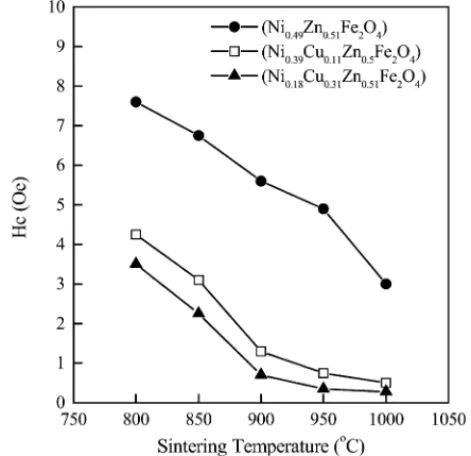
As Ts increases from 800 to 1000◦C, the Hc values
of the ferrites are all decreased with increasing Ts, as
shown in Fig. 11. But, all of the Bs values increase with
increasing Ts, as shown in Fig. 12. Higher sintering
tem-perature and higher Cu content imply a larger grain size and better crystalline in the ferrite, thereby allowing for easier domain movement, which leads lower Hc value and
high Bs value. Consequently, the Ni0.39Cu0.11Zn0.5Fe2O4
and Ni0.18Cu0.31Zn0.51Fe2O4 ferrites produce a lower Hc
value (below 1.5 Oe) and higher Bs value (more than
3000 G) as Ts is higher than 900◦C. The pure NiZn
fer-rite without Cu or sintering temperature below 900◦C, they would incompletely dense and contain non-magnetic pores, produced high Hc and low Bs. Comparing two
fer-Fig. 11. The relationship between Hcvalue and sintering temperature of
various ferrites.
rites Ni0.39Cu0.11Zn0.5Fe2O4and Ni0.18Cu0.31Zn0.51Fe2O4
inFigs. 9–12, reveals that a higher Cu (lower Ni) content yields a higher µ value, as well as a lower Q value, Hc value, and Bs value because the spin moment of Cu2+ ion
is 1Band Ni2+is 2B. If highµ value and low Hcvalue
are expected, high Cu content in the ferrite is preferred. On the other hand, if high Bs value and Q value are expected,
less Cu content but enough densification of the ferrite is favored.
Fig. 12. The relationship between Bsvalue and sintering temperature of
W.-C. Hsu et al. / Materials Science and Engineering B 111 (2004) 142–149 149 4. Conclusions
We have preparing the NiCuZn ferrite nanoparticles from the chemical co-precipitation method. Uniform size of cu-bic crystalline particles with particle size of about 30 nm were obtained at reaction temperature of 70◦C and pH = 12. The ferrite powders with high Cu content could be sin-tered at about 800◦C. The Cu content in the ferrite is an important factor for not only enhancing the densification of the ferrite but also improving the ferrites’ magnetic prop-erties. The optimal Cu content depends on which magnetic property expected. The ferrite with higher Cu content could be sintered at lower temperature. Powder with the compo-sition of Ni0.18Cu0.31Zn0.51Fe2O4after sintering at 850◦C,
the density is 4.82 g/cm3, the initial permeability is about 200 at frequency of 1 MHz and the Hcis about 2 Oe. When
the sintering temperature increased to 900◦C, the density is about 5.01 g/cm3, the initial permeability is about 390; the
Hc would decrease to 0.7 Oe and Bs is about 3000 G. The
Cu substitution for Ni in NiZn ferrite would enhance the densification of the ferrite and subsequently increases theµ value, Bs value, and decreases the Hcvalue of the sintered
ferrite.
Acknowledgements
This work was supported by the National Science Council and Ministry of Economic Affairs of Taiwan through Grant
No. NSC91-2216-E 002-031 and 92-EC-17-A-08-S1-0006, respectively. The authors would like to thank Hsiang-Ping Wen for analysis of composition and homogeneity of the film.
References
[1] A. Ono, T. Maruno, N. Kaihara, in: Proceedings of the Sixth Inter-national Conference on Ferrites, Tokyo, 1992, p. 1206.
[2] M. Satoh, A. Ono, T. Maruno, N. Kaihara, in: Proceedings of the Sixth International Conference on Ferrites, Tokyo, 1992, p. 1210. [3] T. Nomura, A. Nakano, in: Proceedings of the Sixth International
Conference on Ferrites, Tokyo, 1992, p. 1198. [4] P.C. Kuo, T.S. Tsai, J. Appl. Phys. 65 (1989) 4349.
[5] C.J. Chen, K. Bridger, S.R. Winzer, V. Paiverneker, J. Appl. Phys. 63 (1988) 3786.
[6] C.H. Lin, S.Q. Chen, Chin. J. Mater. Sci. 15 (1983) 31.
[7] Z. Yue, L. Li, J. Zhou, H. Zhang, Z. Gui, Mater. Sci. Eng. B64 (1999) 68.
[8] W.C. Kim, S.L. Park, S.J. Kim, S.W. Lee, C.S. Kim, J. Appl. Phys. 87 (2000) 6241.
[9] T.T. Srinivasan, P. Ravindranathan, L.E. Cross, R. Roy, R.E. Newn-han, S.G. Sankar, K.C. Patil, J. Appl. Phys. 63 (1988) 3789. [10] J.H. Nam, H.H. Jung, J.Y. Shin, J.H. Oh, IEEE Trans. Magn. 31
(1995) 3985.
[11] S.F. Wang, Y.R. Wang, C.K. Yang, P.J. Wang, C.A. Lu, Scripta Mater. 43 (2000) 269.
[12] S.R. Murthy, J. Mater. Sci. Lett. 21 (2002) 657.
[13] C.W. Kim, J.G. Koh, J. Magn. Magn. Mater. 257 (2003) 355. [14] B.D. Cullity, Elements of X-ray Diffraction, Addison-Wesley,