The polyphenol extract from Sechium edule shoots inhibits
lipogenesis and stimulates lipolysis via activation of AMPK signals in
HepG2 cells
Cheng-Hsun Wua,b,c, Ting-Tsz Oud, +, Chun-Hua Changd, Xiao-Zong
Change, Mon-Yuan Yangd, Chau-Jong Wangd, f, *
aDepartment of Anatomy, China Medical University, Taichung, Taiwan. bDepartment of Biochemistry, China Medical University, Taichung, Taiwan.
cDepartment of Medical Research, China Medical University Hospital, Taichung,
Taiwan.
dInstitute of Biochemistry and Biotechnology, Chung Shan Medical University,
Taichung, Taiwan.
eDepartment of Medical Technology, Cishan Hospital, Kaohsiung, Taiwan.
fDepartment of Medical Research, Chung Shan Medical University Hospital,
Taichung, Taiwan.
+These authors contributed equally to this work and therefore share first authorship
*Corresponding author Chau-Jong Wang, Ph. D.
Tel: +886-4-24730022ext11670, Professor of the Institute of Biochemistry and Biotechnology, Chung Shan Medical University.
Fax: +886-4-2324-8167
Address: No.110, Sec. 1, Jianguo N. Rd., South District, Taichung, Taiwan 402 E-mail: [email protected] ABSTRACT 1 2 3 4 5 6 7 8 9 10 11 12 13 14 15 16 17 18 19 20 21 22 23 24 25 26
Fatty liver may have implications about metabolic syndrome, such as obesity, hypertension and diabetes. Therefore, the development of pharmacological or natural agents to reduce fat accumulation in the liver is an important effort. The Sechium
edule shoots have already been verified to decrease serum lipid, cholesterol and
prevent atherosclerosis. However, how Sechium edule shoots modulate hepatic lipid metabolism is unclear. This study was designed to investigate the effects and mechanisms of polyphenol extracts (SPE) of Sechium edule shoots in reducing lipid accumulation in oleic acid- treated HepG2 cells. We found that water extracts (SWE) of Sechium edule shoots could decrease serum and hepatic lipid contents (e.g. triacylglycerol and cholesterol). Furthermore, SWE and SPE through the AMPK (AMP-activating protein kinase) signaling pathway could decrease lipogenic relative enzymes, such as FAS (fatty acid synthesis), HMGCoR (HMG-CoA reductase), SREBPs (sterol regulatory element binding proteins) and increase the expression of CPT-I (carnitine palmitoyltransferase I) and PPARα (peroxisome proliferators activated receptor α), which are critical regulators of hepatic lipid metabolism. These observations suggested that Sechium edule shoots have potential for developing health foods for preventing and remedying fatty liver.
KEYWORDS: SPE (polyphenol extracts of Sechium edule shoots), SWE (water
extracts of Sechium edule shoots), AMPK, FAS, HMGCoR, SREBPs 28 29 30 31 32 33 34 35 36 37 38 39 40 41 42 43 44 45 46 47
INTRODUCTION
Excessive lipid may accumulate in liver{Fabbrini, 2010 #1},1 leading to
obesity-associated fatty liver disease (FLD). 2 Fatty liver is closely associated with
life-style-related diseases such as hyperlipidemia, hypertension, arteriosclerosis, type 2 diabetes mellitus and cancer. 3, 4 Fatty liver has a strong positive relationship to outbreaks of
hepatitis, cirrhosis and cancer. 5 The fat that accumulates can cause inflammation and
scarring in the liver. At its most severe, nonalcoholic fatty liver disease can progress to liver failure. 6 Therefore, prevention and treatment of lipid accumulation in liver are
relevant to health promotion.
Previous research showed that the hepatic TG (triacylglycerol) content is significantly correlated with plasma TG levels and fat mass in humans. 7 As we know,
the hepatic TG availability is controlled by the balance between FAS and oxidation in the liver. 8 The underlying cause of fat accumulation in NAFLD is mostly due to the
synthesis of fatty acids and inhibition of fatty acid oxidation. 9 Several recent studies
have demonstrated transcriptional regulation of the gene for the enzymes of synthesis of fatty acids, including FAS (fatty acid synthesis) and glycerol-3-phosphate acyltransferase (GPAT), by sterol regulatory SREBPs. 10, 11 Activation of FAS through
modulation of SREBP-1 has been reported in human breast cancer. 12 The
transcription factor PPAR is expressed at very low levels in the liver, and overexpression of this transcription factor in the liver leads to hepatic adipose accumulation with the expression of several adipogenic genes in the liver. 13 SREBP-1
can modulate the enzymes of lipid production, such as FAS and GPAT, and can affect the formation of fatty acids and TG. In addition, SREBP-1 not only regulates the formation rate of TG but also determines whether TG can be released from the liver.
14, 15 SREBP-2 regulates the generation of cholesterol metabolism-related proteins
48 49 50 51 52 53 54 55 56 57 58 59 60 61 62 63 64 65 66 67 68 69 70 71 72
such as HMGCoR and LDLR. 16, 17 SREBP plays an important role in the process of
controlling the formation of fatty liver. PPARs are the sensors of in vivo lipids. They control the related genes, CPT, in lipid oxidation and thus play a role in regulating lipid metabolism, which controls almost all aspects in fatty acid metabolism. 18 AMPK
phosphorylates and inactivates a number of metabolic enzymes involved in ATP-consuming cellular events including fatty acid and cholesterol synthesis, involving FAS 19 and HMGCoR. 20 The activation of the AMPK pathway is necessary to prevent
fat accumulation.
The Sechium edule shoots contain a lot of nutritional components including flavonoids which are known as a powerful polyphenol and antioxidant. 21It is useful
as a complementary treatment for artheriosclerosis and hypertension and as a diuretic and antiinflammatory remedy. 22, 23 It has already been verified to decrease serum lipid,
cholesterol and prevent atherosclerosis. 22 However, how components of Sechium
edule shoots modulate hepatic lipid metabolism is unclear.
We examined the effect of the SWE and SPE on hepatic hypolipidemia. Human HepG2 cells were treated with indicated concentrations of SWE and SPE in the presence of OA for 24 h. We used this model to elucidate whether SWE and SPE prevents lipid accumulation in hepatic cells.
MATERIALS AND METHODS Materials
Leaves of fresh Sechium edule shoots were collected in Nantou County, located in central Taiwan. The 3-(4, 5-dimethylthiazol-zyl)-2, 5-diphenylterazolium bromide (MTT) and oleic acid were purchased from Sigma-Aldrich (St. Louis, Mo., U.S.A.). GPx, SOD and SREBP antibodies were obtained from Santa Cruz Biotechnology (CA, U.S.A.). Anti-pThr172-AMPK and anti-AMPK antibodies were purchased from 73 74 75 76 77 78 79 80 81 82 83 84 85 86 87 88 89 90 91 92 93 94 95 96 97
Cell Signaling Technology (Beverly, MA, U.S.A). β-actin, FAS, Anti-SREBP-1, Anti-GPAT, Anti-HMGCoR, SREBP-2, Anti-LDLR and anti-catalase antibodies were purchased from Sigma-Aldrich.
Preparation of SWE and SPE
Fresh leaves were chopped and air dried under shade and milled to a coarse powder. The powder was used for the preparation of water extracts (SWE) and phenolic extracts (SPE). The powder (20 g) was then subjected to maceration with sufficient volume of distilled water (1000 ml) for 4℃ for 24 h. Then the aqueous extract was filtered and lypophilized to get the yield of 17.24 %. For preparation of the SPE, 100 g dried powder of Sechium edule was submerged in 300 mL of ethanol and heated at 50℃ for 3 h. The extract was filtered and thereafter lyophilized under reduced pressure at room temperature. The powder was then resuspended in 500 mL of 50℃ distilled water, followed by extraction with 180 mL of ethyl acetate three times, redissolved in 250 mL of distilled water, stored at 70℃ overnight, and lyophilized. The presence and proportion of the main constituents of SPE were then analyzed by HPLC.
HPLC (High Performance Liquid Chromatography) Analysis
HPLC was performed with a Hitachi HPLC system (Hitachi, Danbury, CT, USA) which consisted of a pump (L-6200A), an ultraviolet detector (L-4250) and the Hitachi D-7000 HPLC System Manager program. A reported procedure was used for analyzing the phenolic acids, using a Mightysil RP-18 GP 250 column (Kanto, Tokyo, Japan) and two mobile phase solvent: solvent A, acetic acid/water (2:98, v/v), and solvent B, 0.5% acetic acid in water/acetonitrile (50:50, v/v). The flow rate was 1 mL/min. The gradient for the separation was 100% solvent A at 0 min, 70% solvent A and 30% solvent B at 5 min, 65% solvent A and 35% solvent B at 50 min, 60% 99 100 101 102 103 104 105 106 107 108 109 110 111 112 113 114 115 116 117 118 119 120 121 122 123
solvent A and 40% solvent B at 55 min, 0% solvent A and 100% solvent B at 60 min, followed by a 5 min postrun with HPLC grade water. Phenolic acids were detected at 260 nm.
Cell Culture
Human HepG2 cells obtained from the American Type Culture Collection were maintained in DMEM supplemented with 10% fetal calf serum, 100 U/ml penicillin, 100 μg/ml streptomycin, and 2 mM L-glutamine and kept at 37℃ in a humidified atmosphere of 5 % CO2. Cells were grown to 70% confluence and then incubated in
serum-free medium for 24 h before treatments. To induce FA (fatty acid) overloading, HepG2 cells at 70 % confluence were exposed to a long-chain oleic acid (OA). OA/BSA complex was prepared as reported previously. 24 Stock solutions of 1M OA
prepared in culture medium containing 1% BSA were diluted in culture medium to obtain the desired final concentrations. The OA/BSA complex solution was sterile-filtered through a 0.22 μm pore membrane filter and stored at -20 ℃.
Cytotoxicity Assay
HepG2 cells were seeded at a density of 1 x 10⁶ cells/ ml in 24-well plates and
incubated with oleic acid, SPE and SWE at various concentrations for 24 h. Thereafter, the medium was removed and 3-(4, dimethylthiazol-zyl)-2, 5-diphenylterazolium bromide(MTT, 0.5 mg/ml) was added to incubate for 4 h. The viable cells were directly proportional to the production of formazan. Following dissolution in isopropanol, the absorbance was read at 563 nm with a spectrophotometer (Beckman DU640).
124 125 126 127 128 129 130 131 132 133 134 135 136 137 138 139 140 141 142 143 144 145
Nile Red Stain
HepG2 cells were seeded in 6-well plates (3x 10⁶ cells /ml) and treated with 0.6 mM
oleic acid and different concentrations of SPE and SWE for 24h. After the cells were washed twice with PBS, they were fixed with 4% formaldehyde for 30 min and then stained with 40ug Nile red solution for 30 min at room temperature. Lipid-bounded Nile red fluorescence was observated using Inverted Fluorescence Microscopy.
Preparation of Protein Extract of HepG2 Cells
The proteins of cells were harvested in a cold RIPA (radioimmunoprecipitation assay) buffer [1% NP-40 (nonyl phenoxypolyethoxylethanol), 50 mM Tris–base, 0.1% SDS, 0.5% deoxycholic acid, 150 mM NaCl, pH 7.5] containing leupeptin (17 μg/mL) and sodium orthovanadate (10 μg/mL). The cell mixture was vortexed at 4 °C for 4h. All mixtures were then centrifuged at 12,000 rpm at 4 °C for 10 min, and the protein contents of the supernatants were determined with the conmassie blue total protein reagent (Kenlor Industries, Inc, USA) using bovine serum albumin as the standard.
Western Blot Analysis
Equal amounts of protein samples (50 µg) were subjected toSDS-polyacrylamide gel electrophoresis and electrotransferred to nitrocellulose membranes (Millipore, Bedford, MA, USA). Membranes were blocked with 5% non-fat milk powder with 0.05% Tween 20 in PBSand then incubated with the first antibody at 4 °C overnight. Thereafter, membraneswere washed three times with 0.05% Tween 20 in PBS and incubated with the secondary antibody conjugated to anti-mouse horseradish peroxidase (GE Healthcare, Little Chalfont, Buckinghamshire, UK). Bands were detected and revealed by enhanced chemiluminescence using ECL Western blotting detection reagents and exposed ECL hyperfilm in FUJFILM Las-3000 (Tokyo, Japan). Protein quantitation was determined by densitometry using the FUJFILM-146 147 148 149 150 151 152 153 154 155 156 157 158 159 160 161 162 163 164 165 166 167 168 169 170
Statistical analysis
Results are reported as the mean ± standard deviation of 3 independent experiments and statistical comparisons were evaluated by one-way analysis of variance (ANOVA). P values less than 0.05 was considered statistically significant.
RESULTS
SWE and SPE content assay
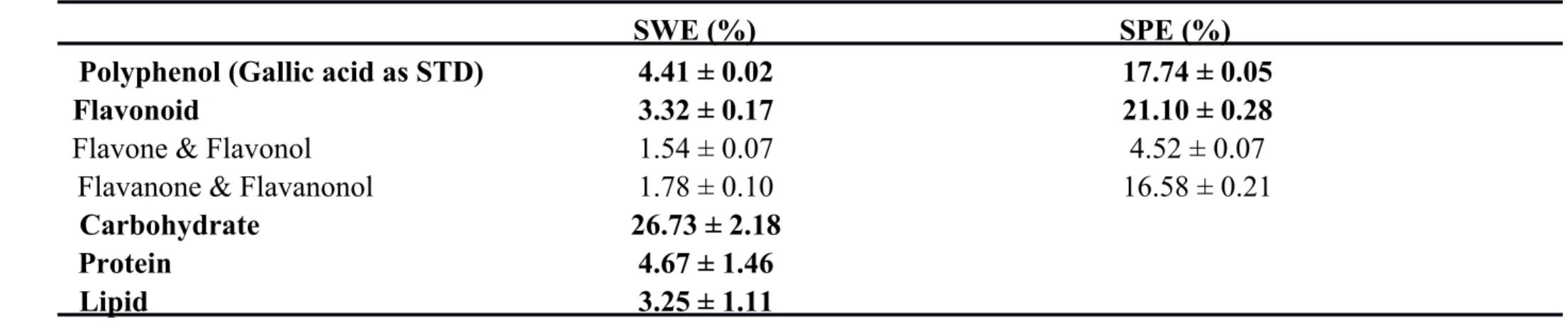
The single-ring type of polyphenol compounds (gallic acid, GA) were used to determine the standard content of total polyphenol. The results show (Table 1) that in SWE, the single-ring polyphenol compounds were 4.41 + 0.02% polyphenol (using gallic acid as the standard), 3.32 + 0.17% flavonoids (using quercetin and naringenin as the standard), 26.73+ 2.18% carbohydrate, 4.67+ 1.46% protein and 3.25+1.611% lipid.
The analysis of SPE revealed that it contained 17.74 + 0.05% total polyphenol (using gallic acid as the standard), 21.10+ 0.28% flavonoids (using quercetin and naringenin as the standard). The presence and proportion of the main constituents of SPE were then analyzed by HPLC (Fig. 1). For the standardization of SPE, the presence of protocatechuic acid (3.56 ± 0.14), gallocatechin gallate (11.06 ± 0.18), caffeic acid (4.42 ± 0.25), rutin (1.14 ± 0.13), quercetin (3.71 ± 0.32), naringenin (11.28 ± 1.12) contained in the SPE.
The effect of SWE and SPE on cell viability of HepG2 cells
172 173 174 175 176 177 178 179 180 181 182 183 184 185 186 187 188 189 190 191 192
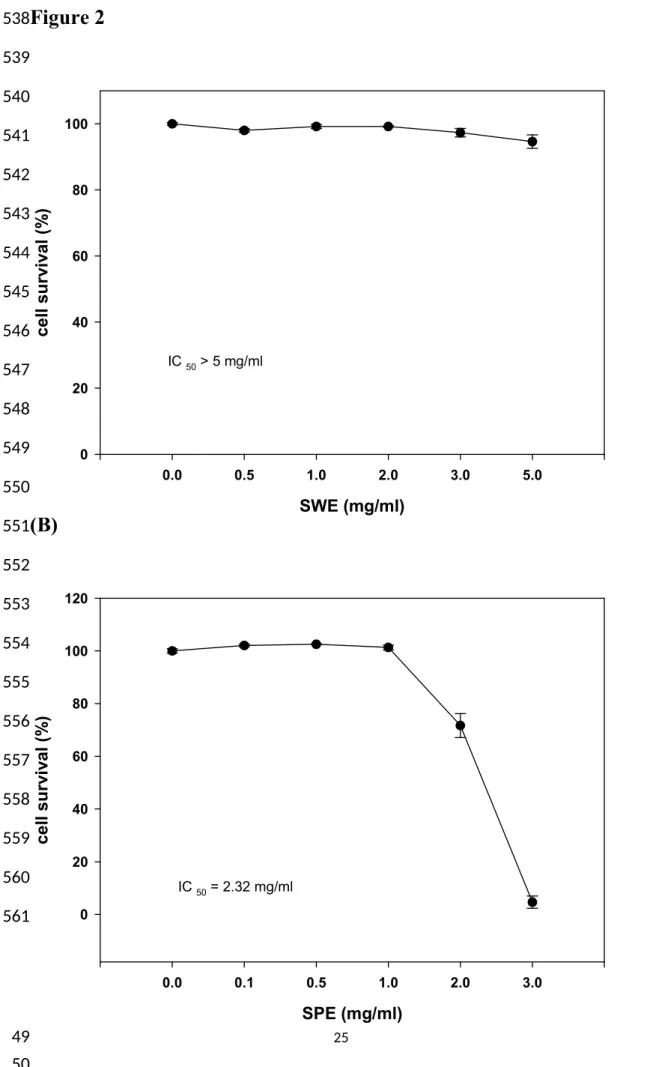
By using different concentrations of SWE and SPE to treat HepG2 cells, after 24 h, we analyzed cell viability. Fig. 2A and 2B showed that from the result of MTT, the drug lethal dose (IC50) of SWE was more than 5 mg/ml and SPE was 2.32 mg/ml
respectively. This experiment focuses on the premise that intracellular lipid accumulation will not cause any damage to cells. So the follow-up experiment used concentration of 1 and 5 mg/ml SWE and 0.5 and 1 mg/ml SPE for treatment of HepG2 cells.
Inhibition of OA- induced lipid accumulation by SWE and SPE in HepG2 cells.
The above results showed that the cell growth condition was good and cell survival rates remained at 100%. Our preliminary work has demonstrated the cell viability was unaffected at a concentration of 0.6 mM OA. Thus, we used 0.6 mM OA and SWE (1 and 5 mg/ml) and SPE (0.5 and 1 mg/ml) to culture HepG2 cells in order to observe the fat accumulation. Fig. 3A is the result of using Nile red fluorescent staining to show that fat accumulation altered the red fluorescence with change in fat in cytoplasm in a dose dependent manner. Next, using Nile red staining and flow cytometric analysis to detect the intensity of fluorescence (Fig. 3B), we found that the intensity of fluorescence was proportional to fat content. Then, we quantified the intracellular fat content (Fig. 3C). The fat content of HepG2 was 2.1 times higher (*p <0.05) than the control group after exposure to OA. SWE treatment of cells at doses 193 194 195 196 197 198 199 200 201 202 203 204 205 206 207 208 209 210 211
of 1 or 5 mg/ml resulted in a reduction of lipid content (92.1% and 84.25%) as compared with the OA group (*p < 0.05). Treatment with SPE, also reduced lipid content about 88.1% and 83.21 (*p<0.05) when compared with the OA group. These results showed that SWE and SPE had the effect of inhibiting intracellular fat accumulation. SPE was more efficient than SWE in causing this effect.
Effect of SWE and SPE on the expression of TG synthesis related proteins.
Fig. 4A shows that cells which were induced by OA had 1.24 times the expression of FAS. When compared with the control group, cells were exposed to 1 or 5 mg/ml SWE, the expression of FAS was 1.08 and 1.03 times respectively. Fig. 4A shows that cells which were induced by OA had 1.28 times the expression of SREBP-1. When compared with the control group, after exposure to 1 or 5 mg/ml SWE, the expression of SWE was 1.21 and 1.11 times respectively. GPAT is the rate-determining enzyme of triglyceride synthesis. Fig. 4A also reveals that the expression of GPAT induced by OA was 1.25 times. When compared with the control group, after cells were exposure to 1 or 5 mg/ml SWE, the expression of GPAT was 1.22 and 1.03 times respectively. Fig. 4B shows that cells induced by OA had the expression of FAS 1.26 times. After exposure to 0.5 or 1.0 mg/ml SPE, the expression of FAS was 1.09 and 0.687 times respectively. SWE and SPE reduced the expression of FAS in HepG2 cells in a dose dependent manner after induction by OA.
212 213 214 215 216 217 218 219 220 221 222 223 224 225 226 227 228 229 230
Fig. 4B shows that cells induced by OA had 1.31 times the expression of SREBP-1. After exposure to 0.5 or 1.0 mg/ml SPE, the expression of SREBP-1 was 1.17 and 1.13 times respectively. SWE and SPE reduced the expression of FAS in HepG2 cells in a dose-dependent manner after induction by OA. Fig. 4B also reveals that the expression of GPAT was induced 1.29 times by OA. When compared with the control group, after cells were exposed to 0.5 or 1 mg/ml SPE, the expression of GPAT was 0.98 and 0.91 times respective. Both SWE and SPE reduced the expression of GPAT in HepG2 cells after induced by OA, and the response was dose-dependent. From those data, we can validate that, through the inhibition of those transcription factors, SWE and SPE may regulate the synthesis of triglycerides.
Effect of SWE and SPE on the expression of cholesterol synthesis related proteins
HMGCoR is the rate-determining enzyme of cholesterol synthesis. To test whether the reduction of lipid accumulation in both SWE- and SPE- treated HepG2 cells is accompanied by changes the cholesterol biosynthesis, Western Blots were performed. As seen in Fig. 5A and B, the expression of HMGCoR, SREBP-2, and LDL-R were remarkably decreased by SWE (1 or 5 mg/ml) or SPE (0.5 or 1 mg/ml) treatment compared with OA- treated group. From those data, we can validate that, through the inhibition of those transcription factors and LDLR, SWE and SPE may regulate the 231 232 233 234 235 236 237 238 239 240 241 242 243 244 245 246 247 248 249
synthesis of cholesterol (Fig. 5).
Effect of SWE and SPE on the expression of fatty acid oxidation related proteins
CPT-1 is an enzyme in the body that helps change fat to energy. In this study, the results have shown that SWE or SPE treatment increase the expression of PPARα and CPT-A as compared with the OA group in HepG2 cells (fig. 6). Thus, through the stimulation of those transcription factors, SWE and SPE were shown to increase the oxidation of fatty acids.
Effect of SWE and SPE on the phosphorylation of AMPK
AMPK is an important regulator in the metabolism mechanism for sugar and fat. In Fig. 7A, cells were treated with 1 or 5 mg/ml SWE, the expression of p-AMPK was significantly increased 1.33 and 1.40 fold respectively, as compared with the OA group. We further observed the change ratio of AMPK /p-AMPK was increased (*p< 0.05, **p < 0.001), indicating that SWE can activate AMPK. In Fig. 7B, the expression of p-AMPK was significantly increased 1.29 and 1.32 fold after treated with 0.5 or 1 mg/ml SPE in HepG2 cells. We also observed the p-AMPK/AMPK ratio had an upward trend. With those results, we prove that SWE and SPE can activate AMPK, and hence, reduce the lipid synthesis of cells.
DISCUSSION
Liver plays an essential role in lipid metabolism via regulating lipogenesis and oxidative stress. 23 Excessive lipid accumulation in liver may progress to
250 251 252 253 254 255 256 257 258 259 260 261 262 263 264 265 266 267 268 269
steatohepatitis. 2 The mechanism study is well known in oleic acid-induced human
hepatoma HepG2 cells model. Here, we attempted to examine the hypolipidemia effect and possible mechanism of SWE or SPE on hepatic lipid metabolism. Previous reports indicated that a regulation of hepatic LDLR and HMGCoR activity could be observed in HepG2 cells. 25, 26 The mechanism underlying fat accumulation of NAFLD
is mostly due to the synthesis of fatty acids and inhibition of fatty acid oxidation. 27
Generally, hepatic hypolipidemic mechanisms were highly associated with expression of lipogenic enzyme, cholesterol biosynthesis, fatty acid β-oxidation, and TG biosynthesis in HepG2 cells. In our present study, the hypolipidemic mechanisms of SWE and SPE were related to expression of lipogenic enzyme (SREBP-1 and FAS), cholesterol biosynthesis (HMGCoR, SREBP-2, and LDL-R), fatty acid β-oxidation (PPAR-α and CPT-1), and TG biosynthesis (GPAT) in OA-induced HepG2 cells.
AMPK is a multisubunit enzyme recognized as a major regulator of lipid biosynthetic pathways due to its role in the phosphorylation and inactivation of key enzymes such as FAS. 28 Studies demonstrated that polyphenolic extracts from plants
can activate AMPK and inhibit FAS expression by preventing SREBP-1 transclocation to the nuclei. 29-31 New paragraph polyphenols are widely found in
Sechium edule shoots. 32 In this study, we found that both SWE and SPE contained
total polyohenols about 7.73 % and 38.84 %, respectively. These concentrations were sufficient to lower lipid levels in the liver. 33 Therefore, both SWE and SPE have great
ability to activate AMPK and then reduce protein expression of SREBP-1, leading to inhibit hepatic lipogenesis. Our data showed that AMPK plays a pivotal role in hypolipid effect and both SWE and SPE can augment AMPK activation (Fig. 7). SREBP-1 is a key lipogenic transcription factor regulating the gene expression of lipogenic enzymes and is dedicated to the synthesis and uptake of fatty acids and 270 271 272 273 274 275 276 277 278 279 280 281 282 283 284 285 286 287 288 289 290 291 292 293 294
triacylglycerol. 31, 34 Our data showed that the expression of SREBP-1 and its
downstream factors, FAS and GAPT, were reduced in response to SWE or SPE treatment in HepG2 cells (Fig. 4). Another recent study suggests that AMPK mediates a decrease in SREBP-1 expression. 29 Consequently, our data suggest the ability of
SWE and SPE to decrease FAS and GAPT expression may occur through AMPK activation and SREBP-1 suppression.
In addition to increase hepatic lipogenesis by activation of SREBP-1 may contribute to the development of chemical-induced fatty liver. 35 AMPK
phosphorylates and inhibits SREBP-2 activity to attenuate hepatic steatosis, 36 whereas
SREBP-2 primarily controls cholesterol homeostasis by activating genes required for cholesterol synthesis and uptake. 37 Our data corroborated these results (Fig.5 and
Fig.7). Similarly, AMPK inhibits in vitro lipogenesis in hepatocytes through the downregulation of the cleavage processing and transcriptional activity of SREBP. 36
PPAR-α is highly expressed in the liver where it activates genes involved in β-oxidation of fatty acids. 38 In our study, both SWE and SPE treatment result in an
increased expression of PPAR-α in OA-induced lipid accumulation cells.
In conclusion, the current study identifies that SWE and SPE can reduce lipid accumulation. We also propose that AMPK is pivotal in closing the anabolic pathway and promoting catabolism by down regulating the activity of key enzymes in lipid metabolism, such as, HMGCoR and FAS. Both SWE and SPE can suppress fat accumulation of the liver and could be developed as a potential therapeutic treatment in order to reduce the formation of a fatty liver.
AKNOWLEDGMENTS:
This work was supported by a National Science Council Grant (NSC99-2321-B-040-295 296 297 298 299 300 301 302 303 304 305 306 307 308 309 310 311 312 313 314 315 316 317 318 319
CONFLICTS OF INTEREST
No potential conflicts of interest were disclosed.
REFERENCES:
1. Fabbrini, E.; Sullivan, S.; Klein, S., Obesity and nonalcoholic fatty liver disease: biochemical, metabolic, and clinical implications. Hepatology 2010, 51, 679-89.
2. Evans, R. M.; Barish, G. D.; Wang, Y. X., PPARs and the complex journey to obesity. Nature Medicine 2004, 10, 355-61.
3. Brooks, S. C., 3rd; Brooks, J. S.; Lee, W. H.; Lee, M. G.; Kim, S. G., Therapeutic potential of dithiolethiones for hepatic diseases. Pharmacology &
Therapeutics 2009, 124, 31-43.
4. Wu, C. H.; Lin, M. C.; Wang, H. C.; Yang, M. Y.; Jou, M. J.; Wang, C. J., Rutin inhibits oleic acid induced lipid accumulation via reducing lipogenesis and oxidative stress in hepatocarcinoma cells. Journal of Food Science 2011,
76, T65-72.
5. Corrao, G.; Torchio, P.; Zambon, A.; D'Amicis, A.; Lepore, A. R.; di Orio, F., Alcohol consumption and micronutrient intake as risk factors for liver cirrhosis: a case-control study. The Provincial Group for the study of Chronic Liver Disease. Annals of Epidemiology 1998, 8, 154-9.
6. Musso, G.; Gambino, R.; Cassader, M.; Pagano, G., A meta-analysis of randomized trials for the treatment of nonalcoholic fatty liver disease.
Hepatology 2010, 52, 79-104.
7. Hartz, A. J.; Rupley, D. C., Jr.; Kalkhoff, R. D.; Rimm, A. A., Relationship of obesity to diabetes: influence of obesity level and body fat distribution. 321 322 323 324 325 326 327 328 329 330 331 332 333 334 335 336 337 338 339 340 341 342 343 344 345 346
Preventive Medicine 1983, 12, 351-7.
8. Chan, D. C.; Watts, G. F.; Ng, T. W.; Hua, J.; Song, S.; Barrett, P. H., Measurement of liver fat by magnetic resonance imaging: Relationships with body fat distribution, insulin sensitivity and plasma lipids in healthy men.
Diabetes, Obesity & Metabolism 2006, 8, 698-702.
9. Duval, C.; Muller, M.; Kersten, S., PPARalpha and dyslipidemia. Biochimica et
Biophysica Acta 2007, 1771, 961-71.
10. Heemers, H.; Maes, B.; Foufelle, F.; Heyns, W.; Verhoeven, G.; Swinnen, J. V., Androgens stimulate lipogenic gene expression in prostate cancer cells by activation of the sterol regulatory element-binding protein cleavage activating protein/sterol regulatory element-binding protein pathway. Molecular
Endocrinology 2001, 15, 1817-28.
11. Reddy, J. K.; Rao, M. S., Lipid metabolism and liver inflammation. II. Fatty liver disease and fatty acid oxidation. American Journal of Physiology.
Gastrointestinal and Liver Physiology 2006, 290, G852-8.
12. Magana, M. M.; Koo, S. H.; Towle, H. C.; Osborne, T. F., Different sterol regulatory element-binding protein-1 isoforms utilize distinct co-regulatory factors to activate the promoter for fatty acid synthase. The Journal of
Biological Chemistry 2000, 275, 4726-33.
13. Magana, M. M.; Osborne, T. F., Two tandem binding sites for sterol regulatory element binding proteins are required for sterol regulation of fatty-acid synthase promoter. The Journal of Biological Chemistry 1996, 271, 32689-94.
14. Matsusue, K.; Haluzik, M.; Lambert, G.; Yim, S. H.; Gavrilova, O.; Ward, J. M.; Brewer, B., Jr.; Reitman, M. L.; Gonzalez, F. J., Liver-specific disruption of PPARgamma in leptin-deficient mice improves fatty liver but aggravates diabetic phenotypes. The Journal of Clinical Investigation 2003, 111, 737-47. 347 348 349 350 351 352 353 354 355 356 357 358 359 360 361 362 363 364 365 366 367 368 369 370 371 372
15. Shimano, H.; Horton, J. D.; Shimomura, I.; Hammer, R. E.; Brown, M. S.; Goldstein, J. L., Isoform 1c of sterol regulatory element binding protein is less active than isoform 1a in livers of transgenic mice and in cultured cells. The
Journal of Clinical Investigation 1997, 99, 846-54.
16. Engelking, L. J.; Kuriyama, H.; Hammer, R. E.; Horton, J. D.; Brown, M. S.; Goldstein, J. L.; Liang, G., Overexpression of Insig-1 in the livers of transgenic mice inhibits SREBP processing and reduces insulin-stimulated lipogenesis.
The Journal of Clinical Investigation 2004, 113, 1168-75.
17. Yahagi, N.; Shimano, H.; Hasty, A. H.; Matsuzaka, T.; Ide, T.; Yoshikawa, T.; Amemiya-Kudo, M.; Tomita, S.; Okazaki, H.; Tamura, Y.; Iizuka, Y.; Ohashi, K.; Osuga, J.; Harada, K.; Gotoda, T.; Nagai, R.; Ishibashi, S.; Yamada, N., Absence of sterol regulatory element-binding protein-1 (SREBP-1) ameliorates fatty livers but not obesity or insulin resistance in Lep(ob)/Lep(ob) mice. The
Journal of Biological Chemistry 2002, 277, 19353-7.
18. Briggs, M. R.; Yokoyama, C.; Wang, X.; Brown, M. S.; Goldstein, J. L., Nuclear protein that binds sterol regulatory element of low density lipoprotein receptor promoter. I. Identification of the protein and delineation of its target nucleotide sequence. The Journal of Biological Chemistry 1993, 268, 14490-6. 19. Schoonjans, K.; Watanabe, M.; Suzuki, H.; Mahfoudi, A.; Krey, G.; Wahli, W.;
Grimaldi, P.; Staels, B.; Yamamoto, T.; Auwerx, J., Induction of the acyl-coenzyme A synthetase gene by fibrates and fatty acids is mediated by a peroxisome proliferator response element in the C promoter. The Journal of
Biological Chemistry 1995, 270, 19269-76.
20. Zhou, G.; Myers, R.; Li, Y.; Chen, Y.; Shen, X.; Fenyk-Melody, J.; Wu, M.; Ventre, J.; Doebber, T.; Fujii, N.; Musi, N.; Hirshman, M. F.; Goodyear, L. J.; 373 374 375 376 377 378 379 380 381 382 383 384 385 386 387 388 389 390 391 392 393 394 395 396 397
metformin action. The Journal of Clinical Investigation 2001, 108, 1167-74. 21. Oliaro-Bosso, S.; Calcio Gaudino, E.; Mantegna, S.; Giraudo, E.; Meda, C.;
Viola, F.; Cravotto, G., Regulation of HMGCoA reductase activity by policosanol and octacosadienol, a new synthetic analogue of octacosanol. Lipids
2009, 44, 907-16.
22. Chandrasekaran C. V. ; Vijayalakshmi M. A. ; Prakash K. ; Bansal V. S. ; Meenakshi J.; A., A., Review Article: Herbal Approach for Obesity Management. American Journal of Plant Sciences 2012, 3, 1003-14.
23. Wellen, K. E.; Hotamisligil, G. S., Inflammation, stress, and diabetes. The
Journal of Clinical Investigation 2005, 115, 1111-9.
24. Cousin, S. P.; Hugl, S. R.; Wrede, C. E.; Kajio, H.; Myers, M. G., Jr.; Rhodes, C. J., Free fatty acid-induced inhibition of glucose and insulin-like growth factor I-induced deoxyribonucleic acid synthesis in the pancreatic beta-cell line INS-1. Endocrinology 2001, 142, 229-40.
25. Kong, W.; Wei, J.; Abidi, P.; Lin, M.; Inaba, S.; Li, C.; Wang, Y.; Wang, Z.; Si, S.; Pan, H.; Wang, S.; Wu, J.; Li, Z.; Liu, J.; Jiang, J. D., Berberine is a novel cholesterol-lowering drug working through a unique mechanism distinct from statins. Nature Medicine 2004, 10, 1344-51.
26. Lu, N.; Li, Y.; Qin, H.; Zhang, Y. L.; Sun, C. H., Gossypin up-regulates LDL receptor through activation of ERK pathway: a signaling mechanism for the hypocholesterolemic effect. Journal of Agricultural and Food Chemistry 2008,
56, 11526-32.
27. Zhang, S.; Zheng, L.; Dong, D.; Xu, L.; Yin, L.; Qi, Y.; Han, X.; Lin, Y.; Liu, K.; Peng, J., Effects of flavonoids from Rosa laevigata Michx fruit against high-fat diet-induced non-alcoholic high-fatty liver disease in rats. Food Chemistry 2013,
141, 2108-16. 399 400 401 402 403 404 405 406 407 408 409 410 411 412 413 414 415 416 417 418 419 420 421 422 423 424
28. Carling, D., The AMP-activated protein kinase cascade--a unifying system for energy control. Trends in Biochemical Sciences 2004, 29, 18-24.
29. Kemp, B. E.; Stapleton, D.; Campbell, D. J.; Chen, Z. P.; Murthy, S.; Walter, M.; Gupta, A.; Adams, J. J.; Katsis, F.; van Denderen, B.; Jennings, I. G.; Iseli, T.; Michell, B. J.; Witters, L. A., AMP-activated protein kinase, super metabolic regulator. Biochemical Society Transactions 2003, 31, 162-8.
30. Hwang, J. T.; Park, I. J.; Shin, J. I.; Lee, Y. K.; Lee, S. K.; Baik, H. W.; Ha, J.; Park, O. J., Genistein, EGCG, and capsaicin inhibit adipocyte differentiation process via activating AMP-activated protein kinase. Biochemical and
Biophysical Research Communications 2005, 338, 694-9.
31. Auger, C.; Teissedre, P. L.; Gerain, P.; Lequeux, N.; Bornet, A.; Serisier, S.; Besancon, P.; Caporiccio, B.; Cristol, J. P.; Rouanet, J. M., Dietary wine phenolics catechin, quercetin, and resveratrol efficiently protect hypercholesterolemic hamsters against aortic fatty streak accumulation. Journal
of Agricultural and Food Chemistry 2005, 53, 2015-21.
32. Flores, E. M., [The chayote, Sechium edule Swartz (Cucurbitaceae)]. Revista de
Biologia tropical 1989, 37 Suppl 1, 1-54.
33. Ribeiro Rde, A.; de Barros, F.; de Melo, M. M.; Muniz, C.; Chieia, S.; Wanderley, M. d. G.; Gomes, C.; Trolin, G., Acute diuretic effects in conscious rats produced by some medicinal plants used in the state of Sao Paulo, Brasil.
Journal of Ethnopharmacology 1988, 24, 19-29.
34. Winder, W. W.; Hardie, D. G., AMP-activated protein kinase, a metabolic master switch: possible roles in type 2 diabetes. The American Journal of
Physiology 1999, 277, E1-10.
35. You, M.; Fischer, M.; Deeg, M. A.; Crabb, D. W., Ethanol induces fatty acid synthesis pathways by activation of sterol regulatory element-binding protein 425 426 427 428 429 430 431 432 433 434 435 436 437 438 439 440 441 442 443 444 445 446 447 448 449 450
(SREBP). The Journal of Biological Chemistry 2002, 277, 29342-7.
36. Li, Y.; Xu, S.; Mihaylova, M. M.; Zheng, B.; Hou, X.; Jiang, B.; Park, O.; Luo, Z.; Lefai, E.; Shyy, J. Y.; Gao, B.; Wierzbicki, M.; Verbeuren, T. J.; Shaw, R. J.; Cohen, R. A.; Zang, M., AMPK phosphorylates and inhibits SREBP activity to attenuate hepatic steatosis and atherosclerosis in diet-induced insulin-resistant mice. Cell Metabolism 2011, 13, 376-88.
37. Jung, E. J.; Kwon, S. W.; Jung, B. H.; Oh, S. H.; Lee, B. H., Role of the AMPK/SREBP-1 pathway in the development of orotic acid-induced fatty liver.
Journal of Lipid Research 2011, 52, 1617-25.
38. Rakhshandehroo, M.; Knoch, B.; Muller, M.; Kersten, S., Peroxisome proliferator-activated receptor alpha target genes. PPAR Research 2010, 2010.
FIGURE CAPTION
Figure 1. The HPLC chromatogram of SPE (polyphenol extracts of Sechium edule shoots). (A) HPLC chromatogram of free polyphenols from SPE (10 mg/mL,
10 μL). (B) HPLC chromatogram of eight kinds of standard polyphenols (1 mg/mL; 10 μL). Peaks: 1, gallic acid; 2, protocatechuic acid; 3, catechin; 4, gallocatechin gallate; 5, caffeic acid; 6, rutin; 7, quercetin; 8, naringenin.
Figure 2. The cytotoxicity effects of SWE (water extracts of Sechium edule shoots) and SPE (polyphenol extracts of Sechium edule shoots) on human hepatocarcinoma cell line. HepG2 cells were treated with various concentrations of
SWE (A) or SPE (B) for 24 hrs. Viability of HepG2 cells was determined by the MTT assay. The results are presented as mean ± SD of two independent experiments. 451 452 453 454 455 456 457 458 459 460 461 462 463 464 465 466 467 468 469 470 471 472 473 474 475 476
Figure 3. Effects of SWE (water extracts of Sechium edule shoots) or SPE
(polyphenol extracts of Sechium edule shoots) on intracellular lipid
accumulation in HepG2 cells. Cells are cotreated with oleic acid
(OA) 0.6 mM and various concentrations of SWE or SPE for 24 hr. (A) After culturing, cells were fixed with formalin and stained with nile red and (B) analyzed by flow cytometry. (C) Quantitative assessment of the percentage of lipid accumulation and represents the average of three independent experiments ± SD. SC, as an internal control of cell stained with nile red. 0, as an induced control of cell treated with oleic acid only. #p<0.05 compared with the SC group. *p<0.05 compared with the OA-induced group.
Figure 4. Treatment of SWE (water extracts of Sechium edule shoots) and SPE (polyphenol extracts of Sechium edule shoots) decreased fatty acid biosynthesis relative protein expression in OA (oleic acid)-induced HepG2 cell.
Cells were coexposed to OA (0.6 mM) and various doses of SWE (A) or SPW (B) for 24 hr. The FAS, SREBP-1 and GPAT protein levels were also examined under the same conditions. The numbers below the panels represent quantification of the immunoblot by densitometry. #p<0.05 compared with a control group. *p<0.05 compared with OA-induced group.
Figure 5. Treatment of SWE (water extracts of Sechium edule shoots) and SPE (polyphenol extracts of Sechium edule shoots) decreased cholesterol biosynthesis relative protein expression in OA (oleic acid)-induced HepG2 cell. Cells were
coexposed to OA (0.6 mM) and various doses of SWE (A) or SPE (B) for 24 hr. The HMGCoR, SREBP-2 and LDLR protein levels were also examined under the same 477 478 479 480 481 482 483 484 485 486 487 488 489 490 491 492 493 494 495 496 497 498 499 500 501
by densitometry. #p<0.05 compared with control group. *p<0.05 compared with OA-induced group.
Figure 6. Treatment of SWE (water extracts of Sechium edule shoots) and SPE (polyphenol extracts of Sechium edule shoots) increased fatty acid oxidation relative protein expression in OA (oleic acid)-induced HepG2 cell. Cells were
coexposed to OA (0.6 mM) and various doses of SWE (A) or SPE (B) for 24 hr. CPT-1 and PPARα were detected by Western blot analysis under the same conditions. The numbers below the panels represent quantification of the immunoblot by densitometry. #p<0.05 compared with control group. *p<0.05 compared with OA-induced group.
Figure 7. Treatment of SWE (water extracts of Sechium edule shoots) and SPE (polyphenol extracts of Sechium edule shoots) increased AMP-activated protein kinase (AMPK) phosphorylation protein expression in OA (oleic acid)-induced HepG2 cell. Cells were coexposed to OA (0.6 mM) and various doses of SWE (A) or
SPE (B) for 24 hr. AMPK phosphorylation (pThr172-AMPK) was detected by Western blot analysis under the same conditions. The numbers below the panels represent quantification of the immunoblot by densitometry. *p<0.05 compared with OA-induced group. 503 504 505 506 507 508 509 510 511 512 513 514 515 516 517 518 519 520 521 522 523