行政院國家科學委員會專題研究計畫期中進度報告(精簡版)
計畫名稱
在四族半導體表面上的超薄離子固體自我組裝與其薄膜、介面性質
(第 1 年)
計畫編號
NSC
95-2112-M-009-039-MY4
執行期間
2006/08/01 ~ 2007/07/31
報告類別
期中進度報告(精簡版)
計畫類別
一般型研究計畫(個別型)
計畫主持人 林登松 教授
執行單位
交通大學物理研究所
參與人員
謝明峰、馮世鑫、鐘仁陽、吳曉婷、鄭閔光
繳交日期
2007 年 5 月 29 日
目錄:
進度與結果簡要說明... 0
Report on Correlation of Reaction Sites during the Chlorine Extraction by Hydrogen
Atoms from Cl/Si(100)-2x1 ... 1
I. INTRODUCTION ... 1
II. EXPERIMENTAL ... 2
III. RESULTS ... 2
IV. DISSCUSION... 4
V. CONCLUSIONS... 5
References ... 6
進度與結果簡要說明
數月以來,我們已陸續將一些已完成
的相關先導性、延續性的科學研究成果整
理發表,其中之一部份關於原子與表面碰
撞 時 的 化 學 鍵 形 成 過 程 ”
Correlation of
Reaction Sites during the Chlorine Extraction
by Hydrogen Atoms from Cl/Si(100)-2x1”報
告於後。(to be published in J. Chem. Phys.)
在主計畫實驗展開與硬體設施方面,
因為本計畫時期較長,國科會又加大了我
們經費使用時間年度限制的彈性,而且計
劃後面兩年將無新設備經費,因此我們有
時間,也必須作較長遠規劃。除了必要的
一部份顯微鏡軟硬體更新與性能提升外,
設備經費經費將保留與第二年經費合併運
用。本年度我們主要重點在測試與評估本
計劃與實驗室整體的短、中期發展軟應體
須要。
我們主要的評估重點在新設備的系統
真空度要在高真空或超高真空作取捨。因
為最初的超高真空的設計雖有科學上的優
勢,但經費龐大且實驗操作受到相當限
制, 其考慮主要是如何將很有限的核定
經費做最有效的利用,這些技術上的細節
我們暫且不在此報告。
0from Cl/Si(100)-2×1
The Cl abstraction by gas-phase H atoms from a Cl-terminated Si(100) surface was investigated by scanning tunneling microscopy (STM), high-resolution core-level photoemission spectroscopy, and computer simulation. The core level measurements indicate that some additional reactions occur besides the removal of Cl. The STM images show that the Cl-extracted sites disperse randomly in the initial phase of the reaction, but form small clusters as more Cl is removed, indicating a correlation between Cl-extracted sites. These results suggest that the hot-atom process may occur during the atom-adatom collision.
I. INTRODUCTION
The extraction of adsorbates on both metal and semi-conductor surfaces by impinging hydrogen atoms has at-tracted attention as a model system for understanding the fundamental dynamics of gas-surface reactions.[1–6] One of the many model systems among these studies is the production of HCl gas species from a Cl-terminated Si(100) surface (Cl/Si(100)). In this system, an incident H-atom flux reacts with Cl atoms adsorbed on the Si(100) surface and produces gaseous HCl molecules: H(g) +
Cl(ad)/Si(100) −→ HCl(g) + Si(100). This gas-surface
reaction has practical applications for Cl reduction in Si atomic layer epitaxy (ALE) at low temperature [7] and for the dry etching process in very-large-scale-integration (VLSI).
One of the main scientific issues behind these studies is to examine the role of three disparate surface-reaction mechanisms at the gas/solid interfaces. In the idealized Lagnmuir-Hinshelwood (LH) mechanism, two reagents react after they have been chemisorbed and are in ther-mal equilibrium with the surface. Most surface reactions are believed to occur by this method. In the idealized Eley-Rideal (ER) mechanism, a direct, single gas-surface collision is responsible for the reaction between an in-cident gas-phase species and another adsorbed reagent. The occurrence of this pathway has been clearly demon-strated by Lykke and Kay [8] and by Rettner.[5] In the hot-atom (HA) mechanism, a trapped incident gas-phase species bounces a few times or diffuses for a short distance before reacting with another adsorbed reagent. This pathway falls between the two idealized pathways and has been shown to be the dominant reaction mechanism for the production of both H2and HCl in the reaction of
H atoms with H- and Cl-covered metal surfaces.[2, 9] Halogen and hydrogen atoms form strong bonds on a semiconductor surface and barely diffuse at near room temperature.[10] Therefore, surface species are likely to retain their position after an extraction of halogen by an incident H atom.[11] Utilizing Auger electron spec-troscopy (AES) and temperature-programmed desorp-tion (TPD) mass spectroscopy, Cheng et al. found that the halogen removal rate by H(g) is first order in both
the Cl/Br surface coverage (θCl, θBr) and in the H flux
(FH).[12] They also reported an activation energy of 91
meV per Cl removed and concluded that the H-extraction process follows an Eley-Rideal reaction mechanism where
the surface reaction is mainly driven by the high inter-nal energy of incident atomic hydrogen. Using time-of-flight scattering and recoiling spectroscopy (TOF-SARS) to measure the real-time surface H and Br coverage, Koleske and Gates verified that the removal rate of Br on the Si(100) surfaces with H atom has a linear dependence on both θBr and FH below 500◦C.[6] In addition to the
linear dependence on θBr and FH, the same reaction on
the Si(111) surface also has a linear dependence on the hydrogen coverage θH, indicating a more complex
kinet-ics. The linear dependence of the reaction rate on θBr is
consistent with an ER pathway. However, the structure dependence of the reaction leads to the suggestion that the H atom may be partially accommodated at the sur-face in a mobile ”hot precursor” state before the reaction with the adsorbed Br. From the theoretical aspect, Kim, Ree, and Shin studied the H(g)+Cl(ad)/Si(100) system
using the classical trajectory approach and concluded that all reactive events occur through a localized ER mechanism.[13]
As mentioned earlier, previous experimental studies employed various spectroscopic techniques to measure the kinetics and dynamics of the gas-surface reaction. Hattori et al. first investigated the fact that atomic hydrogen extracts chlorine from Si(111)-7×7 using a scanning tunneling microscope (STM).[14] The authors showed that Cl atoms are extracted from the Cl-covered Si(111) surface by atomic H, and that the surface Si atoms, after H bombardment, are terminated with H atoms. The clean Si(100) surface after Cl termination at room temperature has a relatively simple structure: the silicon dimers retain their bonding and the surface layer consists of rows of Cl-Si-Si-Cl species.[15, 16] The surface species exhibit the same dimerized structure, namely -Si-Si-Cl, -Si-Si-, H-Si-Si-, and H-Si-Si-H after immediate Cl extraction and further H-adsorption.[16, 17] Taking ad-vantage of these facts, we utilized both the synchrotron radiation photoemission spectroscope and the STM to observe the Cl/Si(100) surface in atomic resolution af-ter H-atom exposure. By comparing the results from the measurement with those from the computer simulation, it is evident that the reaction does not occur simply as the result of a single collision with unitary reaction prob-ability between the gas atom and the adatom.
2
II. EXPERIMENTAL
The Si(100) samples were sliced from Boron-doped wafers with a dopant concentration of approximately 1.5×1015 cm−3. After outgassing at ∼900 K for ∼12
hours, a dimerized clean Si(100) surface was obtained by DC Joule heating to ∼1450 K for a few seconds. After di-rect heating, chlorine molecules were introduced through a leak valve and a stainless-steel tube to the sample surface at room temperature to form the Cl-terminated Si(100)-2×1 structure. A hot tungsten-spiral filament was used to produce atomic hydrogen. The filament was ∼5 cm away from the Si(100) substrate and heated to ∼1800 K when the chamber was backfilled for a period of time T with H2 to a pressure P of about 2×10⁻⁷ torr
without sensitivity correction. Maxwell’s distribution ex-pects the kinetic energy of the dissociated H atoms from the hot filament surface to be 0∼230 meV. From the ge-ometry of the filament and the samples, it was estimated that the incident angles of H atoms was less than ∼25◦
from normal. The apparent H2 exposure, i.e. P×T, is
presumably proportional to the actual dosage of hydro-gen atoms on the surfaces. The atomic hydrohydro-gen flux was not measured directly in the present study. Instead, the apparent exposure in Langmuir (1 L = 10−6 torr·s)
is used as the relative measurement of H-dosage on the Cl-Si(100) surface.
The photoemission spectra were observed at the Tai-wan Light Source laboratory in Hsinchu, TaiTai-wan. Syn-chrotron radiation from a 1.5-GeV storage ring was dis-persed by a wide-range spherical grating monochromator (SGM). The photocurrent from a gold mesh positioned in the synchrotron beam path was monitored to calibrate the incident photon flux. Photoelectrons were collected 15◦ from the surface normal and analyzed by a 125 mm
hemispherical analyzer in a µ-metal shielded UHV sys-tem. The overall energy resolution was less than 120 meV. The STM measurement was performed in a sepa-rated UHV chamber.
III. RESULTS A. Photoemission results
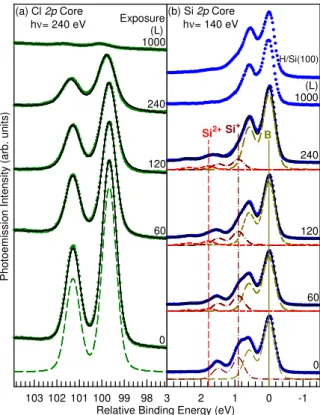
High-resolution core-level photoemission spectroscopy can be used to distinguish atoms at nonequivalent sites and in different chemical bonding configurations, accord-ing to shifts in their bindaccord-ing energy.[18] Figures 1(a) and 1(b) show the respective surface-sensitive Cl 2p and Si 2p core-level spectra (circles), and their decomposition into constituent components from the Cl-Si(100)-2×1 surface before and after H bombardment at 325 K for various dosages. All fitting was least-squares fitting.[19] Each component that consists of a pair of spin-orbit split dou-blets is assumed to have the same Voigt line shape.
The Cl 2p spectra in Fig. 1(a) can be analyzed with a component that consists of a pair of split doublets
sep-98 99 100 101 102 103 P h o to e m is s io n I n te n s it y ( a rb . u n it s ) (a) Cl 2p Core hν= 240 eV 240 120 60 0 1000
Relative Binding Energy (eV)
-1 0 1 2 3 (b) Si 2p Core hν= 140 eV 240 120 60 0 B Si+ Si2+ H/Si(100) 1000 Exposure (L) (L)
FIG. 1: The (a) Cl 2p and (b) Si 2p core level photoemission spectra (circles) for the Cl-Si(100)-2×1 surface and the same surface after various apparent H-atom dosages as labeled. The solid curves are fits to the spectra. The curves labeled B (long dashed curves), Si+(dashed dot) and Si2+(short dashed curves) are the results of decomposition of the Si 2p spectra into contributions from the bulk, Si-Cl, and Cl-Si-Cl species, respectively. The energy zero in (b) refers to the 2p3/2 bulk position for the Cl-Si(100)-2×1 surface. To eliminate the band bending effect, the relative binding energy for the Cl 2p refers to the corresponding Si 2p3/2line of the B component in (b).
arated by 1.60 eV. The binding energy of these Cl 2p spectra relative to that of the corresponding Si 2p re-mains at 99.60 eV, suggesting that the Cl atoms form similar Si-Cl bonds. Figure 2 plots the integrated inten-sities of the Cl 2p spectra (ICl), which are proportional
to the surface Cl coverage. The integrated intensity of the bottom spectrum is normalized to be 1.0 because the chlorine coverage is nominally 1 ML for the Cl-saturated Si(100) surface prior to H-atom bombardment. ICl
de-creases linearly with the dosage of H-atoms in the early stage, indicating that Cl atoms were removed by imping-ing H atoms. This result is consistent with a previous study.[12]
The bottom spectrum in Fig. 1(b) shows the Si 2p core level spectra for the Cl-Si(100)-2×1 surface. This Si 2p spectrum consists of two components, B and Si+,
separated by about 0.9 eV. The B component is respon-sible for emission from the bulk and the Si+ component
from the surface Si-Cl species.[20] As the exposure of atomic hydrogen increases, both the intensities of the Si+ component and the Cl 2p spectra drop off. This
H2 Exposure (L) 0 50 100 150 200 250 C l C o v e ra g e ( M L ) 0.4 0.6 0.8 1 Cl 2p STM
FIG. 2: Cl coverage calculated from the integrated intensities of the Cl 2p core-level spectra in Fig. 1(a) (solid squares) and from those counting from the STM images (open circles). The initial coverage is nominally 1.0 ML based on the STM result.
occurrence suggests that H atoms reduce the surface Cl coverage, similar to the findings of a previous report.[12] After >1000 L of apparent exposure, the line shape of Si 2p is similar to that (top spectrum in Fig. 1(b)) obtained by direct, high-dosage hydrogen exposure on the clean Si(100)-2×1 surface at room temperature.[21] This observation indicates that hydrogen atoms termi-nate nearly all surface dangling bonds and form a mix-ture of dihydride and monohydride surface when most Cl atoms are extracted. It should be noted that a small component labeled Si2+ emerges in Fig. 1(b) after H
impingement. The chemical shift of Si2+, around 1.78
eV on the higher bonding energy side of B, is consistent with a charged state of +2 for Si atoms and is responsible for SiCl2 species.[15] Presumably, the SiCl2 species were
formed as a consequence of the highly exothermic uptake of halogens during the extraction. Although more study is needed, the emersion of the dichloride species implies that impinging H atoms induce other surface reactions besides extracting upon collision with a surface adatom.
B. STM results
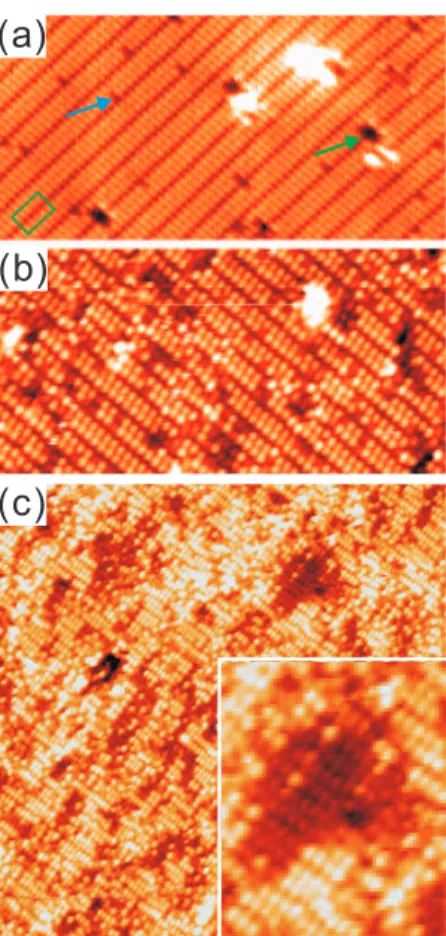
The clean Si(100) surface consists of rows of dimers, where the two dangling bonds from the two atoms in a dimer form a weak pi-bond.[22] Cl adsorption on a clean Si(100) surface saturates the dimer dangling bonds while preserving the basic (2×1) dimer structure without buck-ling, as shown in Fig. 3(a).[23, 24] In Fig. 3(a), a handful of dark sites can be discerned, each occupying one side of a Cl-Si-Si-Cl species. As Figs. 3(b)-3(c) show, the den-sity of these dark sites increase with the H exposure. The dangling bonds generated during the Cl removal exhibit a higher apparent height due to enhanced tunneling near the Fermi level, and they are highly reactive to further H-adsorption.[25] The dark sites in Fig. 3 are H-terminated
(a)
(b)
(c)
FIG. 3: STM images of the Cl/Si(100)-2×1 surface after (a) 0, (b) 36, and (c) 90 L apparent dosages of H atoms. The sample bias used was +2 V. In (a) the green rectangle box, running from the upper right to the lower left, encloses a row of five Cl-Si-Si-Cl (monochloride) species. A surface Cl atom appears as a bright protrusion and forms a narrow el-lipse with another in the neighboring monochloride row in the image. The green and blue arrows point to a missing dimer defect site and a H-termination site, respectively. The inset in (c) shows a 2×1 area of nearly complete H-termination af-ter Cl-extraction. The size of a 1×1 unit cell in the image is 3.84×3.84 ˚A2.
sites. The initial H coverage on the Cl/Si(100) surface is less than 0.02 ML. The presence of some initial sur-face H is likely due to the residue in the cleaning process and/or the adsorption of impurity by the HCl molecules in the Cl2 gas source. The remaining Cl coverage after
H-exposure can be obtained by directly counting its den-sity in the STM images The results are plotted in Fig. 2. Since the STM and photoemission measurements were performed in different chambers, the actual H dosages for the two measurements are different but proportional, as shown in Fig. 2.
When the substrate temperature is held at RT dur-ing H-atom exposure, a reaction site, where a Cl atom is removed by an H atom and an H atom is subsequently ad-sorbed, presumably undergoes no diffusion.[11, 26] The brightest humps in the images are likely weakly bonded terrace SiCl2 moeities, as evident from the
photoemis-4
FIG. 4: STM images of the Cl/Si(100)-2×1 surface after 12 L apparent dosages of H atoms at a sample temperature of 600 K. The sample bias used was +2 V.
sion spectra and as discussed in the previous section. In addition, the remaining Cl-terminated sites and bright humps, and most of the reacted sites in Figs. 3(b) and 3(c) appear to be H-terminated. At first glance, the H-terminated sites, or the Cl-extracted sites, appear to be randomly dispersed. However, as will be analyzed and discussed in the following section, the density and the sizes of the clusters grouped together in neighboring Cl-extracted sites are larger than those created by ran-dom extraction. At higher H-atom exposure, even two-dimensional islands with a H/Si(100)-2×1 structure, as shown in Fig. 3(c), can be easily found. Figure 4 shows an STM image for the H(g)+Cl(ad)/Si(100) reaction at a
substrate temperature of ∼600 K. Similar isolated dark sites occupying one side of a dimer can be easily identi-fied, since they are H-terminated sites after Cl extraction. The density of the Cl-extracted sites increases as the H-atom dosage and the clustering of reaction sites become evident at higher H-atom dosage. The results are similar to those obtained at near room temperature.
IV. DISCUSSION
In the ER mechanism, a Cl-extraction reaction occurs via a collision-induced reaction. The calculated cross sec-tion is smaller than a unit cell within a small proximity around the spot where an H atom strikes.[13] The gas-phase H atoms impinge on the surface in a random fash-ion. In this scenario, a new Cl-extracted site is gener-ated no matter what neighboring chemical environment surrounds the site where an H atom strikes. In other words, the extraction probability upon collision with an H atom is not changed when a Cl-Si surface species is neighboring one or more dangling bond sites or monohy-dride sites. If this scenario is valid, then the distribution of the Cl-extracted sites by the random and sequential impingement of gas-phase H atoms will be completely random in the STM images.
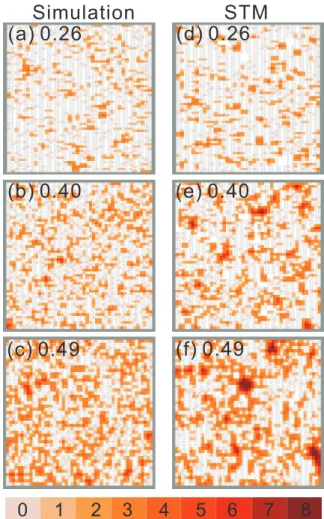
Figures 5(a), 5(b), and 5(c) show the results of the impingement-site distribution from the computer
sim-Simulation
0
1
2
3
4
5
6
7
8
(a) 0.26
(c) 0.49
STM
(d) 0.26
(f) 0.49
(b) 0.40
(e) 0.40
FIG. 5: Distribution of Cl-extracted sites obtained from (a-c) simulation and (e-f) STM. The coverage of Cl-extracted sites in monolayer is labeled. A Cl-extracted site is classified into 8 categories and represented by different colors as indicated.
ulation based on this assumption. In the simulation, a reactive site is randomly generated since the impact parameter found in the classical trajectory approach is small.[13] In Fig. 5, the Cl-extracted sites are classified into 8 categories, and are marked in different colored in-tensity scales (labeled 0–8), according to the degree of reaction-site clustering. A site in categories numbered k = 0, 1, 2, and 3 is a Cl-extracted site with 0, 1, 2, and 3 of its four nearest neighboring Cl-extracted sites (labeled s = 1–4 in Fig. 6), respectively. If a Cl-extracted site with its four nearest neighboring Cl extracted is called a ”surrounded site”, a site in Category 4, 5, 6, 7, and 8 is a ”surrounded site” and has 0, 1, 2, 3, and 4 nearest neigh-boring ”surrounded sites”, respectively. In the classifi-cation scheme, the category number k of a Cl-extracted site indicates the number of other extraction reactions occurring in its immediate vicinity. Therefore, the larger the cluster formed by the Cl-extracted sites, the darker the cluster appears in the image.
function (g0) of Cl-extracted sites, g0(s) = g(s)θ = 1 N N X i=1 ni(s) m(s), (1) , where ni(s) is the number of sth-nearest-neighbor
Cl-extracted sites around the ithCl-extracted site (labeled
0 in Fig. 6), θ denotes the coverage of the Cl-extracted sites, and m(s) denotes the number of sth-neighbor
sites.[27] As expected, the pair distribution g0 obtained
from the simulated images is roughly equal to θ, inde-pendent of site index s. Figure 6 shows that g0
calcu-lated from simulation images such as Figs. 5(d-f) is in agreement with those expected for a completely random distribution. In contrast, g0 for nearest neighboring sites
s = 1–4 obtained from STM images is boosted by about 20%. g0 for next nearest neighboring sites s = 5–10 is
also boosted at higher coverage. The deviation of g0from
the mean coverage θ suggests the existence of correlation and interaction between Cl-extracted sites and, there-fore, rules out the pure ER process with unitary reaction probability.[28]
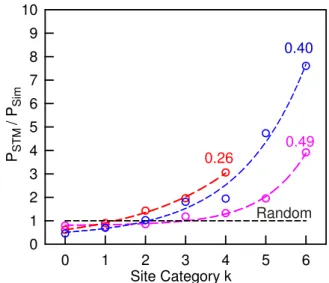
To further examine whether or not the cluster for-mation of Cl-extracted sites results from random H-impingement, STM images taken after the reaction were digitized and are shown in Figs. 5(d), 5(e), and 5(f) in a similar fashion to those in Figs. 5(a-c). A di-rect visual comparison between Figs. 5(b) and 5(e), 5(c) and 5(f) suggests that the site population for categories with a greater k obtained from the STM measurement (PST M(k)) is greater than that (PSim(k)) from the
cor-responding simulated images. Their ratios PST M(k)/
PSim(k), plotted in Fig. 7, deviate significantly from 1.0,
especially for k > 4. This finding also indicates that the simulation based on the assumption of a pure ER pro-cess deviates from the experimental results. The cluster formation of Cl-extracted sites can only be realized if an impinging H atom ”senses” the chemical environment in a small (HA) or large (LH) range beyond the collision spot. The sizes of the clusters in Figs. 5(d-f) are not large; the larger-than-expected pair correlation found in the small coverage of the extraction reaction sites is lim-ited to the nearest neighboring sites (s = 1–4). These facts suggest that the reaction of Cl-extraction likely fol-lows that of the HA process.
V. CONCLUSION
Distinguishing a detailed surface reaction mechanism has been an important but difficult issue. The H(g) +
Cl(ad)/Si(100) is an important prototypical system for
the study of the ER, HA, and LH mechanisms. In our work, a combination of atomic resolved STM im-ages, spectroscopic measurements of core level photoe-mission, and computer simulations provide a detailed picture of the atomic processes involved in this seem-ingly simple gas-surface reaction. The core level
measure-0.49
0.26 Cl-Extracted Site Coverage (ML)
Neighboring Site Index s 1 5 9 13 17 U n n o rm a liz e d P a ir D is tr ib u ti o n F u n ct io n g ' ( M L ) 0.0 0.2 0.4 0.6 0.8 1.0 6 18 5 1 17 10 4 0 3 9 14 11 13 8 20 7 2 19 16 12 15 0.49 ML 0.26 ML
FIG. 6: The Cl-terminated Cl-Si(100) surface and the un-normalized pair distribution function of Cl-extracted sites vs the neighboring site s obtained from the STM images (cir-cles), the simulation (squares), and the completely random distribution calculation(dashed curves). The inset shows the Cl/Si(100)-2×1 lattice; each circle corresponds to an initial Cl adatom site. Numbers mark the respective sites around a Cl-extracted site at the center position (labeled 0).
Site Category k 0 1 2 3 4 5 6 PS T M / PS im 0 1 2 3 4 5 6 7 8 9 10 0.26 0.49 Random 0.40
FIG. 7: The ratio of the population density obtained from STM images PST M to that from simulated images PSim vs site category. The coverage of Cl-extracted sites in monolayer for each curve is labeled.
6 ment and STM images observed the formation of SiCl2
surface species, indicating that ”some” additional reac-tions occur beside the removal of Cl upon impingement of H atoms. Analysis of the STM and simulated im-ages shows that the Cl-extracted sites are correlated to the neighboring Cl-extracted sites. These experimental results cannot be explained by the pure Eley-Rideal pro-cess with unitary reaction probability. We recognize that
other mechanisms, for example, an Eley-Rideal abstrac-tion processes with a reacabstrac-tion probability which depends on the local surface coverage of Cl and maybe H, might possibly lead to our results. However, our findings and consideration lead us to believe that the HA process likely occurs during the atom-adatom collision. Further study is needed to better understand the nature of the gas-solid reactions.
[1] B. Jackson, in The Chemical Physics of Solid Surfaces, edited by D. P. Woodruff (Elsevier, New York, 2003), Vol 11, PP. 51.
[2] J. G. Quattrucci and B. Jackson, J. Chem. Phys. 122, 074705 (2005).
[3] C. T. Rettner and D. J. Auerbach, Phys. Rev. Lett. 74, 4551(1995).
[4] S. A. Buntin, J. Chem. Phys. 108, 1601 (1998). [5] C. T. Rettner, J. Chem. Phys. 101, 1529 (1994). [6] D. D. Koleske and S. M. Gates, J. Chem. Phys. 99, 8218
(1993).
[7] S. M. Gates, J. Phys. Chem. 96,10439 (1992).
[8] K. R. Lykke and B. D. Kay, in Laser Photoionization and Desorption Surface Analysis Techniques, Edited by N. S. Nogar (SPIE, Bellingham, WA, 1990), Vol. 1208, p. 18. [9] B. Jackson, X. Sha, and Z. B. Guvenc, J. Chem. Phys.
116, 2599 (2002).
[10] I. Lyubinetsky, Z. Dohn´alek, W.J. Choyke, and J.T. Yates, Jr., Phys. Rev. B 58, 7950 (1998).
[11] C. M. Aldao and J.H. Weaver, Prog. in Surf. Sci. 68, 189 (2001), and reference therein.
[12] C. C. Cheng, S. R. Lucas, H. Gutleben, W. J. Choyke, and J. T. Yates, Jr., J. Am. Chem. Soc. 114, 1249 (1992); ibid, Surf. Sci. 273, L441 (1992).
[13] Y. H. Kim, J. Ree, and H. K. Shin, J. Chem. Phys. 108, 9821 (1998).
[14] K. Hattori, K. Shudo, M. Ueta, T. Iimori, F. Komori, Surf. Sci. 402-404, 170 (1998).
[15] M.-W. Wu, S.-Y. Pan, W.-H. Hung, and D.-S. Lin, Surf. Sci. 507, 295 (2002).
[16] H. N. Waltenburg and J. T. Yates, Jr., Chem. Rev. 95, 1589 (1995).
[17] Q. Gao, C. C. Cheng, P. J. Chen, W. J. Choyke, and J.
T. Yates Jr., Thin Solid Film 225, 140 (1993).
[18] F. J. Himpsel, F. R. McFeely, J. F. Morar, A. Taleb-Ibrahimi, and J. A. Yarmoff, in Photoemission and Adsorption Spectroscopy of Solids and Interfaces with Synchrotron Radiation, Proceedings of the International School of Physics ”Enrico Fermi”, Course CVIII, edited by G. Scoles (North-Holland, New York, 1991).
[19] T.-C. Chiang, CRC Crit. Rev. Solid State Mater. Sci. 14, 269 (1988).
[20] D.-S. Lin, J. L. Wu, S.-Y. Pan, and T.-C. Chiang, Phys. Rev. Lett. 90, 046102 (2003).
[21] K. Yamamoto and M. Hasegawa, J. Vacuum Sci. Technol. B 12, 2493 (1994).
[22] J. J. Boland, Adv. Phys. 42, 129 (1993) and references therein.
[23] I. Lyubinetsky, Z. Dohnalek, W. J. Choyke, and J. T. Yates, Phys. Rev. B 58, 7950 (1998).
[24] G. J. Xu, K.S. Nakayama, B. R. Trenhaile, C. M. Aldao, and J. H. Weaver, Phys. Rev. B 67 125321 (2003). [25] B. R. Trenhaile, V. N. Antonov, G. J. Xu, A. Agrawal,
A.W. Signor, R. Butera, K. S. Nakayama, and J. H. Weaver, Phys. Rev. B 73, 125318 (2006).
[26] J. H. G. Owen, D. R. Bowler, C. M. Goringe, K. Miki, and G. A. D. Briggs, Phys. Rev. B 54, 14153 (1996). [27] J. Trost, T. Zambelli, J. Wintterlin, and G. Ertl, Phys.
Rev. B 54, 17850 (1996).
[28] There exists a possibility that the trajectory of an in-coming H atom is slightly redirected by the Cl-extracted site to its close vicinity. However, our calculation based on the classical electrostatic force from surface dipoles suggests that the deflection is too small.