Yiqun Wu and Yan Chen are with Huawei Tech-nologies.
Jie Tang and Daniel K. C. So are with the University of Manchester.
Zhikun Xu and Chih-Lin I are with China Mobile.
Paul Ferrand and Jean-Marie Gorce are with, INSA-Lyon.
Chih-Hsuan Tang is with Chunghwa Telecom.
Pei-Rong Li, Kai-Ten Feng, and Li-Chun Wang are with National Chiao Tung University,
Kai Börner and Lars Thiele are with Fraun-hofer HHI.
This article belongs to the joint work of the Green Transmission Technology project in GreenTouch.
1For more information about GreenTouch please refer to www.greentouch.org.
INTRODUCTION
The energy consumption of information and communications technology (ICT) has recently become an economic issue for operators as well as a big challenge for sustainable development. The energy consumption of the ICT industry contributes about 3 percent to the global annual electricity bill, and the amount is rising at the speed of 15–20 percent each year [1]. With vast and rapid deployment of fourth generation (4G) networks, as well as the 5G vision of a totally connected world, with zero waiting and zero dis-tance communications by 2020 [2], the situation
is getting worse. Motivated by these facts, the GreenTouch Consortium has been founded and aims to improve end-to-end energy efficiency by 1000 fold.1Green Transmission Technology (GTT), one of the biggest umbrella projects in GreenTouch, focuses on the energy-efficient design of physical layer transmission technologies and medium access control (MAC) layer radio resource management in wireless networks.
Extensive research has been carried out in the literature on energy-efficient wireless net-works, and diverse technologies have been pro-posed in all aspects, trying to close the gap between practice and expectations [3–8]. To develop a systematic way to evaluate diverse technologies and find the remaining gaps for fur-ther optimization, a unified framework is need-ed. This is the fundamental framework of the energy efficiency (EE) and spectrum efficiency (SE) trade-off [9], which has long been pointed out by Shannon’s ground-breaking theory but has yet to be fully utilized. A widely accepted definition of EE is transmitted bits per unit energy, and SE is usually defined as transmission rate per unit bandwidth. In the case of an addi-tive white Gaussian noise (AWGN) channel, the channel capacity is given by Shannon’s formula,
where W is the bandwidth, Ptis the transmit power, G is the channel gain, and N0is the power spectral density of noise. In this case, it is shown that EE is a monotonic decreasing func-tion of SE [4], which implies that optimizing with respect to only one metric, EE or SE, tends to degrade the other, SE or EE.
The reason that the EE-SE trade-off frame-work is not widely used as expected for the design of green transmission technologies may lie in the fact that practical systems behave dif-ferently than AWGN channels. Challenges may
= + C W P G WN log (12 t ), 0
ABSTRACT
As 4G wireless networks are vastly and rapid-ly deployed worldwide, 5G with its advanced vision of all connected world and zero distance communications is already at the corner. Along with the super quality of user experience brought by these new networks, the shockingly increasing energy consumption of wireless networks has become a worrying economic issue for operators and a big challenge for sustainable development. Green Transmission Technologies (GTT) is a project focusing on the energy-efficient design of physical-layer transmission technologies and MAC-layer radio resource management in wire-less networks. In particular, fundamental trade-offs between spectrum efficiency and energy efficiency have been identified and explored for energy-efficiency-oriented design and optimiza-tion. In this article, four selected GTT solutions are introduced, focusing on how they utilize the degrees of freedom in different resource domains, as well as how they balance the trade-off between energy and spectrum efficiency. On top of the elaboration of separated solutions, the GTT toolbox is introduced as a systematic tool and unified simulation platform to integrate the proposed GTT solutions together.
G
REEN
C
OMMUNICATIONS AND
C
OMPUTING
N
ETWORKS
Yiqun Wu, Yan Chen, Jie Tang, Daniel K. C. So, Zhikun Xu, Chih-Lin I, Paul Ferrand, Jean-Marie Gorce,
Chih-Hsuan Tang, Pei-Rong Li, Kai-Ten Feng, Li-Chun Wang, Kai Börner,
and Lars Thiele
Green Transmission Technologies for
Balancing the Energy Efficiency and
Spectrum Efficiency Trade-off
arise from multi-path fading channels, multi-user sharing the same radio resources (time, frequen-cy, power, antenna, etc.), intercell interference, and the real power consumption model beyond only transmit power. The joint impact of all these factors together usually results in multi-objective and complex optimization problems to derive the EE-SE trade-off. One simple example about the impact of approximate power model is given below. Inside the wireless transceivers, there are various components contributing to the total power consumption, including power ampli-fier, signal processing circuits, power supply, cooling, and so on. One popular approach is to model the total power consumption as a linear function of transmit power [10], Ptot= aPt+ P0, where a is a constant, and P0is the static power. With the total power consumption taken into consideration, the curve of EE-SE relation turns to a bell shape [9] (i.e., partially increases and then decreases). Hence, there is an optimal operational point in terms of EE.
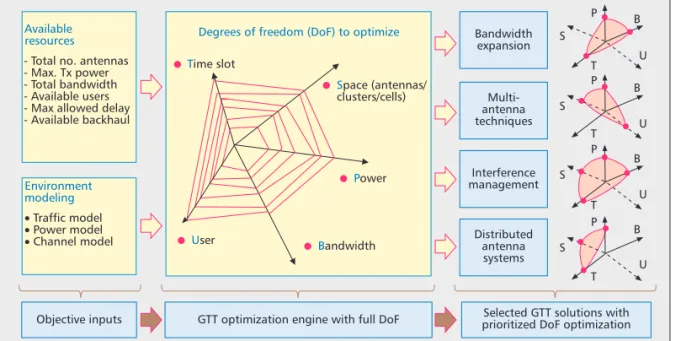
Figure 1 gives an overview of the design prin-ciple and optimization framework in the GTT project. For each specific network scenario, the available resources and environmental models are identified as objective inputs. The network performance is optimized with all the manage-able degrees of freedom (DoFs) as the optimiza-tion variables, which include power, time, space, bandwidth, and user. Inspired by the EE-SE trade-off framework, various GTT solutions are proposed, and each GTT solution has its own prioritized DoF optimization. It should be noted that this article is not a dedicated survey of EE-SE trade-off; only the following four selected GTT solutions will be introduced.
Bandwidth expansion, in which the optimiza-tion of EE-SE trade-off will focus on the priori-tized DoF in radio resources such as power, bandwidth, and time. A new insight here is that to strike a good balance between EE and SE, it is not wise to utilize the radio resources to their extreme ends (as in the case of optimizing SE only). On the contrary, with optimal design,
some extra sacrifice in bandwidth (power) could bring substantial savings in power (bandwidth), which is a good bargain.
Multiple antenna techniques, in which the prioritized DoF for the optimization of EE-SE trade-off will be power, space (subspaces created by multi-antenna schemes), and available users (scheduled and grouped for simultaneous service by multiple antennas). Our research results show that given a large number of antennas, simulta-neously serving multiple users with multi-streams helps to increase both EE and SE, which may not hold for the case of a small number of antennas.
Intercell interference management, in which the prioritized DoF for EE-SE optimization will be time, power, bandwidth, and space (cells or subspaces created by intercell coordinated trans-mission techniques). As is pointed out and theo-retically verified, it is crucial to cancel at least the strongest interference, which could bring over 10 dB gain in useful signal strength and result in order-wise EE improvement for a given SE requirement.
Distributed antenna system, in which the pri-oritized DoF for EE-SE optimization will be power, time, and space (collaborative clusters created by joint transmission of several anten-nas). Our findings show that by the deployment of a distributed antenna system (DAS), known as a coordinated radio access network (RAN), site power can be greatly reduced, and with the smart use of the DoF in the three domains, net-work EE can be improved over 300 percent.
How these solutions are motivated by the EE-SE trade-off framework and how they may utilize different sets of prioritized DoF to balance the EE-SE trade-off are further elaborated later.
For each GTT solution, the EE-SE trade-off is optimized with its own prioritized DoF. How-ever, as shown in Fig. 1, the prioritized DoF of different GTT solutions may overlap, so these solutions are usually interrelated, with some of them even competing with each other. As a result, even with clear understanding of how each solution makes the best trade-off between Figure 1. Overview of the design principle and optimization framework of the GTT project.
B B B B U U U U P P P P T T T T S S S S Bandwidth expansion Multi-antenna techniques Interference management Distributed antenna systems
Objective inputs GTT optimization engine with full DoF prioritized DoF optimizationSelected GTT solutions with
Available
resources Degrees of freedom (DoF) to optimize
- Total no. antennas - Max. Tx power - Total bandwidth - Available users - Max allowed delay - Available backhaul Time slot Environment modeling • Traffic model • Power model • Channel model Space (antennas/ clusters/cells) Power Bandwidth User
Our findings show that by the deployment of DAS,
or known as coordinated RAN, site power can be greatly reduced, and
with the smart use of the DoF in the three domains, the
network energy efficiency can be improved over 300 percent.
EE and SE, it is still uncertain and worth investi-gating how much EE can be improved with the joint efforts of all the solutions, and how to make the best trade-off between EE and SE in the presence of all these solutions. Therefore, beyond investigation of the separate solutions, the GTT toolbox is introduced as a systematic and unified simulation platform to integrate all these GTT solutions together, the key methodol-ogy of which is then elaborated on later. Finally, we summarize the key findings and conclude the entire article.
GREEN
TRANSMISSION
TECHNOLOGIES
INSPIRED BY
EE-SE FRAMEWORK
B
ANDWIDTHE
XPANSIONBased on Shannon’s formula, expanding the transmit bandwidth reduces the transmit power under the same rate requirement. In other words, under the framework of EE-SE trade-off, band-width expansion increases EE and decreases SE. As available spectrum is limited and expensive in practical systems, traditional design of mobile wireless networks mainly focuses on how to opti-mally utilize the available spectrum. However, the traffic load in wireless networks has significant spatial and temporal fluctuations due to user mobility and the bursty nature of data applica-tions. During the peak hours, there are a lot of users waiting to be scheduled, and the bandwidth allocated to each user may not be expandable. On the contrary, during the off-peak hours, band-width expansion can be applied to improve EE.
Rather than solving the EE-SE trade-off problem for a single-point solution (i.e., a pair of EE and SE outputs), a new approach is pro-posed by GTT for EE-SE trade-off, the resource
efficiency (RE) metric for wireless networks, which is defined as follows:
hRE= hEE+ gh– SE[11], where
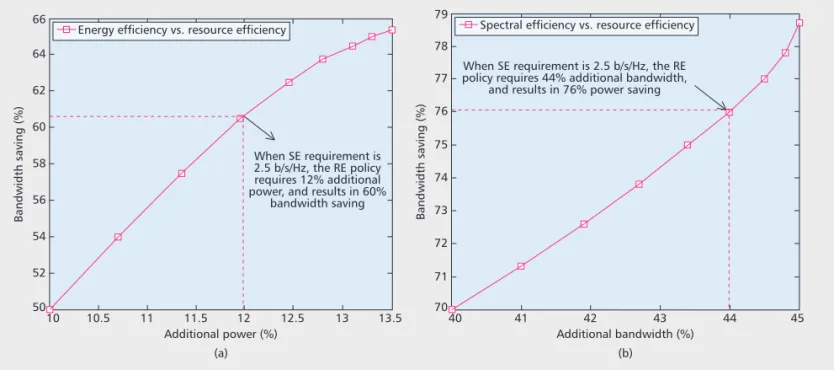
This is a multi-objective optimization problem. There is no a priori correspondence between a weight vector and a solution vector, and it is up to the operator to choose appropriate weights. In particular, g is used to balance between EE and SE; hence, appropriate weights need to be chosen to utilize the available power and band-width. Simulation results in Fig. 2 show that a significant amount of bandwidth can be saved with a slight increase in energy consumption, and a similar conclusion can also be drawn on energy saving by bandwidth expansion. More crucially, it shows that by operating at a slightly reduced EE or SE, the amount of bandwidth or power saved can be substantial. These saved resources can be utilized in other ways; for instance, the vacant bandwidth can be used for improved interference avoidance in a heteroge-neous network scenario, or for a system with cognitive radio subsystems. Hence, the available network resources can be utilized efficiently by designing based on the RE metric.
In the multi-cell scenario, if all the cells employ bandwidth expansion, the transmit power is reduced, and the intercell interference is fur-ther reduced. Thus, the performance gain of bandwidth expansion can be more in the multi-cell scenario compared to the single-multi-cell sce-nario. Our recent work in [12] shows that bandwidth expansion enables savings of power consumption of up to 45 percent if all cells in
γ γ= W
P .
tot tot
Figure 2. Performance of the RE policy compared to the best EE policy and the best SE policy, and each point corresponds to dif-ferent minimum SE requirements (1 b/s/Hz : 0.5 b/s/Hz : 5 b/s/Hz), g = 1: a) EE vs. RE for a trade-off between extra power and bandwidth saving; b) SE vs. RE for trade-off between extra bandwidth and power saving.
Additional power (%) (a) 10.5 10 52 50 Bandwidth saving (%) 54 56 58 60 62 64 66 11 11.5 12 12.5 When SE requirement is 2.5 b/s/Hz, the RE policy requires 12% additional power, and results in 60%
bandwidth saving 13 13.5 Additional bandwidth (%) (b) 40 70 Bandwidth saving (%) 78 79 77 76 75 74 73 72 71 41 42 43 44
When SE requirement is 2.5 b/s/Hz, the RE policy requires 44% additional bandwidth,
and results in 76% power saving
45 Spectral efficiency vs. resource efficiency
the network apply the same bandwidth expan-sion strategy.
Therefore, the potential solution of band-width expansion is to jointly optimize the opera-tions of user scheduling, power, and bandwidth allocation in order to maximize the RE for com-plete wireless networks.The future work for bandwidth expansion may include:
Joint time-frequency expansion:Previous work on bandwidth expansion mainly explores DoFs in the frequency domain. The idea can also be extended to the time domain. The trans-mit power can be reduced by expanding the transmit time. On the other hand, when the transmitters are idle, they can be put into sleep mode to save energy. Consequently, joint time and frequency domain optimization is a promis-ing way to save energy.
Overhead issues:Bandwidth expansion may not always be beneficial for EE in practice because when transmit bandwidth increases, the overhead such as pilots for channel estimation will increase, and the power consumption for signal processing may also increase. Thus, more efforts are needed to investigate the benefits of bandwidth expansion in practice, including devel-oping new power models and new strategies for bandwidth expansion.
M
ULTIPLE-A
NTENNAT
ECHNIQUES Multiple-antenna techniques play an important role in wireless networks today. If multiple antennas are applied at both the transmitter and receiver, it can be regarded as a multiple-input multiple-output (MIMO) system. Additional spatial DoFs by applying multiple antennas enhance the reliability and significantly increase the transmission rate, without additional band-width or power. Thus, the EE-SE trade-off can be improved by multiple-antenna technologies.Multiple-antenna technologies can reduce the transmit power by several means. One approach is beamforming, by which signals can be
com-bined constructively at the receiver. The power gain of beamforming is ntnr, where ntis the num-ber of transmit antennas and nris the number of receive antennas. Transmit power can also be reduced by spatial diversity schemes, which pro-vide redundancy across independent fading branches. Given the same outage probability, much less power is required by spatial diversity schemes. Another way to reduce the transmit power is spatial multiplexing, by which multiple data streams can be transmitted in parallel. Given the same rate requirement, the required transmit power can be reduced.
In cellular networks, base stations (BSs) have more antennas than users, and the MIMO chan-nel capacity is limited by the minimum of ntand
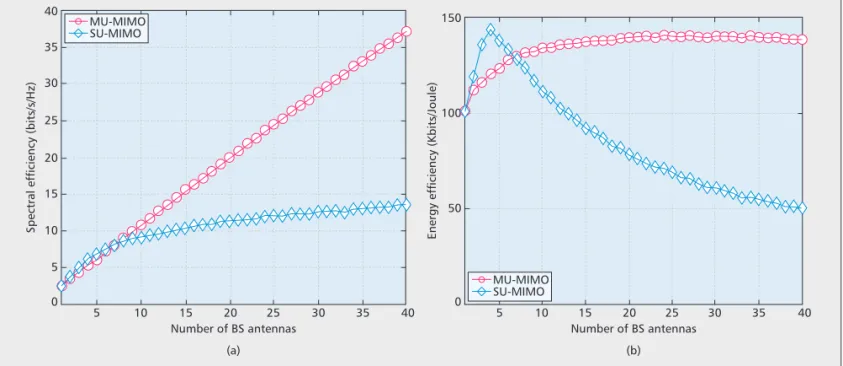
nr. In this case, multi-user MIMO (MU-MIMO) can be applied to improve the system capacity. We compare the EE and SE performance of a MU-MIMO scheme and a single-user MIMO (SU-MIMO) scheme in a single-cell scenario by simulation in Fig. 3. In the simulation, zero-forc-ing precodzero-forc-ing is applied for both schemes, and the number of scheduled users is the maximum value for MU-MIMO. The results show that if the number of antennas is small, SU-MIMO out-performs MU-MIMO in both SE and EE. As the number of antennas increases, the advantage of MU-MIMO over SU-MIMO is enlarged. Therefore, it is beneficial to switch between MU-MIMO and SU-MIMO for better EE-SE trade-off in practice.
Multiple-antenna techniques also have detri-mental effects on energy consumption. First, more circuit energy is consumed for MIMO transmission as additional RF chains are required, and the complexity of signal processing is also higher. Second, more time or frequency resources are spent on the signaling overhead for MIMO transmission. For example, channel state information (CSI) is required for detection at the receiver and precoding at the transmitter. To estimate the CSI at the receiver and feed it
Figure 3. Performance comparison of SU-MIMO and MU-MIMO in a single-cell scenario: a) SE vs. the number of antennas; b) EE vs. the number of antennas.
Number of BS antennas (a) 5
5 0
Spectral efficiency (bits/s/Hz) 10
15 20 25 30 35 40 10 15 20 25 30 35 40 Number of BS antennas (b) 10 0
Energy efficiency (Kbits/Joule)
100 150 50 5 15 20 25 30 35 40 MU-MIMO SU-MIMO MU-MIMO SU-MIMO
back to the transmitter, training symbols, pilots, and control signals are transmitted. Since the number of channel coefficients increases with nt
nr, much more signaling overhead is required for MIMO systems, especially when there are a large number of antennas and users.
MIMO transmission schemes reduce the transmit power but increase the circuit power, so the total power consumption may not always be reduced. If the increase of transmit rate cannot compensate the increase of total power, EE will decrease. To improve EE, the above benefits and detriments need to be balanced. One approach is to adaptively turn on/off the anten-nas and related RF chains so that the EE and SE can be well balanced. In general, the EE-SE trade-off problem with multiple-antenna tech-niques is complicated, involving joint optimiza-tion of precoding, scheduling, power allocaoptimiza-tion, and antenna selection. The future work for mul-tiple antenna technologies may include:
Transmission scheme adaptation: There are many different MIMO transmission schemes, such as spatial diversity, beamforming, multi-plexing, and MU-MIMO. To achieve the best performance, the transmission schemes need to be adaptively selected based on the channel state information (CSI) and user requirement.
Sleep mode management: If spectral efficien-cy can be improved by MIMO transmission, the transmission time is less, and the transmitter can be put into sleep mode. On the other hand, the number of active antennas for each transmitter can also be adaptive. Therefore, joint node-level and antenna-level sleep mode management will be interesting work.
CSI acquisition: CSI plays an important role in multiple-antenna techniques. Without accu-rate CSI, performance will be largely degraded. The accuracy of CSI can be improved if more signaling is done. How to balance the trade-off between CSI accuracy and signaling overhead is valuable and critical work, and needs to be fur-ther investigated.
I
NTERCELLI
NTERFERENCEM
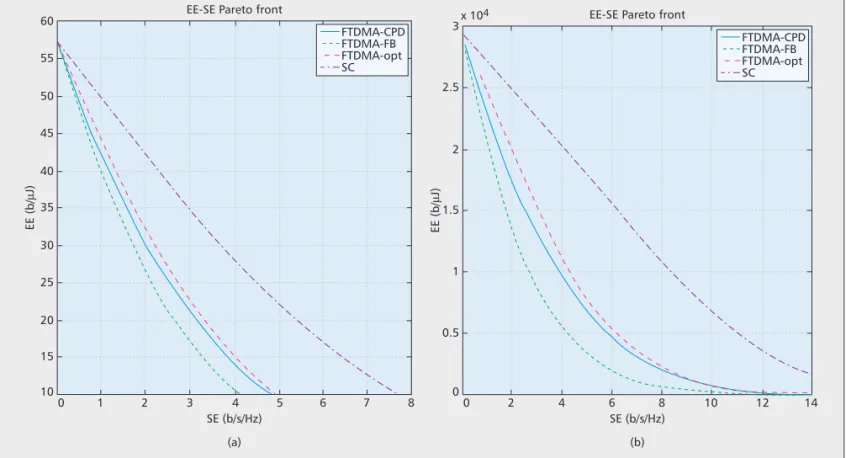
ANAGEMENT The fundamental challenge for a multi-cell sce-nario is the mitigation of intercell interference, especially when the frequency is in full reuse. The EE and SE will be significantly degraded by intercell interference, especially for cell edge users. Reducing interference can be achieved by proper static or dynamic resource allocation over cells providing a significant EE gain. However, most of these techniques rely implicitly on reduc-ing the bandwidth available for each BS, thus introducing an SE loss, and the global trade-off is then shifted.In GTT we analyzed the global impact of intercell interference, which, in degrading both EE and SE, results in poorer system perfor-mance. Two extreme cases are evaluated on a reference scenario corresponding to a current dense urban standard deployment under full load. The first case corresponds to the standard interference limited regime with no interference management, while the second case is an ideal case with full interference removal [13]. The main important figure of merit is that in the sec-ond case, the same fair capacity may be achieved
with a 30 dB reduction of total transmitted power. When using efficient resource sharing techniques exploiting either orthogonal frequen-cy-division multiple access (OFDMA) or super-position coding (SC), the theoretical EE gain is huge: in full interference, EE reaches a maxi-mum of 60 Mb/J while it grows to 30 Gb/J with no interference, as seen in Fig. 4. (Note here that the EE metric includes only the transmit power. If the total energy were considered, EE would decrease by at least a factor of 10.)
However, achieving full interference cancella-tion is infeasible in practice. Interference is pro-duced by a large set of neighbor BSs, including a few strong interferers (the nearest BS) and a bunch of long distance interferers. However, it is estimated that removing the two or three strongest interferers may still provide a gain of about 15 dB [13]. To achieve this gain, different interference management schemes may be used and combined, such as resource partitioning, scheduling, beamforming, cooperative transmis-sion, and interference alignment. These schemes have different coordination requirements and effective gain. In 3GPP, enhanced intercell inter-ference coordination (eICIC) techniques are introduced, which only require minimum coordi-nation between cells.
When full feedback is available, the multi-cell scenario becomes equivalent to a single-cell MIMO scenario, and the optimal performance may be achieved by employing joint transmission and reception of multiple cells. To reduce the amount of backhaul transmissions and coopera-tion requirements, interference alignment is attractive because it requires only information exchange relative to channel states, each mobile being associated with only one BS. However, the performance of interference alignment is limited by imperfect channel estimation and time varia-tions. Interference alignment can also be designed with limited feedback, but at the price of reduced DoFs. Indeed, the local choice made by a transmitter should be restricted to not affect the interference perceived by neighbor receivers.
There are other effective intercell interfer-ence management schemes, but there is no room to enumerate all of them. Future work on inter-cell interference may include:
EE-SE analysis: Theoretical analysis of EE-SE trade-off in a multi-cell scenario will be valu-able and interesting work, which can provide insights on the performance bounds and which schemes are more promising from the viewpoint of EE-SE trade-off. The difficulty mainly lies in how to balance the complexity and model accu-racy.
Intercell coordination: The coordination between cells is the major limitation of intercell interference management schemes. The multi-cell network is a dynamic system with local agents. The appropriate decision loops, feed-back, and decision rules will play a critical role. Furthermore, the delay and limited capacity of backhaul connections have to be considered.
D
ISTRIBUTEDA
NTENNAS
YSTEMS Distributed antenna systems deploy antennas in a distributed manner, so that the network coverage is increased. Since the antennas are closer to theReducing interference can be achieved by a proper
static or dynamic resource allocation over cells providing a
significant EE gain. However, most of these techniques rely implicitly on reducing the bandwidth avail-able for each BS thus introducing a SE loss, and the global trade-off is then shifted.
users, the path loss between transmitters and receivers decreases. Under the EE-SE trade-off framework, both EE and SE can be improved with DASs. Furthermore, a DAS has a novel structure with central baseband units (BBUs) and remote radio units (RRUs), which largely reduces the number of BS sites while maintaining site capacity. As a result, network power consumption of supporting equipment such as cooling can be largely reduced. Due to the limitation of compu-tation power, each BBU can only support several RRUs. Large-scale DASs will become feasible with more and more powerful processors. Figure 5a shows an implementation architecture of large-scale DAS, in which a number of RRUs are con-nected to a pool of BBUs via optical switches. These high-throughput optical switches can dynamically forward and receive real-time data of each RRU to/from its related BBU.
Intuitively, the best performance can be achieved in a DAS by coordinating all the RRUs together and performing distributed beamform-ing. However, this type of coordination can induce considerable computational complexity. To reduce the complexity, antenna clustering according to user location and/or channel quality can be applied. With antenna clustering, intra-cluster interference can be eliminated with the cooperative transmission schemes introduced previously, but inter-cluster interference still exists since there is no coordination among the clusters. As the BBUs are co-located, a central controller can be applied to achieve inter-cluster coordination so that the interference can be fur-ther reduced.
Our recent work in [14] proposed a resource
allocation scheme for large-scale DASs, in which hundreds of antennas are randomly deployed, which jointly considers the power allocation and preceding MIMO. A simplified cloud-RAN-based energy-efficient power allocation (S-CEEPA) scheme is proposed in which instantaneous CSI is not required. Thus, this scheme can easily be employed in frequency-division duplex (FDD) mode. The uncontrollable inter-cluster interfer-ence is also taken into account. The baseline scheme is equal power allocation (EPA) for each antenna. The simulation results in Fig. 5b show that the proposed scheme performs much better than the baseline scheme. For all the scenarios, EE increases with more antennas deployed. This is because with increasing antenna density, the propagation loss decreases, and the interference is largely eliminated by intra-cluster precoding. On the other hand, EE decreases when the num-ber of clusters increases due to higher inter-clus-ter ininter-clus-terference. Future work on distributed antennas systems includes:
Power model: Since the network architecture is different from traditional wireless networks, the power model of large-scale DASs needs to be further investigated. On one hand, the power consumption of support equipment can be reduced with the structure of centralized pro-cessing. On the other hand, additional power consumption is caused by optical switches, BBUs, and the controller for intra-cluster and inter-cluster signal processing.
Imperfect transmission: The RRUs are
assumed to be perfectly synchronized, and the overhead of CSI acquisition is neglected in cur-rent work. If the transmissions are not perfect,
Figure 4. EE-SE trade-off with different resource sharing techniques (FTDMA-CPD, -FB, and -opt: time-frequency division, with constant power density, constant bandwidth per user, and optimal allocation, respectively. SC : superposition coding): a) full reuse scenario; b) interference-free scenario.
SE (b/s/Hz) (a) EE-SE Pareto front
1 0 15 10 EE (b/ μ J) 20 25 30 35 40 45 50 55 60 2 3 4 5 6 7 8 SE (b/s/Hz) (b) EE-SE Pareto front
0 0.5 0 EE (b/ μ J) 1 1.5 2 2.5 3x 10 4 12 14 10 8 6 4 2 FTDMA-CPD FTDMA-FB FTDMA-opt SC FTDMA-CPD FTDMA-FB FTDMA-opt SC
the intra-cluster interference cannot be fully eliminated. To investigate the practical benefit of large-scale DASs, it is necessary to study the optimization of joint clustering and precoding design under imperfect transmission.
INTEGRATION OF
GTT SOLUTIONS
In the previous section, various GTT solutions have been proposed to improve EE-SE trade-off for wireless networks. For each scenario, only one or several solutions can be used. One way to evaluate the EE-SE trade-off with the combined effects of all GTT solutions is to develop a sys-tem-level simulator with all the solutions applied. However, such a simulator is too complicated and time-consuming. In this section, the GTT toolbox is introduced as a systematic simulation tool and unified simulation platform to integrate all these GTT solutions together, as well as the method of integration.
GTT T
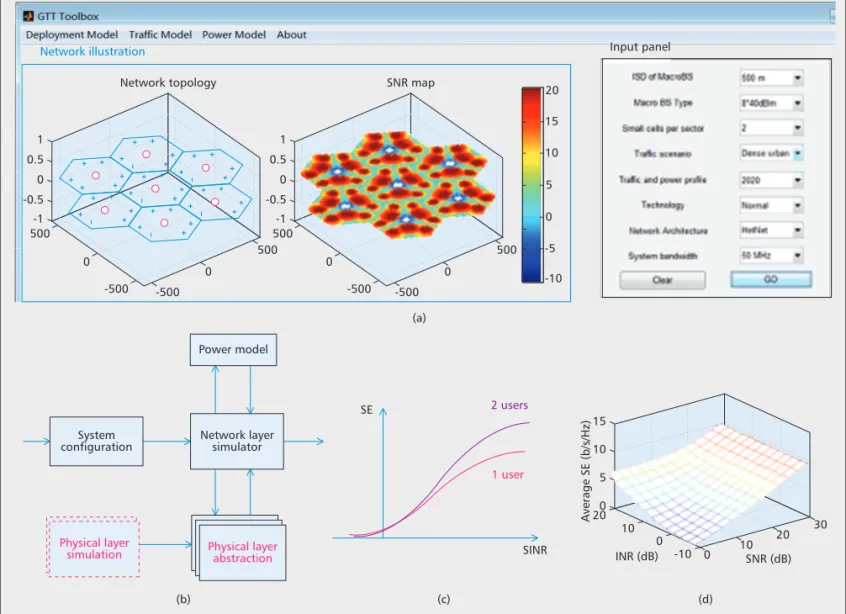
OOLBOXThe GTT toolbox provides a simulation frame-work to evaluate the performance of an integrat-ed GTT solution, which is affectintegrat-ed by variable factors, such as network scenarios, traffic dynam-ics, and large-scale and small-scale fading. There is a graphic user interface to configure all these factors, as shown in Fig. 6a. The network sce-nario and traffic model are both configurable, and the channel models include propagation loss, large-scale fading, and small-scale fading, which mainly follow the parameters specified in [15]. The power model is either a linear model or other more sophisticated models with config-urable parameters. If the “Go” button is pressed, a system-level simulation is executed. After the simulation, different performance metrics, including EE, SE, user throughput, and power consumption, are illustrated.
M
ETHOD OFI
NTEGRATIONThe main difficulty of system-level simulation lies in the time-varying states. If traffic dynamics is considered, the dimension of states becomes intractable. To solve this problem, we propose a new simulator structure in the GTT toolbox, as
illustrated in Fig. 6b. The simulator consists of the network and physical layers. Instead of implementing the GTT solutions in detail, they are abstracted into signal-to-interference-plus-noise ratio (SINR)-SE or signal-to-signal-to-interference-plus-noise ratio (SNR)-interference-to-noise ratio (INR)-SE mapping curves or look-up tables in the physical layer. Each GTT solution may have multiple mapping curves, and each mapping curve corre-sponds to a set of parameters (e.g., the number of transmit and receive antennas).
These mapping curves act as an interface between the network and physical layers. In the network layer simulation, traffic dynamics and large-scale fading are considered. When a user arrives, the SINR, SNR, and INR are calculated based on the large-scale fading model. The average SE is given by the mapping curves, which are func-tions of SINR, SNR, and INR. Usually, the curve with the best SE is selected. If multiple users are served by the same cell, the bandwidth is equally allocated to the users. Thanks to the two-layer structure, the scheduling or bandwidth allocation issues are left to the physical layer simulation.
The mapping curves are obtained by offline simulation, in which the number of users is fixed and all the cells are under full load. Both large-scale and small-large-scale fading are considered. At the beginning of simulation, a number of users are randomly dropped, and the average SINR, SNR, and INR of each user is calculated based on the large-scale fading model, which corre-sponds to the horizontal axis of the mapping curves. Then the users are served by the BSs, and the instantaneous SE for each scheduled user is stored. The pairs of average SE and aver-age SINR form scatter plots, and the mapping curves are computed by curve fitting at the end of the simulation.
If MU-MIMO is applied, users can have more transmission opportunities by bandwidth sharing. However, this is not reflected in the calculation of average SE. The instantaneous SE is multi-plied by the number of users if MU-MIMO is applied to reflect multiuser diversity. Fig. 6c illustrates an example of multiple SINR-SE curves for MU-MIMO. As MU-MIMO can only be applied if there are multiple active users, thus Figure 5. a) Architecture of a large-scale distributed antenna system; b) energy efficiency with different
numbers of antennas. Antenna cluster 2 Number of antennas 256 128 0.5 0 EE (Mb/J) 1 1.5 2 2.5 3 3.5 4 384 512 (a) (b) UE = 16, cluster = 1 UE = 16, cluster = 4 UE = 32, cluster = 1 UE = 32, cluster = 4 Baseline, cluster = 1 Baseline, cluster = 4 Controller Baseband units Switch Antenna cluster 1 The GTT toolbox provides a simulation framework to evalu-ate the performance of integrated GTT solution, which is affected by variable factors, such as net-work scenarios,
traf-fic dynamics, large-scale and
small-scale fading. There is a graphic user inter-face to configure all
for network-layer simulation, the mapping curves are not applicable if there are not enough users.
If intercell interference management is applied, SINR can be improved, especially for cell edge users. Since the average SINR is calcu-lated with all interference, users who suffer from high interference and under deep fade cannot be distinguished with the SINR-SE curve. There-fore, we develop a new kind of mapping curve, the SNR-INR-SE curve, shown in Fig. 6d. In this way, the abstraction is more accurate for multi-cell GTT solutions.
It should be noted that the above method is only an approximation of the real system-level simulation. The approximation holds only if the timescale of network-layer dynamics is much longer than the physical layer (i.e., the service rate of each user can be approximated by the average performance. As a whole, the GTT tool-box provides a simple and flexible way to inte-grate multiple GTT solutions, which play an important role in the whole GTT project.
CONCLUSIONS
This article has described the design principle of energy-efficient wireless networks in the GTT project. Inspired by the fundamental framework
of EE-SE trade-off, four selected GTT solutions have been introduced, including bandwidth expan-sion, multiple-antenna technologies, intercell interference management, and distributed anten-na systems. The performance benefits, as well as design insights and challenges of these solutions have also been elaborated. Furthermore, the GTT toolbox and a novel method of integration have been introduced to integrate all the GTT solutions. Future work in the GTT project will focus on the design of integrated green transmis-sion technologies and provitransmis-sion of a systematic solution for the big challenge of energy consump-tion in current and future 5G wireless networks.
R
EFERENCES[1] E. Oh et al., “Toward Dynamic Energy-Efficient Opera-tion of Cellular Network Infrastructure,” IEEE Commun. Mag., vol. 49, no. 6, June 2011, pp. 56–61.
[2] Huawei, “5G: A Technology Vision,” http://www.huawei.com/5gwhitepaper, 2013. [3] C. Han et al., “Green Radio: Radio Techniques to Enable
Energy-Efficient Wireless Networks,” IEEE Commun. Mag., vol. 49, no. 6, Jun. 2011, pp. 46–54.
[4] Y. G. Li et al., “Energy-Efficient Wireless Communica-tions: Tutorial, Survey, and Open Issues,” IEEE Wireless Commun., vol. 18, no. 6, Dec. 2011, pp. 28–35. [5] Z. Niu et al., “Cell Zooming for Cost-Efficient Green
Cel-lular Networks,” IEEE Commun. Mag., vol. 48, no. 11, Nov. 2010, pp. 74–79.
Figure 6. a) User interface of the GTT toolbox; b) simulator structure of the GTT toolbox; c) the example of SINR-SE curves for MU-MIMO; d) the example of SNR-INR-SE curves for multi-cell solutions.
INR (dB) SNR (dB) 10 Average SE (b/s/Hz) 15 5 0 20 10 Power model (a) (b) (c) (d) SE SINR 2 users 1 user Network layer simulator Physical layer abstraction Physical layer simulation System configuration 0 -10 0 10 20 30 Network topology 0.5 1 0 -0.5 -1 500 0 -500 -500 0 500 SNR map 0.5 1 0 -0.5 -1 500 0 -500 -500 0 500 Network illustration 20 15 10 5 -5 -10 0 Input panel
[6] L. M. Correia et al., “Challenges and Enabling Technolo-gies for Energy Aware Mobile Radio Networks,” IEEE Commun. Mag., vol. 48, no. 11, Nov. 2010, pp. 66–72. [7] T. Chen et al., “Network Energy Saving Technologies for
Green Wireless Access Networks,” IEEE Wireless Com-mun., vol. 18. no. 5, Oct. 2011, pp. 30–38.
[8] C. L. I et al., “Toward Green and Soft: A 5G Perspec-tive,” IEEE Commun. Mag., vol. 52, no. 2, Feb. 2014, pp. 66–73.
[9] Y. Chen et al., “Fundamental Trade-offs on Green Wire-less Networks,” IEEE Commun. Mag., vol. 49, no. 6, June 2011, pp. 30–37.
[10] G. Auer et al., “How Much Energy is Needed to Run A Wireless Network?” IEEE Wireless Commun., vol. 18. no. 5, Oct. 2011, pp. 40–49.
[11] J. Tang et al., “Resource Efficiency: A New Paradigm on Energy Efficiency and Spectral Efficiency Tradeoff,” IEEE Trans. Wireless Commun., vol. 13, no. 8, Aug. 2014, pp. 4656–69.
[12] M. Butt et al., “On the Energy-Bandwidth Tradeoff in Green Wireless Networks: System Level Results,” Proc. IEEE ICCC Wksp., Aug. 2012, pp. 91–95.
[13] J. M. Gorce et al., “Energy-Capacity Trade-Off Bounds in a Downlink Typical Cell,” Proc. IEEE PIMRC, Sept. 2014.
[14] P. R. Li, T. S. Chang, and K. T. Feng, “Energy-Efficient Power Allocation for Distributed Large-Scale MIMO Cloud Radio Access Networks,” Proc. IEEE WCNC, Apr. 2014. [15] 3GPP TR 36.814, “Evolved Universal Terrestrial Radio
Access (E-UTRA): Further Advancements for E-UTRA Physical Layer Aspects,” Mar. 2010.
B
IOGRAPHIESYIQUNWU([email protected]) received B.S. and Ph.D. degrees in electronic engineering from Tsinghua University, China, in 2006 and 2012, respectively. He was a visiting researcher at the Chinese University of Hong Kong from 2007 to 2008 and at Ohio State University from 2010 to 2011. Since 2012, he has been with Huawei Technologies Co., Ltd. Shanghai. His research interests include energy-efficient wireless networks, new waveforms, and multiple access schemes for 5G.
YANCHENreceived her B.Sc. and Ph.D. degrees in informa-tion and communicainforma-tion engineering from Zhejiang Univer-sity, China, in 2004 and 2009, respectively. She was a visiting researcher at Hong Kong University of Science and Technology (HKUST), from 2008 to 2009. She joined Huawei Technologies Co., Ltd. Shanghai in 2009 and has been the team leader for green radio research since then. She is now working as the project manager on green air interface design for fifth generation mobile communica-tions in Huawei and project leader for the GTT project in GreenTouch.
JIETANG[S’10, CM’13] is a postdoctoral research associ-ate in the School of Electrical & Electronics Engineering, University of Manchester, United Kingdom. He received his Ph.D. degree from Loughborough University, United Kingdom, his M.Sc. degree from the University of Bristol, United Kingdom, and his B.Eng. degree from the South C h i n a U n i v e r s i t y o f T e c h n o l o g y , C h i n a . H i s c u r r e n t research interests include green communications, 5G sys-tems, heterogeneous networks, cognitive radio, and MIMO systems.
DANIELK. C. SO[S’96, M’03, SM’14] is a senior lecturer in the School of Electrical and Electronic Engineering, Univer-sity of Manchester. He received his Ph.D. degree from HKUST, and his B.Eng. degree from the University of Auck-land, New Zealand. His current research interests include green communications, 5G networks, heterogeneous net-works, massive MIMO, and cognitive radio.
ZHIKUNXUreceived his B.S.E. and Ph.D. degrees in electrical and computer engineering from Beihang University, China, in 2007 and 2013, respectively. He was a visiting researcher in the School of Electrical and Computer Engineering, Georgia Institute of Technology, from 2009 to 2010. After graduation, he joined the Green Communication Research Center of the China Mobile Research Institute as a project manager. His current research mainly focuses on 5G tech-nologies, including energy efficiency and spectral efficiency co-design, large-scale antenna systems, non-orthogonal multiple access schemes, and cross-layer resource alloca-tion.
CHIH-LINI received her Ph.D. degree in electrical engineering from Stanford University and has almost 30 years of experi-ence in wireless communications. She has worked at various world-class companies and research institutes, including the Wireless Communication Fundamental Research Department of AT&T Bell Labs, the headquarters of AT&T, ITRI of Taiwan, and Hong Kong ASTRI. She received the IEEE Transactions on Communications Stephen Rice Best Paper Award and is a winner of the CCCP National 1000 Talent program. Current-ly, she is China Mobile’s chief scientist of wireless technolo-gies in charge of advanced wireless communication R&D efforts of the China Mobile Research Institute. She estab-lished the Green Communications Research Center of China Mobile, spearheading major initiatives including 5G key technologies R&D; high energy efficiency system architec-ture, technologies, and devices; green energy; and C-RAN and soft base stations. She was an elected Board Member of IEEE ComSoc, Chair of the ComSoc Meetings and Confer-ences Board, and Founding Chair of the IEEE WCNC Steering Committee. She is currently an Executive Board Member of GreenTouch and a Network Operator Council Member of ETSI NFV. Her research interests are green communications, C-RAN, network convergence, bandwidth refarming, EE-SE co-design, massive MIMO, and active antenna arrays. JEAN-MARIEGORCEreceived M.S. and Ph.D. degrees in electri-cal engineering from the National Institute of Applied Sci-ences (INSA), Lyon, France, in 1993 and 1998. After a postdoctoral year at Bracco Research, Switzerland, he joined the Telecommunications Department at INSA Lyon as an associate professor, where he is head of the radio modeling axis of CITI Laboratory. His main research field concerns wireless networks focusing on realistic modeling, wireless system optimization, and performance assessment, consid-ering as well architecture-based and ad hoc networks. CHIH-HSUANTANGreceived her Ph.D. degree from National Chiao Tung University, Hsinchu, Taiwan, in 2007. Since 2007, she has been a researcher at Chunghwa Telecom Laboratories, Taiwan. Her current research interests include green communications, self-optimization networks, and heterogeneous networks.
Pei-Rong Li received her B.S. degree from Yuan Ze Universi-ty, Taoyuan, Taiwan, in 2012. Since 2014, she has been working toward a Ph.D. degree in the Department of Com-munications Engineering, National Chiao Tung University. Her research interests include resource allocation and spec-trum sharing for cooperative networks.
KAI-TENFENGreceived his M.S. degree from the University of Michigan, Ann Arbor, in 1996, and his Ph.D. degree from the University of California, Berkeley, in 2000.Since August 2011, he has been a full professor with the Depart-ment of Electrical and Computer Engineering, National Chiao Tung University. His current research interests include broadband wireless networks, cooperative and cog-nitive networks, and wireless location technologies. LI-CHUNWANG[M’96, SM’06, F’11] received his Ph. D. degree from the Georgia Institute of Technology in 1996. He was with AT&T Laboratories from 1996 to 2000, and is the current Chairman of the Department of Electrical and Computer Engineering of National Chiao Tung University. His current research interests are in the areas of radio resource management and cross-layer optimization tech-niques for heterogeneous wireless networks, and cloud computing for mobile applications.
KAIBÖRNERreceived his M.S. degree in electrical engineer-ing from Technische Universität Berlin, Germany, in 2009. Currently, he is working toward a Ph.D. degree in electrical engineering at Technische Universität Berlin. He joined Fraunhofer Heinrich Hertz Institute (HHI) in April 2009. His research interests lie in channel modeling, energy-efficient transmission, and self-organization in heterogeneous MIMO-OFDM-based networks.
LARSTHIELEreceived his M.S. degree in electrical engineer-ing from Technische Universität Berlin in 2005. He joined Fraunhofer HHI in September 2005. In 2013 he received his Ph.D. degree from the Technical University of Munich. He has contributed to receiver and transmitter optimization under limited feedback, performance analysis for MIMO transmission in cellular OFDM systems, fair-resource alloca-tion, and cooperative multi-point transmission under con-strained channel state information at the transmitter.
Future work of the GTT project will focus on the design of integrated green
transmission technologies and
provision of a systematic solution for the big challenge
of energy consump-tion in current and future 5G wireless