OPTIMIZATION OF AN ULTRATHIN CENTRIFUGAL FAN BASED ON THE TAGUCHI METHOD WITH FUZZY LOGICS
Kuang-Hung Hsien and Shyh-Chour Huang
Department of Mechanical Engineering, National Kaohsiung University of Applied Sciences, Kaohsiung, Taiwan E-mail: [email protected], [email protected]
ICETI 2012-J1001_SCI
No. 13-CSME-47, E.I.C. Accession 3505
ABSTRACT
This paper presents the use of fuzzy-based Taguchi method to optimize the design of the ultrathin cen-trifugal fan with multiple performance characteristics. An orthogonal array, the signal-to-noise (S/N) ratio, multiresponse performance index, analysis of variance (ANOVA), and computational-fluid-dynamics were used to study the multiple-objectives in the ultrathin centrifugal fan design. The design parameters, outlet dimensions, inlet dimensions, blade angle, and impeller diameter were optimized with considerations of the performance characteristics, including volume flow ratio, static pressure, and noise. The results demonstrate that volume flow rate of the new design fan was almost 29% larger than that of the original design. This study also identified the optimized design parameters that affect the cooling performance of the centrifugal fan.
Keywords: Taguchi method; fuzzy logic; optimization.
OPTIMISATION D’UN VENTILATEUR CENTRIFUGE ULTRA LÉGER UTILISANT LA MÉTHODE TAGUCHI DE LA LOGIQUE FLOUE
RÉSUMÉ
Dans cet article, on présente l’utilisation d’une méthode basée sur la logique floue pour optimiser la concep-tion d’un ventilateur centrifuge ultra mince aux multiples caractéristiques de performance. Un réseau ortho-gonal, le rapport signal/bruit, l’index de performance multi-réponse ; l’analyse de variance (ANOVA), et la dynamique numérique des fluides furent utilisés pour étudier les multiples objectifs de la conception d’un ventilateur ultra mince. Les paramètres de conception, les dimensions du point de sortie, l’angle de lame et le diamètre de l’agitateur furent optimisés en considérant les caractéristiques de performance, incluant le rapport du flux volumétrique, la pression statique et le bruit. Les résultats démontrent que le rapport du flux volumétrique du nouveau ventilateur est presque de 29% plus grand que celui du design original. Cette recherche a aussi identifié les paramètres optimisés de conception qui affectent la performance réfrigérante du ventilateur centrifuge.
Mots-clés : méthode Taguchi ; logique floue ; optimisation.
449 Transactions of the Canadian Society for Mechanical Engineering, Vol. 37, No. 3, 2013
NOMENCLATURE
A inlet area (m2)
LS noise of the fan (dB(A)) LSA noise ratio (dB(A))
P pressure (pa)
QM maximize volume flow rate (m3/s)
V fluid velocity (m/s)
X1 outlet dimensions of the fan X2 inlet dimensions of the fan X3 blade angle of the fan X4 impeller diameter of the fan x1−2 input of the fuzzy logic z output of the fuzzy logic
Greek symbols
ρ density of the fluid (kg/m3)
η S/N ratio Subscripts 1 inlet 2 outlet d dynamic s static t total 1. INTRODUCTION
The Taguchi method [1–3] is a functionary and effective design of the experiments method. It provides a simple and systematic approach to optimizing designs for performance by the signal-to-noise (S/N) ratio and analysis of variance (ANOVA). Parameter design of the Taguchi method can optimize the performance char-acteristic by setting of design parameters, and can reduce the sensitivity of sources variation. However, the Taguchi method can only process a single-objective program, and cannot manage a multi-objective problem. This study used fuzzy logic to perform fuzzy inference of multiple-objectives of the ultrathin centrifugal fan. The multiple-objective optimization [4–7] can transfer into optimization of a single performance index by fuzzy logic [8, 9].
This paper presents the optimization design of the ultrathin centrifugal fan with multiple-objectives by fuzzy based Taguchi method. The cooling fan was developed by computational-fluid-dynamics (CFD) [10] in the 1970s as an approach to simulation, design, optimization, and flow analysis. In the flow field of the fan, parameters must be determined for analyzing a procedure, which is time consuming and costly for the design procedure. Although CFD can achieve a superior flow field, it has difficulty in achieving the optimal design by selecting the appropriate parameters of the fan. Therefore, this study used an alternative approach based on the combination of CFD, the Taguchi method, and fuzzy logic to determine the optimal design parameters of the ultrathin fan.
This paper is organized as follows: Section 2 introduces the Taguchi method; Section 3 provides the experimental details of using the Taguchi method to determine and analyze the optimal design parameters; Section 4 presents the optimal design parameters of the fuzzy-based Taguchi method regarding performance indices, such as volume rate, static pressure, and noise; and lastly, Section 5 offers a conclusion.
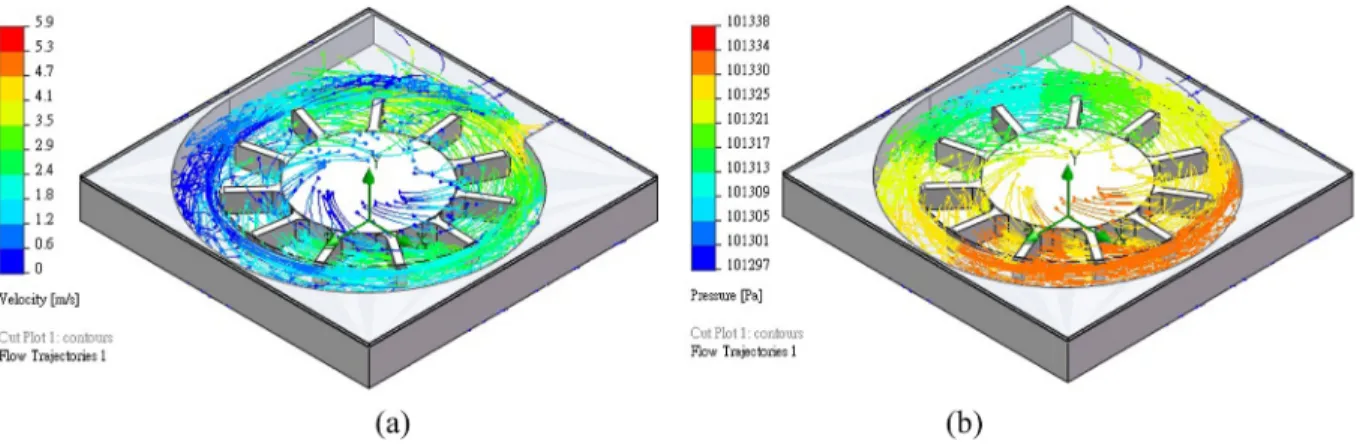
Fig. 5. Predicted velocity fields and total pressure for the centrifugal fan of the optimum design: (a) velocity field; (b) total pressure field.
5. CONFIRMATION EXPERIMENTS
Confirmation experiments were performed to test the fuzzy-based Taguchi method design of the centrifugal fan, which used CFD software, Solidworks Flow Simulation. In the fuzzy-based Taguchi method optimal design, a maximal volume flow rate and static pressure were chosen to obtain the corresponding volume flow rate and static pressure. The performance (P-Q) curves of the fan obtained from the corresponding volume flow rate and static pressure were subsequently drawn to compare the difference between the original and optimized design parameters.
Figure 5 shows the predicted velocity fields and total pressure for the optimally designed fan, with the fluid velocity of inlet at 0.1 m/s. In addition, the noise value of less than 25.5 dB(A) of the optimized fan can fit the standard of a heat dissipation system, and is considerably quiet.
6. CONCLUSIONS
This study optimized the design of an ultrathin centrifugal fan with specific constrained conditions by using the fuzzy-based Taguchi method. According to the results of the experimental analysis, the fuzzy-based Taguchi method obtains an optimal solution. The optimized design of the centrifugal fan increases cooling capability and reduces the noise considerably (25.5 dB(A)). The QMof the new design fan was almost 29%
larger than that of the original design. Decreasing the sensitivity of the design parameter variation further established the design capability. This study combined the Taguchi method and fuzzy inference to obtain an optimal solution, which can serve as a reference for engineers.
ACKNOWLEDGMENT
The authors acknowledge and thank the National Science Council of the Republic of China for their financial support of this study under Contract Number NSC 99-2221-E-151-004-MY2.
REFERENCES
1. Chou, J.H., Optimization Approaches, Lecture Notes and Handouts, KUAS, Taiwan, 2010.
2. Yang, W.H. and Tarng, Y.S., “Design optimization of cutting parameters for turning operations based on the Taguchi method”, Journal of Materials Processing Technology, Vol. 84, pp. 122–129, 1998.
3. Wang, L.k., Shieh, J.Y., Lin, K.H. and Huang, K., “A two-stage Taguchi design example-image quality promotion in miniature camera/cell-phone lens”, International Journal of Engineering and Technology Innovation, Vol. 2, pp. 163–171, 2012.
4. Chen, D.C. and Chen, C.F., “Use of Taguchi method to study a robust design for the sectioned beams curvature during rolling”, Journal of Materials Processing Technology, Vol. 190, pp. 130–137, 2007.
5. Hsien, K.H. and Huang, S.C., “Robust multi-criteria optimal design for improve yield of BGA packaging”, Advance Science Letters, Vol. 13, pp. 420–426, 2012.
6. Lin, Y.C., Le, Q.K., Lai, L.W , Liao, R.M., Jeng, M.S. and Liu, D.S., “Optimizing the organic/inorganic barrier structure for flexible plastic”, International Journal of Engineering and Technology Innovation, Vol. 2, pp. 184– 194, 2012.
7. Hsien, K.H. and Huang, S.C., “Application of Taguchi method to robust multi-criteria optimum design for ultra-thin centrifugal fan”, in Proceedings of the 2011 IEEE International Conference on Systems, Man, and Cyber-netics (IEEE SMC 2011), pp. 1550–1555, 2011.
8. Chou, J.H., Fuzzy Theories with Applications, Lecture Notes and Handouts, KUAS, Taiwan, 2011.
9. Tarng, Y.S., Yang, W.H. and Juang, S.C., “The use of fuzzy logic in the Taguchi method for the optimisation of the submerged arc welding process”, International Journal of Advanced Manufacturing Technology, Vol. 16, pp. 688–694, 2000.
10. Lukšys, D. and Šešok, A., “Simulation and analysis of blood flow in bypass grafts with a cuff”, Journal of Vibroengineering, Vol. 14, pp. 633–636, 2012.
11. Kunjur, A. and Krishnamurty, S., “A robust multi-criteria optimization approach”, Mechanism and Machine Theory, Vol. 32, pp. 797–810, 1997.
457 Transactions of the Canadian Society for Mechanical Engineering, Vol. 37, No. 3, 2013