Preparation
and
characterization
of
nanometer-sized
(Pb
1 x
,Ba
x
)TiO
3
powders
using
acetylacetone
as
a
chelating
agent
in
a
non-aqueous
sol–gel
process
Hong
Zhu
a,
Zhijun
Guo
b,
Wein-Duo
Yang
c,*
,
Wein-Feng
Chang
c,
Cheng-Chin
Wang
ca
InstituteofModernCatalysis,DepartmentofOrganicChemistry,StatekeyLaboratoryofChemicalResourceEngineering, BeijingUniversityofChemicalTechnology,Beijing100029,PRChina
b
SchoolofScience,BeijingJiaotongUniversity,Beijing100044,PRChina c
DepartmentofChemicalandMaterialsEngineering,NationalKaohsiungUniversityofAppliedSciences,Kaohsiung807,Taiwan Received30August2010;receivedinrevisedform18January2011;accepted22March2011
Availableonline27May2011
Abstract
Nanometer-sized
lead
barium
titanate
(Pb
1 xBa
xTiO
3,
PB
xT)
powders
were
prepared
by
a
non-aqueous
sol–gel
process
using
lead
acetate,
barium
acetate,
and
titanium
isopropoxide
as
precursors
and
ethylene
glycol
as
the
solvent.
In
this
procedure,
Ti-isopropoxide
was
chelated
with
acetylacetone.
The
samples
were
characterized
by
Fourier
transform
infrared
spectroscopy
(FTIR),
Raman
spectroscopy,
thermogravimetric
analysis/differential
thermal
analysis
(TGA/DTA),
X-ray
diffraction
(XRD),
scanning
electron
microscopy
(SEM)
and
Brunauer–Emmett–Teller
(BET)
specific
surface
area
analysis.
The
results
indicate
that
perovskite
PB
xT
phases
were
obtained
by
heat
treatment
at
450
8C
for
5
h,
and
a
pure
perovskite
was
examined
at
600
8C.
The
average
particle
sizes
of
perovskite
PB
xT
powders
calcined
at
600
8C
were
approximately
about
40–
80
nm,
and
BET
analysis
showed
that
the
surface
areas
of
the
powders
obtained
at
600
8C
were
approximately
6–16
m
2/g.
In
addition,
the
phase
transition
from
the
tetragonal
ferroelectric
phase
to
the
cubic
paraelectric
phase
occurred
in
a
range
of
approximately
0.6
<
x
<
0.8.
#
2011
Published
by
Elsevier
Ltd
and
Techna
Group
S.r.l.
Keywords:Nanometer-sized;Leadbariumtitanate;Non-aqueous;Sol–gelprocess
1.
Introduction
The
sol–gel
method
involving
hydrolysis
and
polyconden-sation,
gelation,
aging,
drying
and
heat
treatment
results
in
homogeneous
distributed
particles
with
high
purity
and
controlled
chemical
composition
[1,2]
.
It
is
important
that
the
sol–gel
synthesis
is
carried
out
at
a
low
temperature.
Solid
solutions
of
lead
barium
titanate
with
excellent
dielectric
[3]
,
piezoelectric
[4]
,
pyroelectric
[5]
,
ferroelectric
[6]
and
optical
properties
[7]
are
used
in
many
electronic
and
optical
devices,
including
non-volatile
random
access
mem-ories,
infrared
sensors
and
actuators.
The
compatibility
of
the
starting
materials
is
important
to
form
a
stable
precursor
solution
in
the
multicomponent
system.
Ti
alkoxides
are
more
moisture-sensitive,
and
therefore,
some
chemical
agents
are
added
to
stabilize
the
Ti
precursor
[8–
10]
.
Using
acetylacetone
as
a
chelating
agent
with
metal
alkoxide
can
affect
the
hydrolysis
of
the
starting
materials
to
produce
new
precursors
[6,11]
.
However,
the
metal-organic
precursor
chelated
with
acetylacetone
is
no
longer
moisture-sensitive
[12]
.
In
our
previous
work,
acetylacetone-chelated
Ti
isopropoxide
at
a
molar
ratio
of
1:4
produced
modified
metal-organic
precursors
with
better
uniformity,
and
the
PBT
powder
obtained
possessed
better
mechanical
properties
and
lower
synthesis
temperature
[13]
.
Some
research
results
on
Pb
1 xBa
xTiO
3thin
films,
powders
and
ceramics
by
sol–gel
processing
are
available
in
the
literature
[14,15,12]
.
The
Pb
1 xBa
xTiO
3system
has
not
been
thoroughly
studied.
In
this
paper,
Pb
1 xBa
xTiO
3powders
were
prepared
by
a
non-aqueous
sol–gel
route
and
characterized
in
detail.
Moisture-free
Pb
1 xBa
xTiO
3sols
were
obtained
by
mixing
Ti
isopropoxide
chelated
with
acetylacetone
and
an
ethylene
glycol
solution
dissolved
with
lead
acetate
tri-hydrate
www.elsevier.com/locate/ceramint
Available online at www.sciencedirect.com
CeramicsInternational37(2011)3203–3209
*Correspondingauthor.
E-mailaddress:[email protected](W.-D.Yang).
0272-8842/$36.00#2011PublishedbyElsevierLtdandTechnaGroupS.r.l. doi:10.1016/j.ceramint.2011.05.090
4.
Conclusions
Nanometer-sized
Pb
1 xBa
xTiO
3powders
were
prepared
by
a
non-aqueous
sol–gel
process
with
acetylacetone
as
a
chelating
agent
and
ethylene
glycol
as
a
solvent.
In
the
sol–gel
process,
the
hydrolysis
reaction
was
significantly
strengthened
and
the
polycondensation
reaction
was
weakened
upon
increasing
the
barium
content,
which
crosslinked
the
network
gel
cracked
at
lower
temperatures.
The
crystallization
of
the
PB
0.4T
per-ovskite
structure
occurred
at
temperatures
as
low
as
450
8C,
and
a
pure
perovskite
phase
was
obtained
upon
calcination
at
600
8C.
The
average
particle
sizes
of
PB
xT
powders
heat-treat
at
600
8C
were
approximately
40–80
nm.
The
surface
areas
of
the
powders
ranged
from
6.3
m
2/g
to
16.6
m
2/g.
In
addition,
the
phase
transition
from
the
tetragonal
ferroelectric
phase
to
the
cubic
paraelectric
phase
occurred
at
0.6
<
x
<
0.8.
Acknowledgement
The
authors
gratefully
acknowledge
the
financial
support
of
the
National
Science
Council
of
the
Republic
of
China
(Taiwan).
References
[1] D.Bao,X.Wu,L.Zhang,X.Yao,ThinSolidFilms350(1999)30. [2] P.Kumar,S.Singh,M.Spah,J.K.Juneja,C.Prakash,K.K.Raina,Journal
ofAlloysandCompounds489(2010)59.
[3] H.B.Sharma,H.N.K.Sarma,A.Mansingh,JournalofMaterialsScience 34(1999)1385.
[4] A.Garg,D.C.Agrawal,MaterialsScienceandEngineeringB86(2001) 134.
[5] S.Chopra,A.K.Tripathi,T.C.Goel,R.G.Mendiratta,MaterialsScience andEngineeringB100(2003)180.
[6] J.F.Meng,R.S.Katiyar,G.T.Zou,JournalofPhysicsandChemistryof Solids59(1998)1161.
[7] P.T.Diallo,K.Jeanlouis,P.Boutinaud,R.Mahiou,J.C.Cousseins,Journal ofAlloysandCompounds323–324(2001)218.
[8] W.Liu,W.Zhu,MaterialsLetters46(2000)239.
[9] D.Liu,H.Zhang,Z.Wang,L.Zhao,JournalofMaterialsResearch15 (2000)1336.
[10] S.W.Boland,S.C.Pillai,W.-D.Yang,S.M.Haile,JournalofMaterials Research19(2004)1492.
[11] W.D.Yang,S.M.Haile,ThinSolidFilms510(2006)55. [12] N.V.Giridharan,R.Jayavel,MaterialsLetters52(2002)57.
[13] W.-D.Yang,S.M.Haile,JournaloftheEuropeanCeramicSociety25 (2006)3611.
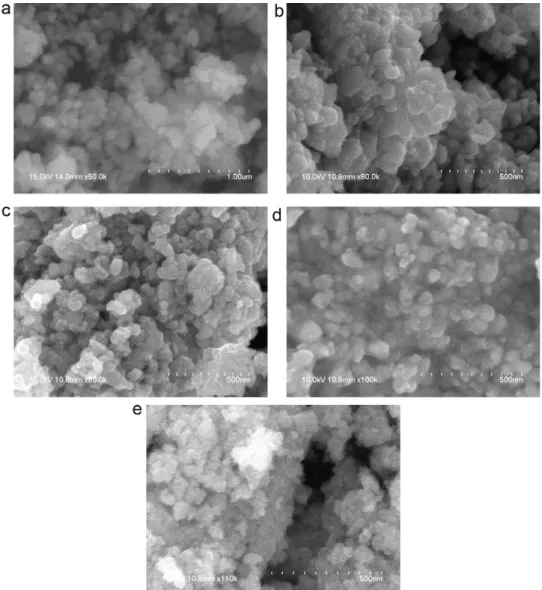
Fig.9. TheSEMmicrographsofthePBxTpowdersasafunctionofx:(a)x=0.2,(b)x=0.4,(c)x=0.5,(d)x=0.6,and(e)x=0.8. H.Zhuetal./CeramicsInternational37(2011)3203–3209
[14] F.MPontes,M.S.Galhiane,L.S.Santos,R.S.Rissato,D.S.L.Pontes,E. Longo,E.R.Leite,P.S.Pizani,A.J.Chiquito,M.A.C.Machado,Materials ChemistryandPhysics108(2008)312.
[15] M.AlguerO´ ,M.L.Calzada,C.Quintana,L.Pardo,AppliedPhysicsA68 (1999)583.
[16] S.Doeuff,M.Henry,C.Sanchez,J.Livage,JournalofNon-Crystalline Solids89(1987)206.
[17] T.Yoko,K.Kamiya,K.Tanaka,JournalofMaterialsScience25(1990) 3922.
[18] C.Lemoine,B.Gilbert,B.Michaux,J.-P.Pirard,A.Lecloux,Journalof Non-CrystallineSolids175(1994)1.
[19] K.-M.Hung,W.-D.Yang,C.-C.Huang,JournaloftheEuropeanCeramic Society23(2003)1901.
[20] M.HFrey,D.A.Payne,ChemistryofMaterials7(1995)123. [21] B.Malic,N.Setter,K.Brooks,M.Kosec,G.Drazic,JournalofSol–Gel
ScienceandTechnology13(1998)833.