Journal of
Materials
Chemistry
www .rsc .or g/mat e rialsSpirobifluorene-based pyrazoloquinolines: efficient blue
electroluminescent materials{
Ching-Hsin Chen,
aFang-Iy Wu,
aChing-Fong Shu,*
aChin-Hsiung Chien
band
Yu-Tai Tao*
ba
Department of Applied Chemistry, National Chiao Tung University, Hsin-Chu, Taiwan 30035
b
Institute of Chemistry, Academia Sinica, Taipei, Taiwan 11529
Received 19th February 2004, Accepted 22nd March 2004 First published as an Advance Article on the web 22nd April 2004
We report the synthesis of spirobifluorene-based pyrazoloquinolines, spiro-PAQ-Me and spiro-PAQ-Ph, in
which two identical luminophores are connected through an sp3-hybridized carbon atom (a spiro center) and
are orthogonally arranged. The incorporation of the rigid spirobifluorene linkage results in significant increases
in the glass transition temperatures, which are in the range 246–280uC. These new materials display the
characteristic absorptions of the mono-pyrazoloquinoline (i.e. non-spiro) derivatives, each with a broad, low-energy absorption at ca. 420 nm, and emit photoluminescence efficiently in the blue region. Electrochemical studies reveal that these compounds exhibit reversible reductions and low-lying LUMO energy levels that originate from the electron-deficient nature of the pyrazoloquinoline ring. Multilayer organic electroluminescent devices constructed using spiro-PAQ-Ph as a dopant in the emitting layer produced bright blue emissions with
maximum luminescence exceeding 20 000 cd m22. For the 2.0%-doped device, a high external quantum
efficiency of 3.6% (4.5 cd A21, 2.02 lm W21) was achieved at 20 mA cm22and 7.0 V with color coordinates of
(0.14, 0.17).
Introduction
Since the discovery of multi-layered organic light-emitting
diodes (OLEDs) by Tang and Van Slyke,1 research into
OLEDs has been pursued intensively because of their potential
for applications in, among other things, flat-panel displays.2–6
With such an application in mind, full-color displays would require three primary-color emissions, i.e. red, green, and blue. Organic light-emitting materials having large band-gap ener-gies that emit blue light efficiently are of particular interest, because they are desired for use as blue light sources in full-color display applications and also because they can be used to achieve green and red color emission by several pathways, such
as dopant emission or fluorescent down-conversion.7–10 A
range of pyrazole-containing derivatives have been
demon-strated to exhibit efficient blue photoluminescence,11–13 and
some of them have been utilized as emitting materials in the fabrication of electroluminescent (EL) devices, in which they
provide bright blue EL emission.14–21
Herein, we report the synthesis and characterization of spirobifluorene-based pyrazoloquinolines, in which the two identi-cal luminophores are aligned orthogonally through bonding to an
sp3-hybridized carbon atom: a spiro center.22,23The introduction
of a spirobifluorene linkage not only increases molecular rigidity but also hinders close packing and intermolecular interactions, so that the tendency for molecules to crystallize may be reduced and the glass transition temperature may be
increased.24–29Amorphous materials possessing a high value of
Tg, which are less vulnerable to heat-induced morphological
changes, are highly desirable for fabricating molecular LEDs, since the tendency for small molecules to crystallize sponta-neously during operation has been identified as one reason for
LED device failure.30–35Moreover, the tetrahedral nature of
the carbon atom at the spiro center connects the conjugated moieties through a s-bonded network, which in turn serves as a conjugation interrupt, and, thus, most of the desired electronic and optical properties of the corresponding non-spiro
mole-cules are preserved.29,36,37 The spirobifluorene-based
pyrazo-loquinoline was used as a dopant in EL devices, which gave bright blue emission from the dopant. The performance of these devices is discussed.
Experimental
General
2,2’-Dinitro-9,9’-spirobifluorene (1),38
9,9-spirobifluoreno-bis-3-phenyl[2,3-c]isoxazole (2),36and
2,2’-diamino-3,3’-diben-zoyl-9,9’-spirobifluorene (3)36 were synthesized according to
literature procedures. Tetrabutylammonium
hexafluoropho-sphate (TBAPF6) was purified by recrystallization from ethyl
acetate and dried in vacuo at 60uC. All other chemicals were
used as received unless otherwise stated. 1H and13C NMR
spectra were recorded on Varian Unity 300 MHz and Bruker-DRX 300 MHz spectrometers. Mass spectra were obtained on a JEOL JMS-SX 102A mass spectrometer. Differential scanning calorimetry (DSC) was performed on a SEIKO EXSTAR
6000DSC unit at a heating rate of 10uC min21
and a cooling
rate of 40uC min21. Samples were scanned from 30 to 400uC,
cooled to 0uC, and then scanned again from 30 to 400 uC. The
glass transition temperatures (Tg) were determined from the
second heating scan. Thermogravimetric analysis (TGA) was undertaken on a DuPont TGA 2950 instrument. The thermal stability of the samples was determined under a nitrogen atmosphere, by measuring weight loss while heating at a rate of
20uC min21
. UV–Visible spectra were measured using an HP 8453 diode-array spectrophotometer. Photoluminescence (PL) spectra were obtained on a Hitachi F-4500 luminescence spectrometer. Cyclic voltammetry (CV) measurements were performed using a BAS 100 B/W electrochemical analyzer. The oxidation and reduction measurements were undertaken,
{Electronic supplementary information (ESI) available: DSC curves
for spiro-PAQ-Me and spiro-PAQ-Ph. See http://www.rsc.org/supp-data/jm/b4/b402584a/
DOI
:
1
0.1039/b402584a
respectively, in anhydrous CH2Cl2and anhydrous THF
con-taining 0.1 M TBAPF6as the supporting electrolyte, at a scan
rate of 50 mV s21. The potentials were measured against an
Ag/Ag1(0.01 M AgNO
3) reference electrode with ferrocene as
the internal standard. The onset potentials were determined from the intersection of two tangents drawn at the rising current and background current of the cyclic voltammogram. Fabrication of light-emitting devices
The hole-transport materials
4,4’-bis[N-(1-naphthyl)-N-phenyl-amino]biphenyl (NPB)32 and 4,4’-dicarbazolyl-1,1’-biphenyl
(CBP)32 and the electron-transport material
1,3,5-tris(N-phenylbenzimidazol-2-yl)benzene (TPBI)39 were synthesized
according to literature procedures and sublimed through a temperature-gradient sublimation system. Pre-patterned ITO
glasses that have active device areas of 3.14 mm2were cleaned
thoroughly by sonication in detergent, ethanol, and DI water, successively, each time for 5 min. After being blown dry under a stream of nitrogen, the glasses were treated with oxygen plasma for 3 min and then loaded into an Ulvac Cryogenic deposition system, which was subsequently evacuated to a
pressure below ca. 2 6 1025Torr. All of the organic layers
were deposited at a rate of 1.5–2.5 A˚ sec21. For doped layers,
the dopant and the host were co-evaporated from two separated boats with the rates controlled independently. An alloy of magnesium and silver (ca. 10 : 1, 50 nm) was deposited
as the cathode, followed by a silver cap (1000 A˚ ). The current–
voltage luminance of each device was measured using a Keithley 2400 Source meter and a Newport 1835C Optical meter equipped with an 818ST silicon photodiode.
Synthesis of spiro-PAQ-Me
A mixture of compound 3 (2.00 g, 3.61 mmol) and 1,3-dimethyl-5-pyrazolone (4; 1.62 g, 14.4 mmol) in ethylene glycol
(15.0 mL) was heated at 190 uC for 12 h. After cooling, the
resulting mixture was poured into water (100 mL). The pre-cipitated solid was collected by filtration, washed with water, and purified by column chromatography (hexane–ethyl
acetate, 3 : 1) to afford spiro-PAQ-Me (1.88 g, 73.7%). 1H
NMR (CDCl3): d 8.09 (s, 2 H), 7.81 (d, J ~ 7.6 Hz, 2 H), 7.69– 7.62 (m, 6 H), 7.56–7.47 (m, 6 H), 7.33 (dd, J ~ 7.2, 7.2 Hz, 2 H), 7.11 (dd, J ~ 7.2, 7.2 Hz, 2 H), 6.83 (d, J ~ 7.6 Hz, 2 H), 4.00 (s, 6 H), 2.04 (s, 6 H).13C NMR (CDCl 3): d 153.7, 149.3, 141.6, 140.7, 137.7, 135.4, 129.8, 129.7, 128.8, 128.4, 128.3, 128.2, 124.8, 123.2, 122.9, 120.7, 116.9, 114.9, 64.9, 33.3, 14.6.
HRMS (m/z): [M1] calcd. for C49H34N6, 706.2845; found
706.2844. Anal. calcd. for C49H34N6: C, 83.26; H, 4.85; N,
11.89. Found: C, 83.35; H, 5.00; N, 12.09%. Synthesis of spiro-PAQ-Ph
A mixture of compound 3 (2.00 g, 3.61 mmol) and 1-phenyl-3-methyl-5-pyrazolone (5; 2.51 g, 14.4 mmol) in ethylene glycol
(15.0 mL) was heated at 190 uC for 24 h. After cooling, the
resulting mixture was poured into water (100 mL). The precipitated solid was collected by filtration, washed with water, and purified by column chromatography (hexane/ethyl
acetate, 5 : 1). Recrystallization from CHCl3 yielded
spiro-PAQ-Ph (1.28 g, 42.7%). 1H NMR (CDCl3): d 8.26 (d, J ~ 8.0 Hz, 4 H), 8.11 (s, 2 H), 7.84 (d, J ~ 7.8 Hz, 2 H), 7.70–7.66 (m, 6 H), 7.60–7.55 (m, 6 H), 7.38 (dd, J ~ 7.6, 7.5 Hz, 4 H), 7.36 (dd, J ~ 7.5, 6.8 Hz, 2 H), 7.13 (dd, J ~ 7.4, 7.6 Hz, 4 H), 6.82 (d, J ~ 7.6 Hz, 2 H), 2.11 (s, 6 H).13C NMR (CDCl3): d 153.5, 149.9, 149.7, 149.0, 144.5, 143.9, 140.6, 139.7, 138.5, 135.3, 130.0, 129.8, 129.0, 128.6, 128.5, 128.3, 125.0, 124.8, 124.0, 123.9, 120.9, 120.4, 116.9, 116.4, 65.1, 14.2. HRMS (m/z): [M1] calcd. for C 59H38N6, 831.3236; found 831.3243.
Anal. calcd. for C59H38N6: C, 85.28; H, 4.61; N, 10.11. Found:
C, 85.45; H, 4.77; N, 10.28%.
Results and discussion
Synthesis
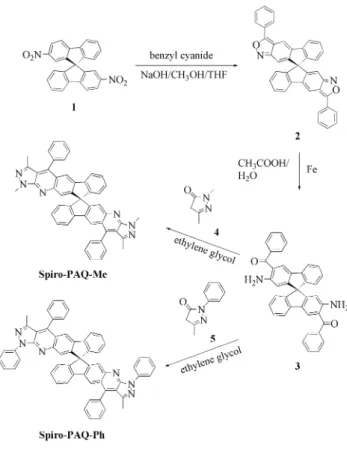
Scheme 1 illustrates the synthetic route followed for the preparation of the 9,9’-spirobifluorene-functionalized bis(pyrazoloquinoline)s. The key intermediate, 2,2’-diamino-3,3’-dibenzoyl-9,9’-spirobifluor-ene (3), was prepared from 2,2’-dinitro-9,9’-spirobifluor2,2’-diamino-3,3’-dibenzoyl-9,9’-spirobifluor-ene (1) as
reported previously.36The reaction of compound 1 with benzyl
nitrile in the presence of base afforded the bisbenzisoxazole 2, which was subsequently transformed into the bis(o-aminoke-tone) 3 by hydrogenation of the isoxazole moiety with an iron powder/acetic acid mixture. The condensation of 3 with pyrazolone derivatives 4 and 5, respectively, in ethylene glycol yielded the target bis(pyrazoloquinoline)s spiro-PAQ-Me and spiro-PAQ-Ph, each containing a 9,9’-spirobifluorene skeleton. The chemical structures of the obtained
spiro-bis(pyrazoloquinoline)s were confirmed by1H and13C NMR
spectroscopy, mass spectrometry, and elemental analysis. Optical properties
Fig. 1a displays the absorption and emission spectra of the spiro-PAQ dyes in EtOAc; their spectral data are summarized in Table 1. The absorption spectrum of spiro-PAQ-Me comprises a broad, low-energy absorption at ca. 420 nm, two weak absorptions in the region 340–360 nm, and a strong main absorption centered at 288 nm. In going from the methyl(spiro-PAQ-Me) to the phenyl-substituted (spiro-PAQ-Ph) bis(pyr-azoloquinoline), there is a slight red-shift (2–6 nm) in position of the peak maximum, which is due to the increase in conjugation length. The features of these absorption spectra resemble those of the mono-pyrazoloquinoline (i.e. non-spiro)
derivatives that have been described previously.12These
spiro-PAQ dyes exhibit strong blue emissions: spiro-spiro-PAQ-Me displays an emission peak at 438 nm and a substitution effect, similar to that described above, is observed for the emission maximum; i.e. spiro-PAQ-Ph has an emission peak at 455 nm. We determined the solution fluorescence quantum
Scheme 1
yields (Wf), 0.67 for the former and 0.95 for the latter, relative
to that of 9,10-diphenylanthracene in cyclohexane (Wf ~
0.90).40 In comparison with their corresponding spectra in
dilute solutions, the emission spectra of films of these spiro-PAQ derivatives, which were prepared by spin-coating on a glass substrate, are broadened and red-shifted by 30–35 nm. This phenomenon probably is due to the formation of inter-molecular species, namely aggregates and excimers, in the solid state.
Thermal properties
We investigated the thermal properties of the spiro-bis(pyr-azoloquinoline)s by differential scanning calorimetry (DSC) and thermogravimetric analysis (TGA). DSC was performed in
the temperature range from 40 to 400uC. Distinct glass
transi-tion temperatures (Tg) were observed at 246 and 280uC for
spiro-PAQ-Me and spiro-PAQ-Ph, respectively. Yet no crystallization or melting of the sample was observed up to
400uC. In contrast, most of the monomeric PAQ dyes reported
previously either do not exhibit a glass transition or have a low
value of Tg (30–60 uC).19,20 The prominent stability of the
amorphous glass states of these spiro molecules may be due to the presence of their rigid, spiro-fused, orthogonal bifluorene linkages. In addition, the higher molecular weights of the bis(pyrazoloquinoline)s, relative to those of their monomers, may also play a role in raising their glass transition tem-peratures. Also evidenced by thermogravimetric analysis, both spiro-PAQ-Me and spiro-PAQ-Ph exhibit high thermochemi-cal stability, with their 5%-weight-loss temperatures under a
nitrogen atmosphere at 410uC for the former and 512 uC for
the latter. Apparently the introduction of spirobifluorene unit effectively improves both morphological and chemical stability of the pristine pyrazoloquinoline compounds.
Electrochemistry
We investigated the electrochemical behavior of the spiro-PAQ dyes by cyclic voltammetry using ferrocene as the internal standard. The results are displayed in Fig. 2 and the data are tabulated in Table 2. Cyclic voltammetry provides a simple method for obtaining the HOMO/LUMO energy levels of these materials, which we calculated with regard to the energy level
of the ferrocene reference (4.8 eV below the vacuum level).41
Upon cathodic scans, spiro-PAQ-Me and spiro-PAQ-Ph exhibit reversible reductions with onset potentials at ca. 22.09 and 22.00 V, respectively. During the anodic sweep, they undergo quasi-reversible oxidation processes with onset potentials at 0.87 V for the former and 0.86 V for the latter. Based on the onset potentials for the oxidation and reduction processes, we estimate the HOMO and LUMO energy levels of the spiro-PAQ dyes, which are summarized in Table 2. Also included in the Table is the band gap calculated from the absorption edge. A small deviation (0.13 eV or less) from the band gap calculated from electrochemical data is observed. The low-lying LUMO energy levels, which originate from the electron-deficient nature of the pyrazoloquinoline ring, are
similar to those reported for dipyrazolopyridine derivatives.21
Electroluminescent devices
To investigate the electroluminescence properties of the spiro-bis(pyrazoloquinoline)s, we selected spiro-PAQ-Ph, which has the higher PL quantum yield and better thermal properties, for the OLED fabrication. We fabricated multilayer devices with
Fig. 1 UV–Vis absorption and PL spectra of spiro-PAQ-Me (—) and
spiro-PAQ-Ph (– – –) (a) in EtOAc solution and (b) in the solid state.
Table 1 Spectral data of spiro-pyrazoloquinolines
lmaxa/nm lem,b/nm lmax/nm (film)c Quantum yields (W)a,d
Spiro-PAQ-Me 288, 340, 358, 398, 420 438 466, 501 (sh) 0.67
Spiro-PAQ-Ph 294, 342, 361, 402, 422 455 490 0.95
a
In EtOAc.bIn EtOAc, excited at 360 nm.cSpin-coating from their CHCl3solution, excited at 360 nm.
d
The relative quantum yield was mea-sured with reference to 9,10-diphenylanthracene in cyclohexane (W ~ 0.90).
Fig. 2 Cyclic voltammograms of spiro-PAQ-Me and spiro-PAQ-Ph.
Table 2 Electrochemical properties of spiro-pyrazoloquinolines
Eonsetox/Va Eonsetred/Va HOMO/eVb LUMO/eVc Egel/eVd Egopt/eVe
Spiro-PAQ-Me 0.87 22.09 5.67 2.71 2.96 2.83
Spiro-PAQ-Ph 0.86 22.00 5.66 2.80 2.86 2.81
a
Potential values referenced vs. Fc/Fc1. b
Determined from the onset oxidation potential.cDetermined from the onset reduction potential.
dElectrochemical band gap, estimated using the equation E
gel~ Eonsetox2 Eonsetred.eOptical band gap, calculated from the absorption edge
of the absorption spectrum.
the configuration ITO/NPB (40 nm)/CBP (10 nm)/TPBI: x% spiro-PAQ-Ph (20 nm)/TPBI (20 nm)/Mg : Ag, where ITO, NPB, CBP, TPBI, and Mg:Ag denote indium tin oxide; 4,4’-bis[N-(1-naphthyl)-N-phenylamino]biphenyl;
4,4’-dicarba-zolyl-1,1’-biphenyl;
2,2’,2@-(benzene-1,3,5-triyl)tris[1-phenyl-1H-benzimidazole]; and magnesium : silver alloy (ca. 10 : 1), respectively. Fig. 3 displays the relative HOMO/LUMO energy levels of NPB, CPB, TPBI, spiro-PAQ-Ph, and the other materials used in this study. Two layers of hole-transporting materials, NPB and CBP, were used because it has been demonstrated previously that CBP serves to provide an intermediate HOMO level by which holes can pass to the
TPBI layer.42,43TPBI was chosen as a host material for the
PAQ-Ph derivative because it is a wide band-gap material that
emits strongly at ca. 376 nm.42 From the analysis of the
emission/absorption spectra of TPBI and spiro-PAQ-Ph (Fig. 1), we obtained reasonable spectral overlap and, thus, there exists an efficient Forster energy transfer from TPBI and the PAQ-Ph dye.
When the concentration of spiro-PAQ-Ph in TPBI was
varied from 1.0 to 5.0 wt%; EL emission with a lmaxaround
460 nm was observed, together with a shoulder of different intensity depending on the concentration, as shown in Fig. 4. In the absence of dopant, the device presents a broad EL spectrum that has a major contribution from TPBI (ca. 380 nm), a minor contribution from NPB (ca. 450 nm), and possibly an emission
from CBP, which occurs at ca. 390 nm.32 This observation
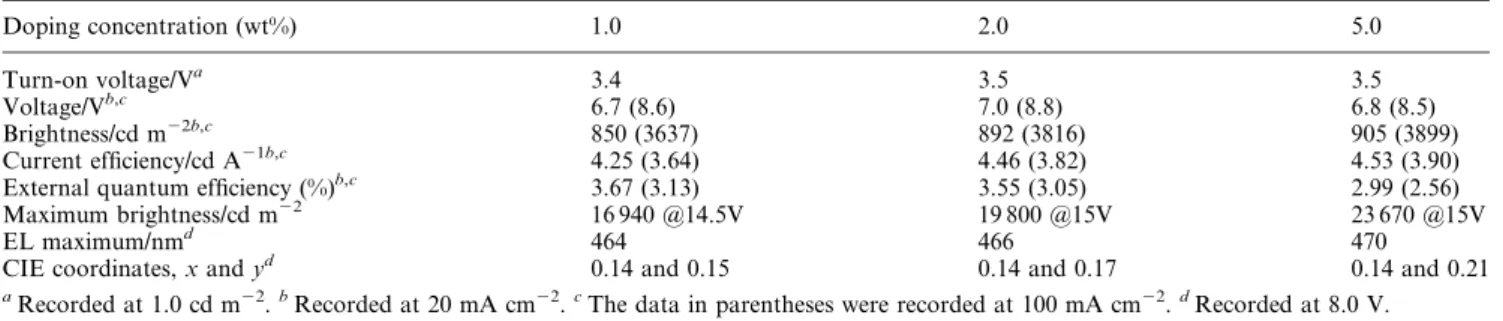
indicates that the recombination region is located mainly in the TPBI region with some excitons formed in the NPB area. At dopant concentrations of 1.0–2.0 wt%, the devices exhibit bright blue emissions, predominantly arising from the dopant, as revealed from a comparison of the EL spectra with the PL spectrum of spiro-PAQ-Ph, together with a very minor con-tribution from the emission of TPBI host that is due to the incomplete energy transfer. Increasing the doping level to 5.0 wt% results in complete energy transfer. The performances of the devices are summarized in Table 3, and the current– voltage–luminance (I–V–L) characteristics of the device having a 2.0-wt% dopant concentration is presented in Fig. 5. For this 2.0%-doped device, the emission begins at ca. 3.5 V and reaches
a maximum luminescence of 19 800 cd m22at ca. 15 V. With a
current density of 20 mA cm22at 7.0 V, the device displayed
high external quantum and luminescence efficiencies of 3.6%
and 4.5 cd A21(2.02 lm W21), respectively, with CIE
coordi-nates of x ~ 0.14 and y ~ 0.17. We note that the external quantum efficiency drops when increasing the dopant con-centration from 2.0 to 5.0 wt%. This finding may be due to self-quenching of the dopant emission at higher concentration, but the external quantum efficiency still remains at ca. 3.0%.
Conclusions
In summary, we have synthesized spirobifluorene-based pyra-zoloquinolines, spiro-PAQ-Me and spiro-PAQ-Ph, by the condensation of 2,2’-diamino-3,3’-dibenzoyl-9,9’-spirobifluo-rene (3) with pyrazolone derivatives, and have discussed details of their thermal properties, electronic properties (viz. absorp-tion and photoluminescence), and electrochemical behavior. The presence of the rigid spirobifluorene skeleton imparts
Fig. 3 Relative HOMO/LUMO energy levels of NPB, CPB, TPBI,
spiro-PAQ-Ph, and other materials used in this study.
Fig. 4 Normalized electroluminescence spectra of ITO/NPB/CBP/
TPBI:spiro-PAQ-Ph (x-wt%)/TPBI/Mg:Ag devices. The applied vol-tage was ca. 8.0 V.
Fig. 5 Current–voltage characteristics and luminescence–voltage
characteristics of an ITO/NPB/CBP/TPBI: spiro-PAQ-Ph (2.0-wt%)/ TPBI/Mg:Ag device.
Table 3 Performance of ITO/NPB/CBP/TPBI:spiro-PAQ-Ph (x-wt%)/TPBI/Mg:Ag devices
Doping concentration (wt%) 1.0 2.0 5.0
Turn-on voltage/Va 3.4 3.5 3.5
Voltage/Vb,c 6.7 (8.6) 7.0 (8.8) 6.8 (8.5)
Brightness/cd m22b,c 850 (3637) 892 (3816) 905 (3899)
Current efficiency/cd A21b,c 4.25 (3.64) 4.46 (3.82) 4.53 (3.90)
External quantum efficiency (%)b,c 3.67 (3.13) 3.55 (3.05) 2.99 (2.56)
Maximum brightness/cd m22 16 940 @14.5V 19 800 @15V 23 670 @15V
EL maximum/nmd 464 466 470
CIE coordinates, x and yd 0.14 and 0.15 0.14 and 0.17 0.14 and 0.21
a
Recorded at 1.0 cd m22.bRecorded at 20 mA cm22.cThe data in parentheses were recorded at 100 mA cm22.dRecorded at 8.0 V.
significant increases in these materials’ glass transition tem-peratures, while preserving the optical and electrochemical characteristics of their pristine pyrazoloquinoline units. Multi-layer EL devices having ITO/NPB/CBP/TPBI:spiro-PAQ-Ph/ TPBI/Mg:Ag configurations display bright blue emissions, with
luminescence intensities exceeding 20 000 cd m22, caused by the
spirobifluorene-based pyrazoloquinoline dopant. At a 2.0 wt% doping level, the device possesses good blue purity, with an EL emission maximum at 466 nm, which corresponds to (0.14, 017) blue chromaticity in CIE coordinates, and exhibits a high
luminescence efficiency of 4.5 cd A21 (2.02 lm W21) at a
current density of 20 mA cm22and a voltage of 7.0 V.
Acknowledgements
We thank the National Science Council of the Republic of China for financial support.
References
1 C. W. Tang and S. A. Van Slyke, Appl. Phys. Lett., 1987, 51, 913.
2 Organic Electroluminescent Materials and Devices, ed. S. Miyata
and H. S. Nalwa, Cordon and Breach Publishers, New York, 1997.
3 C. H. Chen, J. Shi and C. W. Tang, Macromol. Symp., 1997, 125,
1.
4 C. H. Chen, J. Shi and C. W. Tang, Coord. Chem. Rev., 1998, 171,
161.
5 U. Mitschke and P. Bauerle, J. Mater. Chem., 2000, 10, 1471.
6 L. S. Hung and C. H. Chen, Mater. Sci. Eng., R., 2002, 39, 143.
7 J. Kido, K. Hongawa, K. Okuyama and K. Nagai, Appl. Phys.
Lett., 1994, 64, 815.
8 J. Kido, H. Shionoya and K. Nagai, Appl. Phys. Lett., 1995, 67,
2281.
9 F. C. Chen, Y. Yang, M. E. Thompson and J. Kido, Appl. Phys.
Lett., 2002, 80, 2308.
10 G. Gu and S. R. Forrest, IEEE J. Sel. Top. Quantum Electron.,
1998, 4, 83.
11 Z. Yan and S. K. Wu, J. Photochem. Photobiol., 1992, 66, 69.
12 Z. He, G. H. W. Milburn, K. J. Baldwin, D. A. Smith, A. Danel
and P. Tomasik, J. Lumin., 2000, 86, 1.
13 J. Niziol, A. Danel, G. Boiteux, J. Davenas, B. Jarosz, A. Wisla
and G. Seytre, Synth. Met., 2002, 127, 175.
14 X. C. Gao, H. Cao, L. Q. Zhang, B. W. Zhang, Y. Cao and
C. H. Huang, J. Mater. Chem., 1999, 9, 1077.
15 Z. He, G. H. W. Milburn, A. Danel, A. Puchala, P. Tomasik and
D. Rasala, J. Mater. Chem., 1999, 9, 2323.
16 Z. Q. Gao, C. S. Lee, I. Bello, S. T. Lee, S. K. Wu, Z. L. Yan and
X. H. Zhang, Synth. Met., 1999, 105, 141.
17 E. Balasubramaniam, Y. T. Tao, A. Danel and P. Tomasik, Chem.
Mater., 2000, 12, 2788.
18 X. H. Zhang, W. Y. Lai, Z. Q. Gao, T. C. Wong, C. S. Lee,
H. L. Kwong, S. T. Lee and S. K. Wu, Chem. Phys. Lett., 2000, 320, 77.
19 Y. T. Tao, E. Balasubramaniam, A. Danel, A. Wilsla and
P. Tomasik, J. Mater. Chem., 2001, 11, 768.
20 Y. T. Tao, E. Balasubramaniam, A. Danel, B. Jarosz and
P. Tomasik, Chem. Mater., 2001, 13, 1207.
21 Y. T. Tao, C. H. Chuen, C. W. Ko and J. W. Peng, Chem. Mater.,
2002, 14, 4256.
22 R. Wu, J. S. Schumm, D. L. Pearson and J. M. Tour, J. Org.
Chem., 1996, 61, 6906.
23 S. C. Wu and C. F. Shu, J. Polym. Sci., Part A: Polym. Chem.,
2003, 41, 1160.
24 J. Salbeck, N. Yu, J. Bauer, F. Weisso¨rtel and H. Bestgen, Synth.
Met., 1997, 91, 209.
25 J. Salbeck, J. Bauer and F. Weisso¨rtel, Macromol. Symp., 1997,
125, 121.
26 N. Johansson, D. A. dos Santos, S. Guo, J. Cornil, M. Fahlman,
J. Salbeck, H. Schenk, H. Arwin, J. L. Bre´das and W. R. Salenek, J. Chem. Phys., 1997, 107, 2542.
27 N. Johansson, J. Salbeck, J. Bauer, F. Weisso¨rtel, P. Bro¨ms,
A. Andersson and W. R. Salaneck, Adv. Mater., 1998, 10, 1136.
28 H. Tian, B. Chen and P. –H. Liu, Chem. Lett., 2001, 990.
29 W. J. Shen, R. Dodda, C. C. Wu, F. I. Wu, T. H. Liu, H. H. Chen,
C. H. Chen and C. F. Shu, Chem. Mater., 2004, 16, 930.
30 M. D. Joswick, I. H. Cambell, N. N. Barashkov and J. P. Ferraris,
J. Appl. Phys., 1996, 80, 2883.
31 S. Tokito, H. Tanaka, K. Noda, A. Okada and Y. Taga, Appl.
Phys. Lett., 1997, 70, 1929.
32 B. E. Konne, D. E. Loy and M. E. Thompson, Chem. Mater.,
1998, 10, 2235.
33 D. F. O’Brien, P. E. Burrows, S. R. Forrest, B. E. Konne, D. E. Loy
and M. E. Thompson, Adv. Mater., 1998, 10, 1108.
34 F. Steuber, J. Staudigel, M. Sto¨ssel, J. Simmerer, A. Winnacker,
H. Spreitzer, F. Weisso¨rtel and J. Salbeck, Adv. Mater., 2000, 12, 130.
35 Y. Shirota, J. Mater. Chem., 2000, 10, 1.
36 C. L. Chiang and C. F. Shu, Chem. Mater., 2002, 14, 682.
37 F. I. Wu, R. Dodda, D. S. Reddy and C. F. Shu, J. Mater. Chem.,
2002, 12, 2893.
38 J. H. Weisburger, E. K. Weisburger and F. E. Ray, J. Am. Chem.
Soc., 1950, 72, 4253.
39 J. Shi, C. W. Tang and C. H. Chen, U.S. Patent 5,645,948,/1997.
40 D. Eaton, Pure Appl. Chem., 1998, 60, 1107.
41 J. Pommerehne, H. Vestweber, W. Guss, R. F. Mahrt, H. Ba¨ssler,
M. Porsch and J. Daub, Adv. Mater., 1995, 7, 551.
42 Y. T. Tao, E. Balasubramaniam, A. Danel and P. Tomasik, Appl.
Phys. Lett., 2000, 77, 933.
43 Z. Zhang, X. Jiang and S. Xu, Thin Solid Films, 2000, 363, 61.