Automation Power Energy Management Strategy
for Mobile Telecom Industry
Jung-Chin Chen', Jong-Ching Hwang', Jeng-Shyang Pan
2,and Yi-Chao Huang
3 IDept. of Electrical Eng., National Kaohsiung University of Applied Sciences, Taiwan 2Dept. of Electronic Eng., National Kaohsiung University of Applied Sciences, Taiwan 3Dept. of Industrial Management, Pingtung University of Science and Technology, TaiwanE-mail: [email protected]
Abstract - The aim of this research is to study the power
energy cost reduction of the mobile telecom industry through the
supervisor control and data acquisition (SCADA) system
application during globalization and liberalization competition.
Yet this management system can be proposed functions:
operating monitors, the analysis on load characteristics and dropping the cost of management.
I. INTRODUCTION
With the rapid growth of industrial and commercial as well as the living standards, the energy sales of Taiwan Power Company (TPC) increase year by year that results in the insufficient capacity of reserved power supply. It is therefore that the power-rationing crisis could occur in the summer on-peak loading. This will definitely cause inconvenience for the industrial and commercial sectors and affect the civil life, and then the doubt and complaint toward the each procedure implemented by TPC. Thus it is urgent to alleviate the power-rationing pressure through load management (LM) strategies in reducing the power demand of on-peak hours [1]-[3].
In tandem with the draft of electric rate incentive package, the LM strategy includes the beneficial rate in time of use (TOU) rate and interruptible load procedure with respect to current electric rate and demand charge. Both customer and TPC regard the rate as the production cost index. TPC sets up the reasonable rate structure based on the cost of supply side and the characteristics of demand side. By doing so, the rate of on-peak and off-peak hours is drawn up to reflect the power production cost in different power supply periods. The LM option is applied to cope with the power consumption characteristics of customer in demand side [1]-[2].
Generally, the implementation of LM centers on price strategy. The goal of price strategy can be achieved by applying various communication and control equipments plus the control of customer load and techniques of changing the power consumption ratio between peak and off-peak hours [2]. Yet, the comprehensive and general rates in price strategy such as demand charges and TOU rates are more complicated. Besides it can be applied to a great number of customers and should not be changed regularly or drastically. The power industries in the advanced countries adopt localization and selective policy. The target is set on the customers of huge power consumption and high power costs. With price incentives, the result of flexible use of power system and resource as well as LM can be attained. This is similar to the rate policy adopted by TPC.
The foreign load research places emphasis on load forecasting and demand side management mainly as the standing and policy of power supply industry [4]-[5]. It is rate to study power consumption characteristics for the individual industry and provide an effective LM measures in assisting the industry to save rate cost. In this paper, through the management on demand side, it is hoped that effective LM strategies can be implemented to reduce power energy costs and ultimately boost the competitiveness.
II. A SCADA MANAGEMENT FRAMEWORK
Taiwanese telecom industry encounters the difficult of operation and management due to the dispersing of many mobile stations and telecom building in different areas. Therefore it is the important policy for telecom industry that how to draft an effective automation operation method and to drop the cost of management and human resource. The aim of this research is to study the automation operation and power energy management through the SCADA system application, during globalization, privatization and liberalization competition. Results indicated that the SCADA system has been highly willing to telecom industry in the development of power supply quality and to drop the operation and management cost. Also this research aims at measuring the benefit on SCADA system and to provide decision-makers with useful automation strategies as reference.
A SCADA system generally refers to an industrial control system: a computer system monitoring and controlling a process. The process can be industrial, infrastructure or facility. A SCADA system management framework refers to the servers and software responsible for communicating with the field equipment (RTUs, TPs, etc), and then to the Human-Machine Interface (HMI) software running on workstations in the control room. It is included: Centering Processor (CP),Terminal Processor (TP), Remote Terminal Unit (RTU), Sensors and Transducer. RTU provides the interface of monitor and control in SCADA system [6]. Data collection from SCADA system, the power consumption ratio of each process and power consumption of major equipment in the mobile and telecom industry can be analyzed to cope with LM procedure.
In Fig.1 applied the mix transmission network frame to manage the dispersing of many mobile stations and telecom building in different areas. The Dialup Modem and General Packet Radio Service (GPRS) are applied in Basic Station
(BS) transmission network, and the function is shown as follows.
I)The equipment's alarm message and data upload to RTU, through RS232/485 and Line/Modem.
2) RTU received message and to TP through General Packet Radio Service (GPRS), TCP/IP, RS232 /485, Line/Modem, and Dial-up method.
3) TP use TCP/IP, RS232 /485, and Line to CP and operator management center (OMC).
r~-
O n - pea~
Orf- pea k 8 000 0 0 6 000 0 0 10 000 0 0IV. THE POWER ENERGY MANAGEMENT STRATEGIES This section describes the information collection, willingness of participating LM options for the mobile industry and then the power energy management strategies [7]-[12].It includes (I) the implementation of TOU rate (2) the participation of interruptible load rate (3) the load demand control automatic control (4) the implementation of optimal demand contract (5) automatic power factor compensation.
A. The Analysis ofthe TOU Rate
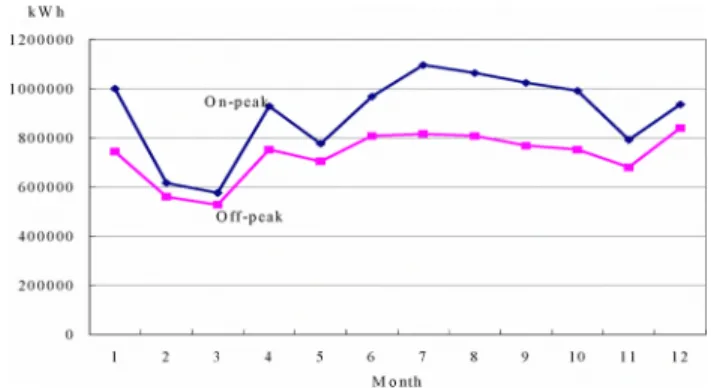
The on-peak hours load ratio of sampling customer is within 60% - 80%. It indicates that this type of customer favorites to use electricity during on-peak time. Therefore most of customers can save expenditure of energy rate by TOU rate. Fig. 2 depicts that the monthly power consumption of sampling customer. It indicates that on-peak power consumption is higher than off-peak power consumption. For instance, on-peak power consumption in July is more than off-on-peak power consumption by 300,000 kWh. The analysis of power consumption characteristics of sampling customer is as follows.
-IO(lOOO f - -- - - j
benefit of reduced power costs.
k W h 12 000 0 0 r -- - - ----, Intern et Fixed Netwo r k OMC Room I I i J
Fig. I Themix type transmission network 2 000 0 0 f - -- - - j
In 1 1 12
111. THE RESEARCH METHOD
This section will study and analyze the rate policy of TPC. Afterwards the power consumption status of customer is observed through its daily load curve. In the meantime the electricity rate of customer is served to evaluate its potentiality in the LM participation [7]-[8]. The methods & steps are as follows:
1. The power consumption characteristics of different processing equipment can be summarized through the rigid survey and analysis power consumption characteristics. 2. Data collection from SCADA system, the power
consumption ratio of each process and power consumption of major equipment can be analyzed to cope with power energy management procedure.
3. Through gathering the monthly power consumption and on-peak & off-peak load, the potentiality introducing of power energy management will be evaluated its potentiality in tune with the rate incentive package.
4. To determine the power energy management strategy for the mobile industry. According to the power consumption characteristics of different process, the great potentiality of the LM methods can be introduced.
5. Itis hoped that the proposed suggestion will be adopted by the telecom industry to implement LM to achieve the
Mo nt h
Fig. 2 The monthly power consumption of On-peak and Off- peak Hours
B. The Analysis ofthe Optimal Demand Contract
With the rapid growth of air conditioner load, the peak loading of customers in summer daytime increases dramatically and the condition of peak loading in the 15-minute leading demand contract become more serious. According to electricity price system of TPC, customers are asked to pay extra cost based on the portion of basic fee in case the peak loading is higher than that stated in demand contract. Although the inappropriate high demand contract can avoid the occurrence of the previous stated problem, it will result in another problem, higher basic electricity fees. The basic idea of an optimal demand contract strategy is to derive a better demand contract so that annual basic electricity cost can be minimized. In other words, the maximum demand is measured by IS-minutes in average. In case customers' actual maximum demand is in excess of that stated in the contract, the demand charge of an excess within 10% of the contracted capacity is twofold of the electricity rate stated in the contract, and an excess of over 10% renders threefold of the stated electricity rate.
For those customers who adopt regular (non-TOU) rate under maximum demand contract, the regular contracted demand is set according to the agreement between the
Power Factor
VI. REFERENCES
[I] Bureau Energy,Ministry of Economic Affairs of USA, White book, ch.4, 19986.
[2] M. L. Chan, Load Management Master Plan for Taiwan Power
Company.Sunnyvale, CA: ML Consulting Group, 1996.
[3] Lab of load management, Institute of Power Research, TPC, The Technologic Platform of Energy Management and Service for Customers, 2002.
[4] M. S. Kang, C. S. Chen, Y.L.Ke, C. H. Lin, C. W. Huang, "Load Profile Synthesis and Wind -Power-Generation Prediction for An Isolated Power System," IEEE Trans. on Industry Applications , Vol. 43, No.6, November/December 2007, pp. 1459-1464.
[5] Lee,T.Y. and N.chen ,"Optimal Utility Contracts for Time-of-Use Rates Industrial customers", Journal of the Chinese Institute of Electrical Engineering, Vol.1,No.4 , pp.247-257, (1994).
[6] "Supervisor Control and Data Acquisition System Maintenance Book", Control-Net International INC, 2000.
V. CONCLUSIONS AND SUGGESTIONS
1. The telecom industry is much willing to participate in the TOU rate package. Also the sampling customer is willing to install the automatic load demand controller and to decrease power energy cost and boost the competitiveness eventually. 2. It is recommended that the customer should adopt the load
demand control to automatically adjust load as long as the load consumption varies so that the peak load won't exceed the demand contract.
3. It is suggested that the customer should review the ratio between current capacity and demand contract in order to decrease the demand contract or participate in the interruptible rate package for the reduction of demand charge.
4. The sampling customer is willing to install the SCADA system, although initial investment need extra cost. Also this research will be adopted by the telecom industry to implement SCADA system decrease rate expenditure and to reduce human cost.
5. Results indicated that the SCADA system has been highly willing to telecom industry in the development of power supply quality and to drop the operation and management cost. Also this research aims at exploring the benefit on power energy management options and to provide decision-makers and leaders with useful operation and management strategies as reference.
6. Itis also desired that a feasible LM strategy is developed to assist other industries customer to reduce power energy cost and to increase the competitive capability.
. /
--...
. / <,
. / <,
./
...
../
[7] Chen, C.L.,Chen , N., "Multi-area Economic Generation and Reserve Dispatch," Proceedings IEEE PICA Conference , pp. 368-373 (2001). [8] Lee,T.Y. and N.chen,"Optimal Utility Contracts for Time-of-Use
Rates Industrial customers", Journal of the Chinese Institute of Electrical Engineering, Vol.1,No.4, pp.247-257 , (1994) .
[9] Lin, W. M., Cheng , F. S., and Tsay, M. T., "An Improved Tabu Search for Economic Dispatch with Multiple Minima, "IEEE Trans.
on Power Systems, Vol. 17, No. I, pp. 108-112 (2002).
[I 0] Yang, H. T., Yang, P. C., and Huang , C. L., "Evolutionary Programming Based Economic Dispatch for Units with Non-smooth Fuel Cost Functions , " IEEE Trans.on Power Systems, Vol.I I, No. I, pp. 112-118 (1996).
[II] Hsiao, H.C., C.Y. Hsiao, M.C. Lin, Q.F. WU and T.C. Chan, "Forecasting the Optimal Contract Capacitie s in Industrial Distribution Systems," Proceeding of the IIthSymposium on Electrical Power Engineering, pp.2I5-220, December (1990).
[12] Yang, C.G., R.T. Shu and G.K. Yang, "Load Management, Determination for the Optimal Contract Capacities ," Load Management PartII ,Taiwan Power Compan y Internal Report, pp.I05-122, May (1991) .
[I3] Gaing, Z.L.,"Particle Swarm Optimization to Solving the Econom ic Dispatch Considering the Generator Constraints , "IEEE Trans. on Power Systems, Vol.18, No. 3,pp.1I87-1195 (2003).
[14] Chang , J.-F., S.-C. Chu, J. F. Roddick and 1.-S. Pan, A parallel article swarm optimization algorithm with communication strategies, Journal of Information Science and Engineering , vol.2I , no.4, pp.809-8I8, 2005.
[I5] AI. Cohen , "An Optimization Method For Load Management Scheduling ", IEEE Trans. on Power Systems, Vol.3, No.2, pp.6I2-618, May, 1988.
[16] J.Chen, F.N. Lee, AM. Bre iphl, and R.Adapa, "Scheduling Direct Load Control to Minimize System Operation Cost", IEEE Trans . on Power Systems, Vo1.10, No.4, pp.I994-2000, November, 1995. [17] D.C. Wei and N. Chen, "Air Condit ioner Direct Load Control By
Multi-pas s Dynam ic Programming ", IEEE Trans. on Power Systems, Vol. 10, No. I,pp.307-313, February, 1995.
[I 8] Y.Y. Hsu and C.C. Su, "Dispatch of Direct Load Control Using Dynamic Programm ing", IEEE Trans. on Power Systems, Vo1.6, No.3, pp.I056-I060, August, 1991.
[19] Chu, W.C., Chen, B.K., and Fu, C.K, "Scheduling of direct load control to minimize load reduction for a utility suffering from generation shortage", IEEE Trans, PWRS-8 , (4), pp.I525-I530, 1994. [20] Lin, W. M., Cheng , F. S., and Tsay, M. T., "An Improved Tabu
Search for Economic Dispatch with Multiple Minima, "IEEE Trans.
on Power Systems, Vol. 17, No. I, pp.I08-112,2002.
[21] Y. C. Chang and H. C. Tu, "An effective method for reducing power consumption-optimal chiller load distribution ," inProc. IEEE Power Control,2002, vol. 2, pp. I 169-I 172.
[22] K.Y. Huang and Y. C. Huang, " Integrating direct load control with interruptible load management to provide instantaneous reserves for ancillary services ,"IEEE Trans. Power Syst.,vol. 19, no. 3, pp. 1626-1634, Aug. 2004 .
[23] Lee,T. F., Cho, Y. M., Hsiao, Y. C., Chao, P. 1., and Fang, F. M., "Optimization and Implementation of a Load Control Scheduler Using Relaxed Dynamic Programming for Large Air Conditioner Loads,"
IEEE Trans.on Power Systems , Vol. 23, No.2, pp.69I-703 ,2008. [24] A Fernandez , J. Sebastian , P. Villegas, M.M. Hernando , D.G. Lamar,
"Dynamic limits of a power-factor preregulator ,' IEEE Trans. on Industrial Electronics,vol. 52, no. I, pp. 77- 87, Jan 2005.
[25] Sudipta Chakraborty, Manoja D. Weiss, M. Godoy Simoes,
"Distributed Intelligent Energy Management System for a Single-Phase High-Frequency AC Microgrid ,' IEEE Trans. on Industrial Electronics,vol. 54, no. I, pp. 97-109, Jan 2007.
Customer D Customer C Customer B Customer A 0.92 0.9 0.88 0.86 0.84 0.82 0.8 0.78 0.76 0.74