
前導組織對影片教學聽力理解的成效—圖像語境線索vs.文字語境關鍵 - 政大學術集成
119
0
0
全文
(2) Effects of Two Advance Organizers on Listening Comprehension in Video Viewing— Pictorial Contextual Cues versus Verbal Contextual Keys. 立. 政 治 大 A Master Thesis. ‧ 國. 學. Presented to. Department of English,. ‧ y. Nat. n. al. er. io. sit. National Chengchi University. Ch. engchi. i n U. v. In Partial Fulfillment of the Requirements for the Degree of Master of Arts. by Hsiu-Fan Chang June, 2013.
(3) To Dr. Shu-Chen Huang 獻給我的恩師黃淑真博士. 立. 政 治 大. ‧. ‧ 國. 學. n. er. io. sit. y. Nat. al. Ch. engchi. iii. i n U. v.
(4) Acknowledgements My deepest and warmest thanks to Dr. Shu-Chen Huang, Director of the Foreign Language Center of National Chengchi University, for her useful comments, brilliant remarks, and inspiring advice throughout my research of this work. I could not. 政 治 大. complete this thesis without her support and guidance. Also, I would like to express. 立. my gratitude to the committee members, Dr. Chieh-Yue Yeh and Dr. Wei-Yu Chen. ‧ 國. 學. for their careful reading of the manuscript and helpful suggestions.. ‧. Furthermore, I would love to show my appreciation to the dear classmates in the. Nat. io. sit. y. Master of Arts in English Teaching Program at National Chengchi University,. er. especially Hsiao-chun Huang, Mandy Peng, and Ellie Chang. Unforgettable summers. al. n. v i n spent with them on campus C were h filled e n gwithc warmth, h i U laughter, and encouragement. Last but not least, deepest gratitude and love for my most supportive parents,. sisters, and my beloved companion, Ebi Wang. Thank them for always being there for me, and keeping company with me in this exhausting but memorable journey of thesis writing.. iv.
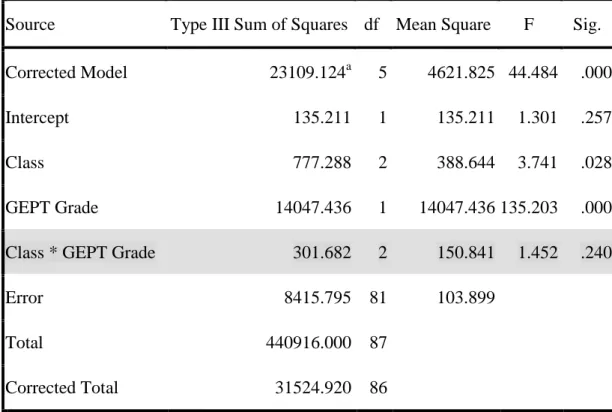
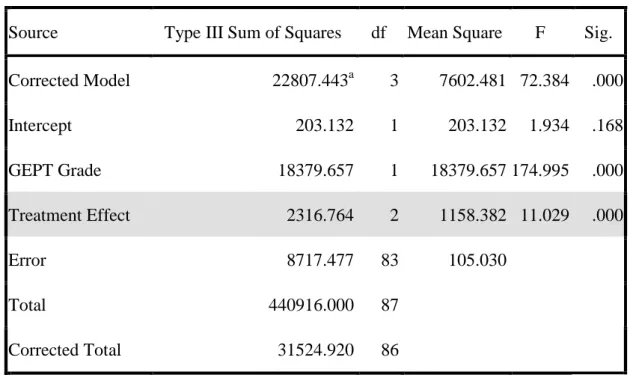
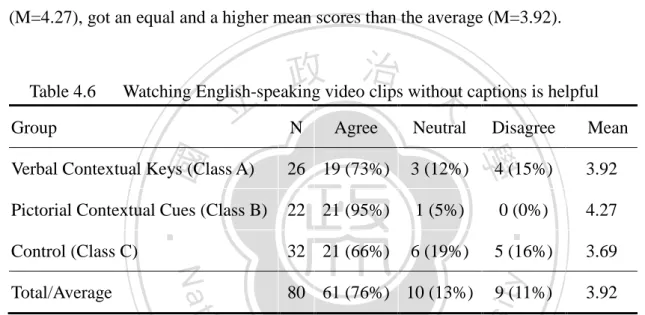
(5) Table of Contents Acknowledgements ....................................................................................................... iv Chinese Abstract ............................................................................................................ x English Abstract ........................................................................................................... xii Chapter One: Introduction ......................................................................................... 1 Background and Motivation ...................................................................................... 1 Purpose of the Study .................................................................................................. 4 Research Questions .................................................................................................... 5. 政 治 大. Significance of This Study ......................................................................................... 5. 立. Chapter Two: Literature Review ................................................................................ 9. ‧ 國. 學. Process of Listening Comprehension......................................................................... 9. ‧. Bottom-up Processing View and Top-down Interpretation View.......................... 10 Schema Theory ..................................................................................................... 12. y. Nat. sit. Using Authentic Video Materials in English Classroom ......................................... 14. n. al. er. io. Advance Organizer .................................................................................................. 17. i n U. v. Pictorial Advance Organizers ............................................................................. 19 Verbal Advance Organizers ................................................................................. 21. Ch. engchi. Chapter Three: Methodology.................................................................................... 25 Participants ............................................................................................................... 25 Instruments ............................................................................................................... 26 The Listening Comprehension Test—GEPT— .................................................... 26 intermediate listening comprehension section ..................................................... 26 Listening Comprehension of the Video -- Multiple-choice tests .......................... 27 Attitude questionnaire .......................................................................................... 28 Treatments ................................................................................................................ 29 Advance Organizer—verbal contextual keys ....................................................... 29 Control Group—using none of the two treatments .............................................. 30 v.
(6) Materials .................................................................................................................. 31 Family Album U.S.A. ........................................................................................... 31 Procedures ................................................................................................................ 32 Procedures for GEPT test .................................................................................... 34 Procedures for giving verbal contextual keys ...................................................... 34 Procedures for giving pictorial contextual cues .................................................. 34 Procedures for not using any treatments ............................................................. 35 Data Analysis ........................................................................................................... 36 Descriptive Statistic ............................................................................................. 36 ANCOVA .............................................................................................................. 36. 政 治 大 Test Results and the Statistical Analysis .................................................................. 37 立. Chapter Four: Results ............................................................................................... 37. ‧ 國. 學. Results of the Questionnaire .................................................................................... 42 Summary .................................................................................................................. 56. ‧. Chapter Five: Discussion and Conclusion ............................................................... 57. y. Nat. sit. Answers to the Research Questions ......................................................................... 57. n. al. er. io. Discussions of the Result ......................................................................................... 59. i n U. v. Pedagogical Implications of the Study .................................................................... 63. Ch. engchi. Limitations of the Study........................................................................................... 65 Suggestions for Further Research ............................................................................ 66 Conclusion ............................................................................................................... 68 Reference ..................................................................................................................... 69 Appendices ................................................................................................................... 77 APPENDIX A .............................................................................................................. 77 Scripts of Video Clip 1 ......................................................................................... 77 APPENDIX B .............................................................................................................. 79 Listening Comprehension Test 1 for Video Clip 1................................................ 79 vi.
(7) APPENDIX C .............................................................................................................. 80 Scripts of Video Clip 2 ......................................................................................... 80 APPENDIX D.............................................................................................................. 82 Listening Comprehension Test 2 for Video Clip 2................................................ 82 APPENDIX E .............................................................................................................. 83 Scripts of Video Clip 3 ......................................................................................... 83 APPENDIX F .............................................................................................................. 85 Listening Comprehension Test 3 for Video Clip 3................................................ 85 APPENDIX G.............................................................................................................. 86 20 Pictures Shown with 20 Descriptive Sentences for Video 1 ............................ 86. 政 治 大 20 Pictures Shown with 20 Descriptive Sentences for Video 2 ............................ 88 立. APPENDIX H.............................................................................................................. 88. APPENDIX I ............................................................................................................... 90. ‧ 國. 學. 20 Pictures Shown with 20 Descriptive Sentences for Video 3 ............................ 90 APPENDIX J ............................................................................................................... 92. ‧. Key Lines for Video 1 ........................................................................................... 92. sit. y. Nat. APPENDIX K.............................................................................................................. 93. io. er. Key Lines for Video 2 ........................................................................................... 93 APPENDIX L .............................................................................................................. 94. n. al. Ch. i n U. v. Key Lines for Video 3 ........................................................................................... 94. engchi. APPENDIX M ............................................................................................................. 95 Questionnaire (Chinese Version)—for Three Groups .......................................... 95 APPENDIX N............................................................................................................ 100 Questionnaire (English Version)—for Three Groups ......................................... 100. vii.
(8) List of Tables Table 2.1 Related Studies on Advance Organizers Instruction........................... 24 Table 3.1. Aids provided by the three treatments ............................................... 31. Table 4.1. Descriptive statistics of different advance organizers ......................... 38. Table 4.2. Tests of between-participants effects .................................................... 39. Table 4.3. Tests of between-participants effects .................................................... 40. Table 4.4. Results of Least Significant Difference ................................................. 41. Table 4.5 Extracurricular accesses to English listening ...................................... 43 Table 4.6. Watching English-speaking video clips without captions is helpful...44. Table 4.7. Watching English-speaking video with English captions is helpful ... 45. 政 治 大. Table 4.8 AOs can help gain English listening comprehension........................... 45. 立. Table 4.9 AOs can help understand video clips more .......................................... 46. ‧ 國. 學. Table 4.10 You like the practice of AOs before watching video .......................... 47 Table 4.11. ‧. Table 4.12. The perceived degree of listening comprehension without AOs ....... 48 The perceived degree of listening comprehension with AOs ............ 48. sit. y. Nat. Table 4.13 Reasons for not comprehending the conversation in video clips...... 49. io. er. Table 4.14 AOs that I’d like to receive before watching video clips ................... 50 Table 4.15. Whether AOs were helpful for video listening comprehension ........ 51. Table 4.16. Reasons for choosing “Yes” or “No” ................................................... 52. Table 4.17. The most suitable length of a video clip with a following test .......... 53. n. al. Ch. engchi. i n U. v. Table 4.18 Being willing to receive AOs as the aid for listening comprehension ...................................................................................................................................... 54 Table 4.19 Opinions and perceptions from respondents ..................................... 55. viii.
(9) List of Figures Figure 3.1. Procedures of the study ........................................................................ 33. Figure 3.2. Procedures of using three treatments in three classes ....................... 33. 立. 政 治 大. ‧. ‧ 國. 學. n. er. io. sit. y. Nat. al. Ch. engchi. ix. i n U. v.
(10) 國立政治大學英國語文學系碩士在職專班 碩士論文提要 論文名稱:前導組織對影片教學聽力理解的成效— 圖像語境線索 vs.文字語境關鍵 指導教授: 黃淑真博士 研究生: 張秀帆 論文提要內容:. 立. 政 治 大. 本研究旨在探討前導組織(advance organizer)教學對國中生英文聽力理解的. ‧ 國. 學. 影響。關於前導組織的實證研究為數眾多,其中不少分別針對圖像類(pictorial) 及文字類(verbal)前導組織對聽力促進、閱讀習得之效用做探討,未見有研究將. ‧. 兩類前導組織的效用一起比較。因此,本實驗採用此兩類前導組織,經量化研究. y. Nat. sit. 方法,探究「圖像語境線索」(Pictorial Contextual Cues)及「文字語境關鍵」(Verbal. n. al. er. io. Contextual Keys) 對國中生觀看無字幕英語發音影片時聽力理解的影響。. i n U. v. 研究對象為台灣北部一所國立高中之國中部三年級三個班的八十七位學. Ch. engchi. 生,三個班級皆採常態分班,經隨機指定為兩實驗組及一對照組。實驗歷時四個 禮拜,實驗前對三組受試者施以前測—GEPT中級聽力測驗—以得知受試者個別 的英文聽力程度。實驗後讓受試者填寫一態度問卷,以得知受試者對前導組織的 看法及感想。實驗時,觀看教學影片前,兩個實驗組及一個對照組分別接受「圖 像語境線索」(Pictorial Contextual Cues)、 「文字語境關鍵」(Verbal Contextual Keys) 及「無實驗處理」(No treatment),前導組織教學後隨即觀看一個約五分鐘長的無 字幕英語教學影片(instructional video)。影片觀看後,三組受試者隨即接受研究 者根據影片聽力內容自編的測驗,以得知受試者的理解程度。如此的實驗過程重 複三次,四個禮拜後,根據三個聽後測驗的結果進行統計分析,本研究主要發現 x.
(11) 如下:(1)整體而言,「圖像語境線索」與「文字語境關鍵」分別對國中生觀看 無字幕英文教學影片的聽力理解是有幫助的;(2)整體而言,「圖像語境線索」 與「文字語境關鍵」對國中生觀看無字幕英文教學影片的聽力理解,兩者間的效 用並無顯著差異;(3)大部分受試者對前導組織教學在英文聽力理解的幫助持正 向態度,認為前導組織有助於英文聽力理解;(4)相較於「圖像語境線索」,較 多受試者願意再接受「文字語境關鍵」前導組織教學的幫助。最後,研究者認為 雖額外準備教材需花費許多時間、精力,但能讓學生經由前導組織的幫助,在影 片教學中習得“真實語言(real language)”,不僅能藉此促進學生的學習動機,也能 讓英文聽力訓練更加有趣、多變。. 立. 政 治 大. ‧. ‧ 國. 學. n. er. io. sit. y. Nat. al. Ch. engchi. xi. i n U. v.
(12) Abstract This study is to investigate the effects of the two advance organizers—pictorial contextual cues and verbal contextual keys—on students’ English listening comprehension. There were many empirical studies examining the effects of pictorial or verbal advance organizers respectively. However, based on the researcher’s. 政 治 大 been compared. Hence, the researcher intended to find out if the two advance 立. literature review, effects of these two distinct types of advance organizers have not. organizers—pictorial contextual cues and verbal contextual keys—facilitate students’. ‧ 國. 學. English listening comprehension on watching video clips without captions.. ‧. sit. y. Nat. There were 87 9th-grade participants, divided into two experimental groups and. io. er. one control group, receiving pictorial contextual cues, verbal contextual keys, and no treatment. In the beginning, all participants received a test, i.e. the listening. al. n. v i n C h English Proficiency comprehension section of General Test (GEPT) intermediate level. engchi U Then, the three groups received their respective treatments in three consecutive weeks. Each time after the treatments, participants watched a 5-minute video clip and took a listening test on the content they just heard. After viewing the three video clips, on the fourth week, participants filled out an attitude questionnaire to express their perceptions of advance organizers. Analyzing the results of the three listening tests and the questionnaire, the researcher found that both groups receiving advance organizers significantly outscored the control group. However, there was no significant difference between the two advance organizers. As for students’ attitude, xii.
(13) more than half of all the participants agreed on the effectiveness of the two advance organizers. Yet, more students in the Verbal Contextual Keys group held positive attitude on receiving the advance organizer again. Though designing or preparing advance organizers and selecting suitable authentic/instructional video materials may take teachers much extra time and energy, students could be motivated when they learned the “real language.” Moreover, English listening training could be more interesting and diverse.. 立. 政 治 大. ‧. ‧ 國. 學. n. er. io. sit. y. Nat. al. Ch. engchi. xiii. i n U. v.
(14) Chapter One Introduction Background and Motivation English is the only foreign language listed as a required course in Taiwan education system. Students in Taiwan need to take English from the 3rd grade in. 政 治 大. elementary school to university. The considerable number of cram schools and. 立. extracurricular learning materials about English has shown that English is a major. ‧ 國. 學. and crucial subject for Taiwan students and teachers. However, with the limited teaching hours, teachers tended to bestow much energy and time on teaching reading. ‧. and writing, but to spend less time on speaking and listening trainings. Activities of. y. Nat. sit. these two skills, speaking and listening, may often be just a small part of teaching. n. al. er. io. plans. Today, more and more attention is drawn to English listening skill. While. i n U. v. enabling junior high school students’ good performance in the Comprehensive. Ch. engchi. Assessment Program, teachers should as well take care of one of the essential functions of a language—to communicate. According to Haskins (1983-1984), listening plays a crucial part not only in learning process but in communication process. Listening takes up 45 percent of a person’s daily communication. However, the time teachers devote to teaching listening skills in general is disproportionate to that to reading and writing skills. One of the few ways used oftentimes in an English classroom to teach English listening comprehension is to introduce English teaching magazines, such as Studio Classroom, Live ABC, to students and have them listen to them by themselves 1.
(15) before taking tests of them. “Just listen more,” might be teachers’ answer to students’ inquiry of “how to improve my listening ability.” Actually, listening is a far more complex procedure than those “just listen more” teachers think. To make an utterance meaningful, a listener needs to decode the message and link it to his/her background knowledge (Ausubel, 1978). During the process, the listener also deals with steps like anticipating and eliminating sources of confusion and so on. Nowadays, classrooms are generally better-equipped, containing DVD players, projectors, projection screens and speakers. Teachers can do so much more for the. 政 治 大 designed for English teaching, other mediums, such as radio programs, movies, TV 立 teaching of English listening comprehension. Except for the magazines especially. series, could also be the means that teachers use to help students develop their. ‧ 國. 學. listening skills, and then improve their listening comprehension. Among the various. ‧. kinds of media, movies and TV series often are the epitome and reflections of the. sit. y. Nat. culture and the status quo of a country. What makes movies and TV series stand out. io. er. is their visual information, which is absent from audio programs. With visual information, such as body language, “video presents the total communicative act”. al. n. v i n C h in movies andUTV series is mostly (Stempleski, 1987). Moreover, the dialogue engchi. everyday conversation that native English speakers use in their daily lives. Through movies and TV series viewing, students might be further motivated if they find themselves successfully dealing with and understanding “the real thing” (Stempleski, 1987). Besides the authenticity, the fun of watching movies and TV series is also a great draw. Thus, movies and TV series could be other great options for teaching English listening. However, the length of a movie is usually more than 90 minutes. On account of the time limit of a class period and students’ attention span, TV series, often 45 minutes an episode, may be more suitable to be the teaching materials for listening comprehension. Yet, Cooper, Lavery and Rinvolucri (1991, p.11) pointed 2.
(16) out the paradox of TV being a medium of language learning: “Video is a supercharged medium of communication and a powerful vehicle of information. It is packed with messages, images and ambiguities.” That is to say, the language in TV series oftentimes carries too much information for learners and it is too quick. That means teachers have to make some judgment of choosing a video, and make some adjustment and arrangement before playing it. Another choice of video teaching material is instructional videos, designed particularly for pedagogical purposes. Containing real language as well,. 政 治 大 control the time length. Teachers could choose either of the two kinds of videos and 立 instructional videos purposefully select words, sentence patterns, themes, and. make it a suitable teaching material for training students’ listening comprehension.. ‧ 國. 學. When using video teaching materials, some teaching aids could also be used to. sit. y. Nat. organizers.. ‧. facilitate students’ listening. One of those useful and popular aids is advance. io. er. The term advance organizer (AO) was first introduced by David P. Ausubel in 1960. According to Ausubel, when receiving new incoming information, learning. al. n. v i n occurs in processes that are C superordinate, representational and combinatorial. The hengchi U mind classifies and stores information in order. As new information of a concept. comes in, it will be filed into the pre-existing framework called schemata, containing a specific information about a concept. When former knowledge is retrieved, this schema provides a framework for new knowledge to attach on (Bromley, 1995). Advance organizers, as embedded in its literal meaning, “are introduced in advance of learning itself,” and are selected in accordance with the “suitability for explaining, integrating and interrelating the material they precede” (Ausubel, 1963, p.81). In short, advance organizers act as a bridge connecting new learning materials to pre-existing related ideas. They have been proved in some studies to be effective in 3.
(17) facilitating foreign language listening comprehension (Herron at al., 1999b; Wilberschied & Berman, 2004). With the variety of advance organizers, such as pre-teaching vocabulary, showing pictures, test questions previewing, main characters introducing, and main idea introducing, teachers can make the best use out of video viewing. Purpose of the Study The purpose of this study was to probe the influences of two advance organizers— pictorial contextual cues and verbal contextual keys—on the 9th. 政 治 大 studies, the researcher found that both verbal and pictorial advance organizers are 立 graders in a national high school in northern Taiwan. Researching on previous. popular pre-teaching activities and have been shown effective in many empirical. ‧ 國. 學. studies (Elkhafaifi, 2005; Li, 2009; Peeck, 1974; Yuill & Joscelyne’s, 1988). For. ‧. example, in Chung and Huang’s (1998) study, the introduction of verbal. sit. y. Nat. information—new vocabulary— outperformed that of main characters. In Beck,. io. er. Omanson, and McKeown’s (1982) research, the presentation of realistic text-relevant pictorial information was shown beneficial for improving. al. n. v i n C hand verbal advanceUorganizers were both comprehension. However, the pictorial engchi indicated effective in different studies and by different researchers, but never. compared in one experiment to see which outperforms the other. Thus, it led to the arrangement of the present study. In this study. the researcher gave participants pictorial contextual cues by showing pictures of crucial scenes selected from the video, hoping to allow participants to link incoming information with their pre-existing knowledge, and construct the general idea of the video later shown through the pictorial way. That is, no verbal material was included, participants accepted pictorial cues only. On the other hand, leading participants to preview key lines provided participants with verbal contextual keys only. Participants had to 4.
(18) connect the new information to their schemata and construct the general idea of the video through verbal messages alone. This study intended to find out which element, pictorial or verbal cues, benefited more to participants’ listening comprehension. Hopefully, through the result of this study would teachers interested in teaching advance organizers before video viewing find a more suitable strategy for their students among so many kinds of advance organizers. Research Questions This study intended to find out answers to these questions:. 政 治 大 cues and verbal contextual keys comprehend better than those who received 立. 1. Do students who received the two advance organizers— pictorial contextual. none?. ‧ 國. 學. 2. Is any of the treatments superior to the other?. ‧. 3. What are the students’ attitudes towards the two types of advance organizers?. er. io. sit. y. Nat. Significance of This Study. English listening has gained more and more attention in Taiwan, judging from. al. n. v i n CinhTaiwan examination the two major policy changes system. Nowadays, not only engchi U senior but junior high graduates will take an English listening test in the Entrance. Examinations. The Joint Board, College Recruitment Commission has announced the decision of making English listening a formal part of 2015 College Entrance Examination on March 23, 2012, and making it the threshold of two college entrance channels-- Individual Application and Registration Distribution. On April 20, 2012, an announcement of all junior high school graduates will take an English listening test in the Comprehensive Assessment Program for junior high school students was also made. Facing the great changes, English teachers in Taiwan will indubitably make an adjustment of the proportion of English teaching. The 5.
(19) improvement of English listening ability is going to be one of the teaching goals in teachers’ syllabuses. That is, effective English listening training methods would be desperately needed. Teachers could no longer tell students to “just listen more.” Efficient trainings for English listening are urgently required. Besides traditional ways of training English listening, DVD/movies/ TV series/instructional video-watching might gain its popularity among teachers as the classrooms are better-equipped. The present study intended to provide English teachers who choose video-watching as a training means an easier choice of efficient. 政 治 大 proper use of advance organizers can the English listening comprehension be 立. advance organizers among all the different varieties of them. Hopefully, through the. facilitated during the training process.. ‧. ‧ 國. 學 Definition of Terms. sit. y. Nat. Three treatments were conducted in the present study—verbal contextual keys,. io. er. pictorial contextual cues, and no treatment. Definition of each treatment was presented in the following paragraph.. al. n. v i n The researcher showed 10 keyC lines chosen from the U h e n g c h i original script of the video. segments through PowerPoint file on the projection screen to participants in Class A. Each key line contained a key word highlighted in red. In the beginning, the researcher read aloud the key lines twice with participants’ repeating after her. During the process of reading and repeating, participants got aural aid for understanding those key lines. Then, the Chinese translation of the key lines was given to the participants. After participants understood the meaning of the 10 key lines, the researcher played the video clips. As for pictorial contextual cues, the researcher showed 20 pictures taken chronologically from the video clip to the participants in Class B. While showing each picture, the researcher read a sentence 6.
(20) describing the motions of the characters in the picture. The researcher’s reading descriptive sentences provided participants aural aid for understanding the motions in pictures. After showing the 20 pictures, the researcher played the video clips. In the control group, the researcher played the video clips without doing anything beforehand. The participants in Class C watched the video clips without having any pre-activities.. 立. 政 治 大. ‧. ‧ 國. 學. n. er. io. sit. y. Nat. al. Ch. engchi. 7. i n U. v.
(21) 立. 政 治 大. ‧. ‧ 國. 學. n. er. io. sit. y. Nat. al. Ch. engchi. 8. i n U. v.
(22) Chapter Two Literature Review In this chapter, theories and studies underpinning listening comprehension are viewed and presented in three sections. At first, strategies of information processing and knowledge transfer are presented for a better understanding of how one works. 政 治 大. when receiving incoming aural inputs. Thus, the first part explicates the process of. 立. listening comprehension by going through bottom-up, top-down and schema. ‧ 國. 學. theories. After having a general understanding of listening process theories, surveys of the materials used in this experiment are discussed. Views and discussions of. ‧. using authentic/instructional videos for teaching in classrooms are presented in the. y. Nat. sit. second section. Then, the last part focuses discussions on theories and empirical. er. io. studies about advance organizers.. n. aProcess iv l C of Listening Comprehension n hengchi U century, listening had been poorly taught and neglected by. In the early 20th. teachers, for it was recognized as a passive and self-taught skill. At that time, teachers thought that by osmosis and without help, students could develop their own listening skill (Mendelssohn, 1984; Oxford, 1993). Namely, it was believed that by listening to the target language all day long—gaining experience of and massively exposing oneself to the target language, students would improve their listening skill. Later on, behaviorists introduced “Hear it, repeat it!”, “Hear it, answer it”, or “Hear it, translate it!” learning activities (Meyer, 1984, p. 343) into the classroom. They believed languages might be 9.
(23) learned through practice and imitation. In 1969, statements brought up in the second AILA (Association Internationale de Linguistique Appliquée, that is International Association of Applied Linguistics) Conference (Cambridge, England) started up the new outlook on listening. Modifying the previous remark upon listening as a passive and self-taught skill, in that conference, researchers proclaimed that listening, recognized as a fundamental skill, is a non passive and very complex receptive process. Besides, in normal daily life, listening is the most performed language skill comparing to the other three. On average, we can expect to listen twice as much as we. 政 治 大 Weaver, 1972). Hence, scholars began to search into listening, for there was “much 立. speak, four times more than we read, and five times more than we write (Rivers, 1981;. work remains to be done in both theory and practice” (Morley, 2001, p.69). As the. ‧ 國. 學. importance of listening was assumed to be greater, theories of listening were brought. ‧. up. Two dominating views, bottom-up processing view and top-down interpretation. y. sit. io. er. comprehension.. Nat. view, have led the way for the last thirty years of most studies on listening. al. n. v i n C hand Top-down Interpretation Bottom-up Processing View View engchi U. Both bottom-up and top-down are listening models processing the incoming aural information. Bottom-up process describes the way a listener builds to the comprehension of an input message. When one hears a message, the listeners starts to decode the sounds in a linear fashion from the smallest units (phonemes) to complete texts-- sounds, words, phrasal units, clauses, sentences, and then texts. Brown (2007) indicates that bottom-up processing "focuses on sounds, words, intonation, grammatical structures, and other components of spoken language (p. 312).” On account of the process is linear, starting from sounds to words, meaningful chunks, phrases, and then sentences, meaning itself is derived as the last step in the whole 10.
(24) process. Therefore, Anderson and Lynch (1988) call this the "listener as tape-recorder", for listeners sequentially take in and record messages they receive sound by sound, word by word, just like a tape-recorder.. Working in the opposite direction, top-down process links to listeners’ prior knowledge or experience of the context and situation within which the utterances take place in order to make sense of what he/she hears. Even when the message hasn’t been heard in its entirety, this knowledge is helpful for listeners to decode an input. 政 治 大 utterance, listeners can predict and infer the meaning of it according to their prior 立. message (Peterson, 2001). Without listening to or understanding every word of an. knowledge of facts and situations. What listeners have seen, read, learned and. ‧ 國. 學. experienced is constructed and stored in their mind, and it is called schema. This. ‧. allows listeners to “fill in the gaps” and get the meaning of one message. This process. sit. y. Nat. of skipping words often occurs in unrehearsed speech in daily life, helping listeners. io. er. reach the global meanings without comprehending every part of the message. Without paying attention to grammatical form, listeners can often congregate a meaning just. al. n. v i n C h of key wordsU(Newton, 2009). from the context and their knowledge engchi. Peterson (2001) claims that the most skilled listeners rely on both bottom-up and top-down processings simultaneously to successfully reach to the meaning. Listeners using multiple listening strategies will assemble meaning of a message more easily and quickly. The understanding of spoken input relies not merely on recognizing sounds and syllables, but more importantly on deriving meaning from the text. Hence, it is suggested that bottom-up and top-down processings work complementarily to achieve comprehension (Bacon, 1989). Rost (2002) also contends that listeners use these dual processing functions interactively to achieve understanding of spoken 11.
(25) messages. Swift (2007) also found that learners in her course can not “fill in the gaps”, for they do not have native speaker competence. Therefore, she suggested while using top-down approach, teachers should help students develop other listening strategies to compensate the “gaps”. By using bottom-up approach, students can make improvement in decoding sounds, words and phrases. However, for EFL/ESL learners, non-native speakers, especially the beginners or low-proficiency learners, bottom-up processing is usually more important than top-down processing in decoding an aural input message. (Tsui & Fullilove, 1998).. 立. 政 治 大 Schema Theory. A British psychologist named Frederic Bartlett was credited with first proposing. ‧ 國. 學. the concept of schema. Jean Piaget introduced the term and popularized it through his. sit. y. Nat. “schemata” offered by Van Rossum (1990):. ‧. work. However, there are differences between Bartlett’s “schemata” and Piaget’s. io. er. In the 1930s the concept is found in the writings of both Bartlett ([1932] 1977) and Piaget ([1936] 1977), albeit in different contexts. Bartlett was mainly. al. n. v i n concerned with the functioningCof memory with respect h e n g c h i U to social psychological phenomena (stressing the recognition function of the schema as memory. structure) while Piaget used the schema in the description and explanation of cognitive development (emphasizing the initiation or recall function of the schema) (p. 3) The concept was expanded into schema theory by the educational psychologist Richard (R.C.) Anderson, and was brought into the field of education.. Schema is a mental structure people use to organize and simplify the knowledge of the world. There may be schemata about oneself, other people, art, food, sports, etc. 12.
(26) In other words, the knowledge and understanding of the world is an organized and elaborate network. According to Piaget’s (1971) idea about schema: Any piece of knowledge is connected with an action ... [T]o know an object or a happening is to make use of it by assimilation into an action schema ... [namely] whatever there is in common between various repetitions or superpositions of the same action. (pp.6-7). Schemata can be related to one another, be added to, act separately, or to develop. 政 治 大 other schemata and itself contains subschema (Anderson, 1977, pp.418-419). “A 立. more variables and specificity in the schema network. Each schema is embedded in. schema of an action consists in those aspects which are repeatable, transposable, or. ‧ 國. 學. generalisable” (Piaget, 1980, p.205). Thus, through assimilation and accommodation,. ‧. schemata adjust themselves, join to and act with one another, and the schema network. sit. y. Nat. grows. Assimilation is the process of taking in new information into our previously. io. er. existing schema. The process is quite subjective because people tend to modify information or experience to fit in with their pre-existing beliefs. Accommodation is. al. n. v i n C h our existing schemata the process of changing or altering in light of new information. engchi U Accommodation involves altering existing schemata, or ideas, as a result of new. information or new experiences. During that process, new schemata might also be developed. Based on Piaget’s notion, Fischbein (Fischbein & Grossman, 1997; Fischbein, 1999) defined a schema as not merely a perceptual framework, but rather a pattern of action. He particularly stressed the behavioral aspect of a schema. He believed that a schema is also a strategy for solving problems, and a plan for action. For Fischbein, a schema is a program with which individuals record, process, control and mentally integrate information; moreover, react meaningfully and efficiently to the environmental stimuli. Take opening a door by its handle for example: We know 13.
(27) we can open a door by pushing down or turning the door handle, and then push in or pull out a door. We hardly pay attention to the action because it’s already instinctive for us. But when we enter another system which we do not recognize, such as in the High Speed Rail train (pushing a square bottom by the door), we need to construct a new schema of action to open a door.. All in all, schemata represent all levels of our experience, at all levels of abstraction. They become theories about reality. All our generic knowledge is. 政 治 大 people predict, remember and recall information via schemata as well, using them to 立 embedded in schemata. Our schemata are our knowledge. Clinging to this concept,. encode memories. Therefore, people use schemata to predict what their conversation. ‧ 國. 學. partners are going to say and to correctly interpret the meaning of partners’ utterances. ‧. (Widmayer, 1999). That is, listening comprehension is viewed theoretically as an. sit. y. Nat. active process that listeners focus on aural input, relate the incoming new information. io. er. to their pre-existing knowledge, and then construct meaning (O’Malley, Chamot, & Küpper, 1989). Applying this theory, teachers attempting to enhance students’. al. n. v i n C h suitable pre-teaching listening comprehension could choose/design activities to engchi U activate students’ schemata, and then use teaching materials to train students’. listening. Because most classrooms these days are well equipped, authentic videos watching has gained its popularity as a teaching material to train students’ listening. The pros and cons of authentic video teaching is presented in the next section.. Using Authentic Video Materials in English Classroom There are two main uses of video. One is called instructional video, specifically created and designed to teach foreign languages. The content and word choice of this video is purposeful, contained and manipulated. Distinguished from the former, the 14.
(28) other is authentic video materials, such as TV series, films, commercials, etc., which are originally created for native speakers of the language with the presentation of communicative situations. The language in authentic video materials is complex, informative, unsimplified, ungraded and “real”. The definition of authentic materials is “exposure to real language and its use in its own community” (Widdowson, 1990). Jordan (1997) also refers to authentic texts as “texts that are not written for language teaching purposes.” Morley (2001) claims real language used for real communication is a viable classroom model. Thus, the “real” language is discussed, highlighted, and. 政 治 大 allows teachers to introduce real life in any aspects into the language learning 立. practiced in foreign languages teaching in recent years. Sherman (2003) claims video. environment that contextualizes the learning process. Stempleski (1987) also. ‧ 國. 學. mentions that the clothing worn by the speakers, gestures they use, so called visual. ‧. clues, and even the music used on a video can help make meaning clearer for student. sit. y. Nat. viewers. Besides, speakers’ facial expressions, actions, and the scene sets are also aids. io. er. to comprehension. Moreover, Stempleski (1987) refers that after watching video, students have a real feeling of accomplishment when they realize they are able to. al. n. v i n C hmaterials made forUnative speakers. Yet, not all the comprehend the “real English,” engchi. teachers agree on the method of using authentic video materials. Stempleski (1987) points out videos are unsimplified and ungraded, spoken in a normal pace and in typical accents. In addition, its content is created in real language; that is, being current and full of idioms and expressions common in contemporary English-speaking environment-- not only is the merit but could also be the defect of video. Because video is a dense medium, through which viewers have to deal with many elements, both visual and sound, simultaneously, low proficiency learners can be easily overwhelmed. Effective ways of using videos in the language classroom are usually various types of pedagogical facilitation. 15.
(29) Jeremy Cross (2009) claims strategy instruction may be one route to augment comprehension, and it’s improbable for learners to deal with the complexities of video without pedagogical direction. Teachers intending to use authentic videos in their classroom for language teaching have to devote extra time selecting suitable materials for their students. Thus, Stempleski (1987) concludes some ground rules for video use: 1) Show short segments. 2) Allow for repeated viewing. 3) Encourage active viewing. 4) Present activities before viewing. 5) Know the video material. 6) Know your equipment. Stempleski (1987) also brought up that carefully-selected and “bite-size”. 政 治 大 segments that are less than five minutes are often sufficient. A two- to three-minute 立. chunks are more digestible to learners. Consequently, with second language learners,. segment can easily supply enough material for a one-hour lesson (Stempleski, 1992).. ‧ 國. 學 ‧. Besides questions about the effects of authentic video materials, another question. sit. y. Nat. emerged: who can the authentic materials benefit? Some researchers, like Kilickaya. io. er. (2004) and Kim (2000), claim that authentic materials can be used only with intermediate and advanced students, for the use of authentic materials may frustrate or. al. n. v i n C h with abundant lexical even demotivate low-proficiency students items and structures engchi U. that they haven’t acquired. However, on the contrary, others claim that the exposure to authentic materials should begin at the earliest stages of language learning (McNeil, 1994; Miller, 2005), for an early exposure could help students develop effective strategies for more complex tasks later on.. Chapple and Curtis’s (2000) study provides support for using videos. They held the theme of their study that learners’ perspectives and language skills are broadened by using videos. In the study, thirty-one Cantonese tertiary-level students were reported to have improvement in all areas of their English language skills, particularly 16.
(30) speaking and listening skills, after watching eight films with follow-up activities— discussion and analysis sessions.. Instructional video, a lot similar to authentic video, is created and designed for a teaching purpose. Besides having the advantages of authentic video, instructional video also contains the corrections of problems inherent with using authentic video in the language classroom. With selected words, themes and content, instructional video saves teachers’ time and energy for filtering unsuitable materials in authentic video.. 政 治 大 Moreover, many instructional videos are packaged as multimedia resources that 立 For lower level learners, instructional video is more favorable and applicable.. include student workbooks, teacher guides, video transcripts, and audiotapes. ‧ 國. 學. (Stempleski, 1992).. ‧. sit. y. Nat. With textbooks, in an English classroom, “language is taught as words and. io. er. sentences, not as discourse and interaction in context” (Kramsch and Andersen, 1999). Though many studies mentioned above presented advantages of using. al. n. v i n C suitable authentic/instructional videos, pedagogicalUinstructions are needed to guide heng chi students to benefit from them. In the next section, one of the most practiced pre-teaching activities, advance organizer, is elaborated.. Advance Organizer Advance organizer is a tool that helps the learner to connect the “known” to the “unknown” and remember the knowledge gained (Gil-Garcia & Villegas, 2003). The term is first coined by David P. Ausubel in 1960. Being influenced by Piaget’s work on cognitive development, Ausubel’s theory has commonalities with theories that involve schema as a central principle. First described by Ausubel as a cognitive 17.
(31) strategy, advance organizers, being meant to help students learn and retain information, “are introduced in advance of learning itself, and are also presented at a higher level of abstraction, generality, and inclusiveness (Ausubel, 1963, p. 81)”. That is, they allow students to develop an understanding of the structure behind a subject or content area—the hierarchy. Advance organizers introduce students to that structure at a general, abstract, and inclusive level. Hassard (2005) also refers that by stimulating schema to enable students to link prior knowledge with new concepts, advance organizers provide a kind of “mental scaffolding to learn new information” (2005, p.. 政 治 大 organizers-- “provide ideational scaffolding.” Thus, through advance organizers, the 立 1). The idea of scaffolding matches the heart of Ausubel’s definition of advance. new information is easier to be understood, learned, retained, and recalled (Ausubel,. ‧ 國. 學. 1960). Yet, some critiques and doubts about advance organizers emerged , for there is. ‧. no one specific example in constructing advance organizers as they “always depend. sit. y. Nat. on the nature of the learning material, the age of the learner, and his degree of prior. io. er. familiarity with the learning passage.” Ausubel (1978) makes a reply to the critics that “advance organizers are designed to favour meaningful learning.” (p. 255).. al. n. v i n C h organizers can U Furthermore, Ausubel argues that advance fulfill any students’ needs engchi. and assist them in bridging a gap between what they already know and what they are about to learn. Just as Kirkman and Shaw (1997) refer “The specific construction of advance organizers will depend on subject matter, learners, and the desired learning outcome” (p. 5). Thus, there isn’t a definite formula in constructing advance organizers.. Advance organizers are a model that helps students organize information by connecting it to a larger cognitive structure existing in students’ knowledge, which is called schemata. Though advance organizer model does not have prescribed stages or 18.
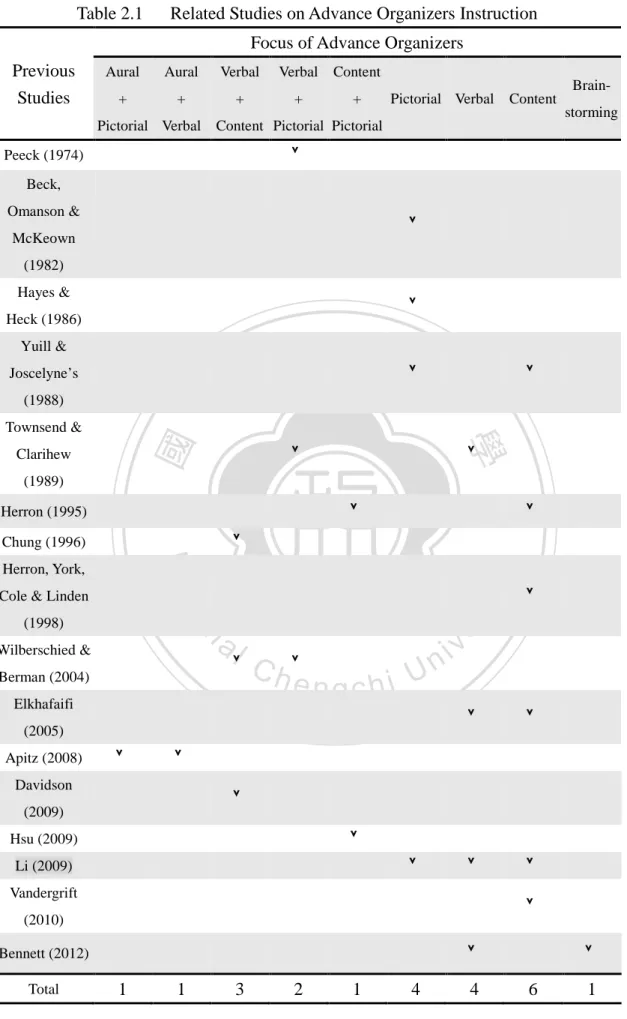
(32) procedures, there are still some ground rules for it. Advance organizers are (NETnet, 2002): ‧organizational cues ‧ tools that help connect the known to the unknown ‧ frameworks for helping students understand what it is they’ll be learning On the other hand, advance organizers are not: ‧ a review of the previous class session ‧ a simple overview. 政 治 大 ‧ telling the students about tomorrow 立. ‧ recalling what was done last week or last year. ‧ stating the objectives of the lesson.. 學. ‧ 國. ‧ recalling a personal experience and relating it to what will be learned. ‧. The list of effective advance organizers has included pictorial context, verbal. sit. y. Nat. descriptions, key vocabulary scripts, pre-questioning, techniques, and cultural. io. n. al. er. background cues, etc.. v i n C Pictorial Advance Organizers hengchi U. Now, there are more and more teachers trying to include a previewing stage in their teaching to facilitate students’ comprehension. Teachers intending to use advance organizers have to make selections with caution according to the learning materials, the learner’s age and level of prior knowledge, and the characteristics of advance organizers.. Through all these years, teachers have developed a variety of forms of advance organizers for effectively organizing learning. Many studies were conducted to find out the effects of those advance organizers. In 1986, Hayes and Henk had students 19.
(33) read procedural texts accompanying 6 analogic and pictorial illustrations in a task where comprehension was assessed by performance in tying a bowline knot. Two weeks later, students were evaluated on their attempts to perform the same task from memory. The results showed that pictures were helpful for both immediate and delayed performance.. More studies about pictorial advance organizers were conducted, such as Peeck’s (1974) and Beck, Omanson, and McKeown’s (1982). The two studies showed the. 政 治 大 Additionally, Beck, Omanson, and McKeown (1982) further indicated that the 立. presentation of pictures consistent with the text information improved comprehension.. presentation of realistic text-relevant pictures was especially beneficial for less skilled. ‧ 國. 學. readers. Yuill and Joscelyne's (1988) study also showed similar outcome. Students in. ‧. the study read stories with titles and pictures which did or did not integrate story. sit. y. Nat. information. The consequence yielded was that integrative cues facilitated better. io. er. comprehension for poor comprehenders. Townsend and Clarihew (1989) found in their study that, for children both with strong and weak prior knowledge, the verbal. al. n. v i n C hstudents achieve aUbetter comprehension than plus pictorial advance organizer helped engchi the verbal one.. In Hsu’s (2009) study, she confirmed the helpfulness of the advance organizer instruction (AOI), namely pictorial contextual cues and pre-questioning. After receiving pictorial contextual cues and pre-questioning, low proficiency students made more progress than high proficiency students in the posttest. Moreover, she found AOI accompanying video viewing contributed to students’ answering picture-description questions of the General English Proficiency Test (GEPT).. 20.
(34) Another study using pictorial advance organizers was conducted by Li in 2009. Li conducted a four-week experiment on 130 8th graders, performing three pre-listening activities— picture viewing, question preview, and vocabulary pre-teaching. Besides the three experimental groups, there was a control group, receiving no treatment. The result yielded from Li’s study showed that only the participants in the picture viewing group significantly outperformed the control group. Generalizing from the studies above, pictorial advance organizers were demonstrated helpful and effective for students’ learning.. 政 治 大 Besides studies about pictorial advance organizers, many other researchers 立 Verbal Advance Organizers. conducted studies on the verbal ones. Elkhafaifi (2005) performed vocabulary. ‧ 國. 學. preview and question preview as advance organizers in two experimental groups. ‧. respectively, and a distracter activity (Arabic verb conjugation) in the control group.. sit. y. Nat. The results confirmed the effectiveness of both the advance organizers. Students in. io. er. two experimental groups outscored the ones in the control group. That is, vocabulary preview and question preview both enhanced students’ understanding.. n. al. Ch. engchi. i n U. v. Contrasting with Elkhafaifi’s (2005) study result confirming the significant effects of verbal advance organizers, Bennett’s (2012) study did not show significance of his pre-teaching activities. Bennett conducted a seven-week experiment on the effects of brain-storming and pre-teaching vocabulary. Participants of the study were forty-five university freshmen majoring in English. The result indicated that neither brain-storming nor pre-teaching vocabulary had significant overall effect on accuracy scores. Moreover, another two studies (Herron, Cole, York, and Linden, 1998; Wilberschied and Berman, 2004) investigating the effects of verbal advance organizers also yielded the similar outcomes as Bennett’s. 21.
(35) In Wilberschied and Berman’s (2004) study, two advance organizers— showing summarized written words and sentences in Chinese of major scenes to participants, and providing the same written material with pictures taken from the video itself— were utilized before sixty-one participants watched video clips from authentic Chinese TV broadcasts. Though there was no significance shown in the result, the exercises seemed to be helpful, particularly for younger and less proficient students. In another study, Herron, Cole, York, and Linden (1998) used two advance organizers on sixty-seven college students of a beginning-level French course. One was reading. 政 治 大 in the upcoming video. The other was reading aloud six interrogative sentences 立. aloud six declarative sentences that summarized, in chronological order, major scenes. transformed from the exact six declarative sentences in the other group. And for each. ‧ 國. 學. question, the teacher provided three possible answers, but with no indication of which. ‧. was correct. Though there were no significant difference in scores between the two. sit. y. Nat. groups, the study result indicated that students in declarative and interrogative groups. io. er. scored significantly higher than those in the control group. Inferring a generality from the studies mentioned, it is still indefinite whether or not advance organizers fully. al. n. v i n promote learning. Yet, much of the C research announces theUuse of advance organizers hengchi to be helpful in improving levels of understanding and recall (Mayer, 2003).. While searching through empirical studies of advance organizers, the researcher found that there were studies investigating the effects of pictorial advance organizers, and some of verbal ones, but there were little empirical studies comparing the effects of these two wildly-used advance organizers in one experiment. As shown in Table 2.1, some studies investigating effects of verbal plus pictorial (Peeck, 1974), some verbal plus pictorial vs. verbal (Townsend & Clarihew, 1989), and still some verbal plus pictorial vs. verbal plus content (Wilberschied & Berman, 2004). Therefore, the 22.
(36) researcher was interested in finding the relation of the pictorial and verbal advance organizers, and whether either of the two outperformed the other in enhancing students’ listening comprehension. And the interest and curiosity led to the design of the present study.. 立. 政 治 大. ‧. ‧ 國. 學. n. er. io. sit. y. Nat. al. Ch. engchi. 23. i n U. v.
(37) Table 2.1. Related Studies on Advance Organizers Instruction Focus of Advance Organizers. Previous Studies. Aural. Aural. Verbal. Verbal. Content. +. +. +. +. +. BrainPictorial Verbal. Content storming. Pictorial Verbal. Content Pictorial Pictorial. ˅. Peeck (1974) Beck, Omanson &. ˅. McKeown (1982) Hayes &. ˅. Heck (1986) Yuill & Joscelyne’s. 立. (1988). 政 治 ˅大. ˅. (1989). Chung (1996). ˅ ˅. io. (1998). sit. Cole & Linden. al. n. Wilberschied &. ˅. Berman (2004) Elkhafaifi. Ch. ˅. engchi. i n U. (2005) Apitz (2008). ˅. ˅. v. ˅. ˅. ˅. ˅. ˅. Davidson. ˅. (2009). ˅. Hsu (2009) Li (2009). ˅. Vandergrift. ˅. (2010). ˅. Bennett (2012) Total. ˅. y. Nat. Herron, York,. ˅. ‧. Herron (1995). ˅. er. Clarihew. 學. ‧ 國. Townsend &. 1. 1. 3. 2. 24. 1. 4. 4. ˅ 6. 1.
(38) Chapter Three Methodology. In this chapter, the process of the experiment is presented in five sections. The first section is the introduction of participants, including the number, background,. 政 治 大 utilized in the experiment 立is introduced in detail. Next, the instructional materials is. academic performances and other information. In the second section, the instruments. ‧ 國. 學. presented in the third section. As for the fourth section, the procedures of conducting the experiment is clearly explained stage by stage along with the introduction of three. ‧. treatments. The last section is the presentation of the statistical methods used for. n. al. Ch. Participants. engchi. er. io. sit. y. Nat. analyzing the data collected from the experiment.. i n U. v. The 87 participants in this experiment were learners from three 9th-grade classes in a national high school in northern Taiwan. At this school, each class contained approximately 32 students or so. Students were randomly arranged into classes, which meant they were not assigned into classes according to their grades or learning abilities. Participants were about 15 years old, and most of them came from the communities nearby. Most residents in this neighborhood were well-educated and enjoyed comparatively higher social economic status than the average citizens. Thus, most parents cared much about the students’ schoolwork and behavior, and so did students themselves. Among the 87 participants, there were 39 females and 48 males. 25.
(39) They were all native speakers of Chinese, and had learned English for at least 4.5 years, 2 years in elementary school and 2.5 in junior high. Students having lived in English-speaking countries for more than a year were eliminated from the experiment. Instruments The instruments used in this study were to collect data of 1) participants’ English listening proficiency, 2) the listening comprehension of the video clips they viewed, and 3) the attitude towards treatments. Thus, the listening comprehension section of the standardized test—General English Proficiency Test (GEPT) was chosen to test. 政 治 大 multiple-choice questions were used to test participants’ listening comprehension of 立. participants’ listening proficiency. In addition, three sets of listening comprehension. the video clips they watched. Last but not least, participants’ attitudes towards. ‧ 國. 學. different treatments were collected through the attitude questionnaire.. sit. y. ‧. Nat. The Listening Comprehension Test—GEPT—. io. er. intermediate listening comprehension section. GEPT is a standardized test commissioned by Taiwan’s Ministry of Education in. al. n. v i n CTraining 1999 and developed by the Language Center (LTTC). It was first h e n gandcTesting hi U administered in 2002. From then on, the score of GEPT is widely acknowledged and. adopted by government institutions, private enterprises, colleges and universities. The validity and reliability of GEPT are generally well acknowledged through all these years and by hundreds of thousands of test takers. According to LTTC’s classification, examinees who pass intermediate listening test, that is, scoring above 80, should be able to understand general conversation in daily life situations and also be able to grasp the general meaning of native English speakers’ conversations and inquiries. The goal of this experiment was to see how the treatments affect participants’ English listening comprehension of the video, a set of instructional video containing 26.
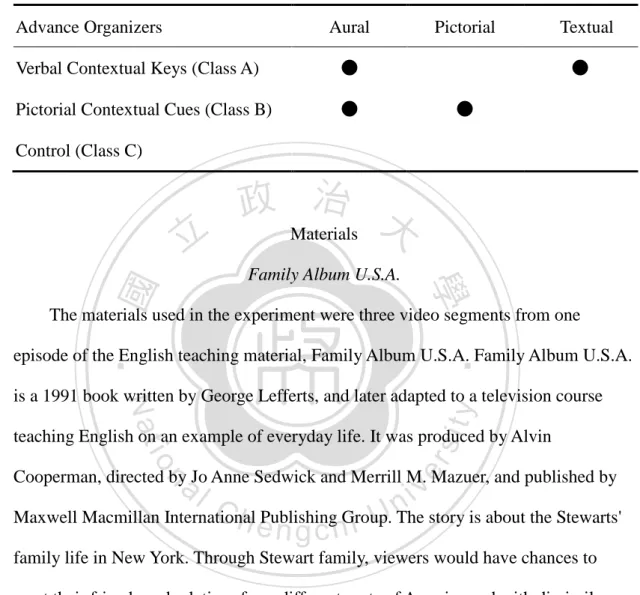
(40) daily conversation. That GEPT intermediate listening test as a test itself matched my purpose of examining students’ listening proficiency as part of the analysis. Hence, the intermediate listening test was chosen to serve one purpose: to allow the researcher to know about participants’ English listening proficiency. The GEPT listening comprehension section is composed of three parts—Picture Description, Answering Questions, and Conversations. In the first part, Picture Description, test takers see a picture while listening to the question for it, and then choose the correct answer out of three options. In the second part, Answering. 政 治 大 response out of the three printed possible answers. In the last part, Conversations, test 立 Questions, test takers listen to a question or a statement, and then choose the best. takers listen to a short dialogue and a question followed, and then just like in the. ‧ 國. 學. second part, they choose the best response out of the three printed possible answers as. ‧. well. There are 45 test items in total in the listening test section. The approximate time. er. io. sit. y. Nat. to complete the test is 30 minutes.. Listening Comprehension of the Video—Multiple-choice tests. al. n. v i n In order to examine theC effects of three treatments, h e n g c h i U there were three sets of. listening comprehension tests (See Appendix B, D, and F) in multiple-choice format in this experiment. Each test had a set of 10 questions, containing questions about the main ideas and detailed information of the video clip that participants viewed. Each question was followed by four possible answers from which participants have to choose the best and correct one. The listening comprehension tests were designed by the researcher to assess the effects of the three treatments on participants’ English listening comprehension. The three tests were viewed and examined by three colleagues of the researcher’s to ensure the content of the tests was adequately clear and suitable. By doing so, the validity of the three listening comprehension tests may 27.
(41) be ensured. After participants viewed a video segment, they received the multiple-choice test immediately. To get the correct answers, participants needed to comprehend the dialogues through listening, the only skill being tested. Moreover, test items could be answered correctly only from information found in the dialogue of the videos, not from information in the advance organizers. The test items, based on the content of the video clips, were written in English. They were designed according to the details of the conversation between characters. Namely, details that could be obtained through viewing, observing or predicting were not materials for the test. 政 治 大 items of global, inference, and function/logic, and focused only on detail items to test 立. items. And because listening was the only skill to be tested, the researcher excluded. score of the tests was 100, while the lowest being 0.. sit. y. ‧. Nat. Attitude questionnaire. 學. ‧ 國. participants’ listening comprehension. Each test item was 10 points, so the highest. io. er. The attitude questionnaire (see Appendix M) was designed based on Li’s study (2009) and was modified for the present experiment. It was utilized to examine. al. n. v i n C h used in the experiment. participants’ preferences for the treatments All the three engchi U. classes answered the same questionnaire written in Chinese, participants’ native language. The reason why the questionnaire was written in Chinese instead of English was that the focus of concern here was learners’ attitude, which for them was easier to express in their mother tongue. Hence, without pressure, participants could fill out the questionnaire in the language that they felt most comfortable with. There were thirteen questions in the questionnaire, twelve of them were multiple-choice and one open-ended. Through the questionnaire, the researcher intended to find out participants’ preferences for and perceptions of the two advance organizers and video watching. 28.
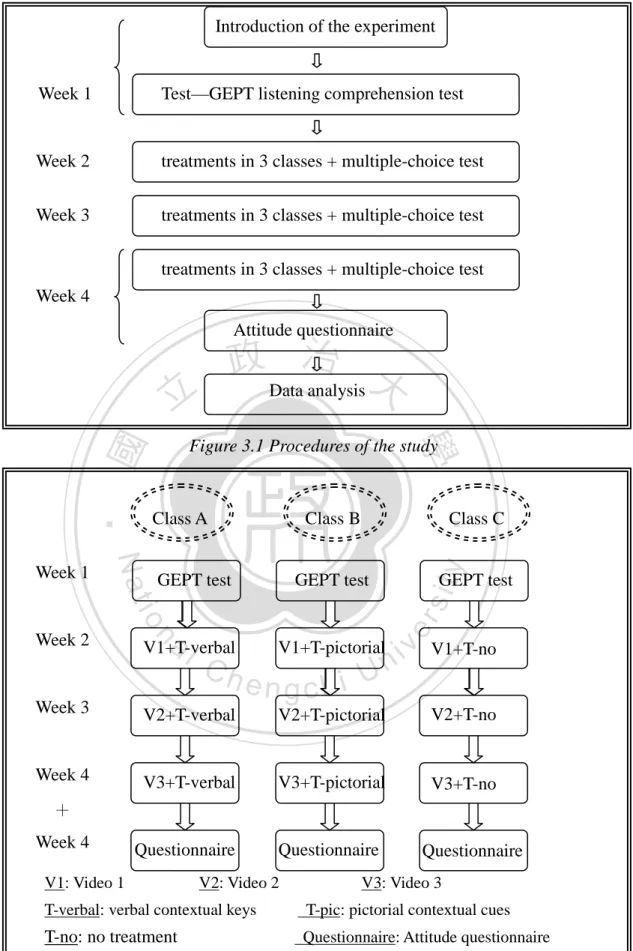
(42) Treatments The three treatments in the experiment were pictorial contextual cues, verbal contextual keys, and using none of the two treatments. The first two treatments were advance organizers. An advance organizer is information provided before learning so that learners can make use of it to systematize and interpret the forthcoming information (Mayer, 2003). The three treatments are introduced more specifically below.. 政 治 大 Before participants watched the video segment, ten key lines were presented 立 Advance Organizer—verbal contextual keys. through PowerPoint file on the projector screen. Each key line contained a key word. ‧ 國. 學. highlighted in red (see Appendix J, K, and L). The researcher explained the meaning. ‧. of the key words and the key lines in Chinese, and led participants to read aloud both. sit. y. Nat. the ten key words and key lines twice. Also, the ten key lines were presented. io. er. chronologically. In addition, the ten key lines were quoted directly from the storylines of the video. Thus, through the lines, the researcher hoped to provide participants an. al. n. v i n C hthem for understanding overview of the plot and prepare the videos verbally. Note engchi U. here that the ten key lines were different from the descriptive sentences read to the Pictorial Contextual Cues group.. Advance Organizer—pictorial contextual cues Prior to playing the video segment, participants were informed in their native language, Chinese, that they were about to view twenty pictures of the video clip in sequence. The pictures were shown for one time only. Each picture was shown for ten seconds. One problem of viewing the pictures was that misunderstandings might occur. If the picture is a man holding a door knob, there would be two interpretations: 29.
(43) the man is opening or closing the door. To avoid misinterpretation of the twenty pictures shown, the researcher read a sentence to describe the motions in the pictures to make sure participants could receive the correct information. Therefore, during the picture showing, the twenty pictures (see Appendix G, H, and I) were shown not only chronologically but with a descriptive sentence each. No further explanation or Chinese translation was given to the participants. Participants might get a general idea about the video segment’s contextual content through the pictures.. 政 治 大 None of the pre-listening activities were held in the control group. The 立 Control Group— using no treatments. researcher informed participants that they would view a 5-minute-long video segment,. ‧ 國. 學. and then took a test about it. No explanation was given to help participants. ‧. comprehend the content of the video clips.. sit. y. Nat. Table 3.1 presented the aids that participants received from each treatment. Both. io. er. verbal contextual keys and pictorial contextual cues provided participants aural information. In Verbal Contextual Keys group, participants got aural stimulation from. al. n. v i n C h and themselves. hearing the key lines read by the researcher In Pictorial Contextual engchi U. Cues group, the aural stimulation came from the researcher’ s reading the descriptive sentences. Both ways were to allow participants to hear information helping them have a better understanding of the visual information—key lines and pictures. Besides, gaining aural aids, the textual (viewing 10 key lines taken from the script of the video clip) and pictorial (viewing 20 pictures taken from the video clip) aids participants received respectively from the two groups were the main effects of the two treatments that the researcher hoped to find out in the experiment. The control group did not receive extra help on comprehending the video clips, which resembled the authentic situation that participants watched videos in their daily lives. Such arrangement for 30.
(44) the control group followed similar beliefs on what controls should be like in previous studies conducted by Herron, York, Cole, & Linden (1998), Lewis (1986), and Tang (2012). Table 3.1 Aids provided by the three treatments Advance Organizers. Aural. Verbal Contextual Keys (Class A). ●. Pictorial Contextual Cues (Class B). ●. Pictorial. Textual ●. ●. Control (Class C). 立. 政 治 大 Materials. ‧ 國. 學. Family Album U.S.A.. The materials used in the experiment were three video segments from one. ‧. episode of the English teaching material, Family Album U.S.A. Family Album U.S.A.. sit. y. Nat. is a 1991 book written by George Lefferts, and later adapted to a television course. io. er. teaching English on an example of everyday life. It was produced by Alvin. al. Cooperman, directed by Jo Anne Sedwick and Merrill M. Mazuer, and published by. n. v i n C h Publishing Group. Maxwell Macmillan International e n g c h i U The story is about the Stewarts' family life in New York. Through Stewart family, viewers would have chances to meet their friends and relatives from different parts of America and with dissimilar jobs, points of views and interests. Family Album U.S.A. was designed in the form of a TV series, containing authentic slang, idioms, and phrases that native speakers use in their daily lives. Designed by the world's leading ELT experts and Emmy Award-winning television producers, in cooperation with the U.S.I.A (United States Information Agency), Family Album U.S.A. has been broadcast in over fifty countries. 31.
(45) Family Album U.S.A. meets Stempleski’s (1987) suggestions on choosing authentic materials for English teaching. The language used in the series is authentic and used by native English speakers in their daily lives. Also, it is transferable to real life situations that participants might come across. The characters speak clearly and naturally enough to be understood by participants. There are natural pauses in the dialogue that give participants time to process the meaning as well. Apart from the linguistic concern, the topics and issues addressed in the series are another reason for the choice of Family Album U.S.A. Together with the main characters dealing with. 政 治 大. different matters in their lives, participants can learn language used in many aspects.. 立. Procedures. ‧ 國. 學. Prior to conducting the experiment, the researcher told the participants that they. ‧. were going to watch an American TV series, Family Album U.S.A., once a week in. sit. y. Nat. English listening class. There were three segments in an episode. Hence, participants. io. er. were arranged to view the three serial segments in three continuous weeks. The instruments and materials of the experiment were be mentioned to the participants.. al. n. v i n C h the first week, participants In the beginning of the experiment, had the GEPT test. engchi U. In the following three weeks, three treatments—pictorial contextual cues, verbal. contextual keys and no treatment-- were given to the three classes separately. The listening comprehension multiple-choice tests were given right after participants viewed the video segments. In the fourth week, after participants finished the multiple-choice test, they filled out the attitude questionnaire. Then, the researcher collected all the data from the tests and questionnaire, and did the data analysis. The procedures of the study are illustrated as Figure 3.1 and introduced in the following section. Figure 3.2 is the procedures of using three treatments in three classes. 32.
(46) Introduction of the experiment. Week 1. Test—GEPT listening comprehension test. Week 2. treatments in 3 classes + multiple-choice test. Week 3. treatments in 3 classes + multiple-choice test treatments in 3 classes + multiple-choice test. Week 4 Attitude questionnaire. 政 治 大 Data analysis. Figure 3.1 Procedures of the study. GEPT test. er. sit. GEPT test. n. al. Class C. y. Class B. GEPT test. io Week 2. ‧. Class A. Nat. Week 1. 學. ‧ 國. 立. V1+T-verbal. Ch. i n U. V1+T-pictorial. engchi. v. V1+T-no. Week 3. V2+T-verbal. V2+T-pictorial. V2+T-no. Week 4. V3+T-verbal. V3+T-pictorial. V3+T-no. Questionnaire. Questionnaire. + Week 4 V1: Video 1. V2: Video 2. Questionnaire. V3: Video 3. T-verbal: verbal contextual keys. T-pic: pictorial contextual cues. T-no: no treatment. Questionnaire: Attitude questionnaire. Figure 3.2 Procedures of using three treatments in three classes. 33.
數據

+7


相關文件
After students have had ample practice with developing characters, describing a setting and writing realistic dialogue, they will need to go back to the Short Story Writing Task
Wang, Solving pseudomonotone variational inequalities and pseudocon- vex optimization problems using the projection neural network, IEEE Transactions on Neural Networks 17
volume suppressed mass: (TeV) 2 /M P ∼ 10 −4 eV → mm range can be experimentally tested for any number of extra dimensions - Light U(1) gauge bosons: no derivative couplings. =>
Define instead the imaginary.. potential, magnetic field, lattice…) Dirac-BdG Hamiltonian:. with small, and matrix
incapable to extract any quantities from QCD, nor to tackle the most interesting physics, namely, the spontaneously chiral symmetry breaking and the color confinement..
• Formation of massive primordial stars as origin of objects in the early universe. • Supernova explosions might be visible to the most
• elearning pilot scheme (Four True Light Schools): WIFI construction, iPad procurement, elearning school visit and teacher training, English starts the elearning lesson.. 2012 •
(Another example of close harmony is the four-bar unaccompanied vocal introduction to “Paperback Writer”, a somewhat later Beatles song.) Overall, Lennon’s and McCartney’s
