This article was downloaded by: [National Chiao Tung University 國立交通大學] On: 27 April 2014, At: 23:42
Publisher: Taylor & Francis
Informa Ltd Registered in England and Wales Registered Number: 1072954 Registered office: Mortimer House, 37-41 Mortimer Street, London W1T 3JH, UK
Liquid Crystals
Publication details, including instructions for authors and subscription information: http://www.tandfonline.com/loi/tlct20
Photo-alignment of liquid crystals using a
crosslinked discotic film
Long-Hai Wu a , Wen-Chin Lee a , Chain-Shu Hsu a & Shin-Tson Wu b a
Department of Applied Chemistry, National Chiao Tung University, Hsinchu, Taiwan 30050, ROC
b
HRL Laboratories, LLC, 3011 Malibu Canyon Road, Malibu, CA 90265, USA Published online: 06 Aug 2010.
To cite this article: Long-Hai Wu , Wen-Chin Lee , Chain-Shu Hsu & Shin-Tson Wu (2001) Photo-alignment of liquid crystals using a crosslinked discotic film, Liquid Crystals, 28:2, 317-320, DOI: 10.1080/02678290010012282
To link to this article: http://dx.doi.org/10.1080/02678290010012282
PLEASE SCROLL DOWN FOR ARTICLE
Taylor & Francis makes every effort to ensure the accuracy of all the information (the “Content”) contained in the publications on our platform. However, Taylor & Francis, our agents, and our licensors make no representations or warranties whatsoever as to the accuracy, completeness, or suitability for any purpose of the Content. Any opinions and views expressed in this publication are the opinions and views of the authors, and are not the views of or endorsed by Taylor & Francis. The accuracy of the Content should not be relied upon and should be independently verified with primary sources of information. Taylor and Francis shall not be liable for any losses, actions, claims, proceedings, demands, costs, expenses, damages, and other liabilities whatsoever or howsoever caused arising directly or indirectly in connection with, in relation to or arising out of the use of the Content.
This article may be used for research, teaching, and private study purposes. Any substantial or
systematic reproduction, redistribution, reselling, loan, sub-licensing, systematic supply, or distribution in any form to anyone is expressly forbidden. Terms & Conditions of access and use can be found at http://www.tandfonline.com/page/terms-and-conditions
Preliminary communication
Photo-alignment of liquid crystals using a crosslinked
discotic lm
LONG-HAI WU, WEN-CHIN LEE, CHAIN-SHU HSU
Department of Applied Chemistry, National Chiao Tung University, Hsinchu, Taiwan 30050, ROC
and SHIN-TSON WU*
HRL Laboratories, LLC, 3011 Malibu Canyon Road, Malibu, CA 90265, USA (Received 4 May 2000; in nal form 25 August 2000; accepted 30 August 2000)
A new photo-alignment layer using a crosslinked discotic compound was demonstrated. This discotic compound exhibits excellent solubility in common organic solvents, the possibility of low temperature processing and good thermal stability. A linearly polarized long wavelength ultraviolet (LPUV) light (l5 350 nm) was used to initiate the crosslinking process and induce liquid crystal alignment on the discotic lm surface. The induced LC directors were found parallel to the electric eld direction of the LPUV light. A 1.2ß pre-tilt angle was achieved using a single exposure at a 30ß oblique angle.
The surface rubbing technique has been commonly In this paper, we report a thermally stable, crosslinked discotic photo-alignment lm processed via long wave used for fabricating large liquid crystal display panels.
However, the rubbing process may cause electrostatic LPUV (l5 350 nm) irradiation. The long wave LPUV initiates the crosslinking process without decomposing charges, dusts, or scratches that tend to reduce the
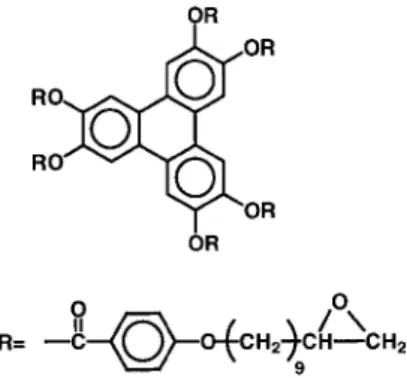
manu-facturing yield. Several non-rubbing methods, such as the the discotic compound. As a result, no charge trapping centre is formed. The structure of the discotic compound use of Langmuir–Blodgett lms [1], stretched polymers
[2], photolithography [3], stamped polymers [4] and used in this study is shown in gure 1. It can be easily dissolved in common organic solvents such as ethyl linearly polarized ultraviolet light (LPUV) exposure of
polymers [5–7] have been developed. Among them, acetate, chloroform, tetrahydrofuran and methyl ethyl ketone. Thus, the lm fabrication process is relatively photo-alignment is promising for overcoming the
draw-backs caused by the rubbing process and providing simple.
In preparing the crosslinked discotic photo-alignment multi-domain structure for widening the viewing angle
[8]. layer, 100 mg of discotic monomer and 2 mg of
photo-initiator (diphenyliodonium hexa uoroarsenate) were Many types of polymers, e.g. polymers doped with
photo-isomerized azo-compounds [9–11], poly(vinyl cinnamate) derivatives [12–15] and polyimides (PIs) [16–19] have been proposed for photo-alignment purpose. Among these alignment agents, poly(vinyl cinnamate) lm showed insu cient thermal stability at elevated temper-atures. On the other hand, PIs possess excellent thermal stability except that a strong UV light (l5 254 nm) is required for generating LC alignment. These high energy UV photons would decompose the polymer backbones and form charge trapping centers on the LC and PI interfaces which, in turn, cause image sticking during active matrix addressing [20].
Figure 1. Molecular structure of the discotic compound used in this study.
*Author for correspondence; e-mail: [email protected]
L iquid Crystals ISSN 0267-8292 print/ISSN 1366-5855 online © 2001 Taylor & Francis Ltd
http://www.tandf.co.uk/journals DOI: 10.1080/02678290010012282
318 Preliminary communication
dissolved in 2 ml of methyl ethyl ketone and spin coated layer is aligned nearly perpendicular to the substrate surface. This monolayer then in uences the bulk to form onto a glass substrate. The substrate was baked at 60ßC
to evaporate the solvent. Afterwards, the lm was homeotropic alignment.
For comparison purposes, an unpolarized UV light exposed to a LPUV light for 2 h to obtain crosslinked
structure. During the experiment, a typical discotic lm was also used to irradiate the discotic lms; no single domain was obtained. By contrast, all the lms exposed was peeled oŒfrom the glass substrate and was found
to be insoluble in any of the solvents studied. This to LPUV light produced single domain LC alignment. Pretilt angle is an important parameter for a LC con rmed the formation of a crosslinked structure.
Figure 2 shows the experimental set-up for the UV cell in the elimination of disclination lines. The discotic lm with LPUV exposure at normal angle showed no exposure system used in this study. The UV exposure
was performed using a long wave UV light (Rayonet pretilt angle, so that when the applied voltage exceeded the Fre´edericksz transition threshold, disclination lines Photochemical Reactor, Model RPR-100, l5 350 nm)
ltered with an Oriel UV linear dichroic polarizer appeared, as shown in gure 3 (a). To increase the
pre-tilt angle for eliminating disclination lines, the discotic (Model 27320). The light intensity at the sample surface
was measured to be 0.65 mW cmÕ 2. If the UV ux was lms were exposed at an oblique angle h, as sketched in gure 2. Figure 3 (b) shows a uniform image without
increased, the exposure time could be reduced
pro-portionally. These discotic lms were highly transparent disclination lines at 5 V
r m s. This implies that a pretilt angle on the discotic surfaces was indeed generated. and their thickness was measured to be about 220 nm,
using a Dektak3 ST ( Vecco USA) a stepper instrument. We measured the pretilt angle of a homogeneous cell using the crystal rotation method [21]. Figure 4 depicts To study the LC alignment characteristics, several
parallel cells with a 25 mm cell gap were assembled using the measured (solid lines) and tted (dashed lines) results for the ZLI-4792 cell exposed at h5 30ß . From tting, these UV-irradiated discotic lms. Five Merck LC
mixtures: ZLI-4792, ZLI-2806, ZLI-5600-100, E7 and the pretilt angle is found to be 1.2ß.
To determine the photo-induced LC molecular 5CB (4-cyano-4¾ -n-pentylbiphenyl ) were used for
align-ment studies. The cells were inspected under a polarizing orientation direction with respect to the incident UV light polarization axis, a homogeneous ZLI-4792 cell optical microscope. Under the crossed polarizer
con-dition, ZLI-4792, ZLI-2806 and ZLI-5600-100 showed doped with 1 wt % dichroic dye, M137 (from Mitsui Chemicals, l
m a x5 638 nm) was prepared and measured birefringence colours. Rotating the cell along the
polar-ization plane led to high contrast bright and dark states. at l5 638 nm) using a spectrophotometer and a linear polarizer. The linear polarizer was consecutively rotated This is clear evidence of homogeneous alignment. In
contrast, the 5CB and E7 cells formed homeotropic from 0ß to 360ß ; 0ß represents that the linearly polarized red light is parallel to the LPUV exposure direction. alignments; the reason for this is not yet completely
understood. Since E7 consists of mainly cyanobiphenyl Figure 5 shows the resulting angular-dependent absorp-tion diagram of the dye-doped ZLI-4792 cell. The cell homologues, we speculate that the cyano group is
adsorbed to the discotic core so that the rst mono- axis, indicated by arrows, is de ned as the electric eld
Figure 2. Experimental set-up for the UV-induced LC alignment at normal and oblique incident angles.
Figure 5. Angular-dependent absorption diagram of a dye-doped homogeneous ZLI-4792 cell. Dye5 1 wt % M-137, l5 638 nm. Arrows indicate the polarization axis of the incident linearly polarized UV light.
To evaluate the thermal stability of the LPUV-induced discotic alignment lms, the ZLI-4792 and 5CB cells were kept in an oven at 120ßC for one week. No degradation in the LC alignment was observed. This high thermal stability is attributed to the crosslinked structure within the lm.
In conclusion, we have demonstrated a new cross-linked discotic lm for serving as a photo-alignment layer. Long wave UV light (l5 350 nm) was used to initiate the crosslinking reaction as well as to induce photo alignment on the lm surface. These new photo-alignment layers possess good thermal stability and a Figure 3. Optical microscope photographs of the disclination
low processing temperature. The long axis of the nematic lines of photo-aligned ZLI-4792 cells. (a) h5 0, (b) h5 30ß;
LC molecules was found to be parallel to the electric h is the exposure angle shown in gure 2. V5 5 Vr m sand
polarizers are crossed. eld direction of the LPUV light. A 1.2ß pretilt angle of the discotic alignment lms was generated under a single UV exposure at 30ß oblique angle. The potential appli-cation of this discotic compound for low temperature polysilicon TFT-LCDs is foreseeable.
The authors are grateful to the National Science Council of the Republic of China for nancial support. The HRL group is indebted to nancial support by AFOSR, under contract number F49620-98-C-0019.
References
[1] Sasaki, T., Fuji, H., and Nishikawa, M., 1992, Jpn.
J. appl. Phys. 2, 31, L632.
[2] Aoyama, H., Yamazaki, Y., Matsuura, N., Mada, H., Figure 4. Pretilt angle measurement of the ZLI-4792 cell and Kobayashi, S., 1981,Mol. Cryst. liq. Cryst., 72, 127. exposed at 30ß oblique angle. Dashed lines represent the [3] Kawata, Y., Takatoh, K., Hasegawa, M., and tting results. From ttings, the pretilt angle is found to Sakamoto, M., 1994,L iq. Cryst., 16, 1027.
be 1.2ß. [4] Lee, E. S., Vetter, P., Miyashita, T., Uchida, T.,
Kano, M., Abe, M., and Sugawara, K., 1993, Jpn. J. appl. Phys. 2, 32, L1436.
vector of the LPUV light during the exposure process.
[5] Ichimura, K., Suzuki, Y., Seki, T., Hosoki, A., and From gure 5, the photo-induced LC directors are found Aoki, K., 1988,L angmuir, 4, 1214.
to be parallel to the electric eld direction of the incident [6] Gibbons, W. M., Shannon, P. J., Sun, S. T., and Swetlin, B. J., 1991,Nature, 351, 49.
LPUV light.
320 Preliminary communication
[7] Hasegawa, M., and Taira, Y., 1994, in Proceedings of [14] Iimura, Y., Saitoh, T., Kobayashi, S., and the International Display Research Conference, Monterey Hashimoto, T., 1995,J. photopolym. Sci. T echnol., 8, 258.
California, p. 213. [15] Kawatsuki, N., Ono, H., Takatsuka, H., Yamamoto, T., [8] Yang, K. H., 1991, in Proceedings of the International and Sangen, O., 1997,Macromolecules, 30, 6680.
Display Research Conference, San Diego California, [16] West, J. L., Wang, X., Ji, Y., and Kelly, J. R., 1995,
p. 68. SID T ech. Dig., 26, 703.
[9] Shannon, P. J., Gibbons, W. M., and Sun, S. T., 1994, [17] Wang, X., and West, J. L., 1997, SID T ech. Dig., 28, 65.
Nature, 368, 532. [18] Nishikawa, M., Taheri, B., and West, J. L., 1998, Appl.
[10] Iimura, Y., Kusano, J., Kobayashi, S., Aoyagi, Y., and Phys. L ett., 72, 2403.
Sugano, T., 1993,Jpn. J. appl. Phys. 2, 32, L93. [19] Lien, A., John, R. A., Anglepolos, M., Lee, K. W.,
[11] Ichimura, K., Hayashi, Y., Akiyama, H., and Ikeda, T.,
Takano, H., Tajima, K., and Takenaka, A., 1995,Appl.
1993,Appl. Phys. L ett., 64, 449.
Phys. L ett., 61, 3180.
[12] Dyadyusha, A., Kozenkov, V., Marusii, T.,
[20] Yang, K. H., Tajima, K., Takenaka, A., and Reznikov, Y., Reshetnyak, V., and Khizhnyak, A.,
Takano, H., 1996,Jpn. J. appl. Phys. 2, 35, L561.
1991,Ukr. Fiz. Zh., 36, 1056.
[21] Witter, V., Baur, G., and Berreman, D. W., 1976, [13] Schadt, M., Schmitt, M., Kizinkov, V., and
Chigrinov, V., 1992,Jpn. J. appl. Phys. 1, 31, 2155. Phys. L ett. A, 56, 142.