Novel Phosphorus-Containing Dicyclopentadiene-Modified
Phenolic Resins for Flame-Retardancy Applications
GING-HO HSIUE,1 SHIN-JEN SHIAO,2 HSIAO-FEN WEI,2 WEN-JANG KUO,1 YI-AN SHA1 1
Department of Chemical Engineering, National Tsing Hua University, Hsinchu, Taiwan 30043, Republic of China 2
Department of Applied Chemistry, National Chiao Tung University, Hsinchu, Taiwan 30043, Republic of China
Received 8 March 2000; accepted 4 April 2000
ABSTRACT: 2-[4-(2-hydroxyphenyl)tricyclo[5.2.1.02,6]dec-8-yl]phenol (HPTCDP) were prepared from dicyclopentadiene (DCPD) and phenol via Friedel-Crafts alkylation. DCPD-containing phenolic resin (DPR) was also synthesized by incorporating the DCPD-containing monomer HPTCDP with formaldehyde. DPR was further modified by grafting the phosphate group. The phosphorylation was confirmed by a Fourier trans-form infrared,31P-NMR spectroscopy, and an element analysis. The phosphorus con-tent in the DPR could be successfully tailored to give values of 3.46 to 7.79 wt % by varying the feeding ratios of the phosphorus group. The thermal stabilities of the phosphorus-containing polymers were identified by differential scanning calorimeter and thermogravimetric analysis. The glass transition temperature values were de-creased as the content of phosphorus inde-creased. High char yield 39 – 47 wt % in thermogravimetric analysis evaluation and limiting oxygen index values of 27 to 34 were found for all the phosphorylated phenolic resins. Such properties make these polymers highly promising for flame-retardant applications.© 2000 John Wiley & Sons, Inc. J Appl Polym Sci 79: 342–349, 2001
Key words: flame-retardant; phosphorus-containing phenolic resin; dicyclopenta-diene
INTRODUCTION
Organic polymeric materials are limited in many applications because of their flammability. Thus, the demand for flame-retardant polymeric mate-rials has steadily increased with the increasing use of polymers. Flame retardation is a process by which adding certain chemicals alters the normal degradation or combustion processes of polymers. Some plastic materials are inherently fire
retar-dant or smoke retarretar-dant and their fire perfor-mance is acceptable for certain applications. How-ever, for many plastic materials, their fire resis-tance must be improved by incorporating commercially available flame retardants. As ex-pected, retardants have to improve fire resistance without excessive loss of other important perfor-mance characteristics.
A conventional means of preparing flame-re-tardant polymers involves blending flame-retar-dant additives with polymeric materials. How-ever, compatibility between the polymer and the additives restricts application of the blended retardant. Covalently incorporating flame-retardant chemicals onto polymer backbones, i.e., using a reactive flame retardant, has attracted
Correspondence to: G. H. Hsiue.
Contract grant sponsors: Chinese Petroleum Company and the National Science Council of the Republic of China; con-tract grant number: NSC 2187-081J2.
Journal of Applied Polymer Science, Vol. 79, 342–349 (2001) © 2000 John Wiley & Sons, Inc.
much attention recently.1– 4 This method creates
a more compatible product than the blended sys-tems do that can also obtain excellent flame re-tardancy.1,2 Nonhalogenated flame retardants
such as phosphorus-containing flame retardant are currently used to avoid the generation of toxic, corrosive, or halogenated gases.1– 4
Cur-rently, phosphorus-containing flame retardants are mainly burned through a condensed-phase mechanism that leads to the production of incom-bustible carbonaceous char.1Consequently, fewer
toxic gases are released into the atmosphere. Fur-thermore, the flame-retardant efficiency of phos-phorus compounds was reported to be better than equal-weighted halogenated compounds and could be further enhanced when phosphorus is covalently bound to the polymers.1– 4
Thermosets are promising candidates for flame retardants because their three-dimensional net-work prefers to generate less decomposition gas-eous products than thermoplastics. When heat-ing, the surface will char, thus preventing igni-tion. Phenolic resins, a thermosets resin, have been used extensively because of their thermal stability and moderate char yield.5–7However, in
some instances, they may have less than desired moisture and flame retardancy. At least one un-saturated hydrocarbon, for example, cyclopen-tene, 1,5-cyclooctadiene, dipencyclopen-tene, or dicyclopen-tadiene can be utilized to improve the desired moisture.8,9 However, a flame retardant or an
improvement of the polymer itself is needed to increase the phenolic resin’s flame retardancy.
Cyclopentadiene (CPD) is a byproduct of C5 streams in oil refineries. The CPD monomer usu-ally exists in the form of dicyclopentadiene (DCPD), which is a dimeric adduct through the Diels Alder reaction at ambient temperature.10In
this work, a series of DCPD-modified phenolic resins (DPR) with and without phosphorus groups was synthesized. The systematic investi-gation of flame-retardation included a differential scanning calorimetry (DSC), thermogravimetric analysis (TGA) thermogram, index of the flame resistance, and the limiting oxygen index (LOI) study.
EXPERIMENTAL Materials
DCPD, phenol, and formalin were purchased from TEDIA Co. The DCPD was extracted by 5%
NaOH solution twice to remove any inhibitors, and was then dried over calcium hydride and distilled before use. The boron trifluoride diethyl-ether (BF3 䡠 Et2O) from the Lancaster Company, copper(I) chloride, diethylphosphoryl chloride (DEPC), and hydrochloric acid (HCl) from the AC-ROS Company, were all used as received. Tetra-hydrofuran (THF) was dried over sodium with benzophenone as an indicator and distilled under nitrogen. Finally, the triethylamine (TEA) was distilled over potassium hydroxide before use.
Syntheses of
2-[4-(2-Hydroxyphenyl)tricyclo[5.2.1.02,6]dec-8-yl]phenol
(HPTCDP)
The dicyclopentadiene and phenol adducts were prepared according to the literature.8Phenol (420
g) and 4 mL of BF3䡠 Et2O were added to a 500-mL three-necked flask equipped with a stirrer, con-denser, and heater. The mixture was heated to 70°C, stirred for 1 h, and then cooled to 40°C. DCPD (30 mL) was added. The temperature was then heated to 120°C for another 3 h. The product mixture was extracted with 5% NaOH aqueous solution followed by distilled water to remove BF3䡠 Et2O and phenol after cooling to room tem-perature. The extract was dried over MgSO4and then concentrated. The final product was ob-tained in a 70% yield: IR (KBr): 3200 cm⫺1 (—OH), 1239 cm⫺1 (C—O); 1H-NMR (CDCl
3): ␦
⫽ 1.23–2.12 ppm (saturated protons for phenyl group and DCPD),␦ ⫽ 2.26–4.18 ppm (—CH2— for DCPD), ␦ ⫽ 5.61 ppm (—OH for phenyl), ␦ ⫽ 6.79–7.33 ppm (aromatic proton). Anal. Calcd for C22H23O2: C, 82.76%; H: 7.21%; O, 10.03%. Found: C, 78.92%; H, 7.66%; O, 13.42%.
Syntheses of DCPD-Modified Phenolic Resin (DPR)
Twenty grams of HPTCDP, 3.2 mL of formalin, and three drops of HCl were added to a 100-mL round-bottom flask equipped with a stirrer and reflux condenser. The solution was then refluxed at 85°C for 30 min. A large amount of cool water was added when the reaction was completed. The crude product was condensed and dried under vacuum at 50°C. Using similar processes, this adducts of HPTCDP (20 g)/formalin (2.0 mL) (mol ratio 1:0.5) and HPTCDP (20 g)/formalin (4.0 mL) (mol ratio 1:1) were also prepared. IR (KBr): 922 cm⫺1 (aromatic proton with three substitutes), 1070 cm⫺1(the end —C—OH), 3200 cm⫺1(—OH).
Anal. Calcd for C23H24O2 (mol ratio of HPTCDP/ formalin ⫽ 1:0.85): C, 83.13%; H: 7.23%; O: 9.64%. Found: C, 83,28%; H, 7.69%; O, 9.03%.
Syntheses of Phosphorus-Containing DCPD-Modified Phenolic Resin (PCDPR)
Ten grams of DPR (0.03 mol) was dissolved in 100 mL of dry THF in a 500-mL round-bottom flask fitted with a magnetic stirrer under nitrogen at-mosphere. Distilled dry triethylamine (20 mL) was added, and the system was then cooled to 0°C. A solution of 3 mL of DEPC (0.15 mol) in 20 mL of THF was added dropwise over a period of 10 min after adding 0.5 g of Cu2Cl2. The reaction system was maintained at 0°C for 2 h and then kept at room temperature overnight. The precip-itant was filtered and washed with THF. The filtrate was concentrated and precipitated from methanol. The obtained product was dried under vacuum at 50°C. The adducts of DPR (10 g)/DEPC (6 mL) (mol ratio 1:1) and DPR (10 g)/DEPC (12 mL) (mol ratio 1:2) were also prepared using sim-ilar processes. IR (KBr): 970 cm⫺1 (—P—OPh), 1295 cm⫺1(—P⫽O). 31P NMR (CDCl
3):␦ ⫽ ⫺18
ppm (Ph—O—P) and␦ ⫽ ⫺26 ppm (—CH2O—P).
Instrumental Analysis
The 1H-NMR and 31P-NMR spectra were
ob-tained from a Bruker AM-400 NMR Spectrome-ter. The Fourier transform infrared (FTIR) tra were measured by a Bio-Rad FTS-155 spec-trometer. Samples were cast onto a KBr tablet for the measurement. Inherent viscosities were mea-sured in THF using an Ostwald viscometer at 25°C. DSC thermograms were recorded with a Seiko SSC 5200 at a heating rate of 10°C/min under nitrogen atmosphere. The elemental anal-ysis was performed with a F002 HERAEUS CHN-O rapid element analyzer using acetanilides as a standard. Gel permeation chromatographic (GPC) analysis was performed with polystyrene standards with a Shimadzu LC-9A liquid chromatographic and a Shimadzu RID-6A refractive index detector using TSK gel columns (eluent THF). TGA was performed with a Seiko EXSTAR 6000 Thermo-gravimetric Analyzer at a heating rate of 10°C/ min under nitrogen atmosphere. The LOI values were measured on a Stanton Redcroft flame meter by a modified method.11,12The percentage
of the O2-N2mixture just sufficient to sustain the flame was taken as the LOI.
RESULTS AND DISCUSSION Monomer (HPTCDP) Synthesis and Characterization
Scheme 1 depicts the synthesis routes of the HPTCDP. The HPTCDP synthesis reaction was performed in the presence of a Friedel-Crafts cat-alyst such as hydrofluoric acid, aluminum chlo-ride, boron trifluoride etherate, and acid com-plexes. Boron trifluoride etherate and its acid complexes are the preferred catalysts.13 The
amount of catalyst required is that amount suffi-cient to cause the reaction to complete a product with a desirably low molecular weight, i.e., lower than 600, and will generally be less than about 1% of weight of the reactants, exclusive of the weight of the catalyst.
The chemical structure of the HPTCDP was identified by an FTIR,1H-NMR, and an element
analysis. Figure 1 displays the FTIR spectra of HPTCDP and its precursor DCPD. The aliphatic stretching characteristic of the DCPD segment was located at 2800⬃ 3000 cm⫺1. The absorption peak appearing at 1590 cm⫺1can be attributed to the aromatic stretching band from the phenol group. Moreover, the characteristic band of the ethylene groups contributed from DCPD is discov-ered from the monomer HPTCDP. The monomer HPTCDP was further characterized by 1H-NMR
(Fig. 2). Chemical shifts appearing at 3.57 and 4.20 ppm can be ascribed to the protons of Ph—
Scheme 1 Synthesis scheme of phosphorus-contain-ing dicyclopentadiene-modified phenolic resin.
CH—. The chemical shifts of aromatic protons (—C6H4) are found at 6.79 –7.33 ppm.
Effect of Reaction Condition for Monomer (HPTCDP) Synthesis
Generally, the molecular weight of the monomer heavily depends on the monomer concentration, reaction temperature, and reaction time. Accord-ing to Nelson et al.,8the optimized monomer con-centration is the mol ratio of phenol to DCPD higher than 20:1. The effects of reaction temper-ature and reaction time were determined to find the optimized reaction condition to prepare HPTCDP. Table I confirms that the reaction con-ditions for sample III are ideal. Chemical modifi-cation of some dienes will occur when tempera-tures rise above 135°C.13 Therefore, tempera-tures markedly exceeding 135°C should be avoided. Herein, 120°C was the optimized reac-tion temperature and reacreac-tion complereac-tion was achieved within 2– 4 h.
Synthesis and Characterization of DCPD-Modified Phenolic Resin (DPR)
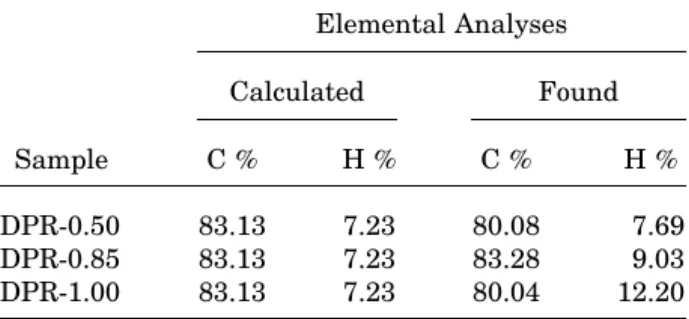
A red semisolid phenolic resin DPR was acquired using HCl as a catalyst by incorporating HPTCDP with formaldehyde. Scheme 1 illus-trates the reactions. Several feed ratios were per-formed to obtain an optimized composition for flame-retardation. Table II shows the elemental analyses of DCPD-modified phenolic resins DPR-0.50, DPR-0.85, and DPR-1.00. The composition of DPR-0.85 obtained from the elemental analy-ses correlated with that of the theoretical calcu-lated value. However, the composition of DPR-0.5 and DPR-1.0 deviated from the calculated value, probably because of the network formation. The network restricts the phosphorus graft. Thus, the composition of DPR is chosen as the molar ratio of HPTCDP/formaldehyde⫽ 1:0.85 for flame retar-dation. Figure 3 depicts the FTIR spectra of DPR-0.85. Peaks appearing at 922 cm⫺1 for the IR spectra verify that the phenyl group possesses three substitute sites. The characteristic
absorp-Figure 1 FTIR spectra of (I) HPTCDP and (II) DCPD.
Figure 2 1H-NMR spectra of adduct HPTCDP.
Table I Reaction Condition for HPTCDP Adduct Sample Code Reaction Temperature (°C) Reaction Time (h) Yield (%)a (dlginh⫺1)b I 120 1 72 0.0856 II 120 3 74 0.0994 III 120 5 78 0.0796 IV 150 1 74 0.0979 V 150 3 70 0.1085 VI 150 5 72 0.0703 aYield of adduct HPTCDP. bMeasure at 25°C in THF.
Table II Element Analysis of DCPD-Modified Phenolic Resins Sample Elemental Analyses Calculated Found C % H % C % H % DPR-0.50 83.13 7.23 80.08 7.69 DPR-0.85 83.13 7.23 83.28 9.03 DPR-1.00 83.13 7.23 80.04 12.20
tion band of the hydroxy group on the aliphatic chain was found at 1070 cm⫺1. The stretching band of the hydroxy group appears at 3200 cm⫺1.
Thermal Properties of the DCPD-Modified Phenolic Resin (DPR)
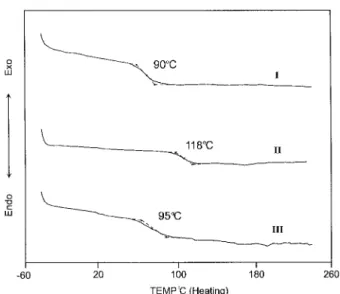
The molecular weight and thermal properties of phenolic resin with and without DCPD-modified are listed in Table III, to help study the effect of DCPD in the phenolic resin. The weight-average molecular weight of the phenolic resin and the DCPD-modified phenolic resin (DPR-0.85) were found with 500 – 800 and 18000, respectively. The degradation temperature at 5% weight loss was found at 144°C and 274°C for phenolic resin and DPR-0.85, respectively. These results indicated that the reactivity and thermal stability could be effectively improved by introducing DCPD into the phenolic backbone. Figure 4 shows the DSC thermograms of the phenolic resins’ DPRs. The phenolic resin DPR-0.85 possesses the highest glass transition temperature (Tg ⫽ 118°C). This
can also prove that the DPR-0.85 has the best linear structure.
Synthesis and Characterization of Phosphorus-Containing DCPD-Modified Phenolic Resin (PCDPR)
A series of phosphorus-containing phenolic res-ins, PCDPRs, were synthesized to increase flame
retardancy of the phenolic resin. The phosphorus-containing phenolic resins PCDPR21, PCDPR11, and PCDPR12 were obtained by incorporating the phenolic resin DPR-0.85 with the phosphonic compound DEPC at the compositions of 2:1, 1:1, and 1:2 by mol ratio, respectively. Figure 5 illus-trates the FTIR spectra of the phosphorus-con-taining phenolic resins PCDPRs. The character-istic absorption peaks of the functional groups of P—OPh and (EtO)3P⫽O for the
phosphorus-con-taining phenolic resin PCDPR21 were assigned at 968 and 1291 cm⫺1, respectively. These three compounds were further identified by 31P-NMR.
Figure 6 demonstrates the 31P-NMR spectra of
the phosphorus-containing phenolic resins. A
Figure 3 FTIR spectra of DPR-0.85.
Table III Thermal Properties of DPR and PR
Sample MW Tg(°C) Td (°C)
Phenolic resin 500–800 112 144
DPR-0.50 — 90 314
DPR-0.85 18,000 118 292
DPR-1.00 — 95 304
Figure 4 DSC thermogram of (I) 0.5, (II) DPR-0.85, and (III) DPR-1.00.
Figure 5 FTIR spectra of (I) PCDPR21, (II) PC-DPR11, and (III) PCDPR12.
chemical shift that appeared at⫺18 ppm exhibit DEPC was incorporated onto the phenolic resin DPR-0.85. The integration of a new chemical shift (␦ ⫽ ⫺26 ppm) appeared as the content of the phosphorus-containing compound increased. The peak that appears at ␦ ⫽ ⫺26 ppm may be as-cribed as the phosphorus-containing group bonded on the terminal hydroxy methylene of the DCPD-modified phenolic resin DPR-0.85. In Fig-ure 6(I), DECP was covalently grafted onto the phenolic resin DPR-0.85 and the peak at␦ ⫽ ⫺26 ppm was not observed when its concentration was low. Table IV summarizes the chemical
charac-teristics of the phosphorus-containing DCPD-modified phenolic resin PCDPR. The phosphorus content can be obtained from element analysis.
The Effect of Phosphorus on the Thermal and Flame-Retardant Properties of Phenolic Resin
TGA and DSC were used to investigate the ther-mal properties of the phosphorus-containing phe-nolic resins. Figure 7 illustrates the DSC thermo-grams of the phenolic resin DPR-0.85 and the phosphorus-modified phenolic resin PCDPR. The crystallinity and Tgs slightly decreased when
di-ethylphosphoryl chloride was grafted onto the phenolic resin. Thus, when the phosphorus con-tent increased, the decrease in the Tgvalue may
be attributed to plasticization of the phosphorus-containing side groups.
Figure 8 depicts the TG and DTG thermograms of the phenolic resin DPR-0.85 and the
phospho-Figure 6 31P-NMR spectra of (I) PCDPR21, (II) PC-DPR11, and (III) PCDPR12.
Table IV FTIR Characteristic Absorptions and Elemental Analysis of PCDPR
Sample P % (wt %) IR (cm⫺1) Elemental Analysis Calculated Found PhOOOP PAO C % H % C% H% PCDPR21 3.46 968 1291 77.72 6.96 77.68 6.36 PCDPR11 5.50 965 1294 74.81 6.06 74.47 5.85 PCDPR12 7.79 964 1297 70.91 5.92 70.85 5.28
Figure 7 DSC thermogram of (I) PCDPR12, (II) PC-DPR11, (III) PCDPR21, and (IV) DPR-0.85.
rus-modified phenolic resin PCDPR12. Despite that introducing phosphorus group onto the phe-nolic resin DPR-0.85 slightly diminished the ther-mal stability of DPR-0.85, the phosphorus-con-taining phenolic resin PCDPR12 still exhibits rel-atively good stability in heating resistance. In Figure 8, one stage degradation behavior was ob-served under nitrogen atmosphere. The degrada-tion may be due to the cracking of the polymer backbones. However, two-stage degradation be-havior was found for the phosphorus-containing resin PCDPR12 under nitrogen when the temper-ature increased. The first-stage degradation at 299°C for PCDPR12 may be caused by the decom-position of the graft phosphate groups. Similar degradation behavior was also observed for the other phosphate-containing polymer.14 With an
increasing temperature, the phosphate groups were aggregated and a solid polyphosphoric acid formed. The covered polyphosphoric acid retards heat penetration and protects the polymer back-bone from further degradation. Thus, the decom-position temperature of the PCDPR12 (503°C) backbone was higher than DPR-0.85 (449°C).
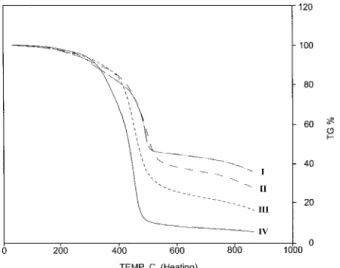
The TGA thermograms of DPR-0.85 and PC-DPR with various phosphorus contents are illus-trated in Figure 9 and are listed in Table V. PCDPRs with various phosphorus contents pre-sented a similar weight loss behavior. The first-stage weight loss temperature decreased as the phosphorus content increased. Whereas the sec-ond degradation stage became gentler and the char yield ratios increased. As the phosphorus content increased, a more phosphorus-rich resi-due formed during the first-stage decomposition.
Because the phosphorus-rich residue prevents the degradation of the phenolic polymer back-bone, a condensed-phase mechanism was in-volved in the flame-retardant mechanism for PC-DPR.3 Alternatively, flame-retardation can be
gauged by the weight of flame residue up to 700°C.15 The char yield for DPR-0.85 was 7%
whereas the phosphorus-containing phenolic res-ins PCDPRs were higher than 23% char yield at 700°C under nitrogen. Thus, the PCDPRs pos-sesses more flame retardancy than the phenolic resin DPR-0.85. Furthermore, the LOI values of PCDPR (LOIⱖ 27) were higher than the phenolic resin DPR-0.85 (LOI ⱕ 17). The LOI values in-crease as the phosphorus content inin-creases, con-firming that the thermal stability at higher tem-peratures and the flame retardancy of the poly-mer can be improved by grafting phosphorus onto the backbone.
CONCLUSIONS
HPTCDP was synthesized via the Friedel-Crafts reaction. DPR was also synthesized by HPTCDP and formaldehyde. The molecular weight could be increased by introducing DCPD into the phenolic resin. When the phosphorus group incorporated into the DPR, the thermal stability was slightly diminished. The char yield and LOI studies veri-fied that the flame retardance of DPR could be improved by phosphorylation. TGA investigation confirmed that a condensed-phase mechanism
Figure 9 TGA thermogram of (I) PCDPR12, (II) PC-DPR11, (III) PCDPR21, and (IV) DPR-0.85.
Figure 8 TG and DTG thermograms of (I) PCDPR12 and (II) DPR-0.85.
prevents the phenolic resin from further degrada-tion. The above results prove that DCPD, a low-valued byproduct obtained from petroleum refin-ery, can be incorporated with phosphorus-con-taining compounds to generate high-valued materials with high flame-retardant characteris-tics. They can have extensive potential applica-tion on flame-retardant industrial products.
The authors thank the Chinese Petroleum Company and the National Science Council of the Republic of China for financially supporting this research (NSG 2187-081J2).
REFERENCES
1. Banks, M.; Ebdon, J. R.; Johnson, M. Polymer 1994, 35, 3470.
2. Banks, M.; Ebdon, J. R.; Johnson, M. Polymer 1993, 35, 4547.
3. Banerjee, S.; Palit, S. K.; Maiti, S. J Polym Sci Polym Chem 1994, 32, 219.
4. Horrocks, A. R.; Zhang, J.; Hall, M. E. Polym Int 1994, 33, 303.
5. Zupancic, J. J.; Conrad, J. P.; Wrezel, J. A.; Zweig, A. M.; Frechet, J. M. U. S. Pat. 4,824,920, 1989. 6. Curvin, D. R. U. S. Pat. 5,587,007, 1996.
7. Bogan, G. W.; Monnerat, G. A. U. S. Pat. 4,806,625, 1989.
8. Nelson, D. L. U. S. Pat. 4,390,680, 1983.
9. Mori, S.; Fujimoto, K.; Tonoki, S. U. S. Pat. 5, 270, 104, 1993.
10. John, M. U. S. Pat. 5,877,366, 1999.
11. Nair, C. P. R.; Glouet, G.; Guilbert, Y. Polym De-grad Stab 1989, 26, 305.
12. Liu, Y. L.; Hsiue, G. H.; Chiu, Y. S.; Jeng, R. J.; Perng, L. H. J Appl Polym Sci 1996, 61, 613. 13. Gobran; Ramsis. U. S. Pat. 3,944,523, 1976. 14. Liu, Y. L.; Hsiue, G. H.; Chiu, Y. S.; Jeng, R. J.; Ma,
C. J Appl Polym Sci 1996, 59, 1619. 15. Krevelen, D. W. Polymer 1975, 16, 615. Table V DSC, TGA Data, and LOI Values of DPR and PCDPR
Samples Tg(°C)
Specific Temperature of Weight Loss from TGA (°C)
Char % at 700°C LOI 5% Loss Step 1 Step 2
DPR-0.85 118 292 — 449 12 ⬍17
PCDPR21 106 218 308 453 39 27
PCDPR11 104 298 299 489 43 31