Preparations, Thermal Properties, and T
gIncrease Mechanism of
Inorganic/Organic Hybrid Polymers Based on Polyhedral Oligomeric
Silsesquioxanes
Hongyao Xu,†,‡Shiao-Wei Kuo,†Juh-Shyong Lee,†and Feng-Chih Chang*,† Department of Applied Chemistry, National Chiao-Tung University, Hsin Chu, Taiwan, and Department of Chemistry, Anhui University, Anhui, 230039, China
Received February 21, 2002
ABSTRACT: A series of novel hybrid poly(acetoxylstyrene-co-isobutylstyryl-POSS)s (PAS-POSS) and poly(vinylpyrrolidone-co-isobutylstyryl-POSS)s (PVP-POSS) are synthesized and characterized. The POSS content in these hybrids can be controlled by varying the monomer feed ratio. The polyhedral oligosilsesquoixane (POSS) moiety can effectively increase the Tgof the resultant organic/inorganic hybrid polymer at a relatively high POSS content and produce the hybrid copolymer with narrower molecular weight distribution. The FTIR spectra are used to investigate the structure-property relationship of these hybrid polymers, and the Tgenhancement mechanism is discussed in detail.
Introduction
Polymeric hybrid materials have attracted great interest recently due to their advantageous performance relative to the nonhybrid counterparts. Typical hybrid materials may contain a cross-linked inorganic phase bonded (often covalently) with an organic phase.1,2 Recently, polyhedral oligosilsesquoixanes (POSS)-based hybrid polymers3-13have received increasing attention among the academic community and industries because of the unique structure of the POSS macromer, which is a well-defined cluster with an inorganic silica-like core (Si8O12) surrounded by eight organic corner groups. This POSS macromer can be easily functionalized with a wide variety of organic groups that can be employed as monomer or comonomer in a typical polymerization. The preparation and properties of POSS-based hybrid poly-mers can be designed and controlled at the molecular level. Many POSS-based hybrid polymers have been prepared and possess a number of desirable properties.3-9 However, only a few papers have reported their Tg increase behavior.3-5 In the study, we will report the syntheses of a series of new POSS-based hybrid poly-mers and the structure-property relationship of these hybrid polymers.
Experimental Section
Materials. Isobutylstyryl polyhedral oligosilsesquioxane
(POSS) was purchased from the Hybrid plastic Co. Inc., which was stored in a dried box before use. Vinylpyrrolidone and acetoxystyrene were purchased from Aldrich, distilled from calcium hydride under reduced pressure, and stored in sealed ampules in a refrigerator. High-purity azobis(isobutyronitrile) (AIBN) was kept in a dried box and used as received. Spectroscopic grade THF and toluene were predried over 4 A molecular sieves and distilled from sodium benzophenone ketyl immediately prior to use. All other solvents were purchased from Aldrich and used without further purification.
Instrumentation. Thermal analyses were carried out on
a DSC from DuPont (DSC-9000). The scan rate was 20 °C/
min within the temperature range 30-260 °C. The sample was quickly cooled to 0 °C from the melt for the first scan and then scanned from 20 to 280 °C at 20 °C/min. The glass transition temperature is obtained at the midpoint of the specific heat increment. FTIR spectra were measured with a spectral resolution of 1 cm-1on a Nicolet Avatar 320 FT-IR spectro-photometer using KBr disks or pellets at room temperature. Weight- and numer-average molecular weights (Mwand Mn) and polydispersity index (Mw/Mn) were determined by a Water 510 gel permeation chromatograph (GPC).1H NMR spectra were recorded on a Bruker ARX300 spectrometer using the chloroform-d solvent.
Polymerizations. All polymerization reactions were
car-ried out under nitrogen using a vacuum-line system. Poly-(vinylpyrrolidone-co-isobutylstyryl-POSS) (PVP-POSS) and poly(acetoxystyrene-co-isobutylstyryl-POSS) (PAS-POSS) were prepared by a conventional free radical polymerization tech-nique. For comparison, the homopoly(vinylpyrrolidone) (PVP) and homopoly(acetoxystyrene) (PAS) were also synthesized as shown in Scheme 1. Typical experimental procedures for these polymers are given below. In a typical reaction, 9.8 mmol of vinylpyrrolidone (VP) and 0.22 mmol of POSS monomer in toluene (dried toluene, 7 mL) were polymerized using the AIBN initiator (1 wt % based on monomer) at 80 °C under a nitrogen atmosphere for 24 h. The product then was poured into excess cyclohexane under vigorously agitation to precipi-tate the copolymer, then purified in THF/cyclohexane, and dried in a vacuum oven. A 58.4 wt % yield was obtained through this procedure.
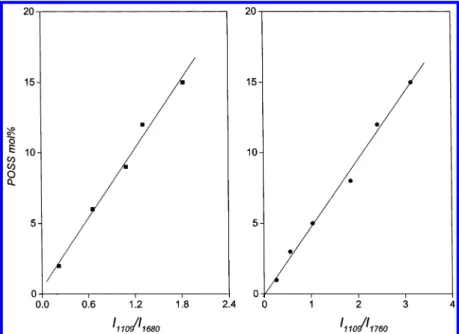
Determination of Component Contents.12,14IR analysis was used to determine the respective component contents of these polymers. The pure poly(acetoxystyrene) (PAS), poly-(vinylpyrrolidinone) (PVP), and poly(isobutylstyryl polyhedral oligosilsesquioxane) (POSS) samples were prepared following similar procedures mentioned above. To establish a calibration curve, a series of POSS/PVP and POSS/PAS mixtures with known amounts of POSS were prepared. To ensure intimate mixing, PVP, PAS, and POSS were first dissolved in a solvent and then cast into a thin film. The carbonyl stretching vibration of the PVP is located at 1680 cm-1. The POSS moiety exhibits a “robust” absorption centered at 1109 cm-1. The carbonyl absorption band of the PAS is located at 1760 cm-1. These carbonyl bands at 1680 and 1760 cm-1were adopted as internal standards for POSS/PVP and POSS/PAS mixtures, respectively. The ratios of band areas, A1109/A1680 and A1109/ A1760, were plotted against the mole fraction of the POSS in the POSS/PVP and POSS/PAS mixtures, and the results are shown in Figure 1a,b. These plots gave a linear calibration †National Chiao-Tung University.
‡Anhui University.
* To whom correspondence should be addressed: e-mail [email protected], Tel 886-35-131512, Fax 886-35-723764.
10.1021/ma0202843 CCC: $22.00 © 2002 American Chemical Society Published on Web 10/03/2002
line between POSS mole fraction and respective band ratios. Therefore, the mole percent of the POSS in PVP-POSS (1) and POSS-PAS (2) copolymers can be calculated as follows:
Results and Discussion
Polymerization. The polymerization of acetoxy-styrene is catalyzed by the AIBN initiator to obtain the poly(acetoxystyrene) (PAS) polymer with a yield of 56 wt %. Figure 2 shows the IR spectra of the POSS-based PAS-POSS hybrid polymer, the pure POSS, and the parent PAS. The IR spectrum of the PAS-POSS is similar to that of the PAS except that the PAS-POSS hybrid polymer shows a new strong absorption peak centered at 1109 cm-1 from the siloxane stretching vibration, revealing that the POSS moiety is indeed incorporated into PAS molecular chains.
To further confirm that the POSS is indeed incorpo-rated into the PAS rather than as a mixture, the
the siloxane characteristic peak (1150-1050 cm-1), implying that the POSS macromer is indeed incorpo-rated into the PAS polymer to produce the PAS-POSS copolymer. Essentially, all the POSS-based polymers prepared exhibit the characteristic absorption band at ∼1109 cm-1, and the absorption intensity varies with POSS content in the reactant mixture. The pure PAS has an absorption band in the region of 1720-1800 cm-1, where the POSS moiety does not have any absorption. This result implies that the band intensity at 1109 cm-1can be further utilized to determine the POSS content of these copolymers by using the band area centered at∼1760 cm-1as an internal reference. Using the strong absorption band of the carbonyl group in the PAS chain at 1760 cm-1as an internal standard, we plot the I1109/I1760 ratio against the POSS mole content, and a calibration line is obtained to give the eq 1 (e.g., Figure 1A). The POSS contents in these PAS-POSS copolymers thus determined are listed in Table 1. Table 1 clearly shows that the POSS content of the POSS-PAS copolymer increases with increasing the POSS feed ratio. Product molecular weight (Mwand Mn), polydispersities, and yield are also summarized in Table 1.
The molecular weights (Mw) of the parent poly-(acetoxystyrene) is 46.23× 10³with a polydispersity of 2.61. When the polymer contains 0.35 mol % POSS, the Mwand polydispersity (PDI) decrease slightly at 40.06 × 10³and 2.13. With the increase of the POSS content, the Mwand PDI further decrease; for example, Mw) 15.59× 10³ and PDI ) 1.39 were obtained when the POSS content in the initial feed ratio is 8.10 mol %. The addition of POSS decreases the polymerization activity of the PAS and results in lower incorporated POSS based on the feed ratio possibly due to the steric bulkiness of the POSS macromer. A similar phenom-enon was also observed in the copolymerization of POSS with ethylene.9
Polymerization of the vinylpyrrolidone catalyzed by AIBN results in Mw) 599.8 × 10³, PDI ) 4.56, and a product yield of 62.3 wt %. When the POSS is added into the polymerization system, the product yield de-creased only slightly, from 62.3 to 58.4 wt % with the POSS feed ratio of 2.25 mol %, while the polydispersity is drastically reduced from 4.56 to 1.20. The product polydispersity further decreases with the increase of the POSS feed ratio. The purified product clearly shows the characteristic IR absorption bands of the POSS moiety as shown in Figure 3.
Different from the copolymerization of AS and POSS, a higher molecular weight of the POSS-containing PVP-POSS copolymer can be produced in the high PVP-POSS feed Y′POSS) 0.082(I1109/I1680) + 0.0018 (1)
ratio (8.84 mol %), and a higher POSS incorporated copolymer can be produced by copolymerizing with vinylpyrrolidone possibly due to higher activity of the vinylpyrrolidone than the acetoxylstyrene. When the POSS feed content is increased, the POSS content in the resulting hybrid also increased as shown in Table 2. Therefore, the POSS content of the hybrid can be effectively controlled by varying the POSS feed ratio. These polymer hybrids are completely soluble in com-mon organic solvents such as THF, DMF, and chloro-form. The excellent solubility of the POSS-containing
hybrid enables the characterization of their molecular structure by the solution spectroscopic method. The1H NMR spectra were obtained using a Bruker 300. The PAS-POSS (sample from Table 1, no. 5) exhibits proton resonance peaks at δ 7.13-6.18, 2.24, 2.01-1.58, 1.58-1.03, 0.94, and 0.62 ppm. The parent PAS does not possess any NMR resonance peak at less than δ 1.0 ppm. Therefore, the δ 0.94 ppm and δ 0.62 ppm resonance bands can be attributed to the isobutyl group (δ 0.94 ppm, -CH2-CH-(CH3)2; δ 0.62 ppm, CH2 -CH-(CH3)2) of the POSS moiety. Similarly, the PVP-POSS Figure 1. Calibration curve for determining component contents of POSS-based hybrid polymers using the area ratios of absorption
bands of POSS at 1109 cm-1, PAS at 1760 cm-1, and PVP at 1680 cm-1.
Table 1. Effect of POSS Feed Ratio on the Result of PAS-POSS
feed mole ratio product mole ratio sample no. AS (mol %) POSS (mol %) PAS (mol %) POSSa (mol %) POSSb (mol %) yield (wt %) Tgc (°C) Mwd(×103 g/mol) Mn(×103 g/mol) PDI 1 100.00 0.00 100.00 0.00 0.00 56.2 122.1 46.23 17.71 2.61 2 99.65 0.35 99.02 0.98 0.41 40.0 113.6 40.06 18.84 2.13 3 98.60 1.40 98.73 1.27 1.38 19.1 105.8 16.40 9.34 1.76 4 97.42 2.58 98.53 1.47 2.66 19.5 104.7 22.75 13.03 1.74 5 93.79 6.21 96.77 3.23 4.18 14.5 103.2 14.86 10.34 1.44 6 91.90 8.10 95.97 4.03 5.43 9.2 107.8 15.59 11.21 1.39 aData were obtained based on the IR standard curve.bDetermined by1H NMR.cData were gathered on the second melt using a heating and cooling rate of 20 °C/min.dDetermined by GPC using the PS standard curve.
Figure 2. FT-IR spectra in the regions from 4000 to 600 cm-1
recorded at room temperature of pure POSS, parent PAS, and PAS-POSS.
Figure 3. FT-IR spectra in the regions from 4000 to 600 cm-1 recorded at room temperature of pure POSS, parent PAS, and PAS-POSS.
(sample from Table 2, no. 1) shows proton resonance peaks at δ 7.16-7.06 (w), 3.85, 3.70, 3.21, 2.02, 1.67, 0.94, and 0.61 ppm. Similar with the PAS-POSS, the resonance bands at δ 0.94 and δ 0.61 ppm are assigned to the isobutyl group (δ 0.94, -CH2-CH-(CH3)2; δ 0.61, CH2-CH(CH3)2) of the POSS moiety because the parent PVP does not possess the resonance spectra at this region. The chemical shift of δ 2.24 ppm in the PAS-POSS and the chemical shift at δ 3.22 in the PVP-PAS-POSS are attributed to the carbonyl-substituted methyl proton peak (-COCH3) in the PAS species of PAS-POSS and the R-methylene proton relative to nitrogen in the pyrrolidonyl ring of PVP species, while the POSS moiety does not possess any resonance band in this region. Therefore, we can also estimate the POSS content in these hybrids based on the 1H NMR spectra. The summarized results are listed in Tables 1 and 2.
Thermal Properties and Tg Increase Mecha-nism. Figure 4 shows the DSC thermograms of various POSS hybrids and the parent PAS. The PAS-POSS hybrid polymer with 0.98 mol % PAS-POSS has a Tg at 113.6 °C, which is even lower than the Tgof the non-POSS parent PAS (at 122.5 °C) by 8.9 °C. It appears that the presence of POSS moiety in the hybrid copoly-mers is unable to increase the Tgof the parent polymer. The presence of POSS at a relative smaller content actually reduces the dipole-dipole interaction of PAS molecules and plays an inert diluent role to decrease the self-association interaction of PAS molecules. The Tg of the PAS-POSS further decreases with the in-crease of the POSS content in the hybrid polymer and approaches a minimum at POSS ) 3.23 mol % (Table 1). The lowest Tgof the PAS-POSS hybrid observed is at 103.1 °C. At a higher POSS content (4.03 mol %), the Tgof the PAS-POSS hybrid increases with the increase of the POSS content. Other than the diluent role to
decrease Tg of the PAS above-mentioned, the POSS moiety must play another role to increase the Tgwhich becomes dominant when its content is relatively higher (more than 4.03 mol %). To understand the Tgchange mechanisms involved in these PAS-POSS hybrids, the characterization of infrared vibration spectra of these PAS-POSSs was carried out. Figure 5 shows the expanded FTIR spectra ranging from 1800 to 1700 cm-1 for the PAS and various PAS-POSSs. The PAS has a characteristic absorption band centered at 1760 cm-1, which is attributed to the carbonyl vibration absorption of the PAS. This absorption maximum tends to shift toward higher frequency when the POSS is incorporated into the PAS. For instance, this PAS peak maximum at 1760 cm-1 decreases to 1762 cm-1 in the PAS-POSS1.27 (1.27 mol % POSS) but increases to 1765 cm-1 in the PAS-POSS4.03 (4.03 mol % POSS). In addition, the band is obviously widened at higher POSS content. Interestingly, a stronger shoulder peak at lower fre-quency (1750 cm-1) is found in the PAS-POSS4.03. It appears that there is a new stronger dipole-dipole interaction existence between the POSS and the carbo-nyl of PAS species, which is probably responsible for the positive contribution to the Tgincrease of the hybrid. However, the POSS itself does not cause Tgincrease of the hybrid. The latter interaction (POSS-PAS) contri-bution is probably weaker than its diluent role of POSS to the self-association of PAS molecules in the PAS-POSS due to the relatively small content of the PAS-POSS cube. Figure 6 shows the expanded FTIR in the region from 1150 to 1050 cm-1of various PAS-POSS’s and the parent PAS. The POSS has a characteristic broad band centered at 1109 cm-1, which is attributed to the siloxane vibration absorption within POSS molecules. Surprisingly, this siloxane characteristic band signifi-Figure 4. Differential scanning calorimetry thermograms of
PAS and PAS-POSSs. Figure 5. Expanded FT-IR spectra in the regions from 1800to 1700 cm-1recorded at room temperature of parent PAS and PAS-POSSs.
cantly shifts to lower frequency with a small amount of the POSS within the PAS main chain. The absorption peak maximum is located at 1103 cm-1with 0.98 mol % POSS. This result can be interpreted as the dipole-dipole interaction occurring between the POSS siloxane and the PAS carbonyl. When the POSS content is increased, the POSS-POSS interaction will increase as would be expected. This is why the siloxane vibration peak maximum shifts back toward the parent POSS absorption again at a higher POSS content. The nano-size POSS and the aggregated POSS cluster physically dominate local polymer chain motion which is able to provide another contribution to the Tgincrease besides the POSS-PAS dipole interaction in the hybrid polymer when the POSS content is higher. Here, the POSS aggregation is mainly derived from the intramolecular or intermolecular POSS-POSS interaction, and the extent of such aggregation depends on the POSS content in the PAS-POSS copolymer. As mentioned above, the presence of POSS also plays the role of a diluent to reduce the extent of the PAS dipole-dipole interaction and thus decreases its Tg. It appears that these two adverse and competitive effects depend on the POSS content in the copolymer. At a relatively lower POSS content, the diluent role to depress Tgis dominant. At a higher POSS content, the POSS and POSS-PAS interaction becomes dominant. As a result, the observed Tg of the PAS-POSS hybrid decreases and then increases with the increase of the POSS content. A similar Tgincrease was also found by Haddad3and Mather.4 Haddad3 found that at a relatively higher POSS content (7.8 mol %) the MPS-POSS has a Tgat 98 °C higher than the parent poly(p-methylstyrene) at 93 °C. Mather4found that PN-POSS with 10 mol % of POSS also has a Tg higher than the parent poly-(norbornene) by 10 °C.
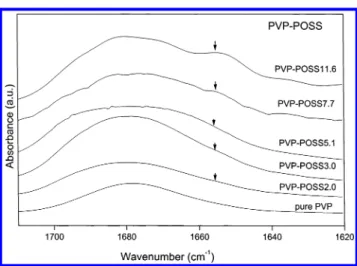
Figure 7 shows the DSC thermograms of various PVP-POSSs and the parent PVP. The PVP-POSS2.0 (2.0 mol %) shows a Tgat 138.9 °C, which is less than that of parent PVP (149.5 °C) by about 10 °C. However, the PVP-POSS3.01 (3.01 mol % POSS) has a Tg at 155.7 °C, which is higher than that of the parent PVP (149.52 °C) by 6 °C. Above 3 mol % POSS content, the Tgof the PVP-POSS increases with the increase of the POSS content. For instance, the PVP-POSS5.14 has a Tgat 167.97 °C, which is higher than that of the parent PVP by 18 °C. To clearly understand the Tg increase mechanism in the PVP-POSS hybrids, the FTIR char-acterization was carried out. Figure 8 shows the
ex-panded FTIR spectra of various PVP-POSSs and the parent PVP ranging from 1720 to 1620 cm-1. The parent PVP shows a characteristic carbonyl vibration band located at 1680 cm-1. The absorption peak maximum slightly shifts toward higher frequency when the POSS moiety is incorporated into the PVP due to the inert diluent role of the POSS to the self-association interac-tion of the PVP molecules. Interestingly, the vibrainterac-tion band is obviously broadened asymmetrically on the low-frequency side, and a significant absorption shoulder appears at the lower wavenumber. This absorption shoulder increases with the increase of the POSS content. For instance, the PVP-POSS with 7.7 mol % POSS exhibits a significant strong shoulder peak cen-tered at 1654 cm-1, which can be assigned as the new dipole-dipole interaction between the POSS and PVP carbonyl. This result is also consistent with the result observed in carbonyl vibration spectra of PAS-POSS4.03, which is also in good agreement with the observed Tg enhancement of the PVP-POSS.
Figure 9 shows the expanded FTIR spectra of the pure POSS and various PVP-POSSs ranging from 1200 to 1040 cm-1. The POSS has a characteristic vibration band located at 1109 cm-1, while the PVP does not have any absorption in the same region. When the POSS moiety is incorporated into the PVP, the characteristic vibration band significantly shifts toward lower fre-quency and results in a broad absorption shoulder in lower wavenumber. This observation further confirms Figure 6. Expanded FT-IR spectra ranging from 1200 to 1050
cm-1of POSS and PAS-POSSs recorded at room temperature. Figure 7. Differential scanning calorimetry thermograms ofPVP and PVP-POSSs.
Figure 8. Expanded FT-IR spectra ranging from 17200 to
1600 cm-1of parent PVP and PVP-POSSs recorded at room temperature.
that a stronger interaction occurs in the PVP-POSS hybrid polymer. The intensity of the shoulder also further increases with the increase of the POSS content (Figure 9). This observation is completely identical with the carbonyl vibration band change trend in the result-ing polymer (Figure 8). In contrast between the PAS-POSS and the PVP-PAS-POSS hybrid polymer, the latter shows much stronger interaction than the former be-tween POSS siloxane and carbonyl group. This is also consistent with their relative Tgchanges, such as the PVP-POSS3.01 has a Tg increase while the PAS-POSS4.01 has a Tg decrease relative to the their respective homopolymers.
Conclusions
In summary, a series of POSS-based hybrid polymer have been prepared, and their structure and thermal properties are characterized. The POSS content in the hybrid can effectively be controlled by varying the feed ratio. The POSS shows low activity in the
copolymeri-References and Notes
(1) Mascia, L. Trends Polym. Sci. 1995, 3, 61. (2) Sanchea, C.; Ribot, F. J. Chem. 1995, 18, 1007.
(3) Haddad, T. S.; Lichtenhan, J. D. Macromolecules 1996, 29, 7302.
(4) Mather, P. T.; Jeon, H. G.; Romo-Uribe, A.; Haddad, T. S.; Lichtenhan, J. D. Macromolecules 1999, 32, 1194.
(5) Bharadwaj, R. K.; Berry, R. J.; Farmer, B. L. Polymer 2000, 41, 7209.
(6) Romo-Uribe, A.; Mater, P. T.; Haddad, T. S.; Lichtenhan, J. D. J. Polym. Sci., Part B: Polym. Phys. 1998, 36, 1857. (7) Zheng, L.; Farris, R. J.; Coughlin, E. B. Macromolecules 2001,
34, 8034.
(8) Lichtenhan, J. D.; Otonari, Y. A.; Carr, M. J. Macromolecules
1995, 28, 8435.
(9) Tschucida, A.; Bolln, C.; Sernetz, F.; Frey, H.; Mulhaupt, R. Macromolecules 1997, 30, 2818.
(10) Lichtenhan, J. D.; Vu, Q. N.; Cater, J. A.; Gilman, J. W.; Feher, F. Macromolecules 1993, 26, 2141.
(11) Mantz, R. A.; Jones, P. F.; Chaffee, K. P.; Lichtenhan, J. D.; Gilman, J. W.; Ismail, I. B. M.; Burmeister, M. J. Chem. Mater. 1996, 8, 1250.
(12) Xu, H.; Kuo, S. W.; Lee, J. L.; Chang, F. C. Polymer 2002, 43, 5117.
(13) Lee, A.; Lichtenhan, J. D. Macromolecules 1998, 31, 4970. (14) Tang, B. Z.; Xu, H.; Lam J. W. Y.; Lee, P. P. S.; Xu, K.; Sun,
Q.; Cheuk, K. L. Chem. Mater. 2000, 12, 1446.
MA0202843 Figure 9. Expanded FT-IR spectra ranging from 1200 to 1050
cm-1of pure POSS and PVP-POSSs recorded at room tem-perature.