Exploring the influence of high order transverse
modes on the temporal dynamics in an optically
pumped mode-locked semiconductor disk laser
C. H. Tsou,1 H. C. Liang,2 C. P. Wen,1 K. W. Su,1 K. F. Huang,1 and Y. F. Chen1,3,*
1Department of Electrophysics, National Chiao Tung University, 1001 Ta-Hsueh Rd. Hsinchu 30010, Taiwan 2Institute of Optoelectronic Science, National Taiwan Ocean University, Keelung 20224, Taiwan 3Department of Electronics Engineering, National Chiao Tung University, 1001 Ta-Hsueh Rd. Hsinchu, Taiwan
Abstract: We quantitatively investigate the influence of high-order transverse modes on the self-mode locking (SML) in an optically pumped semiconductor laser (OPSL) with a nearly hemispherical cavity. A physical aperture is inserted into the cavity to manipulate the excitation of high-order transverse modes. Experimental measurements reveal that the laser is operated in a well-behaved SML state with the existence of the TEM0,0
mode and the first high-order transverse mode. While more high-order transverse modes are excited, it is found that the pulse train is modulated by more beating frequencies of transverse modes. The temporal behavior becomes the random dynamics when too many high-order transverse modes are excited. We observe that the temporal trace exhibits an intermittent mode-locked state in the absence of high-order transverse modes.
©2015 Optical Society of America
OCIS codes: (140.5960) Semiconductor lasers; (140.4050) Mode-locked lasers; (140.7270)
Vertical emitting lasers. References and links
1. A. C. Tropper, H. D. Foreman, A. Garnache, K. G. Wilcox, and S. H. Hoogland, “Vertical-external-cavity semiconductor lasers,” J. Phys. D Appl. Phys. 37(9), R75–R85 (2004).
2. M. Kuznetsov, F. Hakimi, R. Sprague, and A. Mooradian, “High-power (>0.5-W CW) diode-pumped vertical-external-cavity surface-emitting semiconductor lasers with circular TEM00 beams,” IEEE Photon. Technol. Lett.
9(8), 1063–1065 (1997).
3. B. Heinen, T.-L. Wang, M. Sparenberg, A. Weber, B. Kunert, J. Hader, S. W. Koch, J. V. Moloney, M. Koch, and W. Stolz, “106 W continuous-wave output power from vertical-external-cavity surface-emitting laser,” Electron. Lett. 48(9), 516–517 (2012).
4. U. Keller and A. C. Tropper, “Passively modelocked surface-emitting semiconductor lasers,” Phys. Rep. 429(2), 67–120 (2006).
5. H. Haus, “Mode-locking of lasers,” IEEE J. Sel. Top. Quantum Electron. 6(6), 1173–1185 (2000). 6. Y. F. Chen, Y. C. Lee, H. C. Liang, K. Y. Lin, K. W. Su, and K. F. Huang, “Femtosecond high-power
spontaneous mode-locked operation in vertical-external cavity surface-emitting laser with gigahertz oscillation,” Opt. Lett. 36(23), 4581–4583 (2011).
7. H. C. Liang, Y. C. Lee, J. C. Tung, K. W. Su, K. F. Huang, and Y. F. Chen, “Exploring the spatio-temporal dynamics of an optically pumped semiconductor laser with intracavity second harmonic generation,” Opt. Lett.
37(22), 4609–4611 (2012).
8. L. Kornaszewski, G. Maker, G. P. A. Malcolm, M. Butkus, E. U. Rafailov, and C. J. Hamilton, “SESAM-free mode-locked semiconductor disk laser,” Laser Photon. Rev. 6(6), L20–L23 (2012).
9. A. R. Albrecht, Y. Wang, M. Ghasemkhani, D. V. Seletskiy, J. G. Cederberg, and M. Sheik-Bahae, “Exploring ultrafast negative Kerr effect for mode-locking vertical external-cavity surface-emitting lasers,” Opt. Express
21(23), 28801–28808 (2013).
10. M. Gaafar, D. A. Nakdali, C. Möller, K. A. Fedorova, M. Wichmann, M. K. Shakfa, F. Zhang, A. Rahimi-Iman, E. U. Rafailov, and M. Koch, “Self-mode-locked quantum-dot vertical-external-cavity surface-emitting laser,” Opt. Lett. 39(15), 4623–4626 (2014).
13. N. Hodgson and H. Weber, “Measurement of Beam Quality,” in Laser Resonators and Beam Propagation Fundamentals, Advanced Concepts and Applications, 2nd ed. (Springer, 2005), pp. 713–715.
1. Introduction
Nowadays, optically pumped semiconductor lasers (OPSLs), so called vertical external cavity surface emitting lasers (VECSELs), have become versatile light sources with advantages including high output power, flexible emission wavelength, and nearly diffraction-limited beam quality [1]. Since the first demonstration by M. Kuznetsov et al [2], OPSLs have been extensively explored for various emission schemes. In addition to high power continuous-wave (CW) emission [3], methods of generating short pulses in OPSLs are also aroused considerable interest, such as mode-locked operation [4].
The laser operated in mode-locked state is a well-known technique to produce pulses with the pulse duration on the order of picoseconds or femtoseconds [5]. Among numerous mode-locked methods, the phenomenon of self-mode-locking (SML) is of greatly scientific interest in a laser resonator. Here, SML means that no additional active or passive mode-locking elements (such as saturable absorbers) are used in the laser cavity except for the gain medium. In recent years, the SML operation has been reported in OPSLs with different cavity configurations [6–12]. One of these works experimentally explored that the high-order transverse mode played an important role in achieving the SML operation [11]. The experimental results implied that the phase locking between lasing longitudinal modes can be assisted by the existence of TEM1,0 mode. On the other hand, M. Gaafar et al demonstrated an
excellent beam quality of a VECSEL operated in SML state with fundamental transverse mode [12]. So far, the physical mechanism of SML operation in OPSLs is still ambiguous. There is a controversial issue whether SML operation can be assisted by high-order transverse modes in OPSLs. However, the influence of high-order transverse modes on SML operation in an OPSL has not been quantitatively analyzed yet.
With inserting a physical aperture into the cavity, the excitation of high-order transverse modes can be dominated by the aperture size. In this paper, we explore the performance of SML in an OPSL with a nearly hemispherical cavity by utilizing different aperture sizes to manipulate the excitation of high-order transverse modes. At first, we numerically calculate the energy of high-order transverse modes within the aperture size to analyze the excitation of high-order transverse modes. Based on the calculated results, we systematically measure the temporal dynamics of the laser output with specific aperture sizes. With the appropriate aperture size, the experimental observations reveal that only TEM0,0 mode and the first
high-order transverse mode are excited in the laser cavity. Meanwhile, a well-behaved mode-locked pulse train is experimentally observed. When more high-order transverse modes are excited with using a larger aperture size, the mode-locked pulse train is found to be modulated with the transverse beat frequency. Furthermore, in the absence of the aperture, the temporal behavior becomes the random dynamics because there are too many beating frequencies of transverse modes. On the other hand, when the aperture size is too small to excite high-order transverse modes, we observe that the laser is operated in an intermittent mode-locked state.
2. Cavity configuration and design of aperture size
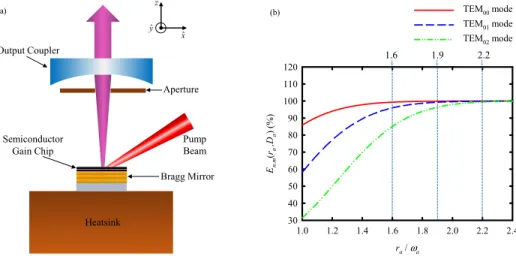
Figure 1(a) illustrates the schematic of the laser experiment. The laser cavity consists of a concave mirror, a semiconductor gain chip, a pump laser diode, and an aperture. The gain chip and the pump laser diode were obtained from a commercial OPSL module (Coherent Inc.). The active region was a structure of multiple quantum wells to form a resonant periodic gain.
Pump Beam Heatsink Bragg Mirror Semiconductor Gain Chip Aperture Output Coupler ˆz ˆy ˆx (a) ra / ωa 1.0 1.2 1.4 1.6 1.8 2.0 2.2 2.4 En, m (ra ,Da ) (% ) 30 40 50 60 70 80 90 100 110 120 TEM00 mode TEM01 mode TEM02 mode 1.9 2.2 1.6 (b)
Fig. 1. (a) Schematic diagram of the experimental setup for exploring the SML in an OPSL. (b) Calculated results for the energy of high-order transverse modes within the aperture
, ( , )
n m a a
E r D versus the ratio of apertures size to the cavity mode size on the aperture ra ωa.
To form a front mirror, the gain chip included a structure of distributed Bragg reflectors (DBRs). The photoluminescence emission wavelength of the gain chip was approximately 1060 nm at room temperature. The gain chip was soldered with indium to chemical vapor deposition diamond heat spreader with DBR side down for effectively removing the heat from the gain structure. The gain structure was antireflection coated at the wavelengths of 808 nm and 1060 nm. The radius of the 808 nm pump beam ωp was approximately 320 μm. The
concave output coupler was utilized with the radius of curvature Roc of 100 mm and the
output transmission of 2%. In order to excite high-order transverse modes effortlessly, a nearly hemispherical cavity was designed with the cavity length Lcav of 96 mm. With ABCD
matrix, the basic formula of cavity mode size is given by [13]:
(
2)
20
( )z 1 M z zR ,
ω =ω + (1)
where ω0 is the beam waist, ω02 =λzR π , zR = Lcav
(
Roc−Lcav)
, λ is the emissionwavelength, and M2 is the beam propagation factor. With the coordinates shown in Fig. 1(a), the beam propagation factor M for a Hermite-Gaussian transverse mode, related to TEM2
n,m,
is (2n + 1) in the x- direction and (2m + 1) in the y- direction. In this nearly hemispherical
cavity, the beam waist was the cavity mode size on the gain chip, and was calculated to be 81
μm. Hence, the pump-to-mode size ratio was obtained to be 3.95. This large value of the
pump-to-mode size ratio caused the pump thresholds of high-order transverse modes to be extremely low [11]. This nearly hemispherical cavity was employed for generating lots of high-order transverse modes. With inserting a physical aperture into the cavity, the excitation of high-order transverse modes could be manipulated. The distance between the aperture and the output coupler Da was set to be 5 mm. With Eq. (1), the cavity mode size of fundamental
transverse mode at the position of the aperture ωa was approximately 386 μm.
To analyze the influence of aperture size on the excitation of high-order transverse modes, we numerically calculate the energy of high-order transverse modes within the aperture area. With the coordinates shown in Fig. 1(a), the electric field in the laser cavity can be expressed as
where
(
)
2 2 2 2( ) ( ) , 1 1 1 2 2 , , , ( ) ( ) ( ) 2 ! ! x y z n m n m n m x y x y z H H e z z z n m ω ω ω ω π + − + − Φ = (3)( )
nH • is the Hermite polynomials of order n,
(
2 2)
2(
2 2)
R
z= +z x +y z z +z ,
, , 2 , ,
n m l n m l
k = πf c, fn m l, , is the eigenmode frequency, c is the speed of light in vacuum, l is
the longitudinal mode index, and n and m are the transverse mode indices. The eigenmode
frequency can be expressed as fn m l, , = Δ + + + Δl fL
(
n m 1)
fT where ΔfL is the longitudinalmode spacing and ΔfT is the transverse mode spacing. For the plano-concave cavity, the
transverse mode spacing ΔfT is given by
( )
1 tan 1(
*)
T L cav oc f f π − L R Δ = Δ , where * 2 L cav f c L Δ = and * cav
L is the optical cavity length. In our cavity configuration, the values of
L
f
Δ and ΔfT was calculated to be 1.56 GHz and 687 MHz, respectively. Considering the central emission wavelength, the energy of transverse modes within the aperture area can be expressed as a definite integral of ( )
(
)
2, , 0 , , HG n m l x y z ψ = :
(
)
2 2 2 ( ) , ( , ) 0 0 , , 0 , , , a a r r y HG n m a n m l E r z =
− ψ = x y z dxdy (4)where ra is the radius of aperture. Figure 1(b) depicts En m, ( ,r D of TEMa a) 0,0, TEM0,1, and
TEM0,2 modes versus the ratio of ra to ωa. When the value of ra ωa is larger than 2.2, each
energy of TEM0,0, TEM0,1, and TEM0,2 modes within the aperture remains the total energy. It
reveals that the aperture sizes in this region cannot affect the excitation of TEM0,0, TEM0,1,
and TEM0,2 modes. In the range of 2.2≥ra ωa ≥1.9, the energy of TEM0,2 mode within the
aperture becomes to reduce with the decreasing aperture size. Thus, the pump threshold of TEM0,2 mode can be increased when the value of ra ωa is less than 2.2. In the range of
1.9≥ra ωa ≥1.6, E0,1( ,r Da a) and E0,2( ,r Da a) both decline with the decreasing aperture
size, but the energy of TEM0,0 mode within the aperture still remains the total energy. It
implies that the pump thresholds of TEM0,1, and TEM0,2 modes can be both risen with
aperture sizes in the range of 1.9≥ra ωa ≥1.6. While the value of ra ωa is less than 1.6, it
can be seen that each energy of transverse modes cannot maintain the total energy. In addition to the increasing pump thresholds of TEM0,1 and TEM0,2 modes, the lasing threshold may be
also risen. Based on the calculated results, we can manipulate the excitation of high-order transverse modes with the different aperture sizes. Consequently, the radii of aperture in experiments were 0.875, 0.75, 0.625, and 0.5 mm corresponding to ra ωa of 2.267, 1.943,
Pump power (W) 0 2 4 6 8 10 12 14 A vera ge out put p ow er (W ) 0.0 0.5 1.0 1.5 2.0 2.5 3.0 3.5
Without the aperture
ra / ωa = 2.267 ra / ωa = 1.943 ra / ωa = 1.619 ra / ωa = 1.295
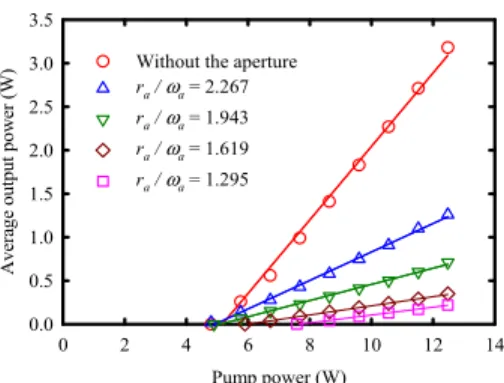
Fig. 2. Average output power versus pump power with different values of ra ωa. 3. Experimental results and discussion
First of all, we explore the influence of the aperture size on the output power. Figure 2 depicts the average output power versus the pump power with different aperture sizes. In the absence of the aperture, the average output power was 3.18 W at a pump power of 12.48 W, and the slope efficiency was approximately 43.45%. With the decreasing aperture size, the maximum output powers were 1.26, 0.71, 0.35, and 0.22 W with ra ωa = 2.267, 1.943, 1.619 and 1.295, respectively. The drop of the maximum output power with ra ωa = 2.267 indicated
that there were lots of high-order transverse modes in addition to TEM0,0, TEM0,1, and TEM0,2
modes in the output beam. Thus, the significant reducing of the output power with the decreasing aperture size was caused by the suppression of high-order transverse modes.
Figure 3 shows the overall observations for the laser operated at a pump power of 7.68 W in the absence of the aperture. The temporal behavior of the laser output was detected by a high-speed InGaAs photodetector (Electro-Optics Technology Inc. ET-3500 with rise time 35 ps), whose output signal was connected to a digital oscilloscope (Lecroy 820Zi-A) with 20 GHz electrical bandwidth and a sampling interval of 25 ps. As shown in Fig. 3(a), the temporal behavior displayed the random dynamics instead of a mode-locked pulse train. It was found that the laser was not operated in a SML state when the aperture was not inserted into this nearly hemispherical cavity. The output signal of the photodetector was also delivered to a radio frequency (RF) spectrum analyzer (Agilent 8563EC) with the bandwidth of 26.5 GHz. In Fig. 3(b), there were a lot of frequency peaks in the RF spectrum in addition to the harmonics of the longitudinal mode spacing ΔfL = 1.567 GHz, and the peak values were generally less than 30 dB. The results revealed that there were many beating frequencies of transverse modes in the RF spectrum. As plotted in the inset of Fig. 3(b), the transverse pattern of the output beam displayed distinctly elliptical shape which was consisted of many high-order transverse modes. Consequently, the temporal behavior displayed the random dynamics with too many beating frequencies of transverse modes.
Next, we inserted the physical aperture into the cavity and set the value of ra ωa to
2.267. The performance of SML was observed for the laser operated at the same pump power. As shown in Fig. 4(a), the temporal trace displayed an indistinctly mode-locked pulse train on top of a CW background. Besides, the mode-locked pulse train was modulated with the additional envelope caused by a beating frequency. Referring to Fig. 4(b), the beating frequency was measured to be approximately 186 MHz which was corresponded to
2
f f
locked pulse train. As plotted in the inset of Fig. 4(b), the transverse pattern which was not a Gaussian-like distribution. The results revealed that laser output did not operated in a well-behaved SML state with the existence of the first and second high-order transverse modes.
Frequency (GHz) 0 1 2 3 4 5 6 In ten sity ( dB m ) 0 20 40 60 80 5 ns/div (a) 0 (b)RBW = 300 kHz VBW = 10 kHz ΔfL 2ΔfL 3Δf L
Fig. 3. Experimental measurements for overall performances in the absence of the aperture: (a) temporal trace, (b) RF power spectrum. Inset: transverse pattern.
Frequency (GHz) 0 1 2 3 4 5 6 In tensity (d Bm) 0 20 40 60 80 (b)RBW = 300 kHz VBW = 10 kHz ΔfL 2ΔfL 3ΔfL ΔfT ΔfL-2ΔfT 5 ns/div (a) 0 1 / (ΔfL-2ΔfT ) 1 / ΔfL
Fig. 4. Experimental measurements with ra ωa=2.267: (a) temporal trace, (b) RF power spectrum. Inset: transverse pattern.
When the value of ra ωa was reduced to 1.943, we explored that the laser was operated in a long-lasting SML state. The critical pump power for achieving SML operation was experimentally found to be 7.11 W. The experimental results of the SML state was measured at a pump power of 7.68 W. The pump power range for the long-lasting SML state was from 7.11 W to 10.56 W. Figures 5(a) and 5(b) show the temporal traces on two different time scales, one with the time span of 200 μs demonstrating the amplitude stability, the other with the time span of 50 ns demonstrating mode-locked pulses. The full modulation of pulse trains without any CW background indicates the realization of complete mode locking, although some slight amplitude fluctuation which was caused by the group velocity dispersion existed in the long span pulse train. In Fig. 5(c), the peak values of the harmonics of the longitudinal modes spacing in the RF spectrum were increased significantly, and the signal to noise was approximately 60 dB, regarding as larger than the standard value of well-behaved SML operation. In the meantime, there were two beat peaks which accompanied the harmonics of the longitudinal mode spacing in the RF spectrum. The beat frequency was measured to be 687 MHz which was corresponded to the transverse mode spacing ΔfT. The peak values of beat frequencies were less than 25 dB. The appearance of the beat peaks at the frequencies of
L T
f = ⋅Δ ± Δu f f with u = 1, 2, 3, 4, 5, 6 in the RF spectrum distinctly revealed the existence
Frequency (GHz) 1.55 1.56 1.57 1.58 Intensity (dBm) 0 10 20 30 40 50 60 70 Frequency (GHz) 0 2 4 6 8 10 Intensity (dB m ) 0 20 40 60 80 5 ns/div (b) 0 20 μs/div (a) (d) RBW = 100 kHz VBW = 30 Hz 0 RBW = 300 kHz VBW = 3 kHz (c) ΔfL ΔfT
Fig. 5. Experimental measurements for overall performances of the laser operated in the mode-locked state with ra ωa=1.943: (a) oscilloscope trace with the time span of 200 μs, (b) oscilloscope trace with the time span of 50 ns, (c) RF spectrum with the frequency span of 10 GHz, (d) RF spectrum of the fundamental harmonic with the frequency span of 40 MHz. Inset: transverse pattern.
Figure 5(d) illustrates the RF spectrum of the fundamental harmonic. The full width at half maximum (FWHM) of the fundamental harmonic was measured to be approximately 400 kHz which implies a nice long term stability. In the inset of Fig. 5(d), the transverse pattern was slightly elliptical. Note that the temporal traces in the position out of the beam center were generally found to be modulated with the transverse beat frequency. This spatiotemporal dynamics is attributed to the simultaneous longitudinal and transverse mode locking [7].
Wavelength (nm) 1054 1056 1058 1060 1062 In te nsit y (a. u.) 0 2000 4000 6000 8000 10000 12000 14000 16000 Time delay (ps) -10 -8 -6 -4 -2 0 2 4 6 8 10 In te nsit y (a. u.) 0 2000 4000 6000 8000 10000 12000
(a) Pulse width ~ 2.35 ps (b)
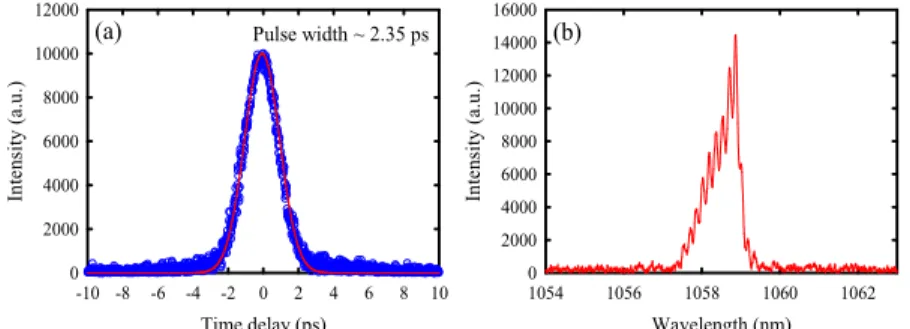
Fig. 6. Experimental results of (a) auto-correlation trace and (b) optical spectrum in the SML state.
The pulse width was measured with a commercial autocorrelator (APE Pulse Check, Angewandte Physik and Elektronik GmbH). Figure 6(a) depicts the FWHM of the central peak of the second-order autocorrelation trace. Assuming the temporal intensity to be a Gaussian-shaped profile, the pulse width was approximately 2.35 ps. A Fourier optical spectrum analyzer (Advantest Q8347), which was constructed with a Michelson interferometer, was employed to monitor the spectral information with the resolution of 0.003 nm. As shown in Fig. 6(b), the FWHM in the optical spectrum was found to be as wide as
coupler. The spacing between two periodic peaks was measured to be 0.15 nm which was corresponded to the optical length of the output coupler of 3.73 mm. When the value of
a a
r ω was decreased to 1.619, the performance of SML was as great as the case of 1.943
a a
r ω = . For the case of ra ωa =1.619, the critical pump power for achieving self-mode-locked state was measure to be 7.49 W which was slightly higher than the case of
1.943
a a
r ω = . The pump power range of self-mode-locked state was from 7.49 W to 10.56 W. The results signify that a long-lasting SML operation can be achieved when only TEM0,0
mode and the first high-order transverse mode are excited in the laser cavity.
Finally, it was found that the laser was operated in an intermittent mode-locked state when the value of ra ωa decreased to 1.295. In Fig. 7(a), the long-span temporal trace of the laser
output is shown for a time window of 200 μs. It can be obviously seen that the temporal behaviors were quite different between the region A and the region B. The short-span temporal traces of region A and B are illustrated in Fig. 7(b) and 7(c) for a time window of 50 ns, respectively. Referring to Fig. 7(b), a mode-locked pulse train can be observed though the performance was not as good as the case shown in Fig. 5. The temporal trace of region B displayed an irregular signal on top of a CW background, as depicted in Fig. 7(c). The results of temporal dynamics indicated that the laser output did not exhibit a long-lasting mode-locked pulse train. In Fig. 7(d), there were only the harmonics of the longitudinal mode spacing in the RF spectrum. The peak values in the RF spectrum were generally less than 25 dB, considering less than the standard value of well-behaved mode-locked lasers. In Fig. 7(e), the transverse pattern was more circularly symmetric than the beam profile shown in Fig. 5. According to the results in the RF spectrum and the transverse pattern, it could be verified that there was only fundamental transverse mode in the output beam. Consequently, the experimental measurements indicate that the laser can be operated in an intermittent mode-locked state when the aperture size is too small to excite high-order transverse modes.
Frequency (GHz) 0 1 2 3 4 5 6 In te ns it y (dBm ) 0 20 40 60 80 (d) RBW = 300 kHz (e) VBW = 3 kHz ΔfL 2ΔfL 3ΔfL 5 ns/div (c) 0 5 ns/div 20 μs/div (a) (b) region A region B region A region B 0 0
Fig. 7. Experimental measurements for overall performances of the laser operated in intermittent mode-locked state with ra ωa=1.295: (a) long-span temporal trace, (b) short-span temporal trace for region A, (c) short-short-span temporal trace for region B, (d) RF power spectrum, (e) transverse pattern.
4. Conclusions
In summary, we have quantitatively explored the influence of high-order transverse modes on SML in an OPSL with a nearly hemispherical cavity. We have employed the different aperture sizes to control the excitation of high-order transverse modes. To analyze the excitation of order transverse modes, we have numerically calculated the energy of high-order transverse modes within the aperture area. According to the calculated results, specific aperture sizes have been exploited to observe the influence of high-order transverse modes on
the temporal dynamics. Experimental results have indicated that the SML operation can be achieved with the appropriate aperture size which only allows the existence of fundamental transverse mode and the first high-order transverse mode. We have demonstrated that the pulse train is modulated with the transverse beat frequency when we use the larger aperture size to excite more high-order transverse modes. Moreover, the random dynamics of the laser output has been observed while there are too many beating frequencies of transverse modes. Eventually, it has been found that the laser is operated in an intermittent mode-locked state when the aperture size is too small to permit the excitation of high-order transverse modes. Acknowledgments
The authors acknowledge the Ministry of Science and Technology for the financial support of this research under Contract No. MOST 103-2112-M-009-0016-MY3.