
Measurement of Capillary Spaces of Woven Fabric by Wicking Determination of Water into Samples
4
0
0
全文
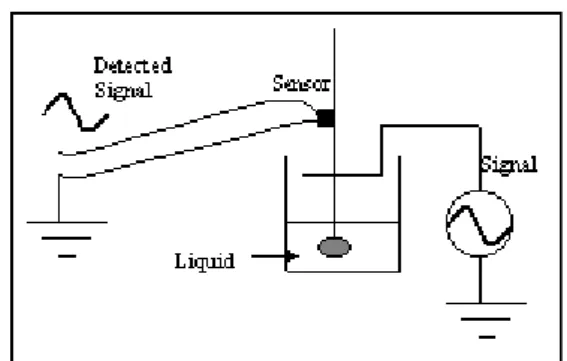
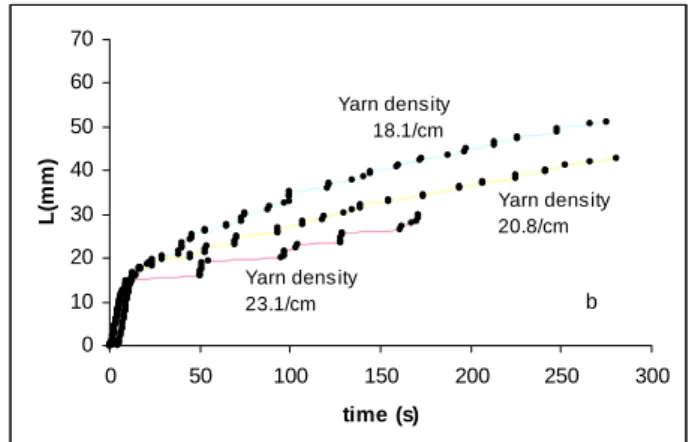
(2) viscosity. All the wicking measurements were performed at room-condition of 28-30 oC and 38%-40% relative humidity. Table 1- weft yarn characteristics of fabric samples. ______________________________________________ Yarn count Density of yarn in fabric Ne /cm ___________________________________________________. Fig. 1- The principle of the measurement method for water transport Fig.2 shows the whole measurement system. The differential signal is obtained by the two sensors are sent to PC for processing and the appropriate control signal is sent from the PC to the DC motor. As the water moves up, the motor drives the vessel down and the dry section of the test sample faces the sensor . In this case the speed of the water transport into the fabric sample is equal to the speed of the water vessel (setup) in opposite direction. Labview and Visual C++ were used for the software part of the measurement system. An A/D and D/A ISA card was used to process the signals and drive the DC motor.. 10,,30 18.1 10,,30 20.8 10,,30 23.1 ___________________________________________________. 3. Result and discussions 3.1.Effect of weft yarn count on wicking rise of water Experimental data of wicked water into fabric samples in figure 2(a,b,c) shows the effect of yarn count in plotted as L (distance of water) versus t(time). The results show that, wicking velocity slows down as the time passes for every individual sample. The curves have a sharp slope in the beginning and tend to a constant state in longer time. It is observed that increasing of weft yarn count has increased the capillary rise of water in fabric samples. So the fabric samples which produced of 10 Ne yarn count have raised water upward wicking through their weft direction comparing with 30 Ne yarn count. 3.2. Effect of weft yarn density in wicking rise of water. Fig. 2- Electrical circuit design of the apparatus 2.2. Materials and treatment condition Plain woven fabric produced by Sulzer DS700 machine made in Switzerland. The samples made of different count and density of weft cotton yarns vertical wicking measurements. Weft yarn characteristics are shown in Table1. Warp yarns characteristics were same in all samples with pet filament 80 den, 800 tpm and density of 300 per meter. Cotton fibers were prepared from domestic cotton 3.3 dtex without further treatments. The fabric samples were washed with 2g/lit a commercial laundry detergent and a solution of 0.1% sodium bicarbonate at 50-55oC for 30 min. The dimensions of fabric samples for wicking measurements were 5 mm wide and 30 cm length. The average of 5 tests were obtained in every individual sample for comparing the results. The liquid used for wicking measurement was single distilled water with an nonionic detergent (a commertial nonionic detergent,Diadavin EWN). The surface tension of diluted water-detergent solution obtained 35mj/m2 by plate method in room temperature while using the apparent viscosity of water in the literature which is approximated to 1 mpas.s due to neglected effects on water. The geometric configuration of porous medium is affected of weft yarn density in fabric samples which determine its water transport properties. Figure 3(a,b) shows that wicking of water rise changes with increasing the density of weft yarn in the fabric sample. The water height in fabric sample with lower yarn density 18.1/cm is faster than in 20.8 /cm and 23.1/cm. capillary spaces between yarns according to reduction of capillary radius between capillary spaces between fiber and yarns..
(3) 70. 70. 60. 60. Ne=10. Yarn density 18.1/cm. 50 L(mm). L(mm). 50 40 Ne=30. 30 20. 40 Yarn density 20.8/cm. 30 20. 10. Yarn density 23.1/cm. 10. a. 0 0. 50. 100. 150. 200. 250. 300. 0. time (s). Ne=10. 150. 200. 250. 300. 2. Evaluation of capillary spaces of fabric samples. 40 L(mm). 100. Fig.3 - The effect of warp yarn density /cm on wicking of water into fabric sample; a:,Ne=10, b:Ne=30. 50. 30. Ne=30. 20 10. b. 0 0. 50. 100. 150. 200. 250. 300. time (s). 60 50 Ne=10 40 L(mm). 50. time (s). 60. 30 Ne=30. 20 10. c. 0 0. 50. 100. 150. 200. 250. 300. time (s). Fig.2- The effect of yarn count on wicking of water into the samples a:yarn density=18.1/cm, b:yarn density=20.8/cm, c:yarn density=23.1/cm 70. The equivalent geometric factor is calculated by the average slope L2/t from the experimental data of wicking of water into the samples. The amount of slope is equal to (r.γlv Cosθ/2η) according to theoretical equation 2. Using the value of surface tension and viscosity of water solution, the amount of rCosθ as the geometrical structural factor of constant capillary spaces of fabric sample can be evaluated. The values of rCosθ for individual samples are given in table 2. To be differentiated from the actual values of capillary radius and contact angle , r Cosθ is replaced by re Cosθe , where re is the effective capillary radius and Cosθe is the overall valve of Cosθ in fabric sample. Table 2-Averages of re Cosθe for individual fabric samples ___________________________________________________ Weft yarn characteristics L2/t re Cosθe(μm) ___________________________________________________ Ne=10, density=18.1/cm 20.722 1.184 Ne=30, density=18.1/cm 14.593 0.834 Ne=10, density=20.8/cm 18.849 1.077 Ne=30, density=20.8/cm 11.368 0.650 Ne=10, density=23.1/cm 12.580 0.719 Ne=30, density=23.1/cm 10.179 0.582 ___________________________________________________ It can be assumed that re and Cosθe are constant for a waterfabric system and then the value of re Cosθe can be considered as a basic geometric structural parameter of the fabric-water system. It indicates that the radii of open channels which act as capillary tubes tend to decrease as a result of using finer yarns and increasing weft yarn density in the woven fabric sample. Conclusion. 60. Yarn density 20.8/cm. Yarn density 18.1/cm. 50 L(mm). b. 0. 40 30. Yarn density 23.1/cm. 20 10. a. 0 0. 50. 100. 150 time (s). 200. 250. 300. A technique for determining the wicking behavior of water in fabrics has been developed. The inductive sensors in the device have the proper sensitivity for tracing the electromagnetic field of water wicked into the fabric samples. The capillary spaces in porous media of fabric changes by increasing the count and density of weft yarn in the woven fabric which mainly affect in capillary wicking of water into the sample. The study shows that the wicking distance and penetration rate reduced by using finer count and higher density of weft yarn in the woven fabric sample. It has been possible to study equivalent geometric factor of capillary spaces during wicking measurement of water into woven fabric samples. The radii of open channels in the woven.
(4) fabric sample tend to decrease as a result of using finer yarns and increasing weft yarn density.. References: [1] N. Ansari, P.R.R. Hasanzadeh, A.M. Rezaei, The wicking of water in yarn as measured by a magnetic induction technique, 5th international conference, TEXSCI 2003 , June 16-18, Liberec, Czech Republic,(2003). [2] N. Ansari and M.H. Kish, Capillary water transport in yarns, Iranian Journal of Polymer Science and Technology, 8, No.28, pp. 87-96,( 1995). [3] P.K. Chatterjee, Mechanism of liquid flow and structure property relationship in Absorbency (Elsevier Science, NY), pp.29-84, (1985). [4] N.R.S. Hollies, M.M. Kaessinger, and H. Bogaty, Water transport mechanism in textile materials. part1,Textile Research Journal, 26, pp.829-835, (1956). [5] N.R.S. Hollies, M.M. Kaessinger, B.S. Watson and H. Bogaty, Water transport mechanism in textile materials. part2, Textile Research Journal, 27, pp.8- 13, (1957). [6] Y.L. Hsieh, Liquid Transport in fabric structures, Textile Research Journal ,65(5), pp.299-307,(1995). [7] Y.L. Hsieh and Yu Bangling, Liquid wetting transport and retention properties of fibrous Assemblies. Part1:Water wetting properties of woven fabrics and their constituent single fibers, Textile Research Journal ,62,11, pp.677685,(1992). [8] H. Ito and Y. Muraoka, Water transport along textile fibers as measured by an electrical capacitance technique. Textile Research Journal, 63, pp.414-420,(1993). [9] B. Miller, Critical evaluation of upward wicking tests", International Nonwovens Journal, 9, No.1, pp.35-43,( 2000) [10] W. B. Palmer, The advance of a liquid front along a glass yarn. Journal of Textile Institute, 44, pp.391- 400, (1953) [11]F. Rahmani, Msc. Thesis, Textile Department of Technology, Amirkabir University, Tehran, Iran, (2006) [12] E.W. Washburn, The dynamic of capillary flow. Physical Review. 17, pp.273-283, (1921) [13] J. Troger, K. Lunkwitz, K. Grundke & W. Burger, Colloid and Surfaces,134, pp. 299-304 , (1998)..
(5)
數據
相關文件
You are given the wavelength and total energy of a light pulse and asked to find the number of photons it
好了既然 Z[x] 中的 ideal 不一定是 principle ideal 那麼我們就不能學 Proposition 7.2.11 的方法得到 Z[x] 中的 irreducible element 就是 prime element 了..
利用 determinant 我 們可以判斷一個 square matrix 是否為 invertible, 也可幫助我們找到一個 invertible matrix 的 inverse, 甚至將聯立方成組的解寫下.
Then, we tested the influence of θ for the rate of convergence of Algorithm 4.1, by using this algorithm with α = 15 and four different θ to solve a test ex- ample generated as
volume suppressed mass: (TeV) 2 /M P ∼ 10 −4 eV → mm range can be experimentally tested for any number of extra dimensions - Light U(1) gauge bosons: no derivative couplings. =>
For pedagogical purposes, let us start consideration from a simple one-dimensional (1D) system, where electrons are confined to a chain parallel to the x axis. As it is well known
The observed small neutrino masses strongly suggest the presence of super heavy Majorana neutrinos N. Out-of-thermal equilibrium processes may be easily realized around the
incapable to extract any quantities from QCD, nor to tackle the most interesting physics, namely, the spontaneously chiral symmetry breaking and the color confinement..
