Porous Inorganic Materials from Living Porogens: Channel-like TiO
2
from Yeast-Assisted Sol
−Gel Process
Yi-Chun Chang,
†Chi-Young Lee,
‡and Hsin-Tien Chiu*
,††Department of Applied Chemistry, National Chiao Tung University, Hsinchu, Taiwan 30010, R. O. C.
‡Department of Materials Science and Engineering, National Tsing Hua University, Hsinchu, Taiwan 30013, R. O. C.
*
S Supporting InformationABSTRACT: Vitality of yeast cells maintained in an aqueous sol−gel solution containing titanium tetraisopropoxide and glucose. The living cells and their metabolites acted as the porogens for a channel-like TiO2precursor. Further processing
of the precursor offered a channel-like meso/macroporous TiO2, a potential anode material for Li-ion battery.
KEYWORDS: biosynthesis, sol−gel processes, mesoporous materials, titanium dioxide, lithium-ion battery
■
INTRODUCTIONBiological materials display natural structures that are difficult to obtain through artificial synthetic ways. Recently, the use of organisms as templates for the generation of unique inorganic structures and materials has received increasing attention.1,2It would be interesting to observe the behavior of“living” cells in a synthetic environment leading to the fabrication of artificial materials.3,4The term biocers (biologically modified ceramics) is a class of nanocomposites that combines biocomponents with ceramic-like matrices.5 Biocomponents are usually prokaryotes (bacteria and fungi),6,7 eukaryotes (animal and plant cells),8−10 and cell-derived subunits (protein, enzymes, and DNA).11,12 Nonetheless, in most of these cases, physiological activities of the bio-components were not maintained. They only act as lifeless templates to assist the formation of specific morphology and shapes. In nature, shells and corals are usually composed of CaCO3 secreted by the
organisms. The blood of mollusca contains minerals that are the source of the shell. CaCO3is not only the metabolite but also the major composition of bones of coral. By such characteristics, ureolytic bacteria are able to precipitate CaCO3
in their environment by converting urea into NH3and CO32−.
The process could be applied for repairing cracks in concretes.13Therefore, organisms might maintain their viability in mild environments in principle.
Yeast (Saccharomyces cerevisiae) is one of the most popular eukaryotic micro-organism in molecular and cell biology. Its external structure and functional organization are similar to the cells of high-level organisms. Its solid cell wall and negatively charged surface have been applied as sacrificial templates for the formation of porous inorganic-structures.14,15 Yeasts are popular porogens because they not only provide hard cell walls but also generate gaseous metabolites. Because yeast has a short generation time, it could be easily incubated. Bread is a product of the yeast metabolism. On the other hand, cases
involving the formation of porous inorganic structures from living porogens are rare. The only one reported in literature briefly discussed the synthesis of porous silica via a sol−gel route in the presence of yeast.16In this study, we employed a simple sol−gel process to fabricate TiO2precursors by reacting
titanium tetraisopropoxide (TTIP, Ti(OiPr)
4), instant yeast,
and glucose in an aqueous solution. Remarkably, the yeast cells maintained their physiological activities while TTIP molecules polymerized into a low toxicity titanate precursor. It is known that the toxicity of TiO2towards yeast is much less than other metal oxides, such as ZnO and CuO.17,18 After further processing, porous channel-like TiO2was prepared. In addition, potential applications of the as-prepared TiO2 in Li ion
batteries were explored. Our preliminary results are reported below.
■
RESULTS AND DISCUSSIONIn a typical experiment, instant yeast supplied locally was added to an aqueous solution containing glucose and TTIP at room temperature. The yeast cells were alive in the aerobic reaction mixture for several hours. Figure 1 shows a series of time-lapse images of yeast in an aqueous mixture of glucose and TTIP. Bubbles were formed in the mixture. After 15 min, its volume expanded significantly (Figure 1b). Clearly, this was the physiological phenomenon of the yeast cells. The mixture remained bubbling and expanded further after 30 min (Figure 1c). After 45 min (Figure 1d), the volume increased six-fold while the acidity of the mixture increased slightly to pH 5−6. The time-lapse images reveal that the swelling phenomenon is analogous to the leavening process of dough in bakeries. Apparently, even in the presence of TTIP and its hydrolysis/
Received: November 15, 2013
Accepted: December 16, 2013
Published: December 16, 2013
condensation products, the glucose metabolism in the yeast cells was maintained for about 90 min. Their respirations produced CO2and H2O as the metabolites. Without glucose,
an aqueous mixture of yeast and TTIP did not show any obvious volume variation (Figure S2 in the Supporting Information).
Because of the presence of a thick sol−gel matrix, many methods for monitoring living yeast are impractical in our case.19−23Instead, optical microscopic images of the yeast cells in an aqueous solution of glucose and TTIP were taken. In Figure 2a, the growth of a bud on a parent cell is observed. Similar cases are found frequently in Figure S3 in the Supporting Information. As displayed in Figure 2b, some yeast cells are covered by layers of inorganic solids, the sol−gel intermediates formed by the condensation of TTIP molecules. The budding phenomenon is the result of common asexual reproductive mode of Saccharomyces cerevisiae. This observation suggests that the yeast cells not only respire but also reproduce in the presence of TTIP and its hydrolysis/condensation products for several hours. According to the physiology of yeast, the life cycle passes through the initial lag phase defined as a short adaptation stage. And then, the cells are metabolically active through a few reproductions. Thus, the overall cell population increases in the exponential phase, reaches the steady phase, andfinally decreases in the decline phase. In our study, the presence of TTIP indeed caused premature decline of the yeast population, as the bubbling phenomenon ceased after ca. 2 h. Another reason for the gradual cell deaths is attributed to the consumption of glucose in the process.
As discussed above, we envision that both the CO2bubbles
from the yeast respiration and the physical cell structures can act cooperatively as the “living templates” to assist the
formation of a porous TiO2 precursor. The light-yellow “inorganic dough” isolated from the reaction suspension was dried. The SEM image in Figure S4 in the Supporting Information reveals its porous nature. The solid was annealed in Ar, and then, oxidized in O2 atmosphere to remove all organic residues. After the processing, a white solid was isolated in nearly quantitative yield. Its bulk density was 0.29 g/cm3, much lower than the value of commercial bulk TiO2, 0.7−0.9 g/cm3. The observation is consistent with the porous nature of the solid. The total pore volume is estimated to be ca. 65 % of the total volume. The scanning electron microscopic (SEM) images in Figure 3 depict the porous nature of the product. They display numerous mesopores with diameters tens of nm (Figure 3a, b) and straight channels with diameters ca. 1 μm and lengths ca. 10 μm (Figure 3a, c, d). The channel-like morphology differs from the results that employed yeast cells as the sacrificial templates.7,14
In these cases, the porous products obtained their morphology from the deceased yeast cells. In this study, we attribute the channel formation to the bubbling action of CO2 generated by the cell respiration. A high
resolution transmission electron microscopic (HRTEM) image in Figure S5 in the Supporting Information and a powder X-ray diffraction (XRD) pattern in Figure S6 in the Supporting Information confirm that the solid product was composed of anatase (major) and rutile (minor) TiO2.
By using N2adsorption-desorption analyses (see Figure S7a
in the Supporting Information), a specific surface area 63 m2/g
is estimated for the solid using the Brunauer−Emmett−Teller (BET) equation. The type IV hysteresis loop of the isotherm reveals some capillary condensation behavior at relatively high pressures. The pore size distribution (see Figure S7b in the Supporting Information) from the Barrett−Joyner−Halenda (BJH) method suggests the presence of smaller (diameter 3.7 nm, with a distribution 2−10 nm) and lager (diameter 40 nm, with a distribution 10−100 nm) mesopores. These are comparable to the pores observed in Figure 3b. As a result, the proportion of the volume occupied by the mesopores is 37%, whereas that occupied by the macropores is 63% of the total volume of all pores. The amount of yeast added into the solution affected the specific surface areas of the porous products (Figure 4). Without yeast, the product shows a specific surface area 34 m2/g. As the amount of yeast added increases, the BET surface area is increased as well. For the sample used 2.5 g of yeast, a specific area 63 m2/g is observed.
Therefore, we discover a tendency that each additional gram of Figure 1. Time-lapse images of the mixture of TTIP and aqueous
glucose solution in the presence of yeast. (a) 0, (b) 15, (c) 30, and (d) 45 min. The original images are shown in Figure S1 in the Supporting Information.
Figure 2.Optical images of yeast cells in an aqueous solution of glucose and TTIP. (a) Bud on a yeast cell. (b) Yeast cells covered by condensed inorganic solids. The images are taken from the photograph shown in Figure S3 in the Supporting Information.
yeast would increase an area ca. 6 m2. In contrast, a porous
TiO2 sample prepared without the addition of yeast and
glucose showed a specific surface area 80 m2/g. We suggest that
in the reaction without any glucose and yeast, TTIP molecules undergo condensation freely to form a low density sol−gel precursor. This would lead to the high surface area product. When glucose is added, TTIP would react with the hydroxyl groups of the monosaccharide and use it as the center for the condensation polymerization.24 Thus, the product is denser with a much smaller surface area. When both glucose and yeast are added to the solution containing TTIP, gaseous CO2 is generated by the metabolism of glucose in the cells. The
bubbling action may generate less dense sol−gel precursors that provide higher-surface-area porous TiO2products.16One of the
factors that affects the growth and respiration activities of yeast is temperature. Generally, temperatures suitable for the metabolism of baker’s yeast are 25−30 °C. Below the temperature range, the activity of yeast increases as the temperature is raised. Nonetheless, the temperature above the desirable range is harmful for the yeast growth. Consequently, although the channel morphology still exists for the samples incubated at 35 and 50°C (see Figure S8 in the Supporting Information), theirfinal specific surface areas are reduced to 45 and 40 m2/g, respectively.
A reaction pathway is proposed in Scheme 1 to rationalize the formation of the channel-like porous TiO2. Glucose
molecules can function both as the center for the hydrolysis/ condensation polymerization of TTIP and as the nutrient for yeast. The cells maintain physiological activities while their respiration generates CO2 bubbles. The as-formed carbonic acid lowers the pH of the mixture. Gradually, layers of titanates mixed with unconsumed glucose molecules accumulate on cell surfaces while the evolution of CO2 produces numerous channels in the inorganic matrix. The bubbling action, the cells, and the residual glucose molecules act together as the pore generation templates. Similar hypothesis for pore generation through the bubbling effect has been proposed recently.25After the inorganic/organic mixture is processed further at 400 °C under Ar, the deceased cells, the unreacted molecules, and the Figure 3.SEM images. (a) Top-view. (b) Enlarged view from the marked area in a. (c) Side-view image. (d) Enlarged view from the marked area in c.
Figure 4.Effect of the amount of yeast on the BET surface areas of the porous materials.
residual isopropoxy ligands are either vaporized to leave empty spaces or decomposed into nanosized carbon particles. At 400 °C in O2, all carbon residues are oxidized to offer mesopores,
whereas the titanate crystallizes into the channel-like porous TiO2.
Li-ion batteries are one of the major electrical power storage devices.26,27Intercalation of Li+ions into TiO
2displays a small
volume change (<4%). This differs from other common anode materials, graphite, Si, and Sn.28−30Their high volume changes (10−400%) during charge/discharge cycling induce irreversible structural destruction. The small TiO2lattice variation during Li+intercalation/deintercalation maintains its structural stability and cycle life.31−35During the discharging, Li+ions intercalate
into the octahedral sites of anatase TiO2 and convert it to
LixTiO2(x≈ 0.5) by the following electrochemical process, eq 1, in a TiO2/Li half-cell36,37
+x ++x −→
TiO2 Li e Li TiOx 2 (1)
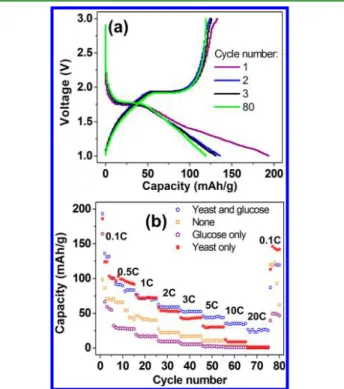
In this study, we explored the possibility of using the channel-like porous TiO2 as the cathode in half-cell type coin cells (CR2032). A piece of Li metal was used as the anode in the assembled device. The first discharge−charge cycle shows an irreversible capacity loss (31% at 0.1 C) in Figure 5a. This
agrees with the literature data (30−50 %).38,39 The battery maintains a reversible capacity 136 mAh/g at the discharge rate 0.1 C. After cycled at various discharge/charge rates 80 times, the device still retains a respectable capacity 120 mAh/g (Figure 5b). For comparison, performances of samples prepared without the presence of glucose, yeast, or both are also represented in Figure 5b. All of the samples do not show channel morphology (see Figure S9a in the Supporting
Information). Their specific surface areas are 50 m2/g (without
glucose, addition of 2.5 g of yeast), 34 m2/g (without yeast, addition of 0.5 g of glucose), and 80 m2/g (without glucose and
yeast). Most of them are composed of anatase phase TiO2(see
Figure S9b in the Supporting Information). Performances of the cathodes fabricated from those samples reveal lower capacities than the sample synthesized in the presence of living yeast cells, especially at high discharge rates. There are several possible reasons for the differences. Because all of them do not have channel structures (due to the lack of physiological activity), the intercalation/deintercalation of Li+ ions in them
may not be as fast as in the channel-like porous TiO2prepared
in this study. The sample prepared without the addition of yeast shows the worst performance. Probably, glucose molecules function as the center for the hydrolysis/ condensation polymerization of TTIP. Thus, the as-prepared sample has the smallest specific surface area. The observations do suggest that the unique porous structure of the TiO2
prepared from the living porogen route probably provides easily accessible sites for the intercalation/deintercalation of Li+ ions in the batteries. This is also comparable to recent observations employing electrodes composed of meso/macro-porous TiO2synthesized using different strategies.25,40On the basis of the preliminary observations reported here, we anticipate that the performance of our unique TiO2 structure can be improved further.
■
CONCLUSIONSIn summary, instant yeast cells maintain their physiological activities for several hours in an aqueous glucose solution containing TTIP. As TTIP polymerizes via a sol−gel route on the cells, bubbles of CO2 from the cell respiration generate
numerous channels in the precursor. Glucose and yeast work cooperatively to offer the final meso/macro porous channel-like structure. The as-formed porous TiO2 can function as an
electrode material for Li-ion battery. These unique hierarchi-cally-structured porous materials may find potential applica-tions in other areas.41 By controlling the physiological environment for yeast growth and using different alkoxides, other metal oxides with unique properties could be obtained.
■
ASSOCIATED CONTENT*
S Supporting InformationExperimental section, time lapse images, optical micrograph, XRD pattern, specific surface area data, and SEM and HRTEM images. This material is available free of charge via the Internet at http://pubs.acs.org.
■
AUTHOR INFORMATIONCorresponding Author
*E-mail: [email protected].
Notes
The authors declare no competingfinancial interest.
■
ACKNOWLEDGMENTSWe thank Industrial Technology Research Institute of Taiwan, R.O.C, for assembly of the battery and the National Science Council, ‘‘Aim for the Top University Plan’’ of the National Chiao Tung University, and the Ministry of Education of Taiwan, the Republic of China.
Figure 5.(a) Profiles of the first discharge/charge (0.1 C) cycles of Li-ion battery fabricated from the channel-like porous TiO2. (b)
Performance of Li-ion batteries at different discharge rates for 80 cycles (1 C = 334 mAh/g; yeast and glucose, sample prepared in the presence of yeast and glucose; none, sample prepared without the addition of yeast and glucose; glucose only, only glucose was added; yeast only, only yeast was added).
■
REFERENCES(1) Studart, A. R.; Gonzenbach, U. T.; Tervoort, E.; Gauckler, L. J. J. Am. Ceram. Soc. 2006, 89, 1771−1789.
(2) van Bommel, K. J. C.; Friggeri, A.; Shinkai, S. Angew. Chem., Int. Ed. 2003, 42, 980−999.
(3) Blondeau, M.; Coradin, T. J. Mater. Chem. 2012, 22, 22335− 22343.
(4) Godlewska-Żyłkiewicz, B. Anal. Bioanal. Chem. 2006, 384, 114− 123.
(5) Bottcher, H.; Soltmann, U.; Mertig, M.; Pompe, W. J. Mater. Chem. 2004, 14, 2176−2188.
(6) Nomura, T.; Morimoto, Y.; Tokumoto, H.; Konishi, Y. Mater. Lett. 2008, 62, 3727−3729.
(7) Bai, B.; Wang, P.; Wu, L.; Yang, L.; Chen, Z. Mater. Chem. Phys. 2009, 114, 26−29.
(8) Schnepp, Z.; Yang, W.; Antonietti, M.; Giordano, C. Angew. Chem., Int. Ed. 2010, 49, 6564−6566.
(9) Shi, N.; Li, X.; Fan, T.; Zhou, H.; Ding, J.; Zhang, D.; Zhu, H. Energy Environ. Sci. 2011, 4, 172−180.
(10) Yang, D.; Fan, T.; Zhang, D.; Zhu, J.; Wang, Y.; Du, B.; Yan, Y. Chem.Eur. J. 2013, 19, 4742−4747.
(11) Yan, J.; Wu, G.; Li, L.; Yu, A.; Sun, X.; Guan, N. J. Nanosci. Nanotechnol. 2010, 10, 5767−5775.
(12) Numata, M.; Sugiyasu, K.; Hasegawa, T.; Shinkai, S. Angew. Chem., Int. Ed. 2004, 43, 3279−3283.
(13) Van Tittelboom, K.; De Belie, N.; De Muynck, W.; Verstraete, W. Cem. Concr. Res. 2010, 40, 157−166.
(14) Chia, S.; Urano, J.; Tamanoi, F.; Dunn, B.; Zink, J. I. J. Am. Chem. Soc. 2000, 122, 6488−6489.
(15) He, W.; Cui, J.; Yue, Y.; Zhang, X.; Xia, X.; Liu, H.; Lui, S. J. Colloid Interface Sci. 2011, 354, 109−115.
(16) Manap, N. R. A.; Jais, U. S. Mater. Res. Innovations 2009, 13, 382−385.
(17) Huang, Y.-W.; Wu, C.-h.; Aronstam, R. S. Materials 2010, 3, 4842−4859.
(18) Kasemets, K.; Ivask, A.; Dubourguier, H.-C.; Kahru, A. Toxicol. In Vitro 2009, 23, 1116−1122.
(19) Sagot, I.; Bonneu, M.; Balguerie, A.; Aigle, M. FEBS Lett. 1999, 447, 53−57.
(20) Hediger, F.; Taddei, A.; Neumann, F. R.; Gasser, S. M. In Methods in Enzymology; Allis, C. D., Carl, W., Eds.; Academic Press: New York, 2003; Vol. Vol. 375, p 345−365.
(21) Wang, B.; Liu, P.; Jiang, W.; Pan, H.; Xu, X.; Tang, R. Angew. Chem., Int. Ed. 2008, 47, 3560−3564.
(22) Fraser, C. G. J. Phys. Chem. 1919, 24, 741−748. (23) Bonora, A.; Mares, D. Curr. Microbiol. 1982, 7, 217−221. (24) Yang, D.-H.; Takahara, N.; Lee, S.-W.; Kunitake, T. Sens. Actuators, B 2008, 130, 379−385.
(25) Wang, H.; Yang, H.; Lu, L.; Zhou, Y.; Wang, Y. Dalton Trans. 2013, 42, 8781−8787.
(26) Liu, D.; Cao, G. Energy Environ. Sci. 2010, 3, 1218−1237. (27) Zhang, X.; He, W.; Yue, Y.; Wang, R.; Shen, J.; Liu, S.; Ma, J.; Li, M.; Xu, F. J. Mater. Chem. 2012, 22, 19948−19956.
(28) Yang, Z.; Choi, D.; Kerisit, S.; Rosso, K. M.; Wang, D.; Zhang, J.; Graff, G.; Liu, J. J. Power Sources 2009, 192, 588−598.
(29) Hsu, K.-C.; Liu, C.-E.; Chen, P.-C.; Lee, C.-Y.; Chiu, H.-T. J. Mater. Chem. 2012, 22, 21533−21539.
(30) Lafont, U.; Carta, D.; Mountjoy, G.; Chadwick, A. V.; Kelder, E. M. J. Phys. Chem. C 2009, 114, 1372−1378.
(31) Zhang, D.; Wen, M.; Zhang, P.; Zhu, J.; Li, G.; Li, H. Langmuir 2012, 28, 4543−4547.
(32) Kubiak, P.; Fröschl, T.; Hüsing, N.; Hörmann, U.; Kaiser, U.; Schiller, R.; Weiss, C. K.; Landfester, K.; Wohlfahrt-Mehrens, M. Small 2011, 7, 1690−1696.
(33) Park, K.-S.; Min, K.-M.; Jin, Y.-H.; Seo, S.-D.; Lee, G.-H.; Shim, H.-W.; Kim, D.-W. J. Mater. Chem. 2012, 22, 15981−15986.
(34) Feckl, J. M.; Fominykh, K.; Döblinger, M.; Fattakhova-Rohlfing, D.; Bein, T. Angew. Chem., Int. Ed. 2012, 51, 7459−7463.
(35) Chen, P.-C.; Tsai, M.-C.; Chen, H.-C.; Lin, I. N.; Sheu, H.-S.; Lin, Y.-S.; Duh, J.-G.; Chiu, H.-T.; Lee, C.-Y. J. Mater. Chem. 2012, 22, 5349−5355.
(36) Chen, J. S.; Tan, Y. L.; Li, C. M.; Cheah, Y. L.; Luan, D.; Madhavi, S.; Boey, F. Y. C.; Archer, L. A.; Lou, X. W. J. Am. Chem. Soc. 2010, 132, 6124−6130.
(37) Wang, Z.; Lou, X. W. Adv. Mater. 2012, 24, 4124−4129. (38) Xu, J.; Jia, C.; Cao, B.; Zhang, W. F. Electrochim. Acta 2007, 52, 8044−8047.
(39) Armstrong, A. R.; Armstrong, G.; Canales, J.; García, R.; Bruce, P. G. Adv. Mater. 2005, 17, 862−865.
(40) Liu, H.; Bi, Z.; Sun, X.-G.; Unocic, R. R.; Paranthaman, M. P.; Dai, S.; Brown, G. M. Adv. Mater. 2011, 23, 3450−3454.
(41) Li, Y.; Fu, Z.-Y.; Su, B.-L. Adv. Funct. Mater. 2012, 22, 4634− 4667.