ALGORITHM AND ARCHITECTURE DESIGN FOR A LOW-COMPLEXITY ADAPTIVE
EQUALIZER
Chun-Nan Chen, Kuan-Hung Chen, and Tzi-Dar Chiueh
Graduate Institute of Electronics Engineering and Department
of
Electrical Engineering,
National Taiwan University, Taipei, Taiwan
10617.
ABSTRACT
As the need for multimedia communication continues to surge, consumers demand higher and higher transmission data rate. To circumvent the channel impairment caused by multipath fading, more and more receivers resort to adap- tive equalizers. However, the complexity of time-domain adaptive equalizers can be too high for some specific ap- plications. In this paper, a novel adaptive algorithm and its low-complexity architecture are proposed. This algorithm, called GSPT LMS algorithm, employs a new Grouped Signed Power-of-Two (GSPT) number representation. An adaptive equalizer using the proposed algorithm has been simulated and shown to be capable of equalization of 8PSK signals in several practical channels. Finally, the proposed adap- tive equalizer and two other adaptive equalizers are imple- mented on FPGA. Simulation results show that the proposed architecture has the lowest complexity and saves about 50% to 70% of hardware.
1. INTRODUCTION
With the advent of modern communication technology and VLSI implementation, wireless communication services, such as mobile phones and indoor wireless networks have been advancing very rapidly. However, with the increase in trans- mission rate and signal constellation complexity, inter-symbol interference (1%) caused by the multipath fading channel becomes more and more unbearable. To this end, equalizers have play an important role in removing ISI. Furthermore, adaptive equalizers have become popular since channels in mobile communication are constantly changing.
An adaptive equalizer is essentially a linear adaptive fil- ter used to model the inverse transfer function of the chan- nel. Two well-known adaptive algorithms are the least mean square (LMS) algorithm and the recursive least square (RLS) algorithm, Although the RLS algorithm has better conver- gence speed than the LMS algorithm, its complexity for hardware implementation can be very high. Actually, the LMS algorithm is widely adopted in hardware implemen- tation because of its simplicity and robustness. Even so, power consumption is very crucial for many portable ap- plications that use batteries. Therefore, new techniques for
This work WLX supported in pan by MediaTek Inc.
the algorithm and the implementation of equalizers are still needed to further reduce their complexity and power con- sumption.
An LMS adaptive equalizer can be divided into two parts: the feedforward filter and the updating unit. Multiplication operations are required in both parts. The canonical signed digit (CSD) representation, also known as signed power-of- two (SPT). has been used for filter coefficients representa- tion to reduce FIR filter complexity [ I , 2,3]. By employing such representations, multiplications required for the filter- ing process can be replaced by simple shift and addhubtract operations and the implementation complexity of the feed- forward filter can be reduced. To reduce the implementation complexity of the updating part, several adaptive algorithms such as sign-sign, sign-error, sign-data, and log-log LMS al- gorithms have been proposed [4]. In addition, by utilizing these techniques, several multiplierless adaptive equalizers have been implemented [5, 61. One of the two equalizers, referred to Chen's scheme from now on, deserves detail de- scription [ 6 ] . In Chen's scheme, the sign-data LMS algo- rithm is adopted for coefficient updating. The updated co- efficient is then encoded by a modified radix-4 Booth algo-
rithm. Suppose the coefficient wordlength is chosen as t and
the t / 2 encoded signed digits are numbered from 1 (LSB) to t / Z (MSBj. The encoded signed digits are then split into t / 4 groups and each group has two signed digits numbered with z and z - t/4. There is at most one nonzero signed digit allowed in each group and the larger signed digit is se- lected if it is nonzero, otherwise the smaller one is selected, resulting in only t/4 signed digits in each tap.
In this paper, both the algorithm and the architecture of a new low-complexity adaptive equalizer are proposed. First, we propose a new number system, called grouped signed power-of-two (GSPT) number system. Next, an equalizer adaptation algorithm based on the GSPT number system is presented. The GSPT number system divides the signed digits of each number into several groups and allows at most one nonzero signed digit in one group. So, the complexity of the feedforward filter can be further reduced as compared to the traditional signed power-of-two number system. The adaptive algorithm operates like the sign-sign LMS algo- rithm with variable step-size controlled by a simple mech- anism, The hardware complexity required to realize the
II-304 0-7803-7761-31031S17.00 0 2 0 0 3 IEEE
adaptive algorithm is only slightly more than the sign-sign
LMS algorithm.
The rest of the paper is organized as follows. In Section 2, the GSPT number system and the GSF'T LMS algorithm are presented. Then, simulation results of a GSF'T LMS adaptive equalizer used in receiving 8PSK signals over sev- eral practical channels are presented in Section 3. In Section 4, FPGA implementation complexity of the proposed archi- tecture, the LMS equalizer, and the architecture proposed in [6] are compared. Finally, Section 5 concludes this paper.
2. GSF'T LMS ALGORITHM
The updating equation of the LMS algorithm can he de-
scribed by the following equation
(1) where p represents the step-size; w k , e k , and X k represent the coefficient of the feedforward filter, the error signal, and the input signal at time k respectively. While implementing a low-complexity adaptive equalizer, the LMS algorithm is
usually simplified to the sign-error (sign-data) LMS algo-
rithm by replacing e k ( Z k ) with simply the sign of e k ( x k ) .
Actually, sign-sign LMS algorithm can be used to further
reduce the implementation complexity by employing only the signs of e k and Z k for updating. This fact implies that the updating in w k needs not be precise but only monotonic to guarantee the convergence. In light of this idea, we pro- pose a new number representation system and an adaptation algorithm based on the new number system to reduce the complexity of both the feedforward filter and the updating unit.
w k + l = w k
+
fi ' e k ' Z k ,2.1. GSPT Number System;
The proposed number system is called the Grouped Signed Power-of-Two (GSPT) number system. The idea is to part- tion the digits of a number into several groups and then rep- resent each group by signed digits. Furthermore, each group can he represented by at most one nonzero signed digit (1 or -1). For example, if a 12-bit number is considered here and partitioned into 3 groups, then a number can be represented
by the GSPT number system is shown as following:
449 = 0010
oioo
0001,where each group is marked by an underline and the signed digit '-1' is represented by
i.
2.2. Basic Updating Algorithm
In the GSPT LMS adaptation algorithm, only the direction of the term, p . e k . X k . is considered in coefficient updating.
The coefficient adaptation is given by
W k f ,if p L e k . X k > O
w k , % f P ' e k ' X k = o (3) w k - ,if p . e k . x k < O
If the term, p e k . xk, is positive (negative or zero), we in- crease (decrease or freeze) the feedforward filter coefficient
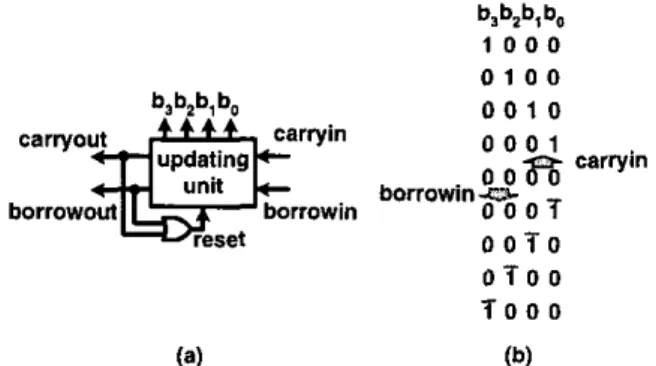
w k . An updating unit shown in Figure l(a) is designed to
perform the above updating algorithm and the updating op- eration is illustrated in Figure I(b).
b,b*b,b, carryin updating unit borrowout borrowin b,bzb,b, 1 0 0 0 0 1 0 0 0 0 1 0
o o i o
O i O O T O O 0 (b)Figure 1: (a) Updating unit. (b) Illustration of the operation in an updating unit.
If a positive trigger signal (carryin) is received, b3626160 of this updating unit 'shifts up' to increase the value of this group. On the contrary, if a negative trigger signal (bor- rowin) is received, b3b2b1bo of this updating unit 'shifts
down' to decrease the value of this group. If bSb2b1bo has
been already at the topmost (hottom-most) limit 1000 CTOOO) and a positive (negative) trigger signal is received, the out- put signal carryout (borrowout) is activated and b3b26160
is reset to
oo00.
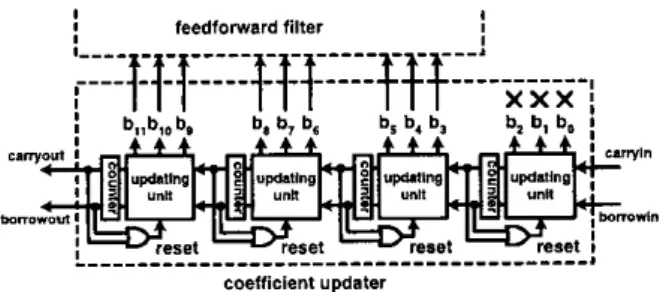
Figure 2 shows the coefficient updater im- plemented by cascading three updating units in an equal- izer with 12-bit coefficients. Notice that in Figure 2, some counters are introduced between two updating units. These counters act as buffers that accumulate the carryout or bor-rowout signals from the less-significant updating unit and trigger the carryin or borrowin signal to the more signifi- cant updating unit once a specified number of carryout or borrowout signals have been received. Basically, they are introduced to reduce the influence caused by fluctuations due to noise. Besides, these counters will decrease the con- vergence speed and a trade-off between the steady-state er- ror and the convergence speed must be made carefully.
Figure 2: Coefficient updater.
2.3. GSPT-A LMS Algorithm
It is well known that, for any adaptive algorithm, the smaller the updating step-size the lower the steady-state error. Even though the step-size is variable but not fixed in the GSPT
LMS algorithm, we can decrease the step-size by increasing the wordlength of filter coefficients. To improve the steady- state error performance without increasing the complexity of the feedforward filter, we can increase the wordlength considered in updating but use only a more significant part of the coefficient in the feedforward filter. The concept is
shown in Figure 3 and referred to as the GSPT-A LMS al-
gorithm. Hqwever, the convergence speed will be slower than GSPT LMS algorithm due to a smaller step-size.
feedforward filter L _ _ _
-
__
i ~ i ~ T " " ~ ~ ~
-
-- - -
--
-,
x x x
I!
b,,b,.b, b, b7 b6 bs b4 b, bz bt bo coetticient updaterFigure 3: Coefficient updater for the GSPT-A LMS algo- rithm.
3. SIMULATION RESULTS
To verify the feasibility of the proposed adaptive algorithms in practical multipath fading channels, simulation of an adap- tive equalizer in an 8PSK communication system is con- ducted, At the transmitter end, the bit stream is randomly generated and sent to an 8PSK modulator. The modulated signal is then upsampled with over-sampling ratio.of eight and the result is passed to a pulse shaping filter to gener- ate the transmitter output. The transmitter output is then distorted by the multipath fading channel and AWGN. At the receiver end, the received signal is first passed through a pulse shaping filter, down-sampled, and sent to a T14-spaced 41-tap adaptive equalizer. Finally, a decision block is used to decide the output symbol for calculating the symbol error rate. The GSM channel model [7] without Doppler effect is
taken as the multipath fading channel for simulation. Actually, there are several modifications to the LMS al- gorithm, such as sign-data, sign-error, and sign-sign LMS algorithms. However, these schemes converge much slower than the GSPT-A LMS, thus we compare only the GSPT LMS, GSPT-A LMS, and the conventional LMS in this sec- tion.
To begin with, the GSM channel without Doppler effect is selected as the multipath channel. The basic scheme of GSPT LMS algorithm is applied to the adaptive equalizer with different parameters. The group size, g, is chosen as
3 or 4, while the upper bound of'the counter, c, is chosen as 1 or 2. The wordlength w considered for updating is set to 12. The simulation results on typical urban (TU) channel and hilly terrain (HT) channel
are
plotted in Figure 4. It is not surprising that GSPT LMS with g = 3 has much betterperformance than g = 4 while the performance with c = 2 is superior to c = 1 case regardless of the group size. Notice that the symbol error rate is very close for all schemes in low
E s / N o cases but has non-trivial difference in high E , / N o
cases. This phenomenon is caused by different coefficient precision in different schemes. The higher the precision, the better the error performance.
TU Channel -4 -2 0 2 4 6 8 10 12 14 16 18 Es.& (dB) HT Channel
i
lo.' 1 0" 10" -4 -2 0 2 4 6 8 10 12 14 16 18 E M 0 (d8)Figure 4: Symbol error rate versus
E 8 / y ~
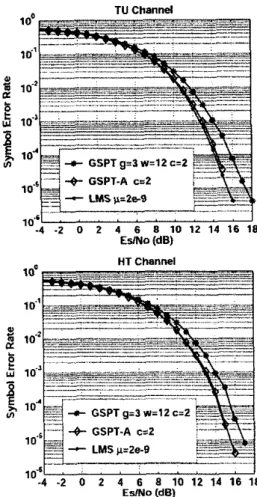
on TU channel and HT channel using the GSPT LMS algorithm with dif- ferent parameters.Next, we compare the error performance between GSPT LMS, GSPT-A LMS, and LMS algorithm by simulations. The group size is chosen as 3 while the updating wordlength is set at 12 and 15 for GSPT and GSPT-A, respectively. The simulation results shown in Figure 5 indicate that GSPT-A
is superior to GSPT on error performance as expected and
is very close to the LMS algorithm.
TU Channel SPT 9 4 w=12 c=2 HT Channel ...
+
GSPTg=3w=lZc=Z 4 GSPT.A c=ZFigure 5 : Symbol error rate versus E,INo on TU chan-
nel and HT channel: comparison between LMS. GSPT and GSPT-A.
4. FPGA IMPLEMENTATION
In this section, three adaptive equalizers based on the LMS algorithm, Chen’s scheme, and the proposed GSPT-A LMS algorithm are implemented on FPGA to compare the im- plementation complexity. An 11-tap adaptive equalizer is adopted for FGPA implementation. Parameters of the GSPT- A algorithm are chosen as g = 3, w = 15, and c = 1. The coefficient wordlength of the feedforward filter is chosen as
12 for all three schemes.
Table 1 lists the number of logic element (LE) used for three different architectures. It is obvious that the pro- posed GSPT-A LMS algorithm can be implemented with much lower complexity, which is about 30% of the hard- ware resource required by the conventional LMS algorithm, or about 50% of that in Chen’s scheme.
Table 1: Implementation complexity comparison between LMS, Chen’s scheme, and GSPT-A.
5. SUMMARY
In this paper, a low-complexity equalizer algorithm based on a new number system (GSPT) is proposed. Simulations for the GSPT algorithm and an improved scheme, GSPT-A, verify their advantages and feasibility. FPGA implementa- tion results show that the GSPT-A has the lowest complex- ity, which is about 30% of that in the LMS equalizer or 50% of that in Chen’s scheme.
6 . REFERENCES
[ I ] Y. M. Hasan, L. J. Karem, M. Falkinburg, A. Helwig, and M. Ronning, “Canonic Signed Digit Chebyshev FIR Filter Design,” IEEE Signal Processing Letters, vol. 8 , pp. 167-169, June 2001. . :
[2] R. M. Hewlitt and E. S . Swartzlantler Jr., “Canoni- cal Signed Digit Representation for FIR Digital Fil- ters:’ l E E E Workshop on Signal Processing Systems, pp.416-426,2000.
[3] Y. C. Lim, R. Yang, D.
N.
Li, and J. J. Song, “Signed Power-of-Two Term Allocation Scheme for the De- sign of Digital Filters,” IEEE Trans. on Circuits and SJ’srems 11 : Analog and Digital Signal Processing, vol. 46, issue 5. pp. 577-584, May 1999.[4] S. S. Mahant-Shetti, S. Hosur, and A. Gatherer, “The Log-Log LMS Algorithm,” in Proc. of IEEE Cont on Acoustics, Speech, and Signal Processing, 1997, pp. 2357-2360.
[5] H. E Chi, “A High-speed RSD Adaptive Filter Archi- tecture with a Fast Carryfree SPT Converter,” in Proc. IEEE ISCAS-99, 1999, pp. 187-190.
[6] C. L. Chen, K. Y. Khoo, and A.
N.
Wilson Jr., “ASimplified Signed Powers-of-two Conversion for Mul- tiplierless Adaptive Filters,” in Proc. IEEE ISCAS-96, 1996, pp. 364-361.
[7] P. Dent, G. E. Bottomley, and T. Croft, “Jakes Fading Model Revisited,” Electronic Letters, vol. 29, no. 13, pp. 1162-1 163, June 1993.