On Reservation-Based MAC Protocol for IEEE
802.11 Wireless Ad Hoc Networks
With Directional Antenna
Jin-Jia Chang, Student Member, IEEE, Wanjiun Liao, Fellow, IEEE, and Jiunn-Ru Lai, Member, IEEE
Abstract—In this paper, we study the issues of medium access control (MAC) for multihop wireless networks with directional antennas. Existing solutions to directional antenna MAC problems rarely account for the impact of minor lobes and typically assume that the neighboring nodes’ locations are known a priori. As a result, they are not applicable to practical systems or mobile nodes. In this paper, we propose a reservation-based directional medium access control (RDMAC) protocol for multihop wireless networks based on the IEEE 802.11 distributed coordination function. The design objective of RDMAC is to increase the network throughput by reducing interference among neighboring nodes. We then de-velop an analytical model for RDMAC to investigate the through-put performance of RDMAC under arbitrary node density. The analytical model provides insights into RDMAC parameter set-tings. We also evaluate the performance of the proposed RDMAC through ns-2 simulations. The results validate the accuracy of our analytical model and show that our mechanism outperforms existing solutions, in terms of higher throughput.
Index Terms—Throughput, wireless ad hoc networks. I. INTRODUCTION
I
N THIS paper, we study the medium access control (MAC) problem for multihop wireless networks with directional antennas. For systems with omnidirectional antennas, the same amount of power is transmitted in all directions. This condition causes excessive cochannel interference among nodes and in-efficient use of transmission power. To reduce the interference problem and increase the network throughput by exploiting spa-tial reuse, directional antennas are introduced. With directional antennas, the transmission power and the reception sensitivity in different directions may be different by directing radio beams with higher gain toward preferential directions. Spatial reuse is then improved by properly coordinating multiple concurrentManuscript received August 26, 2010; accepted April 27, 2011. Date of publication May 19, 2011; date of current version July 18, 2011. This work was supported in part by the Excellent Research Projects of the National Taiwan University under Grant 97R0062-06 and by the National Science Council, Taiwan, under Grant NSCE-002-029-MY3 and Grant NSC 99-2221-E-151-008. The review of this paper was coordinated by Prof. P. Langendoerfer. J.-J. Chang is with the Graduate Institute of Communications Engineering, National Taiwan University, Taipei 10617, Taiwan.
W. Liao is with the Department of Electrical Engineering and the Grad-uate Institute of Communication Engineering, National Taiwan University, Taipei 106, Taiwan (e-mail: [email protected]).
J.-R. Lai is with the Department of Electrical Engineering, National Kaohsiung University of Applied Science, Kaohsiung 807, Taiwan.
Color versions of one or more of the figures in this paper are available online at http://ieeexplore.ieee.org.
Digital Object Identifier 10.1109/TVT.2011.2157188
transmissions in the same vicinity. This way, the system can enjoy the advantages of spatial separation among contending transmissions, thus improving the system throughput.
In the IEEE 802.11 distributed coordination function (DCF) [1], channel access among nodes is arbitrated by carrier sense multiple access with collision avoidance (CSMA/CA). The hidden terminal problem is tackled by a request-to-send/clear-to-send (RTS/CTS) exchange before each data transmission. Although simple, the IEEE 802.11 CSMA/CA mechanism is best suited to networks with omnidirectional antennas. To ex-tend the CSMA/CA mechanism to directional antenna systems, the typical approach is to make the RTS/CTS exchange and the ensuing data transmission directional (e.g., [2]–[4]). Due to the properties of asymmetry in antenna gain and unheard RTS/CTS exchanges for busy nodes, such an approach may introduce new problems of location-dependent carrier sensing, e.g., the directional hidden terminal problem [3], [5] and the deafness problem [6]. These problems result mainly from the fact that the data transmission period of certain nodes may overlap the RTS/CTS exchange period of their neighboring nodes or of nodes that are located outside the antenna beam of the RTS/CTS exchange. Consequently, these nodes cannot overhear the RTS/CTS frame exchanges from their neighboring nodes, yielding the malfunction of the system.
Several protocols have been proposed to solve the location-dependent carrier-sensing problem, including circular direc-tional request to send medium access control (CDR-MAC) [3], diametrically opposite directional request to send/clear to send (DOD) [4], backward request to send (BRTS) [7], relayed clear to send (RCTS) [7], high-gain clear to send (HCTS) [7], SYN-MAC [8], and directional transmission and reception al-gorithm (DTRA) [9]. These existing solutions typically assume that, for each node, the location information of its neighboring nodes is known a priori. In addition, they do not take into account the effect of the minor-lobe problem on the operation. In practice, an antenna beam pattern comprises a main lobe with a peak gain and several minor lobes (e.g., sidelobe or backlobe) of smaller gains. Nodes that receive frames through the main lobes may collide with the transmissions from the minor lobes of some other nodes, leading to substantial interference and se-rious performance degradation. This problem has been pointed out in [10] but has not properly been addressed in the literature. A recent result called smart-antenna-based wider range access MAC protocol (SWAMP) [11] has dealt with the influence of minor lobes on the system operation by preceding the tone and 0018-9545/$26.00 © 2011 IEEE
rotation of directional receiving antenna beams through 360◦. However, using a smaller antenna beamwidth will increase the rotational overhead. In addition, minor-lobe interference on the receipt of acknowledgment (ACK) frames is still left unsolved in SWAMP.
In this paper, we propose a new MAC protocol called reservation-based directional medium access control (RDMAC) to tackle the problems of location-dependent carrier sensing and minor-lobe interference for IEEE 802.11 DCF-based mul-tihop wireless networks with directional antennas. Our design objective is to improve the network aggregate throughput by reducing interference among nodes. RDMAC is designed for nodes with practical antenna beams, which have a main lobe and multiple minor lobes with different antenna gains in each direction. More importantly, it can operate without out-of-band wireless tone, strict time slot synchronization, and antenna beam alignment.
RDMAC operates in runs, and each run consists of the following two periods: 1) the contention period and 2) the
transmission period. The contention period is further composed
of a set of the following two subperiods: 1) the probing sub-period and 2) the beam-indication subsub-period. The purpose of having two subperiods in the contention period is to combine the advantages of physical and virtual carrier sensing to combat the minor-lobe problem in practical systems. In each run, only nodes that win the channel access in the contention period are eligible for parallel transmissions in the transmission period. Our mechanism assumes no prior information on neighboring nodes’ location, needs no centralized synchronization mecha-nism for operation, and can operate under practical antenna beam patterns. Therefore, it is applicable to multihop mobile networks, e.g., vehicular ad hoc networks. We also analyze the throughput performance of RDMAC and evaluate the perfor-mance of RDMAC through ns-2 simulations. The results show that RDMAC outperforms existing solutions in terms of higher throughput. We also validate the accuracy of our analytical model through simulations.
The rest of this paper is organized as follows. In Section II, the minor-lobe problem is described. In Section III, the pro-posed RDMAC protocol is presented. In Section IV, the throughput performance of RDMAC is analyzed. In Section V, the simulation results are shown. Finally, this paper is con-cluded in Section VI.
II. MINOR-LOBEPROBLEM INDIRECTIONALANTENNAS In this section, we describe the impact of minor lobes on the MAC protocol operation in directional antenna systems and propose an antenna beam pattern detection mechanism for advertising-required information for the neighboring nodes of the ongoing transmission to avoid the minor-lobe problem.
1) Interference From Minor Lobes: The interference that
is received at a node is a function of the transmitter and re-ceiver antenna gains. In general, the minor-lobe antenna gain is smaller than the main-lobe antenna gain. We assume that, if the transmitter’s main lobe overlaps with the receiver’s main lobe, then these two nodes are considered within the transmission range of each other. Similarly, if the transmitter’s main lobe
overlaps with the receiver’s minor lobe, the node pair is re-garded as within the interference range of each other. In practi-cal directional antenna systems, nodes may transmit and receive signals from the main and minor lobes. Therefore, nodes that receive frames from the main lobes may collide with the frames that are transmitted from other nodes through their minor lobes. Under interference-prone channel conditions, wireless commu-nication systems generally require ACKs for reliable DATA frame transmissions. Thus, a successful DATA frame transmis-sion includes a DATA frame from the transmitter to the receiver plus an ACK frame in reply, all through their main lobes. The protocol design for directional antenna systems should take into account the receptions of both DATA and ACK frames.
2) Challenge on Mitigating Interference From Minor Lobes:
In the following discussion, we will highlight the antenna beam pattern issues on nodes in multihop wireless networks. We will also discuss the impact of physical carrier sensing (PCS) and virtual carrier sensing (VCS) on the protocol design of directional antenna systems with minor lobes.
a) VCS in Practical Directional Antenna Systems: VCS
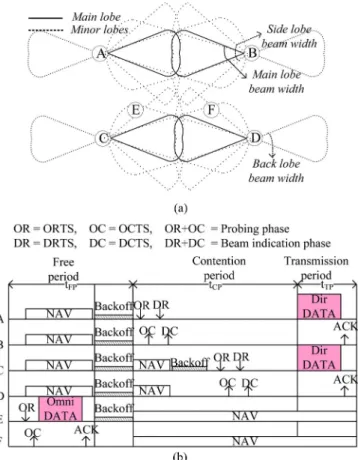
requires successfully decoding frames. In [2], [4], and [5], VCS is adopted; therefore, each node, upon successfully decoding frames, can identify the time period and the direction for each directional communication in the vicinity and will not introduce interference to the ongoing directional communication. The problem with VCS is that, as shown in Fig. 1, the minor-lobe antenna gain from node D to node F may not be sufficiently large for successful frame decoding at node F. As a result, node F may assume that it is safe to transmit toward the direction of the minor lobe of node D’s ongoing transmission, thereby causing interference to the frame reception at node D.
b) PCS in Practical Directional Antenna Systems: Unlike
VCS, PCS is an energy-detection-based mechanism; there-fore, no frame decoding is required. When the detected signal strength exceeds a certain threshold, the existence of an ongo-ing transmission is assumed. Compared with the frame decod-ing mechanism, e.g., VCS, PCS has the advantage of faster and enhanced sensitivity. When a node transmits toward some other node through a directional antenna, the transmitting node will implicitly announce its antenna beam pattern to its neighboring nodes. Therefore, although a node cannot successfully decode the frame that is sent from the transmitter, this node can still identify the existence of the minor lobe of the transmitter. The problem with PCS in directional antenna systems is that, when a node detects no signal toward some other node, it does not mean that it is safe to transmit without collision.
In summary, VCS can be used to notify neighboring nodes of the directional communication period, but it cannot identify the existence of minor lobes. PCS, on the contrary, can identify the weak signal of minor lobes at the transmitter but cannot identify the existence of minor lobes at the receiver. If there is a mechanism for the receiver to announce its antenna beam pattern to its neighboring nodes, the receiver can avoid being interfered by its neighboring nodes.
3) Antenna Beam Pattern Detection Mechanism: To tackle
the interference problem of minor lobes, we design an antenna beam pattern detection mechanism to incorporate VCS and PCS into our RDMAC protocol in Section III. With this mechanism,
Fig. 1. Example operation of RDMAC. (a) Network topology. (b) Frame exchange among nodes.
the neighboring nodes of the transmitter can identify the pres-ence of minor lobes of the ongoing transmission by detecting the sensed signal strength. Because reflection may affect the signal propagation path, this minor-lobe detection mechanism based on the signal strength should be the most effective mech-anism for identifying the existence of minor lobes in directional antenna systems. Furthermore, this signal-strength detection mechanism can be applied to networks that are composed of nodes with different antenna beam patterns. In this paper, we do not restrict our protocol to any specific antenna beam pattern. Instead, our mechanism can support wireless networks that contain nodes with heterogeneous antenna beam patterns.
The antenna beam pattern detection mechanism is described as follows. Consider a transmitter and a receiver pair, e.g., nodes C and D, respectively, in the system, as shown in Fig. 1. Before DATA and ACK frames are exchanged, the transmitter C will directionally transmit a signal toward its receiver D such that node C’s neighboring nodes will detect the antenna beam pattern of node C. Similarly, the receiver D will also direc-tionally transmit a signal toward the transmitter C to enable node D’s neighboring nodes to detect the antenna beam pattern of node D. Because each node has information about the an-tenna beam patterns of its neighboring nodes, if a neighboring node of the transmitter or the receiver wants to start a trans-mission by its main lobe to another direction, it can use such information to estimate whether the signal strength of the new transmission that is emitted from its minor lobes will affect the ongoing transmission. Only when the estimated signal strength is lower than the interference threshold will the neighboring
node transmit. This way, the neighboring nodes can use their main lobes to transmit frames toward other direction(s) while keeping their minor lobes from interfering with the ongoing reception.
III. RESERVATION-BASEDDIRECTIONAL MEDIUMACCESSCONTROL
RDMAC is a MAC-layer protocol that is designed for IEEE-802.11-based wireless ad hoc networks with directional anten-nas. RDMAC operates in runs. Each run is of fixed duration and is divided into the following two periods: 1) the contention period and 2) the transmission period. The contention period is further decomposed into a set of probing and beam-indication subperiods. In the probing subperiod, each node contends for the channel through an RTS/CTS exchange through an omni-directional antenna (ORTS/OCTS), which is used to address the deafness and head-of-line blocking problem. In the beam-indication subperiod, the pair of nodes that wins the channel access announces the antenna beam pattern to neighboring nodes through RTS/CTS signaling through a directional an-tenna (DRTS/DCTS) to coordinate spatial reuse in different directions and combat the minor-lobe interference problem. In the transmission period, both DATA and ACK frames are directionally transmitted (denoted as DDATA/DACK).
Each node maintains a network access vector (NAV), a directional network access vector (DNAV) table, and a neighbor table. In the NAV, each entry records the duration that the node must be silent to avoid causing interference to the ORTS/OCTS exchange. The DNAV table, as shown in [5], is used to record the direction to which the node must not initiate directional communication in the transmission period to avoid interference. In the neighbor table, each entry records the information for one of its neighboring nodes. The information includes the following two factors: 1) the beam direction from the node toward a specific neighboring node and 2) the status of the specific neighboring node, i.e., whether it has scheduled DATA communication in the transmission period.
1) Channel Contention Period:
a) Probing Subperiod: In the probing subperiod, each
node contends for the channel by the IEEE 802.11 DCF operation through an omnidirectional transmission. The node whose backoff interval is counted down to zero will start an ORTS/OCTS exchange. In [13], the authors propose a novel approach for estimating the direction of arrival (DOA) using a directional antenna. The mean and standard deviation of the estimation error are 0.67◦ and 0.59◦, respectively. Based on the same assumptions as the DOA [4], [5], [8], [9] technique, the node then determines which beam to use for DRTS/DCTS exchange during the beam-indication subperiod. Upon receiv-ing an ORTS frame, the receiver, based on its DOA, checks its DNAV table to determine if the antenna beam pattern and the time period for the DDATA/DACK transmission will be safe from interference. Only when it is safe will an OCTS frame be replied. As such, the minor-lobe problem can be reduced. The transmitting node that hears no OCTS in reply will enter the backoff process of DCF and increase the contention window. The neighboring nodes of the transmitter and the receiver, upon
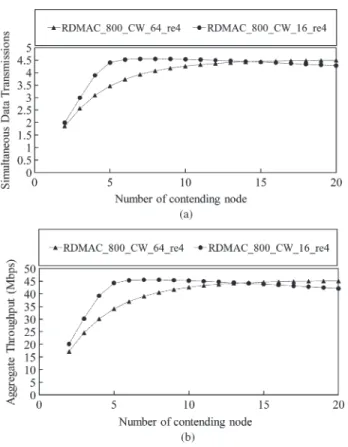
Fig. 7. Analytical results for different spans of contention window sizes. (a) Number of simultaneous data transmissions E[nSx]. (b) Aggregate throughput.
To investigate the effect ofCWminon the aggregate
through-put, we simulate two sets of initial contention window sizes, i.e., 16 and 64, based on the parameter set in set (d) of Table I. For each node, a largerCWmin leads to a larger average
con-tention window size. This case, in turn, results in a significantly extended contention window between two consecutive RTS at-tempts. We further observe that a largerCWmincan more
effec-tively reduce the collision problem among nodes by spreading RTS transmission attempts in a longer backoff process. Fig. 7 shows the performance of RDMAC in a nonsaturated state. A largerCWminresults in a smallerE[nT x]. This case is because, under the condition of low node density, the channel collision probability is relatively small, and E[nT x] is dominated by the interarrival time between two consecutive RTS attempts. Therefore, the larger CWmin, the smaller the nonsaturated E[nT x], and thus, the lower the aggregate throughput. With a smallerCWmin,E[nT x] saturates faster, because as the number of nodes increases under low node density, smaller interarrival allows the nodes to react faster and schedule more RTS/CTS handshakes intCP, which speeds up saturation.
VI. CONCLUSION
In this paper, we have proposed a new MAC mechanism called RDMAC for IEEE 802.11 DCF-based multihop wire-less networks with directional antennas. We attempt to reduce the location-dependent carrier-sensing and the interference problems caused by minor lobes. Our contention mechanism eliminates the requirements of a centralized synchronization
mechanism and prior location information on neighboring nodes. Such requirements are necessary in most existing direc-tional MAC protocols. The performance of our mechanism is evaluated through ns-2 simulations. The results show that the aggregate throughput of RDMAC are superior to the existing work. We also analyze the throughput performance of RDMAC and validate the correctness of the analytical model under saturated and nonsaturated network conditions. The effects of CWmin, tCP, and N on the aggregate throughput of the RDMAC protocol have been investigated. The analytical model also suggests the optimal size of the contention period with prior node density and beamwidth information. The analytical model provides an in-depth understanding and insights into the RDMAC protocol and serves as a helpful tool for further study as well.
ACKNOWLEDGMENT
J.-J. Chang would like to thank Prof. T-C. Hou for his very helpful feedback on the early draft of this paper.
REFERENCES
[1] Part 11: Wireless LAN Medium Access Control (MAC) and Physical Layer
(PHY) Specification, IEEE Std. 802.11 WG, 1999.
[2] R. R. Choudhury, X. Yang, R. Ramanathan, and N. Vaidya, “Using direc-tional antennas for medium access control in ad hoc networks,” in Proc.
ACM Mobicom, 2002, pp. 59–70.
[3] T. Korakis, G. Jakllari, and L. Tassiulas, “A MAC protocol for full ex-ploitation of directional antennas in ad hoc wireless networks,” in Proc.
ACM MobiHoc, 2003, pp. 98–107.
[4] H. Gossain, C. Cordeiro, and D. P. Agrawal, “MDA: An efficient di-rectional MAC scheme for wireless ad hoc networks,” in Proc. IEEE
Globecom, 2005, p. 3637.
[5] R. R. Choudhury, X. Yang, R. Ramanathan, and N. Vaidya, “On designing MAC protocols for wireless networks using directional antennas,” IEEE
Trans. Mobile Comput., vol. 5, no. 5, pp. 477–491, May 2006.
[6] R. R. Choudhury and N. Vaidya, “Deafness: A MAC problem in ad hoc networks when using directional antennas,” in Proc. IEEE ICNP, 2004, pp. 283–292.
[7] M. Sekido, M. Takata, M. Bandai, and T. Watanabe, “A directional hidden terminal problem in ad hoc network MAC protocols with smart antennas and its solutions,” in Proc. IEEE Globecom, 2005, p. 2583.
[8] J. Wang, Y. Fang, and D. Wu, “SYN-DMAC: A directional MAC protocol for ad hoc networks with synchronization,” in Proc. IEEE MILCOM, 2005, pp. 2258–2263.
[9] Z. Zhang, “DTRA: Directional transmission and reception algorithms in WLANs with directional antennas for QoS support,” IEEE Netw., vol. 19, no. 3, pp. 27–32, May/Jun. 2005.
[10] M. Takai, J. Martin, A. Ren, and R. Bagrodia, “Directional virtual carrier sensing for directional antennas in mobile ad hoc networks,” in Proc. ACM
MobiHoc, 2002, pp. 183–193.
[11] Y. Takatsuka, K. Nagashima, M. Takata, M. Bandai, and T. Watanabe, “A directional MAC protocol for practical smart antennas,” in Proc. IEEE
Globecom, 2006, pp. 1–6.
[12] J. Wang, H. Zhai, P. Li, Y. Fang, and D. Wu, “Directional medium access control for ad hoc networks,” Wireless Netw., vol. 15, no. 8, pp. 1059– 1073, 2008.
[13] E. Taillefer, A. Hirate, and T. Ohira, “Direction-of-arrival estimation using radiation power pattern with an ESPAR antenna,” IEEE Trans. Antennas
Propag., vol. 53, no. 2, pp. 678–684, Feb. 2005.
[14] K. Park, J. Hou, T. Basar, and H. Kim, “Noncooperative carrier sense game in wireless networks,” IEEE Trans. Wireless Commun., vol. 8, no. 10, pp. 5280–5289, Oct. 2009.
[15] A. Nasipuri, S. Ye, J. You, and R. E. Hiromoto, “A MAC protocol for mo-bile ad hoc networks using directional antennas,” in Proc. IEEE WCNC, 2000, pp. 1214–1219.
[16] F. Babich, M. Comisso, and L. Manià, “Sustainable simultaneous commu-nications in ad hoc networks using smart antenna systems,” ACM Wireless
[17] A. Kumar, E. Altman, D. Miorandi, and M. Goyal, “New insights from a fixed-point analysis of single-cell IEEE 802.11 WLANs,” IEEE/ACM
Trans. Netw., vol. 15, no. 3, pp. 588–601, Jun. 2007.
[18] J. Chang and W. Liao, “On medium access control for IEEE 802.11 wireless ad hoc networks with directional antenna,” in Proc. ICCCAS, Xiamen, China, 2008.
[19] NOAH: NO Ad Hoc Routing Agent. [Online]. Available: http://icapeople. epfl.ch/widmer/uwb/ns-2/noah/
Jin-Jia Chang (S’09) received the B.S. degree
in communications engineering from the National Chiao Tung University, Hsinchu, Taiwan, in 2002 and the M.S. degree in electrical engineering from the National Chung Cheng University, Chiayi, Taiwan, in 2004. He is currently working toward the Ph.D. degree with the Graduate Institute of Commu-nications Engineering, National Taiwan University, Taipei, Taiwan.
His research interests include the performance analysis of medium access control protocols in wire-less and vehicular networks.
Wanjiun Liao (M’97–SM’09–F’10) received the
Ph.D. degree in electrical engineering from the Uni-versity of Southern California, Los Angeles, in 1997. She is currently a Distinguished Professor of elec-trical engineering with the Department of Elecelec-trical Engineering and the Graduate Institute of Commu-nications Engineering, National Taiwan University, Taipei, Taiwan, and an Adjunct Research Fellow with the Research Center for Information Technol-ogy Innovation, Academia Sinica, Taipei. Her re-search interests include the design and analysis of wireless and multimedia networking protocols.
Prof. Liao has received many research awards and recognitions from different government and professional organizations, including IEEE and ACM. She was a recipient of the Republic of China Distinguished Women Medal in 2000. She has been elected as an IEEE Communications Society Distinguished Lecturer for 2011–2012. She is currently the Associate Editor for the IEEE TRANSACTIONS ONWIRELESSCOMMUNICATIONSand was on the Editorial Board of the IEEE TRANSACTIONS ONMULTIMEDIA. She has also served on the Organizing Committees of several international conferences, e.g., as a Tutorial Cochair of the 23rd IEEE International Conference on Computer Communications in 2004, the Technical Program Committee (TPC) Area Chair of the 2004 IEEE International Conferences on Multimedia and Expo, the TPC Vice Chair of the 2005 IEEE Global Commmunications (GLOBECOM) Symposium on Autonomous Networks, a TPC Cochair of the 2007 IEEE GLOBECOM General Symposium, a TPC Cochair of the 2010 IEEE Vehic-ular Technology Conference–Spring, and a TPC Cochair of the 2010 IEEE International Control Conference Next-Generation Networking and Internet Symposium.
Jiunn-Ru Lai (M’09) received the B.S. and Ph.D.
degrees from the National Taiwan University, Taipei, Taiwan, in 1995 and 2004, respectively.
From 2004 to 2005, he was a Postdoctoral Re-searcher with the Department of Electrical Engineer-ing, National Taiwan University. From 2005 to 2006, he was with the National Tsing Hua University, Hsinchu, Taiwan, as a system engineer for the pilot voice over internet protocol project supported by Intel. Since 2006, he has been with the Department of Electrical Engineering, National Kaohsiung Uni-versity of Applied Science, Kaohsiung, Taiwan, as an Assistant Professor. His research interests include mobile and wireless networking, multicast, mobility management, media access control, and quality of service in wireless networks.