ELSEVIER ADVANCED TECHNOL(~;Y
Biosensors & Bioelectronics Vol. 11, No. 8, pp. 703-707, 1996 © 1996 Published by Elsevier Science Limited Printed in Great Britain. All rights reserved 0956-5663/96/$15.00
Development of a conductivity-based
immunosensor for sensitive detection
of methamphetamine (stimulant drug)
in human urine
Kaoru Yagiuda, Akihide Hemmi, Satoshi Ito & Yasukazu Asano
DKK Corporation, 4-13-14 Kichijoji Kitamachi, Musashino-shi, Tokyo 180, Japan Tel: [81] (422) 535111 Fax: [81] (422) 522042
Yoshito Fushinuki
Scientific Investigation Research Laboratory, Kagoshima Pref. Police HQ, 13-1 Yamashita-cho, Kagoshima-shi, Kagoshima 892, Japan
Chien-Yuan Chen
Department of Agricultural Chemistry, National Taiwan University, 1, Sec. 4, Roosevelt Rd., Taipei 106, Taiwan
Isao Karube
Research Center for Advanced Science and Technology, The University of Tokyo, 4-6-1 Komaba, Meguro-ku, Tokyo 153, Japan
(Received 13 June 1994; revised 5 June 1995; accepted 15 August 1995)
Abstract: A simple immunosensor based on a conductivity method was developed for determination of methamphetamine (MA, a stimulant drug) in urine. Anti-MA antibody was immobilized onto the surface of a pair of platinum electrodes. The reaction of MA with the antibody causes a decrease in the conductivity of the anti-MA immobilized layer between the electrodes. A linear relationship was obtained between the conductivity and MA concentration in the range of 1-10 p.g/ml. The method requires the sample to be rinsed with water on the electrodes after the immunoreaction. This detection system was applied to the determination of MA in urine and proved to be a useful and a simple detection technique of MA in forensic science in comparison with a gas chromatography-mass spectrometry method.
© 1996 Published by Elsevier Science Limited.
Keywords: immunosensor, conductivity method, methamphetamine, human urine
I N T R O D U C T I O N
Recently the drug problem has become more serious in Japan. Therefore, the need for a simple, sensitive and selective method to determine the presence of the stimulant drug methamphetamine
(CloH15 N,
molecular weight 149.24, abbreviatedas MA) in a drug abuser's urine in order to cut off the supply routes of addictive MA and to arrest MA abusers quickly has arisen. The method based on gas chromatography-mass spectrometry (GC-MS) has been used conventionally. This method is accurate, but it needs expensive instrumentation and is time-consuming. Methods based on the chemical reactivity of secondary amino groups of MA have also been used for screening MA in human urine (Makahara & Sekine, 1984), but the selectivity for MA of these methods is low. Recently, immunoassays of MA employing polyclonal or monoclonal antibodies against MA, such as enzyme-linked immuno- sorbent assay (Aoki & Kuroiwa, 1983), latex agglutination assay (Aoki & Kuroiwa, 1985; Uda, 1991), and a piezoelectric crystal immunosensor (Miura et al., 1991) and analytical membrane (Kawashima & Fusinuki, 1988) have been reported. However, most of these methods are time-consuming, complicated, need several oper- ations, and are not suitable for field use. There- fore, a simpler and easy to handle portable MA checker which can be used to investigate suspects in action, is needed as a means to resolve drug problems in the drug enforcement division in Japan.
The requirements for the MA checker include portability, disposability of the sensing probe, battery operated, high selectivity, low cost, wide use of the principle, simple procedure, long-term stability and so on for personal use. In the case of the drug checker, reliability and stability of the checker are particularly important because results obtained from the checker have the possibility of affecting the judgment of a suspect and the suspect's human rights. From several preliminary experiments, we noticed excellent selectivity of immuno-reaction and good stability of conductivity detection aimed at developing a new MA sensor. A stable blank signal is one of the important factors for development of a simple detector for MA because the MA checker is often used without calibration due to the need for a quick search in the field. The stability of the blank signal affects the signal reliability which
is desired in the measurement of MA. Based on this point, the conductivity method satisfies the requirements for a simple MA detector, because the conductivity of the blank is stable and repeatable.
In order to establish a practically applicable measuring system for MA, we have developed a simple immunosensor system based on the conductivity method using an antibody-immobil- ized electrode. The conductivity change due to a specific immuno-reaction on the electrode was utilized. This system was applied to determine proteins and stimulants such as mouse immuno- globulin G (IgG) and MA. In this study, a detection system for MA using a specific immuno- reaction and a stable conductivity detector was constructed.[7] (PCT Patent pending).
E X P E R I M E N T A L
Reagents
MA antibody
Anti-MA antibody was prepared from rabbits. MA modified with bovin serum albumin (BSA) was synthesized according to a well-known method (Fatori & Hunter, 1980). The solution containing 3 mg/l MA modified with BSA was injected into the blood of such rabbits, 2 times a week for the first 2 months and once every 2 months for the next 6 months. MA antibody was produced in the bodies of rabbits over 8 months. The antibody was separated and purified by gel filtration after collecting blood from the rabbits. Anti-MA antibody was in 30-40% yield from 0.5 g of MA. The antibody was stored in a freezer.
Other reagents
Other reagents were commercially available ana- lytical reagents or laboratory grade and were used as received. Pure water was used throughout the work.
Apparatus
The immuno-sensing system was constructed from a conductivity cell with immobilized antibody electrode and a conductivity meter (AOL-40, DKK Co., Tokyo, Japan). The structure of the conductivity cell is shown in Fig. 1. The conductivity cell consisted of a pair of platinum
Sensor body made of epoxy resin Signal terminal
/ Lead wire
Sample ~
I 'i
I i
Sample
inlet
~
Sample
ce11(88.5
~ I)
__X Sample
Sample outlet
Antibody immobilized platinum electrode
Fig. 1. Structure of conductivity cell.
RESULTS AND DISCUSSION electrodes (surface area, 0.95 cm2), separated
from each other by 0.5 mm. The cell constant and cell volume were 0.05 cm -1 and 0.09 cm 3, respectively. Anti-MA antibody was immobilized onto the surface of the platinum electrodes using 3-aminopropyltriethoxysilane (~/-APTES) and glutaraldehyde. Conductivities were meas- ured using the conductivity meter.
Procedure for determination o f M A
Anti-M antibody was immobilized onto the sur- face of the platinum electrodes by spreading 10 pJ of 0.2% "y-APTES acetone solution onto the electrodes, and incubating for 12 h at 120°C. The electrodes coated with ~/-APTES were rinsed with water and incubated in a 5% glutaraldehyde solution for 2 h at room temperature. Sub- sequently, the modified electrodes were incubated in an anti-MA antibody. The resulting conduc- tivity cell with the immobilized antibody elec- trodes was kept at 4°C in a phosphate buffer solution (pH 7.4).
A procedure for detection of the immuno- reaction is as follows. MA standard samples were prepared by diluting the standard solution with the phosphate buffer solution. A 100 p,l sample of the MA solution was injected into the conductivity cell and incubated for 15 min at 25°C. After the reaction the cell was washed and filled with pure water, then the conductivity of pure water was measured by using the conductivity detector.
Calibration curve E d. t- O o
MA concentration was measured from the con- ductivity change of the immuno-sensing system in pure water after the immuno-reaction. The conductivity decreased in this system. Figure 2 shows the relationship between the conductivity and the MA concentration. A linear relationship was obtained between the conductivity and the MA concentration in the range 1-10 p,g/ml. The minimum detectable concentration for MA was 0.5 p~g/ml. The conductivity was reproducible
50 40 30 20 10 0 0 I I I 10 2o 30
Biosensors & Bioelectronics A conductivity-based immunosensor
M A conc. (~g/ml)
within an average relative error of 5% for five time measurements of the sample containing 10 Ixg/ml MA.
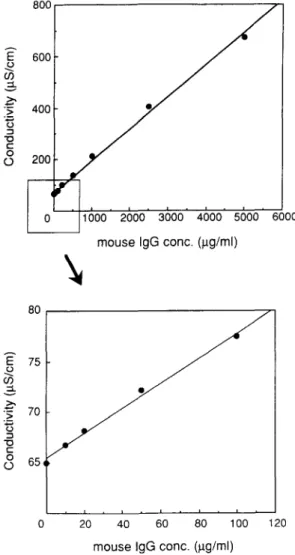
On the other hand, the conductivity increased in proportion to the concentration of IgG as shown in Fig. 3 in case of the immobilized IgG- antibody sensor. These two phenomena seem to be based on the immuno-reaction. The ionic property of the substances on the electrodes seems to be caused by the difference in the surface charge between both immunoreactions.
Selectivity
The selectivity of the conductivity detector for MA was investigated for several drugs. The concentration of the drugs was adjusted to 10 ixg/ml. No conductivity decrease was observed
E cO > , > O "13 C O O 800 600 400 200
I
1000 000 3000 4000 5000 6000 m o u s e IgG conc. (gg/ml) 80 E o 03 =L ._> "d "O t - O O 75 70 65, i i i i i 20 40 60 80 100 m o u s e IgG conc. (~tg/ml) 120Fig. 3. Calibration curve for mouse IgG
for the drugs examined except for MA. The conductivity decreased only in the presence of MA. This result suggests that the specific antigen-antibody reaction can provide selective determination of MA.
The selectivity of the immunosensor developed was examined by applying it to human urine even when other components were present in the samples. The conductivity was decreased when MA was present in the sample. On the other hand, in the solution without MA, the conductivity did not decrease. We also investi- gated the effects of BSA, casein, H P R and starch (each component was present at a concentration of 1 mg/ml) on the sensor signal. Little change in the conductivity was observed.
These results indicate that the developed immu- nosensor was applicable to the selective determi- nation of MA in human urine.
Correlation between the present method and the conventional method
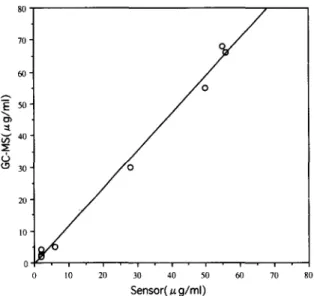
The concentration of MA in human urine of an MA abuser has generally been reported to be in the range 1-50 txg/ml (Kanda et al., 1978). We applied the immuno-conductivity method to the human urine sample and compared the results with those obtained by conventional GC-MS. The measurements were done using multiple sensors. We compared the samples of more than 10 ~g/ml MA after diluting them 5-10 times with pure water. As a result, the correlation factor and regression line between both methods were ,~2 = 0.994 and Y = 1.18X - 0.52, respectively, as shown in Fig. 4.
The sensor's measurements on eight samples had relative errors of 20 to - 5 0 % from the standard GC-MS data. It seems that different sensors were used to determine MA for the samples.
CONCLUSION
We have developed an immunosensor for MA based on a conductivity method which detects MA in human urine from a decrease in the conductivity. The sensor has a pair of platinum electrodes with immobilized anti-MA antibody. The conductivity of the immobilized antibody layer decreases after contacting with the sample solution containing MA due to the immuno-
8 0 7 0 ' 6 0 ' • i • i , i • i , i , i • i 10 20 30 40 .so 6o 70 S e n s o r ( u g / m l ) 50 ¸ ~ ' 40 :g, ~ 3 0 0 0
Biosensors & Bioelectronics A conductivity-based immunosensor
8 O
Fig. 4. Correlation between sensor method and GC- MS method.
reaction. Based on this principle, determination of MA in the concentration range 1-10 ixg/ml was possible within about 15 min for each sample. The sensor has been proven to be sensitive and stable enough to determine the critical concentration (1 ~g/ml) of M A in human urine. As a result of this research, we concluded that the immuno-conductivity sensor is useful for
screening and field-research of MA in disposable use. Efforts are under way to improve the sensitivity of the MA sensor to less than 1 p,g/ml.
The present idea can also be applied to detect other drugs such as cocaine, using the same method at the MA sensor which is currently under investigation.
R E F E R E N C E S
Aoki, K. & Kuroiwa, Y. (1983). J. Pharmacobiodyn.,
6, 33.
Aoki, K. & Kuroiwa, Y. (1985). Forensic Sci. Int., 27, 49.
Fatori, D. & Hunter, W. M. (1980). Clin. Chim. Acta, 100, 81.
Kanda, Y., Inoue, T., Kishi, T., Niwase, T. & Niwaguchi, T. (1978). Rep. Nat. Res. Inst. Police Sci. 31, 159.
Kawashima, T. & Fusinuki, Y. (1988). Chem. Eng.
30, 21.
Makahara, Y. & Sekine, H. (1984). Forensic Sci. Int., 26, 277.
Miura, N., Higobashi, H., Takeyasu, A., Uda, T. & Yamazoe, N. (1991). Chem. Sensors, 1991, 7B, 53.
PCT Patent pending (08/530, 178).
Uda, T. (1991). In Chemical Sensor Technology, Vol. 3, p. 281. Kodansha, Tokyo.