Beam-propagation-dominant instability in an
axially pumped solid-state laser
near degenerate resonator configurations
Ching-Hsu Chen, Ming-Dar Wei, and Wen-Feng HsiehInstitute of Electro-Optical Engineering, National Chiao Tung University, 1001 Ta-Hsueh Road, Hsinchu 30050, Taiwan
Received December 5, 2000
Propagation-dominant instabilities and chaos were found under so-called good-cavity conditions in an axially pumped solid-state laser operated near the 1/3-degenerate cavity configuration that had not previously been studied numerically. By using the generalized Huygens integral together with rate equations, we obtained a V-shaped configuration that depends on a quasi-periodic threshold. We call the propagation dominant be-cause the laser behaves as a conservative system governed by beam propagation. Although it had previously been predicted that chaos would be impossible under nearly degenerate conditions, we have recognized that the laser is transformed into chaos as a result of the interplay of beam propagation and gain dynamics as the cavity is tuned close to degeneracy. © 2001 Optical Society of America
OCIS codes: 140.0140, 140.1540, 140.3580, 140.4780, 140.5560.
1. INTRODUCTION
On the basis of beam propagation in a laser cavity that contains a homogeneously broadened gain medium, Melnikov et al.1 constructed and analyzed a three-dimensional point map that presented the evolution of the beam parameters (spot size and wave-front curvature) to-gether with the field intensity with which to model the nonlinear laser dynamics. They found that in a uni-formly pumped laser with a high-loss cavity the laser has a continuously smooth quasi-periodic threshold through-out the geometrically stable region, except that some sin-gular points that correspond to transverse mode degeneration2 may become chaotic at high-power pump-ing.
However, by using a diffraction integral and a rate equation, Hollinger and co-workers3–5 studied the insta-bility of single-longitudinal but multitransverse modes. They found that, in a laser with a high-loss cavity and uniform high-power pumping, the laser’s output appears to be chaotic at the configurations that have a g1g2 pa-rameter equal to 0.4 but to be only quasi-periodic at
g1g2⫽ 0.5, which corresponds to the 1/4-degenerate figuration. In the former case, chaotic behavior was con-sidered a condition in which the phase shift between ad-jacent transverse modes per round trip is an irrational multiple of and does not lie close to any rational number with a small denominator. As in the configuration at
g1g2, whose phase shift is a rational multiple of, the la-ser output behaves quasi-periodically, even with much higher pumping. This result contradicts the conclusion described in Ref. 1 that the laser behaves chaotically as the transverse mode degenerate configurations.
Lugiato et al.6,7 expressed the Maxwell–Bloch equa-tions in terms of modal amplitudes by using a suitably cy-lindrically symmetric empty-cavity-mode expansion. They presented a variety of spatiotemporal instabilities, including chaos and cooperative frequency locking, that
occur under uniform and low-power pumping, by tuning the mode spacing. They were able to do this because the Laguerre–Gauss modes are a set of good bases only when the uniform-field limit is applied for a so-called good cav-ity with small gain. Thus their results are valid only for a laser in which the pump size is larger than the mini-mum cavity beam waist.8
By applying Greene’s residue theorem9 to analyze the iterative map of a Gaussian beam q parameter of a gen-eral optical resonator,10 we found that, even when only fundamental mode propagation is considered, some spe-cific configurations that have so-called low-order resonance9 may become unstable under the influence of persistent nonlinear effects.10–12 These configurations with g1g2 parameters equal to 1/2, 1/4, and 3/4 corre-spond to 1/4, 1/3, and 1/6 transverse-mode degenerate configurations, respectively. When only the optical Kerr effect is considered as the nonlinear dynamic parameter and the gain saturation effect is excluded, optical bistability11and multiple-period bifurcation12are possible for Kerr-lens mode-locked lasers. However, gain satura-tion provides an inherently nonlinear effect. When the pump size was smaller than the waist of the cold cavity, peculiar lasing behavior13,14 was observed in an end-pumped Nd:YVO4laser near these degenerate configura-tions. Low lasing threshold and beam waist shrinkage accompanied by multiple-pass transverse modes were exhibited.14
In this paper we focus on the configuration-dependent instabilities near 1/4, 1/3, and 1/6 transverse-mode degen-erate configurations and consider only gain saturation as the nonlinear effect that occurs when the pump size is larger than the waist of the cold cavity, as described by Lugiato et al.6,7 The generalized Huygens integral and the rate equations were used to model dynamics of the Gaussian end-pumped solid-state laser. We found that a good-cavity laser exhibits a V-shaped quasi-periodic
bility threshold rather than a smooth variation about these transverse-mode degenerate configurations, as the pump size is one to two times that of the waist of the cold cavity. Here a ‘‘good cavity’’ means that the cavity loss per round trip is ⬍10% and also that a class-B laser condition15 rather than a bad-cavity condition produces Lorentz–Haken instability.15 With higher Gaussian pumping at the point of degeneration, the laser output cannot lead to chaotic behavior, unlike the result de-scribed by Melnikov et al.1 but the same as that of Hollinger and Jung. However, the chaotic region is close to degeneration, a result that is different from the results of Ref. 3 because the phase shift between adjacent trans-verse modes in a round trip is close to 2/3 for the 1/3-degenerate configuration. Moreover, a variety of insta-bilities were found near the 1/3-degenerate configuration, and a frequency characterized by precession in phase space has been used to recognize them. We have orga-nized the remainder of this paper as follows: In Section 2 we formulate the equations of motion. The numerical re-sults are discussed and compared with previous research in Sections 3–6. In Section 7 we summarize our conclu-sions.
2. MODELING
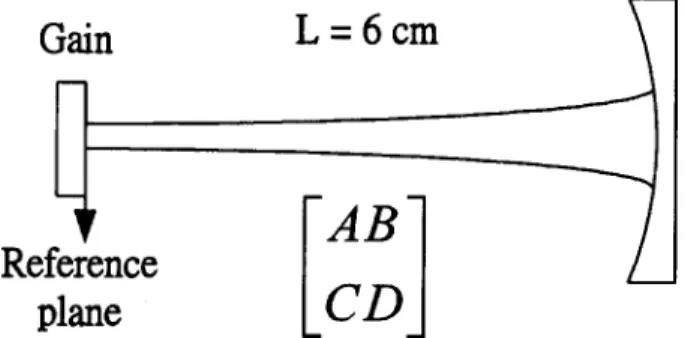
Consider the plano–concave axially pumped solid-state laser shown in Fig. 1. It consists of a laser crystal with one of its end faces (I) high-reflection coated as the flat mirror and with a curved mirror with radius of curvature
R separated from it by a distance L. Let the reference plane be the place where the light beam just leaves the laser crystal in the direction of the curved mirror. Under cylindrical symmetry, propagation of the light field to-ward the curved mirror and back to the flat mirror (end face I of the crystal) according to the generalized Huygens diffraction integral is Em⫹1⫺共r兲 ⫽ 2j B
冕
exp共 jk2L兲Em ⫹共r⬘兲exp关⫺共 j/B兲 ⫻ 共Ar⬘2⫹ Dr2兲兴J 0共2rr⬘/B兲r⬘dr⬘, (1) with round-trip transmission matrix冋
A BC D
册
.Here Em⫹(r⬘) and Em⫹1⫺(r) are the electric fields of the
mth and the (m⫹ 1)st round trips at the planes
imme-diately after and before the gain medium (denoted by the
superscripts⫹ and ⫺), where r⬘and r are the correspond-ing radial coordinates, is the wavelength of laser, and J0 is the Bessel function of zero order. In a thin-slab ap-proximation, we can relate the electric fields Em⫹1⫹ to
Em⫹1⫺ (after and before the gain medium) in the same round trip as
Em⫹1⫹共r兲 ⫽ Em⫹1⫺共r兲exp共⌬Nd兲⌸共r/a兲, (2) where 1⫺2 is the round-trip energy loss, is the stimulated-emission cross section, ⌬N is the population inversion per unit volume, d is the length of the active medium, and⌸(r/a) is an aperture function that equals 1 for r less than aperture radius a and equals 0 otherwise. Furthermore, assuming that the evolution of the popula-tion inversion follows the rate equapopula-tion of a four-level sys-tem, we can write the rate equation as
⌬Nm⫹1⫽ ⌬Nm ⫹ Rpm共N0⫺ ⌬Nm兲⌬t ⫺ ␥⌬Nm⌬t ⫺ 共兩Em兩2/E
s2兲⌬Nm⌬t, (3)
where Rpm is the pumping rate, ⌬t is the travel time through the gain medium, Esis the saturation parameter, ␥ is the spontaneous decay rate, and N0is the total den-sity of the active medium. This method was used to model a single-longitudinal multitransversal high-power solid-state ring laser3–5and to analyze the decay rate of standing-wave laser cavities in the linear regime.16 It was found that a standing-wave resonator can be approxi-mated by a ring resonator if a thin gain medium is placed close to one of the end mirrors.17 For a continuous Gaussian pump profile Rpm⫽ Rp0exp(⫺r2/2wp2) with constant pumping beam radius wpthroughout the active medium (thin slab), the total pumping rate over the entire active medium is
冕
RpmdV⫽ Pp/hp, (4)where Pp is the effective pumping power and hp is the photon energy of the pumping laser. Because we consid-ered only single-longitudinal-mode dynamics, we have omitted the dispersion of the active medium, so the gain is assumed to be real. Therefore we have four control pa-rameters: , R, wp, and Pp, which play important roles in the laser system and are investigated in detail as fol-lows.
In an ordinary axially pumped solid-state laser, the round-trip propagation time is many orders of magnitude shorter than the spontaneous decay time, especially in a short cavity. As a result, it would take a large number of iterations to arrive at the final state (which may be stable or unstable). To reduce computation time and because the quasi-periodic bifurcation point is just above the stable continuous-wave solution, we used the scaling method16to magnify␥ by 104 times to determine the bi-furcation points. We also checked some important points without scaling that showed no promising change in the quasi-periodic threshold. To reduce the influence of the diffraction loss, we slightly varied R of the curved mirror rather than changing cavity length L to simulate tuning the laser cavity across the point of degeneration.
3. BEAM-PROPAGATION-DOMINANT
DYNAMICS
As mentioned above, in the low-order-resonance configu-rations within the geometrically stable region the laser may become unstable under the influence of persistent nonlinear effects.10–12 Thus we concentrate our simula-tion on these configurasimula-tions, using the parameters of an axially pumped Nd:YVO4 laser, a class B laser with ⫽ 1.064m, 1/␥ ⫽ 50 s, ⫽ 25 ⫻ 10⫺19cm2,
N0⫽ 1.7 ⫻ 1020cm⫺3, d⫽ 1 mm, a refractive index of 1.96, and L ⫽ 6 cm at 808-nm pumping and setting aper-ture radius a ⫽ 1 mm, which is large enough for g1g2 ⫽ 1/4. In as much as our results are ascribed mainly to the dependence of laser dynamics on configuration as dis-cussed below, we chose the cavity parameter product
g1g2⫽ 1 ⫺ L/R to be 1/2, 1/4, and 3/4 for studying non-linear dynamics. These configurations correspond to R ⫽ 8, 12, 24 cm, respectively.
In the numerical simulations we set the initial values of E and ⌬N to zero and added to Eq. (2) a term that simulates the spontaneous emission whose amplitude is given by the spontaneous decay term in Eq. (3) and a phase obtained from a random generator. To implement the generalized Huygens integral by the Romberg method we divided a 1-mm aperture into 1024 segments.
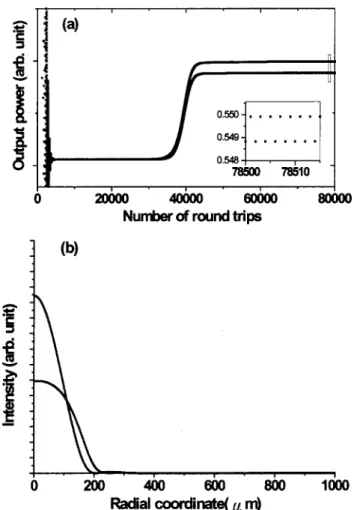
As expected, when the laser is continuously pumped slightly above the lasing threshold it starts with relax-ation oscillation and eventually converges to the continuous-wave steady state. Because⌬t is 1/30 of the round-trip time Tcavunder magnification of␥ by p times, the actual relaxation oscillation frequency fr is equal to the numerical frequency multiplied by 关(Tcav/⌬t)/p兴1/2. When one increases the pump power beyond a certain level, bifurcation, or instability threshold, the laser out-put is no longer stable but becomes multiperiodic. Fig-ure 2(a) shows the evolution of the laser pumped with Gaussian pump radius wp⫽ 330m at Pp⫽ 313 mW above the bifurcation and wp ⫽ 309 mW at the configura-tion g1g2⫽ 1/2 with ⫽ 0.95. Note that cavity beam ra-dius w0is⬃142m and that ⌿, defined as wp/w0, equals 2.32. The laser begins with the relaxation oscillation (⬃6.08 MHz, corresponding to fr⫽ 333 kHz) followed by a short period of metastable output and finally develops into a flip-flopping steady-state period-2 solution. The corresponding field intensity profile, like the spot size on the plane-mirror end shown in Fig. 2(b), also flip-flops to repeat itself after two round trips, in contradiction to the regular situation of self-consistency after only one round trip. This result is equivalent to what is obtained from a stability analysis of a conservative map involving only Gaussian beam propagation, as in Fig. 4(a) of Ref. 10, where the rotation angle in phase space (spanned by spot size w and the curvature 1/Rg) per round trip equals for
g1g2⫽ 1/2.
Similarly, both of the transverse-mode-degenerate configurations for the 1/3-degenerate configuration at
g1g2⫽ 1/4 and the 1/6-degenerate configuration at g1g2 ⫽ 3/4 belong to the third-order resonance and need three round trips to repeat themselves (or period-3 solutions) in phase space.10 For the configuration slightly tuned away from its corresponding point of degeneration, e.g., at
g1g2⫽ 0.25466 or R ⫽ 8.05 cm, the laser shows nonde-caying quasi-periodic oscillation [Fig. 3(a) and its inset]. We can see that the laser emission successively circulates in the resonator to form three branches of oscillation with a period of roughly 293 iterations. This is similar to the evolution of spot size in Fig. 3(b) of Ref. 10.
This period can be determined from 2/兩 ⫺ 2/n兩, where is the rotation angle in phase space per round trip,102/n is the closest rational fraction rotation angle in phase space, and n ⫽ 3 in this case. In Fig. 3(b) we plot the evolution of the three consecutive states, 1, 2, and 3, in (w, 1/Rg) space for the quasi-periodic case. Assume that the initial state is state 1 and that it will evolve in sequence and rotate at an angle per iteration (or per round trip). If/2 is a rational number, the dynamics is periodic. Contrarily, if /2 is irrational, the initial state will never repeat itself but will precess an angle
n( ⫺ 2/n) (or recede for a negative angle) in phase
space after n iterations. As a consequence, an arbitrary initial state will nearly return to itself but will precess (or recede) a minimal angle after Tp⫽ 2/(n兩 ⫺ 2/n兩) it-erations. We therefore define the precession frequency fp as c/2LTp.
The power spectrum [see Fig. 3(c)] of Fig. 3(a) shows that a low-frequency peak at 25.6 MHz is fp, which equals the beat frequency (fb) of the two nearly
degener-Fig. 2. (a) Output power evolution and (b) beam profile of the period-2 steady state for g1g2⫽ 1/2 with⫽ 0.95 above the
ate Laguerre–Gauss modes, LGn,0,0 and LGn⫺2,3,0. Al-though there is a lower-order LGn⫺1,1,1mode that degen-erates with the fundamental mode, it will not be excited under cylindrical symmetry. The highest peak at 842 MHz results from circulating among those three oscillat-ing branches and returnoscillat-ing to the initial branch every three round trips (as the longitudinal mode spacing is 2.5 GHz). This peak is accompanied by a sideband owing to beating with a 25.6-MHz peak. We say that the laser is beam-propagation dominant because it behaves as a con-servative system governed by Gaussian beam
propaga-tion. Therefore, when the laser is axially pumped a bit above the quasi-periodic threshold about the point of de-generation, the laser behaves as if the beam propagation were dominant.
It is interesting to note that the laser output behaves the same as in a lossless optical resonator described by a conservative map. It seems that the laser will become a conservative system, although it does include dissipative elements such as gain and Gaussian (pump) aperture. For low pumping, the Gaussian gain profile is a weak Gaussian aperture and provides the damping mechanism; however, because there is already saturated gain above the instability threshold, the effective radius of the aper-ture increases. As a result, cavity field propagation dominates the laser dynamics and behaves as conserva-tive propagation as illustrated in Ref. 10.
4. THRESHOLD OF A QUASI PERIOD
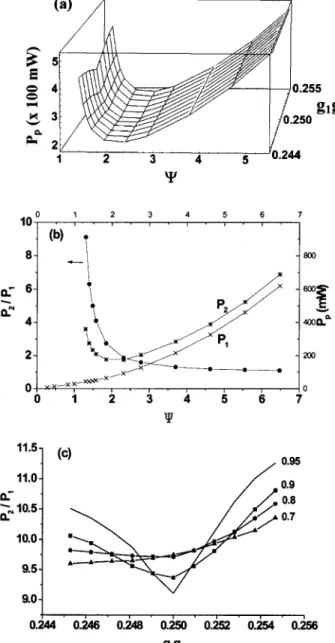
A. Good CavityFigure 4(a) is a three-dimensional bifurcation diagram that shows quasi-periodic instability threshold P2at vari-ous values of⌿ near g1g2⫽ 1/4 for ⫽ 0.95. It is obvi-ous that the system has a V-shaped quasi-periodic thresh-old with a local minimum at the point of degeneration over 1 ⬍ ⌿ ⭐ 2. The farther the cavity is tuned away from degeneration, the higher the quasi-periodic thresh-old is. This result confirms our previous prediction10 that the degenerate configuration is unstable under the nonlinear effect. Moreover, the V-shaped threshold is deeper as ⌿ is close to 1 and becomes flat for large ⌿. This shows that the quasi-periodic threshold is indepen-dent of cavity configuration if a uniform pump is used, as reported in Ref. 6. Similar results can be obtained with other degeneration configurations.
Fixing g1g2⫽ 1/4, we plotted the ratio (P2/P1) of quasi-periodic threshold P2 to lasing threshold P1versus ⌿ [Fig. 4(b)]. The ratio approaches 1 with uniform pumping for ⌿ approaching infinity, and it increases sharply as⌿ becomes close to 1. The result is the same as that derived by Lugiato et al.,6namely, that instability in terms of the threshold ratio favors a cavity operated with large⌿, where it is easier to excite multitransverse modes to develop spatiotemporal instabilities. However, as the lasing threshold increases monotonically as a func-tion of⌿, a minimal quasi-periodic threshold power of 175 mW occurs at ⌿ ⬇ 2.3, where P2/P1⬇ 1.8. Further-more, the lasing threshold is almost independent of g1g2 about the point of degeneration as⌿ ⬎ 1; thus the lowest quasi-periodic threshold at degeneration that is due to sensitivity to nonlinear effects is demonstrated in Ref. 10. B. High-Loss Cavities
We have discussed cavity-configuration-dependent laser dynamics under the good-cavity condition with ⫽ 0.95. To examine the influence of cavity loss on laser dynamics, we have chosen values of of 0.95, 0.9, 0.8, and 0.7 for ⌿ ⫽ 1.3. From Fig. 4(c) we found that the V-shaped threshold behavior disappears as decreases to 0.7. It develops into a monotonically increasing smooth curve with respect to g1g2, and the threshold at degen-eration is no longer a local minimum. This smooth curve Fig. 3. (a) Evolution of the output power of the quasi-periodic
oscillation at g1g2⫽ 0.25466, ⫽ 0.95, ⌿ ⫽ 2.32, and Pp
⫽ 210 mW. The inset is the magnification of six precession pe-riods. (b) Phase space of (w, 1/R), as in Ref. 10, provides an ex-planation. The numbered filled circles stand for the number of it-erations. (c) The corresponding spectrum of (a).
is similar to that described in Ref. 1 for 50% mirror reflec-tion or 2⫽ 0.5. As mentioned above, the laser with high mirror reflectivity mimics a conservative system and becomes propagation dominant when it is operated in a quasi-periodic state. Thus the V-shaped quasi-periodic threshold will not be found in the research reported in Ref. 1, where a high-loss cavity was considered, nor in Ref. 7, with uniform pumping. Note that these curves are asymmetric. Normally, if the aperture radius and the cavity length are both constant, the larger the g1g2 parameter, the larger the spot size is on the flat mirror, which is also a gain medium. Because diffraction loss is minimized by choice of a sufficiently large aperture, in our simulation the asymmetry is ascribed mainly to a change in the overlap integral of the cavity field with the pumping as g1g2varies.
5. BIFURCATION DIAGRAM
It is worth noting that, when the laser is pumped just above the bifurcation, the stripe denoted for quasi-periodic oscillation in Fig. 3(a) has less than a 1%
varia-Fig. 4. (a) Three-dimensional quasi-periodic bifurcation dia-gram in terms of Pp,⌿, and g1g2for⫽ 0.95. (b) Dependence of the ratio of the instability threshold (P2) to the lasing
thresh-old (P1) on parameter⌿ for g1g2⫽ 1/4 and⫽ 0.95. (c)
De-pendence of P2/P1on g1g2for⌿ ⫽ 1.3 with different values of
as indicated.
Fig. 5. (a) Bifurcation diagram for higher pumping with ⫽ 0.95 and ⌿ ⫽ 2.78 near g1g2⫽ 1/4, (b) power evolution of a
tion. Raising the pump power makes the stripe wider. When the pump power is further increased, the laser is operated far away from the linear regime, and its highly saturated gain may cause serious instabilities. Because the instabilities induced by higher pumping may depend on the spontaneous decay rate, we magnify ␥ only 10 times to investigate the high-pumping condition. In fact, there are minor differences compared with scaling␥ by 10 times and 100 times if we simply want to classify the types of instability.
With a spatially inhomogeneous pump, because of com-petition between two transverse modes a laser can pro-duce chaotic emission.18 Thus we suspect that it might be easier to obtain chaos at a minimal quasi-periodic threshold where ⌿ ⫽ 2.32. Indeed, we tried the pump power up to 7 P1 at⌿ ⫽ 2.32, but chaos was not found. By using⌿ ⫽ 2.78 we can classify the many kinds of in-stability shown in Fig. 5(a) for ⫽ 0.95. For instance, we defined the so-called modulated quasi-periodic state shown in Fig. 5(b) for R ⫽ 8.0075 cm and Pp⫽ 400 mW. Further increasing the pump power, we found so-called modulated pulsing and chaos when R ⫽ 8.0075 cm, as shown in Figs. 5(c) and 5(d) for Pp⫽ 500 and
Pp ⫽ 600 mW, respectively. In the region where
R⬎ 8.015 cm, the laser is in the so-called precession
os-cillation state, showing three overlapped sinusoidallike oscillations, as illustrated in Fig. 6(a) for R⫽ 8.05 cm and Pp⫽ 650 mW. Its corresponding power spectrum is shown in Fig. 6(b). We can see the power spectrum that
has a precession frequency of 24.75 MHz that is close to 25.6 MHz for lower pumping as in Fig. 3(c). The preces-sion oscillation appears to be soft in amplitude and hard in frequency, even for Pp as much as 1 W. The inset in Fig. 6(b) is the expansion of a high-frequency spectrum. The main peak at 841.6 MHz again corresponds to one third of the longitudinal mode spacing, and the peak at 816.6 MHz, which has downshifted ⬃25 MHz, corre-sponds to fp. The presence of small peak, located 150⫾ 25 kHz beside the main peaks, is ascribed to beat-ing with the subharmonics of the relaxation oscillation. Note that the numerical relaxation oscillation frequency is now⬃350 kHz.
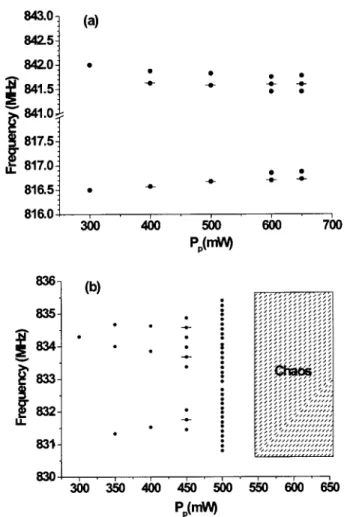
We have plotted in Fig. 7(a) the frequencies of the spec-tral peaks as Pp increases for R⫽ 8.05 cm. At low pump, we had only two peaks, separated by fp, until
Pp⫽ 400 mW, a sideband attributed to frequency beating with relaxation oscillation, appeared in the high-frequency region. To show how the spectrum develops as
Ppincreases, we used a filled circle bisected by a shortline to mark the highest peak in that group of spectral peaks. We found not only that the precession frequency is slightly redshifted but also that the subharmonic of the relaxation oscillation appears as increasing Pp; for in-stance, the frequency spacing of the main peak and its sideband at Pp⫽ 600 mW is half that at Pp⫽ 500 mW. Figure 7(b) shows the bifurcation diagram for
R ⫽ 8.0075 cm, which is closer to the 1/3-degenerate
con-Fig. 6. (a) Precession oscillation and (b) power spectrum at
g1g2⫽ 0.25466 with⫽ 0.95, ⌿ ⫽ 2.78, and Pp⫽ 650 mW.
Fig. 7. Frequency bifurcation plot using Ppas the parameter for (a) R⫽ 8.05 cm and (b) R ⫽ 8.0075 cm.
figuration. As Pp⫽ 350– 400 mW, the difference be-tween the two peaks near 834 MHz approaches the third harmonic of the relaxation oscillation frequency. Each of the three main peaks shows sideband frequencies owing to beating with the relaxation oscillation at
Pp ⫽ 450 mW. Further increasing the pumping, we ob-served increasingly more sidebands caused by beating with the subharmonics of the relaxation oscillation; fi-nally, the laser became chaotic. We believe that either increasing the pumping or tuning the cavity configuration toward the point of degeneration will enhance the gain dynamic effect and will cause subharmonic bifurcation owing to nonlinear gain. A transition from a mechanism that is dominated by beam propagation to one dominated by gain dynamics will result. We can also suppress the diffraction effect by reducing the reflectance; for example, when ⫽ 0.8, the region of chaos becomes wider and far-ther away from degeneration than for ⫽ 0.95.
6. INTERPLAY OF BEAM PROPAGATION
AND GAIN DYNAMIC BIFURCATION
If we maintain proper pump power and scan over the whole range of R in Fig. 5(a) we will obtain instabilities similar to those described in Ref. 7, in which the trans-verse mode spacing varies about g1g2⫽ 1. We can also achieve the results of Fig. 5(a) by using Fig. 6 of Ref. 19 where chaos exists within small ranges of phase differ-ence (which corresponds to R in our case) and round trip loss (or 1 ⫺2).
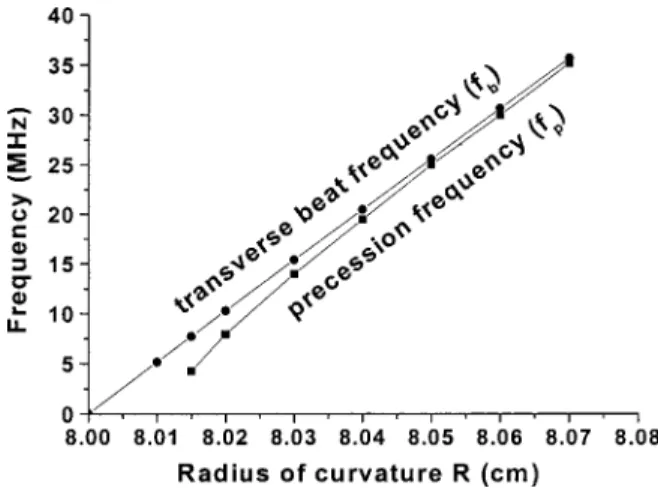
Maintaining Ppat 650 mW, we show in Fig. 8 the trans-verse beat frequency (fb) of the cold cavity and the pre-cession frequency (fp) relative to R for ⫽ 0.95. We have found that the numerical precession frequency nearly equals the transverse beat frequency when the la-ser is propagation dominant as R ⭓ 8.03 cm. Another evidence that propagation- dominant instability is surely governed by the diffraction integral is that the precession frequency is independent of the spontaneous-emission rate or gain. As R is tuned toward the degenerate or the chaotic region, however, precession frequency fp deviates from the transverse beat frequency because the gain dy-namics, like the rate equations, begin to play a crucial role in change of the precession frequency. The gain ap-erture and saturation effects take control of the dynamics when the precession frequency declines to several times the relaxation oscillation frequency as R⬇ 8.01 cm. In Fig. 7(b), for small Pp, two frequencies,⬃834 and ⬃831 MHz, appear to be quasi-periodic, mainly because of beam propagation or diffraction, so their difference is under-stood as fp. The laser has increasingly sideband fre-quencies as a result of period multiplication owing to the nonlinear gain through the rate equations for larger Pp. It seems that the route to chaos close to degeneration is the interplay (or the mixing effect) of the quasi-period and the period multiplied as shown in Fig. 7(b).
We believe that the cavity loss 1 ⫺2is the key factor that differentiates the results of Melnikov et al.1 and Hollinger et al.5,19 from ours. The V-shaped threshold becomes as smooth as Melnikov’s result [Fig. 4(c)] for a high-loss cavity. Hollinger et al. obtained their results
with a high-loss cavity, but they did not investigate how close g1g2should be to 0.5 for the laser output to be quasi-periodic but not to become chaotic,3however, in our good-cavity case the chaotic region becomes narrower and can be close to degeneracy.
7. CONCLUSIONS
Numerically propagating a cavity field through the gener-alized Huygens integral and using the atomic rate equa-tions for a homogeneously broadened gain medium with Gaussian pumping, we obtained propagation-dominant laser instabilities. We have investigated in detail the temporal behavior of the instabilities near the 1/3-degenerate configuration. We determined the quasi-periodic threshold as the cavity was tuned across the de-generate configurations. A laser with a good cavity including a saturated gain medium shows a V-shaped quasi-periodic threshold; however, a high-loss cavity has not a V shape but a smooth monotonic curve. Further-more, the propagation-dominant V-shaped threshold de-pends not only on the resonator configuration but also on the pump size. There is a best value⌿ in a good cavity to produce the lowest-instability pump power. In addition to a quasi-periodic region, we obtained another region of propagation-dominant instability outside the chaotic re-gion near the 1/3-degenerate configuration in the good-cavity conditions. We ascribed this type of instability to the special dependence of the geometrical configuration.
Furthermore, chaos was found in a good cavity close to the 1/3-degenerate configuration. Although the phase shift between adjacent transverse modes in one round trip is irrational multiples of and lies close to 2/3, the laser output can become chaotic in a good cavity under Gaussian pumping. This result is different from the re-sults of Hollinger et al.5,19 We believe that, as the cavity is tuned toward 1/3 degeneration, the beam-propagation-dominant laser dynamics is transformed into an interplay of beam propagation and gain dynamics. Thus the route to chaos close to the degenerate configuration involves the mixing effect of quasi-period- and period-multiplying bi-furcation.
Fig. 8. Transverse beat frequency of the cold cavity and the pre-cession frequency versus R for Ppfixed at 650 mW.
ACKNOWLEDGMENTS
This research was partially supported by the National Science Council (NSC) of the Republic of China under grant NSC89-2112-009-071 and by the Ministry of Educa-tion of the Republic of China under grant 89-E- FA-1-4. C. H. Chen gratefully acknowledges fellowship from the NSC.
W.-F. Hsieh’s e-mail address is [email protected].
REFERENCES
1. L. A. Melnikov, S. A. Tatarkova, and G. N. Tatarkov, ‘‘Non-linear dynamics of beam parameters and intensity in a uni-directional ring laser with a homogeneously broadened line,’’ J. Opt. Soc. Am. B 7, 1286–1292 (1990).
2. A. E. Siegman, Lasers (University Science, Mill Valley, Cali-fornia, 1986), p. 761.
3. F. Hollinger and Chr. Jung, ‘‘Single-longitudinal-mode laser as a discrete dynamical system,’’ J. Opt. Soc. Am. B 2, 218– 225 (1985).
4. R. Hauck, F. Hollinger, and H. Weber, ‘‘Chaotic and periodic emission of high power solid state lasers,’’ Opt. Commun.
47, 141–145 (1983).
5. F. Hollinger, Chr. Jung, and H. Weber, ‘‘Quasiperiodicity versus chaos in high power solid state lasers in multitrans-versal mode operation,’’ Opt. Commun. 75, 84–92 (1990).
6. L. A. Lugiato, F. Prati, L. M. Naducci, P. Ru, J. R. Tredicce, and D. K. Bandy, ‘‘Role of transverse effects in laser insta-bilities,’’ Phys. Rev. A 37, 3847–3866 (1988).
7. L. A. Lugiato, G. L. Oppo, J. R. Tredicce, L. M. Narducci, and M. A. Pernigo, ‘‘Instabilities and spatial complexity in a laser,’’ J. Opt. Soc. Am. B 7, 1019–1033 (1990).
8. G. D’Alessandro and G. L. Oppo, ‘‘Gauss–Laguerre modes:
a ‘sensible’ basis for laser dynamics,’’ Opt. Commun. 88, 130–136 (1992).
9. J. M. Greene, ‘‘A method for determining a stochastic tran-sition,’’ J. Math. Phys. 20, 1183–1201 (1979).
10. M. D. Wei, W. F. Hsieh, and C. C. Sung, ‘‘Dynamics of an optical resonator determined by its iterative map of beam parameters,’’ Opt. Commun. 146, 201–207 (1998).
11. M. D. Wei and W. F. Hsieh, ‘‘Bifurcation of fundamental gaussian modes in Kerr-lens mode-locked lasers,’’ Opt. Commun. 168, 161–166 (1999).
12. M. D. Wei and W. F. Hsieh, ‘‘Cavity configuration dependent nonlinear dynamics in Kerr lens mode-locked lasers,’’ J. Opt. Soc. Am. B 17, 1335–1342 (2000).
13. H. H. Wu and W. F. Hsieh, ‘‘Observations of multipass transverse modes in an axially pumped solid state laser with different fractionally degenerate resonator configura-tions,’’ J. Opt. Soc. Am. B 18, 7–12 (2001).
14. H. H. Wu, C. C. Sheu, T. W. Chen, M. D. Wei, and W. F. Hsieh, ‘‘Observation of power drop and low threshold due to beam waist shrinkage around critical configurations in an end-pumped Nd:YVO4laser,’’ Opt. Commun. 165, 225–229
(1999).
15. C. O. Weiss and R. Vilaseca, Dynamics of Lasers (Wein-heim, New York, 1991), pp. 14, 26.
16. Y. J. Cheng, P. L. Mussche, and A. E. Siegman, ‘‘Cavity de-cay rate and relaxation oscillation frequency in unconven-tional laser cavities,’’ IEEE J. Quantum Electron. 31, 391– 398 (1995).
17. M. Moller, L. M. Hoffer, G. L. Lippi, T. Ackemann, A. Gahl, and W. Lange, ‘‘Fabry–Perot and ring cavity configurations and transverse optical patterns,’’ J. Mod. Opt. 45, 1913– 1926 (1998).
18. M. L. Shih and P. W. Milonni, ‘‘Chaotic two-mode lasing,’’ Opt. Commun. 49, 155–160 (1984).
19. F. Hollinger, Chr. Jung, and H. Weber, ‘‘Simple mathemati-cal model describing multitransversal solid-state lasers,’’ J. Opt. Soc. Am. B 7, 1013–1018 (1990).