1328 OPTICS LETTERS / Vol. 16, No. 17 / September 1, 1991
Buildup of steady-state picosecond pulses
in an actively mode-locked laser-diode array
Jahn-Chung Kuo, C.-S. Chang, and Ci-Ling Pan
Institute of Electro-optical Engineering, National Chiao Tung University, Hsinchu, Taiwan 300, China
Received April 22, 1991
We have studied experimentally the temporal and spectral characteristics of an actively mode-locked laser-diode array in an external cavity as it evolves to the steady state. It is found that the buildup time to steady-state picosecond pulses takes less than 45 round trips. The number of clusters of the longitudinal-mode spectrum reduces during the evolution and finally approaches a steady-state spectral distribution with the pulse energy mainly distributed among a few clusters near the line center.
Much effort has been directed to the study of ac-tively mode-locked semiconductor lasers.`7 Active
mode locking of the laser-diode array has also been reported.8'l0 Most of these studies, however,
con-centrated on the steady-state characteristics, and
relatively less attention has been paid to the tran-sient buildup mechanisms. Using a fast photodiode and the sampling oscilloscope, AuYeung et al.11
observed that an actively mode-locked
double-heterostructure GaAlAs laser took approximately 30 round trips to reach the steady state. Their results, however, were limited by the bandwidth of the de-tection system. In a numerical study, Demokan'2
found that the pulse evolution time of an actively mode-locked GaAlAs/GaAs laser with one perfectly antireflection-coated facet would be =150 round trips. Recently, Blixt and Krotkus'3 showed both
theoretically and experimentally that an actively
mode-locked InGaAsP buried-heterostructure laser diode reached its steady state in 40 to 50 round trips.
In their study the laser diode was biased with
rectangular pulses of different durations. The
pulse duration measured corresponded to an average of the mode-locked pulses from the beginning to the end of the rectangular pulse. As a result, the pulse evolution during the initial stage of the buildup was not known. In this Letter we report what are to our
knowledge the first results on the evolution to
the steady state of the pulse widths and the
cor-responding spectra of an actively mode-locked
laser-diode array in an external cavity by time-gating
techniques.
A block diagram of our experimental setup is
shown in Fig. 1. We used a commercial 10-stripe phase-locked laser-diode array (Spectral Diode Lab-oratories SDL-2419C, A = 0.81 gm) as the gain medium. It had a high-reflectivity coating of 95% on the back facet and an antireflection coating of -0.1% reflectivity on the front facet. A 20x, 0.5-N.A. microscope objective lens and a cylindrical lens
(f = 150 mm) imaged the antireflection-coated
facet of the laser-diode chip onto an output mirror(R = 40%). The laser was dc biased at 250 mA
(Ith = 260 mA) and injected simultaneously with a
rf sinusoidal modulation signal of as much as 1 W at 433 MHz. To minimize the optical pulse width,
the frequency of the rf modulation signal was
slightly detuned below the frequency matched to the external-cavity round-trip time. A train of stable single pulses with a FWHM of 45 ps, assuming Gaussian pulse shapes, could be routinely obtained. The average output power was 15 mW In order to
investigate the transient behavior of the actively
mode-locked laser-diode array, the rf sinusoidal sig-nal was chopped by a fast microwave P-I-N diode switch (Hewlett-Packard 33144A). The output of the P-I-N switch was a 433-MHz signal that had a square envelope with a repetition rate of 0.5 MHz, a duty cycle of 50%, and a rise time of 30 ns. The laser output was fed to a noncollinear autocorrelator or a monochromator and detected by a gatable photo-multiplier tube (PMT) with a gate width of 10 ns. A boxcar integrator with a 50-ns gate was used for sig-nal averaging. By delaying these two synchronous gates with respect to the onset of diode-laser action, we can sample the temporal and spectral character-istics of the laser as it evolves to the steady state.
Figure 2 illustrates the pulse widths of the actively mode-locked external-cavity laser-diode array as a function of delay time. Zero delay time corre-sponded to the onset of diode-laser action. A typical autocorrelation trace iof a steady-state mode-locked pulse is shown in the inset of Fig. 2. The buildup can be qualitatively described as follows: Since the dc bias was below the threshold, initially there was only spontaneous emission inside the cavity. As the P-I-N diode switch was turned on, a sinusoidal signal superimposed onto the dc bias was also injected into the laser-diode array. A train of weakly modulated optical pulses would appear. As these weak pulses circulated inside the cavity, the central regions of the pulses would experience more gain than their wings. As a result, the pulse shapes sharpened as
the pulse energies built up. During the first 40 ns, the pulse width shortened quickly and approached the steady state in approximately 100 ns. This
cor-responded to 45 round trips. The laser output
power reached the steady state at the same time.
September 1, 1991 / Vol. 16, No. 17 / OPTICS LETTERS 1329
Fig. 1. Block diagram of the experimental arrangement. PMT, photomultiplier tube; amp., amplifier.
210 190 170 150 130 110 90 70 so -20 0
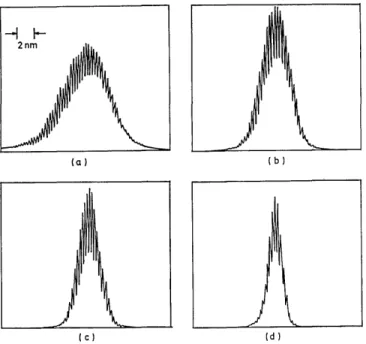
The FWHM of the corresponding spectra as a function of the delay time is shown in Fig. 3. Intu-itively one would expect the spectra to broaden as the laser pulse shortens and approaches the steady state. It was observed instead that the bandwidth of the spectrum also narrowed quickly during the initial stage of the buildup (=40 ns) and then reached a steady state in approximately 100 ns. Figure 4 shows a series of spectra that correspond to the points labeled (a)-(d) in Fig. 3. The spacing of the clusters of longitudinal modes of the chip cavity was -0.3 nm, corresponding to a chip length of 250 ,m with a group velocity of c/4.3. It should be noted that the average spectra of the laser output consist of multiple clusters, and the number of clusters was re-duced as the pulse widths narrowed. This can be explained by the following: Numerical studies by Garside and Kempf6 have shown that multiple re-flections between the two facets of the chip would still be present even if the residual reflectivity of
E .5 E LL P to 20 40 60 80 100 120 140 160 180 200 220 240 260 280
delay time ( nsec )
Fig. 2. Pulse width as a function of the delay time from the onset of laser-diode array action. The inset shows an autocorrelation trace of the steady-state laser pulse.
This is consistent with the observation of Blixt and Krotkus."3 An overshoot behavior at the beginning of the buildup was also observed. Since our P-I-N diode switch had a rise time of 30 ns, the actual buildup time to the steady state of our test laser should be shorter than 45 round trips. This result was somewhat shorter than those reported in previ-ous studies (Refs. 12 and 13) for solitary laser diodes at 0.83 and 1.3 gum, respectively. Buildup of optical
pulses in mode-locked lasers with other types of
gain medium takes even more round trips. For a passive colliding-pulse mode-locked ring Rhodamine
110/HICI
dye laser, Williams et al.14 reported thatthe pulse widths and the corresponding spectra
evolved to the steady state in approximately 12.5 As, which corresponds to 1300 round trips. We have
also measured a buildup time of =15 ,s, i.e.,
approximately 1500 round trips, for a Rhodamine 6G/DODCI colliding-pulse mode-locked laser sys-tem.'5 Using a mode-locked argon-ion laser to
syn-chronously pump the Rhodamine 6G dye laser,
Kasinski et al."6 found that the buildup time to steady-state picosecond pulses took approximately 10 is, i.e., 800 round trips. A recent study on an additive-pulse mode-locked Ti:A1203 laser showed
that ultrashort mode-locked pulses evolved from
mode-beating intensity fluctuations in
approxi-mately 200 As, or 16,000 round trips.'7
-20 0 20 40 60 80 100 120 140 160 180 200 220 240 260 280
delay time ( nsec )
Fig. 3. The FWHM of the laser spectrum as a function of the delay time.
(a) (b)
(c) (d)
Fig. 4. Actual spectra of the laser at points labeled
(a)-(d) in Fig. 3. 0I1 II
~~~~~~~~52
psec 0 .... .~4 - - 0 - 4 - X 4 - - - 4 4 - 4 4 4 4 - -e - 4 4 - - 4 10 9 8 7 6 ( 5 3 * (c) 2 . .__w ._ ._._._. . .(d . 21330 OPTICS LETTERS / Vol. 16, No. 17 / September 1, 1991
the diode facet facing the external-cavity mirror
were low. This effect gave rise to a laser output spectrum that exhibited multiple clusters. During the initial stage of the pulse formation, the unlocked
spectrum translated into random fast fluctuations
in time and longer pulse durations, and several
diode chip cavity modes would build up. After a
few round trips, the pulse shapes monotonously
shortened and cleaned up. At the same time, the number of clusters in the spectrum would also de-crease owing to the effect of competition among the clusters in a homogeneous broadened medium. Fi-nally, the pulses approached the steady state with the energy of the entire pulse distributed among a few clusters of the longitudinal modes of the chip cavity near the line center. During the pulse evolu-tion, the pulse durations gradually narrowed, and we expect the bandwidth of each of the clusters to also broaden. Owing to the resolution limitation of our monochromator, however, we did not measure the variations of cluster bandwidth as a function of
the delay time at this time.
In summary, we have presented detailed data on the temporal and spectral evolution of picosecond pulses generated by an actively mode-locked laser-diode array in an external cavity. The buildup to the steady state takes approximately 45 round trips, if we neglect the rise time of the P-I-N diode switch. The number of clusters of the longitudinal-mode spectrum reduces during the evolution and finally approaches a steady-state spectral distribution with the pulse energy mainly distributed among a few clusters near the line center. This is a manifesta-tion of homogeneous broadening. Initially, the lon-gitudinal modes are unlocked, and random and fast fluctuations in time correspond to a broad output spectrum. As the pulses clean up, the spectrum narrows. At the same time, the pulse width also approaches its steady-state value.
This research was partially supported by the
National Science Council of the Republic of China
under grants 0417-E009-05 and
NSC80-0417-E009-17. The authors thank the reviewer for valuable comments.
References
1. S. W Corzine, J. E. Bowers, G. Przybylek, U. Koren,
B. I. Miller, and C. E. Soccolich, Appl. Phys. Lett. 52,
348 (1988).
2. P. T. Ho, L. A. Glasser, E. P. Ippen, and H. A. Haus, Appl. Phys. Lett. 33, 241 (1978).
3. J. P. van der Ziel, J. Appl. Phys. 52, 4435 (1981). 4. J. C. AuYeung, IEEE J. Quantum Electron. QE-17,
398 (1981).
5. J. C. Goodwin and B. K. Garside, IEEE J. Quantum
Electron. QE-19, 1068 (1983).
6. B. K. Garside and P. Kempf, Appl. Opt. 25, 3846
(1986).
7. J. E. Bowers, P. A. Morton, A. Mar, and S. W Corzine,
IEEE J. Quantum Electron. 25, 1426 (1989).
8. J. P. van der Ziel, H. Temkin, R. D. Dupuis, and R. M.
Mikulyak, Appl. Phys. Lett. 44, 357 (1984).
9. L. G. Joneckis and R-T. Ho, in Digest of Conference
on Lasers and Electro-Optics
(Optical Society of
America, Washington, D.C., 1988), paper WM4.
10. H. Masuda and A. Takada, Electron. Lett. 25, 1418
(1989).
11. J. C. AuYeung, L. A. Bergman, and A. R. Johnson, Appl. Phys. Lett. 41, 124 (1982).
12. M. S. Demokan, Int. J. Electron. 60, 67 (1986).
13. P. Blixt and A. Krotkus, Opt. Quantum Electron. 22,
561 (1990).
14. J. A. R. Williams, P. M. W French, and J. R. Taylor,
IEEE J. Quantum Electron. 26, 1434 (1990).
15. J. C. Kuo and C. L. Pan, Opt. Lett. 15, 1297 (1990).
16. J. J. Kasinski, L. A. Gomez-Jahn, R. J. Dwayne
Miller, P. Geist, B. Geoffroy, R Heisel, A. Martz, and J. A. Miehe, J. Opt. Soc. Am. B 3, 1566 (1986).
17. J. Goodberlet, J. Wang, J. G. Fujimoto, and P. A.