CHINESE JOURNAL OF PHYSICS VOL. 32, NO. 1 FEBRUARY 1994
Polarization Correlations of Radiation from Electron-Impact Excited Atoms
Wen-Yu Cheng
Department of Physics, National Taiwan University, Taipei, Taiwan 106, R.O.C.
Keh-Ning Huang
Institute of Atomic and Molecular Sciences, Academia Sinica, Taipei, Taiwan 106, R.O.C.
and Department of Physics, National Taiwan University, Taipei, Taiwan 106, R.O.C.
(Received November 3, 1993; revised manuscript received November 27, 1993)
A kinematic analysis of radiation from atoms or ions after electron-impact excita-tion is carried out in a relativistic framework. The polarizaexcita-tion state of the radiaexcita-tion is related to that of the incident electron by considering rotation and parity symme-tries. Kinematic formulas for angular distribution and polarization of the radiation are presented in terms of angle-independent dynamic parameters. These dynamic pa-rameters are given as linear sums of reduced matrix elements suitable for numerical computation. All electromagnetic multipole amplitudes are included in the calculation. Physical interpretations of the five independent dynamic parameters in the electric dipole approximation are given.
PACS. 34.80.D~ - Atomic excitation and ionization by electron impact. PACS. 32.50.+d - Fluorescence, phosphorescence (inc. quenching).
I . I N T R O D U C T I O N
Studies of correlations in electron-atom collisions can provide much valuable
infor-mation about the collision dynamics. Using polarized electron beam as a probe, we can investigate atomic structures by studying the angular distribution and polarization of the scattered electron or the emitted photon. An excellent discussion of the scattering of po-larized electrons has been given [l] and the spin effects in inelastic electron-atom collisions have been reviewed [2]. For heavy atoms or ions, relativistic effects are important and should be taken into account. A relativistic theory of electron-atom scatterings has been reported for polarized incident electrons on unpolarized target atoms [3-51.
6 5 @ 1994 THE PHYSICAL SOCIETY OF THE REPUBLIC OF CHINA
66 POLARIZATIOK CORRELATIONS OF RADIATION FROM . . VOL. 31
More detailed information is available by measuring the scattered electron in coinci-dence with the emitted photon. A review of electron-photon angular correlations has been reported (61. A theory of electron-photon coincidence with polarized electrons was given [7]. Electron-impact excitations of mercury [8,9] and magnesium [lo] have been studied by electron-photon coincidence techniques. Light polarizations in mercury [11,12] and in cesium [13] after impact excitation by polarized electrons have been measured.
In this paper, we will treat the radiative de-excitation process [14,15] of the target atom or ion after electron-impact excitation. It is useful to separate the kinematics and dynamics of the collision processes in the application of various dynamic theories. A kine-matic analysis of radiation from atoms or ions after electron-impact excitation is carried out in a relativistic framework. The procedure is similar to that for the treatment of ra-diation after photoexcitation [14]. A formal scattering theory is given in Sec. II in terms of density matrices and a symmetry analysis is carried out in Sec. III. In Sec. IV, general formulas for angular distribution and polarization of the radiation are presented in terms of angle-independent dynamic parameters. The electric dipole transition is discussed in Sec. V as a special case. Finally we make a conclusion in Sec. VI.
I I . F O R M A L S C A T T E R I N G T H E O R Y
We shall consider the angular distribution and polarization of radiation emitted by an atom or ion after excitation by a polarized electron. The excitation and subsequent radiative de-excitation are treated as two independent processes. We consider first the electron-impact excitation in Sec. II-1 and the radiative de-excitation in Sec. 11-2.
I I - l . E l e c t r o n - i m p a c t e x c i t a t i o n
The relativistic wave equation for the composite system of an incident electron and an N-electron target is assumed to be
HN+1p >= Ep4 >,
where the (N + 1)-electron Hamiltonian is given in atomic units by
(24
l&v+1 =
HZ +
i7; +v.
(2.2)
Here the Hamiltonian of the target atom or ion is
Hc =
g(-iCGi * +i +
C2pi -
Z/T;) +E
l/r;j,(2.3)
i=l j>i=l
and the Hamiltonian of the incident electron in the long-range Coulomb potential of the target is
VOL.31 WEN-YU CHENGAND KEH-NING HUANG 67
HE = -icf_=i!‘o*
To +
c2po -
(2 - q/n).(2.4)
The interaction Hamiltonian is given by
v =
-N/To +
5
l,roj, (2.5)j=l
which is a short-range potential. In the the above equations, c is the speed of light, 2 is the charge of the nucleus, and Gi and ,Bi denote the Dirac matrices of electron i.
Now we consider a collision process of the type
e- + A(o) + e- + A(cr), (2.6)
in which an electron with linear momentum Zi and helicity pi is incident upon a target atom or ion A in the eigenstate with angular momentum Jo and energy We. After the collision, a scattered electron with linear momentum & emerges, and the target is left in the eigenstate with angular momentum J, and energy IVa. From energy conservation we have
E=Ei+Wo=E,+Wo, (2.7)
where E; and E, are the energies of the incident and scattered electrons, respectively. The wave function of an eigenstate of the total Hamiltonian is given asymptotically by
w h e r e ya = (2 - iV)E,/(c’k,),~ = I?‘,o[, and ? = 70//7~[. Here the subscript i in /!I? > and 14: > refers to the initial state, and the superscript “+” indicates that they satisfy the outgoing-wave boundary condition. The second term on the right-hand side of (2.8) contains contributions at infinity from all atomic states corresponding to open channels, for which E, 2 c2. The logarithmic phase factors are included to take care of the distortion by the Coulomb field of the target ion and vanish for a neutral target atom. The scattering amplitude for the inelastic collision is given in post form by
where the superscript “-” indicates the incoming-wave boundary condition
IdG >
r.m
eiy, ln(k,r-&.r’) 5I
cdo+~
e-iya In2k,r
T I- ?k,/L’, > j;,&; 4,(2.10)
68 POLARIZATION CORRELATIONS OF RADIATION FROM VOL. 31
where fLapIJ&; k,) is the Coulomb scattering amplitude and contributes for elastic scat-terings only. The differential cross section for the scattering is given by
(2.11) where vi = c’ki/Ei is the velocity of the incident electron, and w, that of the scattered electron. The total cross section is obtained by integrating over all scattering angles.
We now consider the collision process in which a polarized electron with density matrix p+ impinges on an unpolarized target atom which has initially a well-defined angular momentum Jo and is excited to states of angular momentum J,. If the angular distribution and polarization of the scattered electron are not observed, the density matrices of the incident electron and the excited target are related by
where the interaction matrix is defined as
Here we have defined the transition amplitude
It is convenient to describe a polarized atom by state multipoles defined as
(2.14)
(2.15)
where [I] = (2Z + Z)‘i2, and we have made use of the 3 - jm coefficients [16,17]. In terms of state multipoles, we may rewrite (2.12) as
where we have introduced the coupled interaction matrix
(2.16)
VOL.31 WEN-YUCHENGANDKEH-NINGHUANG 69
11-2. Radiative de-excitation
The excited atom will de-excite by radiative or Auger transitions. Here we are interested in the radiative de-excitation
44 + 44 + 7, (2.18)
in which an atom or ion A is initially in the excited state ]J,M, > and makes the transition to a lower-energy state ]J,Ma > by radiating one photon 7. The angular distribution and polarization of the emitted photon can be measured. The transition amplitude of the spontaneous photon emission at time t after the excitation can be written in the Coulomb gauge as
where w = kc is the angular frequency of the emitted photon, N is the total number of electrons in the target atom, & denote the Dirac matrices of the n-th electron, 2~~ denotes the linear helicity state [14] of the vector potential, Ed and 7a are the energy eigenvalue and decay constant, respectively, of the excited atomic state IJaMa >. The time-dependent exponential factor characterizes the time evolution of the excited state I J,M, >. Because
we start from a relativistic formulation, all fine structures of the atomic spectrum are built in from the outset. If the excited atomic ensemble has a sufficiently long lifetime such that the electrons can couple with the nucleus through hyperfine interactions, the coupled electronic and nuclear state would be specified by I( J&FM > in place of 1 J&f, >, where
F is the total angular momentum of the combined electronic and nuclear system. If the de-excited target has a well-defined angular momentum J,, the density matrix of the emitted photon is then related to that of the excited target by the relation
pqlq =
c c
hm(q’q;
J:, Ja)Qlm( J: Jo>,lm .JbJa
(2.20)
where the coupled interaction matrix of the radiative de-excitation is defined as rirn(dq; J& Ja)
70 POLARIZATIOIK CORRELATIONS OF RADIATION FROM . . VOL. 31
III. SYMMETRY ANALYSIS
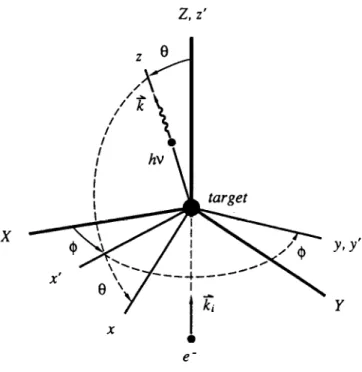
Assume all interactions involved during the collision are invariant under rotations and space inversion. This guarantees that the interaction matrix is invariant under rotations and mirror reflections. The incident direction ki of the electron and the emitting direction k of the photon span the scattering plane, and the angle between them is 8. It suffices to define two coordinate frames (zyz) and (z’y’z’) as shown in Fig. 1, where the two z-axes are in the k and & directions, respectively, and their common y-axis is normal to the scattering plane. In the (z’y’z’) frame, (2.16) is written explicitly as
where 5’ indicates the direction of the quantization axis. In the (z~z) frame, (2.20) is written as
(3.2)
III-l. Rotation symmetry
Under a rotation through angle q about the z/-axis, PP:P* +
e
-WPt)vp,~,;,QIM(JLJ&;
2’) -+
e-‘-QIM(J;Ja;2’).
So for interactions invariant under rotations about the Y-axis, we have
Consequently, it follows
QdJ:J,; 2’) = 4s (J;Jo;*; F ;) P+;.
Similarly, we haveh&k J;Jo> = 6,(,1-,)1~(4,-9)(q’q; J;Jcx>,
and(3.5)
(3.6)
(3.7)
(3.8)
VOL.31 WEN-YUCHENGANDKEH-NINGHUANG 71
e-FIG. 1. Geometric relationships between the three coordinate frames (zyz), (z’y’z’), and (XYZ).
P*1*1 =
c
c
bo(flzt
1; J:J,)QIo(J:J~;i),
(3.9)
1 J;J,
PH~I =
c
c
hz(fl
T 1; J~Ja)Q~~~(J;J,;2).
(3.10) 1 J&J‘,The state multipoles in the two frames are related by
Q~rn(JhJa; 2) =
c
(I- &I)
[QIM(J;Ja;i’)&,,#)
M>O+(
-)“+m
QLM(JLJ~;i’)dh_,(6)].
(3.11)
111-2. Rotation and space inversion symmetry
Under the mirror reflection with respect to the z/z’-plane, we have
lz+i > ;r+ (-)k-fii[& - pi >it, (3.12)
lJa& >ij+ xa(-)Ja-MaIJa - Ad, >it, (3.13)
where the notation 7r, denotes the parity of the atomic state 1 JaMa >. So for interactions invariant under rotations and space inversion, it can be shown
7 2 POLARIZATIOK CORRELATIONS OF RADIATION FROM . . VOL. 31
~~(,:-,i)(J~J,;~:lli) =
“a’“a(-)‘~~_(~:_~i)(J~J,; -p: -
Pi).
(3.14) By adopting the normalization conditionPf$ +p_;_+ = 1, (3.15)
we can write the three components of the polarization vector P of the incident electron in the (z’y’z’) frame as
Pd =
Pf_f+ p-g,
&I = i(P$_$ - P_U), p,t = P$f
- p+:.
Define the spherical components of the polarization vector P’ by
P& = +$Pzf f iPy’), PA = Pp. (3.16) (3.17) (3.18) (3.19) (3.20) We have therefore
pi1 = rJZp+,:,
(3.21) PA = Pfr$ - P_f_f. (3.22)Substituting (3.15), (3.21), and (3.22) into (3.6) and (3.7) and making use of (3.14), we obtain
Qlo(J;Ja;
2’) = q/o(J:Ja; i’)(~+ + w-P;>,
(3.23)QdJ:Ja; 2’) = m(J:Ja; i’)j+,
(3.24)Q,-,(J;J,;
2’) = -qll(J;J,;
+s,or,(-)‘I’;,
Jz
where
(3.25)
4lo(J;JJa 2’) =
IlO
(JkJo;
;;) ,
(3.26)VOL. 31 WEN-YU CHENGAND KEH-NING HUANG 73
It is also convenient to define the quantities
Q[j$ ’ = Q&J;.&; i’) f K~~K,(-)‘-~Q~_~(J~J(; i’), which is given explicitly by
Q
jo+)
’ = qlo( J,!& ,?‘)27r+, Qi,’ ’ = qlo( J;Ja; i’)2~ P,, ,Q{:” = -q&J,; i’)iP,,,
Q[;’ ’ = q&J,; i’)P+
Under the mirror reflection with respect to the x’z’ plane, we have
(3.28) (3.29) (3.30) (3.31) (3.32) (3.33) Px’ + -Px’7 (3.34) PyI + Py’, (3.35) P2’ + - Pz’7 (3.36)
qL&&L; 2’) + GV&Ja; i’), (3.37)
where the last symmetry relation can be seen from (3.14). Consequently we have
Qgj' +
kQ$‘. (3.38)The differential intensity and Stokes parameters of the emitted photon is defined as
dI z = Pll + p-1-1, (3.39) sx = h-1 + P-1l)/(Pll+ P - l - l ) , % = W-1- P-1lMPll +p-l-l), s= = h- P-l-lMPl1 +p-l-l). Similar to (3.14), we have
$!$-,)(&L JLL> = K,rKa(-)lI~_(q’--q)(-q’ - q; J&).
(3.40) (3.41) (3.42)
(3.43)
74 POLARIZATION CORRELATIONS OF RADIATION FROM . VOL. 31
By substituting (3.9) and (3.10) into (3.39)-(3.42) and making use of (3.43), we obtain
(3.45)
(3.46)
where we have defined the short-handed notations
(3.49)
The linear combinations of state multipoles in the two coordinate frames are now related by
Q::'= c (
1 -fbm)
Qinfi! ‘[&,(8) f WL(-)‘-“&-,(e)],
(3.50)M>O
where the unprimed Qi:’ and the primed Q[,$)’ refer to the (zyz) and (z’y’z’) coordinate frames, respectively.
IV. ANGULAR DISTRIBUTION FUNCTION AND STOKES PARAMETERS
It is convenient to introduce the angular distribution function F(i) as
dl
LF(i), dR = 47r
where I is the total intensity I = dig. J
w
(4.2)
/ hVOL.31 MEN-YU CHENG AND KEH-NING HUANG 75
Substituting (3.30)-(3.33), (3.50) and (4.1) into (3.44)-(3.47), we have
m =
a+bPg,(4.3)
&F(i) = c + dP,t,
(44
S,J’ik) = eP,t + fP,,,
(4.5)&F(k) = gPzl + hP,t,
(4.6)
where the eight functions of the polar angle 0 are defined as
c =
c
to&(e),
(4.9)
.
122 e = C773&2(% 122 (4.11) f = ~[-~2142(e) + rlll4-2(U, 112 (4.12) (4.13) (4.14)In Eqs. (4.7)-(4.14), the eight classes of angle-independent dynamic parameters are given by (+I PO1 =
c
Nlf&JJ), (4.15) Jh Ja (+I p2, = -ic
Nl(J:JJ), (4.16) J:, Jm I’-76 POLARIZATION CORRELATIONS OF RADIATION FROM VOL. 31
(+I
to1 =
c
No(J~J, -
I>,
(4.17)J; Ja (4.18) (4.19) t-1 7731 = i C Nlo(J&J, - l), (4.20) J; Ja t-1
Cl1 =
c
N&J&l), (4.21) Jh Jo t-1 (31 = c 4o(Jm), (4.22) J; Jawhere the superscripts (*) in the summation of Eqs. (4.15)-(4.22) denote the parity selec-tion rule
(6) E 1, when ?T,I?T,(--)I = fl,
0, when ~~!7;~(-)’ = ~1, (4.23)
and the coefficients are
(4.25)
The explicit expressions of Kl(J,!J,q) and qIM(JAJol; 2’) can be evaluated expediently by a graphical method [17] as
qIM(J;Jo; 2’) = C C C(_)r+Jo+J’+J+Jb+j~+l/2~~[JIJ][j:ji]
J ’ J k:k, k,
x { ; ;; i. } { $ $ ;a } b,+ilr(ir’a).
VOL.31 WEN-YUCHENGAND KEH-NINGHUANG 77 l{,(JAJaq) =
C(_)Ja+Jb+i~Ij’jl[il
j’j (4.27) ‘I 3 j 1 -1 q l-q d;,d,G~( J; Jo; t>, where (4.28) (4.29)The reduced matrix element for the electron-impact excitation of an atom is defined as
D,, = il~-l”
p*a
-2,< ~~~J~)J’~~V~~(K~J~)J’+ >, (4.30)
where urc! a n d u+, are the relativistic Coulomb phase shifts for the incident and scattered electrons: respectively, and I(K: Jo) J/M’+ > is the coupled total angular-momentum eigen-state of the combined system, which contains incoming spherical Couloumb waves only in the initial channel. The reduced matrix element for photoabsorption of an atom is defined as
d,, = --& [qda,t”j’) + id?‘)] , (4.31)
where the reduced matrix elements for electric and magnetic multipole transitions are
@‘fj’) = _ cx’
(4.32)
(4.33)
In Eq. (4.27), the time evolution between the excitation and de-excitation is charac-terized by the time-dependent factor
where W,I, and 7=la are given by
78 POLARIZATION CORRELATIONS OF RADIATION FROM . VOL. 31
Ya’a =
(Y:, +
Yew
(4.36)If the hyperfine interaction with the nuclear spin is also important, the time-evolution factor becomes
(4.37)
The polarization vector can be expressed in a fixed frame (XYZ), related to the frame (z’y’z’) by a rotation of angle 4 with respect to the common Z-axis. The geometric relationships among the three coordinate frames, (zyz), (z’y’z’), and (XYZ), are shown in Fig. 1; the transformations among their components are given in Appendix A. In terms of (Px, Py , Pz), we may rewrite (4.3)-(4.6) as
F(6,4) = a + b(Py cos 4 - Px sin 4), (4.38)
SZF(~,~) = c + d(Py cos 4 - Px sin 4), (4.39)
S&e, 4) =
epz +
f(Px ~0s4 +
rt sin
+),
(4.40)S,F(B, 4) = gPz + h(Px cos 4 + Py sin 4). (4.41)
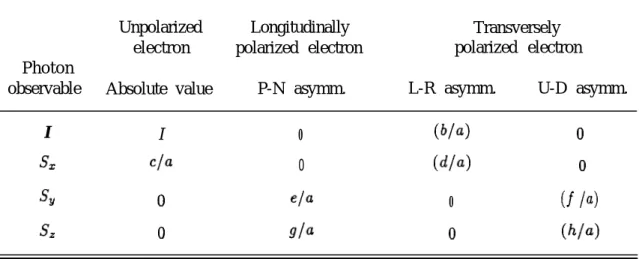
The anglar distribution function F(B, 4) is a function of the angles 8 and q5 which specify the direction of linear momentum k of the emitted photon in the (XYZ) coordinate frame as shown in Fig. 1. The eight coefficients a, b,c,d,e, f,g, and h given in (4.7)-(4.14) are functions of the polar angle 8. Their physical meanings are given in Table I, where various asymmetry parameters are defined in Appendix B. From Table I, we see that for measuring the left-right asymmetry parameters (L-R asymm.) of I, SZ, S,, and S, it sufficies to choose 4 = 0, such that the emitted photon lies on the X2-plane. When up-down asymmetry parameters (U-D asymm.) are measured, we choose 4 = n/2, i.e., the emitted photon lies on the YZ-plane. We shall adopt these conventions hereafter, and therefore Table I reduces to Table II. For an unpolarized incident electron beam, only I and S, exist, and all asymmetry parameters vanish, which can be seen from (4.38)-(4.41). For a longitudinally polarized electron beam, the positive-negative asymmetry parameters (P-N asymm.) of S, and S, can be measured, while for a transversely polarized electron beam, either the left-right or up-down asymmetries can be measured.
V . E L E C T R I C D I P O L E T R A N S I T I O N
The measured intensity of radiation from target atoms or ions after electron-impact excitation is a gross sum of all possible multipole contributions. Nevertheless, the electric
VOL. 31 WEN-YU CHENG AND KEH-NING HUANG 79
TABLE I. Asymmetry parameters with (8,4)-dependence for radiation from atoms after electron-impact excitation.
Unpolarized Longitudinally Transversely
electron polarized electron polarized electron Photon
observable Absolute value P-N asymm. L-R asymm. U-D asymm.
I I
sz
c/a
%I
0S*
0 0 0e/a
s/a
(b/4
~0s(b
0(d/a)
~0s4
0 0 (fl+W 0 (h/a) sin 4TABLE II. Asymmetry parameters with &dependence for radiation from atoms after elec-tron-impact excitation.
Unpolarized Longitudinally Transversely
electron polarized electron polarized electron Photon
observable Absolute value P-N asymm. L-R asymm. U-D asymm.
I I 0
w-4
0SZ
c/a
0(d/a)
0SY
0e/a
0 (f14
S*
0da
0v-44
dipole amplitude dominates in the long wavelength region, when allowed by selection rules. Besides, it may be the only possible transition under certain circumstances. Consequently, it is desirable to examine the electric dipole transition for which the rank of electromagnetic multipole is j’ = j = 1, and the ranks of state multipoles are 1 = 0, 1, and 2. Because the parity of the electric dipole field is odd, the parity of the excited atomic state must be opposite to that of the final atomic state, i.e., X,I = 7ra = -K,. Therefore the parity
80 POLARIZATION CORRELATIONS OF RADIATION FROM . VOL. 31
W = {
1, when 1 is even (odd) for + (-),
0, when 1 is odd (even) for + (-). (54
By making use of the relation
K*(J& - 1) = AX&J~J,l), (5.2)
and writing out the d-functions explicitly, the angular functions in (4.7)-(4.14) reduce in the electric dipole approximation to
selection rule (4.23) reduces to
a = 1 + $3 cos2 6 - l), b = -JsinOcos8, c = !/I sin2 8, 2 d = [sinecos8, e = 0, f = -[sine, g = ccOse, (5.3) (5.4) (5.5) (5.6) (5.7) (5.8) (5.9)
h=-JZ
L6sint?,where we have defined the parameters P = PO27
I = 122,
6 = Cll, c = c31+
Making use of the constraints
(5.10) (5.11) (5.12) (5.13) (5.14) (5.15) (5.16)
VOL. 31 WEN-YU CHENGAND KEH-NING HUANG 81
we can deduce the following kinematic relations:
t2 + b2/2
5(1 t
P>(l - V),
(5.17)c2
I(1 t P)“.
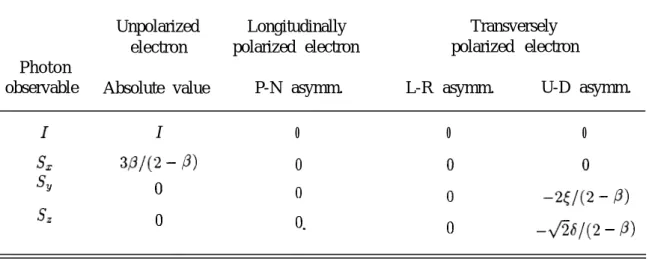
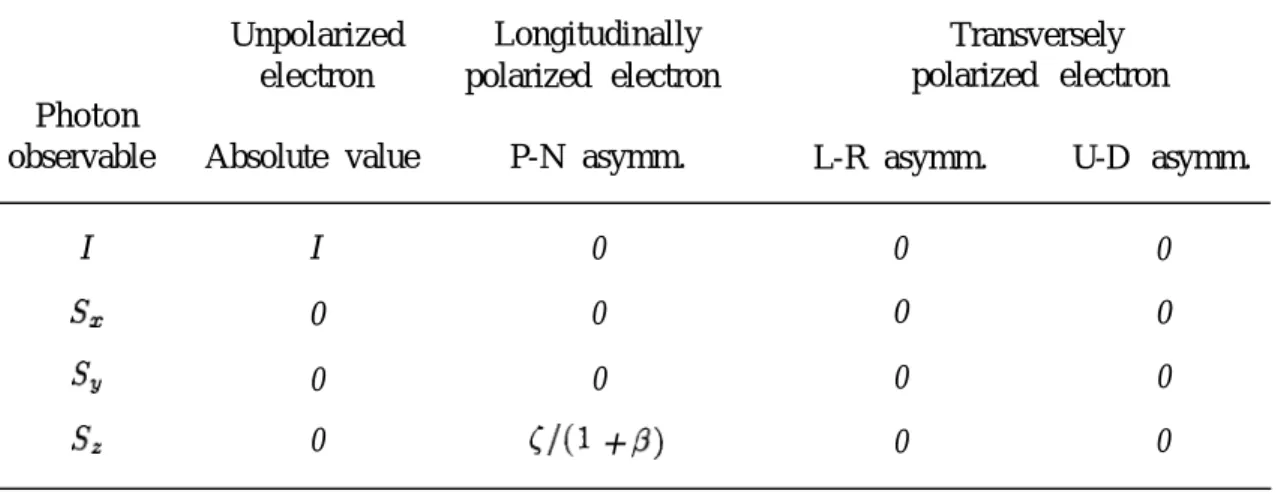
(5.18)When the equality in (5.16) holds, the polarization of the emitted photon is in a pure state. There are three possible situations when this condition is fulfilled. The first is when the equality in (5.17) holds, and the photon is measured in the direction transverse to that of the polarization vector of the incident electron, the second is when the equality in (5.18) holds and the photon is measured in the forward direction, and the last is when p = -1, which implies [ = S = c = 0, and in this case the photons emitted in any directions are all in pure states. The physical meanings of these dynamic parameters are given in Table III for photons emitted in the transverse direction (0 = 7r/2) and in Table IV for the forward direction (0 = 0). This provides a possible set of complete measurement of the five dynamic parameters: the absolute value of S,, the up-down asymmetry parameter of S, and S, in the transverse direction, the positive-negative asymmetry parameter of S, in the forward direction, and the total intensity I.
It is interesting to note that for the electric dipole transition
d = -b, (5.18)
e = 0. (5.19)
TABLE III. Asymmetry parameters at 0 = r/2 in the electric dipole approximation.
Unpolarized Longitudinally Transversely
electron polarized electron polarized electron Photon
observable Absolute value P-N asymm. L-R asymm. U-D asymm.
I I 0 0 0
SC
3/J/(2 - /?
0 0 0%I
0 0 0-2m -
P>
SZ
0 0. 04%5/p -
P>
82 POLARIZATION CORRELATIONS OF RADIATION FROM . . VOL. 31
TABLE IV. Asymmetry parameters at 8 = 0 in the electric dipole approximation.
Unpolarized Longitudinally Transversely
electron polarized electron polarized electron Photon
observable Absolute value P-N asymm. L-R asymm. U-D asymm.
I I 0 0 0
SZ 0 0 0 0
$4 0 0 0 0
SZ 0 C/(1 + P) 0 0
This offers tests of the validity of the electric dipole approximation. The violation of these conditions implies that the effects of higher multipole transitions are significant. From Table I, this violation occurs either when the left-right asymmetry parameters of I and S, are not equal in magnitude and opposite in sign or when the positive-negative asymmetry parameter of S, does not vanish. For a generally polarized target, nine independent parameters are needed to completely specify their polarization states up to the state multipole 1 = 2. For instance, by coincident measurement of the scattered electron with the emitted photon after electron-impact excitation, the nine components can be determined completely. However, when only the emitted photon is observed, the components of the state multipoles can take only the values M = 0, 1, or -1, so that the components (1M) = (22) and (2-2) are forbidden. Besides, from Eqs. (3.24) and (3.25), we note that the two components (IM) = (11) and (l-l) are dependent, similarly for (1.M) = (21) and (2-l). C onsequently, we are left with five independent dynamic parameters: I, C, 6, p and t; the first results from the state multipole
1 = 0, the next two from 1 = 1, and the last two from 1 = 2 of the excited atomic state:
d~d,Go(J,J,;t)qoo(JcrJcr; i’),
.d~,cl,G1(J~J,;t)qlo(J~J,; i’),
(5.20)
(5.21)
VOL.31 WEN-YUCHENGANDKEH-NINGHUANG I= -’ c(_)Ja+J:,&cw J:, Ja where 83 (5.22) (5.23) (5.24) C, = 7re2w/c. (5.25)
In order to obtain the five parameters in one experiment, the incident electron must
. possess both transverse and longitudinal polarization components, and the angular distri-bution and the degree of circular polarization of the radiation must be measured. If the electron is transversely polarized, we can obtain at most four parameters; while three for longitudinally polarized electron and two for unpolarized electron. When the polarization of the radiation is not measured, we can obtain at most three parameters. So it is clear that polarization analyses enhance our knowledge on the collision process and reveal much valuable information about the collision dynamics.
V I . C O N C L U S I O N S
We have carried out a kinematic analysis of radiation from targets after excitation by incident spin-l/2 particles. The projectile can be any spin-l/2 particle (e.g., electron, positron, muon, etc.), the target is a bound system composed of any number of particles (e.g., atoms, ions, exotic atoms, etc.), and all the interactions treated here during the collision are invariant under rotations and space inversion. The angular distribution and polarization of the radiation are presented in terms of compact parametrized form. There are eight characteristic angular functions in general, which are expressed in terms of eight classes of angle-independent dynamic parameters. These dynamic parameters are given as linear sums of reduced matrix elements suitable for numerical computation. In the electric dipole approximation, the number of independent dynamic parameters reduces to five. The dynamic parameters can be measured by experiments, and their physical interpretations are given.
84 POLARIZATION CORRELATIONS OF RADIATION FROM . . VOL. 31
The advantages of the present approach are that it includes the polarization, rela-tivistic, and electromagnetic multipole effects. The polarization effects provide additional information about the collision dynamics. Because we start from a relativistic framework, fine structure interaction and other relativistic effects which are important for highly ion-ized atoms are included automatically. Furthermore, electromagnetic multipole effects are not negligible when the electric dipole transition is forbidden by selection rules or when the photon energy is high.
Another important feature of our treatment is the separation of kinematics and dynamics. These kinematic relations are quite general and may be applied to any kine-matically equivalent collision processes. So long as the same kind of species are detected, their angular distribution and polarization will have the same functional dependence on the initial polarization of the incident particle. The present results bear great similarity to those of photoionization processes [14], which can be viewed as a kinematically reversed process as far as the polarization states are concerned.
. The dynamic parameters are presented in a form ready for numerical computation
in different dynamic theories. This facilitates the comparison between various dynamic theories and with experiment. Applications to ions of the hydrogen isoelectronic sequence in the distorted-wave approximation are in progress.
A P P E N D I X A : R O T A T I O N T R A N S F O R M A T I O N O F T H E P O L A R I Z A T I O N V E C T O R
The right-handed Cartesian coordinate frame (xcyz) is related to another one (XYZ) by three successive Euler rotations (&$). A polarization vector P is expressed in these two frames as (P,,P,,P,) and (Px,Py,Pz), respectively. Then the two sets of components are related by
where
R(&%) =
(
cos 4 cos 0 cos y - sin 4 sin cp - cos 4 cos 0 sin cp - sin 4 cos ‘p cos 4 sin B sindcosBcoscp+cos4sincp -sin4cosOsincp+cosf$coscp sindsin0
- sin e 0 case
-~
VOL. 31 WEN-YUCHENGANDKEH-NINGHUANG 85
and RT($dy) denotes the transpose of R(@p).
APPENDIX B. DEFINITIONS OF ASYMMETRY PARAMETERS
For a transversely polarized incident electron beam, choosing the coordinate frame with P,y = 0, the up-down and left-right asymmetry parameters of a physical observable w(6,4) of the photon emitted in the direction (0,4) are defined as
where an example of F(0,4) is given in (4.38). W hen the incident electron beam is longitu-dinally polarized, the positive-negative asymmetry parameter of that observable is defined as
where the bracket [I- denotes that the quantity in the bracket is measured by reversing the helicity of the incident electron (Pz + -Pz).
In the present case, where rotation and parity invariance are assumed, the angular distribution function is given explicitly by (4.38) such that
tw
Thus (Bl) and (B3) become
RU_D(e 7 4) =
44
4) -
wte,
-4
2Py ’P5)
P-3
F r o m ( 4 . 4 0 ) a n dW)
W
86 POLARIZATION CORRELATIONS OF RADIATION FROM VOL. 31
(S,)P-hip, 4) =
s,p,
4 + S,P? -4)
* Qw(sz>lw+4 4 = &(4 4) + w, -4)2Pz . (BW
We note that (B6), (B9), and
PI
PI
.
PI
PI
PI
WI
I71
PI
PI
PO1
Pll
WI
P31
P41
WI
P61
1171
R E F E R E N C E SScience Council of the Republic of
J. Kessler, Polarized Electrons, 2nd ed. (Springer, Berlin, 1985). G. F. Hanne, Phys. Rep. 95, 95 (1983).
K.-N. Huang, Argonne National Lab. Report ANL-82-65 (Argonne National Lab., Argonne, Illinois, 1983), p 54.
K.-N. Huang, Chin. J. Phys. 25, 156 (1987).
K. Bartschat and D. H. Madison, J. Phys. B21, 2621 (1988). K. Blum and H. Kleinpoppen, Phys. Rep. 52, 203 (1979).
K. Bartschat, K. Blum, G. F. Hanne, and J. Kessler, J. Phys. B14, 3761 (1981). A. Wolcke, J. Goeke, G. F. Hanne, J. Kessler, W. Vollmer, K. Bartschat, and K. Blum, Phys. Rev. Lett. 52, 1108 (1984).
J. Goeke, G. F. Hanne, J. Kessler, J. Phys. B22, 1075 (1989).
M. J. Brunger, J. L. Riley, R. E. Scholten, P. J. 0. Teubner, J. Phys. B22, 1431 (1989).
A. Wolcke, K. Bartschat, K. Blum, H. Borgmann, G. F. Hanne, and J. Kessler, J. Phys. B16, 639 (1983).
J. Goeke, G. F. Hanne, J. Kessler, and A. Wolcke, Phys. Rev. Lett. 51, 2273
(1983).
F. Fschen, G. F. Hanne, K. Jost, and J. Kessler, J. Phys. B22, L455 (1989). K.-N. Huang, Phys. Rev. A25, 3438 (1982).
K.-N. Huang, Nucl. Instrum. Methods, A262, 156 (1987).
E. P. Wigner, Group Theory (Academic, New York, 1959), p. 295. K.-N. Huang, Rev. Mod. Phys. 51, 215 (1979).