
DAL
TON
FULL P
APER
Biimidazole complexes of ML
2 21[M
5 Ru or Os, L 5
2-(phenylazo)-pyridine]. Synthesis, structure and redox properties of mono- and
di-nuclear complexes ‡
Partha Majumdar,
aShie-Ming Peng
band Sreebrata Goswami *
,†
,aa
Department of Inorganic Chemistry, Indian Association for the Cultivation of Science,
Calcutta 700 032, India
b
Department of Chemistry, National Taiwan University, Taipei, Taiwan
A series of mono- and di-nuclear complexes of ruthenium and osmium containing the terminal ligands 2-(phenylazo)pyridine (pap), 2,29-bipyridine (bpy) and the bridging ligand 2,29-biimidazole(H2biim) have been prepared. The mononuclear complex [Ru(pap)2(H2biim)][ClO4]2?3CH2Cl2 was characterised by a single-crystal structure determination. The mononuclear complexes [M(pap)2(H2biim)]21 (M= Ru or Os) act as dibasic acids and undergo deprotonation to afford [M(pap)2(Hbiim)]1 and [M(pap)2(biim)]. The completely deprotonated complexes behave as reactive building units (‘metal complex as ligand’) which react smoothly with metal complex units to produce homo- and hetero-dinuclear complexes. The structure of the dinuclear complex
[Ru2(bpy)4(biim)][ClO4]2 was determined. Cyclic voltammetric studies on the above complexes were performed. The quasi-reversible half-wave potentials of the oxidation processes of the dinuclear complexes are dependent on the metal as well as on the nature of the terminal ligands. These undergo two one-electron oxidation processes centered at the metal. Partial oxidation of the dinuclear complexes led to unsymmetrical bridge cleavage to form monomeric complexes. Large numbers of ligand reduction responses were observed. In some cases the first ligand reduction occurs close to zero potential (with respect to the SCE).
Di- and poly-nuclear ruthenium and osmium complexes of biimidazole (H2biim) containing ligands have received much attention1–4 in recent years in the context of studies of electron-transfer processes and intermetal electronic inter-actions.5,6 Protonation-induced switching of metal–metal interactions in these complexes has been an area of recent activity. The biimidazole ligand requires deprotonation in order to act as a bridge and the pKa values are quite high.7 For this reason the complex [Ru(bpy)2(H2biim)]21 is a poor ligand for the construction1 of polynuclear material. Against this background we focused our attention on [M(pap)2(H2biim)]21
[M= Ru or Os; pap = 2-(phenylazo)pyridine] as a possible building unit for the construction of complexes of higher nuclearity. As a terminal ligand, pap has been recognised8 as one of the most powerful π acceptors which undergoes revers-ible electron transfer at low potentials on co-ordination. The very strong π-acceptor ability is expected to facilitate deproton-ation9 of [M(pap)
2(H2biim)]
21 and in turn make them potential
building units for the construction of complexes of higher nuclearity.10,11
In this paper we report a comprehensive study of the synthesis and properties of the mononuclear building units
[M(pap)2(H2biim)][ClO4]2, and their use to generate mixed-metal and mixed-ligand dinuclear complexes. The single-crystal structures of a mononuclear complex, [Ru(pap)2(H2biim)]
-[ClO4]2, and a dinuclear complex, [{Ru(bpy)2}2(biim)][ClO4]2, have been analysed. Structurally characterised mono- and di-nuclear complexes of Ru/Os containing neutral terminal H2biim or bianionic bridging, biim, are scarce.2
† E-Mail: [email protected]
‡ Supplementary data available: 1H NMR spectrum of [Ru(pap) 2
-(H2biim)][ClO4]2. For direct electronic access see http://www.rsc.org/
suppdata/dt/1998/1569/, otherwise available from BLDSC (No. SUP 57357, 3 pp.) or the RSC Library. See Instructions for Authors, 1998, Issue 1 (http://www.rsc.org/dalton).
Results and Discussion
Synthesis of [M(pap)2(H2biim)][ClO4]2 (M5 Ru or Os) The trans,cis isomer12,13 of the bis-chelated dihalogeno com-plexes M(pap)2X2 (X= Cl or Br) were used as starting materials. These react smoothly with [Ag(H2biim)]NO3, obtained from equimolar quantities of AgNO3 and H2biim in boiling aqueous ethanol, in 1 : 2 molar proportion [equations (1) and (2)]. After
[RuCl2(pap)2]1 2[Ag(H2biim)]1
[Ru(pap)2(H2biim)]211 H2biim1 2AgCl (1)
[OsBr2(pap)2]1 2[Ag(H2biim)]1
[Os(pap)2(H2biim)]211 H2biim1 2AgBr (2) the removal of insoluble AgCl, aqueous sodium perchlorate was added to precipitate [M(pap)2(H2biim)][ClO4]2 in excellent yields (92% when M= Ru and 75% when M = Os). By applica-tion of the above synthetic strategy it was possible to synthesize
[Ru(bpy)2(H2biim)][ClO4]2 (bpy= 2,29-bipyridine) directly from
cis-[RuCl2(bpy)2] in high yield (90%).
The above silver-assisted synthetic route14 has several advan-tages. This one-step and one-pot synthesis of the mixed-ligand tris chelates occurs very smoothly and rapidly (30 min). For comparison, a similar reaction starting from substitutionally labile9[Ru(pap)
2(OH2)2]21 and free H2biim requires more than 2 h of reflux for completion of the reaction and the yield of
[Ru(pap)2(H2biim)][ClO4]2 was also poor. The usefulness of this route is more recognised for the synthesis of [Os(pap)2(H2 -biim)]21. In this case, unlike the ruthenium congener, [Os(pap)
2 -(OH2)2]21 is not known. The substitution of cis-bromides in
[OsBr2(pap)2] by H2biim could only be achieved by following the above route (2). As a reagent, [Ag(H2biim)]1 acts as a source of halide abstractor as well as a source of H2biim ligand.
Characterisation of [M(pap)2(H2biim)][ClO4]2 and structure of [Ru(pap)2(H2biim)][ClO4]2
The compounds (M= Ru or Os) were formulated by elemental analysis. They are 1 : 2 electrolytes in CH3CN. Their IR spectra consist of (i) a broad absorption at 3100 cm21, assigned to the N]H stretching mode, (ii) a doublet ν(N]]N) at 1270–1250 cm21, (iii) absorptions at ca. 1100 (broad) and at ca. 620 cm21 (sharp) due to the presence of ClO42. The rest of the spectra indicate co-ordination of pap as well as H2biim. The molecular geometry of the mononuclear complex cation [Ru(pap)2(H2 -biim)]21 with the atom numbering scheme is shown in Fig. 1.
The cation is located at the crystallographic two-fold axis; only half of it occupies the asymmetric unit. Atoms given the same atom label are symmetry related. Table 1 contains selected bond distances and angles. The co-ordination geometry of the RuII is approximately octahedral involving the pap ligand in a trans,cis geometry and a H2biim ligand. The Ru]N (H2biim) distance is 2.078(12) Å and is the longest amongst the Ru]N distances present. Interestingly, the Ru]N (azo) distance, 2.007(11) Å, is shorter than the Ru]N (py) distance, 2.060(11) Å, indicating significant dπ–pπ interactions between ruthenium (t2g) and low-lying π*(azo) orbitals of pap. This effect is also reflected in the long8b,16 N]N length, 1.271(17) Å, and low8ν(N]]N). It is reasonable to compare here the N]N length in [Ru(pap)2(H2 -biim)][ClO4]2 with that, 1.258(5) Å, in [Hpap][ClO4]. Evidently the N]N distance in the complex is significantly longer. An ORTEP diagram of the cation [Hpap]1 is shown as an inset of Fig. 1. Details of its structure and properties will be reported elsewhere.
Fig. 1 An ORTEP15 plot and atom numbering scheme for [
Ru-(pap)2(H2biim)]21 in [Ru(pap)2(H2biim)][ClO4]2?3CH2Cl2. Inset is an
ORTEP plot for [Hpap]1
Table 1 Selected bond angles (8) and distances (Å)
[Ru(pap)2(H2biim)][ClO4]2?3CH2Cl2
Ru]N1 Ru]N3 N4]Ru]N4 2.060(11) 2.007(11) 78.6(5) Ru]N4 N2]N3 N1]Ru]N3 2.078(12) 1.271(17) 99.5(5)
[(bpy)2Ru(biim)Ru(bpy)2][ClO4]2
Ru]N1 Ru]N2 Ru]N3 Ru]N4 N1]Ru]N2 N3]Ru]N4 2.140(6) 2.143(6) 2.035(7) 2.035(6) 82.01(23) 79.69(24) Ru]N5 Ru]N6 C1]C1 N5]Ru]N6 2.024(6) 2.045(6) 1.422(14) 79.50(3)
The 1H NMR spectra of [M(pap)
2(H2biim)]21 in CD3CN indicate the retention of a two-fold axis of symmetry also in solution. The characteristic proton resonances17,18 for the com-plexes are: (i) four pyridyl proton resonances appear from δ 7.3 to 8.8, (ii) phenyl protons resonate in the range δ 7.0 to 7.4, (iii) two protons of the imidazole ring at δ 6.88 and 7.36. The 1H NMR spectrum of [Ru(pap)2(H2biim)][ClO4]2 is available as SUP 57357.
Protic equilibria
The monomeric compounds [M(pap)2(H2biim)]21 (M= Ru 1 or Os 2) act as dibasic acids and can be titrated pH-metrically in water–1,4-dioxane (1 : 1). At 298 K we obtained pK1= 4.2 ± 0.1, pK2= 8.0 ± 0.1 for 1 and pK1= 3.8 ± 0.1, pK2= 6.5 ± 0.1 for 2. The osmium complex is the stronger acid. Reactions (3) and (4) are reversible and each of the three
[M(pap)2(H2biim)]21 K1 [M(pap)2(Hbiim)]11 H1 (3) [M(pap)2(Hbiim)]1 K2 [M(pap)2(biim)]1 H1 (4) species involved in the equilibria can be converted into any one of the other two simply by adjustment of pH. We have been able to isolate both [M(pap)2(Hbiim)]ClO4 3 and [M(pap)2 -(biim)] 4 in their pure state. The biim compound 4 behaves as a strong base. No crystalline ruthenium compounds contain-ing anionic biimidazole (Hbiim2 or biim22) are known. This is
due to the high pKa of the known Ru]H2biim complexes. For comparison, the pKa values19 for the [Ru(bpy)2(H2biim)]21 complexes are: pK1= 7.2 and pK2= 12.1. Such dramatic changes of acid-dissociation constants in the pap complexes are attributed to the very high π acidity of pap compared with that of bpy.
As the pH of a solution (in 1 : 1 water–1,4-dioxane) of
[Ru(pap)2(H2biim)]
21 is varied from 2.5 to 13.0 the MLCT band
is progressively red shifted. The pH-dependent spectra (Fig. 2) of [Ru(pap)2(H2biim)]21 show an isosbestic point at 540 nm, which indicates stepwise formation20 of the deprotonated species with addition of OH2 (increasing pH). The spectrum at pH 5.8 is that of almost pure [Ru(pap)2(Hbiim)]1. The pH-dependent visible range spectra of [Os(pap)2(H2biim)]21 also show a sharp isosbestic point at 550 nm in the pH range 1.5 to 8.0. At a higher pH a deviation21 from the isosbestic point is noticed.
Fig. 2 Visible range spectra of [Ru(pap)2(H2biim)]21 as a function of
Table 2 The UV/VIS spectral data at 298 K
Compound Absorptionaλ
max/nm (ε/dm3 mol21 cm21)
[Ru(pap)2(H2biim)][ClO4]2 618b (1600), 531 (14 100), 502b (9650), 357b (20 650), 287 (29 600), 218 (31 750)
[Ru(pap)2(Hbiim)]ClO4?H2O 663b (1200), 539 (9750), 360b (15 500), 313 (24 700), 218 (24 500)
[Ru(pap)2(biim)]?2H2O 692b (1750), 559 (11 150), 457b (3400), 319 (26 450), 215 (34 650)
[Os(pap)2(H2biim)][ClO4]2?2H2O 630b (2000), 505 (12 400), 334b (20 800), 282 (25 000), 219 (28 700)
[Os(pap)2(Hbiim)]ClO4?H2O 660b (2050), 509 (12 600), 313 (26 550), 224 (32 000)
[Os(pap)2(biim)]?2H2O 670b (2400), 515 (12 300), 317 (21 600), 226b (23 750), 202 (38 400)
[(pap)2Ru(biim)Ru(pap)2][ClO4]2?3H2O 526 (20 000), 450b (7900), 358b (32 500), 312 (44 000), 282b (36 000), 216 (61 000)
[(pap)2Ru(biim)Os(pap)2][ClO4]2?2H2O 531 (22 800), 364b (42 250), 311 (53 000), 214 (71 000)
[(pap)2Ru(biim)Ru(bpy)2][ClO4]2?3H2O 545b (11 500), 507 (17 000), 448b (8500), 322b (32 300), 292 (74 700), 245b (40 500)
[(pap)2Os(biim)Os(pap)2][ClO4]2?2H2O 765b (1700), 508 (14 500), 309 (28 700), 221 (52 500)
[(pap)2Os(biim)Ru(bpy)2][ClO4]2?3H2O 589b (26 250), 500 (21 200), 335 (35 000), 292 (87 500), 244 (52 500), 210 (69 300)
aIn CH
3CN.
bShoulder.
Use of M(pap)2(biim) as a building unit
It is quite evident, from the foregoing discussion, that the neutral complex [M(pap)2(biim)] would be a potential building unit for the synthesis of polynuclear complexes. Following the strategy22 of using it as a ‘ligand’ and the complex [ML
2X2]0/21
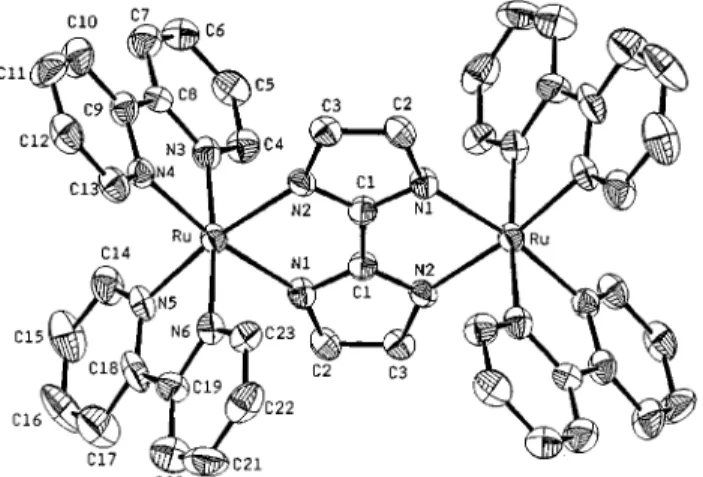
[M= Ru or Os; L = pap or bpy; X = Cl, Br or CH3CN] as ‘metal’ it has been possible to synthesize a group of bimetallic complexes in moderate to high yields. Examples of unsymmet-rical complexes containing different metals as well as different ligands as in [(pap)2Os(biim)Ru(bpy)2]21 are very limited.23 Here we also describe the crystal structure of [(bpy)2 Ru(biim)-Ru(bpy)2]21 (Fig. 3). This compound has long been known.1 To the best of our knowledge this represents the first structural characterisation2 of a dimeric ruthenium compound contain-ing dianionic biim as the bridgcontain-ing ligand. The structure of the [Ru2(bpy)4(biim)]21 has been compared with that18 of
[Rh2(cod)2(biim)]. The asymmetric unit consists of half of the molecule which generates the dinuclear complex through a crystallographic inversion centre located at the midpoint of the C1]C1 bond. The bridging biim22 co-ordinates as a planar Fig. 3 An ORTEP plot and atom numbering scheme for [{Ru(bpy)2}2
-(biim)]21 in [{Ru(bpy) 2}2(biim)][ClO4]2 N N N N L1 2M1 M2L22 Ru Ru Ru Os Os Ru Os Ru Os Ru pap pap pap pap pap pap pap bpy pap bpy M1 M2 L1 L2 2+
ligand in a bis-chelated four-co-ordinated manner with two
[Ru(bpy)2]21 moieties. The geometry about each ruthenium atom is octahedral. Selected bond angles and distances are presented in Table 1. The length of the bond C1]C1 joining the two imidazolato rings, 1.422(14) Å, is comparable to that observed in [Rh2(cod)2(biim)] and is shorter than in the com-plex [Rh4(CO)8(biim)2].24 The bond lengths in each imidazolato ring are in the range reported for corresponding parameters in complexes containing bidentate imidazolato ligands, C3H3N22. The Ru]N (bpy) bond length, 2.035(6) Å (average) is consider-ably shorter than Ru]N (biim), 2.141(6) Å (average). This may be attributed to the π interaction between the Ru(t2g) and π*(bpy) orbitals in [{Ru(bpy)}2(biim)]21. Interestingly, the Ru]N (biim) distance in the above dimer is longer than Ru]N (H2biim) in [Ru(pap)2(H2biim)]21. It would be interesting to
compare the above Ru]N lengths with Ru]N (biim) in a
Ru(pap)2(biim) molecule. Unfortunately, we have not yet suc-ceeded in growing X-ray-quality crystals of a compound containing a M(pap)221 unit and dianionic biim22 ligand. Electronic spectral data for the mono- and di-nuclear complexes are collected in Table 2.
Electrochemistry
The redox responses in both anodic and cathodic regions were determined for each mono- and di-nuclear species using cyclic voltammetry (CV). Electrochemical data are collected in Table 3 and representative voltammograms are shown in Fig. 4.
(i) Oxidation processes. The mononuclear complexes
[M(pap)2(H2biim)]21 undergo oxidation irreversibly at 1.70 (M= Ru) and 1.52 V (M = Os) in acetonitrile. This response shifts cathodically for the deprotonated complexes, viz. [M(pap)2 -(Hbiim)]1 and [M(pap)2(biim)]. The values of pK for the above protonated complexes are small which is believed to be responsible for the irreversible nature in an aprotic solvent. For the homobinuclear complexes [(pap)2Ru(biim)Ru(pap)2]21 and
[(pap)2Os(biim)Os(pap)2]21 two successive electrode oxidation couples are observed and the separations between the two are 0.26 (Ru) and 0.24 V (Os). The first oxidation potentials of the binuclear complexes are systematically much lower (ca. 0.5 V) than the anodic responses for the mononuclear complex. This is due24 to the stronger π-donor ability of the dianion bridge biim22 than the neutral terminal H
2biim. The separation between two successive anodic responses for the unsymmetrical
[(bpy)2Ru(biim)Ru(pap)2]21 is 0.26 V. The first oxidation pro-cess, in this case, is assigned to the (bpy)2RuIII(biim)– (bpy)2Ru
II(biim) couple. The two oxidative waves for the most unsymmetrical complex [(bpy)2Ru(biim)Os(pap)2]21 occur at 0.79 and 1.00 V, the former being attributed to the oxidation of the ruthenium centre in the above complex.
In order to study the properties of the mixed-valence species, controlled-potential coulometry of [(pap)2Ru(biim)Ru(pap)2]21
Table 3 Cyclic voltammetric dataa
Compound
[Ru(pap)2(H2biim)][ClO4]2
[Ru(pap)2(Hbiim)]ClO4?H2O
[Ru(pap)2(biim)]?2H2O
[Os(pap)2(H2biim)][ClO4]2?2H2O
[Os(pap)2(Hbiim)]ClO4?H2O
[Os(pap)2(biim)]?2H2O
[(pap)2Ru(biim)Ru(pap)2][ClO4]2?3H2O
[(pap)2Ru(biim)Os(pap)2][ClO4]2?2H2O
[(pap)2Ru(biim)Ru(bpy)2][ClO4]2?3H2O
[(pap)2Os(biim)Os(pap)2][ClO4]2?2H2O
[(pap)2Os(biim)Ru(bpy)2][ClO4]2?3H2O
Oxidation E₂₁/V 1.70b 0.96b 0.38b 1.52b 0.94b 0.34b 1.13, 1.39 1.10, 1.28 0.76, 1.15 1.05, 1.29 0.79, 1.0 Reduction 2E₂₁/V 0.18, 0.30, 0.65, 1.08,c 1.54,c 2.0c 0.33, 0.45, 1.0, 1.78, 1.88c 0.28, 0.42, 0.85, 1.01, 1.78c 0.16, 0.43, 1.34,c 1.56,c 2.10c 0.30, 0.85, 1.36c 0.25, 0.68, 1.16c 0.33, 0.47, 0.88, 0.97, 1.84 0.31, 0.46, 0.84, 0.95, 1.65,c 1.87,c 2.12c 0.36, 0.93, 1.63, 1.80,c 1.93,c 2.60c 0.28, 0.50, 0.80, 0.92, 2.10c 0.41, 0.88, 1.61,c 1.86,c 2.08c aExperiments were carried out in CH
3CN at 298 K using 0.1 NEt4ClO4 as supporting electrolyte. The reported data correspond to a scan rate
of 50 mV s21. bIrreversible response; the potential corresponds to E
pa.
cIrreversible response; the potential corresponds to E
pc.
was performed at 1.3 V in CH3CN. The spectrum of the elec-trolysed solution did not show any characteristic intervalence transition. However, cyclic voltammetry of the oxidised solution showed responses due to the complexes [Ru(pap)2 -(CH3CN)2]31/21, [Ru(pap)2(biim)]1/0 and [Ru(pap)2(Hbiim)]21/1.. These results suggest that the mixed-valence [(pap)2RuIII (biim)-RuII(pap)
2]31 dimer is stable only on the cyclic voltammetry timescale, but is unstable on a longer timescale and undergoes unsymmetrical bridge cleavage to form monomeric species as shown in equations (5) and (6). A similar result was obtained
[(pap)2Ru(biim)Ru(pap)2]21
[(pap)2Ru(biim)Ru(pap)2]311 e2 (5)
[(pap)2Ru(biim)Ru(pap)2]311 2CH3CN
[Ru(pap)2(CH3CN)2]211[Ru(pap)2(biim)]1 (6) from the spectral analysis of the partially oxidised dimer with Ce41. The appearance of the monomeric protonated complex is
consistent with the basicity of the co-ordinated biim. This situ-ation is similar26 to the dipyrazolyl-bridged dimer [(bpy)
2 Ru-(pz)2Ru(bpy)2]21 where it has been concluded that the difference between the formal electrode potentials for the two anodic responses is due to electrostatic effects and the mixed-valence complexes in these cases may be described as localised.
(ii) Reduction processes. Free pap displays two
quasi-reversible cyclic voltammetric responses8a at 21.31 and 21.57 V. Therefore, multiple reduction waves were anticipated in both mono- and di-nuclear complexes. The monomeric
com-Fig. 4 Cyclic voltammogram of [(pap)2Ru(biim)Os(pap)2]21 in
CH3CN: working electrode, platinum; scan rate 50 mV s21; supporting
electrolyte, NEt4ClO4
plexes [M(pap)2(H2biim)]21 display four reduction waves in the range 20.15 to 22.5 V. The symmetrical dimeric complexes
[(pap)2Ru(biim)Ru(pap)2]
21 and [(pap)
2Os(biim)Os(pap)2] 21
show almost identical voltammetric responses in the range 0 to 22.5 V at a glassy-carbon working electrode. The first four waves appear as two pairs10,27 (two closely spaced responses) and the fifth is a two electron-transfer process. The first reduc-tion of the ruthenium dimer occurs at 20.33 V and that for the osmium congener at 20.28 V. Theoretically, eight-electron reduction is expected in a complex containing four pap ligands. However, in practice, six ligand reductions are observed. We believe that two more lie beyond the accessible potential range. The heterodinuclear complex [(pap)2Ru(biim)Os(pap)2]21 shows a similar pattern of reductive waves. This indicates that the ligand-based reductions are very little affected by the change of metal from ruthenium to osmium. The situation was completely different in the two asymmetric complexes contain-ing two different terminal ligands, [(pap)2Ru(biim)Ru(bpy)2]21 and [(pap)2Os(biim)Ru(bpy)2]
21 where well separated responses
were observed. The azo ligand, pap, being a better π acceptor, is reduced first before the reduction of bpy starts.
Experimental
Materials
The starting complexes M(pap)2X2 (M= Ru or Os, X = Cl or Br), [Ru(bpy)2Cl2],28 [Ru(pap)2(OH2)2][ClO4]2?H2O9 and
[Ru(pap)2(CH3CN)2][ClO4]29 were prepared by the literature methods. The synthesis of biimidazole29 and its reaction with silver were reported earlier.30 Solvents and chemicals used for syntheses were of analytical grade. The supporting electrolyte tetraethylammonium perchlorate and solvents for electro-chemical work were obtained as before.8 CAUTION: perchlor-ate salts of metal complexes are generally explosive. Although no detonation tendencies have been observed, care is advised and handling of only small quantities recommended.
Physical measurements
A Shimadzu UV 2100 UV/VIS spectrophotometer was used to record electronic spectra. The IR spectra was recorded with a Perkin-Elmer 783 spectrophotometer, 1H NMR spectra in
CD3CN with a Bruker Avance DPX 300 spectrophotometer;
SiMe4 was used as internal standard. A Perkin-Elmer 240C elemental analyzer was used to collect microanalytical data (C, H, N). Electrochemical measurements were performed under a dry nitrogen atmosphere on a PAR model 370-4 electrochem-istry system as described earlier.31 All potentials reported in this work are referenced to the saturated calomel electrode (SCE) and are uncorrected for junction contribution. The pH meas-urements were made with a µ-pH System 361 Systronics pH meter, standardised with buffers 7.0 and 9.2. A 50% water–1,4-dioxane buffer mixture was employed because of the limited
solubility of the complexes in pure aqueous solution. Electrical conductivities were measured by using a Systronics Direct Reading Conductivity meter 304. The pK values were deter-mined by pH-metric titration as described before.11,32,33
Syntheses of complexes
[Ag(H2biim)]NO3. To a boiling ethanolic suspension of H2biim (0.197 g, 1.47 mmol) was added AgNO3 (0.25 g, 1.47 mmol) and refluxed for 1 h during which the solution became straw yellow. It was then concentrated to one-third of its initial volume and kept in a refrigerator overnight. Off-white crystals were filtered off and washed with a small volume of cold water. Yield: 95% (Found: C, 23.38; H, 2.10; N, 23.29. Calc. for C6H6AgN5O3: C, 23.68; H, 1.97; N, 23.02%).
The monomeric complexes were synthesized by following the silver()-assisted transmetallation route. Details are given for one representative case.
[Ru(pap)2(H2biim)][ClO4]2. The complex [RuCl2(pap)2] (0.142 g, 0.263 mmol) and [Ag(H2biim)]NO3 (0.160 g, 0.536 mmol) were refluxed for 1 h in methanol–water (3:1 v/v, 70 cm3). The solution changed from blue to pink. The cooled mixture was filtered to remove precipitated AgCl. The pink filtrate was then evaporated under reduced pressure to remove methanol, filtered and further concentrated to 15 cm3, to which was added a sat-urated aqueous solution (2 cm3) of sodium perchlorate contain-ing 0.1 perchloric acid. The reddish pink precipitate of
[Ru(pap)2(H2biim)][ClO4]2, thus obtained, was filtered off and recrystallised from dichloromethane–diethyl ether. Yield: 92% (Found: C, 41.60; H, 3.12; N, 17.11. Calc. for C28H24 -Cl2N10O8Ru: C, 42.00; H, 3.00; N, 17.49%). ΛM= 260 Ω21 cm2 mol21 (1 × 10²³ in CH3CN).
[Os(pap)2(H2biim)][ClO4]2?2H2O. This brownish red complex was synthesized by an analogous procedure, starting from
[OsBr2(pap)2] instead of [RuCl2(pap)2]. Yield: 75% (Found: C, 36.00; H, 2.90; N, 15.00. Calc. for C28H28Cl2N10O10Os: C, 36.31; H, 3.02; N, 15.13%). ΛM= 270 Ω21 cm2 mol21 (1 × 10²³ in CH3CN).
[Ru(bpy)2(H2biim)][ClO4]2?H2O. Synthesized by following a similar procedure to that described for its pap analogue. Yield: 90%.
[M(pap)2(Hbiim)]ClO4?H2O (M5 Ru or Os). The com-pound, [Ru(pap)2(H2biim)][ClO4]2 (0.1 g, 0.125 mmol) was dis-solved in aqueous acetonitrile (10 cm3). The solution was raised to pH 5.5 by addition of dilute aqueous NaOH. It became violet. On addition of a saturated aqueous solution (0.5 cm3) of sodium perchlorate the desired crystalline compound was deposited. It was filtered off and dried in vacuum over P4O10. Yield: 90% (Found: C, 46.27; H, 3.41; N, 19.27. Calc. for C28H25ClN10O5Ru: C, 46.82; H, 3.48; N, 19.50%). ΛM= 120 Ω21 cm2 mol21 (1 × 10²³ in CH
3CN). The osmium analogue was obtained similarly in 82% yield (Found: C, 41.40; H, 3.02; N, 17.48. Calc. for C28H25ClN10O5Os: C, 41.65; H, 3.09; N, 17.35%). ΛM= 160 Ω21 cm
2 mol21 (1 × 10²³ in CH
3CN). [M(pap)2(biim)]?2H2O (M5Ru or Os). These complexes were prepared using a similar procedure. For example, in the synthesis of [Ru(pap)2(biim)]?2H2O, triethylamine (0.05 g, 0.495 mmol) was added to a methanolic solution (25 cm3) of
[Ru(pap)2(H2biim)][ClO4]2 (0.1 g, 0.125 mmol). The reddish pink solution immediately became intense blue-violet. After being refluxed for 30 min, the solution was concentrated to one-third of its initial volume and diethyl ether added. The precipitate was immediately filtered off and dried in vacuum. Yield 85% (Found: C, 52.16; H, 3.98; N, 21.65. Calc. for C28H26N10O2Ru: C, 52.90; H, 4.09; N, 22.04%). The osmium analogue [Os(pap)2(biim)]?2H2O was obtained similarly in
80% yield (Found: C, 46.25; H, 3.48; N, 19.76. Calc. for C28H26N10O2Os: C, 46.39; H, 3.59; N, 19.33%).
[{Ru(pap)2}2(biim)][ClO4]2?3H2O. The complex [Ru(pap)2 -(H2biim)][ClO4]2 (0.1 g, 0.125 mmol) was dissolved in acetonitrile (30 cm3) and triethylamine (0.03 g, 0.297 mmol) was added which produced an intense blue-violet solution. To it
[Ru(pap)2(CH3CN)2][ClO4]2 (0.093 g, 0.124 mmol) was added and the mixture heated to reflux under N2 for 6 h. The solution changed to brown-violet. It was concentrated to one-third of its initial volume and a solid mass was precipitated on addition of diethyl ether. The precipitate was redissolved in the minimum volume of dichloromethane and subjected to column chroma-tography on neutral alumina (1 × 10 cm). A red-violet band was eluted with dichloromethane–acetonitrile (3 : 1). The solv-ent was evaporated to dryness under vacuum and recrystallised from dichloromethane–diethyl ether. Yield: 58% (Found: C, 45.72; H, 3.55; N, 16.54. Calc. for C50H46Cl2N16O11Ru2: C, 45.48; H, 3.48; N, 16.97%). ΛM= 260 Ω21 cm
2 mol21 (1 × 10²³
in CH3CN).
[(pap)2Ru(biim)Os(pap)2][ClO4]2?2H2O. Using [OsBr2(pap)2] in place of [Ru(pap)2(CH3CN)2][ClO4]2 and following the above-mentioned procedure a pink compound was isolated. Yield: 45% (Found: C, 43.23; H, 3.53; N, 16.02. Calc. for C50H44Cl2N16O10OsRu: C, 43.15; H, 3.16; N, 16.11%). ΛM= 240 Ω21 cm2 mol21 (1 × 10²³ in CH
3CN).
[(pap)2Ru(biim)Ru(bpy)2][ClO4]2?3H2O. Following the same procedure and using [Ru(pap)2(H2biim)][ClO4]2 and [Ru(bpy)2 -(CH3CN)2]
21 in 1 : 1 molar proportion, a brownish red
com-pound was isolated. Yield: 60% (Found: C, 45.76; H, 3.63; N, 15.45. Calc. for C48H44Cl2N14O11Ru2: C, 45.52; H, 3.47; N, 15.49%). ΛM= 270 Ω21 cm2 mol21 (1 × 10²³ in CH3CN).
[{Os(pap)2}2(biim)][ClO4]2?2H2O. The complex [Os(pap)2 -(H2biim)][ClO4]2?2H2O (0.1 g, 0.108 mmol) was dissolved in acetonitrile (30 cm3) and triethylamine (0.025 g, 0.247 mmol) was added which produced a pinkish brown colour. To it
[OsBr2(pap)2] (0.077 g, 0.107 mmol) was added and the mixture heated to reflux for 8 h under N2. The solution became brown. It was concentrated to one-third of its initial volume and diethyl ether added. The precipitate was dissolved in the min-imum volume of dichloromethane and subjected to column chromatography on neutral alumina (1 × 10 cm). A brown band was eluted with dichloromethane–acetonitrile (2 : 1). The compound was obtained on evaporation to dryness under vacuum and recrystallised from acetonitrile–water. Yield: 40% (Found: C, 40.79; H, 3.05; N, 15.45. Calc. for C50H44Cl2 -N16O10Os2: C, 40.55; H, 2.97; N, 15.14%). ΛM= 230 Ω21 cm2 mol21 (1 × 10²³ in CH3CN).
[(pap)2Os(biim)Ru(bpy)2][ClO4]2?3H2O. This brown com-pound was synthesized following a similar procedure using
[Os(pap)2(H2biim)][ClO4]2?2H2O and [Ru(bpy)2(CH3CN)2]21 in 1 : 1 molar proportions. Yield: 52%. (Found: C, 42.75; H, 3.10; N, 14.73. Calc. for C48H44Cl2N14O11OsRu: C, 42.53; H, 3.24; N, 14.47%). ΛM= 260 Ω21 cm
2 mol21 (1 × 10²³ in CH
3CN). Crystallography
Diffraction measurements were carried out at 25 8C on a Nonius CAD-4 fully automated four-circle diffractometer. The unit-cell dimensions are listed in Table 4. All data reduction and structure refinements were performed using the NRCVAX package.34 The structures were solved by the Patterson method. Absorption corrections were made with the NRCVAX package of programs. Hydrogen atoms were placed at calculated positions.
Single crystals of [Ru(pap)2(H2biim)][ClO4]2?3CH2Cl2 were grown at room temperature by slow diffusion of toluene into
a dichloromethane solution of the compound. The crystals contain three molecules of CH2Cl2 as solvent of crystallisation. The cation is located at the crystallographic two-fold axis; only half of the cation occupies the asymmetric unit. The perchlor-ate is locperchlor-ated at a general position; there is no crystallographic symmetry present in the anion. All three CH2Cl2 are located at two-fold axes, two being disordered. The unit cell was deter-mined and refined using setting angles of 25 reflections, with 2θ angles in the range 15.44 to 24.08. Data were collected by θ–2θ scans with 2θmax= 508.
Single crystals of [(bpy)2Ru(biim)Ru(bpy)2][ClO4]2 were obtained similarly. The asymmetric unit consists of half the molecule which generates the dinuclear complex through a crystallographic inversion centre located at the midpoint of the C1]C1 bond. The unit cell was determined and refined using setting angles of 25 reflections, with 2θ angles in the range 15.16 to 22.468. Data were collected as above.
CCDC reference number 186/906.
Acknowledgements
Financial support received from the Department of Science and Technology, New Dehli, is gratefully acknowledged. We thank Professor P. Banerjee for his help.
References
1 D. P. Rillema, R. Sahai, P. Matthews, A. K. Edwards, R. J. Shaver and L. Morgan, Inorg. Chem., 1990, 29, 167.
2 M. Haga, M. Md. Ali, S. Koseki, K. Fujimoto, A. Yoshimura, K. Nozaki, T. Ohno, K. Nakajima and D. J. Stufkens, Inorg. Chem., 1996, 35, 3335 and refs. therein.
3 M. Haga, M. Md. Ali, H. Maegawa, K. Nozaki, A. Yoshimura and T. Ohno, Coord. Chem. Rev., 1994, 132, 99.
4 M. Haga, M. Md. Ali and R. Arakawa, Angew. Chem., Int. Ed.
Engl., 1996, 35, 76.
5 M. D. Ward, Chem. Soc. Rev., 1995, 121.
Table 4 Crystallographic data and refinement results for [Ru(pap)2
-(H2biim)][ClO4]2?3CH2Cl2 1 and [{Ru(bpy)2}2(biim)][ClO4]2 2
Formula M Crystal system Space group a/Å b/Å c/Å β/8 U/Å3 Dc/g cm23 Measured reflections Observed reflections [I > 2σ(I)] Transmission factors (maximum, minimum) µ/cm21 Crystal size/mm R, R9 Goodness of fit 1 C31H30Cl8N10O8Ru 1055.75 Orthorhombic Pnna 15.3913(19) 12.611(6) 21.571(4) 4186.9(22) 1.665 3682 1565 0.975, 1.000 5.438 0.40 × 0.45 × 0.75 0.083, 0.089 1.70 2 C46H36Cl2N12O8Ru2 1157.90 Monoclinic C2/c 22.300(5) 14.6141(18) 17.028(3) 121.177(17) 4747.8(15) 1.620 4178 1874 0.958, 1.000 9.552 0.13 × 0.13 × 0.13 0.044, 0.040 1.23 Details in common: Z= 4; λ(Mo-Kα) 0.7107 Å.
6 K. Kalyanasundaram and Md. K. Nazeeruddin, Inorg. Chim. Acta, 1994, 226, 213.
7 F. Holmes, K. M. Jones and E. G. Torrible, J. Chem. Soc., 1961, 4790.
8 (a) S. Goswami, R. N. Mukherjee and A. Chakravorty, Inorg.
Chem., 1983, 22, 2825; (b) B. K. Ghosh, A. Mukhopadhyay,
S. Goswami, S. Ray and A. Chakravorty, Inorg. Chem., 1984, 23, 4633; (c) R. A. Krause and K. Krause, Inorg. Chem., 1982, 21, 1714; (d ) S. Goswami, A. R. Chakravarty and A. Chakravorty, Inorg.
Chem., 1982, 21, 2737.
9 S. Goswami, A. R. Chakravarty and A. Chakravorty, Inorg. Chem., 1983, 22, 602.
10 T. K. Mallick, P. K. Das, B. K. Roy and B. K. Ghosh, J. Chem. Res., 1993, (S), 374.
11 P. Ghosh and A. Chakravorty, J. Chem. Soc., Dalton Trans., 1985, 361.
12 S. Goswami, A. R. Chakravarty and A. Chakravorty, Inorg. Chem., 1981, 20, 2246; R. A. Krause and K. Krause, Inorg. Chem., 1980, 19, 2600.
13 B. K. Ghosh, S. Goswami and A. Chakravorty, Inorg. Chem., 1983, 22, 3358.
14 M. Kakoti, A. K. Deb and S. Goswami, Inorg. Chem., 1992, 31, 1302; S. Choudhury, A. K. Deb and S. Goswami, Polyhedron, 1994, 13, 1063; S. Choudhury, A. K. Deb, W. Kharmawphlang and S. Goswami, Proc. Indian Acad. Sci., 1994, 106, 665; S. Choudhury, A. K. Deb and S. Goswami, J. Chem. Soc., Dalton Trans., 1994, 1305; W. Kharmawphlang, S. Choudhury, A. K. Deb and S. Goswami, Inorg. Chem., 1995, 34, 3826; P. Majumdar, A. K. Ghosh, L. R. Falvello, S. M. Peng and S. Goswami, Inorg. Chem., in press.
15 C. K. Johnson, ORTEP, Report ORNL-5138, Oak Ridge National Laboratory, Oak Ridge, TN, 1976.
16 A. Seal and S. Ray, Acta Crystallogr., Sect. C, 1984, 40, 929. 17 A. K. Mahapatra, B. K. Ghosh, S. Goswami and A. Chakravorty,
J. Indian Chem. Soc., 1986, 63, 101.
18 S. W. Kaiser, R. B. Saillant, W. M. Butler and P. G. Rasmussen,
Inorg. Chem., 1976, 15, 2681.
19 M. Haga, Inorg. Chim. Acta, 1983, 75, 29.
20 S. Belanger and A. L. Beauchamp, Inorg. Chem., 1996, 35, 7836. 21 P. J. Giordano and M. S. Wrighton, J. Am. Chem. Soc., 1979, 101,
2888; M. Haga, Inorg. Chim. Acta, 1980, 45, L183.
22 G. Denti, S. Campagna, S. Serroni, M. Ciano and V. Balzani, J. Am.
Chem. Soc., 1992, 114, 2944; A. Juris, V. Balzani, F. Barigelletti,
S. Campagna, P. Belser and A. von Zelewski, Coord. Chem. Rev., 1988, 84, 85; S. Serroni and G. Denti, Inorg. Chem., 1992, 31, 4251; G. D. Marco, A. Bartolotta, V. Ricevuto, S. Campagna, G. Denti, L. Sabatino and G. D. Rosa, Inorg. Chem., 1991, 30, 270.
23 G. Giuffrida and S. Campagna, Coord. Chem. Rev., 1994, 135/136, 517.
24 S. W. Kaiser, R. B. Saillant, W. M. Butler and P. G. Rasmussen,
Inorg. Chem., 1976, 15, 2688.
25 M. Haga and A. M. Bond, Inorg. Chem., 1991, 30, 475.
26 B. P. Sullivan, D. J. Salmon, T. J. Meyer and J. Peedin, Inorg. Chem., 1979, 18, 3369.
27 A. A. Vlcek, Coord. Chem. Rev., 1982, 43, 39.
28 P. J. Giordano, C. R. Bock and M. S. Wrighton, J. Am. Chem. Soc., 1978, 100, 6960.
29 B. F. Fieselmann, D. N. Hendrickson and G. D. Stucky, Inorg.
Chem., 1978, 17, 2078.
30 K. Lehmstedt, Liebigs Ann. Chem., 1927, 456, 253.
31 S. K. Chandra, P. Basu, D. Ray, S. Pal and A. Chakravorty, Inorg.
Chem., 1990, 29, 2423.
32 A. I. Vogel, Quantitative Inorganic Analysis, Longmans, Green and Co., London, 1953, p. 177.
33 E. J. King, Acid-Base Equilibria, Pergamon, Oxford, 1965, p. 226. 34 E. J. Gabe, Y. Le Page, P. S. White and F. L. Lee, Acta Crystallogr.,
Sect. A, 1987, 43, 5294.
![Table 1 Selected bond angles ( 8) and distances (Å) [Ru(pap) 2 (H 2 biim)][ClO 4 ] 2 ?3CH 2 Cl 2 Ru ]N1 Ru ]N3 N4 ]Ru]N4 2.060(11)2.007(11)78.6(5) Ru ]N4N2 ]N3N1 ]Ru]N3 2.078(12)1.271(17)99.5(5) [(bpy) 2 Ru(biim)Ru(bpy) 2 ][ClO 4 ] 2](https://thumb-ap.123doks.com/thumbv2/9libinfo/8874632.249691/2.918.92.438.72.358/table-selected-bond-angles-distances-biim-clo-clo.webp)
![Table 3 Cyclic voltammetric data a Compound [Ru(pap) 2 (H 2 biim)][ClO 4 ] 2 [Ru(pap) 2 (Hbiim)]ClO 4 ?H 2 O [Ru(pap) 2 (biim)] ?2H 2 O [Os(pap) 2 (H 2 biim)][ClO 4 ] 2 ?2H 2 O [Os(pap) 2 (Hbiim)]ClO 4 ?H 2 O [Os(pap) 2 (biim)] ?2H 2 O](https://thumb-ap.123doks.com/thumbv2/9libinfo/8874632.249691/4.918.185.731.106.277/table-cyclic-voltammetric-compound-hbiim-clo-biim-hbiim.webp)
![Table 4 Crystallographic data and re finement results for [Ru(pap) 2 - -(H 2 biim)][ClO 4 ] 2 ?3CH 2 Cl 2 1 and [{Ru(bpy) 2 } 2 (biim)][ClO 4 ] 2 2](https://thumb-ap.123doks.com/thumbv2/9libinfo/8874632.249691/6.918.82.446.127.414/table-crystallographic-finement-results-biim-clo-biim-clo.webp)
