Volume 12, Number 2 May 2007 – August 2007
From How to Solve It to
Problem Solving in Geometry (II)
K. K. Kwok
Munsang College (HK Island)
Olympiad Corner
Below are the problems of the 2006 Belarussian Math Olympiad, Final Round, Category C.
Problem 1. Is it possible to partition the set of all integers into three nonempty pairwise disjoint subsets so that for any two numbers a and b from different subsets,
a) there is a number c in the third subset such that a + b = 2c?
b) there are two numbers c1 and c2 in the
third subset such that a + b = c1 + c2? Problem 2.
Points X, Y, Z are marked on the sides AB, BC, CD of the rhombus ABCD, respectively, so that XY||AZ. Prove that XZ, AY and BD are concurrent.
Problem 3. Let a, b, c be real positive numbers such that abc = 1. Prove that
2(a2+b2+c2)+a+b+c ≥ 6+ab+bc+ca.
Problem 4. Given triangle ABC with ,
60o
=
∠A AB = 2005, AC = 2006. Bob and Bill in turn (Bob is the first) cut the triangle along any straight line so that two new triangles with area more than or equal to 1 appear.
(continued on page 4)
Editors: 張 百 康(CHEUNG Pak-Hong), Munsang College, HK
高 子 眉 (KO Tsz-Mei)
梁 達 榮 (LEUNG Tat-Wing)
李 健 賢 (LI Kin-Yin), Dept. of Math., HKUST
吳 鏡 波 (NG Keng-Po Roger), ITC, HKPU
Artist: 楊 秀 英 (YEUNG Sau-Ying Camille), MFA, CU
Acknowledgment: Thanks to Elina Chiu, Math. Dept.,
HKUST for general assistance.
On-line:
http://www.math.ust.hk/mathematical_excalibur/ The editors welcome contributions from all teachers and students. With your submission, please include your name, address, school, email, telephone and fax numbers (if available). Electronic submissions, especially in MS Word, are encouraged. The deadline for receiving material for the next issue is August 20, 2007.
For individual subscription for the next five issues for the 05-06 academic year, send us five stamped self-addressed envelopes. Send all correspondence to:
Dr. Kin-Yin LI Department of Mathematics
The Hong Kong University of Science and Technology Clear Water Bay, Kowloon, Hong Kong
Fax: (852) 2358 1643 Email: [email protected]
We will continue with more examples.
Example 9. In the trapezium ABCD,
AB||CD and the diagonals intersect at O. P, Q are points on AD and BC respectively such that ∠APB = ∠CPD and∠AQB=∠CQD. Show that OP=OQ. Idea:
We shall try to find OP in terms of “more basic” lengths, e.g. AB, CD, OA, OC, …. To achieve that, we can construct a triangle that is similar to ΔDPC.
Solution Outline:
(1) Extend DA to B′ such that BB′ = BA. Then ∠PB′B = ∠B′AB = ∠PDC. So ΔDPC ∼ ΔB′PB. (2) It follows that BO DO BA CD B B CD B P DP = = ′ = ′ and so PO || BB′.
(3) Since ΔDPO ∼ ΔDB′B, we have DB DO AB DB DO B B OP= ′× = × . (4) Similarly, we have CA CO AB OQ= × and the result follows.
Example 10. In quadrilateral ABCD, the diagonals intersect at P. M and N are midpoint of BD and AC respectively. Q is the reflected image of P about MN. The line through P and parallel to MN cuts AB and CD at X and Y respectively. The line through Q parallel to MN cuts AB, BD, AC and CD at E, F, G and H respectively. Prove that EF = GH.
Idea:
The diagram is not simple. We shall try to express the lengths involved in terms of “more basic” lengths, e.g. PA, PB, PC and PD.
Solution Outline:
(1) First observe that PM = MF and PN = NG, hence BF = PD and CG = PA. (2) BP PD BP BF XP EF = = , BP XP PD EF = × . Similarly, we have CP YP PA GH= × . (3) Let the line MN cuts AB and CD at S and T respectively. Then
BP BD BP BM XP SM 2 = = , AP AC AP AN XP SN 2 = = .
Subtracting the equalities get ⎟ ⎠ ⎞ ⎜ ⎝ ⎛ − = BP BD AP AC XP MN 2 1 . Similarly, we have ⎟ ⎠ ⎞ ⎜ ⎝ ⎛ − = PC AC PD BD YP MN 2 1 . D C A P B O B' A D C B P M N Q X Y H E F G A D C B P M N X Y S T
Mathematical Excalibur, Vol. 12, No. 2, May 07 – Aug. 07 Page 2 (4) EF = GH ⇔ CP YP PA BP XP PD× = × ⇔ XP CP MN PA YP BP MN PD × × = × × . By (3), ⎟ ⎠ ⎞ ⎜ ⎝ ⎛ − = ⎟ ⎠ ⎞ ⎜ ⎝ ⎛ − BP BD AP AC CP PA PC AC PD BD BP PD ⇔ BP CP BD PA CP AC PC BP AC PD BP BD × × − = × × − ⇔ PC BP AC PD CP AC BP CP BD PA BP BD × × + = × × + .
By addition, both sides of the last equation equal CP BP BD AC × × .
Example 11. [IMO 2000] Two circles
Γ1 and Γ2 intersect at M and N. Let L
be the common tangent toΓ1 and Γ2 so
that M is closer to L than N is. Let L touch Γ1 at A and Γ2 at B. Let the line
through M parallel to L meet the circle Γ1 again at C and the circle Γ2 again at
D. Lines CA and DB meet at E; lines AN and CD meet at P; lines BN and CD meet at Q. Show that EP = EQ.
Idea:
First, note that if EP = EQ, then E lies on the perpendicular bisector of PQ. Observe that AB || CD implies A and B are the midpoints of arc CAM and arc DBM respectively, from which we see ΔACM and ΔBDM are isosceles. Second, we have ∠EAB = ∠ECM = ∠AMC = ∠BAM and similarly, ∠EBA = ∠ABM. That means E is the reflected image of M about AB. In particular, EM ⊥ AB and hence EM ⊥ PQ. Therefore, the result follows if we can show that M is the midpoint of PQ. Solution outline:
(1) Extend NM to meet AB at K. (2) AK2 = KN×KM = BK2 ⇒ K is the
midpoint of AB ⇒ M is the midpoint of PQ.
(3) Following the steps discussed above, we get EM ⊥ PQ and hence EP = EQ.
Example 12. [IMO 2001] Let ABC be an acute-angled triangle with circumcentre O. Let P on BC be the foot of the altitude from A. Suppose that ∠BCA ≥ ∠ABC + 30o. Prove that ∠CAB + ∠COP < 90o.
Idea:
(1) Examine the conclusion ∠CAB + ∠COP < 90o, which is equivalent to
2∠CAB + 2∠COP < 180o. That is,
∠COB + 2∠COP < 180o.
On the other hand, we have ∠COB + 2∠OCP = 180o. Therefore, we shall show
∠COP < ∠OCP or PC < OP.
(2) Examine the condition ∠BCA ≥ ∠ABC + 30o, which is equivalent to 2∠BCA −
2∠ABC ≥ 60o. That is,
∠BOA − ∠AOC ≥ 60o.
What is the meaning of ∠BOA − ∠AOC ?
Solution outline:
(1) Let D and E be the reflected image of A and P about the perpendicular bisector of BC respectively. Let R be the circumradius. (2) ∠BCA ≥ ∠ABC + 30o ⇒ ∠BOA − ∠AOC ≥ 60o ⇒ ∠DOA ≥ 60o ⇒ EP = DA ≥ R. (3) OP + R = OP + OC = OE + OC > EC = EP + PC ≥ R + PC ⇒ OP > PC ⇒ ∠COP < ∠OCP. (4) 2∠CAB + 2∠COP = ∠COB + 2∠COP < ∠COB + 2∠OCP < 180o
and the result follows.
Example 13. [Simson’s Theorem] The
feet of the perpendiculars drawn from any point on the circumcircle of a triangle to the sides of the triangle are collinear.
Solution:
In the figure below, D is a point on the circumcircle of ΔABC, P, Q, and R are feet of perpendiculars from D to BC, AC, and BA respectively.
Note that DQAR, DCPQ, and DPBR are cyclic quadrilaterals. So
∠DQR = ∠DAR = ∠BCD = 180o − ∠PQD ,
i.e. ∠DQR + ∠PQD = 180o. Thus, P,
Q, and R are collinear.
D C A B Q P R
Example 14. [IMO 2003] Let ABCD be a cyclic quadrilateral. Let P, Q and R be the feet of the perpendiculars from D to the lines BC, CA and AB respectively. Show that PQ = QR if and only if the bisector of ∠ABC and ∠ADC meet on AC.
Solution :
From Simson’s theorem, P, Q, and R are collinear. Now
∠DPC = ∠DQC = 90o
⇒ D, P, C and Q are concyclic ⇒ ∠DCA = ∠DPQ = ∠DPR. Similarly, since D, Q, R and A are concyclic, we get ∠DAC = ∠DRP. It follows that ΔDCA ∼ ΔDPR.
Similarly, ΔDAB ∼ ΔDQP and ΔDBC ∼ ΔDRQ. So, DA DC = DR DP= DB⋅QR BC DB⋅PQ BA =QR PQ⋅ BA BC
.
Therefore,PQ = QR⇔DA DC= BA BC.
Example 15.
[
IMO 2001]
In a triangle ABC, let AP bisect ∠BAC, with P on BC, and let BQ bisect ∠ABC, with Q on CA. It is known that ∠BAC = 60oand that AB + BP = AQ + QB. What are the possible angles of triangle ABC?
(continued on page 4) K Q P E D C N M A B P O C B A E D P O C B A
Problem Corner
We welcome readers to submit their solutions to the problems posed below for publication consideration. The solutions should be preceded by the solver’s name, home (or email) address and school affiliation. Please send submissions to Dr. Kin Y. Li, Department of Mathematics, The Hong Kong University of Science & Technology, Clear Water Bay, Kowloon, Hong Kong. The deadline for submitting solutions is August 20,
2007.
Problem 276. Let n be a positive integer. Given a (2n−1)×(2n−1) square board with exactly one of the following arrows ↑, ↓, →, ← at each of its cells. A beetle sits in one of the cells. Per year the beetle creeps from one cell to another in accordance with the arrow’s direction. When the beetle leaves the cell, the arrow at that cell makes a counterclockwise 90-degree turn. Prove that the beetle leaves the board in at most 23n−1(n−1)! −3 years.
(Source: 2001 Belarussian Math Olympiad)
Problem 277. (Due to Koopa Koo, Univ. of Washington, Seattle, WA, USA) Prove that the equation
x2 + y2 + z2
+ 2xyz = 1
has infinitely many integer solutions (then try to get all solutions – Editiors). Problem 278. Line segment SA is perpendicular to the plane of the square ABCD. Let E be the foot of the perpendicular from A to line segment SB. Let P, Q, R be the midpoints of SD, BD, CD respectively. Let M, N be on line segments PQ, PR respectively. Prove that AE is perpendicular to MN. Problem 279. Let R be the set of all real numbers. Determine (with proof) all functions f: R→R such that for all real x and y,
(
f(x) y)
2x f(
f(f(y)) x)
.f + = + −
Problem 280. Let n and k be fixed positive integers. A basket of peanuts is distributed into n piles. We gather the piles and rearrange them into n+k new piles. Prove that at least k+1 peanuts are transferred to smaller piles than the respective original piles that contained them. Also, give an example to show the constant k+1 cannot be improved.
*****************
Solutions
****************Problem 271. There are 6 coins that look the same. Five of them have the same weight, each of these is called a good coin. The remaining one has a different weight from the 5 good coins and it is called a bad coin. Devise a scheme to weigh groups of the coins using a scale (not a balance) three times only to determine the bad coin and its weight.
(Source: 1998 Zhejiang Math Contest)
Solution. Jeff CHEN (Virginia, USA), St.
Paul’s College Math Team, YIM Wing Yin (HKU, Year 1) and Fai YUNG. Number the coins 1 to 6. For the first weighting, let us weigh coins 1, 2, 3 and let the weight be 3a. For the second weighting, let us weigh coins 1, 2, 4, 5 and let the weight be 4b.
If a = b, then coin 6 is bad and we can use the third weighting to find the weight of this coin.
If a ≠ b, then the bad coin is among coins 1 to 5. For the third weighting, let us weigh coins 2, 4 and let the weight be 2c. If coin 1 is bad, then c and 4b−3a are both the weight of a good coin. So 3a−4b+c=0. Similarly, if coin 2 or 3 or 4 or 5 is bad, we get respective equations 3a−2b−c=0, b−c=0, a−2b+c=0 and a−c=0.
We can check that if any two of these equations are satisfied simultaneously, then we will arrive at a=b, a contradiction. Therefore, exactly one of these five equations will hold.
If the first equation 3a−4b+c=0 holds, then coin 1 is bad and its weight can be found by the first and third weightings to be 3a−2c. Similarly, for k = 2 to 5, if the k-th equation holds, then coin k is bad and its weight can be found to be 3c−2b, 3a−2c, 4b−3a and 4b−3a respectively. Problem 272.
Δ
ABC is equilateral. Find the locus of all point Q inside the triangle such that. 90o = ∠ + ∠ + ∠QAB QBC QCA
(Source: 2000 Chinese IMO Team Training Test)
Solution. Alex Kin-Chit O (STFA
Cheng Yu Tung Secondary School) and YEUNG Wai Kit (STFA Leung Kau Kui College, Form 6).
We take the origin at the center O of
Δ
ABC. Let ω ≠ 1 be a cube root of unity and A,B,C,Q correspond to the complex numbers 1, ω, ω2=ω , z respectively. Then o 90 = ∠ + ∠ + ∠QAB QBC QCA if and only if 1 | 1 | ) ( 1 1 1 3 2 − − − = − − ⋅ − − ⋅ − − z z z z ω ω ω ω ω ω ω ω ωis purely imaginary, which is equivalent to z3 is real. These are the
complex numbers whose arguments are multiples of π/3. Therefore, the required locus is the set of points on the three altitudes.
Commended solvers: Jeff CHEN (Virginia, USA), St. Paul’s College Math Team, Simon YAU and YIM Wing Yin (HKU, Year 1).
Problem 273. Let R and r be the circumradius and the inradius of triangle ABC. Prove that
. sin cos sin cos sin cos 2 2 2 r R C C B B A A + + ≥
(Source: 2000 Beijing Math Contest)
Solution. Jeff CHEN (Virginia, USA),
Kelvin LEE (Winchester College, England), NG Eric Ngai Fung (STFA Leung Kau Kui College), YEUNG Wai Kit (STFA Leung Kau Kui College, Form 6) and YIM Wing Yin (HKU, Year 1). Without loss of generality, let a, b, c be the sides and a ≥ b ≥ c. By the extended sine law, R = a/(2sin A) = b/(2sin B) = c/(2sin C). Now the area of the triangle is (bc sin A)/2=abc/(4R) and is also rs, where s = (a + b + c)/2 is the semi- perimeter. So abc=4Rrs. Next, observe that for any positive x and y, we have (x2 − y2)(1/x − 1/y) ≤ 0,
which after expansion yields 2 2 x y.
x y y
x + ≥ + (*) By the cosine law and the extended sine law, we get
2 2 2 2 2 ( /2 ) 2 / ) ( sin cos R a bc a c b A A = + − . 2 2 2 2 2 2 2 2 ⎟⎟ ⎠ ⎞ ⎜⎜ ⎝ ⎛ + − = ⎟⎟ ⎠ ⎞ ⎜⎜ ⎝ ⎛ + − = a a c a b rs R a a c b abc R
Adding this to the similar terms for B and C, we get
Mathematical Excalibur, Vol. 12, No. 2, May 07 – Aug. 07 Page 4 C C B B A A 2 2 2 sin cos sin cos sin cos + + ⎟⎟ ⎠ ⎞ ⎜⎜ ⎝ ⎛ − − − + + + + + = a b c a c c a c b b c b a a b rs R 2 2 2 2 2 2 2 r R c b a rs R + + = ≥ ( ) 2 by (*).
Commended solvers: CHEUNG Wang Chi (Singapore).
Problem 274. Let n < 11 be a positive integer. Let p1, p2, p3, p be prime
numbers such that n p
p1+ 3is prime. If
p1 + p2 = 3p, p2+p3=p1n(p1+p3)
and p2> 9, then determine p1p2p3n.
(Source: 1997 Hubei Math Contest)
Solution. CHEUNG Wang Chi
(Singapore), NG Eric Ngai Fung (STFA Leung Kau Kui College), YIM Wing Yin (HKU, Year 1) and Fai YUNG.
Assume p1≥ 3. Then p1+p2 > 12 and 3p
is even, which would imply p is even and at least 5, contradicting p is prime. So p1=2 and p2=3p−2.
Modulo 3, the given equation p2 + p3 =
p1n(p1+p3) leads to 0 ≡ 3p = p2+2 = 2n(2+p3)+2 = 2n+1 + 2 + (2n−1)p 3 ≡ (−1)n+1+2+((−1)n−1)p 3 (mod 3).
The case n is even results in the contradiction 0 ≡ 1 (mod 3). So n is odd and we get 0 ≡ p3 (mod 3). So p3 = 3.
Finally, the cases n = 1, 3, 5, 7, 9 lead to p1 + p3n = 5, 29, 245, 2189, 19685
respectively. Since 245, 19685 are divisible by 5 and 2189 is divisible by 11, n can only be 1 or 3 for p1+p3n to be
prime. Now p2 = p1n(p1+p3) −p3 = 2n5−3
> 9 implies n = 3. Then the answer is . 1998 3 37 2 3 3 2 1 = ⋅ ⋅ = n p p p
Problem 275. There is a group of children coming from 11 countries (at least one child from each of the 11 countries). Their ages are from 7 to 13. Prove that there are 5 children in the group, for each of them, the number of children in the group with the same age is greater than the number of children in the group from the same country.
Solution. Jeff CHEN (Virginia, USA).
For i =7 to 13 and j = 1 to 11, let aij be the
number of children of age i from country j in the group. Then
∑
= ≥ = 11 1 0 j ij i a b and 13 1 7 ≥ =∑
= i ij j a care the number of children of age i in the group and the number of children from country j respectively. Note that
∑
∑
≠ = = = 0 13 7 bi ij i ij j a a c , where∑
≠0 i b is used to denote summing i from 7 to 13 skipping those i for which bi=0. Now
∑∑
≠ = ⎟ ⎟ ⎠ ⎞ ⎜ ⎜ ⎝ ⎛ − 0 11 1 1 1 i b j j i ij b c a∑
∑
∑
∑
= ≠ = ≠ − = 11 1 0 11 1 0 j b i j ij j b ij i i b a c a 111 1 4. 1 13 7 = − ≥∑ ∑
= = j iSince aij(1/cj − 1/bi) < aij/cj ≤ 1, there are at
least five terms aij(1/cj − 1/bi) > 0. So
there are at least five ordered pairs (i,j) such that aij > 0 (so we can take a child of
age i from country j) and we have bi > cj.
Olympiad Corner
(continued from page 1)
Problem 4. (Cont.) After that an obtused-angled triangle (or any of two right-angled triangles) is deleted and the procedure is repeated with the remained triangle. The player loses if he cannot do the next cutting. Determine, which player wins if both play in the best way.
Problem 5. AA1, BB1 and CC1 are the
altitudes of an acute triangle ABC. Prove that the feet of the perpendiculars from C1
onto the segments AC, BC, BB1 and AA1
lie on the same straight line.
Problem 6. Given real numbers a, b, k (k>0). The circle with the center (a,b) has at least three common points with the parabola y = kx2; one of them is the origin
(0,0) and two of the others lie on the line y=kx+b. Prove that b ≥ 2.
Problem 7. Let x, y, z be real numbers greater than 1 such that
xy2−y2+4xy+4x−4y=4004, and xz2−z2+6xz+9x−6z=1009. Determine all possible values of the expression xyz+3xy+2xz−yz+6x−3y−2z.
Problem 8. A 2n×2n square is divided into 4n2 unit squares. What is the
greatest possible number of diagonals of these unit squares one can draw so that no two of them have a common point (including the endpoints of the diagonals)?
From How to Solve It to
Problem Solving in
Geometry (II)
(continued from page 2)
Idea:
By examining the conditions given, we may see that the point C is not too important. C A B P' P Q B'
We will focus on how to represent the condition AB + BP = AQ + QB in the diagram. For that, we construct points P′ and B′ on AB and AQ extended respectively so that PB = P′B and QB′ = QB. Then
AB + BP = AQ + QB
⇒ AB + BP′ = AQ + QB′ ⇒ AP′ = AB′ ⇒AP′B′is equilateral (as∠B′AP′= 60o).
Solution outline:
(1) Let ∠ABQ = ∠QBP = θ. Since PB = P′B, we have ∠PP′B = θ.
(2) Since AP bisects ∠QAB and ΔAB′P′ is equilateral, it follows that B′ is the reflected image of P′ about AP. So, PP′ = PB′ and ∠QB′P =∠AP′P = θ.
(3)
Since QB = QB′ and ∠QBP = θ =∠QB′P, by Example 2, P lies on either BB′ or the perpendicular bisector of BB′. If P does not lie on BB′, we will have PB = PB′ = PP′. This will imply ΔBPP′ is equilateral, θ = 60o and∠QAB + ∠ABP = 60o + 2θ = 180o,
which is absurd. So, P must lie on BB′. Therefore, B′ = C.
(4) Since
QB=QB′=QC, ∠QCB = ∠QBC = θ. So ∠QAB + 2θ + θ = 180o⇒ 60o + 3θ = 180o ⇒ θ = 40o.
Category C
. I . _ .
1.
Answer:
a) it-is impossible:b)
it'is possible. . .a)
By
condition, thesum
of numbers fromany
two subsets is even. So, in anytwo
subsets all numbers have the same parity, which is impossible.
. b) The following example gives the required partition:
. ..
. . ..
A = { 3 k : k E Z } , E - = { % + l : k E Z } , C = { 3 k + 2 : k € , Z } . . .
. .
2. Note that €he triangles
XBY
and' ZDA are similar(LBYX
= LZAD; LxBY = LZDA). So,BX
:BY
= Z? : DA. 'Let K and L behtersection points of the diagonalBD
and the . . segmentsXY
andAZ,
respectively. Since'the diagpnal. .
' BD is a bisector of& angles &3C and
ADC
of the rhombus-we have.BX..;
BY
=X K
:KY
andLZ
: LA IZD.:
DA. Therefore,X K
:fl'=
LZ
: ALYor . .. . . (1) . . . ' . . .. . ,. , .
- - X K
:LZ
= K Y : AL. '.'Let the segment. AY intersect the .diagonal
ED
atMI,
and. the .segment'XZ
intersect the diagonal.BP
at h4-2. It. is easy. to see that the triangles- K y M 1 andLAM1 are similar ( L K Y M 1 = LLAMi, LKMIY = LLM1A ). ItTollows that .'
i
I
. .
Likewise, the triangles
KXM2
andLZMa are
similar, SO.
..XK:
LZ=
K M g :M&.
.(3) . .From
(1)-(3)it
follows that KMl : M I L =XM;
:M2t,
which givesMI
=M2,
as'. ,
. .
required. . ..
2a2
+
2bz+
2c2-
(ab+bc+
ca)+
(a+ b + c) == (a2
+
b')+
(b2+
2)
+
(2
c
u2)-
(ad t.bc
+
cu) f ( a+
b+
c)2
2
2(ab+ bc+ m)-
( a b f bc -t- ca)+
(a+
b+ c) = ( u b f bc+
ca)+
(a i- b+
c)='
:1
2
[ ; + a > 2 , 1 ' + b 2 2 , - - f - c > 2 Z 2 . + 2 + 2 = 6 .T;
l' C1
, . .. . . . .
4. Answer: Bob wins.
Let the point Cl lie on the segment AC and ACI = 2005. Consider the triangle
ABCl. If for this triangle the fiid player has a winning strategy, then (taking into account that ABC1 is. an equilateral triangle) we can suppose that the
first
cutting .for
,4334 is the segment B D , whereD
is a point on the side AC. So,it
suffices for Bobto
cut ABC along BD and then to play.usirig the winning strategy of the firstplay- for the triangle AEC,. If for the triangle ABC; the second player has a winning 'strategy, then it suffices for Bdbfo cut ABC along BCI and later fo use the winning
strategy of the second player for the triangte ABCl
.
It
is evident that bhe game is finite because after every move the areaof
the new triangle is at least 1. less than area of the previous one.'5.
Let
B2, A',M
and
.N
be foots of the perpendicularsfrom
Cl
onto the segments A C ,BC,
BE1 and AAI, respectively; letLCBA
=p.
Since4 ,
B 2 ,C
and A2 are concyclic, we have LCB2A2 =On the other hand, since B? , A , C1 .and
N
are concyclic, we have LA&N = 9Oo+LC1B2N =. .
. LCC1Ai = 90"
-
dCiCA2 = LABC 4;a.
90"
+
LCiAA1 = -900 f .90" -/LABC = 180'-
p ,
SO, 'LAB2N I- LCBzAa = 180". Similarly, LBA2M+
LCA2B2 = 180". Thesetwo equalities give that all points B2,
N,
M,6. By condition, the equation of thegiven circle has the form ( ~ - u ) ~ + ( y - b ) ~ I
R2.
AA2 lie on the samistraight line.
Since the origin (0; 0) belongs to this circle, we have a2
+
b2 5R2,
and the circle aequation can be rewritten as
23
-
2ux+
y2-
2by
= 0.circle; Then \
.
Let ( X I ,
m)
and ( 5 2 , yz) be points lying on the parabola, the straightline
and the '\
k$ =I hi
+
b,= kx2
+
b,+
k2x:-
2bk~T 1 0,X :
-
Since z1
#
0, zz#
0,
we can divide (3), (4) by 21, zz, respectively and subtract the second obtained equality from thefirst
one:P ( 4
-
z
:
)
+
(1 -2bk)(~l - ~ z ) = 0.Since (zl,yl) and (zZ,& are different points on the parabola, we have z1# 22. So,
from
(5) it follows that. .
P(Z:
+
z1zp 4- 2:)+
(1-
2bk) = 0.From
quadratic (I) equation and (2) it
k 2
follows-
kz
-
that b=
ZI, 0. By z.1 Vihte'sare
roots formulae, of theYL)
z1 f 2% = 1, qz2 = -b / k Therefore, (6) gives 21 2 2 2
ak
-
1 =k'(4
+ZlZZ +2;) = = k3((21+z#
-
ZIZZ) = k'(1+
b/k), 1k
so, b = (A?
+
l)/k.Now,
the evident inequalityk
+ -
2
2 implies the required result.7. Answer: 2006. Set , 'I" L
A + - e z + 3~
+
222-
YZ+
62-
3y-
b.It is easy to see that
.\
A -
6 = Z ~ Z+
3 ~ 2 ~ 2 - + Y Z + ~ Z-
39- 2~-
6 = (Z-
l)(y+ 2 ) ( ~ + 3 ) .Rewrite the given system of equations as
-yZ +42y+ 4 ~ - 4 ~
-
4 * 4000,-
2
+ ~ z z + 92- 6~-
9 = 1O00,( A
-
6)2 = (5-
1)"~+
2 ) i ( ~+
3)2 = (Z-
I)(g+
2)' '= 4 0 0 0 - 1 0 0 0 ~ 4 ~ 1 0 6 . then Thwfore,- _
( z - l ) ( ? / + 2 ) 2 = r n , (2-
l)(z+ 3)' = 1OOO.Since A - 6
>
0 (z, y, t aregreaterthan I), we have A - 6*
2000, i.e. A=
2006.8. Answer: n(2n
+
1) diagonals.Suppose, contraty to our clhrn, that one can draw at least n(2n
+
1)+
1 diagonalsin the unit squares so that no
two
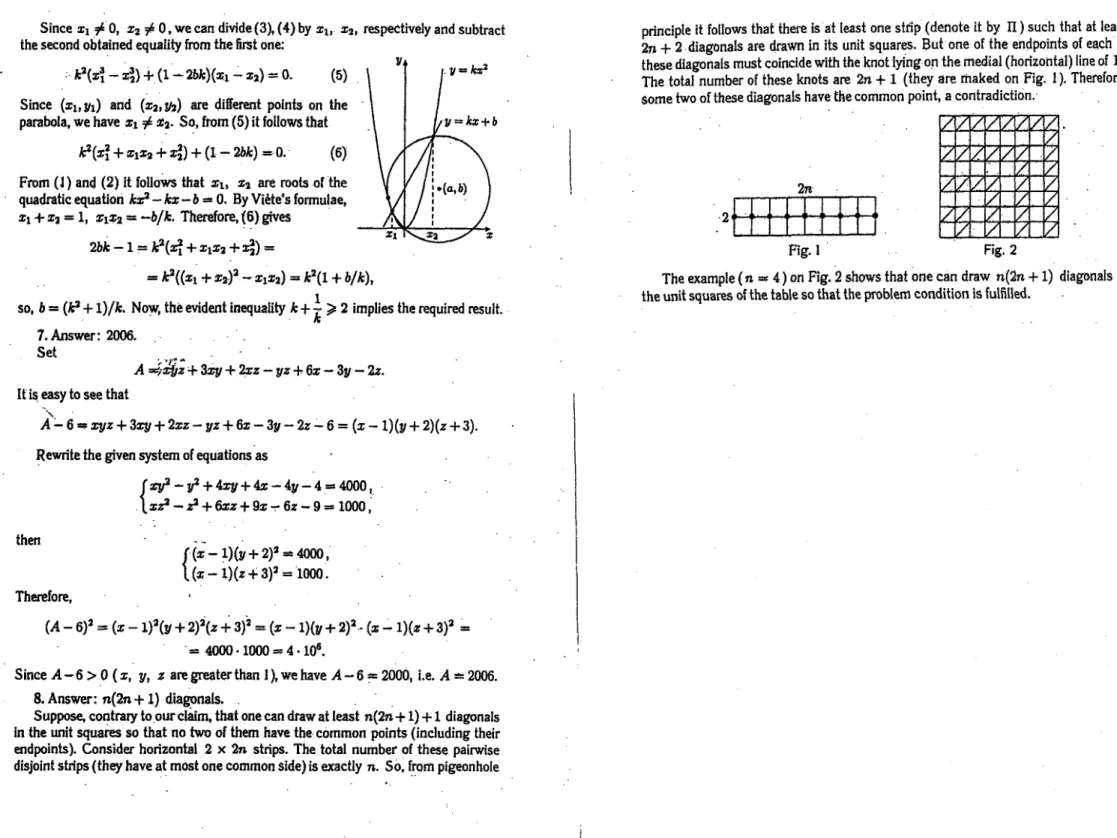
of them have the common points (including their endpoints). Consider horizontal 2 x 2n strips. The total number of these pairwise disjoint strips (they have at most one common side) is exactly n. So. from pigeonholeprinciple it follows that there is at least one strip (denote it by
II)
such that at least2n
+
2 diagonals are drawn in its unit squares. But one of the endpoints of eachof
these diagonals must coincide with the knotlying
on the medial (horizontal) line ofII.
The total number of these knots ate 2rt
+
1 (they are maked on Fig. 1). Therefore,some two of these diagonals have Ehe common point, a contradiction.
Fig. 1 Fig. 2
The example ( n 1:4 ) on Fig. 2 shows that one can draw n(2n
+
1) diagonals inthe unit squares of the table so that the problem condition