Completely self-starting picosecond and femtosecond
Kerr-lens mode-locked Ti:sapphire laser
J.-M. Shieh, F. Ganikhanov, K.-H. Lin, W.-F. Hsieh, and Ci-Ling Pan
Institute of Electro-Optical Engineering, National Chiao Tung University, Hsinchu, Taiwan 300
Received July 20, 1994
Completely self-starting and stable operation of a Kerr-lens mode-locked Ti:sapphire laser was realized in both picosecond and femtosecond regimes. The cavity has a symmetric X configuration with soft aperturing. Enhanced Kerr nonlinearity and reduced backscattering effects were thought to be key to obtaining stable self-starting self-mode-locked operation from 765 to 815 nm for the picosecond regime and from 770 to 835 nm for the femtosecond regime. The mode-locking starting time as measured by the onset of the second-harmonic signal ranged from 300 ms to 2 s, depending on cavity alignment. Preliminary data also suggest that intracavity intensity fluctuation necessary for the laser to evolve into stable mode locking could be as short as 10 – 40 ps.
1.
INTRODUCTION
The Kerr-lens mode-locked (self-mode-locked) Ti:sapphire laser has been recognized as the premiere source of tun-able ultrashort pulses in the near infrared. In this laser, Kerr nonlinearity acts as an equivalent fast saturable ab-sorber, therefore making the laser not easily self-starting from cw intensity fluctuations. Previously a number of researchers demonstrated continuously self-starting fem-tosecond Ti:sapphire lasers by using a variety of auxil-iary techniques, such as active mode locking,1 passive
mode locking with a dye saturable absorber,2
coupled-cavity mode locking with a multi-quantum-well absorber,3
and mode locking with a moving intracavity4or
external-cavity mirror.5
Several theoretical approaches analyzing both steady-state operation and self-starting conditions have also been developed.6–9 These studies focused on the
mode-locking threshold and parameters of the initial intensity fluctuation necessary to initiate mode locking. The con-sensus has been found that self-starting conditions are less likely satisfied for the unperturbed laser. Thus the problem of whether a Kerr-lens mode-locked laser can be made self-starting and robust without the use of any auxiliary technique is of great interest both from funda-mental and practical standpoints. The characteristics of such a purely self-mode-locked laser, e.g., mode-locking starting and pulse-formation time and output parame-ters of pulses, would provide useful information for the refinement of different theoretical approaches.
Kerr-lens mode locking was clearly observed for the first time of which we are aware in the research re-ported in Ref. 10, in which the authors observed that spontaneous starting and termination of the mode-locked picosecond pulse train were due to transverse mode beating. A self-starting picosecond Ti:sapphire laser was reported by Tamura et al.,11 who employed a
unidirectional cavity design to suppress efficiently the ´etalon (or backscattering) effect that prevents the self-starting process. Recently self-starting self-mode-locked femtosecond Ti:sapphire lasers were reported.12,13 In
Ref. 12, which reports self-starting near the gain peak at 840 nm, the author attributed the effect to the gain saturation lens. The authors of Refs. 13 and 14 report achievement of self-starting in a symmetric cavity de-sign by exploiting hard aperturing to enhance the depth of modulation introduced by the Kerr-lens effect in the initial stage. It was reported in Ref. 14 that the mode-locking buildup time was strongly dependent on the slit size, pump power level, and the intracavity dispersion. Self-starting from the intracavity intensity fluctuations was also achieved when an additional highly nonlinear intracavity element was inserted,15 thus reducing the
pump power threshold for mode locking. In this paper we report stable operation of a completely self-starting tunable Kerr-lens mode-locked Ti:sapphire laser with or without intracavity dispersion control. Tunability of the self-starting laser as well as the role of soft and hard aperturing effects are examined. The starting time for mode locking has also been measured.
2.
EXPERIMENT
The Kerr-lens mode-locked Ti:sapphire laser layout is shown in Fig. 1. The astigmatically compensated main cavity, consisting of mirrors M1 – M4 was arranged in a symmetric X configuration. The length of each of the two linear arms was 830 mm. We chose this symmetric con-figuration because it was recently shown theoretically16
to be more efficient than the asymmetric design for ini-tiating mode locking. Plane output coupler M4 had a transmission of 5% at 800 nm. We used Brewster-angle-cut 8- or 20-mm-length Ti:sapphire crystals with a dop-ing concentration of 0.1%. Spherical mirrors M2 and M3 sr 10 cmd were highly reflecting at 800 nm and highly transmitting for the pump laser wavelength. Such four-mirror cavities were aligned at folding angles of 21±for
the 8-mm rod and 33±for the 20-mm rod. An all-line
Ar1laser (Coherent, Innova 200) pump beam was focused
into the Ti:sapphire gain medium by a 10-cm focal-length spherical lens (L), which was turned 4.7±away from
nor-mal incidence to provide a better overlap of the pump 0740-3224/95/050945-05$06.00 1995 Optical Society of America
Fig. 1. Layout of the self-starting self-mode-locked Ti:sapphire laser. beam with cavity mode. A 0.5-mm-thick birefringent
fil-ter (BF) was used for tuning the laser wavelength in the picosecond regime. Two Brewster-angle-cut SF10 glass prisms were spaced 65 cm apart (for a 20-mm rod) in the cavity for dispersion compensation in the femtosec-ond regime. In the femtosecond regime of operation, the birefringent filter was replaced by a variable horizontal slit for wavelength tuning. We also experimented with the vertical slit placed near the output coupler in order to examine the role of hard aperturing.
The mode-locked pulses from the laser were recorded by an intensity autocorrelator. The pulse spectrum was recorded by an optical spectrum analyzer (ADVANTEST, Model TQ8345). A y – t recorder was used to record the temporal development of second-harmonic intensity, while a photodiode (PD) and an oscilloscope were used to monitor the laser pulse train.
3.
RESULTS AND DISCUSSION
With the cavity layout shown in Fig. 1 (without intra-cavity prisms) and at a pump power level of 5.2 W, the output power of the Ti:sapphire laser in the cw regime was,850 mW when the laser was aligned carefully for maximum output. At this point the laser could be made to self-start and mode lock. We realigned the cavity slightly by changing the position of concave mirror (M3) along the laser axis until strong modulation (70 – 80% of the depth and constant amplitude) of the output was ob-served on the oscilloscope. This strong modulation was obtained for two different positions of mirror M3.
Self-starting and stable self-mode-locked operation (Fig. 2) was achieved at the farthest position of mir-ror M3. At this position the output power dropped to ,700 mW and the beam’s spatial mode became slightly triangular. The pulse-train amplitude observed on the oscilloscope was more than twice that of the cw modulation.
We then optimized this regime by fine adjustment of the end mirrors. We also changed the position of the crystal and the focusing lens from the pump as well as the orientation of the crystal in the horizontal plane by a slight (within 60.2±) rotation of the crystal mount near
the Brewster angle. The latter operation was found to be a key adjustment procedure for obtaining stable
self-starting self-mode-locked operation. Misalignment of the crystal led to a reduced tolerance range of self-starting self-mode-locked operation in the picosecond regime and even to the vanishing of mode locking. This probably can be explained by the fact that crystal misalignment causes less than perfect overlapping of the laser and pump beam modes inside the crystal and enhanced backscat-tering intensity. The latter effect was shown in Ref. 11 to be responsible for the frustration of self-starting. For the optimal case the tolerance in the distance between mirrors M2 and M3 at which self-starting and a stable pulse train were observed was ,80–100 mm. Corre-spondingly, the tolerance in the distance between the focusing lens and the laser crystal was 1.5 – 2 mm. Self-starting was achieved with a pump power ranging from 3.8 to 6.3 W for the curved-mirror position near the cen-ter of the tolerance range. With a 20-mm Ti:sapphire crystal we were able to align the laser with the short-est starting time for mode locking of .300 ms while the laser was chopped intracavity at 2 Hz. It is worth noting that hard aperturing had not been used so far. This regime was stable for hours. At the edges of the tolerance range the pulse train was less stable, and the starting time increased to several seconds. The same
Fig. 2. Picosecond pulse train generated by the self-starting self-mode-locked Ti:sapphire laser.
effect was observed when the end mirrors were purposely misaligned slightly from their optimized position for self-starting. This can be explained also by less than perfect overlapping of the modes. Thus soft aperturing as well as reduced backscattering effects play important roles in achievement of stable self-starting self-mode-locked operation. It should be noted also that, at the edges of the tolerance range for self-starting, insertion of a hard aperture and optimization of its size (the vertical slit in Fig. 1) made the picosecond pulse train more stable while not affecting the starting time of mode locking. Slightly outside the tolerance range for self-starting the laser still could be made mode locked by gentle tapping of any one of the cavity elements. Spontaneous starting and failing of mode locking were also observed for this case.
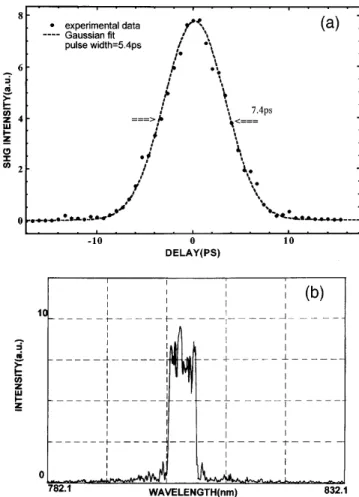
Figures 3(a) and 3(b), respectively, illustrate a typical autocorrelation trace and the spectrum of a picosecond pulse at 800 nm. The pulse shape is Gaussian. Strong self-phase modulation can be clearly identified from the shape of the spectrum. That is, pulses generated from the picosecond laser have a very large frequency chirp. The time – bandwidth product for the picosecond pulses was 10.
A highly chirped pulse is an indication of a significant Kerr-lens effect in our case because the frequency chirp originated mainly from self-phase modulation, i.e., from the real part of the intensity-dependent refractive index of the Ti:sapphire crystal. We could tune our laser wave-length from 765 to 815 nm while keeping the laser mode locked and self-starting. Self-starting became more dif-ficult with degradation of the pulse-train stability at the edges of the tuning range. Outside this range, mode locking was not possible for picosecond pulses at the pump power that we employed. This situation probably can be attributed to lower average power (350 – 400 mW of output power) inside the cavity. With the use of the birefringent filter the second-harmonic (SH) inten-sity of the pulse train was more stable [63 – 4%; see trace (a) of Fig. 4] than without the birefringent filter; [65 – 8% trace (b) of Fig. 4]. We attribute this obser-vation to the fluctuation of the wavelength of operation when the birefringent filter was not used. We have also recorded evolution of the second-harmonic signal after the opening of the mechanical shutter inside the cavity on the y – t recorder (,100 ms of response time; Fig. 5). The shutter opening time is indicated by the arrows in Fig. 5. The delay in the rise of the SH signal deter-mines the mode-locking starting time. The SH signal reached its steady-state value within approximately 1 s from the onset.
With two intracavity SF10 glass prisms, nearly transform-limited stpDn. 0.35d Gaussian pulses stp . 110 fsd were generated. The shape of the spectral dis-tribution was close to sech2. These pulses are shown
in Fig. 6.17 The beam’s spatial profile had a perfect
round form. Self-starting and self-mode locking were found within the tuning range from 770 to 835 nm, which is slightly extended from the long-wavelength side in comparison with that in the picosecond regime. Fem-tosecond pulse-train stability is noteworthys61%). This regime was also self-sustaining for hours. The mode-locking starting time was not significantly changed for the femtosecond regime.
Analysis of experimental observations and data lead us to believe that Kerr nonlinearity is the only mecha-nism responsible for self-starting and sustained mode locking in the steady state because neither gain satu-ration lensing12 nor dispersion effects were found to
af-fect significantly the mode-locking buildup time. Fur-thermore, self-starting with the same order of buildup time was observed over almost all of the spectral region of reflectivity of the intracavity mirrors. As was
men-Fig. 3. (a) Autocorrelation trace and (b) the corresponding spectrum of the self-starting self-mode-locked Ti:sapphire laser operating in the picosecond regime.
Fig. 4. Long-term stability of the SH intensity generated by a picosecond pulse train from self-starting Kerr-lens mode-locked laser (a) with and (b) without a birefringent filter.
Fig. 5. SH signal intensity. Arrows indicate the opening times of the mechanical shutter. The delay in the rise of the SH signal determines the mode-locking starting time. Self-starting in the case of periodic interruptions is shown in the inset.
Fig. 6. (a) Autocorrelation trace17 and (b) the corresponding
spectrum of the self-starting self-mode-locked laser in the fem-tosecond regime of operation.
tioned above, the buildup time was not noticeably differ-ent for picosecond (without dispersion control) and fem-tosecond regimes of operation. Therefore we propose two primary competitive pulse-shaping forces in the Kerr-lens mode-locked laser. These will determine the magnitude of the initial cw intensity fluctuation of the laser. Pulse shortening resulting from loss modulation through the Kerr-lens effect favors mode locking of the laser. On the other hand, in real laser systems the initial fluctu-ation tends to be destroyed by uncorrelated phase
per-turbations of the longitudinal modes. The initial fluc-tuation results in mode locking if its peak intensity in-crease during one round trip exceeds the dein-crease owing to the phase diffusion effect. In other words, the pulse-shortening speed resulting from the Kerr-lens effect must exceed the pulse-broadening speed arising from the phase breaking. Quantitatively, using the results of Ref. 6, we can express this condition as
gPf l. TRytc, (1)
where g is a Kerr-lens strength parameter,8,16 P f l is the
peak intensity of the initial fluctuation, TR is the cav-ity round-trip time (11.7 ns for our case), and tc is the phase correlation time. We believe that for our case the left- and right-hand sides of relation (1) are approxi-mately equal, because the experimentally observed start-ing times were fairly long. Fluctuation s640%) of the values of the starting times registered in successive mea-surements is also an indication that the strengths of the counteractive ( pulse-shortening and -broadening) forces are almost equal and that the origin of the laser intensity fluctuations is stochastic. We have also measured the 3-dB bandwidthsDn3dB. 500 Hzd of the laser to estimate
that tc . 0.65 ms according to the definition in Ref. 7. For our cavity design16we calculated that g. 1027W21.
Using these numbers, we estimated from relation (1) that the initial fluctuation intensity for mode locking is ,190 W. This peak power corresponds to a fluctuation width of nearly 80 ps if we assume that the fluctuation contains all the energy of the pulse in the steady-state mode-locked regime, which is approximately equal to 150 nJ. However, this case is less probable and can be considered an upper limit for an intracavity intensity fluctuation width. That is, we speculate that the initial fluctuation consists of a primary pulse containing less energy than the steady-state pulse and that the pulse width is accordingly less than 80 ps. Recently we found experimentally that the first distinguishable single pulse train in a passively mode-locked Ti:sapphire laser with an intracavity DDI-dye jet as the saturable absorber con-sists of a primary pulse as short as .5 ps and smaller secondary peaks, with approximately 50% of the steady-state pulse energy in the primary pulse.18 This is in
reasonable agreement with recent calculations by Chilla and Martinez,19 who showed that the minimum energy
needed for initiation of Kerr-lens mode locking is,50% of the steady-state pulse energy if the width of the fluc-tuation is as short as tens of picoseconds. Based on the above analysis and our data, we estimated that the initial intracavity fluctuation necessary for the laser to evolve into stable mode locking has a width of the order of 10 – 40 ps and contains correspondingly less than 50% of energy of the pulse in the steady state.
4.
CONCLUSIONS
We have demonstrated completely self-starting and stable Kerr-lens mode-locking operation in a Ti:sapphire laser for both picosecond and femtosecond regimes. We have made the following observations: (1) Enhanced Kerr nonlinearity can be achieved in a symmetric cavity design, thus providing self-starting conditions along with stable mode locking for both picosecond (without
disper-sion control) and femtosecond regimes of operation under a moderate pumping power level. (2) The laser is tun-able in the range from 765 to 815 nm for the picosecond regime (and 770 to 835 nm for femtosecond pulses) and operates well within the tuning range. (3) A soft aper-turing effect was found more effective for self-starting than hard aperturing. (4) Gain saturation lensing and dispersion effects are of less importance than Kerr lens-ing for self-startlens-ing. (5) Taking mode-rephasing effects (e.g., results of backscattering) into account, we estimated that the initial fluctuation width necessary for the laser to evolve into stable mode locking is of the order of tens of picoseconds. We note also that for the picosecond regime of operation (without dispersion control) the laser repre-sents the simplest four-mirror cavity design in which stable Kerr-lens mode locking can be realized.
While the manuscript of this paper was being prepared for publication, self-starting femtosecond Ti:sapphire lasers with buildup times on a time scale of few mil-liseconds were achieved in our laboratory. The laser was pumped at 8 W. Further studies, focused on its pulse-evolution dynamics, are currently being performed.
ACKNOWLEDGMENTS
The authors are grateful to M-H. Lu for the loan of the Ar1laser. F. Ganikhanov is grateful to the National Sci-ence Council of the Republic of China (NSC) for providing a postdoctoral fellowship. This research was partially supported by the NSC under grant NCS-82-0417-E-009-397.
Correspondence should be addressed to C.- L. Pan.
REFERENCES AND NOTES
1. P. F. Curley and A. I. Ferguson, “Actively mode-locked Ti:sapphire laser producing transform-limited pulses of 150-fs duration,” Opt. Lett. 16, 1016 (1991).
2. N. Sarukara, Y. Ishida, and H. Nakano, “Generation of 50-fs pulses from a pulse compressed, cw, passively mode-locked Ti:sapphire laser,” Opt. Lett. 16, 153 (1991).
3. U. Keller, G. W. t’Hooft, W. H. Knox, and J. E. Cunningham, “Femtosecond pulses from a continuously self-starting pas-sively mode-locked Ti:sapphire laser,” Opt. Lett. 16, 1022 (1991).
4. Y. Lui, K. W. Sun, P. R. Pruncal, and S. A. Lyan, “Simple method to start and maintain self-mode-locking of a Ti:sapphire laser,” Opt. Lett. 17, 1219 (1992).
5. N. H. Rivzi, R. M. W. French, and J. R. Taylor, “Continuously self-mode-locked Ti:sapphire laser that produces sub-50-fs pulses,” Opt. Lett. 17, 279 (1992).
6. F. Krausz, T. Brabec, and Ch. Spielmann, “Self-starting pas-sive mode locking,” Opt. Lett. 16, 235 (1991).
7. H. A. Haus and E. P. Ippen, “Self-starting of passively mode-locked lasers,” Opt. Lett. 16, 1331 (1991).
8. J. Hermann, “Theory of Kerr-lens mode locking: role of self-focusing and radially varying gain,” J. Opt. Soc. Am. B 11, 498 (1994).
9. S. Chen and J. Wang, “Self-starting issues of passive self-focusing mode locking,” Opt. Lett. 16, 1689 (1991). 10. D. E. Spence, P. N. Kean, and W. Sibbett, “60-fsec pulse
generation from a self-mode-locked Ti:sapphire laser,” Opt. Lett. 16, 42 (1991).
11. K. Tamura, J. Jacobson, E. P. Ippen, H. A. Haus, and J. G. Fujimoto, “Unidirectional ring resonators for self-starting passively mode-locked lasers,” Opt. Lett. 18, 220 (1993).
12. M. Lai, “Self-starting, self-mode-locked Ti:sapphire laser,” Opt. Lett. 19, 722 (1994).
13. G. Cerullo, S. De Silvestri, V. Magni, and P. L. Pallero, “Resonators for Kerr-lens mode-locked femtosecond Ti:sapphire lasers,” Opt. Lett. 19, 807 (1994); G. Cerullo, S. De Silvestri, V. Magni, and O. Zvelto, “Self-starting femtosecond Kerr lens mode-locked Ti:sapphire laser,” in Conference on Lasers and Electro-Optics, Vol. 8 of 1994 OSA Technical Digest Series (Optical Society of America, Washington, D. C., 1994), paper CWA57.
14. G. Cerullo, S. De Silvestri, and V. Magni, “Self-starting Kerr lens mode-locking of a Ti:sapphire laser,” Opt. Lett. 19, 1040 (1994).
15. C. Radzewicz, G. W. Pearson, and J. S. Crasinski, “Use of ZnS as an additional nonlinear intracavity self-focusing ele-ment in a Ti:sapphire self-mode locked laser,” Opt. Commun. 102, 464 (1993).
16. K. H. Lin and W. F. Hsieh, “Analytical design of symmetrical Kerr-lens mode-locking laser cavities,” J. Opt. Soc. Am B 11, 737 (1994).
17. After completion of this research we found that the autocor-relator that we had used is rather dispersive, and the auto-correlation trace in Fig. 6(b) must be corrected by a factor of 1.4 – 1.5, so the actual pulse width is 100 – 110 fs.
18. N. W. Pu, J.-M. Shieh, Y. Lai, and C. L. Pan, “Starting dynamics of a cw passively mode-locked picosecond Ti:sapphire/ DDI laser,” Opt. Lett. 20, 163 (1995).
19. J. L. A. Chilla and O. E. Martinez, “Spatial-temporal analy-sis of the self-mode-locked Ti:sapphire laser,” J. Opt. Soc. Am. B 10, 638 (1993).