Introduction
The worldwide availability of the internet has brought significant changes to commerce and social communication. It has become one of the most common ways of communication and is regularly referenced in commercials, academic studies and any kind of news. Therefore, internet might feature as a central theme of delusions. Our review of the literature found 16 cases of internet-related delusion were reported during the period from 1997 to 2005 [1-9]. As internet addiction had gradually been accepted as a novel form of psy-chopathology [10], internet-related delusions mi-ght also represented a new form of
psychopath-ology [2]. We report a case of psychotic symptoms highly related to the internet and review the repor-ted literature on this condition.
Case Report
An 18-year-old female senior high school student was brought to the outpatient clinic by her mother due to problems including crying all night, social withdrawal, frequent absence from school and deteriorated school performance for three months.
She stated that she had done something wrong to her French boyfriend, which had made him commit suicide three months ago. She be-lieved that this was true. She added that she had 1
Department of Psychiatry, Lotung St. Mary's Hospital 2
Department of Psychiatry, National Taiwan University Hospital and Col-lege of Medicine, National Taiwan University
Received: November 21, 2005; revised: May 25, 2006; accepted: July 10, 2006
Address correspondence to: Dr Joseph Kuo, Lotung Street, Mary's Hospital, No. 160, Chong-Cheng S. Road, Lotung, Ilan 265, Ta-iwan
Internet-related Delusional Disorder
Joseph Kuo, M.D.
1, Hai-Gwo Hwu, M.D.
2Objective: We report a case of internet-related delusional disorder and review
the psychiatric literature of 16 reported cases from 1997 to 2005. Case report: This 18-year-old female student claimed that her virtual boyfriend who she had never met suddenly lost contact and that another internet acquaintance had sent messages relating the suicide of her boyfriend, his parents and grandparents. The delusion was also associated with major depressive episode. The internet-related delusion and depressive disorder showed good response to combined treatment by pharmacotherapy and psychotherapy in four weeks. Conclusion: The present case and our review of the literature suggest that the internet can have specific influen-ces on the etiology, form and implications for the management of delusional disor-ders. Internet-related delusion, just like internet addiction may represent a novel form of psychopathology.
Key words: delusion, internet
met her boyfriend on the internet for three years and had contact with him only by email everyday. She described having fell in love with him and that this was her first love of her life. She described ro-mantic responses from him via e-mail. After a short-term honeymoon period during the first 3 months of their relationship, however, he frequen-tly argued that she had an irresponsible manner and always delayed her replies to his e-mail. But she also noted that they still had many precious memories.
The patient reported that she and her boy-friend had one mutual female boy-friend who also con-tacted with them by e-mail frequently. She claimed that three months prior to her visit to our clinic, her boyfriend abruptly lost contact with her and their mutual female friend suddenly sent a message to her that he had committed suicide be-cause she did something irresponsible to him. A few days later, she described that their female friend sent another message again that both of her boy friend's parents had also committed suicide due to the boyfriend's suicide. A few days later, a third message was sent that her boyfriend's grand-parents on his father's side had also committed suicide due to the suicide of her boyfriend's par-ents. She reported feeling extremely guilty that these five suicides were all her fault and that these events had led to the onset of a deep depressive state manifested by her reluctance to eat, sleep, and talk. She described hiding in her bedroom and crying till midnight and poor motivation to attend the school. She reported planning to commit sui-cide, later. She suffered from depressed mood, loss of interest, poor concentration, guilty de-lusion, strong suicidal idea, insomnia, poor appe-tite with body weight loss (3 kg in three months), lack of energy and psychomotor retardation. The-se symptomatic manifestations persisted for three months and fulfilled the Diagnostic and Statistical
Manual, 4th edition (DSM-IV) criteria of major depressive episode [11].
She described having spent at least one hour daily communicating with her boyfriend via the internet. She confessed that she had never met her boyfriend or the female friend who sent the mess-ages about the serial suicidal events. Nevertheless, she insisted that all of these individuals were real and the events were true, even under firm persua-sion and clear explanation by her family and tea-chers. She did not receive any further messages from her two internet companions after these events and so could not demonstrate their exis-tence. She described that they had vanished from the internet and she became delusional and de-pressed.
She did not have any previous history of psy-chiatric disorder or major medical disorder. There was no family history of psychotic or depressive disorders. She attended a local public senior high school and had a regular school life with average school performance before this episode. Despite explanation and guidance based on common sense reality, this patient firmly believed that this inter-net-related tragedy of suicidal events had occurred and that it was all her fault. Delusional disorder, internet-related and depressive disorder, NOS were diagnosed based on DSM-IV criteria [11]. In addition to supportive psychotherapy and educa-tional guidance, combined pharmacotherapy with aripiprazole 10 mg daily and citalopram 20 mg daily was given for four weeks. The patient's inter-net-related delusional symptoms gradually remit-ted and she no longer felt guilty again. She also re-ported that she could not remember the details ab-out the internet-related events and did not want to think about this troublesome experience. She had improved sleep and appetite and no longer cried at night. She began to smile, attended more social activities and helped with some housekeeping.
She planned to quit school temporarily to release stress due to her academic requirements and de-cided not to use the internet temporarily for her psychological wellbeing.
Discussion
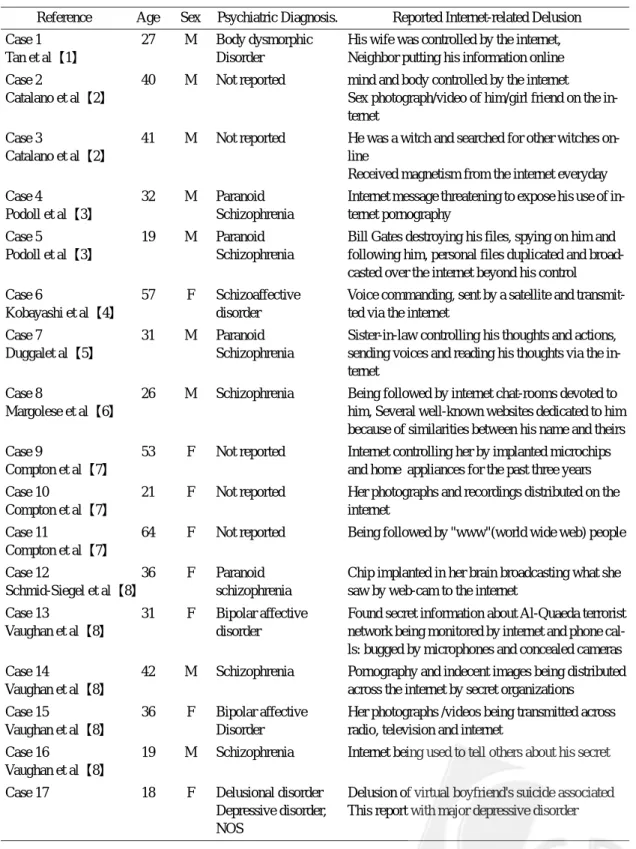
Our review of published cases of internet de-lusion revealed that the presentation of dede-lusions involving the internet may vary considerably. (Table 1) The role of the internet in such delu-sional beliefs is largely confined to two major the-mes. The first theme is the use of the internet as an explanatory tool to account for unusual experien-ces, such as experiences of being controlled, audi-tory hallucination or having one's thoughts read. The second theme is the supposed use of the inter-net by people who are thought to be conspiring ag-ainst the affected person.
Analysis of the contents of presentation rev-ealed that almost all of the cases had a persecutory nature manifested by claims of being controlled, threatened, spied on, followed, monitored, con-spired against or having thought broadcasted. Co-morbid psychiatric disorders included schizo-phrenia spectrum disorders in eight cases were, bi-polar affective disorder in two, body dysmorphic disorder in one, but were not clearly reported in five cases. Nine cases were male and seven were female. The age ranged widely from 19 till 64.
Our patient was relatively young (18-years-old) and was clearly delusional. She used the in-ternet without transmission of photographs as a daily routine and had developed a virtual love relationship. Overindulgence led to the develop-ment of a romantic fantasy involving a romantic intimate relationship with feelings of love and ex-citement. It is unclear what event precipitated the patient to believe that she had a boyfriend from a foreign country and that he had a female friend
who delivered the messages about suicides. It is also unclear the extent to which she had developed actual virtual relationship. The patient could certa-inly not be considered responsible for having caused the serial suicides which she described and her narrative suggested the events were false and impossible due to lack of sound objective reaso-ning and evidences. She had delusional conviction that a series of suicides were all her fault. This led to the diagnosis assignment of delusional disorder. The manifestations of the process of pathological grief reaction with guilty delusion were sufficient for the diagnosis of major depressive episode.
Stompe et al [12] considered that socio-cul-tural influences on delusional presentation can be broken down into a number of levels, all of which could be susceptible to the influences of cultural and social setting. They reported that technical in-novations only affect the final stages (concretiza-tion) of a multi-stage pathological process that culminates in the formation of a delusion. There-fore they suggested that the influence of a technol-ogy such as the internet is relatively unimportant as an etiological factor in psychosis.
Vaughan et al [9] suggested that the internet may not only simply affect the epiphenomenal manifestations of the underlying biological sign, but also create the etiology and form of psycho-pathology. This kind of psychopathological pro-cess has implications for the clinical management of the resulting symptomology. Catalano et al [2] postulated that a lack of knowledge about the rel-evant technology may fuel internet-themed delu-sions. Based on their successful treatment of inter-net delusion using cognitive behavioral therapy, Vaughan et al [9] concluded that using both didac-tic and interactive exploration of the internet could dispel magical notions about internet technology, and this was of therapeutic value. Besides, Duggal et al [5] suggested that the presence of
internet-Table 1. Reported Cases of Internet-related Delusion
Reference Age Sex Psychiatric Diagnosis. Reported Internet-related Delusion Case 1
Tan et al【1】
27 M Body dysmorphic Disorder
His wife was controlled by the internet, Neighbor putting his information online Case 2
Catalano et al【2】
40 M Not reported mind and body controlled by the internet Sex photograph/video of him/girl friend on the in-ternet
Case 3
Catalano et al【2】
41 M Not reported He was a witch and searched for other witches on-line
Received magnetism from the internet everyday Case 4
Podoll et al【3】
32 M Paranoid Schizophrenia
Internet message threatening to expose his use of in-ternet pornography
Case 5
Podoll et al【3】
19 M Paranoid Schizophrenia
Bill Gates destroying his files, spying on him and following him, personal files duplicated and broad-casted over the internet beyond his control Case 6
Kobayashi et al【4】
57 F Schizoaffective disorder
Voice commanding, sent by a satellite and transmit-ted via the internet
Case 7
Duggalet al【5】
31 M Paranoid Schizophrenia
Sister-in-law controlling his thoughts and actions, sending voices and reading his thoughts via the in-ternet
Case 8
Margolese et al【6】
26 M Schizophrenia Being followed by internet chat-rooms devoted to him, Several well-known websites dedicated to him because of similarities between his name and theirs Case 9
Compton et al【7】
53 F Not reported Internet controlling her by implanted microchips and home appliances for the past three years Case 10
Compton et al【7】
21 F Not reported Her photographs and recordings distributed on the internet
Case 11
Compton et al【7】
64 F Not reported Being followed by "www"(world wide web) people
Case 12
Schmid-Siegel et al【8】
36 F Paranoid schizophrenia
Chip implanted in her brain broadcasting what she saw by web-cam to the internet
Case 13
Vaughan et al【8】
31 F Bipolar affective disorder
Found secret information about Al-Quaeda terrorist network being monitored by internet and phone cal-ls: bugged by microphones and concealed cameras Case 14
Vaughan et al【8】
42 M Schizophrenia Pornography and indecent images being distributed across the internet by secret organizations
Case 15
Vaughan et al【8】
36 F Bipolar affective Disorder
Her photographs /videos being transmitted across radio, television and internet
Case 16
Vaughan et al【8】
19 M Schizophrenia Internet being used to tell others about his secret
Case 17 18 F Delusional disorder
Depressive disorder, NOS
Delusion of virtual boyfriend's suicide associated This report with major depressive disorder
themed delusions may be a specific prognostic in-dicator. They noted that cognitive therapy was particularly effective in treating the delusional be-lief, largely because of the ease by which reality testing by collaborative empiricism can be used in therapy. These reports suggest that technological concepts may have specific influences on the eti-ology, form and implications for the clinical man-agement of patients with such delusional beliefs.
The internet is now widely used in Taiwan, and nearly all students and workers used the inter-net as a routine activity. Our patient was well ac-quainted with the process of internet, but she still developed magical notions from internet technol-ogy. The failure of her family, teachers and psy-chiatrists to persuade her of the false nature of her delusional beliefs, however, led to an increasingly severe condition.
This patient had elaborate delusions about a tragedy involving a virtual boyfriend from a for-eign country who suddenly vanished and another virtual female friend who acted as a messenger ab-out serial suicides of her boyfriend and his family. The concealed crucial aspects of the delusions (all of the characters died for her fault) led to the cre-ation of tension and drama. The virtual aspects of this patient's delusions were characteristic of their false and emotion-laden nature. Both of these emotional elements could dramatically affect the life and spirit of an individual. Our review of re-ported cases of delusions involving the internet suggested a possible pathway by which the virtual world of the internet can be incorporated into de-lusions. The need for a clear self-awareness and attention to avoiding situations which may pre-cipitate such delusions should be emphasized.
Our review of the literature revealed a lack of information regarding the prognosis of internet delusion. Two of the reported cases showed good response to cognitive behavioral therapy. The
in-ternet-related delusion in this case showed good response to combined treatment with the anti-psychotic aripiprazole and the antidepressant cit-alopram in four weeks suggesting that there might be a psycho-physiological component in the mor-bid state, other than the patho-psychological prob-lem of internet-related delusion.
References
1. Tan S, Shea C, Kopala L: Paranoid schizophrenia with delusions regarding the internet. J Psychiatry and Neuroscience 1997;22:143.
2. Catalano G, Catalano MC, Embi CS, Frankel RL: Delusions about the Internet. Southern Med J 1999;92:609-10.
3. Podoll K, Habermeyer E, Noller B, Ebel H, Sass H: The internet as a delusional topic in paranoid schizophrenia. Nervenarzt 2000;71:912-4. 4. Kobayashi T, Okada Y, Nisijima K, Kato S:
"In-ternet delusion" in a patient with a schizoaffective disorder. Can J Psychiatry 2001;46:89-90. 5. Duggal HS, Jagadheedshan K, Nizamie H:
"Inter-net delusion" responsive to cognitive therapy. In-dian J Psychiatry 2002;44:293-6.
6. Margolese HC, Chouinard G, Beauclair L, Miller R: Using the rating scale for psychotic symptoms to characterize delusions expressed in a schizo-phrenia patient with "Internet psychosis". Can J Psychiatry 2002;47:485.
7. Compton MTL Internet delusions. Southern Med J 2003;96:61-3.
8. Schmid-Siegel B, Stompe T, Ortwein-Swoboda G: Being a webcam. Psychopathology 2004;38:84-5. 9. Vaugh B, Ethan G, Cara M, Peter WH, Hadyn DE: "Internet delusions": A case series and theoretical integration. Psychopathology 2005;38:144-50. 10. Shapira NA, Lessig MC, Goldmith TD, et al.:
Problematic internet use: proposed classification and diagnostic criteria. Depression and Anxiety 2003;17:207-16.
Statistical Manual, 4th ed. (DSM-IV), Washington DC, 1994.
12. Stompe T, Ortwein-Swoboda G, Ritter K, Schanda
H: Old wine in new bottles? stability and plasticity of the contents of schizophrenic delusions. Psy-chopathology 2004;36:6-12.
目的:報告一位網際網路相關妄想症案 例,並回顧從1997 至 2005 年,文獻上所報告 的16 位個案。病例報告:一位 18 歲的女性聲 稱交往三年的法國男網友突然失去聯絡。不 久,從網路傳來數通有關其法國男友、男友之 父母及祖父母因她的過失相繼自殺。個案對此 網路事件深信不疑,因而陷入罪惡妄想及重鬱 症。經過門診支持性心理治療與藥物治療四週 之後,其妄想及重鬱症狀已明顯緩解。結論: 由於這些個案研究報告顯示,新科技概念對此 類特殊妄想之病因、形式及臨床治療有特殊的 影響。因此網際網路相關妄想,如同網際網路 成癮,可能漸漸會被接受成為一種新興的精神 病理類型。