MATERIALS CHARACTERIZATION 41:151–162 (1998)
© Elsevier Science Inc., 1998 1044-5803/98/$19.00
655 Avenue of the Americas, New York, NY 10010 PII S1044-5803(98)00032-1
151
A
Study on Ternary Ti-rich TiNiZr Shape
Memory Alloys
S. F. Hsieh and S. K. Wu
Institute of Materials Science and Engineering, National Taiwan University, Taipei, Taiwan 106, Republic of China
The martensitic transformation in Ti50.5-XNi49.5ZrXand Ti51.5-XNi48.5ZrX alloys (X = 0–25 at.%) was studied by using thermomechanical treatments. These alloys have a B2↔B199 transfor-mation sequence, and their transfortransfor-mation peak temperature M* can be raised to 50–4508C by different additions of Zr. Although a great many second-phase particles exist around (Ti,Zr)Ni grain boundaries, these alloys still exhibit $80% shape-memory recovery. Ther-mal cycling can depress the M* temperature more significantly in the Ti41.5Ni48.5Zr10 alloy
than in the Ti40.5Ni49.5Zr10 alloy in the first ten cycles, owing to the former’s having greater
hardness and more second-phase particles. Martensite stabilization can be induced by cold rolling at room temperature for Ti-rich ternary TiNiZr alloys. The strengthening effects of cold rolling and thermal cycling on Ms temperatures of these alloys were found to follow
the expression Ms = T0-KDsy, in which K values are related to the as-annealed hardness of
these alloys. For the study of 4008C aging effects, the martensite stabilization appearing in the Ti26.5Ni48.5Zr15 alloy may be due to the pinning effect on the interfaces of martensite
plates by the point defects. © Elsevier Science Inc., 1998
INTRODUCTION
Among the reported shape-memory alloys (SMAs), TiNi alloys are the most attractive ones because of their excellent shape-mem-ory effect and pesudoelasticity. However, they are limited to being used at a tempera-ture lower than 1508C because their marten-sitic transformation starting temperature, Ms, is usually lower than 1008C.
High-temperature SMAs with an Ms temperature
higher than 1008C have been exhaustively researched owing to their potential appli-cations. Ternary TiNiX high-temperature SMAs—with X being precious metals Pd, Pt, and Au—also have been developed [1– 4]. However, the high cost of precious met-als limits the practical application of these alloys. For this reason, other TiNiX high-temperature SMAs need to be investigated. Among them, TiNiZr SMAs are the most prospective ones.
Meisner and Sivokha [5] reported that (Ti,Zr)2Ni7, (Ti,Zr)7Ni10 and NiZr phases
can be observed in Ni-rich Ti50-XNi50ZrX
al-loys with Zr content in the range of 30– 50at.% at room temperature. Three phases, (Ti,Zr)Ni, (Ti,Zr)2Ni, and l1, are observed
at room temperature in Ti-rich Ti53-XNi47ZrX
alloys with the Zr content in the range of 5– 20at.% [6]. Here, the l1 phase is a TiNiZr
ternary solid solution and the (Ti,Zr)Ni phase can exhibit B2↔B199 martensitic transformation with an Ms temperature in
the range of 60–2608C [6]. Meanwhile, Mul-der et al. [7] reported that the decrease in transformation temperatures in the ther-mally cycled Ti31.5Ni48.5Zr20 alloy is affected
by the (Ti,Zr)2Ni precipitates.
It has been confirmed that the properties of Ti-rich TiNi binary SMAs can be affected by various thermomechanical treatments, such as thermal cycling, aging, and cold rolling [8]. However, few reports have been
152 S. F. Hsieh and S. K. Wu made on Ti-rich TiNiZr ternary alloys [9]
whose transformation behaviors and shape-memory characteristics are affected by dif-ferent thermomechanical treatments. The aim of the present work is to systematically investigate the general characteristics of Ti-rich TiNiZr SMAs. The effects of aging, cold rolling, and thermal cycling on these also are discussed.
EXPERIMENTAL PROCEDURE
The conventional tungsten arc melting technique was employed to prepare Ti
50.5-XNi49.5ZrX (A alloys) and Ti51.5-XNi48.5ZrX (B alloys) alloys with X = 0–25at.%. Tita-nium (purity, 99.7%wt.%), nickel (purity, 99.9wt.%), and aluminum (purity, 99.9wt.%), totaling about 120g, were melted and re-melted at least six times in an argon atmo-sphere. A pure titanium button was used as a getter during the arc melting. Weight loss during melting was negligibly small. The as-melted ingots were homogenized at 9508C 3 72 h and then quenched in water. The ingots were cut into several plates with a low-speed diamond saw and then an-nealed at 9008C 3 2 h and quenched in wa-ter. After the annealing treatment, three experimental procedures were conducted. First, several plates were vacuum sealed in quartz tubes and aged at 4008C for 1 h to 100 h and then quenched in water. Second, several more plates were cold rolled at room temperature to 5%, 10%, 15%, and 25% reductions in thickness. Third, other plates were subjected to thermal cycling N times from 08C to 3008C with N = 1–100 cy-cles. Specimens for a DSC measurement, hardness test, shape-recovery test, internal friction test, and microstructure observa-tion were carefully cut from plates treated in accord with the aforedescribed proce-dures. DSC measurements were made with a Dupont 2000 thermal analyzer equipped with a quantitative scanning system 910 DSC cell for controlled heating and cooling runs on samples encapsulated in an alumi-num pan. The running temperature range was from 08C to 4008C with a heating and
cooling rate of 10C8/minute. An internal friction test was carried out with a SINKU-RIKO 1500 M/L series inverted torsion pendulum in the temperature range from 21508C to 2508C. The temperature rate was precisely controlled at 2C8/minute, and the test frequency was approximately 1Hz. Specimens for the hardness test were first mechanically polished and then subjected to measurement in a Vickers microhard-ness tester with a 500g load at room tem-perature. For each specimen, the average hardness value was taken from at least five test readings. The microstructural observa-tions were made by transmission electron microscopy with a JOEL-100CXII micro-scope equipped with a conventional dou-ble-tilting stage. The shape-recovery mea-surement was performed as described by Lin and Wu [10]. A quantitative analysis of each alloy’s chemical composition was performed by using a JOEL JXA-8600SX electron probe microanalyzer (EPMA) equipped with a WDX analysis system.
EXPERIMENTAL RESULTS AND DISCUSSION
TRANSFORMATION BEHAVIOR IN Ti50.5-XNi49.5ZrX, AND Ti51.5-XNi48.5ZrX ALLOYS
Figure 1 shows the experimental results of DSC measurements for the annealed Ti
50.5-XNi49.5ZrX (A alloys) and Ti51.5-XNi48.5ZrX (B alloys) alloys with X = 0–20at.% or 0– 25at.% in both forward and reverse trans-formations, respectively. The peaks M* and A* (including Ms, Mf, As, and Af points)
ap-pearing in Fig. 1 are associated with the martensite transformation of B2↔M. Here Ms and Mf indicate the starting and
finish-ing temperatures, respectively, of the mar-tensitic transformation; As and Af refer to
the starting and finishing temperatures, re-spectively, of the reverse martensitic trans-formation. The transformation peak tem-peratures versus Zr content shown in Fig. 1 are plotted in Fig. 2. From Fig. 2, it is clear that the transformation peak temperatures
Ti-Rich TiNiZr Shape-Memory Alloys 153
increase from 508C to 4508C with a rela-tively increasing Zr content. Therefore, on the basis of the results of Fig. 2, a TiNiZr SMA alloy with a desired transformation temperature can be obtained by carefully controlling its corresponding Zr content. For the same Zr content, the A* and M* temperatures of B alloys are higher than those of A alloys. This characteristic is simi-lar to that of the Ti-rich TiNi binary alloys. The As temperature of TiNi binary alloys is
reported to increase linearly as the Ti con-tent increases to as much as 50.5at.% and then levels off at approximately 1138C [11]. Thus, we propose that the As temperature
of Ti-rich TiNiZr alloys also can increase as the (Ti + Zr) content increases to 51.5at.%.
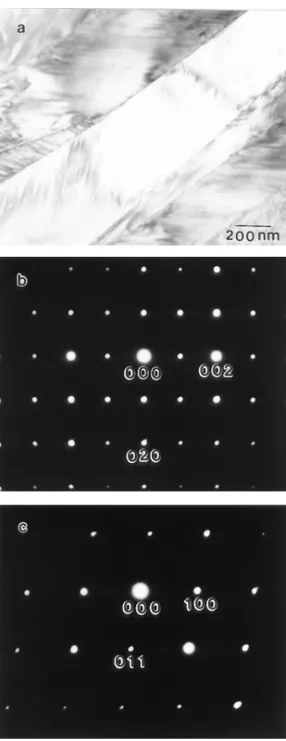
Figure 3(a) shows the TEM bright field im-age of martensite in annealed Ti30.5Ni49.5Zr20
FIG. 1. DSC curves of as-annelaed (a) Ti50.5-XNi49.5ZrX (X = 0–20at.%) and (b) Ti51.5-XNi48.5ZrX alloys (X = 0–25at.%).
M* and A* are peak temperatures of forward and reverse martensitic transformation, respectively.
FIG. 2. Transformation temperatures of A* and M* versus Zr content for Ti50.5-XNi49.5ZrX and Ti 51.5-XNi48.5ZrX alloys.
alloy. Figure 3(b, c) shows the selected area diffraction patterns (SADPs) of this alloy, in which the foil is parallel to [100]M and
[011]M directions, respectively. Han et al.
[12] found that the lattice parameter of mar-tensite in the Ti36.5Ni48.5Hf15 alloy is a
mono-clinic B199 structure with a = 0.293nm, b = 0.411nm, c = 0.473nm, and b = 100.48. The SADPs of Fig. 3(b, c) coincide with those of Han’s results; therefore, the structure of martensite in the Ti30.5Ni49.5Zr20 alloy is
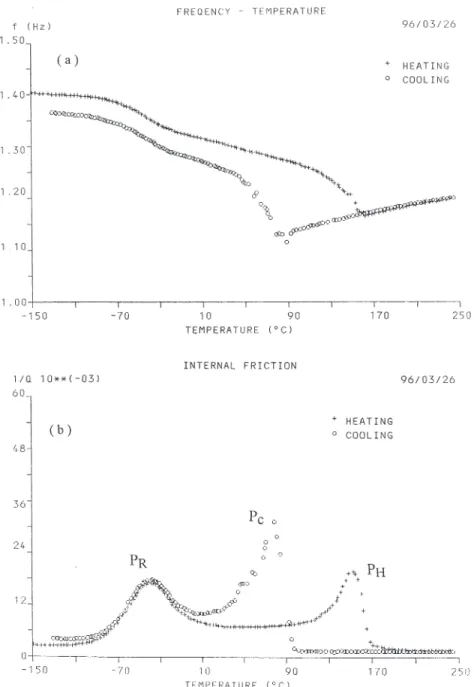
sug-gested to be monoclinic B199 structure. Figure 4 shows plots of frequency, f (shear modulus), and internal friction, Q-1,
versus the temperature of the annealed Ti40.5Ni49.5Zr10 alloy. In Fig. 4(b), there is one
peak, PC at 848C on cooling and one peak,
PH, at 1518C on heating; both peaks
corre-spond to the minima of frequency f, as shown in Fig. 4(a). These two peaks are as-sociated with the martensitic transforma-tion [13]. The peak PR appearing at 2388C,
not corresponding to the minimum of fre-quency f, is proposed to be a relaxation peak [14, 15]. In the TiNi binary SMA, this kind of relaxation peak is suggested to be associated with the interaction of disloca-tions and point defects [15] and is indepen-dent of the martensite and premartensite transformations [13]. The temperature dif-ference DT between PH and PC is
approxi-mately 67C8 for the Ti40.5Ni49.5Zr10 alloy,
which is larger than that of the Ti51Ni49
al-loy (DT = 41C8) [8]. This feature indicates that the Zr atoms in solid solution in Ti-rich TiNi alloys will result in a different chemi-cal free energy between binary TiNi and ternary TiNiZr SMAs. From Figs. 1, 3, and 4, the transformation sequence of mar-tensite in alloys A and B is found to be a B2↔B199 sequence.
Figure 5 shows EPMA backscattering electron images (BEIs) of 9008C annealed A alloys with X = 5, 10, 15, and 20at.%, re-spectively. A great many second-phase particles are found around the grain boundaries of the matrix. The chemical compositions of the matrix and second-phase particles found by EPMA analysis are given in Table 1. The ratio (Ti + Zr)/Ni of the matrix and that of the second-phase particles also are shown in Table 1. On the basis of a previous paper [6], the results in Table 1 indicate that the matrix in Fig. 5 is the (Ti,Zr)Ni phase; the black particles are
FIG. 3. Transmission electron micrographic bright-field image of as-annelaed Ti30.5Ni49.5Zr20 alloy. (b)
SADP of (a) with [100]M zone axis. (c) SADP of (a) with
Ti-Rich TiNiZr Shape-Memory Alloys 155
Figure 6 shows the shape-memory char-acteristics of alloys A and B, respectively. Despite the existence of many more sec-ond-phase particles, B alloys still exhibit rather good shape recovery, which can reach about 80%. It is rather uncommon that the shape recovery of Ti-rich TiNiZr ternary SMAs is not so much at the Af
tem-perature. For example, from Fig. 6, the the (Ti,Zr)2Ni phase for alloys with X #
10at.% and are the l1 phase for alloys with
X $ 15at.%. The microstructures of B alloys are similar to those of A alloys and are thus omitted here. However, the volume frac-tions of second-phase particles are quite different for these two alloys, approxi-mately 10% for the former and 4% for the latter.
FIG. 4. (a) Frequency, f, and (b) internal friction, Q-1, versus temperature for the Ti
40.5Ni49.5Zr10 alloy. Peaks PC and
for annealed Ti40.5Ni49.5Zr10 and Ti41.5Ni48.5Zr10
alloys, respectively. In Fig. 7, the M* and A* temperatures decrease, but the hardness, HV, increases with increasing thermal cy-cling N. It has been proposed that this fea-shape recovery of alloys A or B for X = 10
reaches about 60% at Af temperature, but
gradually increases with increasing tem-perature at Theating ^ Af. Lin et al. [8]
re-ported that the shape recovery of the equi-atomic or Ni-rich TiNi alloys can reach about 90% at Theating = Af and undergo only
minor recovery during the subsequent heating. We believe that the aforemen-tioned difference is closely related to the existence of second-phase particles; this phenomenon is also observed in binary Ti-rich Ti51Ni49 alloy [8]. These particles do not
transform martensitically when the tem-perature changes. They are characterized by high brittleness and limited plasticity. Therefore, the shape recovery of A alloys is slightly more than that of B alloys, owing to A alloys having few particles, as shown in Fig. 6.
THERMAL CYCLING EFFECTS ON Ti-RICH TiNiZr ALLOYS
Figure 7 shows peak temperatures M* and A* and hardness, HV versus thermal cycle, N,
Table 1 Compositional Analyses by EPMA for Ti50.5-XNi49.5ZrX Alloys Annealed
at 9508C 3 24 h
Ti50.5-XNi49.5ZrX alloys
Composition (at.%) (Ti 1 Zr)
Ni ratio Ti Ni Zr X 5 5 Matrix 46.14 48.79 5.07 1.05 Second phase 59.36 33.70 6.94 1.97 X 5 10 Matrix 40.81 49.01 10.18 1.04 Second phase 55.52 33.19 10.29 1.98 X 5 15 Matrix 36.45 49.18 14.37 1.03 Second phase 46.80 37.55 15.65 1.66 X 520 Matrix 31.50 48.88 19.62 1.04 Second phase 40.43 37.96 21.61 1.63
Ti-Rich TiNiZr Shape-Memory Alloys 157
ture comes from the thermally cycling in-duced dislocations [16]. The A* and M* values decrease quickly for the first ten cy-cles, with the decrement of Fig. 7(b), being about 238C at N = 10, which is larger than that of Fig. 7(a) (ù198C). The increment in hardness of Fig. 7(b) (DHV = 37) also is greater than that of Fig. 7(a) (DHV = 27) at the same N = 10 cycles. This difference indi-cates that the Ti41.5Ni48.5Zr10 alloy can induce
more dislocations than the Ti40.5Ni49.5Zr10 in
the early thermal cycling. This comes from the fact that Ti41.5Ni48.5Zr10 alloy has more
(Ti,Zr)2Ni particles and a higher hardness
than in the original. We suggest that the volume change during the martensitic trans-formation can produce a complex stress field at the interface of (Ti,Zr)2Ni particles and the
B2/B199 matrix during thermal cycling. This complex stress field can enhance dislocation multiplication, which increases the alloy’s hardness and depresses its M* temperature.
In Fig. 7, after 50 cycles, the M* and A* tem-peratures reach a constant value. This may imply that the quantities of induced dislo-cations reach a saturated value after 50 cy-cles in these alloys.
COLD-ROLLING EFFECT ON Ti-RICH TiNiZr ALLOYS
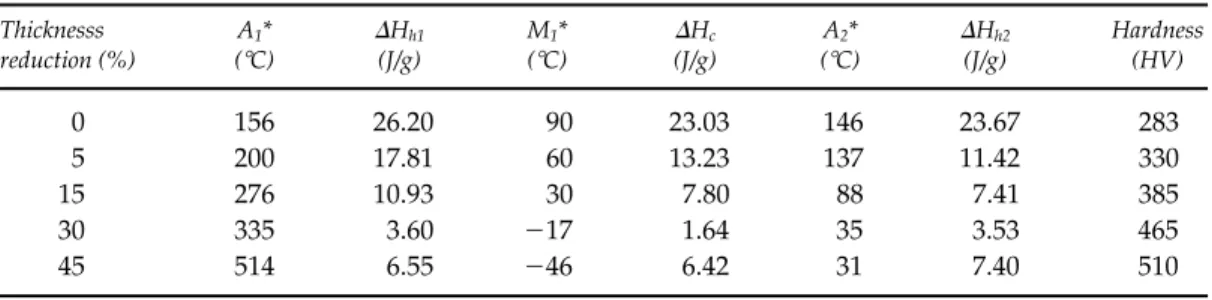
Tables 2 and 3 show the detailed results of DSC and hardness measurements, includ-ing A*, DH, HV, and so forth, for various amounts of cold rolling (0–45%) in Ti35.5Ni49.5Zr15 and Ti41.5Ni48.5Zr10 alloys,
re-spectively. The subscripts 1 and 2 of A1*,DHh1, and A2* respectively indicate the
specimens subjected to the first and second heating cycle after cold rolling. The data in Table 3 are plotted in Fig. 8 for peak values M1*, A1*, and A2* versus cold rolling for the
Ti41.5Ni48.5Zr10 alloy. In Fig. 8, A1*
tempera-tures significantly increase, but A2*
de-FIG. 7. Peak temperatures A* and M* and hardness, HV, versus number of thermal cycles, N, for (a) Ti40.5Ni49.5Zr10 alloy and (b) Ti41.5Ni48.5Zr10 alloy.
FIG. 6. Shape recovery versus heating temperature for (a) Ti50.5-XNi49.5ZrX alloys and (b) Ti51.5-XNi48.5ZrX alloys.
creases, with an increasing degree of cold rolling. The M* temperature also is found to decrease with an increasing amount of cold rolling. This phenomenon is regarded as mechanically induced martensite stabili-zation, which is the same behavior as that reported for Ti50Ni50 and Ti51Ni49 alloys [8,
17]. After the occurrence of the reverse martensitic transformation of B199→B2, the martensite stabilization dies out and A2*
temperatures are dramatically lowered. The possible mechanism for the martensite stabilization illustrated in Fig. 8 is sug-gested to be the interference of reverse transformation by the cold-deformed struc-tures and deformation-induced defects [17]. The same behavior is also listed in Ta-ble 2. From TaTa-bles 2 and 3, under the same 15% cold rolling, the increment of hardness in the Ti35.5Ni49.5Zr15 (DHV = 117) is larger
than that of the Ti41.5Ni48.5Zr10 alloy (DHV =
102). This feature results from the as-annealed hardness of the former alloy be-ing greater than that of the latter alloy.
STRENGTHENING EFFECTS OF COLD ROLLING AND THERMAL CYCLING ON MARTENSITIC TRANSFORMATION
TEMPERATURES OF Ti-RICH TiNiZr ALLOYS
Table 4 gives the peak temperature M* and hardness HV of thermal cycled Ti40.5Ni49.5Zr10
and Ti41.5Ni48.5Zr10 alloys. From Tables 2, 3,
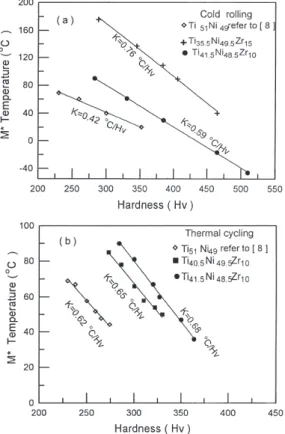
and 4, peak temperature M* is found to de-crease with increasing cold rolling percent-age and thermal cycling N in these alloys. The decrement of peak temperatures is suggested to be related to the dislocations introduced by cold rolling and thermal cy-cling. Figure 9 shows the curves of peak temperature M* versus hardness HV for the cold-rolled and thermal-cycled Ti40.5Ni49.5Zr10,
Ti35.5Ni49.5Zr15, and Ti41.5Ni48.5Zr10 alloys,
re-spectively. The results for cold-rolled and thermal-cycled Ti-rich Ti51Ni49 alloys also
are shown in Fig. 9. It was pointed out that a strengthening mechanism that impedes the transformation shear can lower the transformation temperatures, because the
Table 3 DSC Measurements and Hardness, HV, of Ti41.5Ni48.5Zr10 Alloy at Various
Thickness Reductions Thicknesss reduction (%) A1* (8C) DHh1 (J/g) M1* (8C) DHc (J/g) A2* (8C) DHh2 (J/g) Hardness (HV) 0 156 26.20 90 23.03 146 23.67 283 5 200 17.81 60 13.23 137 11.42 330 15 276 10.93 30 7.80 88 7.41 385 30 335 3.60 217 1.64 35 3.53 465 45 514 6.55 246 6.42 31 7.40 510
Table 2 DSC Measurements and Hardness, HV, of Ti35.5Ni49.5Zr15 Alloy at Various
Thickness Reductions Thicknesss reduction (%) A1* (8C) DHh1 (J/g) M1* (8C) DHc (J/g) A2* (8C) DHh2 (J/g) Hardness (HV) 0 217 28.12 176 24.18 207 24.79 289 5 275 18.24 137 14.23 203 12.35 346 10 312 10.47 109 9.10 168 7.41 384 15 383 6.34 89 5.42 145 5.59 406 25 467 4.64 40 4.54 116 3.85 465
Ti-Rich TiNiZr Shape-Memory Alloys 159
martensitic transformation involves a shear process [18, 19]. This feature can be ex-pressed by Eq. (1):
(1) The constant K contains the factors of proportionality between the critical shear stress and the yield stress Dsy, the
equilib-rium temperature T0 is a function of the
chemical composition, and the yield stress Dsy is considered to be proportional to the
hardness.
In this study, both cold rolling and ther-mal cycling do not change the alloy’s com-position; hence T0 is a constant. In addition,
both cold rolling and thermal cycling can strengthen the alloys by inducing disloca-tions and therefore can raise the yield stress Dsy. As derived from Eq. (1), this feature
should cause the M* and A* temperatures Ms = T0–K∆σy
to be lowered by the strengthening effect. This prediction is qualitatively consistent with the results of Fig. 9, in which the slope represents the constant K, which is not the same for different strengthening processes. Figure 9 indicates that the processes of cold rolling and thermal cycling can provide dif-ferent strengthening mechanisms and ex-hibit different effects on transformation temperatures. For example, the constant K of the Ti41.5Ni48.5Zr10 alloy is 0.59C8/HV for
cold rolling, but 0.68C8/HV for thermal cy-cling, as shown in Fig. 9. As already men-tioned, strengthening processes can intro-duce dislocations in these alloys. However, dislocations induced by cold rolling come from the plastic deformation of martensite and those induced by thermal cycling come from the thermal stress and transformation shear associated with B2→B199. Careful ex-amination of Fig. 9(b) reveals that the con-stant K of the Ti41.5Ni48.5Zr10 alloy is larger
than that of the Ti40.5Ni49.5Zr10 and Ti51Ni49
alloys for the same strengthening process. We propose that the K value is related to the inherent hardness of annealed TiNi bi-nary or TiNiX terbi-nary alloys. The higher the original hardness, the larger the K value will be. For example, the thermal-cycled Ti41.5Ni48.5Zr10 alloy has an annealed
hard-ness of 283 HV and its K value is found to be 0.68C8/HV, which is larger than those of thermal-cycled Ti40.5Ni49,5Zr10 ( 273HV, K =
0.65 C8/HV ) and Ti51Ni49 ( 230HV, K = 0.62
C8/HV) alloys. This characteristic is also found in cold-rolled alloys, as shown in Fig. 9(a). In other words, the depression of
Table 4 Transformation Peak Temperature, M*, and Hardness, HV, for Different Thermal Cycles in Ti41.5Ni48.5Zr10 and Ti40.5Ni49.5Zr10 Alloys Thermal cycles (N) Ti40.5Ni49.5Zr10 Ti41.5Ni48.5Zr10 M* (8C) Hardness (HV) M* (8C) Hardness (HV) 1 84 273 90 283 2 78 286 81 300 10 66 300 67 320 20 58 310 60 327 50 54 322 47 350 100 50 330 36 364
FIG. 8. Transformation peak temperatures A1*, A2*,
and M1* versus thickness reduction for the cold-rolled
Ms (M*) and As(A*) temperatures by the
strengthening mechanism is stronger for the alloys having a higher annealed hard-ness. Ti-rich TiNiZr alloys have a higher in-herent hardness owing to Zr atoms in solid solution in the TiNi alloy. This also eluci-dates why the K values of Ti-rich TiNiZr al-loys are higher than that of the Ti51Ni49
al-loy for the same strengthening process, as shown in Fig. 9.
AGING EFFECT ON Ti-RICH TiNiZr ALLOYS
Figure 10 shows the results of the DSC mea-surement in the 4008C aged Ti26.5Ni48.5Zr25
alloy. In Fig. 10, the A1* temperature
in-creases with increasing aging time. This feature exhibits the phenomenon of mar-tensite stabilization, the same behavior as reported in Cu-based SMAs [20–23]. Two mechanisms were proposed for martensite
stabilization in Cu-based SMAs: (1) reor-dering in martensite, where atomic rear-rangement in martensite results in some change in relative stability between parent and martensite [20, 21] and (2) pinning or locking of martensite–parent and marten-site–martensite interfaces by aged-induced defects or precipitates [22, 23]. Figure 11(a) shows the a transmission electron micro-graphic bright-field image of the martensite in a 4008C x 100 h aged Ti26.5Ni48.5Zr25 alloy.
Figure 11(b–d) shows the SADPs of Fig. 11(a), in which the foil is parallel to [001]M,
[110]M, and [101]M directions, respectively.
No extra reflection spots can be observed in Fig. 11 after the martensite has been stabi-lized. The martensite phase of TiNi binary SMAs consist of twin-related plates in which self-accommodating groups are formed. If the twins in the martensite plates are as-sumed to be created by a pole mechanism [24, 25], it is reasonable to suggest that a high density of twin dislocations inherently exists in the martensite phase. The same be-havior may arise in the Ti26.5Ni48.5Zr25 alloy.
The interstitial atoms (such as H, O, etc.) can be put into solid solution in specimens during the arc-melting process, and the ex-cess vacancies can be obtained by quench-ing the annealed specimen. Therefore, we propose that the immobile interfaces be-tween parent phase B2–martensite or mar-tensite–martensite plates in the martensite stabilized Ti26.5Ni48.5Zr25 may be pinned by
these point defects.
FIG. 10. Peak temperatures A* and M* and hardness HV versus aging time for Ti26.5Ni48.5Zr25 alloy.
FIG. 9. The temperature M* versus hardness HV for (a) cold-rolled and (b) thermal cycled Ti41.5Ni48.5Zr10,
Ti-Rich TiNiZr Shape-Memory Alloys 161
CONCLUSION
1. The annealed Ti50.5-XNi49.5ZrX and Ti
51.5-XNi48.5ZrX alloys undergo B2↔B199 mar-tensitic transformation in which the transformation peak temperatures M* in-crease from 508C to 4508C with increas-ing X from 0at.% to 25at.%. Many sec-ond-phase particles are found around the grain boundaries of the matrix. They are (Ti,Zr)2Ni particles for alloys with X #
10at.% and l1 phase for alloys with X $
15at.%. Despite the existence of second-phase particles, the alloys still exhibit good shape recovery, which can reach about 80%.
2. A* and M* temperatures decrease and the hardness increases in the first ten cy-cles of thermal-cycled Ti41.5Ni48.5Zr10 and
Ti40.5Ni49.5Zr10 alloys. Meanwhile, the
decrement of A* temperatures of the former is larger than that of the latter at the same cycle, owing to the former’s
having the harder matrix and the greater number of (Ti,Zr)2Ni particles.
3. Martensite stabilization of Ti41.5Ni48.5Zr10
and Ti35.5Ni49.5Zr15 alloys can be induced
by cold rolling at room temperature. The hardness increment of the former is less than that of the latter under the same de-gree of cold rolling, owing to the latter’s being harder than the former in the an-nealed condition.
4. The strengthening effects of cold rolling and thermal cycling on Ms (M*)
tempera-tures of Ti41.5Ni48.5Zr10, Ti40.5Ni49.5Zr10,
and Ti35.5Ni49.5Zr15 alloys are found to be
in accord with the equation Ms = T0 2
KDsy. Strengthening processes of cold
rolling and thermal cycling have differ-ent K values. Experimdiffer-ental results show that K values are associated with the in-herent hardness of the annealed TiNi and TiNiX alloys. The Ti-rich TiNiZr al-loys have Zr atoms in solid solution and thus have a higher annealed hardness
FIG. 11. (a) Bright field image of martensite in 4008C 3 100 h aged Ti26.5Ni48.5Zr25 alloy; (b) SADP of (a), [001]M
than that of the Ti51Ni49 alloy. This causes
Ti-rich TiNiZr alloys to have higher K values than that of the Ti51Ni49 alloy
un-der the same strengthening process. 5. Martensite stabilization of the Ti26.5Ni48.5Zr25
alloy occurs at the 4008C aging treatment because the interfaces of B2–martensite or martensite–martensite plates may be pinned by point defects.
The authors are grateful to Dr. T. S. Chou, Steel and Aluminum R & D Department, China Steel Corporation, for his great assistance with the internal friction measurement. The financial support of this study by the National Science Council (NSC), Republic of China, under Grant No. NSC 85-2216-E002-022, is also sincerely appreciated.
References
1. H. C. Yi and J. J. Moore: Combustion Synthesis of
Ti-Pd and Ti-Ni-Pd High Transition Temperature Shape Memory Alloys. Proc. Int. Conf. on Martensitic
Transformation, Sydney, Australia (July 3–7, 1989). 2. P. G. Lindqist and C. M. Wayman: Shape Memory and Transformation Behavior of Martensitic Ti-Pd-Ni and Ti-Pt-Ni Alloys. Engineering aspects of shape memory alloys. T. W. Duering, K. N. Mel-ton, D. Stockel, and C. M. Wayman, eds., Butter-worth Heinemann, London, p. 58 (1990).
3. Y. C. Lo, S. K. Wu, and C. M. Wayman: Transfor-mation heat as a function of ternary Pd additions in Ti50Ni50-XPdX alloys with x 5 20–50at.%. Scr.
Metall. 24:1571–1576 (1990).
4. S. K. Wu and C. M. Wayman: Martensitic transfor-mations and the shape memory effect in Ti50Ni10Au40
and Ti50Au50 alloys. Metallography 20:359–376 (1987).
5. L. Meisner and V. P. Sivokha: Deformation of crystal lattice in the process of martensitic trans-formation in alloys of Ni50Ti50-XZrX. J. Phys. IV C8:
765–769 (1995).
6. S. F. Hsieh and S. K. Wu: Room-temperature phase observed in Ti53-XNi47ZrX high-temperature
shape memory alloys. J. Alloys Compounds 266: 276–282 (1998).
7. J. H. Mulder, J. H. Mass, and J. Beyer: Martensitic
Transformations and Shape Memory Effects in Ti-Ni-Zr Alloys. Proc. Int. Conf. on Martensitic
Transfor-mations, Monterey, CA (July 20–24, 1992). 8. H. C. Lin, S. K. Wu, and J. C. Lin: The martensitic
transformation in Ti-rich TiNi shape memory al-loys. Mater. Chem. Phys. 37:184–190 (1994). 9. S. H. Chen: A study on ternary Ti-rich Ti51.5-X
-Ni48.5ZrX shape memory alloys. Master’s Thesis,
Institute of Materials Science and Engineering, National Taiwan University, Taipei, Taiwan (1994).
10. H. C. Lin and S. K. Wu: Strengthening effect of shape recovery characteristic of the equiatomic TiNi alloys. Scr. Metall. 26:59–61 (1992).
11. K. H. Eckelmeyer: The effect of alloying on the shape memory phenomenon in nitinol. Scr. Metall. 10:667–672 (1976).
12. X. D. Han, W. H. Zou, R. Wang, Z. Zhang, D. Z. Yang, and K. H. Wu: The martensite structure and aging precipitates of a TiNiHf high temperature shape memory alloy. J. Phys. IV C8:753–758 (1995). 13. S. K. Wu, H. C. Lin, and T. S. Chou: A study on electrial resistivity, internal friction and shear modulus on an aged Ti49Ni51 alloy. Acta Metall. 38:
95–102 (1990).
14. H. C. Lin: A study on binary TiNi shape memory alloys. Ph.D. Thesis, Institute of Materials Science and Engineering, National Taiwan University, Taipei, Taiwan (1992).
15. J. S. Zhu, R. Schaller, and W. Benoit: Relaxation peak near 200 K in NiTi alloy. Phys. Lett. A 141: 177–180 (1989).
16. S. Miyazaki, Y. Igo, and K. Otsuka: Effect of ther-mal cycling on the transformation temperatures of TiNi alloys. Acta Metall. 34:2045–2051 (1986). 17. H. C. Lin, S. K. Wu, T. S. Chou, and H. P. Kao: The
effects of cold rolling on the martensitic transfor-mation of an equiatomic TiNi alloy. Acta Metall. 39:2069–2080 (1991).
18. M. Cohen, E. S. Machlin, and V. G. Paranjpe:
Ther-modynamics in Physical Metallurgy. American
Soci-ety for Metals, Metals Park, OH, p. 242 (1950). 19. E. Hornbogen: The effect of variables on
martensi-tic transformation temperatures. Acta Metall. 33: 595–601 (1991).
20. G. Scarsbrook and W. M. Stobbs: The martensitic transformation behavior and stabilization of rap-idly quenched Cu-Zn-Al ribbons. Acta Metall. 35: 47–56 (1987).
21. A. A. Arab, M. Chandrasekaran, and M. Ahlers: Martensite aging and its stabilization in Cu-Zn-Al shape memory alloys. Scr. Metall. 18:709–714 (1984). 22. M. Ahlers: The Stabilization of Martensite in
Cu-Zn-Al. Proc. Int. Conf. on Martensitc Transformation,
Nara, Japan (August 26–30, 1986).
23. M. H. Wu and C. M. Wayman: Isothermal aging of martensite in a Cu-Zn-Al shape memory alloy.
Mater. Sci. Forum 56–58:553–558 (1990).
24. R. E. Reed-Hill: Physical Metallurgy Principles. 3rd ed., PWS-Kent Pub., Boston, p. 552 (1992). 25. J. W. Christian: The Theory of Transformations in
Metals and Alloys. Pergamon Press, Oxford,
En-gland, p. 792 (1965).