Journal of Thermal Analysis, Vol. 40 (1993) 1181-1192
P I L L A R E D L A Y E R E D M A N G A N E S E O X I D E S y n t h e s i s a n d r e d o x p r o p e r t i e s
She-Tin Wong and Soofin Cheng
DEPARTMENT OF CHEMISTRY, NATIONAL TAIWAN UNIVERSITY, TAIPEI, TAIWAN 10764, R.O.C.
Keggin ion-pillared buserite was prepared by ion-exchanging the hexylammonium ion-ex- panded buserite with Keggin ions, [AI1304(OH)24(H20)12] 7+. The starting material was synthetic Na-buserite, which is a layered manganese oxide of composition Na4MnI4026-xH20. The thermal and redox properties of this oxide and its pillared derivative were compared in 02, N2 and H2 en- vironments using TG, DSC and XRD. The results indicated an improvement in thermal stability of pillared compound relative to Na-buserite in all gaseous environments. By using these compounds in catalysing the oxidation of ethane, it was found that they were very active for complete oxida- tion.
Keywords: manganese oxide, pillaring layered compounds, TG/DSC, X-ray diffraction
Introduction
Pillaring layered compounds with robust polyoxometallic oligomers is a new route to prepare microporous materials. Structure and properties of such as- semblies can be mediated by controlling subtle guest-host interaction [1-4]. This area has received much attention due to the potential use of the resultant com- pounds in catalysis and adsorption. In this study, Na-buserite was used as the starting material for preparation of both hexylammonium ion-expanded and Keg- gin ion-pillared buserite, abbreviated as HEB and KPB, respectively. In HEB, the free interlayer spacing is expanded from 1.94 A (in Na-buserite)to 12.94 A [5]. This allows the ion-exchange process with Keggin ion of diameter 8.6 A to proceed. Na-buserite is a non-stoichiometric layered manganese oxide (Fig. 1), with unit cell formula Na4Mn14026-xH20 [6-7]. It is a major component of man- ganese nodules which occur abundantly in both marine and fresh water sedi- ments. In a review article, Nitta [8] showed that manganese nodules were as effective as some commercial catalysts and adsorbents. In a previous report, we described the successful preparation of KPB with increased surface area and ther- mal stability [5]. The aim of this investigation was to characterize the thermal and
John Wiley & Sons, Limited, Chichester Akad~miai Kiadr, Budapest
1182 WONG, CHENG: PILLARED LAYERED MANGANESE OXIDE
redox properties o f both Na-buserite and KPB, so that their applications in catalysis could be explored.
Experimental procedures
The method for Na-buserite synthesis was adapted from St~ihli [5, 9]. In the preparation of KPB, HEB instead of Na-buserite was used as the precursor for ion-exchange reaction with Keggin ion solution. The preparation method and structural characterization o f both Na-buserite and KPB have been described [5]. Powder X-ray diffraction (XRD) patterns were obtained on a Philips PW 1840 automated powder diffractometer, using Ni-filtered CuK~ radiation. Ther- mogravimetric analysis (TG) and differential scanning calorimetry (DSC) were carried out on a DuPont 951 TG analyzer and a NETZSCH DSC 404, respective- ly. Heating rates were 10 deg.min -~.
F|g. 1 Three-dimensional representation of Na-buserite structure
Catalytic experiments were carried out on a fixed-bed flow-through system with a diluted catalyst. Catalyst/SiO2 weight ratio --- 1/20. The diluted catalyst was pre-treated at 370~ in an air flow overnight. The reactant was a mixture of ethane and air, with ethane/air mole ratios of 1/2 and 0.42/70 for oxy- dehydrogenation and combustion reactions, respectively. The products were analysed both on- and off-line by gas chromatography (GC).
Results
S y n t h e s i s o f N a - b u s e r i t e a n d K P B
XRD patterns of Na-buserite and KPB are shown in Figs 2a and 2b respective- ly. Na-buserite in its dehydrated state shows a first diffraction peak at d = 7.1 A.
WONG, CHENG: PILLARED LAYERED MANGANESE OXIDE 1183
~" I I J I I , I
o 2 to z o 30 40 50 60 70
c o ( ' )
Fig. 2 XRD patterns of (a) Na-buserite, (b) KPB, (c) Na-buserite, after reaction at 370~ (contact time = 1.57x10 -3 g.min.ml-l), (d) KPB, after reaction at 3400(:: (contact time= 1.41• ~' g.min.ml-I), (e) Na-buserite, after reaction at 370~ (contact time =
1.41• g.min.mF ])
1184 WONG. CHENG: PILLARED LAYERED MANGANESE OXIDE
When calcined in air at 300~ this peak shifted to a lower d-spacing and all peaks became weaker and broadened (not shown). In KPB, the first diffraction peak ap- peared at d = 13.8 A. Figs 2c to 2e will be described in later sections.
Redox properties
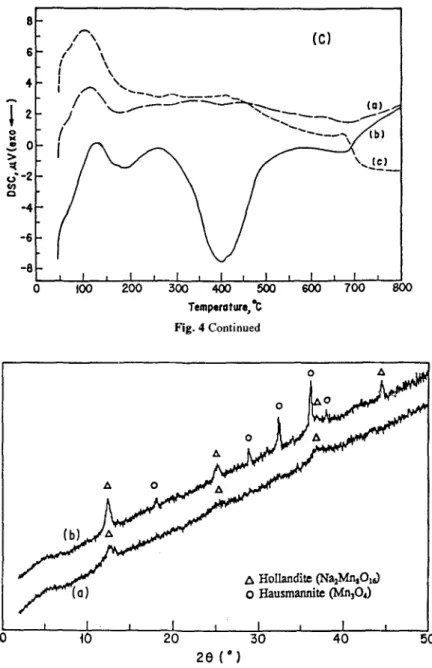
The redox properties of Na-buserite and KPB in different gaseous environ- ments were studied by TG, DSC and XRD. TG and DTG curves for Na-buserite are shown in Figs 3A and 3B, respectively. The corresponding curves for KPB are shown in Figs 4A and 4B, respectively. DSC curves for Na-buserite and KPB are shown in Figs 3C and 4C, respectively. Peaks shown on these curves are related to temperatures of structural transformation. In Na-buserite, the Mn to O stoichiometry of the resultant compound(s) formed after each structural transfor- mation can be determined from related weight losses on TG curves. These inter- mediate compounds can be further confirmed by XRD, and representative patterns for Na-buserite in a N2 environment are shown in Fig. 5.
Peaks below = 200~ in the DTG curves are due to desorption of physisorbed and chemisorbed water, and the corresponding DSC curves show endothermic peaks for these processes. These will not be covered in subsequent sections.
For Na-buserite, the two weight losses in a N2 environment correspond to en- dothermic peaks. During the first process, hollandite (Na2MnsO~6) and Mn203 are formed. Mn203 is converted to Mn304 during the second process. Both hollandite and Mn304 in the final product gave XRD peaks of similar intensity. In a H2 en- vironment, however, the three weight losses are exothermic processes, which cor- respond to formation of Mn203, MnaO4 and MnO, respectively. In an 02
t05 I00 95 ~ 9o 85 80 75 70
(A)
\ I I I I I I (cl (a) (bl IFig. 3 (A) TG, (B) DTG and (C) DSC curves of Na-buserite in (a) N2, (b) N2:H2 = 9:1 (TG) or Ar:H2 = 49:1 (DSC), and (c) 0 2
W O N G , C H E N G : P I L L A R E D L A Y E R E D M A N G A N E S E O X I D E 1185 t13 a2 .-~0.1 r ~ O - -Q! Desorptlon of Water
{e}
529'~ ~4r'e 42e'eJ
~ _
__-
(b)
I I 1 I I, I 20 15 I0 > 0 - I 0 - t 5 -20~..
(c)
.f"'--._
ta) .
t I I I I 1 ! , I l I ~ I i I00 200 300 400 500 600 700 800 Teml~ratur., "C F i g . 3 C o n t i n u e denvironment, the sample shows a gradual endothermic weight loss between 300 ~ and 500~ which leads to formation of a compound(s) with Mn to O stoichiometry o f Mn;+O25.2. At = 560~ the sample is obviously gaining weight by an exothermic process. Na2MnsOto is formed together with a smaller quantity o f c r y p t o m e l a n e (Nal-2MnsO16). In addition, an exothermic peak at -- 750~ is
1186 WONG, CHENG: PILLARED LAYERED MANGANESE OXIDE
prominent. XRD analysis of the Na-buserite sample calcined in air at 800~ showed that Mn203 and Na4MngO]s were formed.
For KPB, two endothermic weight losses occurred in both N2 and 02 environ- ments. XRD analysis of KPB calcined in air or N2 at 700~ showed that either Mn304 or Mn203 formed. At 500~ however, the structure of KPB remained in- tact. In a [H2] environment, two DTG peaks occurred at 334~ and 448~ The lat- ter peak is much smaller and not always well ,resolved. The DSC curve of the
I05 t00 ~ ~ 95 85 80 ~ ~ ~...~__ (b) .... (.) 75 I I I I I I I
Oesorptlon
of
(B)
Water
~ 334'c
~_0.1 9 ~" _ 6zr'cFig. 4 (A) TG, (B) DTG and (C) DSC curves of KPB in (a) N2, (b) N2:H2 = 9:1 (TG) or Ar:H2 = 49:1 (DSC), and (c) 02
WONG, CHENG: PILLARED LAYERED MANGANESE OXIDE 1187 8 ~ = 6 4
T
2 o 0 :> o ' - 2 r 0 -4 - 6 - 8 0 / ', (C)/
\
I \ ! \ I \ II
- - ---':='-~:---~...
Ca) I . n I J I i I n I l I I I t I go0 200 300 400 500 600 700 t00 Temper0tum, ~; Fig. 4 Continued o A o o o Z~ z~ i I i I I I l I I t0 20 30 40 50 2 e ( * )Fig. 5 XRD patterns of Na-buseritr in N2 at (a) 320~ (b) 550~
sample shows an intense asymmetric exothermic peak at --402~ From XRD analysis, the reduction product at 600~ for 2 h was a mixture of Mn304 and
1188 W O N G , C H E N G : P I L L A R E D L A Y E R E D M A N G A N E S E OXIDE
minor MnO. The two weight losses thus appear to be due to formation of Mn304 and MnO, respectively. The peak of the initial reduction product, Mn203, cannot be resolved, but a shoulder is present near 300~ in the DTG curve. Other en- dothermic peaks also occur between 200~176 in all the DSC curves, although they are less prominent in an 02 environment. In both H2 and N2 environments, an additional intense endothermic peak begins at 675 ~ and 666~ respectively.
Catalytic studies
Results of combustion and oxy-dehydrogenation of C 2 H 6 o v e r Na-buserite and KPB are shown in Table 1. In the oxy-dehydrogenation reaction, the conversion (per surface area) o v e r Na-buserite catalyst increases as the reaction temperature was raised from 300 ~ to 340~ At both temperatures, the conversion does not vary significantly with time on stream. As the reaction temperature was raised to 370~ the conversion decreased. A similar conversion was obtained with a fresh catalyst. The X R D pattern of the used catalyst (Fig. 2e) was similar to that of Na-
Table 1 C a t a l y t i c d a t a f o r o x y - d e h y d r o g e n a t i o n and c o m b u s t i o n of e t h a n e at steady state S a m p l e T e m p . / C o n t a c t t i m e / U n i t conv.* S e l e c t i v i t y / % ~ g.mirrm1-1 % / m 2 C2H4 C O CO2 O x y d e Na-B Na-B 3 0 0 1.41><10-4 0.4 8.8 tr 91.2 3 4 0 1.1 7.4 1.5 91.1 3 7 0 0.7 tr 4.5 95.5 3 7 0 1.57><10 -3 25.8 1.2 0.4 98.4 K P B 3 0 0 1.41><10-4 0.3 18.3 13.0 68.7 3 4 0 11.3 20.8 3.6 75.6 C o m b . Na-B 3 0 0 1.52<10-4 1.4 - - 100 3 4 0 4.8 - - 100 3 7 0 10.4 - - 100 K P B 3 0 0 1.52><10 -4 1.7 - - 100 3 4 0 6.1 - - 100 3 7 0 17.2 - 5.7 94.3 t r = t r a c e B E T s u r f a c e areas f o r N a - b u s e r i t e a n d KPB w e r e 57 and 142 m2/g, r e s p e c t i v e l y J. Thermal Anal., 40, 1993
WONG, CHENG: PILLARED LAYERED MANGANESE OXIDE 1189
buserite heated in a Nz environment at a similar temperature, where Mn203 and hollandite were formed. The intense peaks (d values not indicated) are due to SIO2. However, if the initial contact time at 370~ was increased more than 10- fold, e.g. from 1.41x10 -4 to 1.57xlff 3 g.min.ml -~, the conversion increased sharply. The XRD pattern of the used catalyst showed that MnzO3 or Mn304 were formed (Fig. 2c). The conversion over the KPB catalyst was lower than over Na-buserite at 300~ with the same contact time. When the reaction temperature was in- creased to 340~ conversion increased sharply as noted above for Na-buserite, with the formation of the same product (Fig. 2d). The selectivity of both C2H4 and CO over KPB catalyst at 300~ were significantly higher than that over Na- buserite.
In the combustion reaction, conversion over Na-buserite catalyst was quite stable at each of the temperatures studied. XRD analysis of the used catalyst after reaction at 370~ showed that the structure remained intact. However, the layered structure was highly disordered, as indicated by the diffuse nature of the XRD peaks. Over the KPB catalyst, conversion at each of the reaction temperatures decayed very slightly with time on stream at the initial stages of reaction. How- ever, they maintained a stable value at steady state. Conversions at steady state were higher than for Na-buserite. CO2 was the only product of reaction over Na- buserite. This was also true with KPB catalyst at steady state except at 370~ where CO (4-8%) was also produced throughout the reaction. During the initial stages of reaction, C2I-h (at 340 ~ and 370~ and CO (at 300 ~ and 340~ were ob- served also.
Discussion
The interlayer free spacing of dehydrated Na-buserite is about 1.9 A, which corresponds to the diameter of Na § ions. Therefore, the basal thickness of the layer is 5.2 A. As the Na § ions are replaced by Keggin ions in KPB, the free spac- ing will increase to --- 8.6 A, which is the diameter of Keggin ions. This cor- responds to an interlayer spacing of 13.8 A, i.e. basal thickness plus free spacing. The presence of this peak in the XRD pattern of KPB confirmed the successful synthesis of this pillared compound.
Na-buserite behaves differently in different gaseous environments. Hydrogen tends to reduce Na-buserite to MnO whereas oxygen and air tend to oxidize Na- buserite to NazMnsO10 and cryptomelane. However, a reduced compound such as Mn203 can form at high temperature. In nitrogen, a mixture of reduced (Mn304) and oxidized (hollandite) compounds is formed. Therefore, the latter rearrange- ment process can be induced thermally and the oxygen required for the formation o f oxidised compound must have come from the buserite structure itself. As a result, part of the structure is initially reduced to Mn203. In an 02 environment, the amount of reduced product formed is negligible, as would be expected.
1190 WONG~ CHENG: PILLARED LAYERED MANGANESE OXIDE
KPB is relatively more stable than Na-buserite in all of the gaseous environ- ments studied. Its structure is stable to >600~ in both 02 and N2 environments. In a H2 environment, the KPB structure is relatively less stable. The endothermic processes occurring between 200~176 in all the gaseous environments are due mainly to slight loss of surface oxygen, since they are less prominent in an O2 en- vironment. Similarly, oxigen loss from the Na-buserite structure is also found to be least favoured in an 02 environment. These processes are not likely to be due to chemical reactions or rearrangement, which were found to be exothermic in this study. Accordingly, the collapse in the KPB structure between 600~176 in both 02 and N2 environments may be the result of loss of lattice oxygen. The remaining exothermic process at temperature between 400~176 has been as- signed to water loss, as a result of condensation between hydroxyls of the Keggin ions and the layers.
The products of structural transformation are different between Na-buserite and KPB in non-reducing environments, such as 02 and N2. It is noted that com- pounds with tunnel structure such as hollandite and cryptomelane are present only in Na-buserite. These compounds consist of MnO6 octahedra sharing edges to form double chains, which then linked by shared vertices forming [2• chan- nels [10]. In this case, the ion-exchange sites in the channels are occupied by Na* ions. As a result, formation of these compounds requires that the opposite layers in the Na-buserite come into close contact with each other at the intercationic spaces. This is possible since the interlayers are completely dehydrated and disor- dered at temperatures required for formation of the tunnel compounds (>300~ The layers will be significantly folded as a result of electrostatic attraction be- tween the negatively charged layers and the cations [1 l]. In contrast, the Keggin ion pillars in the interlayers improve thermal stability of the layered structure by keeping the opposite layers further apart. In a H2 environment, however, reduc- tion of the layered structure probably begins at a temperature lower than that re- quired for structural rearrangement to occur. The presence of aluminium, which is one of the components of Keggin ions, appears to stabilize the reduced man- ganese oxide phases. Therefore, reduction of Mn304 to MnO was not complete even at 600~
The catalytic performance of the catalysts was consistent with their redox be- haviour. In an oxidation reaction, structural oxygen of various non-stoichiometric Mn oxides has been known to participate in the reaction [8]. If the structural oxygen consumed is not replenished, then reduction of the structure will occur. Since both catalysts are stable in combustion reactions, the redox behaviour of the structure is reversible. This is as expected since the reactant mixture is oxygen-rich in the combustion reaction. Besides, the maximum reaction tempera- ture of 370~ is below the structural transformation temperature of 560~ in 02. The initial decrease in the conversion over KPB catalyst is due to occupation of active sites by partially oxidized products
(C2H4
and CO) for further oxidation.In the oxy-dehydrogenation reaction, Na-buserite catalyst deactivates at 370~ This is caused by rearrangement of the layered structure into stoichio- metric compounds of Mn203 and hollandite. These compounds are similar to
WONG, CHENG: PILLARED LAYERED MANGANESE OXIDE 1191
those observed in a N2 environment. Therefore, the property of the reactant mix- ture surrounding the catalyst approaches that of N2. The Na-buserite catalyst is stable below 370~ which is also consistent with the above suggestion. Hence, a decrease in the proportion of 02 in the reactant mixture from combustion to oxy- dehydrogenation reaction renders it less oxidising. If the 02 in the mixture is nearly or completely consumed in the reaction, then the structure will be reduced to Mn203 or Mn304. This situation can occur at high reaction rates. In fact, the cal- culated 02 conversion is nearly 100% at the conditions where structure reduction occurred. In this case, the partially oxidized products (C2H4, CO) and even C2H6
can act as reducing agents. Since the small interlayer free spacing of Na-buserite only allowed reactions to occur on the external surfaces, this reductive disintegra- tion of the catalyst increase the active surface area and accessibility to the inter- nal sites. As a result, conversion increases sharply.
Unexpectedly, one can see that reductive disintegration of KPB catalyst oc- curred at 340~ even though it is stable in Nz to temperatures higher than 600~ The reduction must originate from the interlayers since Na-buserite is stable at similar conditions. Therefore, it can be concluded that an O:-deficient environ- ment is created in the interlayers of KPB at high reaction rate. By comparing the product selectivity of both catalysts, it is found that diffusion limitation is occur- ring in the interlayer. As 3.5 moles of Oz is required to fully oxidize one mole of
C2H6, the rate of supply of Oz into the interlayer by diffusion will not be sufficient to cope with the rate of consumption at higher reaction rate. Besides, C2H4 and CO produced in the interlayers are subjected to further oxidation by structural oxygen as they diffuse out of the interlayers. Once the interlayers are severely O2- deficient, the lattice oxygen will then be irreversibly consumed by C2H4 or CO, and reduction of the structure to Mn203 or Mn304 occurs.
Conclusion
This study demonstrates that the catalytic behaviour of Na-buserite and KPB can be elucidated by their thermal stability in various gaseous environments. The presence of Keggin ion pillars in the interlayers of buserite improved the thermal stability of the structure in both N2 and O2 environments. KPB is much less stable when either the external surface or the interlayer is in a reducing environment. Therefore, KPB is not suitable for use as a catalyst or a catalyst support for reac- tions such as CO hydrogenation. Instead, both Na-buserite and KPB are very ac- tive in complete oxidation reaction.
Financial support from the National Science Council of the Republic of China is grate- fully acknowledged. The authors are also pleased to extend their acknowledgment to NETZSCH Thermal Analysis Laboratory for the DSC measurements.
1192 WONG, CHENG: PILLARED LAYERED MANGANESE OXIDE
References
1 M. A. Drezdzon, Inorg. Chem., 27 (1988) 4628.
2 T. J. Pinnavaia, T. Kwon and G. A. Tsigdinos, J. Am. Chem. Soc., 110 (1988) 3653. 3 L. F. Nazar, S. W. Liblong and X. To Yin, J. Am. Chem. Soc., 113 (1991) 5889. 4 S. Cheng and T. C. Wang, Inorg. Chem., 28 (1989) 1283.
5 S. T. Wong and S. Cheng, Inorg. Chem., 31 (1992) 1165.
6 R. Giovanoli, H. Buhler and K. Sokolowska, J. Microscopie, 18 (1973) 271. 7 R. Giovanoli, E. St~ihli and W. Feitknecht, Helv. Chim. Acta, 53 (1970) 209. 8 M. Nitta, Appl. Catal., 9 (1984) 151.
9 E. St~,hli, Ph.D. Thesis, University of Bern, Bern. Switzerland 1968.
10 D. C. Golden, C. C. Chen and J. B. Dixon, Clays and Clay Minerals, 35 (1987) 271.
11 F. Liebau, Structural Chemistry of Silicates - Structure, Bonding and Classification, Springer- Vedag, Berlin 1985, p.198.
Zusammenfassung- Keggin-ionengesttitztes Buserit wurde durch lonenaustausch von hexyl- ammoniumionenerweitertem Buserit mit Keggin-lonen [AlI304(OH)24(H20)12] 7§ erhalten. Das Ausgangsmaterial war synthetisches Na-Buserit, ein schichtiges Manganoxid der Zusammen- setzung Na4Mn14026xH20. In Sauerstoff-, Stickstoff- und Wasserstoffumgebung wurden mittels TG, DSC und RiSntgendiffraktion die thermischen und Redoxeigenschaften dieses Oxides und der gest/itzten Derivate miteinander verglichen. Bei allen gasf6rmigen Umgebungen erweisen sich die gest~itzten Verbindungen thermisch stahiler als Na-Buserit. Bei der Anwendung dieser Verbin- dungen zur Katalyse der Oxidation von Ethan fand man, dab sie beziiglich einer vollst~indigen Oxidation sehr aktiv sind.