Ferromagnetic behavior of a triplet superconductor
A. Knigavko, B. Rosenstein, Y. F. Chen, H. L. Huang, and M. T. LinCitation: Journal of Applied Physics 85, 6064 (1999); doi: 10.1063/1.369083
View online: http://dx.doi.org/10.1063/1.369083
View Table of Contents: http://scitation.aip.org/content/aip/journal/jap/85/8?ver=pdfcov Published by the AIP Publishing
Articles you may be interested in
Evidence for decoupled two-dimensional vortex behavior of YBa 2 Cu 3 O 7 in La 0.7 Sr 0.3 MnO 3 / YBa 2 Cu 3 O 7 / La 0.7 Sr 0.3 MnO 3 trilayer
J. Appl. Phys. 108, 123909 (2010); 10.1063/1.3524545
Coexistence of triplet superconductivity and itinerant ferromagnetism AIP Conf. Proc. 1134, 68 (2009); 10.1063/1.3149501
Thermal Fluctuations and Disorder Effect on The Squarerhombic Structural Phase Transition of The Vortex Lattice in Tetragonal Superconductors
AIP Conf. Proc. 850, 837 (2006); 10.1063/1.2354965
Global minimizer for the Ginzburg-Landau functional of an inhomogeneous superconductor J. Math. Phys. 43, 803 (2002); 10.1063/1.1428808
Hysteretic behavior of microwave second harmonic emission by superconductors in the critical state AIP Conf. Proc. 513, 3 (2000); 10.1063/1.1303313
[This article is copyrighted as indicated in the article. Reuse of AIP content is subject to the terms at: http://scitation.aip.org/termsconditions. Downloaded to ] IP: 140.113.38.11 On: Thu, 01 May 2014 08:42:38
Ferromagnetic behavior of a triplet superconductor
A. KnigavkoPhysics Department, National Taiwan University, Taipei, Taiwan 10764, Republic of China B. Rosenstein and Y. F. Chen
Electrophysics Department, National Chiao Tung University, Hsinchu, Taiwan 30050, Republic of China H. L. Huang and M. T. Lin
Physics Department, National Taiwan University, Taipei, Taiwan 10764, Republic of China
Properties of a type II triplet superconductor with equal spin pairing are investigated using the phenomenological Ginzburg–Landau approach. It is shown that there exist two kinds of fluxons: vortices and magnetic skyrmions. Vector nature of the order parameter allows a direct coupling of the effective spin of the condensate to a magnetic field. This coupling, which is reminiscent to Zeeman interaction in the form, significantly modifies the structure of an isolated vortex, as compared to the usual Abrikosov vortex, and changes the energetics of a vortex lattice. If the coupling is sufficiently strong, then magnetization of the triplet superconductor becomes positive at high magnetic fields. Formation of spontaneous vortex state is also possible. © 1999 American
Institute of Physics.@S0021-8979~99!55408-X#
In the majority of low Tcsuperconductors pairing occurs in s channel. In this conventional case the total spin of a Cooper pair is equal to zero. A magnetic field influences the superconducting condensate very strongly via coupling to orbital motion of the pairs. Zeeman coupling of the magnetic field to the spins of electrons is not effective in the first approximation and does not show up in most physical situa-tions, although it contributes to the destruction of Cooper pairs and leads, for example, to corrections for the value of
Hc2. The situation might be different in the case of triplet pairing when members of a Cooper pair have parallel spins. The triplet pairing is suspected to occur in recently dis-covered new class of Ru based type II superconductors Sr2YRu12xCuxO6.1At the same temperature of about 60 K, at which superconductivity sets in, these materials begin to exhibit basic ferromagnetic properties like a hysteresis loop with a positive remanent magnetization. Exact overlap of superconductivity and ferromagnetism naturally suggests that in these particular materials Cooper pairs might in fact be magnetic moments and that they themselves are respon-sible, at least partially, for overcoming the usual diamagnetic response of a superconductor. In this paper we consider in some detail this fascinating scenario.
We employ a phenomenological Ginzburg–Landau~GL! theory. Within this framework, nonzero spin of the Cooper pair can be taken into account by introducing an order pa-rameter of the vector type ci(r), i51,2,3.
2
The free energy density for such a model has the form: F5Fbulk1Fgrad, where Fbulk52acici*1 b1 2 ~cici*! 21b2 2 uciciu 2, ~1! Fgrad5 \2 2m*~Djci!~Djci!*1 Bi2 8p2mSiBi. ~2! Magnetic field B is coupled to the order parameter in two ways @see Eq. ~2!#. First, via covariant derivatives Di[]i
2i(e*/c\)Ai. This is the usual type of coupling leading to diamagnetism. Note also that it is the reason for the appear-ance of topological solitons in type II superconductors. The second type of coupling is a direct interaction with the spin
Si[2iei j kc*jck carried by the order parameter field. It is only possible if the order parameter has a vector nature. It can lead, as shown below, to ferromagnetism in a sense that the system can show positive response on an external mag-netic field and can have spontaneously magnetized ground state. The direct coupling 2mSiBi looks exactly like Zee-man interaction~ZI!, and below we adopt this name for clar-ity. Note, however, that in our theory Siis actually an effec-tive spin andmis a phenomenological parameter.
Our analysis consists of the following steps. First, we find which homogeneous superconducting phase ZI is effec-tive and, thus, ferromagnetism could be possible. Second, we classify topologically stable line defects which would deter-mine behavior of a type II superconductor in external mag-netic fields. Third, we gain some knowledge about the topo-logical objects by numerical solution of appropriate GL equations. Finally, we develop a simple analytical model of the vortex lattice.
Minimization of Eq. ~1! yields two different homoge-neous superconducting phases. Only one of them has SÞ0 and we will subsequently concentrate on it. The order param-eter has the formc5 f0(n1im)/
A
2, where f05A
a/b1 andm, n are arbitrary unit vectors satisfying n'm. The spin of
the condensate is given by S5 f02l, l[n3m. The phase is
stable if a.0,b1.0, andb2.0. The ground state free en-ergy is 2a2/2b1. The ground state is highly degenerate. Each vacuum is specified by a choice of the orthonormal triad l, n, m. The vacuum manifold is isomorphic to a group SO~3!. It consists of ~1! arbitrary rotations of vector l and ~2! combined transformations: rotations of pair m, n, around l by angle q which are accompanied by gauge transformations
eiq.
To study magnetic effects we proceed to consider
spa-JOURNAL OF APPLIED PHYSICS VOLUME 85, NUMBER 8 15 APRIL 1999
6064
0021-8979/99/85(8)/6064/3/$15.00 © 1999 American Institute of Physics
[This article is copyrighted as indicated in the article. Reuse of AIP content is subject to the terms at: http://scitation.aip.org/termsconditions. Downloaded to ] IP: 140.113.38.11 On: Thu, 01 May 2014 08:42:38
tially nonuniform configurations which are translationally in-variant in the direction z of an external magnetic field. We use the following approach: we allow that the modulus of the order parameterucu[ f depends on spatial coordinates, while still keeping c;n1im. Then the free energy per unit length, measured from its vacuum value, reads
F5
E
d2xF
k 2 2 ~12 f 2!21~] if!21 1 2f 2~] il!2 1 f2@n] im2Ai#21Bi 22g f2l iBiG
. ~3!In Eq.~3! the dimensionless units were used such that ucu is measured in units of f0, length—in units of l
[(c/ue*u f0)
A
m*/4p, magnetic flux—in units of F0[hc/e*, the line free energy—in units ofe0[(F0/4pl)2. GL parameter k[l/j is defined via coherence length j
[\/
A
2am*. ZI strength is characterized by g [(2m*c/e*\)m. GL equations read:ni“mi2A1g
2¹3~ f
2l!5“3B[j, ~4!
Dl2l~lDl!12 jk~l3]kl!
1g@B2l~lB!2~“3l!k~l3]kl!#50, ~5! where B5“3A. Equation ~4! shows that the superconduct-ing velocity is given by np“mp52“q, where the angleq specifies the direction of n in the plane perpendicular to l. Thus, it isqthat takes the role of superconducting phase.
Let us determine finite energy solutions to GL equations on the whole x2y plane ~solitons! which carry nonzero magnetic flux. It follows from Eq. ~3! that they should sat-isfy: f→1,]if→0,]il→0 and 2“q}A when uxu→`. @In this paper we restrict consideration to the case B(`)50]. Imposing the flux quantization condition restricts the vacuum manifold: SO~3!→SO(2)^S2 where S2 is the direction of l and SO~2! is the phaseq. For a given number of flux quanta
N, the phase qmakes N winds at infinity. The first homot-ropy group of this part is therefore fixed:p1@SO(2)#5Z. If vector l is fixed throughout the volume of the supercon-ductor, there is no way to avoid singularity in the phase q
@note the fourth term in integrand in Eq. ~3!#. Accordingly,
the modulus of the order parameter f has to vanish at some point and we arrive at the picture of a vortex. Energy of the vortex line is high for type II superconductors because it contains a large factor logk. However, the finite energy re-quirement for solutions tells us that l should be fixed only at infinity. This effectively ‘‘compactifies’’ x2y plane into S2. The relevant homotropy group isp2(S2)5Z. The new topo-logical number is Q5(1/8p)*ei jl(]il3]jl)d2r.3
Thus, all configurations fall into classes characterized by two integers N and Q. The presence of two topological num-bers produces a very interesting effect: there exist nontrivial
~spatially nonuniform! configurations in which f assumes its
saturation value everywhere. We call these solutions mag-netic skyrmions. For them magmag-netic flux number N and skyr-mion number Q are related to each other: Q5N/2. This re-lation is obtained by integrating supercurrent equation @Eq.
~4!# along a remote contour. Unlike vortices, magnetic
skyr-mions have no normal core and for small g their line energy should be smaller than vortex line energy by the factor logk. We now turn to investigate the structure of topological solitons. We are concerned with well isolated line defects which are cylindrically symmetric. Accordingly, it is conve-nient to utilize polar coordinatesrandw. The lowest energy vortex has Q50 and N561. Using Anzatz l5ez, n
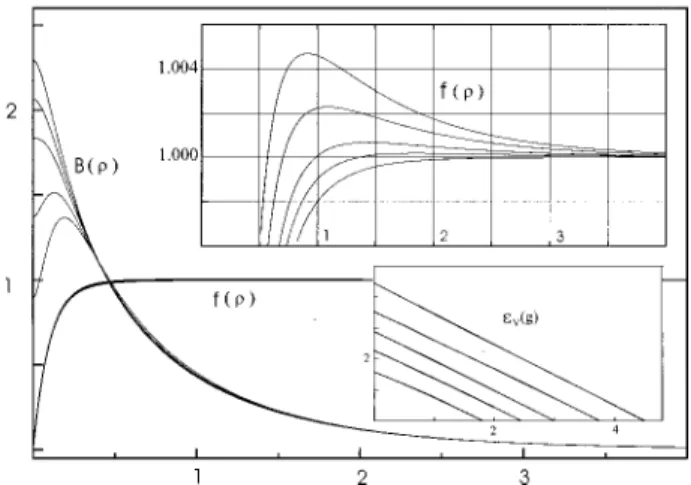
5excosw1eysinw, and m52exsinw1eycosw we can simplify Eqs. ~4! and ~5! considerably. Only two unknown functions are felt: f (r) and A(r). The corresponding system of differential equations is then solved numerically by the finite element method. The results are presented in Fig. 1. In a vortex, the magnetic field falls off exponentially at dis-tances of the orderl, while f already changes considerably in the range of j. This is similar to vortices in conventional superconductors. The effect of ZI is considerable. It changes behavior of magnetic field B in the core, and also modifies the way f approaches its vacuum value and reduces the core size ~see upper inset in Fig. 1!. The most prominent conse-quence of ZI, however, is that the energy of a vortex acquires a bulk negative contribution. As a result, the vortex line en-ergyeVlinearly decreases with g~see lower inset in Fig. 1!. This finding is in agreement with earlier work by Toknyasu
et al.4At large g, of the order of logk, the vortex line tension becomes zero indicating instability of a homogeneous super-conducting state at H50. Thus, we arrive at the conclusion that a spontaneous vortex state, carrying a magnetic flux, could exist. Note that in our calculations we have set g.0. However, all the above results on the dependence of vortex structure on g are not, in fact, affected by the sign of g. Let us fix the direction of B then, for any sign of g there always exists a vortex with the directions of l such that the ZI con-tribution to the vortex energy is negative.
The magnetic skyrmion with the lowest energy satisfies
N52Q562. We employ Anzatz: f 5 f0 and l5ezcosU
1ersinU, n5tsinw1ewcosw, m5tcosw2ewsinw, where U5ezl and t5ezsinU2ercosU(r). Again, only two un-known functions U~r! and A(r) are left in Eqs.~5! and ~4!. The results of numerical integration are presented in Fig. 2.
FIG. 1. Structure of a vortex. Modulus of the order parameter f and mag-netic field B as functions ofrfor g from 0 to 1.5 andk510. Distanceris measured in units ofl. Upper inset illustrates fine structure of f. Lower inset shows vortex line energyeVas a function of g forkfrom 2 to 50.
6065 J. Appl. Phys., Vol. 85, No. 8, 15 April 1999 Knigavkoet al.
[This article is copyrighted as indicated in the article. Reuse of AIP content is subject to the terms at: http://scitation.aip.org/termsconditions. Downloaded to ] IP: 140.113.38.11 On: Thu, 01 May 2014 08:42:38
We immediately observe that a magnetic skyrmion is a much larger object than a vortex. Magnetic field is localized within the range of 50l. Moreover, it decays with distance as a power. The line energy of the magnetic skyrmion, eMS, is quite small and independent of k. The dependence on g is very week~see inset!. We associate this with the fact that ZI contributes to eMS with opposite signs on small and large distances. In fact, magnetic skyrmions are lighter than vorti-ces of a wide range of g and, hence they will deterrnine Hc1 and dominate the physics in our model at low external mag-netic fields. However, a magmag-netic skyrmion lattice is ex-pected to be destroyed when distance between skyrmion be-comes about several l. Accordingly, at H of about several
Hc1 there should be a crossover to a vortex lattice.
The domain of vortex lattice existence is much larger because Hc2/Hc1'k2@1 for type II superconductors. Therefore, it is useful to develop an analytical model of vor-tex lattice behavior. We proceed by assuming that vorvor-tex core size d depends on H. Such a point of view is actually supported by our numerical results on a single vortex ~see upper inset in Fig. 1!. For simplicity, the behavior of f is approximated by step function. The Gibbs free energy den-sity in dimensionless units reads:
G5B
F
B2loghdA
B1k2d2
4 22H2g
S
12d2B
2
DG
. ~6! The first two terms represent the usual vortex interaction energy excluding ZI. It is obtained by standard methods of summing up all the interactions using transformation to the reciprocal space and replacement of the summation over thereciprocal vortex lattice by appropriate integration ~see Ref. 5!. The third term is the energy lost in the core due to melt-ing of the condensate. The fourth term is due to the external magnetic field. The terms with g summarize ZI contribution: energy gain in the region between vortices minus energy loss in vortex cores due to vanishing of effective spin S there. Coefficienth is an unknown quantity of order 1. The value of d is found from the condition dG/drc50 that gives
dc(B)5
A
2/(k212gB). We see that as the magnetic field increases the core shrinks. Shrinking of cores makes room for more vortices to squeeze in and allows internal magnetic field B to increase when H increases ~of course, when the core becomes microscopic in size the whole approach ceases to be applicable!. The magnetization curve is found from minimization of G with respect to B. This leads to the equa-tion H5B21 2log dc~B!A
B h 2 g 2S
12 dc~B!2B 2D
, ~7!that implicitly determines the magnetic induction B as a function of external magnetic field H. Note that for suffi-ciently large values of g Eq. ~7! has solution B.0 even if
H50. This agrees with our previous conclusion about the
existence of a spontaneous vortex state. On the other hand, even at smaller values of g, as H increases magnetization
M[(B2H)/4p approaches a positive saturation value. For strongly type II superconductors~highk! parameterhcan be estimated from the requirement that the magnetization curve given by Eq. ~7! should smoothly join the magnetization curve which is derived by perturbative treatment of the free energy Eqs. ~1! and ~2! near upper critical field Hc2.
5 The saturation magnetization then reads: Ms5(1/16p)@(g21)
3(11bA)/bA2log g#, where bA.1.16 is Abrikosov pa-rameter.
In summary, a type II triplet superconductor can possess ferromagnetic properties due to a direct coupling of the spin of the condensate to a magnetic field. If this coupling is strong properties of the vortex matter are significantly modi-fied. Response on high external magnetic field is positive. Above some critical value of g, a vortex state is created spontaneously. On the other hand the physics of a triplet superconductor at low magnetic field for sufficiently small g
~weak ZI! is dominated by magnetic skyrmions, novel
topo-logical objects which are quite different from vortices. This work was supported by Grant No. 87-2216-E-002-005 from NSC.
1
M. K. Wu et al., Z. Phys. B 102, 37~1997!.
2J. Annett, Adv. Phys. 39, 83~1990!; M. Sigrist and K. Ueda, Rev. Mod.
Phys. 63, 239~1991!.
3R. Rajaraman, Solitons and Instantons~North-Holland Amsterdam, 1982!. 4
T. A. Tokuyasu, D. W. Hess, and J. A. Sauls, Phys. Rev. B 41, 8891
~1990!.
5M. Tinkham, Introduction to Superconductivity~McGraw-Hill, Singapore,
1996!. FIG. 2. Structure of a magnetic skyrmion. Upper and lower panels show
azimuthal angleU and magnetic field B, correspondingly, as functions ofr. Distanceris measured in units ofl. Inset shows magnetic skyrmion line energy as a function of g.
6066 J. Appl. Phys., Vol. 85, No. 8, 15 April 1999 Knigavkoet al.
[This article is copyrighted as indicated in the article. Reuse of AIP content is subject to the terms at: http://scitation.aip.org/termsconditions. Downloaded to ] IP: 140.113.38.11 On: Thu, 01 May 2014 08:42:38