This content has been downloaded from IOPscience. Please scroll down to see the full text.
Download details:
IP Address: 140.113.38.11
This content was downloaded on 26/04/2014 at 05:25
Please note that terms and conditions apply.
Using ring-filter and saturable-absorber-based filter for stable erbium fiber laser
View the table of contents for this issue, or go to the journal homepage for more 2007 Laser Phys. Lett. 4 543
(http://iopscience.iop.org/1612-202X/4/7/011)
Laser Phys. Lett. 4, No. 7, 543–545 (2007) / DOI 10.1002/lapl.200710018 543
Abstract: A stable single-frequency dual-coupler ring (DCR) laser is proposed that operates in a single mode for more than an hour by an incorporating unpumped erbium-doped fiber (EDF) as a saturable-absorber filter and optimizing the length of the EDF used as gain medium. The proposed fiber laser doesn’t use any fiber Bragg gratings or etalon filters into intracavity to lase a single-frequency. This laser has an optical signal to noise ratio (OSNR) of > 60 dB at 1562.9 nm. In addition, the stabilities of
the output power and wavelength have also been studied. Outpu
t p ow e r, dBm -20 -16 -12 -8 -4 0 80 70 60 50 40 OSN R, d B 200 160 120 80 40 0 Pumping power, mW Output power OSNR
Output power and OSNR versus the different pumping power at 1562.9 nm initially
c
° 2007 by Astro Ltd.
Published exclusively by WILEY-VCH Verlag GmbH & Co. KGaA
Using ring-filter and saturable-absorber-based filter for
stable erbium fiber laser
C.-H. Yeh,1,∗C.-T. Chen,2C.-N. Lee,2F.-Y. Shih,2and S. Chi2,3
1
Information and Communications Research Laboratories, Industrial Technology Research Institute, Hsinchu 310-40, Taiwan
2
Department of Electrical Engineering, Yuan Ze University, Chungli 320-03, Taiwan
3
Department of Photonics and Institute of Electro-Optical Engineering, National Chiao Tung University, Hsinchu 300-10, Taiwan Received: 15 February 2007, Accepted: 18 February 2007
Published online: 27 February 2007
Key words: single-frequency; dual-coupler; ring laser PACS: 42.60.Da, 42.81.-i, 42.81.Wg
1. Introduction
Erbium-doped fiber (EDF) ring lasers with single-frequency operation are useful in optical fiber communi-cations. Unfortunately, the fiber laser has the possibility of multi-mode operation with mode-hopping effect. There-fore, the fiber lasers were mainly used with fiber Bragg grating or etalon filters in the cavity for single-mode op-eration. If the etalon filter is used in the cavity for single-mode selection, high-finesse [1,2] is required which is dif-ficult to fabricate and expensive. In addition, several fiber laser techniques have been studied, such as using a passive multiple-ring cavity or a compound fiber ring structure [3,4], integrating two cascaded FFP filters of wide differ-ent free spectral ranges (FSRs) into cavity to provide full tunability and single-longitudinal-mode (SLM) operation
[5], and using an unpumped EDF as a narrow bandwidth autotracking filter [6,7].
In this paper, we propose and experimentally demon-strate a single-frequency fiber ring laser using a dual-coupler ring (DCR) filter and a saturable-absorber-based (SAB) filter, which is composed of an unpumped EDF and a fiber reflected mirror (FRM). The stabilities of the out-put power and wavelength stabilities, and optical signal to noise ratio (OSNR) have also been studied.
2. Experiments and results
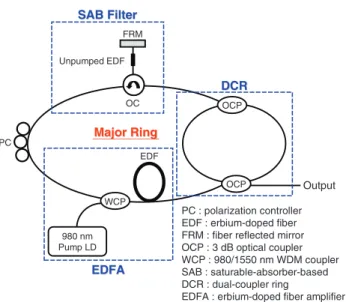
The schematic of our experimental setup for the fiber ring laser is shown in Fig. 1. The proposed laser scheme con-sists of an EDFA, an SAB filter, a DCR filter and a
po-∗
Corresponding author: e-mail: [email protected]
c
° 2007 by Astro Ltd.
Published exclusively by WILEY-VCH Verlag GmbH & Co. KGaA The Laser Physics Letters archive is now available in IOPscience iopscience.iop.org/lpl
544 C.-H. Yeh, C.-T. Chen, et al.: Using ring-filter and saturable-absorber-based filter WCP EDF Output EDFA EDFA PC OCP OCP OC FRM Major Ring Major Ring Unpumped EDF DCR DCR SAB Filter SAB Filter 980 nm Pump LD PC : polarization controller EDF : erbium-doped fiber FRM : fiber reflected mirror OCP : 3 dB optical coupler WCP : 980/1550 nm WDM coupler SAB : saturable-absorber-based DCR : dual-coupler ring
EDFA : erbium-doped fiber amplifier
Figure 1 (online color at www.lphys.org) Proposed single-frequency fiber laser by using a DCR structure and a SAB filter
Outpu t p ow e r, dBm -70 -60 -50 -40 -30 -20 -10 0 1566 1565 1564 1563 1562 1561 1560 Wavelength, nm
Figure 2 Output spectrum of the proposed laser with a 170 mW pumping power
larization controller (PC). The EDFA is constructed by an EDF with 10 m long, a 980/1550 nm WDM coupler, and a 980 nm pumping laser with 170 mW. A DCR is inserted in series with a major ring which contains an EDFA for am-plification. An SAB filter consists of a l m long EDF as a narrow bandwidth autotracking filter, an optical circulator (OC), and a FRM. The compound ring is completed with a DCR filter which serves as an in-line mode selector and an output coupler. Both rings have the laser light propa-gate in a counterclockwise direction oriented by the OC, as shown in Fig. 1. The two cavities have the free spec-tral ranges (FSRs), FSR = c/nL, where c is the speed of light in vacuum, n = 1.468 is the average refractive index of the single-mode fiber and L is the total cavity length.
Outpu t p ow e r, dBm -20 -16 -12 -8 -4 0 80 70 60 50 40 OSN R, d B 200 160 120 80 40 0 Pumping power, mW Output power OSNR
Figure 3 (online color at www.lphys.org) Output power and OSNR versus the different pumping power at 1562.9 nm initially
Therefore, the DCR has a ring length of 4 m, which gives a FSR of 50.5 MHz. The total length of major ring is about 26 m long, corresponding to a passive cavity mode spacing of 7.8 MHz. An in-line polarization controller was used to control the intracavity polarization states. Moreover, the output power and wavelength of proposed fiber laser are measured by an optical spectrum analyzer (OSA) with a 0.05 nm resolution.
In the compound ring laser, since the DCR filter is polarization-dependent, the output power can be adjusted by varying the eigenstate of the polarization in the ring. Therefore, by rotating the PC to align the maximal out-put power of eigenstate of the polarization can always be obtained. When a 980 nm pumping power increases to 170 mW, the output of proposed fiber laser is shown in Fig. 2. The output power and wavelength of the las-ing light are −5.1 dBm and 1562.9 nm, respectively. In Fig. 2, the OSNR of this wavelength is larger than 60 dB. Fig. 3 shows the output power and OSNR versus the dif-ferent pumping power level of 980 nm LD at 1562.9 nm initially. When the pumping power operates between 7 to 170 mW, the output power and OSNR are distributed at −16.8 to −5.1 dBm and 54 to 60 dB, respectively. More-over, we also observe the slope efficiency of nearly 0.002. In addition, the mode-hopping effect is also observed by a self-homodyne detection method in a GHz bandwidth for the proposed laser, when an SAB filter is removed in Fig. 1.While an SAB filter is used in the ring intracavity to serve as a narrow bandwidth filter, the lasing wavelength can be guaranteed in single-longitudinal-mode (SLM) op-eration.
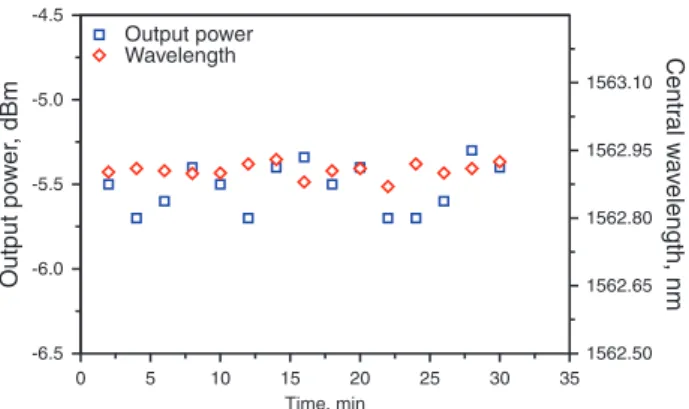
To investigate the laser stabilities of the output power and output wavelength, the short-term stability of the pro-posed structure is measured and shown in Fig. 4. The las-ing wavelength is 1562.9 nm initially and the observlas-ing time is over 30 minutes. From observed results, the output central wavelength variation and the output power fluctu-ation of the proposed ring laser are smaller than 0.05 nm
c
° 2007 by Astro Ltd.
Published exclusively by WILEY-VCH Verlag GmbH & Co. KGaA www.lphys.org
Laser Phys. Lett. 4, No. 7 (2007) 545 Outpu t p ow e r, dBm -6.5 -6.0 -5.5 -5.0 -4.5 1563.10 1562.95 1562.80 1562.65 1562.50 Ce n tr a l w av e le n gt h , n m 0 5 10 15 20 25 30 35 Time, min Output power Wavelength
Figure 4 (online color at www.lphys.org) Observing short-term stability of the proposed laser when the observing time is over 30 minutes at 1562.9 nm
and 0.4 dB, respectively, as shown in Fig. 4. During a 1-h observation, the stabilized output of the ring laser is still maintained.
According to the past studies [8–17] either used op-tical filter (fiber Bragg grating, fiber Fabry-Perot tunable filter, and birefringence fiber loop mirror et al., or adjusted nonlinear effect in the ring cavity to achieve the single-frequency operation. Comparing with these papers, our proposed fiber laser not only hasn’t any optical filter in the cavity (only uses passive fiber), but also retrieves the stabilities of output power and wavelength.
3. Conclusion
In summary, we have proposed and investigated a stable single-frequency DCR fiber laser that operates in a SLM for more than an hour by an incorporating unpumped EDF as an autotracking filter and optimizing the length of the EDFA used as gain medium. The proposed fiber laser lases at the single-frequency without using any fiber Bragg grat-ings or etalon filters in the cavity. The OSNR of the laser is larger than 60 dB at 1562.9 nm. Moreover, the stabilities of the output power and wavelength stabilities have also been studied.
Acknowledgements This work was supported in part by the Na-tional Science Council (NSC) of Taiwan (ROC) under grants NSC 95-2221-E-155-059 and NSC 95-2221-E-155-072.
References
[1]T. Haber, K. Hsu, C. Miller, and Y. Bao, IEEE Photon. Tech. Lett. 12, 1456–1458 (2000).
[2]H.Y. Ryu, D. Lee, K.D. Park, W.K. Lee, H.S. Moon, S.K. Kim, and H. Suh, Appl. Phys. B. 79, 583–586 (2004). [3]J. Zhang, C.Y. Yue, G.W. Schinn, W.R.L. Clements, and
J.W.Y. Lit, J. Lightwave Tech. 14, 104–109 (1996). [4]C.C. Lee, Y.K. Chen, and S.K. Liaw, Opt. Lett. 23, 58–360
(1998).
[5]K.J. Vahala, P. Namkyoo, J. Dawson, and S. Sanders, Lasers and Electro-Optics Society Annual Meeting, November,15– 18, 1993, San Jose, CA, USA, IEEE Proc. LEOS’93, pp. 708–709.
[6]H.Y. Ryu, W.-K. Lee, H.S. Moon, S.K. Kim, H.S. Suh, and D. Lee, IEEE Photon. Tech. Lett. 17, 1824–1826 (2005). [7]S.-Y. Chou, C.-H. Yeh, and S. Chi, Laser Phys. Lett. 4, 382–
384 (2007).
[8]D. Chen, Laser Phys. Lett. 4, 437–439 (2007).
[9]D. Chen and L. Shen, Laser Phys. Lett. 4, 368–370 (2007). [10]D. Chen, H. Ou, H. Fu, S. Qin, and S. Gao, Laser Phys. Lett.
4, 287–290 (2007).
[11]M.H. Al-Mansoori, A.W. Naji, S.J. Iqbal, M.K. Abdullah, and M.A. Mahdi, Laser Phys. Lett. 4, 371–375 (2007). [12]D.-M. Liang, X.-F. Xu, Y. Li, J.-H. Pei, Y. Jiang, Z.-H. Kang,
and J.-Y. Gao, Laser Phys. Lett. 4, 57–60 (2007).
[13]S.-P. Chen, L. Ding, S.-M. Wang, Y.-G. Li, K.-C. Lu, and S.-H. Zhou, Laser Phys. Lett. 3, 584–587 (2006).
[14]S.W. Harun, F.A. Rahman, K. Dimyati, and H. Ahmad, Laser Phys. Lett. 3, 495–497 (2006).
[15]S.W. Harun, M.Z. Zulkifli, and H. Ahmad, Laser Phys. Lett.
3, 369–371 (2006).
[16]F. Abdullah, A.S.M. Noor, M.A. Mahdi, H.A.A. Rashid, and M.K. Abdullah, Laser Phys. Lett. 2, 535–537 (2005). [17]H. Ahmad, N.K. Saat, and S.W. Harun, Laser Phys. Lett. 2,
369–371 (2005).
www.lphys.org ° 2007 by Astro Ltd.Published exclusively by WILEY-VCH Verlag GmbH & Co. KGaAc The Laser Physics Letters archive is now available in IOPscience iopscience.iop.org/lpl